It’s possible that I shall make an ass of myself. But in that case one can always get out of it with a little dialectic. I have, of course, so worded my proposition as to be right either way (K.Marx, Letter to F.Engels on the Indian Mutiny)
NASA aims for nuclear-powered Mars mission in 2028
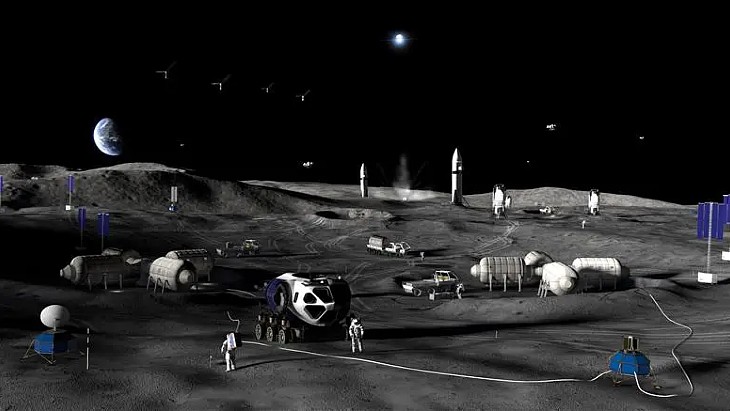
The US space agency NASA has set out a series of ambitious goals for missions, which include a return to the Moon by early 2028 as well as a Mars mission the same year utilising nuclear propulsion technology.
An artist's impression for NASA of its Moon base (Image: NASA)
NASA Administrator Jared Isaacman, speaking at the agency's 'Ignition' event earlier this week, said: "If we concentrate NASA's extraordinary resources on the objectives of the National Space Policy, clear away needless obstacles that impede progress, and unleash the workforce and industrial might of our nation and partners, then returning to the Moon and building a base will seem pale in comparison to what we will be capable of accomplishing in the years ahead."
The announcements included "a major step forward in bringing nuclear power and propulsion from the lab to space. NASA will launch the Space Reactor‑1 Freedom, the first nuclear-powered interplanetary spacecraft, to Mars before the end of 2028, demonstrating advanced nuclear electric propulsion in deep space. Nuclear electric propulsion provides an extraordinary capability for efficient mass transport in deep space and enables high-power missions beyond Jupiter where solar arrays are not effective".
The announced plan is that when the spacecraft reaches Mars "it will deploy the Skyfall payload of Ingenuity‑class helicopters to continue exploring the Red Planet". NASA said the mission "will establish flight heritage nuclear hardware, set regulatory and launch precedent, and activate the industrial base for future fission power systems across propulsion, surface, and long‑duration missions. NASA and its US Department of Energy partner will unlock the capabilities required for sustained exploration beyond the Moon and eventual journeys to Mars and the outer solar system".
Plans for the return of people to the surface of the Moon continue, with NASA saying on Wednesday that teams at Kennedy Space Center in Florida continue preparing the SLS (Space Launch System) rocket and Orion spacecraft for its crewed launch as early as Wednesday, 1 April. This rocket aims to take the four crew around the Moon and back to Earth as part of the developing programme for astronauts to land on the Moon in 2028.
Background
In January NASA and the US Department of Energy (DOE) said they had signed a memorandum of understanding to solidify their collaboration and advance the "vision of American space superiority" set out in an Executive Order signed by US President Donald Trump on 18 December. As well as "returning Americans to the Moon by 2028" - through the Artemis Program - this order includes deploying nuclear reactors on the Moon and in orbit, including the development of a lunar surface reactor by 2030, as a priority.
The agencies - which have a 50-year long history of collaboration - said they "anticipate deploying a fission surface power system capable of producing safe, efficient, and plentiful electrical power that will be able to operate for years without the need to refuel. The deployment of a lunar surface reactor will enable future sustained lunar missions by providing continuous and abundant power, regardless of sunlight or temperature".
Nuclear fission power was one of the two main power generation technologies for crewed surface exploration architectures considered in NASA's 2025 Integrated Lunar Power Strategy Considerations White Paper (the other is solar). The White Paper forms part of the agency's Moon to Mars Architecture, which defines the elements needed for long-term, human-led scientific discovery in deep space.
The USA's CNN said Steven Sinacore, who will also oversee the SR-1 Freedom mission for NASA, had told it there will need to be an information programme to ease any public concerns over the use of nuclear propulsion: "Ultimately, it is safe. On the ground, the reactor is off. There's no radiation coming from it. It doesn’t actually turn on until you're up in space."
According to a SpaceNews report of the event, Sinacore said the SR-1 Freedom will use a nuclear reactor that NASA plans to develop in-house, generating 20 kilowatts of electrical power using high-assay low-enriched uranium (HALEU). The journey time to Mars is expected to be about a year, and NASA said it plans to share the reactor design for SR-1 Freedom with industry.
Assessment completed of Chernobyl shelter repair works
The costs of repairing the damaged New Safe Confinement at the Chernobyl nuclear power plant in Ukraine will be "in the order of" EUR500 million (USD577 million), according to a preliminary technical assessment by Bouygues and Vinci.
(Image: EBRD)
The New Safe Confinement (NSC) is the largest moveable land-based structure built - with a span of 257 metres, a length of 162 metres, a height of 108 metres and a total weight of 36,000 tonnes equipped - and with a lifetime of 100 years, it has been designed to allow for the eventual dismantling of the ageing makeshift shelter built over the destroyed Chernobyl unit 4 in a matter of just months after the 1986 accident and the management of radioactive waste. It has also been designed to withstand temperatures ranging from -43°C to +45°C, a class-three tornado, and an earthquake with a magnitude of 6 on the Richter scale. The process of sliding the entire arched structure from its assembly point into position over unit 4 was completed on 29 November 2016.
A drone strike on 14 February last year caused a 15-square-metre hole in the external cladding of the NSC, with further damage to a wider area of about 200-square-metres, as well as to some joints and bolts. It took about three weeks to fully extinguish smouldering fires in the insulation layers of the shelter. Temporary repair work was carried out before the winter to prevent weather damage.
French firms Bouygues Travaux Publics and Vinci Construction Grands Projets - who previously formed the Novarka consortium responsible for the original design and construction of the NSC - have now completed a preliminary technical assessment of damage sustained by the structure.
The assessment identified a series of potential repair activities - both temporary protective measures and longer-term restoration works. These include: temporary protection and stabilisation measures, such as weatherproofing of the roof and repairs to damaged steel components; restoration of the external cladding, together with additional repairs required to re-establish sufficient airtightness of the NSC annular space; repair or replacement of sealing joints affected by the damage; testing and re-commissioning of the annular space ventilation system following completion of repairs; restoration of leak-tight membranes within the NSC structure; and restoration of the main crane system, which is essential for safe internal operations.
The assessment identifies the restoration of full NSC functionality by 2030 as a key objective, to limit the risk of corrosion of the steel arch structure and maintain long-term safety. However, it says that this timeline would only be met if site access and security conditions allow works to proceed, and that construction activities begin by around the end of 2027. The assessment stresses that the schedule remains subject to significant uncertainty and would need to be refined once detailed designs, regulatory approvals, and procurement strategies are defined.
The assessment concludes that it is not yet possible to provide a reliable cost estimate for the repair works. However, based on the current level of information, the total cost "could be in the order of EUR500 million". It says a more robust cost estimate would depend on: completion of a detailed repair design; confirmation of procurement routes and market conditions; clarification of security-related constraints; and alignment with regulatory and donor requirements.
"The assessment is intended to provide an initial technical basis for understanding the nature of the damage, potential repair pathways, and key constraints," said the European Bank for Reconstruction & Development (EBRD), which led the project to fund and construct the NSC. "It does not constitute a final repair design, investment decision, or implementation plan. Further engineering, regulatory review, and donor coordination would be required before any works could proceed."
The report will be presented to the 31 March meeting of the International Chernobyl Cooperation Account, which was established in November 2020 by the EBRD at the Ukrainian government's request to support a comprehensive plan for Chernobyl.
“In October last year, the plant's staff and the SES units managed to carry out a number of urgent measures and close the hole in the outer cladding of the Confinement damaged by a Russian drone," said Serhii Tarakanov, Director General of SSE Chornobyl NPP (ChNPP) on 9 March after a working meeting of representatives from ChNPP, the EBRD and the French companies. "This made it possible to get through the autumn-winter period relatively smoothly and to prevent excessive ingress of precipitation into the structure. However, this solution was only temporary. Now it is necessary to undertake comprehensive repairs and full restoration of the NSC functionality.
"It is very important to restore the function of containing radioactive substances within the NSC, as well as active anti-corrosion protection to ensure the functioning of the Confinement for the designed 100 years. After completing the comprehensive repair work within the specified time frame (by 2030), we will be able to move on to the implementation of the main task for which the New Safe Confinement was built - dismantling the unstable structures of the Shelter Object and transforming it into an environmentally safe system."
Singapore to bolster nuclear safety capabilities
Singapore's National Environment Agency said it will issue tenders to commission three studies on nuclear safety standards and environmental considerations as the island city-state studies the potential deployment of nuclear energy.
(Image: cegoh / Pixabay)
The three studies will examine different aspects of nuclear safety: safety standards adopted by international organisations and national regulators, including how to design and operate the reactor safely, what safety systems are needed, and how to prevent accidents; international environmental standards and regulatory frameworks for nuclear facilities; and environmental considerations for the potential deployment of nuclear energy in Singapore and the region – both of which focus on how to protect public health and the environment.
"These studies will complement the ongoing study commissioned by the Energy Market Authority (EMA) to evaluate the safety performance and technical feasibility of advanced nuclear energy technologies," the National Environment Agency (NEA) noted.
The NEA, as the radiation and nuclear safety regulator, has been developing Singapore's nuclear safety capabilities through close partnerships with the International Atomic Energy Agency and established regulatory bodies in Finland, France and the USA, as well as its regional neighbours with whom it engages in nuclear safety cooperation discussions. The NEA's Nuclear Safety Advisory Panel, comprising experts in nuclear and related scientific fields, provides independent advice on nuclear safety, security and safeguards.
"The studies, together with our other capability-building efforts, ensure that Singapore is well equipped with the knowledge and technical expertise to independently assess the potential for safe deployment of nuclear energy in Singapore," the NEA said. "These capabilities will also allow us to contribute to strengthen regional discussion on nuclear, to better prepare for a region with nuclear power plants. The studies will also support our preparations in the event that countries in our region decide to deploy nuclear power."
In 2012, the Singapore government conducted a pre-feasibility study on nuclear energy. While the study concluded that nuclear power plants of the time were not suited for a small and densely populated city-state, it recommended that Singapore continue to monitor the progress of new nuclear energy technologies.
In March 2022, the EMA released a report that concluded nuclear energy could supply around 10% of Singapore's energy needs, helping its power sector achieve net-zero carbon emissions by 2050.
In October 2024, the EMA signed a memorandum of understanding (MoU) with the UAE's Emirates Nuclear Energy Company to develop capabilities in nuclear energy. Through the MoU, both parties would work together to strengthen capabilities in nuclear science and technology, and identify activities of mutual interest in areas such as the assessment of emerging nuclear technologies and human resource development. The parties agreed to facilitate information sharing through workshops, technical exchanges, and/or staff attachments.
In September 2025, the EMA appointed UK-headquartered engineering firm Mott MacDonald to conduct a study on the safety and technical feasibility of advanced nuclear energy technologies. The study aims to evaluate the safety performance and technical feasibility of advanced nuclear energy technologies, such as small modular reactors, based on their safety features, technology maturity, and commercial readiness.
Delivering his Budget 2025 speech in February last year, Prime Minister Lawrence Wong - who is also Finance Minister - said the government would study the potential deployment of nuclear power in Singapore and take further steps to systematically build up capabilities in this area. "We will need new capabilities to evaluate options, and to consider if there is a solution that Singapore can deploy in a safe and cost-effective way," he said.
Brazil's NBEPar and Rosatom create joint venture
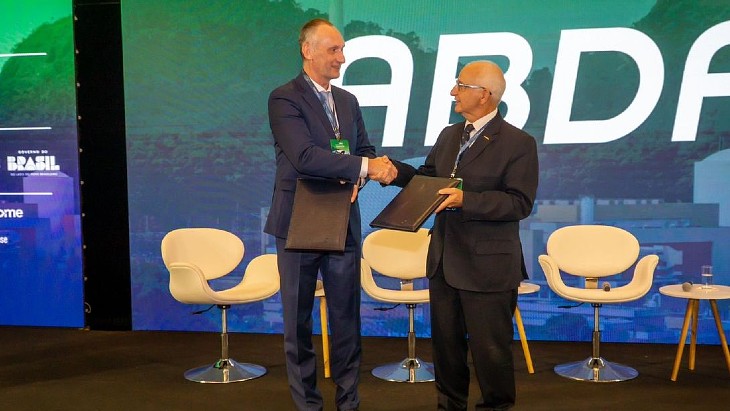
Rosatom's Uranium One Group and Nucleo Brasil Energia Participações have signed an agreement to establish a joint venture to implement critical mineral exploration and extraction projects in Brazil.
(Image: Rosatom)
The signing ceremony for the new company, to be called Nadina Minerals, took place at the Nuclear Summit 2026 international forum in Rio de Janeiro, Brazil.
Rosatom said: "As part of their joint venture, the partners plan to obtain the necessary permits, conduct geological exploration at promising deposits, and build modern facilities for the extraction and processing of metals critical to the development of high-tech industries. The project is an important step in strengthening international cooperation and a strategic step for the development of Brazil's national economy."
It added that the Russian state nuclear corporation has "extensive experience collaborating with Brazil in the nuclear fuel cycle, primarily in the supply of enriched uranium for fuel production at the Angra Nuclear Power Plant, as well as services for the conversion of Brazilian uranium. The signed agreement lays the foundation for expanding this partnership".
Based in São Paulo, privately owned Núcleo Brasil Energia Participações (NBEPar) was created in 2024 "to structure the nuclear sector of the Diamante Group, which has been operating in the area of thermoelectric power generation for six decades". It describes its mission as "to build partnerships with public and private companies to guarantee a supply chain for nuclear power generation in Brazil".
Brazil's uranium plans
The Nuclear Summit 2026 featured discussion of the opportunities and potential for Brazil in terms of uranium resources and nuclear fuel production.
Reinaldo Gonzaga, director of Nuclear Fuel for Indústrias Nucleares do Brasil (INB), said that with the support of the publicly-owned holding company Empresa Brasileira de Participações em Energia Nuclear e Binacional SA (ENBPar), they were working to structure new business models with the objective of expanding national production, with input as well from the National Bank for Economic and Social Development (BNDES).
He said that developing mining, conversion and enrichment abilities was a way to reduce external dependence and add value to the uranium produced in the country. In addition to a number of international agreements relating to its critical mineral resources, Brazil has outlined its plans to return to uranium exploration and expand its nuclear fuel cycle capabilities.
A Request for Information was launched by BNDES in December for consulting firms interested in participating in the structuring of Indústrias Nucleares do Brasil's uranium production expansion project.
Indústrias Nucleares do Brasil (INB) launched the Pró-Urânio programme in 2024 "with the aim of expanding and accelerating the exploration of new deposits, and which will involve BNDES in developing the model for partnerships with mining companies".
Background
According to World Nuclear Association, following active exploration in the 1970s and 1980s, Brazil has reasonably assured resources of 210,000 tonnes of uranium. There has been little exploration since the mid-1980s.
The country's three main deposits are: Pocos de Caldas in Minas Gerais state, where a uranium mine closed in 1997; Lagoa Real or Caetité in Bahia state, which has been operating since 1999; and Itataia, now called Santa Quitéria, in Ceará state, where the production of uranium as a co-product with phosphate is planned.
Uranium has been mined in Brazil since 1982, but the only operating mine is INB's Lagoa Real/Caetité mine, with a capacity of 340 tU per year. The mine has known resources of 10,000 tU at 0.3%U.
INB commenced developing the adjacent Engenho mine in January 2017, a 200-300 tU per year open pit operation. Production was initially planned from October 2017, but did not commence.
In January 2020, the country's energy minister reported that investment in INB would allow it to produce 150 tU annually from Caetité, starting in 2020, and expanding to 360 tU per year by 2023. The Santa Quitéria Consortium - a partnership between INB and privately owned fertiliser producer Galvani - expects to produce 2,300 tonnes of uranium concentrate annually from the Itataia deposit.
In 2022, Brazil produced 43 tU. All mined uranium is used domestically, after conversion and most enrichment abroad. The country's uranium requirements are currently about 339 tU per year.
Kentucky incentives support laser enrichment plant
A USD98.9 million incentive package from the Commonwealth of Kentucky and McCracken County will support the ongoing development of Global Laser Enrichment's planned Paducah Laser Enrichment Facility.
GLE's vision of the PLEF (Image: GLE)
North Carolina-based Global Laser Enrichment (GLE) completed its full licence application to the US Nuclear Regulatory Commission for the Paducah Laser Enrichment Facility (PLEF) in July last year. It intends to re-enrich high-assay depleted uranium tails acquired from the Department of Energy at the facility at Paducah, Kentucky, and says the project represents a transformational investment opportunity for the greater Paducah region. It is expected to be the single largest capital investment in Western Kentucky's history.
The performance-based incentive package will potentially provide up to USD98.9 million in tax and other economic incentives should GLE reach agreed investment and job creation thresholds, the company said.
"GLE greatly appreciates McCracken County and the Commonwealth of Kentucky's enthusiasm and support for nuclear energy and the creation of new US domestic nuclear fuel sources," GLE CEO Stephen Long said. "The incentive package reflects a shared vision for economic development, technological leadership, and the establishment of a resilient domestic nuclear fuel supply chain."
GLE is the exclusive licensee of the SILEX laser enrichment technology invented by Australian company Silex Sytems Ltd. The company completed a large-scale uranium enrichment demonstration programme last year at its Wilmington, North Carolina Test Loop facility, reaching Technology Readiness Level 6, and is continuing its technology maturation program (TRL-7+) and full-scale preliminary detailed design for the PLEF.
The company said it "remains on track to begin re-enriching the DOE’s Paducah inventory of depleted uranium tails by 2030".
Deep Isolation further validates borehole technology
US nuclear waste disposal company Deep Isolation Nuclear Inc announced that federally funded research has shown that deep borehole disposal could be a viable option for disposing of high-level radioactive waste from advanced reactor fuel recycling.
A prototype UCS canister (Image: Deep Isolation)
Deep Isolation was among the recipients of USD36 million in funding announced in March 2022 by the US Department of Energy (DOE) for 11 projects seeking to increase the use of nuclear power as a reliable source of clean energy and to limit the amount of radioactive waste produced from advanced reactors. The awards were made through the DOE Advanced Research Projects Agency-Energy's (ARPA-E's) Optimising Nuclear Waste and Advanced Reactor Disposal Systems (ONWARDS) programme. ONWARDS was launched in 2021 as ARPA-E's first programme created to identify and facilitate technologies for advanced reactor used fuel recycling, waste forms, used fuel disposal pathways and associated advanced safeguards technologies.
In one project - titled Enabling the Near Term Commercialisation of an Electrorefining Facility to Close the Metal Fuel Cycle - which received a USD4 million grant, Deep Isolation was joined by Oklo Inc and the Argonne and Idaho national laboratories to commercialise a fuel recycling facility that will include, for the non-recyclable waste, the development of a final waste solution compatible with a deep borehole repository. The Oklo-led project was the first focused programme to identify pathways to reduce waste material and minimise the need for disposal sites, and was the first federally-funded programme to explore pairing a commercial borehole solution with a recycling facility for an advanced reactor developer.
In the project, Deep Isolation analysed the waste streams that would be generated by the electrorefining facility to identify waste forms suitable for a deep borehole repository. It would also establish the technical and cost savings framework for using deep borehole repositories as a complement to electrorefining. Oklo and Argonne would focus on industrialising fuel recycling through advanced automation techniques and sensor technologies.
Deep Isolation has now said its analysis has "confirmed that nuclear waste streams partitioned through the Argonne-baseline electrorefining process are compatible with deep borehole disposal, demonstrating a safe and practical pathway for permanent isolation. Physics-based modelling showed that high-level waste, when disposed of in Deep Isolation's deep borehole system within generic shale and granitic host rocks, achieved long-term safety levels surpassing targets set in developing the model and achieving exposure levels that were several orders of magnitude below a stringent radiological exposure dose standard".
It added: "The results of this comprehensive initiative provide confidence that borehole disposal could serve as a viable option for high-level radioactive waste from advanced reactor fuel recycling, highlighting a potential pathway for closing the metal fuel cycle if US law is changed to authorise borehole repositories for high-level waste."
Jesse Sloane, Executive Vice President of Engineering, Deep Isolation, said: "This collaboration with Oklo represents an important step forward for the advanced reactor ecosystem and our deep borehole disposal solutions for nuclear waste. By pairing innovation in fuel recycling with advanced deep geologic disposal technology, we are helping build the technical foundation for a fully integrated, sustainable nuclear future."
The borehole technology
Disposal in deep boreholes - narrow, vertical holes drilled deep into the earth's crust - has been considered as an option for the geological isolation of radioactive wastes since the 1950s. Deep borehole concepts have been developed in countries including Denmark, Sweden, Switzerland, and the USA but have not yet been implemented.
Deep Isolation's patented technology leverages standard drilling technology using off-the-shelf tools and equipment that are common in the oil and gas drilling industry. It envisages emplacing nuclear waste in corrosion-resistant canisters - typically 9-13 inches (22-33 centimetres) in diameter and 14 feet long - into drillholes in rock that has been stable for tens to hundreds of millions of years. The drillhole - which is lined with a steel casing - begins with a vertical access section which then gradually curves until it is nearly horizontal, with a slight upward tilt. This horizontal 'disposal section' would be up to two miles (3.2 kilometres) in length and lie anything from a few thousand feet to two miles beneath the surface, depending on geology. Once the waste is in place, the vertical access section of the drillhole and the beginning of its horizontal disposal section would be sealed using rock, bentonite and other materials.
Deep Isolation's Universal Canister System (UCS) - developed in collaboration with NAC International Inc through a three-year project funded by the DOE's Advanced Research Projects Agency–Energy (ARPA-E) - is designed to accommodate a range of advanced reactor waste streams, including vitrified waste from reprocessing, TRISO used fuel, and halide salts from molten salt reactors. It is compatible with modern dry storage and transport infrastructure, and meets performance and safety requirements across both borehole and mined repository options, which gives greater flexibility and reduced uncertainty in future waste disposition, the company says.
In January, Deep Isolation said that a two-year research project, also funded by the DOE's ARPA-E programme, subjected its UCS to the kinds of conditions found thousands of feet below the surface had shown materials used in its fabrication perform reliably and remain resistant to corrosion over time.
Last month, Deep Isolation announced the launch of its multi-year, full-scale, at-depth deep borehole demonstration programme to test its technology for safely and permanently disposing of nuclear waste deep underground.
_75258.jpg)

_18080.jpg)
_13211.jpg)

No comments:
Post a Comment