The impact of war goes beyond immediate destruction, quietly shaping the health of future generations.
By Eman Abu Zayed ,
April 15, 2026
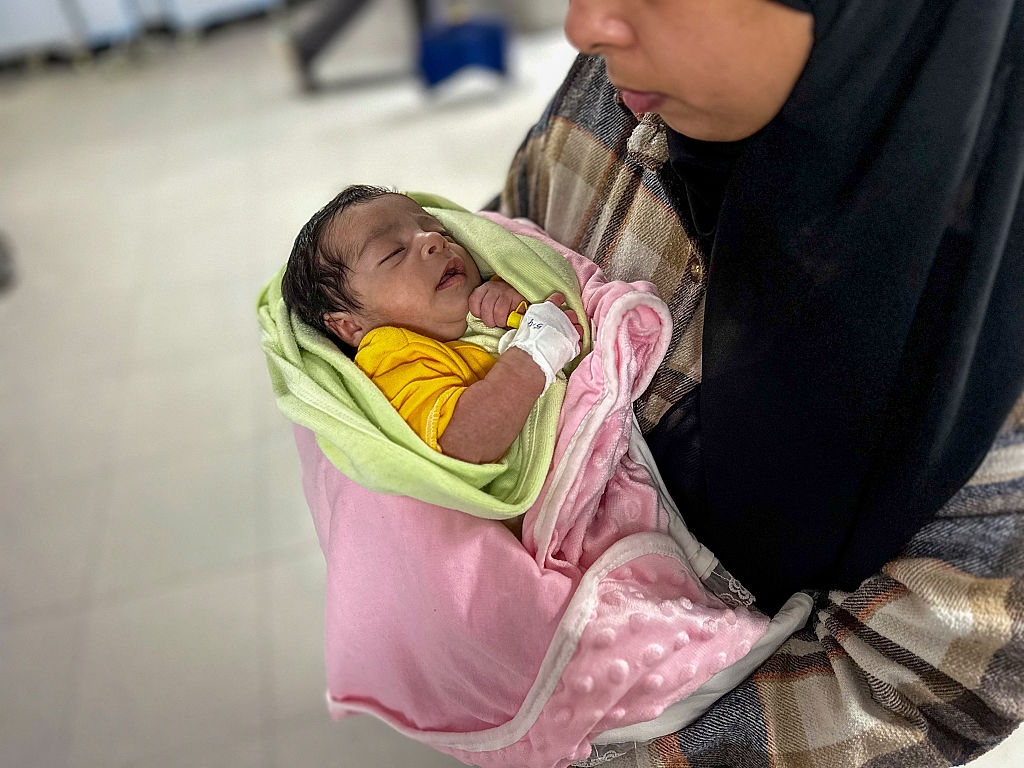
The mother of 21-day-old Palestinian infant Ghazal Harzallah holds her baby at Nasser Medical Complex in Khan Younis in the southern Gaza Strip, on April 5, 2026.Doaa Albaz / Middle East Images / AFP via Getty Images
In Gaza, the effects of war do not end when the bombing stops. Beyond the rubble and debris, a silent health crisis is emerging affecting the most vulnerable, particularly pregnant women and their children. Since the start of Israel’s assault on Gaza in 2023, maternity wards have reported alarming increases in miscarriages, premature births, and rare congenital disabilities.
Doctors note that such patterns were far less common before the war and point to environmental factors created by bombardment — including dust, smoke, and chemical substances — as significant contributors.
Explosives leave behind a complex mix of heavy metals and toxic compounds, while the use of white phosphorus — a toxic chemical weapon deployed by the Israeli military — adds another layer of environmental hazard. These substances do not disappear after attacks cease; they settle in the air, contaminate the soil, and linger in the debris, becoming a constant source of exposure for residents.
In Gaza, the effects of war do not end when the bombing stops. Beyond the rubble and debris, a silent health crisis is emerging affecting the most vulnerable, particularly pregnant women and their children. Since the start of Israel’s assault on Gaza in 2023, maternity wards have reported alarming increases in miscarriages, premature births, and rare congenital disabilities.
Doctors note that such patterns were far less common before the war and point to environmental factors created by bombardment — including dust, smoke, and chemical substances — as significant contributors.
Explosives leave behind a complex mix of heavy metals and toxic compounds, while the use of white phosphorus — a toxic chemical weapon deployed by the Israeli military — adds another layer of environmental hazard. These substances do not disappear after attacks cease; they settle in the air, contaminate the soil, and linger in the debris, becoming a constant source of exposure for residents.
The impact is not limited to immediate injury. Prolonged exposure to polluted air and dust affects pregnant people, increasing the likelihood of complications that threaten both parent and child.
Within this context, individual stories reveal the human toll more clearly than statistics ever could.
Israel Destroyed Gaza’s Hospitals. Now It’s Banning Doctors Without Borders.
Israel says it will start enforcing its ban on 37 aid groups in Gaza in March, putting more Palestinian lives at risk. By Eman Abu Zayed , TruthoutFebruary 12, 2026
Samira Kafana, 30, a mother of two, was pregnant with her third child during the war. She endured a grueling displacement from northern Gaza to the south, walking long distances with her children through smoke and toxic substances left by bombardment.
She describes the journey as suffocating, with severe breathing difficulties and persistent chest pain. This exposure continued for hours without protection or access to medical care.
Upon arrival, Kafana settled in a tent lacking basic living conditions. As her health deteriorated, labor began suddenly in her eighth month.
“I was completely exhausted, and there was no medical follow-up,” she recalled. “When I gave birth, I felt my baby was weaker than normal.”
Kafana’s son, Omar, was born underweight and in an unstable condition, requiring ongoing medical care. Although births in the eighth month are generally considered relatively safe, his condition reflected a pattern of complications increasingly observed by medical teams.
Dr. Saadi Al-Hilu, a specialist in obstetrics and gynecology, notes that these cases were uncommon before the war. He points out that intensive exposure to smoke and chemical substances may be contributing to the rise in pregnancy complications, based on clinical observation.
Another story highlights a different dimension of the crisis.
Inas Abdo carried her first pregnancy under severe food scarcity and a lack of basic resources. As her due date approached, she underwent a cesarean section in an attempt to save her life and that of her daughter.
Despite the success of the procedure, her baby, Rama, died shortly after birth.
“I hadn’t eaten anything for two days before the operation. There was no food, and a pregnant woman needs proper nutrition. The circumstances changed everything.”
“I hadn’t eaten anything for two days before the operation. There was no food, and a pregnant woman needs proper nutrition. The circumstances changed everything,” Abdo said.
Her experience reflects the reality faced by thousands of women. Malnutrition weakens pregnant mothers and directly affects fetal survival. Inadequate maternal nutrition is closely associated with higher risks of premature birth, low birth weight, and neonatal death.
Under these conditions, pregnancy becomes a high-risk experience shaped by the combined pressures of war, hunger, and limited health care.
Despite the growing number of such cases, scientific verification remains extremely limited.
Much of Gaza’s health care infrastructure has been destroyed, and specialized laboratories are unavailable, preventing the testing needed to analyze soil, air, or biological samples. This makes it difficult to determine the nature of pollutants or measure contamination levels accurately.
Current understanding relies largely on clinical observation and field experience rather than laboratory-confirmed evidence. In scientific terms, linking a specific pollutant to a congenital condition requires detailed studies and testing not currently possible.
Even with these limitations, a concerning pattern emerges.
The overlap between widespread exposure to war remnants and the emergence of unusual health conditions raises urgent questions about long-term effects, particularly for future generations.
The impact is not limited to pregnancy and childbirth.
Medical observations indicate rising rates of respiratory illness, recurrent skin infections, and general neurological symptoms among children growing up in an environment affected by polluted air, unsafe water, and unremoved debris.
In this context, a third case illustrates the ongoing risks after birth.
The overlap between widespread exposure to war remnants and the emergence of unusual health conditions raises urgent questions about long-term effects, particularly for future generations.
Maha Al-Najjar, 27, gave birth to her first child, Youssef, after months of repeated displacement during the war. Throughout her pregnancy, she lived in overcrowded shelters and makeshift tents, exposed to dust, smoke, and poor sanitation, with limited access to clean water or consistent medical care.
She recalls experiencing persistent fatigue, dizziness, and breathing difficulties, without any opportunity for regular prenatal monitoring. “I didn’t know if my baby was developing normally. There were no tests, no follow-up, nothing to reassure me,” Al-Najjar said.
After giving birth, concerns emerged. Youssef showed signs of developmental delay and recurrent health issues, requiring repeated visits to medical points operating with minimal resources.
“He gets sick very easily, and sometimes he doesn’t respond like other babies his age,” Al-Najjar explained. “I keep asking doctors if this is normal, but there are no clear answers.”
Medical staff note that while no definitive diagnosis could be established due to limited diagnostic tools, such patterns are increasingly observed among children born in similar conditions. Exposure to environmental toxins, stress, and inadequate maternal health care may contribute to these outcomes, though confirmation remains beyond current capabilities.
Al-Najjar’s story highlights a different dimension of the crisis: The suffering does not end at birth but continues with the uncertainty surrounding a child’s development in a war-affected environment.
Together, these stories paint a clear picture: The impact of war goes beyond immediate destruction, quietly shaping the health of future generations.
Gaza today faces a dual challenge: surviving amid the remnants of bombardment while also confronting the long-term health consequences of war on children and mothers.
This reality calls for urgent and independent intervention, including a thorough medical and environmental investigation, testing of soil, water, and air, and long-term monitoring of health outcomes. Without such action, risks will continue to grow, the health care system will remain under pressure, and the future of Gaza’s children will remain fragile.
In this city, survival is no longer defined only by enduring the genocide, but also by protecting the health of generations born into an environment shaped by the hidden dangers of war.
This article is licensed under Creative Commons (CC BY-NC-ND 4.0), and you are free to share and republish under the terms of the license.

Eman Abu Zayed
Eman Abu Zayed is a writer and journalist from Gaza who believes in the power of words to change reality.

No comments:
Post a Comment