Ewan Gleadow
April 17, 2026
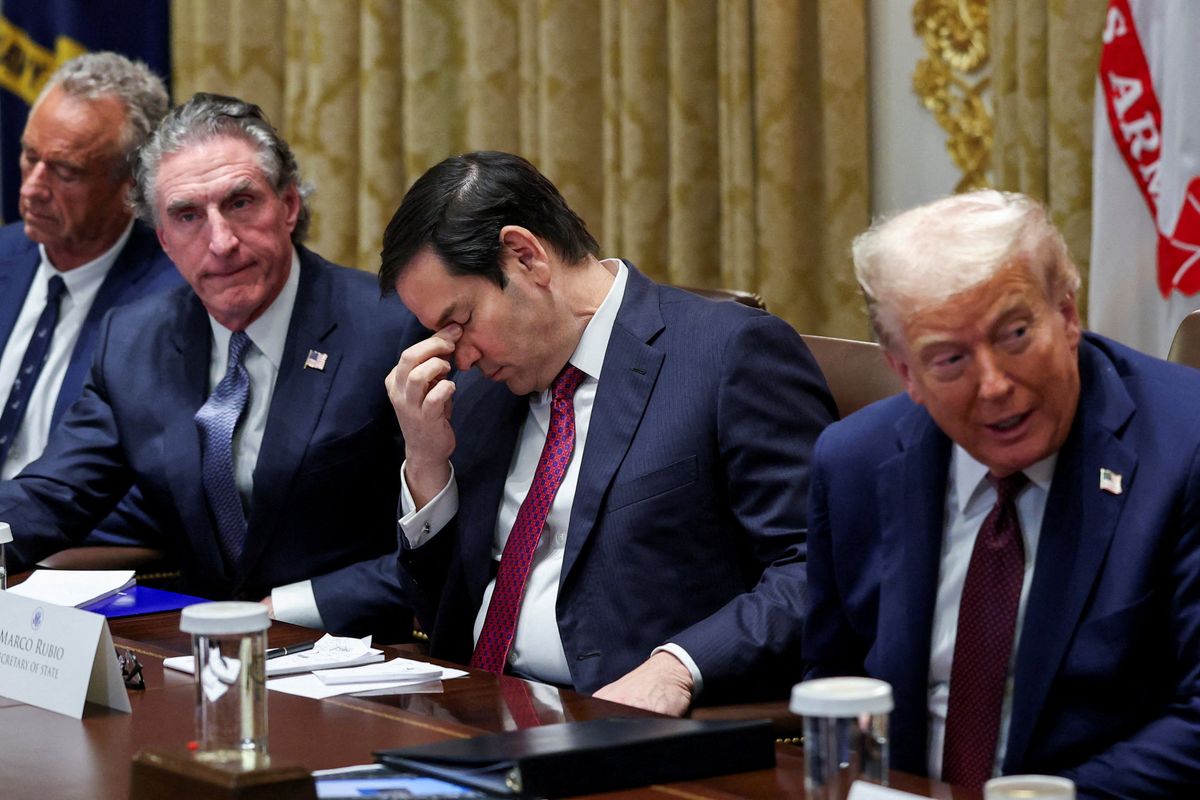
Donald Trump hosts a cabinet meeting. REUTERS/Jonathan Ernst
President Donald Trump's administration has attempted to shift the consequences of the Iran war to an ally, a report has found.
Trump's team caused fallout in Bahrain, which has undermined support for the United States. But internal documents shared by Politico show the admin has tried to pin the blame for the fallout on the United Kingdom. Nahal Toosi wrote, "Bahrain’s government is facing questions about whether the U.S. abandoned it to fend for itself against Iranian drones and missiles.
"Bahrain and the U.S. are stalwart allies, and the Middle Eastern country hosts an American military base that serves as headquarters for the U.S. Navy’s Fifth Fleet.
"But the Iran war has led to public perceptions that the U.S. abandoned Bahrain to focus on protecting Israel instead, according to the cable from the Bahraini capital, Manama."
Internal documents added to this pressure on the United States's relationship with Bahrain. Toosi added, "Still, the cable also notes that such Bahraini neglect to mention the U.S. may have partly stemmed from a 'desire to protect and maintain the operational security of U.S. personnel and materiel.'
"While the cable never directly says the embassy itself failed on messaging, it points out that the British Embassy’s highly active social media presence 'created a distorted perception of the scale of British assistance and an impression that the U.K. was stepping up where the United States was retreating.'"
Trump has been outspoken about the lack of support received by NATO countries, including the UK, over the war in Iran. British officials cited concerns about the legality of the unilateral military action and the lack of clear congressional approval for the conflict.
The UK's position reflects growing international skepticism about the war's justification and strategic objectives. Trump's response included threats to reconsider U.S. security commitments to the UK and NATO, warning that countries failing to support American military actions would face consequences.
The dispute has exposed deep rifts between Trump and traditional Western allies over military intervention and international law.
The UK's refusal signals that Trump's Iran war has further alienated America from longstanding partners, leaving the administration with diminished international coalition-building capacity for future military operations.
NATO Allies Adopt Evasive Policies on US War in Iran
Trump administration officials are discovering that a daunting number of longstanding U.S. allies and security clients are adopting hedging policies or even openly opposing Washington’s decision to wage war against Iran. That sobering reality has become even clearer over the past week than it was during the earlier stages of the armed conflict. On April 12, the president called upon NATO members to join U.S. naval forces in blockading Iranian ports. The proposed move was in response to Tehran’s continuing efforts to selectively close the vital Strait of Hormuz to foreign shipping.
However, most of Washington’s alliance partners refused to join the retaliatory blockade. British prime minister Keir Starmer was especially blunt and negative. The U.K. is “not supporting” the U.S. blockade of Iranian ports, Starmer stated, insisting that the country would not get “dragged in” to the Iran war. Starmer, along with French President Emmanuel Macron, instead proposed intensified international efforts, including a conference, to secure an effective agreement to reopen the strait.
The extensive allied refusal regarding Washington’s blockade plans reflects growing European dissatisfaction with overall U.S. policy toward Iran and, indeed, with Trump’s entire approach to world affairs. Concerned longtime proponents of close transatlantic security cooperation are expressing mounting worries that disagreements between the United States and its principal European allies about Iran policy could lead to a fatal breach in NATO.
European leaders and their publics clearly are getting restless. Serge Schmemann, the Moscow bureau chief for the New York Times, emphasizes the extent of the change. “Mr. Trump’s war on Iran, about which NATO allies were not consulted and in which they subsequently declined to participate, has made clear that Europeans no longer defer to Mr. Trump as the de facto “‘leader of the free world.’”
At the same time, European leaders have tried to avoid directly antagonizing President Trump. Achieving such a balance is not easy. Trump expressed fury at NATO allies who have failed to support Washington’s intervention against Iran. Even before the latest intra-alliance spat over establishing a blockade, the president denounced such allies as “cowards.” Administration officials also are examining ways to punish uncooperative Alliance partners. Secretary of State Marco Rubio echoed and amplified Trump’s earlier doubts about the continuing value of NATO to America’s security. “Why are we in NATO? You have to ask that question. Why do we send trillions of dollars and have all of these American forces stationed in the region, if in our time of need, we won’t be allowed to use those bases?” Rubio said during an interview with Fox News in early April. The refusal of most NATO members to authorize U.S. airstrikes and other offensive operations against targets in Iran has especially irritated administration officials.
However, as Wall Street Journal columnists Linas Kojalaand and Vytautas Leškevičius point out, with the notable and ostentatious exception of Spain, the most significant and influential Alliance members, including Britain, France, and Italy, have all quietly assisted the U.S. war effort in other ways. The outcome has been a bit of a muddle. “Politically, the war with Iran has widened the gap between Washington and many European governments. Operationally, it has underscored how heavily the U.S. still relies on Europe – and how cooperative most European governments are.”
European NATO leaders seem to be trying to have it both ways. By condemning Washington’s war of aggression against Iran and the widespread economic disruption that the conflict has caused, those countries maximize their ability to win the plaudits of outraged populations and governments around the world. Yet providing quiet backing for at least some U.S military operations and diplomatic efforts to limit Iran’s power and influence placates other countries–especially those in the Middle East – that worry about both the clerical regime’s current conduct and its long-term strategic ambitions.
It is a very delicate balancing act on several levels, and it remains to be seen if European political elites can carry it off. Important factions within the U.S. diplomatic, intelligence, and military communities may well sympathize with at least some of the European objections to the Trump administration’s Iran policy. However, hardliners in those same U.S. institutions are not pleased with the perceived reluctance of other NATO members to support an armed intervention that the administration regards as a high priority. Worse, Trump himself has expressed vitriolic displeasure at what he considers unreliability at best and outright betrayal at worst. His anger is not a trivial matter. Even a lame-duck president with low domestic public approval ratings exercises a dominant role in U.S. foreign policy. Policy differences about the Iran war have already exacerbated transatlantic tensions, and if the war does not end quickly, those tensions are almost certain to worsen dramatically.

No comments:
Post a Comment