On US Tax Day, Socially Conscious Millionaires Say Make Us Pay More!
“We cannot hand over the keys to our democracy to people who are unwilling to address the economic injustices that exist today,” said Scott Ellis of the Patriotic Millionaires.
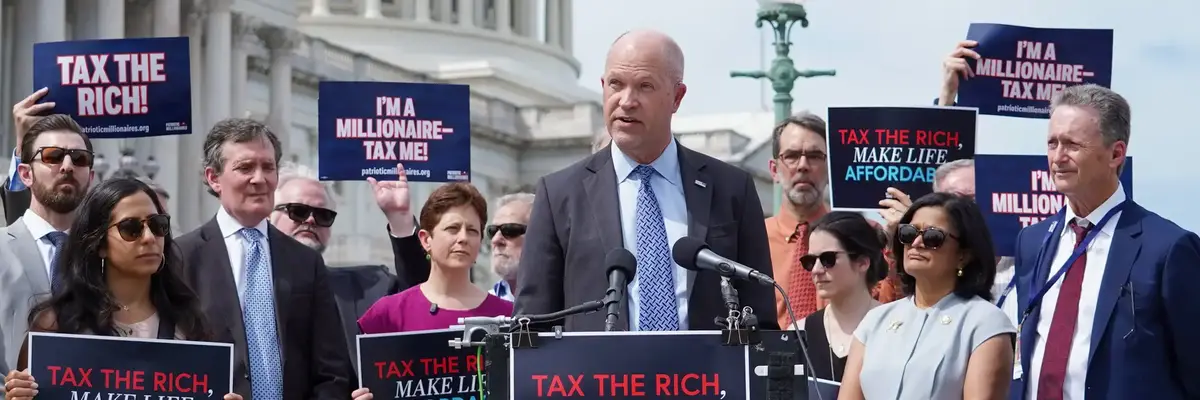
Scott Ellis of the Patriotic Millionaires joined other advocates and lawmakers for a rally calling to tax the rich on April 15, 2026 in Washington, DC.
(Photo by the Patriotic Millionaires/Bluesky)
Jessica Corbett
Apr 15, 2026
“Millionaires like me who want a rich, stable, free country demand an economy that ensures it. That begins with commonsense revenue raisers and tax reforms that stop the accumulation of oligarchic concentrations of wealth.”
That’s what Scott Ellis of the Patriotic Millionaire said Wednesday—Tax Day in the United States—as he gathered with members of various organizations, plus Sens. Chris Van Hollen (D-Md.) and Ed Markey (D-Mass.), as well as Reps. Don Beyer (D-Va,), Chris Deluzio (D-Pa.), and Pramila Jayapal (D-Wash.), for a “tax the rich” rally on Capitol Hill.
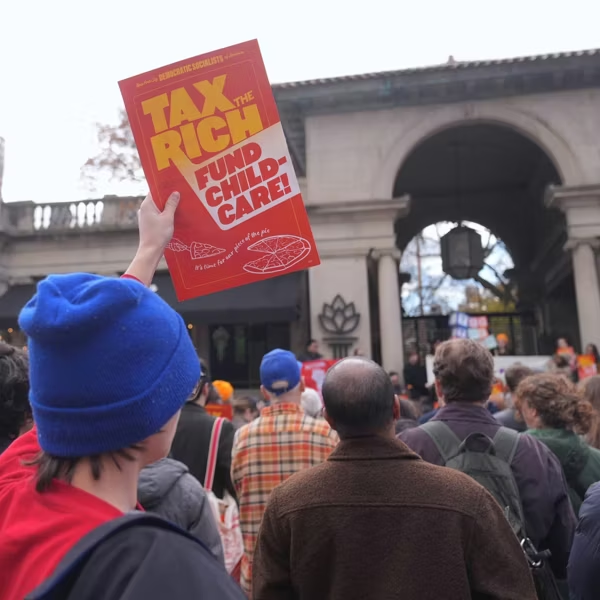
‘The Current Tax Code Is Rigged,’ Plus 6.2 Trillion Other Reasons to Tax America’s Ultrarich
‘Taxing Billionaires Is Not Radical’: Mamdani Joins Top Economists to Denounce ‘Rigged’ US Tax System
“While I’ve seen examples of the good that wealth can do, I have also seen all the ways it can lead to irreparable harm to our personal, political, moral, and societal well-being,” said Ellis. “There is a level of wealth beyond which it threatens the health and even the existence of our democracy and our economy. We cannot hand over the keys to our democracy to people who are unwilling to address the economic injustices that exist today.”
Ellis said that he joined the lawmakers and others gathered “to urge our government leaders to deal with the money problem in our country head-on with solutions like those found in the Patriotic Millionaires’ MONEY Agenda platform. Every time inequality reaches extraordinary levels, we create a vulnerability to authoritarianism where money becomes power. If we want to unrig our economy, we need a bold, surprisingly simple economic vision.”
So far, two bills tied to the MONEY Agenda have been introduced in Congress: the Equal Tax Act, sponsored by Markey and Rep. Delia Ramirez (D-Ill.), and the Working Americans’ Tax Cut Act, spearheaded by Van Hollen and Beyer.
“Teachers, nurses, and millions [of] working people are paying more while getting less because our tax code is rigged to reward wealth over work,” Markey said in a statement. “The Equal Tax Act brings fairness to our tax code by requiring millionaires and billionaires to pay taxes on investment income the same way working people pay taxes. On Tax Day, I’m proud to work with Congresswoman Ramirez to fight for legislation that has the wealthy pay their fair share, and rewards work every bit as much as wealth.”
Van Hollen, meanwhile, said Wednesday that “my Working Americans’ Tax Cut Act creates a fairer system that ensures those who are stretching to make ends meet can keep more of what they earn, while asking the well-off to pitch in more. It’s long past time that we rebalanced our tax code to put working people first—and promote greater opportunity and shared prosperity for all.”
(Photo by the Patriotic Millionaires/Bluesky)
Jessica Corbett
Apr 15, 2026
“Millionaires like me who want a rich, stable, free country demand an economy that ensures it. That begins with commonsense revenue raisers and tax reforms that stop the accumulation of oligarchic concentrations of wealth.”
That’s what Scott Ellis of the Patriotic Millionaire said Wednesday—Tax Day in the United States—as he gathered with members of various organizations, plus Sens. Chris Van Hollen (D-Md.) and Ed Markey (D-Mass.), as well as Reps. Don Beyer (D-Va,), Chris Deluzio (D-Pa.), and Pramila Jayapal (D-Wash.), for a “tax the rich” rally on Capitol Hill.
‘The Current Tax Code Is Rigged,’ Plus 6.2 Trillion Other Reasons to Tax America’s Ultrarich
‘Taxing Billionaires Is Not Radical’: Mamdani Joins Top Economists to Denounce ‘Rigged’ US Tax System
“While I’ve seen examples of the good that wealth can do, I have also seen all the ways it can lead to irreparable harm to our personal, political, moral, and societal well-being,” said Ellis. “There is a level of wealth beyond which it threatens the health and even the existence of our democracy and our economy. We cannot hand over the keys to our democracy to people who are unwilling to address the economic injustices that exist today.”
Ellis said that he joined the lawmakers and others gathered “to urge our government leaders to deal with the money problem in our country head-on with solutions like those found in the Patriotic Millionaires’ MONEY Agenda platform. Every time inequality reaches extraordinary levels, we create a vulnerability to authoritarianism where money becomes power. If we want to unrig our economy, we need a bold, surprisingly simple economic vision.”
So far, two bills tied to the MONEY Agenda have been introduced in Congress: the Equal Tax Act, sponsored by Markey and Rep. Delia Ramirez (D-Ill.), and the Working Americans’ Tax Cut Act, spearheaded by Van Hollen and Beyer.
“Teachers, nurses, and millions [of] working people are paying more while getting less because our tax code is rigged to reward wealth over work,” Markey said in a statement. “The Equal Tax Act brings fairness to our tax code by requiring millionaires and billionaires to pay taxes on investment income the same way working people pay taxes. On Tax Day, I’m proud to work with Congresswoman Ramirez to fight for legislation that has the wealthy pay their fair share, and rewards work every bit as much as wealth.”
Van Hollen, meanwhile, said Wednesday that “my Working Americans’ Tax Cut Act creates a fairer system that ensures those who are stretching to make ends meet can keep more of what they earn, while asking the well-off to pitch in more. It’s long past time that we rebalanced our tax code to put working people first—and promote greater opportunity and shared prosperity for all.”
Deluzio used the “Tax the Rich, Make Life Affordable” rally to call out the agenda of elected Republicans—who control the White House and both chambers of Congress—and promote another bill led by Jayapal, Rep. Brendan Boyle (D-Pa.), and Sen. Elizabeth Warren (D-Mass.).
“Our government has a fiscal recklessness problem, and it looks like this: the richest people in the history of Earth facing lower tax rates than Americans who earn a paycheck,” said Deluzio. “Yet that is the Republican plan—jack up the national debt and slash healthcare and more for the American people to pay for these huge tax giveaways to corporations and the ultrarich. We need a vastly different approach, like passing the Ultra-Millionaires Tax to get some sanity back into our tax system.”
To illustrate just how broken the current system is, EJ Juárez, executive director of State Innovation Exchange, noted that “in 2025 alone, billionaire wealth grew 22%—from $6.7 trillion to $8.2 trillion—while working families see the cost of living go up, and wages too low. That is why SiX is working alongside state legislators across the country to lead the way.”
“Across all 50 states, lawmakers are advancing bold solutions to make the ultrawealthy pay what they owe, close corporate loopholes, and build tax systems that actually lower costs and empower working families,” Juárez said, nodding to initiatives in places such as California and Washington state. “Together, states are proving a better future is possible.”
Beyond Washington, DC, New York City Mayor Zohran Mamdani partnered with Nobel laureate in economics Joseph Stiglitz and Paris School of Economics professor Gabriel Zucman for a Tax Day op-ed calling out the “rigged” US tax code.
“The idea that billionaires should pay higher tax rates than working people is not radical,” the trio wrote for The Guardian. “What is radical is allowing a system where extreme wealth exists alongside widespread hardship—and where those billionaires can in effect opt out of contributing to the society that made their success possible.”
“Our government has a fiscal recklessness problem, and it looks like this: the richest people in the history of Earth facing lower tax rates than Americans who earn a paycheck,” said Deluzio. “Yet that is the Republican plan—jack up the national debt and slash healthcare and more for the American people to pay for these huge tax giveaways to corporations and the ultrarich. We need a vastly different approach, like passing the Ultra-Millionaires Tax to get some sanity back into our tax system.”
To illustrate just how broken the current system is, EJ Juárez, executive director of State Innovation Exchange, noted that “in 2025 alone, billionaire wealth grew 22%—from $6.7 trillion to $8.2 trillion—while working families see the cost of living go up, and wages too low. That is why SiX is working alongside state legislators across the country to lead the way.”
“Across all 50 states, lawmakers are advancing bold solutions to make the ultrawealthy pay what they owe, close corporate loopholes, and build tax systems that actually lower costs and empower working families,” Juárez said, nodding to initiatives in places such as California and Washington state. “Together, states are proving a better future is possible.”
Beyond Washington, DC, New York City Mayor Zohran Mamdani partnered with Nobel laureate in economics Joseph Stiglitz and Paris School of Economics professor Gabriel Zucman for a Tax Day op-ed calling out the “rigged” US tax code.
“The idea that billionaires should pay higher tax rates than working people is not radical,” the trio wrote for The Guardian. “What is radical is allowing a system where extreme wealth exists alongside widespread hardship—and where those billionaires can in effect opt out of contributing to the society that made their success possible.”
‘Taxing Billionaires Is Not Radical’: Mamdani Joins Top Economists to Denounce ‘Rigged’ US Tax System
While most Americans are paying more in taxes this year, the wealthiest 1% are saving an average of $9,000 thanks to Trump’s tax legislation.
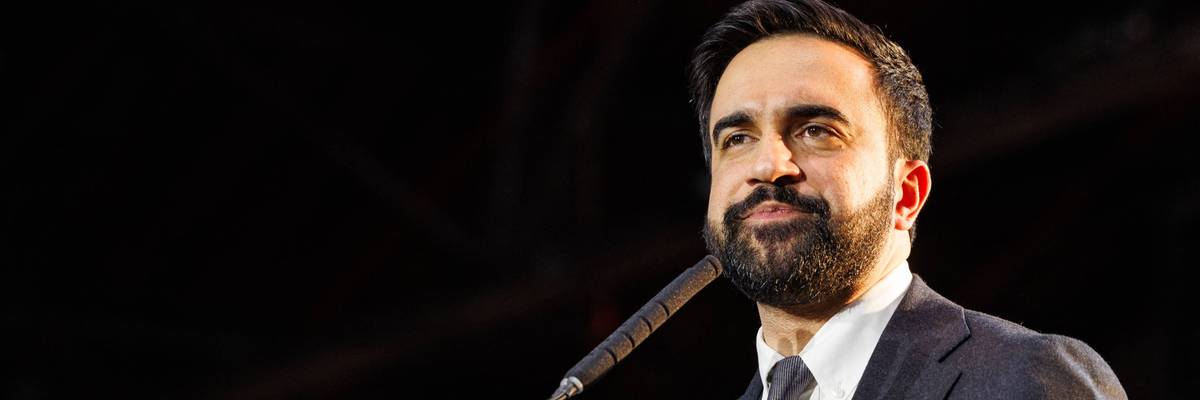
New York City Mayor Zohran Mamdani delivers an address to the crowd at his 100 Days Rally at the Knockdown Center in New York on April 12, 2026.
(Photo by Jason Alpert-Wisnia/Hans Lucas/AFP via Getty Images)
Stephen Prager
Apr 15, 2026
COMMON DREAMS
New York City Mayor Zohran Mamdani is using Tax Day to remind Americans that the nation’s tax code is “rigged” to protect the superrich while making the case for a more equitable system.
In a Guardian op-ed co-written with Nobel laureate in economics Joseph Stiglitz and Paris School of Economics professor Gabriel Zucman, New York’s democratic socialist mayor lamented that the world is living with greater wealth inequality than ever before, with just 0.0001% of the global population holding the equivalent of 16% of global wealth—more than the bottom half of humanity.
Mamdani and the economists attributed the global surge in inequality in large part to America’s “regressive” tax system, which has grown dramatically more favorable to the wealthy over the past half-century.
Compared to 1960, when the 400 richest Americans paid roughly half their incomes in taxes, they now pay about 24%—helped by a combination of lower marginal tax rates and loopholes that allow billionaires and corporations to shield their wealth and effectively pay a smaller share of their incomes than everyone else.
This inequality was further exacerbated by the massive GOP tax law signed by President Donald Trump last year, which a report by Americans for Tax Fairness found gave the wealthiest 1% of households an average tax break of $9,000.
While the Trump administration promised earlier this year that the average American family would receive a $1,000 tax refund from the legislation, Corey Husak, director of tax policy at the Center for American Progress, found that the average refund was just $346 higher than the previous year—and that even that figure was heavily inflated by the benefits accrued by the richest earners.
Meanwhile, those gains were more than wiped out by the added cost of Trump’s tariffs and the dramatic cuts to the social safety net passed by Republicans, which have led to spiking health insurance costs and thrown millions off Supplemental Nutrition Assistance Program (SNAP) benefits.
“We can disagree about how progressive tax systems should be—the extent to which the rich should pay more tax, relative to their income, than the rest of us,” Mamdani, Stiglitz, and Zucman wrote. “But there is no justification for a regressive system in which the superrich contribute less than the rest of us. This is how inequality is deepened and sustained.”
The authors praised efforts in other countries to combat rising inequality. One initiative they highlighted was a 2% tax on the wealth of those with more than €100 million ($117 million), a proposal championed by Zucman. A version of the measure was passed last year by France’s National Assembly but stalled in the Senate after being blocked by centrist and right-wing parties.
But the initiative still has momentum around the world. This weekend, Spanish Prime Minister Pedro Sánchez and Brazilian President Luiz Inácio Lula da Silva will meet with the leaders of several other nations, including Mexico, Colombia, and South Africa, to discuss adopting similar taxes.
Meanwhile, in the US, a proposed ballot initiative for a one-time 5% billionaire tax in California—aimed at recouping losses from Trump’s Medicaid cuts—appears overwhelmingly popular, with around two-thirds support according to a poll last month, despite aggressive lobbying by billionaires to stop the measure.
Mamdani has pushed for a similar measure in New York City to help balance the city budget and fund universal childcare and affordable housing.
On Wednesday, Democratic New York Gov. Kathy Hochul announced that she was backing a so-called “pied-à-terre tax,” which applies a surcharge to anyone with a second home valued over $5 million in New York City. Mamdani’s office has estimated that it will raise $500 million annually.
In early 2026, consumer prices and housing costs have soared far faster than wages can match. A January poll from KFF found that 82% of adults said their overall cost of living had increased over the past year, with around two-thirds saying they worried about affording healthcare for themselves and their families, and nearly a quarter saying they were worried about affording food and rent.
In response to this economic precarity, more than 62% of Americans said in a January YouGov survey that they felt billionaires are taxed too little, and more than half said that wealth inequality is a problem.
“The idea that billionaires should pay higher tax rates than working people is not radical,” the authors of the Guardian op-ed said. “What is radical is allowing a system where extreme wealth exists alongside widespread hardship—and where those billionaires can in effect opt out of contributing to the society that made their success possible.”
While most Americans are paying more in taxes this year, the wealthiest 1% are saving an average of $9,000 thanks to Trump’s tax legislation.
New York City Mayor Zohran Mamdani delivers an address to the crowd at his 100 Days Rally at the Knockdown Center in New York on April 12, 2026.
(Photo by Jason Alpert-Wisnia/Hans Lucas/AFP via Getty Images)
Stephen Prager
Apr 15, 2026
COMMON DREAMS
New York City Mayor Zohran Mamdani is using Tax Day to remind Americans that the nation’s tax code is “rigged” to protect the superrich while making the case for a more equitable system.
In a Guardian op-ed co-written with Nobel laureate in economics Joseph Stiglitz and Paris School of Economics professor Gabriel Zucman, New York’s democratic socialist mayor lamented that the world is living with greater wealth inequality than ever before, with just 0.0001% of the global population holding the equivalent of 16% of global wealth—more than the bottom half of humanity.
Mamdani and the economists attributed the global surge in inequality in large part to America’s “regressive” tax system, which has grown dramatically more favorable to the wealthy over the past half-century.
Compared to 1960, when the 400 richest Americans paid roughly half their incomes in taxes, they now pay about 24%—helped by a combination of lower marginal tax rates and loopholes that allow billionaires and corporations to shield their wealth and effectively pay a smaller share of their incomes than everyone else.
This inequality was further exacerbated by the massive GOP tax law signed by President Donald Trump last year, which a report by Americans for Tax Fairness found gave the wealthiest 1% of households an average tax break of $9,000.
While the Trump administration promised earlier this year that the average American family would receive a $1,000 tax refund from the legislation, Corey Husak, director of tax policy at the Center for American Progress, found that the average refund was just $346 higher than the previous year—and that even that figure was heavily inflated by the benefits accrued by the richest earners.
Meanwhile, those gains were more than wiped out by the added cost of Trump’s tariffs and the dramatic cuts to the social safety net passed by Republicans, which have led to spiking health insurance costs and thrown millions off Supplemental Nutrition Assistance Program (SNAP) benefits.
“We can disagree about how progressive tax systems should be—the extent to which the rich should pay more tax, relative to their income, than the rest of us,” Mamdani, Stiglitz, and Zucman wrote. “But there is no justification for a regressive system in which the superrich contribute less than the rest of us. This is how inequality is deepened and sustained.”
The authors praised efforts in other countries to combat rising inequality. One initiative they highlighted was a 2% tax on the wealth of those with more than €100 million ($117 million), a proposal championed by Zucman. A version of the measure was passed last year by France’s National Assembly but stalled in the Senate after being blocked by centrist and right-wing parties.
But the initiative still has momentum around the world. This weekend, Spanish Prime Minister Pedro Sánchez and Brazilian President Luiz Inácio Lula da Silva will meet with the leaders of several other nations, including Mexico, Colombia, and South Africa, to discuss adopting similar taxes.
Meanwhile, in the US, a proposed ballot initiative for a one-time 5% billionaire tax in California—aimed at recouping losses from Trump’s Medicaid cuts—appears overwhelmingly popular, with around two-thirds support according to a poll last month, despite aggressive lobbying by billionaires to stop the measure.
Mamdani has pushed for a similar measure in New York City to help balance the city budget and fund universal childcare and affordable housing.
On Wednesday, Democratic New York Gov. Kathy Hochul announced that she was backing a so-called “pied-à-terre tax,” which applies a surcharge to anyone with a second home valued over $5 million in New York City. Mamdani’s office has estimated that it will raise $500 million annually.
In early 2026, consumer prices and housing costs have soared far faster than wages can match. A January poll from KFF found that 82% of adults said their overall cost of living had increased over the past year, with around two-thirds saying they worried about affording healthcare for themselves and their families, and nearly a quarter saying they were worried about affording food and rent.
In response to this economic precarity, more than 62% of Americans said in a January YouGov survey that they felt billionaires are taxed too little, and more than half said that wealth inequality is a problem.
“The idea that billionaires should pay higher tax rates than working people is not radical,” the authors of the Guardian op-ed said. “What is radical is allowing a system where extreme wealth exists alongside widespread hardship—and where those billionaires can in effect opt out of contributing to the society that made their success possible.”


No comments:
Post a Comment