It’s possible that I shall make an ass of myself. But in that case one can always get out of it with a little dialectic. I have, of course, so worded my proposition as to be right either way (K.Marx, Letter to F.Engels on the Indian Mutiny)
Wednesday, April 22, 2026
Pan-African Activist Kemi Seba Detained in Pretoria as Rights Groups Fight Benin Extradition
Last updated: April 20, 2026
Prominent Beninese pan-African activist Kemi Seba remains in custody in South Africa following his arrest earlier this week, as extradition proceedings to Benin get underway. Human rights activists and his legal team are mobilizing to block the extradition, arguing that he would not receive a fair trial in Benin due to political persecution.
Seba (real name Stellio Gilles Robert Capo Chichi) was arrested on Monday in a sting operation at a Pretoria shopping centre alongside his 18-year-old son and a facilitator. Authorities say the group was attempting to cross illegally into Zimbabwe en route to Europe, paying around 250,000 rand for assistance. South African police acted on a Benin-issued international arrest warrant from December 2025.
Benin accuses Seba of “inciting rebellion,” “advocating crimes against state security,” and supporting a failed coup attempt in December 2025. He appeared in court and has been remanded in custody until April 20, 2026, with local charges of conspiracy and immigration violations also filed.
Human Rights Concerns and Opposition to Extradition
A growing number of activists, pan-African voices, and legal supporters — including prominent French lawyer Juan Branco — are campaigning against Seba’s extradition. They describe the case as politically motivated persecution by Benin’s government under President Patrice Talon, claiming the country’s judicial system, particularly the special court (CRIET), lacks independence and is used to silence dissent.
Critics argue Seba faces a high risk of an unfair trial, prolonged detention without due process, and harsh treatment as a high-profile government opponent. His legal team is also leveraging his Nigerien diplomatic passport, asserting immunity and political refugee status. Supporters highlight recent arrests of Seba’s family members in Benin as further evidence of targeted harassment.
International and regional human rights observers are watching the case closely, with calls for South Africa — which has a history of protecting political refugees — to carefully review any extradition request under principles of non-refoulement (not returning individuals to places where they risk persecution or unfair trials).
Background on Kemi Seba
The 45-year-old activist is known for his strong anti-colonial, anti-Western rhetoric, promotion of pan-Africanism, and large social media following. He has previously staged symbolic protests, such as burning French currency.
Benin authorities maintain the charges are legitimate national security matters following the foiled coup, which resulted in multiple arrests.
Seba’s next court appearance is scheduled for April 20, 2026, where extradition arguments, including human rights objections, are expected to be central.
Europeans fear Washington more than Beijing for the first time, Politico reports
Donald Trump is the leading reason of Europe going cold on the US, new data reveals. / CC: White HouseFacebook
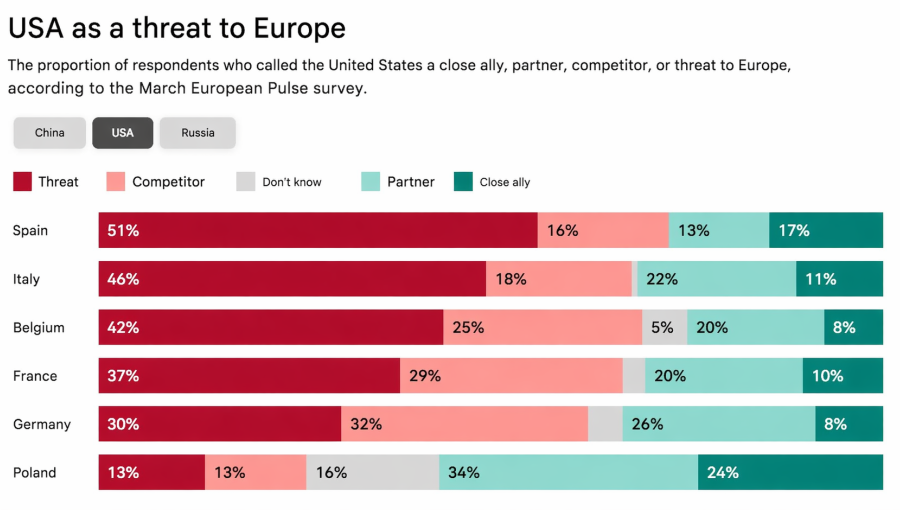
For the first time in the history of transatlantic polling, more Europeans view the United States as a threat to their continent than view China in the same light, a seismic shift in public sentiment.
A Politico European Pulse survey conducted between March 13 and 21 across Belgium, France, Germany, Italy, Poland and Spain, with at least 1,000 adults surveyed in each country, found that an average of 36% of respondents considered the US a threat to Europe.
In contrast, only 29% expressed equivalent concerns about Beijing. One thing remains unchanged: Russia retains its position as the number one perceived enemy, cited by 70% of respondents across the six countries.
The headline figures mask stark national variations, revealing the fractured geography of European opinion. In Spain, 51% of respondents described the US as a threat, while only 17% considered it a close ally.
Italy followed at 46%, Belgium at 42%, and France at 37%. The biggest shift recorded was in France, where in 2021 only 21% considered the United States a threat.
Only 12% of respondents across the six countries now see the US as a close ally. Among young Europeans aged 18 to 34, the figure describing the US as a threat reaches 55%, and 63% of Europeans consider the United States an unreliable ally.
Poland stands as the clear outlier. Only 13% of Polish respondents viewed America as a threat, with an equal share labelling it a competitor. A significant 34% considered the US a partner, and 24% a close ally, figures that reflect Warsaw's deep dependence on the US security umbrella and its positioning on Nato's eastern flank facing Russia.
Politico, which commissioned the survey, said these perceptions are linked to US President Donald Trump's policies. Since taking office just over a year ago, Trump has imposed tariffs on European allies, pushed for the annexation of Greenland from Denmark, and started a war with Iran, jeopardising global energy stability.
The Iran conflict has proved particularly damaging to European perceptions of Washington. The closure of the Strait of Hormuz since late February has triggered a severe energy crisis across the continent, with European officials largely excluded from decision-making over a war that has driven gas prices up by 60 to 70% and petrol by as much as 34% in some markets. The crisis has exposed Europe's limited influence over major security events, now driven and commanded primarily by the United States.
Trump's repeated public questioning of the value of Nato, and his description of Ukraine as "not our war", has added a security dimension to the economic grievances generated by his tariff agenda.
The transatlantic relationship is under exceptional strain, with Europe's security environment described by the EU Institute for Security Studies as "bleak and uncertain," and a US withdrawal of security guarantees now listed among the most acute risks facing the bloc.
The finding that Europeans fear the US more than China does not reflect any warming toward Beijing. Rather, it captures the speed and scale of Washington's reputational collapse. In France and Belgium, more respondents identified China as a threat, 43% and 38%, respectively, than said the same about the US, 37% and 42%, respectively, suggesting the US-as-threat finding is driven primarily by southern European sentiment rather than a uniform continental shift.
The data also points to a European public that is anxious but not mobilised. Only 19% of respondents said they would be willing to take up arms and fight in the event of an attack.
On Ukraine, opinion is sharply divided along national lines: in Germany, 45% said Europe is "not doing enough," while in Italy, 42% called the aid "too much."
The survey lands at a moment when European governments are racing to construct defence architectures less dependent on Washington, with the EU's rearmament programme accelerating and Article 42.7 receiving more serious attention than at any point since it was written into the Lisbon Treaty. Whether the political will exists to build genuine European strategic autonomy, however, remains deeply uncertain.
What is not uncertain is the scale of the reputational damage. Trust in the United States is at a record low across Europe's largest economies, with Washington now regarded as a greater threat than North Korea by a measurable share of the European public.
EU Ukraine fatigue growing - Kallas
EU foreign policy chief acknowledges waning allied support and mounting internal pressures even as Hungary's electoral shift raises hopes of unblocking long-stalled financial lifeline. / bne IntelliNews
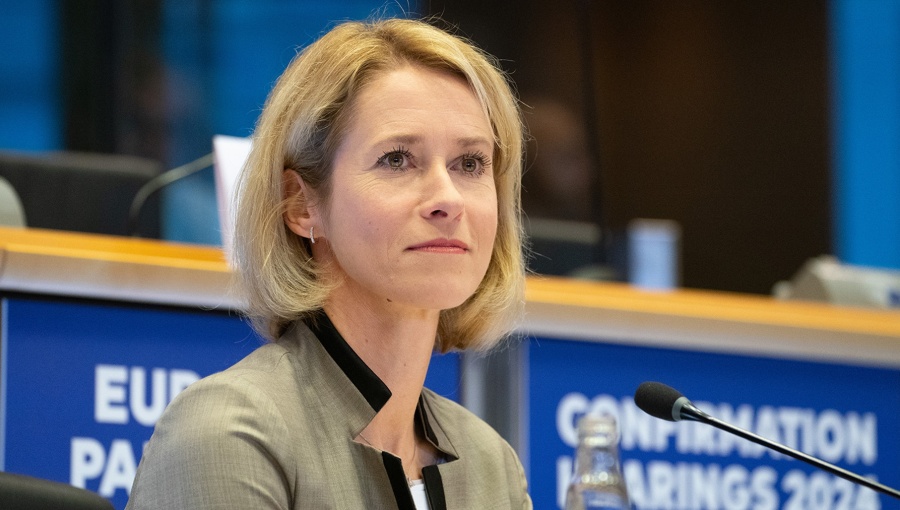
The EU's foreign policy chief Kaja Kallas has warned that the bloc is bearing an increasingly heavy and lonely burden in sustaining support for Ukraine, even as Brussels moves urgently to unlock a €90bn EU loan that Kyiv's government desperately needs to stave off a macroeconomic collapse in the coming months if no fresh funding is found.
Speaking on the margins of an EU Foreign Affairs Council meeting in Luxembourg on April 21, Kallas acknowledged that Europe's position as Ukraine's principal backer was becoming harder to sustain.
"We have a problem, namely Ukraine: we are there largely on our own, and we are the biggest supporters there. Not completely alone, that would not be true, but we also have our own concerns," she told reporters.
Kallas has been among Ukraine's most vocal and unwavering defenders in Brussels, but as IntelliNews has reported, disunity in the EU has been growing as the strains of the cost of the war and the pain of the boomerang effect of sanctions on Russia increasingly take their toll.
At the same meeting, EU foreign ministers could not agree to suspend a free trade agreement with Israel for the mounting atrocities the IDF is committing in Gaza and now Lebanon, championed by Spanish Prime Minister Pedro Sanchez who is calling for the arrest of Israeli Prime Minister Benjamin Netanyahu on war crime charges. Despite the extreme sanctions imposed on Russia in the first week of the war in Ukraine, the motion to condemn Israel, which has committed many of the same offenses, was shot down by Germany and Italy.
Kallas, a former Estonian prime minister who took office as the EU's high representative for foreign affairs in late 2024, has consistently argued that Russian aggression poses an existential threat to European security and that Europe must do more, not less, to ensure Ukraine prevails. However, both Kallas and her boss, European Commission President Ursula von der Leyen, have offered only muted criticism of Israel.
Her Luxembourg remarks reflect the reality confronting Brussels as the US has pulled back from support of the Ukrainian cause and the Iran war consumes Washington's strategic bandwidth. Ukraine fatigue has been growing slowly as the war entered a stalemate following the failure of the 2023 summer offensive, but is now gathering momentum.
In general, the EU project is facing increasing problems as recession looms across the whole region that is fuelling the “rise of the right”. Hungarian Prime Minister Viktor Orban loss of last weekend’s election was welcomed in Brussels as the most pro-Russia and illiberal government in the EU, but his replacement, Hungarian Prime Minister Peter Magyar, is not as pro-EU as billed. A similar election in Bulgaria also returned a pro-Russia populist and now Romania faces a political crisis. The leaders coming as a result of these election upsets are generally not so much illiberal pro-Kremlin politicians, but, as IntelliNews reported, euroscepticism-lite governments, many of which would like to end the support of Ukraine.
The €90bn loan: a window opens
Against that backdrop, the meeting in Luxembourg was dominated by efforts to unblock the €90bn loan package originally agreed by all 27 EU member states in December but subsequently stalled by Hungary's veto.
"We expect some positive decisions tomorrow on the €90bn loan," Kallas told reporters, as EU foreign ministers gathered. Orban has been the sticking point for the release of the loan, but Magyar has promised to drop Budapest’s objections provided Russian oil deliveries via the Druzhba pipeline resume – which is due to happen on April 22. A European Commission delegation has been in Budapest to discuss implementation with Magyar's incoming team, which formally takes office on May 9.
On April 21, Ukrainian President Volodymyr Zelenskiy confirmed that Ukraine had completed repairs to the pipeline. Slovak opposition to the twentieth sanctions package against Russia has also been caught up in the diplomatic spat and follows a similar logic.
Sanctions, accession and weapons
Kallas also told ministers that the EU "must continue to give Ukraine what it needs to hold its own until Putin understands that this war leads nowhere," and called for a rapid advance on multiple fronts simultaneously.
She urged foreign ministers to "rapidly move forward with the twentieth sanctions package" against Russia and called for a revisiting of "long-blocked decisions, including opening negotiation clusters with Ukraine" on EU accession. In December as part of the 27-point peace plan (27PPP) the Trump administration proposed to accelerate Ukraine’s accession to the EU, joining in 2027. However, the EU member states have shot that idea down and Ukraine is unlikely to become a member for a decade.
On April 22, Zelenskiy compromised and suggested that Ukraine might accept a temporary diminished “observer” status that would allow it to participate in EU meetings, but would not have access to EU funds that come with full membership – in particular, it would have no access to the Common Agricultural Policy (CAP) funding that makes up a third of the EU budget spending. In theory, as a full member, Ukraine would be entitled to massive €186bn a year of subsidies.
The European Peace Facility weapons fund — another vehicle for channelling military assistance to Kyiv — was also flagged as requiring renewed momentum by Kallas, who remains one of Europe’s most prominent Russia hawks.
Kallas presented the fourth pillar of the EU's evolving security guarantee framework for Ukraine to ministers at the same meeting, as discussions continue on what binding commitments the bloc can offer Kyiv in the absence of the full Nato membership that Ukraine has long sought and Washington has not endorsed.
The burden question
Kallas’ frank admission that the EU is "largely on its own" reflects a change of tone in Europe where leaders appear to have largely given up on keeping the “special transatlantic relation” alive that has dominated international politics since the end of WWII. For much of Trump’s first year in office the tactics have been to flatter the US president and attempt to manipulate his ego. Those efforts appear to have stopped now as various EU leaders have become more openly critical of the White House. The issue of condemning Israel’s actions in its military campaign in the Middle East is the most obvious break with US foreign policy and Europe’s. To add injury to insult, the Trump administration announced on April 21 that it was diverting more weapons originally intended for Ukraine to the Middle East.
Kallas acknowledged as recently as September 2025 that "Europe cannot support Kyiv on its own without Washington's involvement," telling Politico that Trump "was the one who promised to stop the killing — so it can't be on us." Her remarks this week suggest her calculus has also shifted since then and she has also given up on new US support. Brussels is now faced with managing a situation it had hoped to avoid: acting as Ukraine's primary backer not by choice but by default.
Ukraine needs more money
The unlocking of the €90bn loan — expected to receive formal approval from ambassadors on April 23 — would provide Kyiv with critical budget support across 2026 and 2027, covering military salaries, social payments and weapons procurement. However, it is insufficient to completely fund Ukraine until the end of 2027 as Ukraine needs a total of some €140bn over the coming two years. Additional money will have to be raised from other G7 partners like Japan and Canada to reach that goal. During the meeting in Luxembourg, Kallas admitted there are no guarantees of financing for the final third of Ukraine's needs in 2027.
The European Union plans to cover two-thirds of Ukraine's external financing needs in 2026-2027 with the €90bn loan, but Ukraine's other international partners have only confirmed the availability of funds to cover the remainder of Kyiv's needs for 2026, said European Commissioner for Economic Affairs Valdis Dombrovskis at the meeting. Ukraine's other international partners have not yet confirmed plans for its 2027 financing.
"I would say that now [in 2026] we are more than provided [with funds to finance Ukraine]. This year, the financing deficit for 2027 is a much more acute issue," Dombrovskis said.
Dombrovskis outlined that in 2026 and 2027, the EU will provide Ukraine with €45bn, covering two-thirds of Ukraine's budgetary and military requirements for those years.
Kyiv has warned that without additional funding, it faces a cash shortage within months that would threaten its ability to sustain the war effort.
Hungary’s new leader unlikely to shift EU stance on Russia and Ukraine dramatically
Hungary’s political landscape has been reshaped by the electoral defeat of longtime Prime Minister Viktor Orbán, but expectations that the country will now pivot sharply away from Russia and toward a more assertive European Union policy on Ukraine may prove misplaced, says a commentary by Carnegie Politika.
The opposition Tisza party, led by Péter Magyar, swept to victory in parliamentary elections on April 12, ending Orbán’s two-decade dominance. While Magyar is widely expected to soften Hungary’s combative tone within the EU, analysts say structural constraints will limit how far he can go.
Orbán had cultivated a reputation as the EU’s chief spoiler on Ukraine policy, positioning himself as a lone dissenter. However, this image was somewhat misleading. “Orbán created an image for himself as virtually the only opponent of aid to Ukraine in the entire EU,” writes Maksim Samorukov, fellow at the Carnegie Russia Eurasia Center. However, he adds, “in reality, he was simply willing to use his veto to absorb all the backlash, allowing other opponents to remain in the shadows.”
Hungary’s deep-rooted ties with Russia, particularly in the energy sector, predate Orbán and will continue to shape policy under his successor, according to Samorukov. Even during the Cold War, Budapest relied heavily on Soviet energy supplies, and diversification efforts since the 1990s have only partially reduced that dependence.
Today, Russian involvement remains embedded in key sectors of the Hungarian economy. Multibillion-dollar loans tied to the expansion of the Paks nuclear power plant, gas imports routed through the TurkStream pipeline, and oil supplies via the Druzhba pipeline all underpin economic stability. “No leader could afford to sacrifice all that overnight,” Samorukov said.
Magyar has acknowledged these realities. During the campaign, he avoided bold pledges on Russia, offering instead cautious proposals to review existing agreements for corruption and “gradually reduce dependence on Russian supplies by the mid-2030s”, as pointed out by Samorukov. Such timelines fall well short of EU targets to eliminate Russian energy imports by 2027.
Domestic political constraints further complicate any rapid shift. Although Tisza has taken power, much of the state apparatus remains staffed by Orbán-era appointees, including senior judicial figures and prosecutors. Efforts to overhaul these institutions quickly would risk destabilising governance and provoking resistance from entrenched interests.
As a result, Magyar faces a difficult choice: pursue incremental reforms within the existing system or engage in a prolonged struggle against the old guard, Samorukov writes. He suggests the former is more likely, pointing to the risk of political and economic disruption.
Orbán’s downfall itself had little to do with foreign policy. Instead, it stemmed from domestic concerns, particularly economic stagnation and perceptions that the prime minister had grown detached from everyday governance. After years in power, critics said he was “far more interested in meeting with global leaders and facilitating ultra-right parties around Europe than in attempting an economic recovery at home,” the commentary said.
Magyar’s Tisza movement capitalised on this fatigue, presenting itself as a generational alternative rather than an ideological break. Many of its leaders, including Magyar, emerged from the same political elite as Orbán’s Fidesz party, highlighting the continuity underlying Hungary’s political transition.
The new government is expected to repair relations with Brussels, particularly to unlock billions of euros in frozen EU funds withheld over rule-of-law concerns, says Samorukov. There is growing speculation that the EU may release a substantial portion of these funds without demanding sweeping concessions, partly as a reward for Orbán’s removal.
“Reducing the share of Russian energy supplies in the Hungarian economy can take a back seat for now,” Samorukov suggests, as Brussels prioritises political normalisation over immediate structural change.
Relations with Ukraine are also likely to improve in tone but not necessarily in substance, Samorukov forecasts. Magyar is expected to adopt a less confrontational approach than Orbán, whose disputes with Kyiv often spilled into EU forums. However, policy differences remain significant.
Magyar has indicated that Ukraine’s potential EU membership should be subject to a referendum in Hungary, opposes arms deliveries, and has raised concerns about the treatment of ethnic Hungarians in western Ukraine. Public opinion reflects this ambivalence: even among Tisza supporters, more respondents view Ukraine as a threat than as a partner.
These attitudes are not unique to Hungary. Across Central and Eastern Europe, enthusiasm for Ukraine’s integration into the EU has waned, driven by concerns over competition for subsidies, labor markets, and agricultural exports.
In this broader context, Hungary’s leadership change is unlikely to transform EU policy. While Orbán’s departure removes a consistent veto player, it does not eliminate underlying divisions within the bloc.
“In his absence, someone else is likely to step up and call for second thoughts on providing extra help to Kyiv or imposing new sanctions on Moscow,” Samorukov noted, highlighting the persistence of dissenting voices.
For Russia, the loss of a reliable ally in Budapest presents challenges. The Kremlin had cultivated close ties with Orbán, relying on his support to blunt EU initiatives. Establishing a similar relationship with Magyar will be more difficult, particularly given the current geopolitical climate.
Nevertheless, expectations of a dramatic shift may be overstated. Hungary’s economic ties to Russia, combined with broader European uncertainties, will continue to constrain policy.
The EU itself faces mounting pressures, including internal political divisions, strained relations with the United States, and the economic impact of global conflicts and high energy prices. These factors complicate efforts to maintain a unified and robust stance on Russia.
For now, Hungary appears set to adopt a more cooperative tone within the EU while maintaining many of the underlying policies shaped by geography, economics, and public opinion—suggesting continuity rather than transformation in Europe’s approach to Russia and Ukraine.
Gulf war poses major threat to global fertiliser markets and food security, IFPRI warns
Gulf war poses major threat to global fertiliser markets and food security, IFPRI warns. / bne IntelliNewsFacebookTwitter
By bnm Gulf bureauApril 22, 2026
The ongoing Iran war is disrupting global fertiliser markets with sustained impacts likely on food production, particularly in Africa and South Asia, the International Food Policy Research Institute (IFPRI) said on April 1.
Shipping restrictions in the Strait of Hormuz have already driven sharp increases in fertiliser and energy prices, with the disruption threatening agricultural output if prolonged. Up to 30% of global fertiliser trade passed through the Strait of Hormuz from the Persian Gulf to export markets in 2024, alongside 20% of liquefied natural gas (LNG) supplies and 27% of globally traded oil.
Attacks by both sides in the conflict have damaged production sites and export hubs, including Ras Laffan Industrial City in Qatar, the largest LNG facility in the world, and Iran's Kharg Island oil terminal. Further attacks would reduce supplies further, IFPRI said.
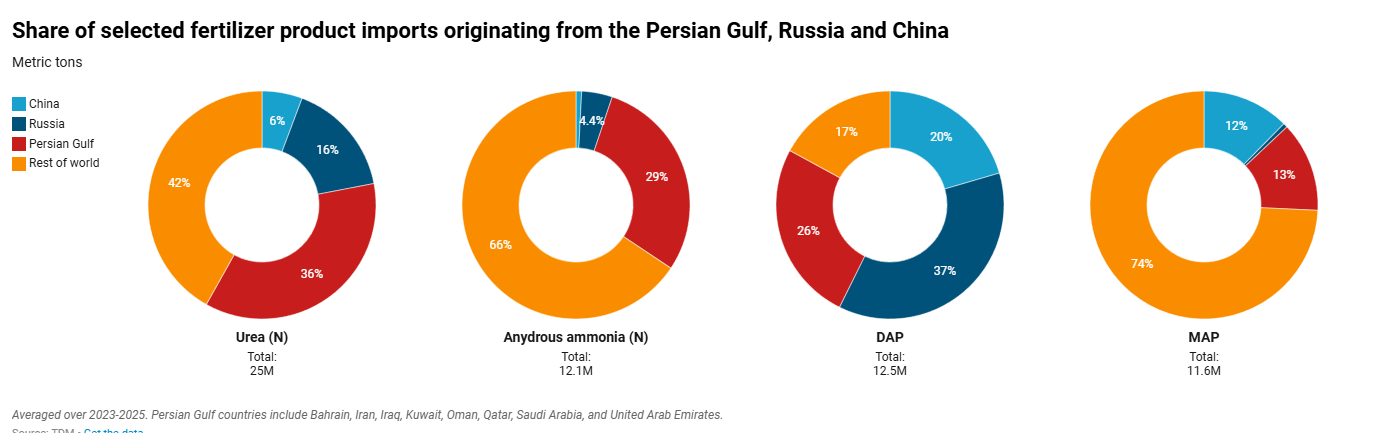
Gulf countries were the single biggest regional exporter of urea and ammonia, both nitrogen-based products, and the second largest regional exporter of diammonium phosphate (DAP) and monoammonium phosphate (MAP) fertilisers between 2023 and 2025. Qatar supplies around 10% of globally traded natural gas, with LNG exports vital for fertiliser production in India, Pakistan, Bangladesh and Turkey.
The Gulf region accounted for 36% of global urea exports from 2023 to 2025, with Iran and Qatar the largest exporters, followed by Saudi Arabia. Iran itself is a major urea producer, with the International Fertiliser Association (IFA) estimating Tehran as the largest urea exporter in the Gulf region despite minimal official export data.
On phosphate, the Gulf region accounts for 26% of DAP and 13% of MAP global exports, with Saudi Arabia the largest producer and exporter. The region also provides close to 50% of globally traded sulphur, a byproduct of oil and gas refining that is critical for phosphate fertiliser production.
European fertiliser producers have requested government support amid steep rises in natural gas prices. US President Donald Trump has issued a 60-day suspension of the Jones Act for fertiliser transportation, offered support for cargo and hull insurance and lifted sanctions on three Belarusian potash producers. The US also suspended sanctions on Russian oil to stem conflict-related price increases.
India has sufficient fertiliser inventory for the Kharif rainy season starting in June, according to the Fertiliser Association of India. The organisation has called on the government to factor raw material price spikes into producer subsidy rates and prioritise fertiliser in natural gas allocation.
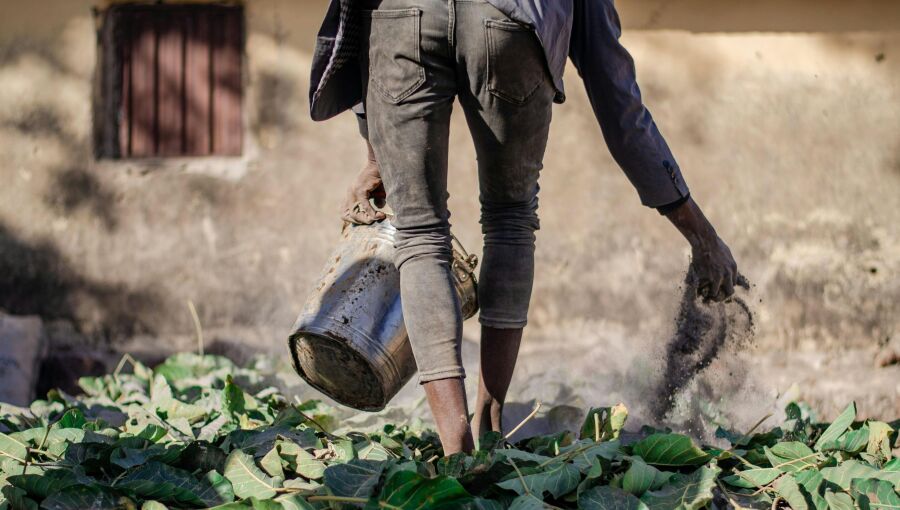
African countries are particularly vulnerable, IFPRI warned, given the region's heavy dependence on imports. Fertiliser use in Africa fell 25% in 2022 following the Russian invasion of Ukraine. Low-income countries may find it harder to finance subsidies, given existing fiscal constraints and declining overseas development assistance.
The International Rice Research Institute has warned that if Strait of Hormuz shipping disruptions continue, energy and fertiliser channels could become more consequential short and medium-term risks than initial logistic shocks for Asia's next crop cycle.
Global average yields did not decline following the 2022 fertiliser price spikes, IFPRI noted, as some nutrients remain in soils for multiple years and farmers can shift towards less fertiliser-intensive crops.
A sustained crisis could also increase the use of coal to maintain energy supplies and produce fertiliser, worsening climate change. Chinese fertiliser production already relies on coal for 70% to 80% of ammonia production.
The IFA November 2025 outlook suggested 2026 nitrogen capacity would increase 4% over 2024, with phosphate and potash capacity up 5% each.
"Stabilising fertiliser markets will depend on reducing hostilities and ending the Iran war," IFPRI said.
Paramount’s Purchase of CNN Heralds a New Trump-Friendly Media Empire
The Hollywood Reporter (2/27/26) reported Paramount‘s disclosure that funding for its WBD takeover “may include other strategic and financial partners” who go unnamed. The Reporter noted that “previous bids included funding from Middle East sovereign wealth funds, Tencent and Jared Kushner’s Affinity Partners.”
The ultra-wealthy have long leveraged their capital to build sprawling media empires that narrow our public range of debate (FAIR.org, 6/1/87). But Paramount Skydance‘s winning bid to acquire Warner Bros. Discovery (WBD) marks a major milestone in media monopolization that, if successful, will further expand Trump-allied tech moguls Larry and David Ellison’s burgeoning power over US news and entertainment media.
Even before a winner was announced, the bidding war among Paramount, Netflix and Comcast to take over WBD had attracted intense scrutiny, as the acquisition would not only confer lucrative franchises and a huge advantage in the streaming wars, but also control of major media outlets, including CNN, consolidating a greater swath of the media ecosystem under a single owner.
The fallout of the deal was destined to enhance the power of an already-sizable media behemoth, no matter which corporate giant won. On February 27, 2026, after a series of hostile takeover bids by Paramount that disrupted what seemed to be a done deal between Netflix and WBD, Netflix abruptly pulled out of the struggle for ownership, stating that it would not be matching Paramount’s higher offer.
The current Paramount offer is valued at $31 per share and, including WBD’s debt load, amounts to a grand total of roughly $111 billion.
Father-and-son moguls
Alex Shephard (New Republic, 10/27/25): “The administration will use its antitrust power to ensure that it gets the owner of Warner Bros. that it wants: the Ellison family.”
Steering this deal, and Paramount’s rapid expansion, are Larry and David Ellison, father-and-son moguls who, in just a single year, have parlayed their tech fortune into a colossal media empire. Larry Ellison, billionaire co-founder of Oracle, has bankrolled Paramount’s ballooning growth, which is overseen by his son David. The pair are notoriously close to Donald Trump, and have already weaponized their newfound media control to shift public discourse to the right (FAIR.org, 9/9/25, 9/19/25, 10/9/25, 11/6/25).
In August 2025, the Ellisons’ Skydance Media acquired Paramount, owner of CBS, and spearheaded a blatant ideological overhaul of the news network (FAIR.org, 7/24/25). This MAGA-friendly transformation has been aided by Ellison-appointed editor-in-chief Bari Weiss, who had previously made a name for herself as an “anti-woke” crusader and founder of the right-wing media company Free Press. Weiss has been at the forefront of such decisions as canceling the Late Show With Stephen Colbert, pulling a 60 Minutes episode that criticized the Trump administration’s mistreatment of Venezuelan migrants, and promoting Tony Dokoupil to primetime anchor, where he promptly gave War Secretary Pete Hegseth an extended and uncritical platform.
Less than six months after the closure of the Paramount deal, in January 2026, Larry Ellison finalized a deal with TikTok, which sold 80% of its US operations to an investor consortium that includes Oracle, and left Ellison with a majority stake in TikTok’s US operations.
Since then, a number of changes have been implemented that reek of censorship and surveillance. For one, TikTok immediately altered its privacy policy to permit more extensive data collection, including tracking user location.
There have also been accusations of content suppression. This became a prominent conversation after the murder of Alex Pretti, as many users reported that they were unable to upload anti-ICE posts and that, if uploaded, their content was receiving unusually low engagement. Researchers found there was a site-wide outage at the time, but they pointed out that because TikTok isn’t transparent with its data or its algorithm, there’s no way to confirm it’s not shadowbanning content (NPR, 2/4/26)
Now, on the precipice of acquiring WBD, with a targeted completion date of September 30, 2026, the Ellisons are slated to have massively expanded their entertainment, media and tech empire in barely over a year. If the deal moves forward, the family would gain control of a vast portfolio spanning legacy media and Big Tech—including film, news, television, sports and social media—granting them substantial influence over how the world is seen and understood.
Shuffling the media oligarchy
In FAIR’s recent online news ownership study (2/3/26), WBD took the third spot and Paramount/Skydance the 16th. By taking over WBD, the Ellisons would vault into third, just behind Rupert Murdoch’s dynasty.
What does this look like in terms of numbers? According to Pew, 37% of adults in the US use TikTok. Pew notes that “just over half of US adults who use TikTok (55%) say they regularly get news there. That works out to 20% of all US adults,” or about 54 million people. Given TikTok’s expanding reach as a news source, the Ellisons’ ownership of the platform is especially significant.
When factoring in CBS and the additional audience that would accompany an acquisition of CNN, the scope of Ellison-owned media widens even more. As FAIR noted in a recent study (2/3/26), the digital reach alone of these networks is considerable—from December 2024 to November 2025, CBS and CNN attracted 905 million and 4 billion views, respectively. If we use these numbers to project a future in which the Ellisons control CNN, their annual online news view count would be around 5 billion.
The actual broadcast and cable TV viewership of CBS and CNN adds relatively little to the Ellisons’ reach: In a recent week in March, CNNaveraged 751,000 total primetime viewers, while the CBS Evening News typically had an audience of 4.3 million in the first quarter of 2026.
While the Ellisons’ rapidly consolidating media dynasty is not unprecedented, these developments have reconfigured the media oligarchy, partially displacing established players and amassing holdings that extend beyond traditional cable and print news into digital and technology media.
Revisiting FAIR’s ranking of digital media owners by site traffic, an Ellison acquisition of WBD would catapult them to the No. 3 spot, driven by CNN’s more than 4 billion annual visits, placing them just behind the No. 1 Ochs-Sulzberger family of the New York Times and the No. 2 Murdoch family.
However, unlike with the Ochs-Sulzbergers, the Ellison media empire would also translate to a strong broadcast and cable news presence, as CNN is regarded as one of the “Big Three” cable news channels, generally trailing only Fox News and Comcast’s MS NOW (formerly MSNBC).
And, although the Murdochs wield considerable power in cable, digital and print news, the Ellison portfolio expands into the social media realm as well. This is notable considering the ever-increasing number of Americans that rely on social media for news. According to Pew, 53% of US adults get news from social media “sometimes” or “often.” Facebook and YouTube are the most popular sites for news, while 20% get news “regularly” from Instagram and TikTok.
While the Ellisons do not lead in social media news ownership—that distinction belongs to Mark Zuckerberg of Meta (which owns Facebook and Instagram) and Larry Page and Sergey Brin of Google (which owns YouTube)—their media empire, like the Murdochs’, ranks prominently across multiple platforms.
Corrupted regulation
The Wall Street Journal (12/8/25) reported that “David Ellison offered assurances to Trump administration officials that if he bought Warner, he’d make sweeping changes to CNN…. Trump has told people close to him that he wants new ownership of CNN as well as changes to CNN programming.”
The Paramount/WBD deal has been unanimously approved by the boards of both companies. The next phase is a WBDshareholders vote, which is scheduled to take place on April 23, 2026, and is expected to move forward without complications.
Reuters (2/27/26) reports that approval in the EU is not anticipated to pose a significant hurdle, given that a combined Paramount/WBD entity would hold less than a 20% market share across European markets.
In the US, the merger would require clearance from both the Department of Justice (DoJ) and the Federal Communications Commission (FCC), which are both controlled by Trump appointees. The anti–public interest antics of FCC chair Brendan Carr are already well-documented by FAIR (2/26/25, 4/2/26; CounterSpin, 4/4/25), and newly appointed Attorney General Todd Blanche appears to have been promoted solely for his unwavering deference to Trump.
DoJ official Omeed Assefi, himself a Trump appointee, has insisted that the transaction would “absolutely not” be fast-tracked for political reasons. Yet this claim has been loudly contradicted by statements from Trump’s inner circle. For instance, Hegseth recently said, “The sooner David Ellison takes over that network [CNN], the better.”
A lawsuit filed against Paramount and assorted executives by a former consultant alleges that the elder Ellison was told by Trump, “Larry, it looks like Netflix is gonna get Warner Bros., but if you really really want it, Larry, I’ll make sure you get it” (Hollywood Reporter, 3/17/26).
Even if Trump has not explicitly vocalized his preference for an Ellison-owned CNN, it is clear that his personal preference effectively amounts to federal regulatory approval. Put simply, when it comes to antitrust matters, or virtually anything regulatory, pandering to Trump is a prerequisite.
And the Ellisons are not shy about pandering: In early December 2025, while the Netflix deal was still in play, David Ellison met with Trump and DoJ officials in Washington, DC, where he publicly pitched that, if Paramount acquired WBD, he would implement “sweeping changes” at CNN.
As Josh Marshall of Talking Points Memo (12/8/25) observed, shady backdoor dealing and political corruption form the scaffolding of the media oligarchy, a dynamic that reaches new extremes under the Trump regime:
Trump has refashioned antitrust oversight to be little more than a personal veto for the Trump family. Friends can do mergers; foes can’t. Indeed, the indifferent and uncommitted can’t either. You need to get right with the Trump family.
Hope from the states
David Dayen (American Prospect, 2/27/26): “A lifeline exists outside of Trump’s grasp to rethink this looming disaster…. But the state AGs are going to have to act fast.”
While it seems unlikely that federal officials with the power to intervene will do so, there is some cause for optimism at the state level. State governments, particularly state attorneys general, have both the authority and a track record of blocking mergers, even those approved by federal agencies.
Currently leading the charge is California Attorney General Rob Bonta, who, immediately following the news of a potential Paramount/WBD deal, posted on X (2/26/26) that his office would vigorously investigate the merger. California has taken center stage in this fight, due to the outsized impact that such a deal would have on the state’s television and film workforce.
Recent history underscores the validity of these concerns. Just last year, mass layoffs followed the Ellisons’ Skydance/Paramount merger, demonstrating the damage that monopolistic practices wreak on workers.
How effective this resistance will be against the sheer capital and political forces driving the Paramount/WBD deal remains uncertain. As David Dayen explains in the American Prospect (2/27/26), states are well aware of the path forward, and there is historical precedence for them to invoke the Clayton Act to challenge the merger. However, he emphasizes the need to act quickly, noting that states “are in a race against Paramount’s savvy consultants, who are trying to speedrun the deal in a matter of weeks.”
This article was originally published by FAIR; please consider supporting the original publication, and read the original version at the link above.Email
Caitlin Scialla is a freelance writer based in Brooklyn. She is currently interning with Fairness and Accuracy in Reporting (FAIR) and has previously worked with The Progressive magazine.