Showing posts sorted by date for query American Exceptionalism. Sort by relevance Show all posts

Sunday, November 08, 2026


Till Death Do Us Part: The Unholy Matrimony Between the US and Israel

by | Nov 6, 2026 | 

The standard narrative of American foreign policy has long rested on the pillar of moral exceptionalism: the assertion that the United States acts as a global guardian of human rights, international law and democratic governance.

However, Washington’s support for the ongoing holocaust in the occupied Gaza Strip, West Bank and unlawful war on Iran have exposed glaring contradictions at the heart of this narrative.  They reveal the true character of a political system defined not by its lofty noble declarations, but by its iniquitous decisions and actions.

These inequalities accentuate the true nature of U.S. geopolitics; essentially that human rights ideals are of little account to predatory imperial powers.

For over a century, the subjugation of Palestine and West Asia has been orchestrated through a legacy of colonial bigotry and pro-Zionist geopolitical engineering.  The region has been treated not as home to sovereign peoples but as an imperial chessboard ripe for exploitation.

The wars throughout the region, particularly on Palestine and Iran, are the culmination of imperial agendas set in motion a century ago.  The current geopolitical course began with the stroke of a pen set to the Balfour Declaration in 1917, in which a distant European empire casually bartered away a homeland that was not theirs to give.  This colonizing scheme reached its peak in the 1996 “A Clean Break: A New Strategy for Securing the Realm” document – a stratagem advanced by American neoconservatives and Zionist hardliners to reshape West Asia in Israel’s image.

Together these imperial blueprints established frameworks for domination that have led the region and global community to the precipice of disaster.

Underpinning these policies is a deeply-rooted colonial chauvinism that views the indigenous people of the region as obstacles to be displaced, managed or crushed, rather than human beings with inalienable rights to freedom, self-determination and dignity.

When examined across a century, the trajectory from Balfour to “Clean Break”  demonstrates a consistent structural logic. Whether foreign powers use imperial decrees, global mandates, diplomatic accords or military force, the goal is always the same: to secure and maintain control, fundamentally disregarding the rights of the native populations to govern themselves.

The bilateral partnership with Israel, originally formed to secure its existence, has now become a strategic liability.  The Israel that once proved useful to Washington as its regional enforcer, now seems to be in the catbird seat.

The eventual subordination of American foreign policy to Israeli strategic ambitions is not a historic accident, but the predictable outcome of a powerful deeply-entrenched military-industrial-security nexus that long ago equated regional dominance with U.S. national interests.

What began as a Cold War strategy to project American power across West Asia without a large-scale troop presence, has evolved into an institutionalized, self-perpetuating deadly alliance, in which the balance of control has become blurred.

Decades of deeply-entrenched military, intelligence and industrial ties with Tel Aviv have created an institutional inertia so powerful that Washington now reflexively accepts global criticism, regional anger and multi-trillion-dollar detours into foreign interventions as a matter of course – as a worthy price to pay for their “special relationship.”

Instead of exerting its strategic agency over a client state, the United States has become captive to Israeli dogmatism, which asserts that anything less than unconditional support signals U.S. weakness and vulnerability.  Consequently, this has fallen on American taxpayers to subsidize and service members to fight  military campaigns that compromise the nation’s interests and long-term stability.

Adding to this geopolitical trap is a domestic political echo chamber engineered to penalize flexibility and alternative strategies, while rewarding absolute conformity and compliance with Israeli objectives.

The alliance with Israel is so thoroughly embedded in the American body politic that it functions as a “third rail” of U.S. foreign policy and public discourse.  It remains above criticism through a combination of highly organized influential lobbying groups, massive political campaign financing schemes, a powerful evangelical voting bloc, and weaponization of the anti-Semitic label.

When paired with a deeply-ingrained pro-Israel media and cultural narrative that frames regional escalation as inevitable, rather than preventable, Washington’s political class most often chooses the safety of domestic capitulation over the discipline of sovereign statecraft, guaranteeing political submission to Israeli goading.

The result is a chronically unsettled America perpetually drawn into Israel’s expansionist wars.  This involvement is driven not by clear strategic necessity, but by a systemic inability in Washington to break free from domestic pressures and external mandates.

From the colonial promises of the Balfour Declaration to the “Clean Break” document, Israel has consistently prioritized expansionism over international law, formal agreements and even the strategic interests of its closest ally and main benefactor, the United States.

A core folly in Washington’s Israel/West Asian policy has been in treating a strategic burden as an indispensable ally.

Prioritizing the regional ambitions of a hegemonic foreign “ally” over core U.S. interests have entangled America in Israel’s reckless wars and conflicts.  Decades of blank-check diplomacy have inflamed anti-American sentiment, compromised its global credibility, strained vital alliances, and drained finite military and economic resources that would be better directed toward urgent domestic needs.

Paradoxically, the imperial strategies meant to safeguard Israel at the expense of West Asia are now taking a toll on America as well.  The United States will not, and cannot, recover its strategic autonomy and moral leadership unless it makes a clean break from its damaging relationship with Israel.

© 2026, M. Reza Behnam, Ph.D.

Dr. Behnam is a political scientist who specializes in comparative politics with a focus on West Asia. His “Cultural Foundations of Iranian Politics,” published by University of Utah Press, and still in print, was recognized by Choice as Outstanding Academic Book for 1987–1988. 

Saturday, November 07, 2026

Democrats, Please Take Note: Peace Is Good Politics

The message of voters is the same everywhere: diplomacy is safer, more effective, and trillions of dollars cheaper than war.


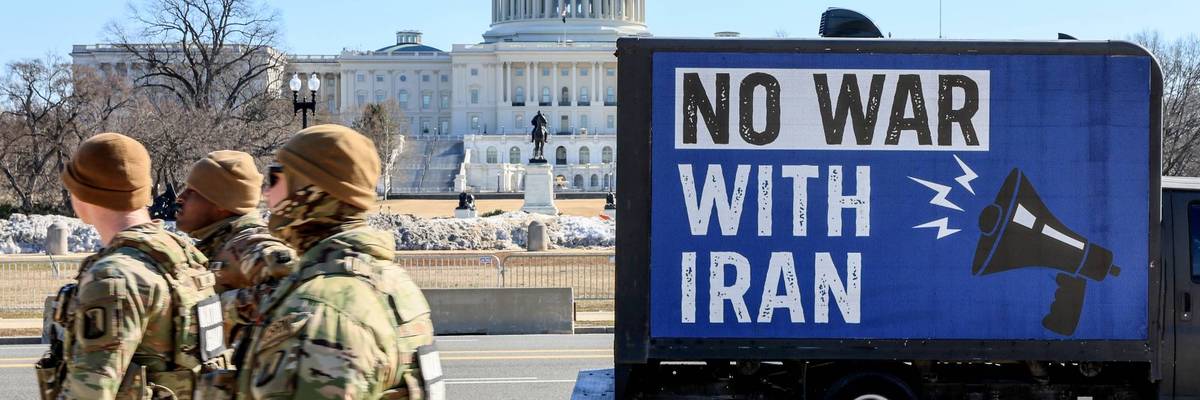
A group of National Guardsmen walk past the Win Without War Billboard Truck displaying the message “No War With Iran” in front of the U.S. Capitol on State Of The Union Day on February 24, 2026 in Washington, DC.
(Photo by Jemal Countess/Getty Images for Win Without War)

Jeffrey D. Sachs
Nov 05, 2026
Common Dreams

Voters across the United States were loud and clear on Tuesday in their historic drubbing of Trumpism. The election was a decisive rejection of Trump’s war on Iran and its staggering costs at home. While savoring their victory and the historic opportunity to restore America’s constitutional order, the Democrats should take the anti-war message of the election to heart, because they suffered the same verdict two years ago, when voters rejected the Biden administration’s wars in Ukraine and Gaza. Last week Israeli voters rejected Netanyahu’s reckless wars, and European voters are also rejecting parties that prolong the Ukraine War. The message of voters is the same everywhere: diplomacy is safer, more effective, and trillions of dollars cheaper than war.

On election night Trump conceded to Fox News, “I think a part of it was Iran.” The next day Vice President JD Vance was far blunter, posting on X: “The reason we lost is the war. The president himself said so last night.... everyone knows why we lost.” In the AP Voter Poll, about 60 percent of voters said the decision to use military force against Iran was wrong, and about 90 percent called the cost of living a crucial or major factor in their vote.

The war and the cost of living were of course utterly intertwined. Gasoline prices, around $2.80 per gallon before the war began on February 28, had risen by about 55 percent by mid-May and reached a monthly average of $4.43 in September. The 10-year Treasury yield climbed from below 4 percent before the war to above 5 percent in the autumn, and the Pentagon sought more than $200 billion in supplemental war funding. Every family with a mortgage, a car loan or a credit card balance suffered from the war.

Voters everywhere are sending the same message: peace through diplomacy.

The first duty of the new Congress is to restore its constitutional authority over war and its power of the purse to ensure that US forces are not sent back into combat in Iran or anywhere else on the whim of a president and the behest of domestic or foreign lobbies. Trump must of course refrain from restarting the war, which was never remotely necessary or justified. Remember that on February 28, the day the US and Israel launched the war, Oman’s foreign minister, who was mediating the U.S.-Iran talks, had said that a deal was within reach.

The Democrats should not imagine that the anti-war lesson applies only to Republicans. Kamala Harris lost in 2024 because voters held the Biden administration responsible for the costs of its own wars. The energy shock that followed the escalation of the Ukraine war in 2022 drove up inflation, and gasoline topped $5 per gallon for the first time in June 2022. Biden twice rejected negotiations that could have ended the conflict: in December 2021, when his administration refused to negotiate on NATO enlargement in response to Russia’s draft security treaty, and in April 2022, when the Istanbul talks were abandoned at the behest of the US and UK.

The Gaza genocide also cost the Democrats directly. Among Americans who voted for Joe Biden in 2020 but not for Harris in 2024, 29 percent named ending Israel’s violence in Gaza as the main factor in their decision, the most frequently cited issue. The party’s voters have moved far ahead of its leaders. A New York Times/Siena poll in May 2026 found that roughly three-quarters of Democratic voters oppose US military and economic assistance to Israel.

Voters everywhere are sending the same message: peace through diplomacy. On October 27, after Israeli wars in Gaza, Lebanon and Iran, Netanyahu lost his majority. Similarly, European leaders who have tied themselves to open-ended war in Ukraine are being rejected by the voters. Only 10 percent of Germans are satisfied with Chancellor Friedrich Merz, the lowest rating ever recorded for a German chancellor. Emmanuel Macron’s approval fell to 15 percent in October. In Bulgaria, Iliana Iotova, who favors dialogue with Moscow, won the presidency on November 1 with more than 58 percent of the vote.

A key upcoming key test for the Democrats will be Ukraine. They must stop their party’s typical Russia-bashing and instead support a diplomatic end to the war.

As a start, the Democrats should remember why the war started. In 1990 the United States assured Mikhail Gorbachev that NATO would not move “one inch eastward.” The Clinton administration broke that promise. In 2008 the Bush administration pushed through the Bucharest declaration that Ukraine and Georgia “will become members of NATO,” despite Ambassador William Burns’s warning that this was the brightest of all red lines for Russia. In 2014 the United States backed the coup against Ukraine’s elected president, Viktor Yanukovych, as the leaked Nuland-Pyatt call made clear. In April 2022, when negotiators in Istanbul came close to a peace agreement based on Ukrainian neutrality, the US and UK actually intervened to block the agreement. Today 75 percent of Ukrainians support negotiations with Russia to end the war.

The Democrats should not mistake their victory for a mandate to pursue their own wars.

In view of these causes of the war, I have recently set out a straightforward diplomatic framework for peace in Ukraine that would end the war. NATO would end its eastward expansion. Ukraine would adopt permanent neutrality on the model of Austria in 1955. An armistice line would be drawn, with both sides renouncing the use of force to change it. Ukraine would pursue membership in the European Union as a permanently neutral state. The Democrats should support such a diplomatic approach. It’s what can end the war, save Ukraine, and win the backing of both the Ukrainian and American people.

Most importantly, the Democrats should not mistake their victory for a mandate to pursue their own wars. The new Democratic majority should quickly reassert the constitutional authority of Congress over war and peace, champion a negotiated peace in Ukraine, end support for Israel’s wars, cut the military budget, and redirect the savings toward lowering the cost of living and repairing the public finances.

These positions are not only right but are good politics. For the Democrats to win the White House in 2028, they should become the party of peace. Better yet, both parties should become parties of peace and conduct the 2028 campaign on which party will best address America’s needs for decent jobs, affordability, healthcare, housing, a safe environment, and quality education.


Our work is licensed under Creative Commons (CC BY-NC-ND 3.0). Feel free to republish and share widely.


Jeffrey D. Sachs
Jeffrey D. Sachs is a University Professor and Director of the Center for Sustainable Development at Columbia University, where he directed The Earth Institute from 2002 until 2016. He is also President of the UN Sustainable Development Solutions Network and a commissioner of the UN Broadband Commission for Development. He has been advisor to three United Nations Secretaries-General, and currently serves as an SDG Advocate under Secretary-General Antonio Guterres. Sachs is the author, most recently, of "A New Foreign Policy: Beyond American Exceptionalism" (2020). Other books include: "Building the New American Economy: Smart, Fair, and Sustainable" (2017) and "The Age of Sustainable Development," (2015) with Ban Ki-moon.
Full Bio >


With 74% of Voters Saying Iran War Was Big Factor in Midterms, Dems Urged to Become Peace Party

“Will Democrats finally get it?” asked one progressive expert. “Americans are tired of war. They want a new foreign policy.


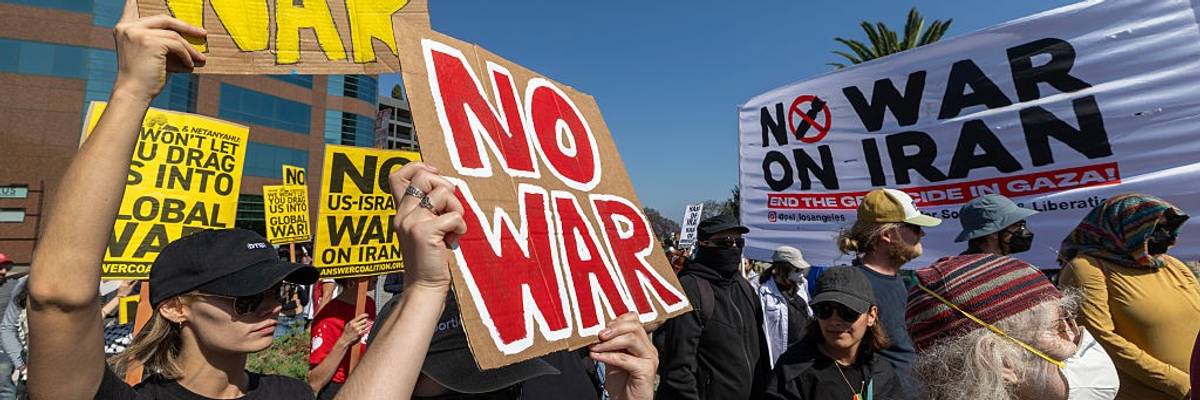
People oppose US war on Iran and support for Israel’s genocide in Gaza during a June 22, 2025 protest in Los Angeles.
(Photo by David McNew/Getty Images)

Brett Wilkins
Nov 04, 2026
COMMON DREAMS


Nearly three-quarters of Americans who voted in Tuesday’s midterm elections said that President Donald Trump’s illegal war of choice on Iran was a significant factor in their vote, a figure that opponents of US militarism said underscored the need for the Democrats to become a true anti-war party.

According to NBC News exit polling, 74% of voters called the ongoing US-Israeli war on Iran a “crucial” or “major” factor in their vote, with Democrats winning 63% of people who responded that way. Meanwhile, 63% of voters said the Trump administration made the wrong decision in taking military action against Iran, compared with 37% who said it was the right decision.

“There will be a lot of infighting and arguing over what happened and why that is,” Vice President JD Vance said Tuesday in a lengthy social media post. “One of the pollsters I really respect told me that our economic messaging wasn’t sharp enough down the stretch. I’m sure that’s true.”

“But the real reason we lost is obvious to almost everyone,” the vice president continued. “The reason we lost is the war. The president himself said so last night.”

Indeed, Trump acknowledged that the war harmed Republicans, telling Fox News, “I think a part of it was Iran,” but nevertheless defended the 35-week military campaign, insisting that “people understood the importance of what I’ve done with Iran.”

In an interview with The Wall Street Journal, Trump was similarly unapologetic, declaring: “I did the right thing. I would have done it again.”

Numerous observers contended that Tuesday’s results offered an opportunity for Democrats to do more than simply capitalize on Republican mistakes.

“Among other things, this is an absolute rebuke of the war in Iran. Democrats would be wise to heed that lesson and truly become the anti-war party,” said commentator Ben Rhodes—who, while serving as a senior national security adviser to then-President Barack Obama, supported US intervention in countries including Iraq, Libya, and Syria, as well as Obama’s wider drone war campaign.

Geopolitics scholar Van Jackson opined on social media that “if Democrats remain the party of the national security state, they will lose everything in 2028. If they become the anti-war party, they’ll consolidate this wave with the presidency.”

A Wednesday analysis on the libertarian site Reason by Matthew Petti argued that Democrats now have an opportunity to exercise Congress’ constitutional power over the war, including by withholding military funding.

Petti noted that Rep. Ro Khanna (D-Calif.) told Fox News last week, “The House and the Senate should stop the funding for any further actions in the Iran War,” just like “we did to stop the Vietnam War.”

However, Petti cautioned that Democratic electoral victories usually don’t lead to anti-war foreign policy.

“Party leadership that is willing to attack Republicans’ execution of the war may not share a principled anti-war commitment,” he wrote, recalling how Democrats who swept the 2006 midterms over public anger with the Iraq War but then struggled to use their control of both chambers of Congress to end it.

Sen. Chris Van Hollen (D-Md.) wants his party to cut off funding for Trump’s war and said Democrats can do so by demanding explicit restrictions on war spending as a condition of supporting the fiscal year 2027 government funding bill that expires next month.

“Right now, the continuing resolution goes through December 11,” Van Hollen told The Lever on Tuesday. “And my view is that Democrats should not advance spending to continue to fund this war.”

“The Vietnam War ended only when Congress defunded it,” he added. “This is an illegal war, and we need to make sure that taxpayer monies are not used to continue an illegal war.”

Institute for Middle East Understanding executive director Margaret DeReus pleaded on social media, “For the love of all that is good, Democrats, do not squander this.”

“The voters have given you a mandate. Use it. Be the party of working people. Be the anti-war party. Be the anti-corruption party,” she added. “We cannot go back to business as usual.”

Matt Duss, a former top aide to US Sen. Bernie Sanders (I-Vt.) who serves as executive vice president at the Center for International Policy, noted that “Trump ran and won as an anti-war candidate in 2024 because Democrats left that lane wide open for him.”

“Voters have just brutally punished him and the GOP for breaking that promise. Will Democrats finally get it?” Duss added. “Americans are tired of war. They want a new foreign policy.”

Monday, November 02, 2026

On the Eve of the November US Elections

Saturday 31 October 2026, by Kay Mann


In the closing weeks and days of the November US “midterm election” campaigns, the likelihood that the Democratic party will win enough local elections to give them a majority in the House of Representatives and possibly the Senate, has significantly increased as the Republicans find themselves on the defensive in several formerly “safe” electoral districts including some which have not seen a Democratic victory in decades.

After several years of seeming to be politically invincible, Trump has become increasingly unpopular including even in MAGA circles and is widely seen as a handicap for Republican candidates. Losing control over one or both houses of congress would represent a blow to Trump’s domestic and international agenda. A defeat for congressional Republicans will also be a sharp rebuke to Trump himself who has stepped up his efforts to use state power to prevent Democratic party victories through lies about election fraud and non-citizen immigrants voting, attempts to use the courts to limit voting in Democratic areas, and dark threats to send armed ICE agents and even the military to polling stations.

The elections are referred to as “midterm” in reference to the academic calendar and take place at the halfway point of the four-year presidential mandate for many, but not all offices at the federal and state levels as well as elections for state governors. Trump has had a Republican majority in both house of congress which has acted as a rubber stamp for his imperialist adventures and assault on democratic rights, political institutions, vulnerable communities, and the environment. But Trump has pursued his reactionary agenda largely through executive orders that have often overstepped congressional authority. Trump will very likely continue to try to sidestep congress, particularly if the Democrats become the majority party in both houses. The Supreme Court with its conservative majority has largely also acted as a rubberstamp for Trump but has nonetheless shown an independent streak in several important rulings such as on the question of birthright citizenship and on his attempts to intervene in the voting process.

Invincible No More

Trump’s slumping political fortunes are largely the predictable result of his own policies, particularly the high cost of living exacerbated by his tariff policies and the Iran war. His Republican allies have mostly sought to distance them from him. His insistence on weak candidates for Senate in South Carolina and Texas where Republicans have held those seats for decades, will likely be seen as major political gaffes in the event that Democrats prevail in those elections which could mean that the Republicans would lose their Senate majority. The billionaires behind Trump have been exasperated by the tariffs which have mostly harmed them, and some sectors such as agriculture and meatpacking, areas with large, mostly Mexican immigrant labor have come to resent the scope of Trump’s anti-immigrant campaign. Latinos, a population of which over 40% has voted Republican in recent national elections have recoiled at the violence and cruelty of the ICE terror campaign against immigrant Latino communities.

The anticipated victory of enough Democratics to take over the House of Representatives and possibly the Senate has nothing to do with the Democrats offering any progressive alternative to Trump’s policy. During Trump’s worst outrages from the deployment of violent ICE brigades in US cities and the deportations, to the kidnapping of Venezuelan President Nicolas Maduro and his wife Cilia Flores and the looting of the Venezuela’s oil wealth, to the attack on trans people, to the war on Iran, no oppositional voices have been milder that those of the congressional Democratic party congressional leaders, Chuck Shumer, leader of the Democratic party delegation in the Senate, and Hakeem Jeffries, Democratic leader of the Democratic delegation in the House of Representatives. It was the Democratic party’s slide to right and its embrace of neo-liberal economic and social policies that help make Trump’s first victory in 2016 over Hillary Clinton possible. If the Democrats take the majority in the House of Representatives and much more so if they win the Senate majority and thus control both house of congress, they will be under immense pressure to undo Trump’s policy faster and more thoroughgoing than they would like.

The Big Tent

There is also a discussion within the Democratic Party and DSA on the relation between the two. Bernie Sanders favors a big tent party with a range of political and ideological currents which would include DSA. The reformist and electoralist currents in DSA are very interested in having a seat at the table. DSA-endorsed Francesca Hong, a Wisconsin state representative who ran and narrowly lost, in the Democratic Party primary for governor spoke in favor of a big tent Democratic party during a televised debate. Hong is now campaigning for David Crowley, who narrowly beat her in the gubernatorial Democratic primary with support from the Democratic party establishment. The conservative big money wing of the Democratic party is largely against giving the democratic socialists a place in the party although some enlightened centrists could very well see advantages in integrating an energetic electoralist oriented left wing which it could control better within the party than without. As gangsters in the Francis Ford Coppola film The Godfather reasoned, one should “keep your friends close, and your enemies even closer.” In any event, if all DSA-endorsed candidates for the House of Representatives win their elections, they would have a delegation of seven (there are currently 214 Democrats to 218 Republicans), far too small to have much influence on party policy.

DSA at a Crossroads

Since its rapid growth beginning with Bernie Sanders’ campaign for the Democratic Party presidential nomination in 2016, DSA has not endorsed a candidate for President. Currently however, the more pro-Democratic party reformist wing in the DSA leadership seems to favor DSA endorsing a candidate for the 2028 presidential elections and it would be in the Democratic party, very possibly Alexandria Ocasio-Cortez. Many on the revolutionary socialist left today also support the strategy of using the Democratic party ticket - the so-called “dirty break” with the Democratic party - as opposed to those who support a “clean break” with the Democrats in favor of independent political action. Revolutionary socialists who favor using the Democratic party ballot line see it as a short-term tactic on the road to building a left alternative or Labor party at some point in the future. But as Kim Moody recently put it, this “tactic becomes strategy.” Indeed, there are clearly widespread illusions among the largely inexperienced DSA membership about the possibility of transforming the capitalist-run Democratic party into a pro-working class, anti-capitalist party. For many DSA members, running in Democratic Party primaries is a strategy.

The Mamdani Experience

Zohran Mamdani’s victory for Mayor of New York city and the good possibilities that DSA endorsed candidates for mayor in Washington DC and Los Angeles could win in November, have put wind in the sails of the strategy of using the Democratic party ballot line to win primaries and then general elections. But a closer look at Mamdani’s experience in office reveals the contradictions and limitations of socialists running as Democratics with Democratic political and material resources.

The victory of Zohran Mamdani in the New York Democratic mayoral primary election which all but assured his victory in the general election has had a big impact on debates on the left and in DSA. In the primary Mamdani faced Andrew Cuomo, the former governor of New York state who was accused by several women of sexual harassment, which made Mamdani’s primary victory possible which in turn all but assured his victory in the general election given the strength of the Democrats and weakness of the Republicans in New York city politics. Mamdani appealed directly to working class New Yorkers with a program of rent control, free public transportation, and affordable childcare. Winning the Democratic Party primary gave Mamdani access to considerable political and material resources including the endorsement of centrist Democrat Governor of New York, Kathy Hochul.

But of course, this support came with strings attached. Hochul made it clear that Mamdani’s proposal to levy a billionaire’s tax on the great fortunes to pay for his programs was off the table. He has also felt politically constrained to retain the former police chief Jessica Tisch, a billionaire in her position even after NYC police aided ICE agents who recently killed a person during a violent operation. To these political constraints preventing Mamdani from acting consistently on behalf of working-class New Yorkers are added institutional constraints facing any mayor. Budgetary restraints prevented Mamdani from supporting the just demand of New York city’s paraprofessionals for a one-time ten-thousand-dollar bonus.

Independent Political Action

The Mamdani experience and the debates on the left regarding the use of the Democratic party ballot line is the most recent incarnation of the debate around the question of independent political action. The absence of a mass political party with some sort of institutional connection to the labor movement is a key aspect of American exceptionalism and an important barrier to the independent mobilization of the working class outside of the two main capitalist parties. Revolutionary socialists in the US have long considered the independent pollical organization of the working class and its allies as a fundamental and necessary step to bring the working class out of its atomization and political subordination to the capitalist parties, towards anticapitalist class consciousness, action, and organization. The DSA today has the opportunity to help solve the question of independent working-class political action by educating its members and political audience on the class nature of the Democratic party and agitating on the need for a mass independent socialist or labor party.

However, reformist currents in the DSA leadership particularly the Groundwork and Socialist Majority caucuses have come out in favor of DSA endorsing a candidate for the 2028 presidential election, beginning with endorsing a candidate in the Democratic party primaries. They have launched a campaign to “draft” Alexandria Ocasio-Cortez (AOC) as candidate in the Democratic party primaries. Some revolutionary socialists like the Bread and Roses caucus in DSA also support an AOC candidacy in the Democratic primaries.

Post-election Period

The post-election period will present a new political terrain. If the Democrats win control of both houses of congress, they will be under enormous pressure to undo the damage Trump has done. Such pressure would likely push the Schumer-Jeffries congressional Democratic party establishment to go further than it would like on issues such as US support to Israel, tax cuts, transgender rights on which they have already shown themselves as unreliable allies, environmental deregulation, releasing the Epstein files, and much of the mostly neo-liberal agenda that Trump and his Republican congressional majority have enacted. Their inevitable hesitancy on these issues will further expose their true nature to those on the left who still harbor illusions on the progressive nature of the Democratic party. The post-election period will also signal the opening of the campaigns for the 2028 presidential elections.

The coming period will also be a crossroads for DSA. Will it chart a course that will bring it and the energy of 135,000, mostly young members into the Democratic party where that energy will be dissipated? Or will it help create an independent political alternative for workers and the oppressed to fight Trump’s neo-fascist, imperialist, extractivist neo-liberal attacks and lay the groundwork for a mass labor party outside and in opposition to the two capitalist parties?

The post-election period will also hopefully signal the return of mass anti-Trump protests. With the exception of a recent massive “protect the vote” called by the pro-Democratic party, NGO-dominated No Kings! apparatus, the mass movement has been largely dormant during the last few months as social movement energy was diverted first to Democratic primary electoral activity, and over the last few months, to the general elections.

Milwaukee,
30 October 2026

Saturday, October 31, 2026

The Solution Staring Israel in the Face

What is needed from the opposition leaders? Nothing beyond decency. The government that ousts Netanyahu is the one that accepts the votes of Arab citizens.


Dozens of demonstrators gather in front of the residence of Gadi Eisenkot, leader of the Yashar Party, to demand the resignation of the right-wing government led by Prime Minister Benjamin Netanyahu and the establishment of an Arab-Jewish coalition government in the Herzliya district of Tel Aviv, Israel on October 29, 2026.
(Photo by Mostafa Alkharouf/Anadolu via Getty Images)

Jeffrey D. Sachs
Oct 30, 2026
Common Dreams

Benjamin Netanyahu, Itamar Ben-Gvir, and Bezalel Smotrich decisively lost Israel’s election on October 27. The governing coalition of Likud, the far right, and the ultra-Orthodox parties fell from 64 seats in 2022 to 53, eight short of a majority in the 120-seat Knesset. The other 67 seats went to parties that campaigned to replace the government: 48 to the Jewish-led opposition headed by Gadi Eisenkot, a former army chief of staff, and 19 to the two Arab parties. Turnout was 77.9 percent, the highest since 1999, and Arab citizens, who make up about one-fifth of Israel’s population, voted at an estimated rate of about 80 percent, up from 53 percent in 2022. The results make it clear: Israeli voters chose to end the Netanyahu government. The solution to Israel’s political crisis is in plain view. The only thing standing in the way of ousting the government is racism: the refusal of Israel’s Jewish opposition leaders to treat Arab citizens as part of the political community.

The racism is not hidden. On election night Netanyahu claimed a “decisive majority among the Zionist and Jewish public,” a formula that simply subtracts the votes of one citizen in five. His Likud party then viciously and absurdly declared that the election had been “stolen” by the Arab parties and demanded investigations by the police and the Shin Bet, Israel’s internal security service. The purpose, of course, is to brand Arab votes as illegitimate, so that no government resting on them can be accepted.

The tragedy is that the opposition leaders have adopted the same premise. Naftali Bennett, a former prime minister, has said that the Arab parties “are not Zionist, and therefore we will not rely on them.” Avigdor Liberman has ruled out any government that depends on Arab votes, even a temporary one. Eisenkot has said that Ra’am’s leader “won’t be part of my next government,” and that he does not “see any Arab or Haredi parties who accept” his conditions for partnership. These leaders do not object to anything the Arab parties would do in government. With good will, they could easily negotiate a governing arrangement.

The consequences of the racism are predictable. If the opposition leaders hold to their refusal, only two outcomes remain. Israel will go to another election, with the current murderous government remaining for many more months, or the opposition will join a unity government in which Netanyahu stays in power. Netanyahu has ruled out abandoning his far-right partners. Either way, the opposition leaders would hand Netanyahu and his murderous colleagues the victory that the voters denied him.

There are no real policy obstacles to cooperation. Ra’am, the United Arab List, has already served in an Israeli government. In 2021 it joined the coalition led by Bennett and Yair Lapid, the first independent Arab party ever to do so. The other Arab party, the Joint List, has said it would vote with an Eisenkot-led government to establish an official inquiry into the failures of October 7, which is the opposition’s own first priority. Israel’s voters appear to be ahead of their leaders. A Hebrew University survey on election night found that more than 61 percent of opposition voters want Eisenkot to form a government with Ra’am, while only 20 percent prefer new elections. Arab and Jewish opposition voters want the same thing, which is to oust Netanyahu, Ben-Gvir, and Smotrich.

A practical plan should follow directly from the arithmetic. First, when the new Knesset convenes, the 67 members opposed to the Netanyahu government should elect a new Speaker, giving the new majority control of the parliamentary agenda even before a government is formed. Second, Eisenkot should form a true coalition in which Ra’am sits as a full partner with ministerial posts, giving 56 seats, with the Joint List supporting the government from outside to reach 67.

The program of such a government would not be hard to negotiate, because the parties that would be in it already share most of it. The government would establish an official inquiry into the failures of October 7. It would adopt an emergency plan against the crime and violence that have devastated Arab towns, and it would invest in housing and services for Arab communities, including the unrecognized Bedouin villages of the Negev. It would restore the independence of the courts and the attorney general.

The government might last a year. Questions of borders and the Palestinian territories would not be settled by this government, but a non-racist coalition government now would move Israel toward a lasting peaceful solution, perhaps toward a binational democratic state or toward the two-state solution of the long-standing Arab Peace Initiative. In the meantime, and crucially, Netanyahu and the other war criminals would be ousted.

Israel’s leaders should also understand what is at stake beyond Israel’s borders. Israel’s racism and murderous campaign in Gaza and the occupied West Bank have profoundly alienated people all over the world. A Pew Research Center survey of 36 countries this spring found that a median of 67 percent of respondents view Israel unfavorably, including 60 percent of Americans. In Pew’s surveys this year, Israel was viewed more negatively than any other country it asked about. More Americans now sympathize with the Palestinians than with the Israelis. The alienation extends to Jews all over the world. If the politicians double down on their racism now, they will confirm the world’s harshest judgments of Israel.

What is needed from the opposition leaders? Nothing beyond decency. The government that ousts Netanyahu is the one that accepts the votes of Arab citizens. Israel’s president has asked the party leaders to come to his consultations with an open mind. The majority to remove Netanyahu exists, provided that the leaders drop their racism

Our work is licensed under Creative Commons (CC BY-NC-ND 3.0). Feel free to republish and share widely.


Jeffrey D. Sachs
Jeffrey D. Sachs is a University Professor and Director of the Center for Sustainable Development at Columbia University, where he directed The Earth Institute from 2002 until 2016. He is also President of the UN Sustainable Development Solutions Network and a commissioner of the UN Broadband Commission for Development. He has been advisor to three United Nations Secretaries-General, and currently serves as an SDG Advocate under Secretary-General Antonio Guterres. Sachs is the author, most recently, of "A New Foreign Policy: Beyond American Exceptionalism" (2020). Other books include: "Building the New American Economy: Smart, Fair, and Sustainable" (2017) and "The Age of Sustainable Development," (2015) with Ban Ki-moon.
Full Bio >

Saturday, October 24, 2026

A Framework for Peace in Ukraine

This proposed settlement – designed to help end a conflict that has cost hundreds of thousands of lives and carries a continuing risk of confrontation – addresses the causes of the war rather than only its symptoms.

by | Oct 22, 2026 | 

The war in Ukraine can be ended permanently on terms that protect Ukraine’s statehood, meet Russia’s security concerns, and lay the foundation for a durable European security order. As another round of negotiations gears up in Norway, I propose a settlement concluded as a single package, signed by Ukraine and Russia, adopted by a vote of the United Nations Security Council under Chapter VII of the Charter, and guaranteed jointly by the five permanent members of the Council together with other states that choose to join. The proposal rests on the principle of indivisible security set out in the Helsinki Final Act and the Charter of Paris.

The package would have four core commitments.

The first is Ukraine’s permanent neutrality, adopted in a constitutional law on the model of Austria’s law of 1955, which would return Ukraine to the founding choice of its Declaration of State Sovereignty of 1990. Ukraine would join no military alliance and host no foreign bases or forces, whether of NATO, the European Union, their member states, or Russia. Neutrality would not mean disarmament, and Ukraine would retain armed forces for its own defense.

The second is that Ukraine would pursue its candidacy for membership in the European Union as a permanently neutral state, with a neutrality protocol in its accession treaty on the model of Ireland’s, and Russia would affirm that Ukraine’s membership in the EU is consistent with Russia’s security.

The third is an armistice line drawn along the line of contact on the date of signature. Each side would exercise de facto jurisdiction on its side of the line, neither would recognize the other’s territorial claims, and both would renounce force in any future adjustment. This formula is compatible with both countries’ constitutions, which bar or severely restrict the cession of territory.

The fourth is the end of NATO enlargement eastward. At signature the North Atlantic Council would declare that NATO will not admit Ukraine or other new members in Eastern Europe or the South Caucasus, withdrawing the Bucharest pledge of 2008.

The settlement would take effect as a permanent end of hostilities on signature, not as a temporary ceasefire, and its provisions would be implemented in stages under international verification. No element would be negotiated in isolation, and no party would be asked to make a concession in advance of signature.

The territorial arrangements are designed to address the concerns and claims of both sides. Ukrainian forces would withdraw from the part of Donetsk region that Ukraine now controls, which would become a demilitarized special zone. Russian forces would not enter it, the existing local civil administration would continue to function, and its final status would be left to negotiation. Russia would withdraw from the areas it holds in Dnipropetrovsk region and from the Kinburn Spit. A Northern Security Zone would be demilitarized on both sides of the Russian-Ukrainian border, and Russian forces would leave the areas they hold in Kharkiv and Sumy regions as Ukrainian forces withdraw from their side. The Zaporizhzhia Nuclear Power Plant would remain under Russian control with IAEA safety oversight and would sell an agreed share of its electricity to Ukraine at cost.

A demilitarized belt would run along both sides of the armistice line, with heavy weapons and long-range strike systems withdrawn to agreed distances, and mutual ceilings on forces would apply in the border regions on both sides. In the Black Sea and the Sea of Azov, commercial navigation would be free for all Ukrainian and Russian ports, and attacks on shipping and ports would be prohibited.

The settlement in Ukraine should also begin the repair of European security as a whole. NATO and Russia would agree on a moratorium on ground-launched intermediate-range missiles in Europe, refrain from deploying nuclear weapons in any additional state, and restore the NATO-Russia Council. Normal diplomatic relations would be restored on both sides. The parties would convene the first summit of the Organization for Security and Co-operation in Europe since 2010 to entrust the OSCE with monitoring the settlement, verifying arms limits, and overseeing the provisions on rights.

Questions of language, education, culture, and religion would be resolved according to European standards, with the Russian language treated on the same basis as Ukraine’s other minority languages, and Russia would accept the same obligations toward Ukrainian speakers and religious communities on its side of the line. All obligations concerning extremism and incitement would be mutual and monitored by the OSCE. Prisoners of war would be exchanged on an all-for-all basis, detained civilians released, and separated children reunited with their families.

Sanctions would be lifted during 2027. Russia’s immobilized sovereign assets would also be released, and private property seized or immobilized on both sides would be restored. An international reconstruction fund administered by the European Investment Bank would finance reconstruction on both sides of the line, with contributions from all parties, Russia included, in a common effort rather than as reparations. Gas transit through Ukraine could resume wherever there are willing buyers, without any commitment by the European Union to purchase Russian gas.

A report of serious violation by an OSCE monitoring mission of unarmed observers from states outside NATO would trigger consultations among the guarantors and referral to the Security Council. Ukraine would lift martial law and hold elections under OSCE observation, and the newly elected Verkhovna Rada would ratify the settlement and adopt the constitutional law on neutrality, while the Russian Federal Assembly would ratify it at the same stage.

This proposed settlement addresses the causes of the war rather than only its symptoms. Europe has been largely absent from the design of the peace. By putting forward such a framework, European governments can take the lead in building Europe’s indivisible security and help end a war that has cost hundreds of thousands of lives and carries a continuing risk of confrontation between nuclear powers.

Reprinted from Common Dreams.

Jeffrey D. Sachs is a University Professor and Director of the Center for Sustainable Development at Columbia University, where he directed The Earth Institute from 2002 until 2016. He is also President of the UN Sustainable Development Solutions Network and a commissioner of the UN Broadband Commission for Development. He has been advisor to three United Nations Secretaries-General, and currently serves as an SDG Advocate under Secretary-General Antonio Guterres. Sachs is the author, most recently, of A New Foreign Policy: Beyond American Exceptionalism (2020). Other books include: Building the New American Economy: Smart, Fair, and Sustainable (2017), and The Age of Sustainable Development, (2015) with Ban Ki-moon.