Tuesday, February 15, 2022


AOC Tells Joe Biden: Cancel More Student Loans to Have 'Any Chance' in 2022

BY DARRAGH ROCHE ON 2/15/22 AT 10:41 AM EST

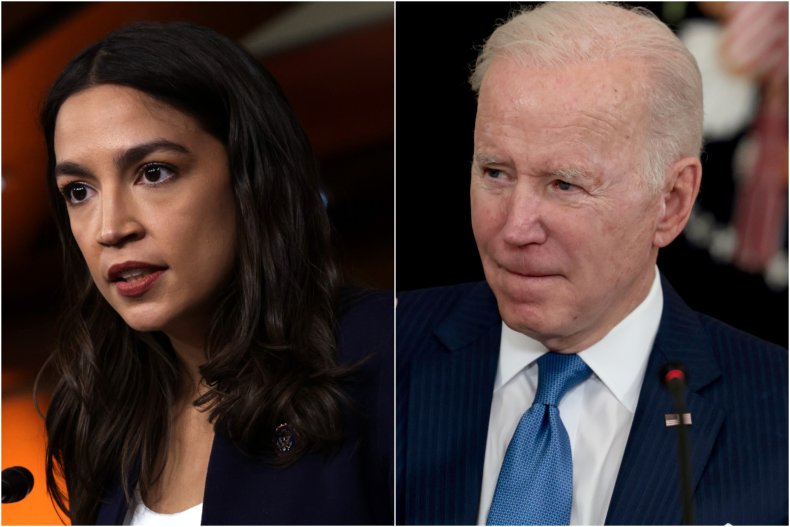
Representative Alexandria Ocasio-Cortez has warned that President Joe Biden should do more on student loan debt cancellation if the Democrats hope to have "any chance" in the 2022 midterm elections.

Ocasio-Cortez, a Democrat who represents New York's 14th congressional district, told The New Yorker in an interview published on Monday that the president's "hesitancy" on the issue was having a demoralizing effect on a key voting bloc.

Her comments come as the Democrats face crucial midterm elections in November with Republicans aiming to take back the House of Representatives and the Senate and then to potentially stymie Biden's agenda.

READ MORE Ocasio-Cortez Calls Working Atmosphere in Congress a 'Sh** Show'

Some Democrats, including Senate Majority Leader Chuck Schumer (D-NY) and Senator Elizabeth Warren (D-MA) have urged Biden to cancel up to $50,000 in student loan debt per borrower through executive action.

The president has expressed skepticism that he has the necessary power to do that, but Ocasio-Cortez reiterated that Biden should take action on the matter.

She suggested the Biden administration had "a reluctance to use executive power."

"The president has not been using his executive power to the extent that some would say is necessary," she said.

"One of the single most impactful things President Biden can do is pursue student-loan cancellation. It's entirely within his power," Ocasio-Cortez went on.

"This really isn't a conversation about providing relief to a small, niche group of people. It's very much a keystone action politically. I think it's a keystone action economically as well," she said.

Ocasio-Cortez suggested that Biden's apparent reluctance to act on canceling student debt through executive action could have an impact on the midterms.

"And I can't underscore how much the hesitancy of the Biden administration to pursue student-loan cancellation has demoralized a very critical voting block that the president, the House, and the Senate need in order to have any chance at preserving any of our majority," she said.

Millennials (those aged 25 to 40) and Generation Z (which includes children as well as adults aged 18 to 24) are a growing demographic group and many hold student loan debt. Polls have also shown these groups generally favor student debt cancellation.

Ocasio-Cortez, who is a member of the progressive "Squad," said she didn't believe there was "any guarantee" that Senators Joe Manchin (D-WV) and Kyrsten Sinema (D-AZ) would approve legislation "that will significantly and materially improve the lives of working people," admitting that was a "dismal assessment."

"The president has a responsibility to look at the tools that he has," she said.

Action on Student Debt


The Biden administration has touted the fact that it has discharged around $15 billion in student debt to more than 675,000 borrowers.

A spokesperson for the Department of Education told Newsweek on February 5: "While we continue to deliver immediate relief for borrowers struggling with debt we are also making permanent changes that reduce indebtedness and make college more affordable."

Nonetheless, Biden has been under pressure to do more. In April, he asked the Department of Education to prepare a memo on his ability to cancel up to $50,000 of student debt per borrower by executive action.

However, that memo has never been released in unredacted form, despite more than 80 lawmakers demanding its release in January, 2022.

Recent polls have shown Republicans leading Democrats ahead of the midterm elections, which may make Ocasio-Cortez's warning more concerning. If the GOP retakes control of either chamber of Congress, they could block President Biden's agenda for the two years leading into the 2024 presidential election.

Newsweek has asked the White House and Rep. Ocasio-Cortez's office for comment.

A judge just handed Trump a major loss in the DC attorney general's lawsuit over inauguration funds as the case heads to trial
President Donald Trump and first lady Melania Trump walk on the South Lawn of the White House in Washington, Saturday, Dec. 5, 2020, before boarding Marine One for a short trip to Andrews Air Force Base, Md. Trump is en route to Georgia for a rally for U.S. Senate candidates David Perdue and Kelly Loeffler. 
AP Photo/Patrick Semansky

A judge reinstated the Trump Organization as a defendant in a lawsuit over the potential misuse of inauguration funds.

The DC Attorney General alleges the organization wrongly took nonprofit funds from Trump's 2017 inauguration.

A judge ruled the AG brought enough evidence to keep the company as a defendant.

A Washington, DC judge reinstated the Trump Organization as a defendant in a lawsuit brought by the district's attorney general over whether former President Donald Trump misused funds for his 2017 inauguration — reversing an earlier decision and handing a major loss to Trump as the case heads to trial.


DC Attorney General Karl A. Racine filed the civil lawsuit in January 2020. He accused the Trump Organization, the Trump International Hotel in DC, and Trump's 2017 presidential inaugural committee, which is a tax-exempt nonprofit, of using tax-free funds to improperly pay the Trump Organization and members of the Trump family.

In November, DC Superior Court Judge José M. López cleaved the Trump Organization off the case, ruling that Racine's office didn't bring enough evidence to establish the company may have broken the law.

Racine filed a motion for reconsideration later that month. On December 31, the case was transferred to a different judge, Yvonne Williams, who ruled Wednesday night that the Trump Organization should remain in the case after all.

She pointed out in her ruling that Gentry Beach, a man who the attorney general's office says was acting on behalf of the Trump Organization, appeared to conflate the company and the inaugural committee when booking a block of hotel rooms.

"The contract involved a large block of rooms booked for people affiliated with the Trump Organization at the Loews Madison Hotel during the week of the 2017 Inauguration," Williams wrote. "Mr. Beach signed the contract on behalf of the Trump Organization and listed Lindsay Santoro, Mr. Donald Trump Jr.'s personal assistant, as the point of contact for the rooms."

Lawyers for the Trump Organization argued that the attorney general's office failed to collect any testimony from Beach. But Williams wrote that López erroneously ruled in their favor without first considering whether Racine should be able to issue a subpoena to depose Beach.

Racine celebrated the new ruling Wednesday night.


"Big news: The judge added the Trump Org in NY back into our lawsuit against the Presidential Inaugural Committee," he wrote on Twitter. "Our lawsuit is moving forward fully intact & full steam ahead. We sued the inaugural committee for misusing funds to enrich the Trump family. Now we're going to trial."

The case is now headed to trial. Stephanie Winston Wolkoff, former First Lady Melania Trump's former close friend, said Monday night that she would be "the lead witness" in the case.

Wolkoff joined the inauguration committee to help plan it before joining Melania Trump's office in the White House. She left in 2018 following reports that she misused inauguration funds herself, and later published a tell-all book in 2020 that burned bridges with the former first lady.

Williams wrote in her new ruling that she would hold a conference on Thursday to address discovery motions, at which point she may set a trial date.


Wife Of Noted Russian Rights Activist Dadin Faces Deportation To Her Native Ukraine

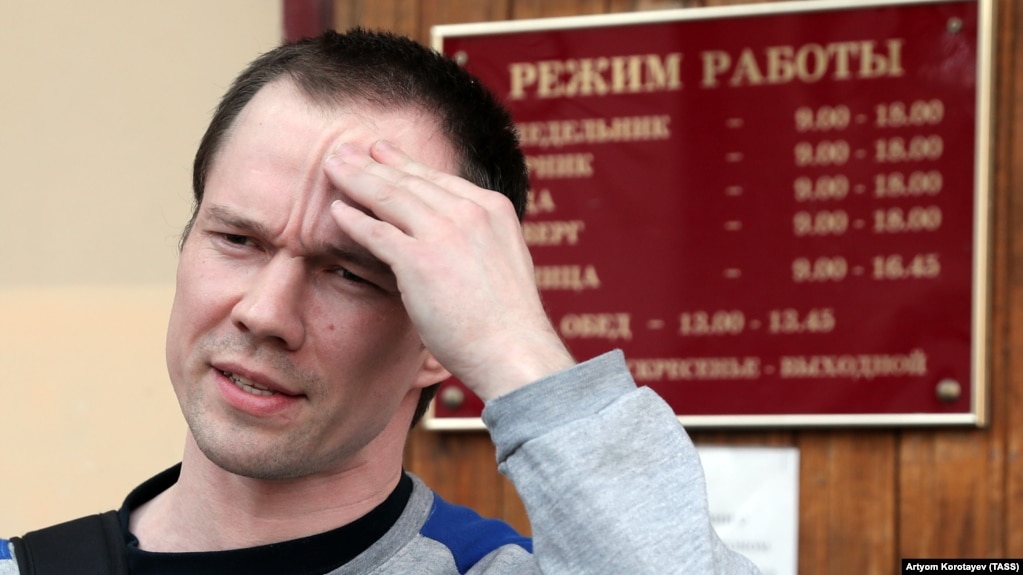
Russian opposition activist Ildar Dadin (file photo)

MOSCOW -- Russian authorities have cancelled the residence permit of Ukrainian citizen Oleksandra Sveshnikova, who is the wife of the well-known Russian rights activist Ildar Dadin.

Sveshnikova’s lawyer Nikolai Zboroshenko said on February 14 that the Interior Ministry's move will be appealed, adding that the Russian authorities’ main goal is to force Dadin and his wife from the country.

Dadin made headlines more than six years ago after he became the first Russian citizen to be convicted under a controversial law that criminalizes participating in more than one unsanctioned protest within a 180-day period.

He served more than a year in prison after he was convicted under the statute in December 2015.

The legislation then became known in the country as Dadin's law.

Russian human rights group recognized him as a political prisoner at the time.

Dadin has said that while serving his term he and other inmates were tortured and abused at a prison in Russia's northwestern region of Karelia.

Man charged after allegedly stealing dinosaur claw from Arizona gem show

By Caroline Kucera and Amanda Musa, CNN
Mon February 14, 2022

A dinosaur claw valued at $25,000 was stolen at a gem show in Tucson, Arizona, police said.

(CNN)A man is facing charges after allegedly stealing a dinosaur claw valued at $25,000 from a vendor at a gem show in Arizona, police said.

Christopher Thomas, 39, is accused of swiping the claw from the showroom of vendor Eric Miller, who was in Tucson selling fossils at the show on January 30, the Tucson Police Department said.

Thomas then tried to sell the claw to another vendor in the area on February 8, police said. The vendor recognized the claw and alerted Miller, police said, noting the vendors have a "tight-knit community."

Thomas was detained and charged with trafficking in stolen property, Tucson police said. CNN reached out to Thomas for comment.

The dinosaur claw was returned to Miller.

"This highlights the importance of vendors/neighbors communicating & working together," Tucson police said in an email to CNN.
Oceans are better at storing carbon than trees. In a warmer future, ocean carbon sinks could help stabilise our planet

The Conversation
February 14, 2022

Ocean Wave AFP

We think of trees and soil as carbon sinks, but the world’s oceans hold far larger carbon stocks and are more effective at storing carbon permanently.

In new research published today, we investigate the long-term rate of permanent carbon removal by seashells of plankton in the ocean near New Zealand.

We show that seashells have drawn down about the same amount of carbon as regional emissions of carbon dioxide, and this process was even higher during ancient periods of climate warming.

Humans are taking carbon out of the ground by burning fossil fuels deposited millions of years ago and putting it into the atmosphere as carbon dioxide. The current rate of new fossil fuel formation is very low. Instead, the main geological (long-term) mechanism of carbon storage today is the formation of seashells that become preserved as sediment on the ocean floor.

The continent of Zealandia is mostly submerged beneath the southwest Pacific Ocean but includes the islands of New Zealand and New Caledonia.


The continent of Zealandia is about twice the size of India, but most of it lies more than 1000m deep in the southwest Pacific Ocean. MU PERHAPS
Author provided, CC BY-ND

Carbon dioxide emissions from burning fossil fuels on the continent add up to about 45 million tonnes per year, which is 0.12% of the global total.

Our work documents a project that was part of the International Ocean Discovery Program (IODP). Expedition 371 drilled into the seabed of Zealandia to investigate how the continent formed and to analyse ancient environmental changes recorded in its sediments.

Drawing carbon to the ocean floor

Organic carbon in the form of dead plants, algae and animals is mostly eaten by other creatures, mainly bacteria, in both the ocean and in forest soils. Most organisms in the ocean are so small (less than 1mm in size) they remain invisible, but as they die and sink, they transport carbon to the deep ocean. Their shells can accumulate on the seabed to make vast deposits of chalk and limestone.

The sediments we cored were many hundreds of metres thick and formed during warmer climates that might resemble the decades and centuries to come. We know the past environments from analysis of fossils.

Seashells, which are made of calcium carbonate, sequester significant amounts of carbon. The accumulation rate of shells averaged over the last million years was about 20 tonnes per square kilometre per year.


Researchers Xiaoli Zhou (US) and Yu-Hyeon Park (Republic of Korea) take samples of water from sediment cores during IODP Expedition 371.
Laia Alegret, IODP, CC BY-ND


The total area of the Zealandia continent is about 6 million square kilometres, so the average rate of calcium carbonate storage was about 120 million tonnes per year, which is equivalent to 53 million tonnes of carbon dioxide per year.

This is about the same as emissions from burning fossil fuels on the continent today, within errors of calculation. However, a much larger area than just Zealandia is accumulating microscopic seashells.


This map shows global ocean surface currents and regions of seabed (shaded) where calcium carbonate shells are accumulating.
Rupert Sutherland, CC BY-ND

The planetary carbon cycle

Earth naturally expels carbon dioxide from mineral springs and volcanoes, as rocks are cooked at depth. This is unlikely to be affected by climate change. The Earth stores carbon dioxide when rocks are altered at the surface and as seashells accumulate on the seabed. Both these mechanisms might be affected by climate change.

The biosphere and oceans also hold significant carbon stocks that are sure to change. It is a complex system and many scientists are trying to understand how it will respond to human activities.

Different parts of the carbon system will respond in different ways and at different rates. Our work provides clues as to what might happen in the ocean.


This cartoon illustrates how carbon moves through the Earth system.
Rupert Sutherland, CC BY-ND

About 4-8 million years ago, the climate was warmer, carbon dioxide levels were similar or even higher than today, and the ocean was more acidic. However, we found the average accumulation rate of seashells on Zealandia was more than double that of the most recent million years.

This is a pattern seen elsewhere around the world. Warmer climates during this period had oceans that produced more seashells, but these data are average accumulation rates over million-year time scales.

The mechanism by which these ancient warmer oceans produced more seashells remains a subject of ongoing research (including ours).

Rivers and the wind deliver nutrients to the ocean, especially during extreme weather events, and changes can occur over short time scales. At the other extreme, fully integrated climate models show that large-scale reorganisation of ocean currents to enhance the supply of nutrients from deep waters could take centuries or even millennia.

Our work highlights and quantifies the important role the ocean, and particularly the microscopic life within it, will eventually play in restoring balance to our planet. The rate at which dead plankton draw carbon to the deep ocean and small seashells permanently store it on the seabed is a significant proportion of human carbon dioxide emissions and it is likely to increase in the future.


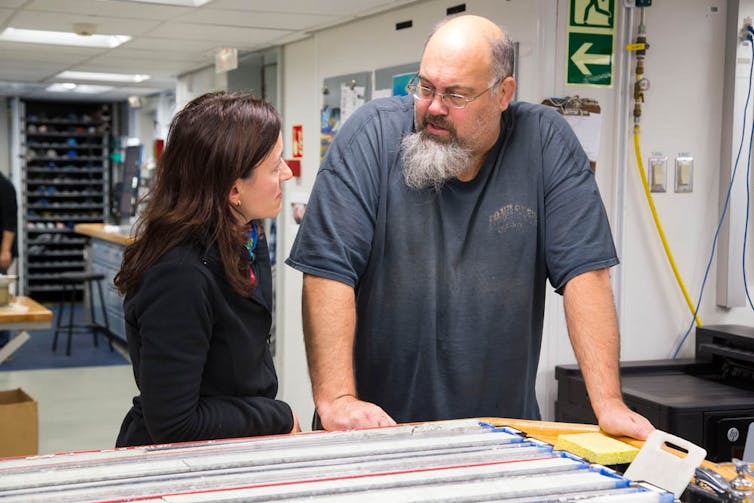
Palaeontologist Laia Alegret (Spain) and co-chief scientist Gerald Dickens (US) discuss a sediment core at the sampling table during IODP Expedition 371.
Tim Fulton, IODP/JRSO, CC BY-ND

Our work reveals that a warmer ocean may eventually produce more calcium carbonate shells than today’s ocean does, even though ocean acidification will almost certainly occur.

How quickly natural carbon sequestration in the ocean might change remains highly uncertain. It will take many centuries before we reach an ocean state similar to that found 4-8 million years ago.

More work is needed to understand how this transition might occur and whether it is possible and sensible to enhance biological productivity in our oceans to mitigate climate change and maintain or increase biodiversity.

Rupert Sutherland, Professor of tectonics and geophysics, Te Herenga Waka — Victoria University of Wellington and Laia Alegret, Professor in Paleontology, Universidad de Zaragoza

This article is republished from The Conversation under a Creative Commons license. Read the original article.
Physics and psychology of cats – an (improbable) conversation

The Conversation
February 14, 2022

Cat (Youtube)

Have you wondered why cats are so nimble and seem to fit perfectly in cups, boxes and other small places? Or how cats communicate with humans?

Marc Abrahams, editor of the Annals of Improbable Research and master of ceremonies of the annual Ig Nobel Prize, Jean Berko Gleason, psycholinguist and professor emerita of Psychological and Brain Science at Boston University, and Marc-Antoine Fardin, rheology researcher at the University of Paris, discussed this and other cat science questions, probable and improbable, in a fascinating and humorous webinar co-hosted by The Conversation and the Annals of Improbable Research.

Physics and psychology of cats - an (improbable) conversation.

Fardin is the winner of the Ig Nobel Prize in physics in 2017 for exploring the use of fluid dynamics to probe the question “Can a cat be both solid and a liquid?”

Below are some highlights from the discussion. Please note that answers have been edited for brevity and clarity.


As many cat owners know, cats tend to like squeezing themselves into small spaces.
Benjamin Torode/Moment via Getty Images

Marc Abrahams: Rheology is studying anything, everything that flows, and, thanks to you, largely, that now includes cats. How did that happen?

Marc-Antoine Fardin: I was on the internet a few years ago, and I saw this set of webpages that were discussing whether cats are liquid. And then they had the definition of a liquid. And usually the definition of a liquid is material that takes the shape of its container. [For example,] if I pour liquid into a mug, the liquid is going to take the shape of the mug, and if I pour it into a wine glass it is going to take the shape of the glass.


If you look at a bunch of different cats, there are many different pictures and experiments that have been run by many people around the world where you see the cats taking the shape of the container [they are in], like a box or a sink. People were asking this question. And so I took this question and put it into the modern lingo of rheology.


Are cats a liquid if they take the shape of the container they are in?
Marion Nivard/FOAP via Getty Images


Marc Abrahams: What does the compressibility of cats refer to?

Marc-Antoine Fardin: Gas in comparison to liquid is compressible. So it means that if you were to push it, you could change its volume. And so for cats, once you answer that the cat might be a liquid, you might also push the question a little further and ask if in some cases a cat could be a gas. And so if it is a gas, it should be compressible. And that’s an experiment that I have not done because I don’t want to get into any trouble.

Beth Daley (to Jean Berko Gleason): Based on your expertise as a psycholinguist, have humans been communicating efficiently with cats? And if not, how should they?

Jean Berko Gleason: Cats have been communicating very efficiently with us. We’ve had cats as pets for, like, 14,000 years. And in 14,000 years, the cats have told us that they want to live with us, and that they would like a comfortable bed, and they want food, and they want us to snuggle with them. In other words, the cats have really communicated all of their interests and needs such that we’re running around doing whatever they have in mind. So they’re doing a very good job.


Our problem with communicating with cats is that you can try to train cats, but [they are very stubborn]. For instance, cats who take part in psychology studies frequently … just leave. The cats do not hang around for the rest of your study.

What people are trying to do really is learn much more about their body language. One of the things that has happened in recent years is that we [have] begun to understand that cats have different facial expressions. And there [are] some bits of research recently in which veterinarians, or people who work in cat hospitals, they’re able to tell the five or six cat facial expressions apart, but we’re not terribly good at that.

Watch the full webinar to hear about additional science behind Fardin’s study on the physics of cats, Berko Gleason’s famous research on children’s language-learning abilities and more.

Beth Daley, Editor and General Manager, The Conversation and Thalia Plata, Editor, The Conversation

This article is republished from The Conversation under a Creative Commons license. Read the original article.
Republicans have dropped the mask — they openly support fascism. What do we do about it?

Chauncey Devega,
 Salon
February 14, 2022

Trump speaks at the "Stop the Steal" rally on Jan. 6. (Screenshot via YouTube.com)

Those of us who have repeatedly sounded the alarm about the Republican Party's threat to democracy and American society have often been told we were exaggerating or being ridiculous. We were hyperbolic, attention-seeking or just plain wrong — because, after all, the Republican Party's leaders and voters really do love America.

Last week the Republican National Committee dropped any remaining pretexts of patriotism or love of democracy with its now-infamous statement that those who attacked the U.S. Capitol on Jan. 6, 2021, were "ordinary citizens engaged in legitimate political discourse." Reports suggest that a draft version of that RNC statement was even bolder in its embrace of right-wing terrorism.

Last Friday's statement of support for fascism announced that the Republican Party has birthed a monster that will ultimately eat it alive. But looking beyond outrage and disgust, what does this tell us about America in this moment of existential crisis?

In terms of the mainstream news media and America's political class, it reveals how deep the capacity for denial goes. Many of the same voices who insisted that the Republicans were not fascists and did not pose an existential threat to democracy also downplayed or outright dismissed the obvious evidence that Donald Trump and his cabal were going to attempt a coup to nullify the 2020 presidential election.

Many of these same gatekeepers and boundary keepers then claimed that the Jan. 6 coup was a one-off, a disorganized and spontaneous "riot," and that the long-term existential dangers were exaggerated. Why? Because they were invested in the idea that "the institutions" had worked, and that Trump's coup was doomed to fail from the beginning, thanks to "democratic norms" and the "rule of law."

Now, more than a year after the attack on the Capitol, there is a mountain of evidence that confirms what was obvious at the time, and even before: Trump's coup attempt was a highly coordinated nationwide effort, whose ultimate goal was to overthrow multiracial democracy and install Trump as de facto dictator.


Ultimately, the Republican Party's embrace of fascism as a now-indispensable part of its identity should not be a surprise. This devolution was years in the making. In a recent essay for the New Republic, Michael Tomasky summarizes this:

The conservative movement that started in Barry Goldwater's time was once an element within the GOP. Then along came Newt Gingrich, the key figure who intensified the culture war, and in time the conservative movement swallowed the party whole — and moved hard to the right while doing it.

And now, in the Trump era, it has become what it's been in process of becoming for some time: an extremist, pro-violence party. The Anti-Defamation League recently released a report finding that more than 100 Republican candidates on various ballots in 2022 have explicitly embraced extremism or violence — House candidates boasting about having the backing of white supremacist leaders, at least 45 candidates giving credence to QAnon conspiracy theories.

This is not some aberration that time will correct. It is a storm that will continue to gather strength, because it's where the action and the money are, and no one in the GOP is opposing it — except the two people who were just essentially read out of the party (Kinzinger is retiring after his current House term).

The Republican Party, like Michael Palin's parrot, has ceased to be. It has become an appendage of Trump dedicated to doing his will and smiting his enemies.

A week or so after the fact, the mainstream news media has already moved on from the Republican National Committee's embrace of fascism. If the American mainstream news media was truly the "guardian of democracy," it would explain how the Republican fascist movement is an indictment of the country's political culture.

The headlines of the month and central narrative of the year should be grappling with the following damning question: How did one of the country's two main institutional political parties come to embrace fascism and right-wing terrorism? What does this mean for the future of the country? These questions are not being asked in a sustained way. Instead, the media is defaulting to the story of the day: "hot takes," horserace reporting, Beltway gossip and both-sides-ism, amounting to a refusal to take any moral stand on the country's democracy crisis and the Republicans' responsibility for creating it.

More than 50 years ago. Hannah Arendt described the role that today's Republican Party plays as a front organization for fascism and authoritarianism in her essential work "The Origins of Totalitarianism":

The front organizations surround the movements' membership with a protective wall which separates them from the outside, normal world; at the same time, they form a bridge back into normalcy, without which the members in the prepower stage would feel too sharply the differences between their beliefs and those of normal people, between the lying fictitiousness of their own and the reality of the normal world.

The ingeniousness of this device during the movements' struggle for power is that the front organizations not only isolate the members but offer them a semblance of outside normalcy which wards off the impact of true reality more effectively than mere indoctrination….

The world at large, on the other side, usually gets its first glimpse of a totalitarian movement through its front organizations. The sympathizers, who are to all appearances still innocuous fellow-citizens in a nontotalitarian society, can hardly be called single-minded fanatics; through them, the movements make their fantastic lies more generally acceptable, can spread their propaganda in milder, more respectable forms, until the whole atmosphere is poisoned with totalitarian elements which are hardly recognizable as such but appear to be normal political reactions or opinions.

As a front organization for American neofascism, the Republican Party's long-term strategy and goal is to normalize right-wing violence as a means of creating a "state of exception," in which they can impose their will on others without restraint by usurping civil and human rights, free speech, the rule of law, the Constitution and finally democracy itself.

The Republican Party's open declaration that it supports terrorism and other political violence offers an opportunity to remind the American people of the power of lists and keeping accurate records and accounts of this crisis. What is fascism, on its most fundamental level? An assault on reality, time, facts and truth. Correctly documenting reality and the facts are a practical way of staying grounded and refusing to be overwhelmed by this tsunami of events.

Americans who support democracy must now accept that elites and other political leaders will not save them. In fact, they must pressure the country's elites through a range of actions, perhaps including national strikes, boycotts, civil disobedience and other forms of direct action. They should consider joining (or even forming) local organizations and other civil society groups to make possible the grassroots organizing that can resist and then defeat American neofascism. Those who have the material resources to support such efforts must consider how best to use them.

Pro-democracy Americans need to understand that the struggle against American neofascism will be long and difficult. There is no rapid or easy solution to this crisis. Defeating fascism will require personal and collective sacrifice.

Writing at the Atlantic, Linda Hirshman offers these lessons from American history and the Black Freedom Struggle, which merit being quoted at length:


The fault lines of today's political chasm go back to the decades that preceded the Civil War. One can see them in our geography — most of the states that will recriminalize abortion, for example, are in the old Confederacy and the rural or deindustrialized regions it influenced — and in our racial division, which continues to render the country into, more or less, two camps. ...

Today's challenges are different — and no offense can be compared with the slavocracy of the antebellum period — but anyone who cares about basic principles of democracy can see that our struggle is much the same. In 2013, the Supreme Court put the Democrats at an enormous disadvantage by gutting the Voting Rights Act and handing back elections to the minority-party-dominated rural-state legislatures. Despite repeated efforts of most of the Democratic senators, Congress has refused to pass a new voting-rights act. In several key states, Republican legislatures have set up new systems that may overturn future election results. Sometime in June, the Supreme Court is likely to rule that American women no longer have a constitutional right to refuse to bear a child, despite the fact that polls regularly show that the overwhelming majority of Americans support some level of abortion rights.

These are dark times, but dark times do not always prevail. Four decades after Black spokesmen told their white so-called friends in the execrable American Colonization Society that they would not be returned to Africa, and just 30-plus years after the Black activist David Walker published an "appeal to the Colored Citizens of the World" promising that "the blacks," once started, would form a "gang of tigers and lions," the newborn Republican Party won the presidency on a platform of restricting slavery. Ten years after Garrison torched his copy of the Constitution, Abraham Lincoln signed the Emancipation Proclamation. How did they do it?

The specifics of their fight are not identical to what prodemocracy Americans now face. But the work of the abolitionist movement is comprehensible and replicable. It is the closest thing we have to a blueprint for how to rescue our democracy.


Almost every tactic the mostly white abolitionists used derived from methods that Black organizers tried first. Walker's appeal, published in 1829, inspired Garrison. There was a Black convention and Lodge movement well before the first white or interracial antislavery society. But one lesson emerges loudly from history: Neither Black nor white Americans could have done it alone.

They made an alliance, and they dug in for the long haul. And they left a playbook.

Americans who believe in democracy must balance optimism and realism, but without succumbing to fatalism. The fight has hardly begun, and too many people are exhausted and have preemptively surrendered. Most important of all, pro-democracy Americans should resist the temptation or urge to compromise with their enemies or appease them. There is no room for "bipartisanship," compromise or truce with the Republican fascists and their allies. That only normalizes evil and all but guarantees the fascists an eventual victory.

Unfortunately, the leaders of the Democratic Party have not learned this lesson. President Biden recently spoke at the National Prayer Breakfast, one day before the Republican National Committee's official embrace of the Jan. 6 insurrection. At the breakfast, Biden spoke directly to Senate Republican leader Mitch McConnell, saying, "Mitch, I don't want to hurt your reputation, but we really are friends. And that is not an epiphany we're having at the moment. You're a man of your word, you're a man of honor. Thank you for being my friend."

In the midst of an existential threat brought on by the Republicans and their followers, the president of the United States told the most powerful Republican legislator, with evident sincerity, that he was a friend. That crystallizes all the ways the Democratic leadership is not reacting with the urgency of how to save American democracy. Biden's words suggest that he and his party are simply not up to the challenge of defending American democracy from the fascist onslaught.

As so often occurs in moments of great struggle and challenge, the few must save the many. And that salvation, if it comes, will not come from the so-called leaders in Washington. Who will step forward?
Why accelerationist Proud Boys latched on to big conservative rallies in DC last month
Jordan Green, Staff Reporter
February 15, 2022


The weekend of Jan. 21-23 brought the annual anti-choice March for Life to Washington, DC, followed two days later by the Defeat the Mandates rally to oppose vaccine mandates. The two events brought thousands of conservatives to the nation’s capital, along with throngs of far-right extremists looking to recruit from their ranks.

A phalanx of members from the avowedly fascist group Patriot Front formed their own column along the March for Life, under heavy police protection as antifascist counter-protesters confronted them. Patriot Front’s appearance, in turn, appeared to act as a magnet for other extremists. Two young men wearing khaki pants, camouflage jackets, work boots and skull masks, as captured in a video by a team member of the veteran-owned open-source intelligence firm Sparverius, showed up and heckled the counter-protesters as Patriot Front members marched past.

One of the men signaled his white power beliefs in ways that were both subtle and blatant: a patch with the red-and-white checkered insignia of the Croatian Legion, a division of the German Army during World War II; stickers on his helmet depicting the image of American Nazi Party founder George Lincoln Rockwell and the slogan “White Lives Matter”; and a Confederate battle flag patch on his military-style backpack.

Two days later, the two men joined members of the Maryland DC Proud Boys chapter at the Lincoln Memorial for the anti-vaccination rally. Among the group of more than a dozen men, about half wore skull masks. Their coats concealed bulky tactical vests, and they carried heavy backpacks. After marching from the Washington Monument, the Proud Boys entourage gathered at the end of the reflecting pool, holding a position at the edge of the large anti-vaccination crowd and near a handful of counter-protesters clumped together at a nearby knoll. At one point, some of the Proud Boys went over to confront the counter-protesters, but then walked off without incident.

“These accelerationists — the guys wearing skull masks, they wear that because they… were signaling to each other that they are extremists, but to the general public they are telegraphing that they are tough, something to be feared, masculine,” Kristofer Goldsmith, Sparverius’ CEO, told Raw Story. “They’re attracting people who think it’s a drinking and street brawler club, and they’re putting them in a pipeline to extremism that ends in domestic terrorism.”

Goldsmith, who is also a senior fellow at the Innovation Lab of Human Rights First, said the Proud Boys’ public presence in DC last month marked a significant turn, following a year in which members across the country have mostly focused on flashpoints of local controversy like school board meetings.

“That weekend Friday through Sunday, between the anti-choice and anti-vax events, was the first major return to DC after the attack on the Capitol,” Goldsmith said. “Though it wasn’t the same numbers and there wasn’t violence the way there had been the year prior, what it did establish to these groups in their psychology is that it is now safe to return to DC in an election year.”


Accelerationists at March for Life

Members of the Proud Boys group also distributed stickers at the anti-vaccination rally with the Proud Boys logo and text, “We are watching.” When a journalist posted a photo of herself holding up the sticker in front of the crowd gathered at the Lincoln Memorial on Twitter, the Proud Boys chapter confirmed responsibility with a post of its own on its Telegram channel that read: “Local antifa scum wanted a business card. That’s right, we are watching.

Matthew Kriner, the managing director of the Accelerationist Research Consortium, told Raw Story that he views the text as a signal that the Proud Boys and their affiliates who attended the rally “are looking for circumstances to insert themselves to instigate further violence and destabilize the political system.” Kriner is also a senior research scholar at the Center on Terrorism, Extremism and Counterterrorism at the Middlebury Institute of International Studies at Monterey.

“After January 6th, this stands out to me as something that shows they’re not afraid to engage in instigator behavior, because we saw them do that on January 6th,” Kriner added. “They instigated a crowd at a right-wing event that became a riot.”

The Maryland DC Proud Boys chapter commemorated its appearance at the anti-vaccination rally by posting a photo of a member nicknamed “Ghost” posing with a plate carrier in front of the Washington Monument, accompanied by the text, “We’re back!” Another heavily stylized photo posted on Telegram shows a handful of members, including the neo-Nazi wearing the Croatian Legion patch, marching away from the Washington Monument. A variation of the image posted on Telegram shows the members superimposed on a war-ravaged urban landscape with the chapter logo slapped in the middle.

Members of the chapter did not respond to requests for comment for this story. Raw Story was able to reach Brandon Heffner, who was identified as the recipient of funds from a GiveSendGo campaign to raise money for a recent Christmas toy drive. Heffner told Raw Story that he is not involved in the chapter, but agreed to handle the funds for the toy drive.

Raw Story also left a voicemail at a phone number listed on the Telegram account for a user named “Joe Bonadio,” eliciting no response.

Notwithstanding Heffner’s claim to not be involved in the chapter, a Telegram user named “HEFF,” along with the “Joe Bonadio” account expressed enthusiasm for a planned White Lives Matter rally in the DC-Maryland-Virginia area last March. In a channel set up to promote the planned rally, “HEFF” commented, “#f*ckantifa proudboys will be the there [sic] in plain clothes or not,” while “Joe Bonadio” wrote, “I’m with ya.” The person behind the “HEFF” account also appears to have a family member involved in the chapter. A user named “LadyHeff” periodically comments on content on the chapter’s Telegram channel, including a post last month blaming people of color for urban decay in which she wrote, “They can take their diversity and shove it up their ass.”

The ethno-nationalist content shared on the chapter’s Telegram channel echoes the white power symbols displayed in public by some of its members. Since December, the channel has forwarded at least two posts from Greyson Arnold, a podcaster who has spoken approvingly about Nazi Germany and who once duped a Republican National Committee member into saying that white nationalist Nick Fuentes should have a voice in picking candidates to run for office in Republican primaries. Later that month, the channel for the Maryland DC chapter forwarded a post by Lauren Witzke, a former US Senate candidate from Delaware who has retweeted posts from VDARE, a white nationalist website.

Beyond forwarding content from other white nationalists, the channel has contributed its own white power messaging. Without specifying the target, a Dec. 29, 2021 post declared, “Special place in hell for these people. Day of the rope mutha fuka.”

READ: 'He is the Yoda of intel': How conspiracy theorists were instrumentalized to mobilize followers to violence on Jan. 6

“Day of the rope” is an explicit reference to The Turner Diaries, a novel written by neo-Nazi William Pierce that inspired the Oklahoma City bombing and an numerous other acts of terrorism and racist violence by perpetrators seeking to emulate the novel’s protagonist by “stockpiling biological weapons, engaging in a racist shooting spree, robbing banks, and assembling pipe bombs with Jewish and Black targets in mind,” according to the Southern Poverty Law Center.

“I would portray the Proud Boys as antisemitic, racist bigots; they would not see themselves as such,” said Michael Loadenthal, an advisory board member at the Accelerationist Research Consortium. “It’s undeniable when they start sharing content that is explicitly racist and antisemitic.”

Loadenthal and Goldsmith both said the barriers between Proud Boys and hardcore neo-Nazi groups, always permeable, are becoming increasingly porous.

Goldsmith said antifascist researchers have identified current members of the openly fascist group Patriot Front who had previously been identified as Proud Boys, indicating a migration between the two groups and a radicalization path towards more extreme violence and racism.

Last week, the Maryland DC Proud Boys chapter reshared a propaganda video produced by the fascist media outfit Media2Rise, which was embedded with Patriot Front during its surprise march through DC in December 2021 and produced high-quality video from the event. Goldsmith told Raw Story that one of Patriot Front leader Thomas Rousseau’s lieutenant’s, Graham Whitson, operates Media2Rise’s online store. Whitson was arrested with Rousseau in August 2020 for plastering Patriot Front stickers on the grounds of county courthouse in Grapevine, Texas.

“Here, we’re establishing the skeleton of how the Proud Boy-fascist pipeline works,” Goldsmith said.

Proud Boys Telegram channels, including the Maryland DC chapter, routinely share content from the “Western Chauvinism” channel, which is named after a primary tenet of Proud Boys doctrine.

“Western Chauvinism produces high-production quality video that is targeting Proud Boys,” Goldsmith said. “It’s shared in Proud Boys channels. It’s encouraging people to embrace fascism as the true law-and-order ideology. I recognize the propaganda videos are deadly serious, and they’re created by people who are deadly serious.

“The actual absurdity of trying to whitewash Hitler and put on pedestal Hitler himself and the rise of the Nazis is deliberately too far,” he continued. “It’s part of the Proud Boys’ claim that ‘we’re not actually Nazis, just edge lords; we’re just trolling the libs.’ The reason we had kids in their early twenties showing up in Charlottesville is they started out on the internet making jokes about the Holocaust, and then they started to believe in it.”

Jordan Green covers right-wing extremism for Raw Story. A Kentucky native, he now lives in North Carolina, where he spent 16 years writing for alt-weeklies and freelancing for the Washington Post and other publications

.
US oligarchs don't care what the majority of Americans thinks about taxing the rich -- here's why

Noah Berlatsky
February 14, 2022
www.rawstory.com


With one political party entirely committed to expanding inequality, and the other divided on the issue, overwhelming public support and commonsense ethical commitments don’t carry much weight.

That’s how oligarchies consolidate. The wealthy horde power and wealth, then that power and wealth gives them the ability to shape institutions to further increase their power and wealth.

Yellen has had some successes in restraining wealthy and corporate power. She negotiated an international agreement with 136 countries to implement a global corporate minimum tax of 15 percent.

At some point, corruption stops being a bug in democracy and starts becoming a feature of oligarchy.

Has the US passed that threshold?

Based on the sweeping and effective resistance to commonsense solutions to reign in wealthy tax scofflaws, the answer is not encouraging.

Since the 1970s, the United States has become steadily and inexorably more economically unequal. According to Pew, upper income families have brought in a larger and larger share of total income.

US income inequality is the highest of all G7 nations. Its Gini coefficient is .434, well above second highest UK at .392.

Based on the sweeping and effective resistance to commonsense solutions to reign in wealthy tax scofflaws, the answer is not encouraging.

Since the 1970s, the United States has become steadily and inexorably more economically unequal. According to Pew, upper income families have brought in a larger and larger share of total income.

US income inequality is the highest of all G7 nations. Its Gini coefficient is .434, well above second highest UK at .392.

This massive concentration of wealth is also a massive concentration of power. The wealthiest people have access to the best lawyers, the best tax attorneys and the most powerful politicians.

That means that it is very difficult for the government to restrain them, or to create a more equitable economy and society against their wishes.

That’s how oligarchies consolidate. The wealthy horde power and wealth, then that power and wealth gives them the ability to shape institutions to further increase their power and wealth.

An example of oligarchical power is billionaire tax evasion. A recent IRS study found that wealthy Americans conceal more than 20 percent of their earnings. They are able to do this because of complex accounting scams involving offshore tax shelters.

The lost tax costs the government at least $175 billion a year in revenue. The top 1 percent of earners are responsible for a third of unpaid federal taxes.

In addition to these straightforwardly illegal accounting tricks, the very wealthy also benefit from at least nominally legal loopholes.

For instance, wealthy people have many assets that increase in value over time, but they do not pay taxes on those assets until they sell them.

They can borrow against those assets without paying taxes, since again the assets aren’t considered income. Then, if they die before selling the assets, they can pass them on to their heirs using trusts and other accounting shenanigans to avoid the estate tax.

ProPublica called this strategy Buy, Borrow, Die. It’s a key method for hoarding generational wealth, and entrenching oligarchy.

The Biden administration, led by Secretary of the Treasury Janet Yellen, have proposed strong measures to rein in billionaire corruption. In part, they want to restrain inequality. In part, they hope to fund other priorities like climate mitigation and anti-poverty measures in the administration’s Build Back Better infrastructure plan.

To address billionaire tax evasion, BBB included $80 billion to boost capacity and staff at the IRS. That would help make up for the steady budget-cuts under Republican administrations. Those have led to a 60 percent decrease in audits of taxpayers who earn more than $1 million. Biden said the investment would allow the IRS to collect $400 billion in taxes.

Biden, Yellen and Senate Finance Chair Ron Wyden have also been pushing for a billionaire tax to force the very wealthy to pay taxes on the increased value of their assets.

This would strike at the heart of the oligarchic “Buy, Borrow, Die” lifestyle. It would force the ultra-wealthy to pay their fair share, like everyone else, every year, year after year.

Policies that prevent the rich from escaping a tax burden everyone has to pay should be easy to pass in a democracy. You’d think preventing billionaires from cheating on their taxes would be a popular policy.

And you’d be correct.

A 2019 poll, for example, showed that 76 percent of Americans agreed that the wealthiest should pay more in taxes. Proposals to tax income over $10 million at 70 percent — a huge increase over current rates — obtained more than 50 percent support.

In an oligarchy, though, public support doesn’t necessarily count for all that much.

A notorious 2015 study found that politicians were much more likely to listen to and follow the political preferences of economic elites than those of the less affluent.

You can see that playing out in the politics of billionaire taxation.

Build Back Better, which included the beefed-up IRS funding, was scuttled by millionaire West Virginia Senator Joe Manchin, in large part, reportedly, because he was worried that poor parents would spend money on drugs.

A wealthy politician refused to enforce the law against billionaires because he was worried that poor people are natural criminals.

That is what you call class consciousness.

Wyden’s proposal to end “Buy, Borrow, Die” also failed after opposition from Manchin. It was of course opposed by Senate Republicans, whose main goal is to shovel as much money as possible to the rich in as short a time as possible.

Yellen has had some successes in restraining wealthy and corporate power. She negotiated an international agreement with 136 countries to implement a global corporate minimum tax of 15 percent. This would make it harder for businesses to escape tax burdens by moving their corporate offices. Congress still has to pass the treaty, but Yellen said she was confident they would do so.

The corporate minimum tax is a substantial achievement. But it’s also a small dam erected against the tsunami of inequality in the US.

With one political party entirely committed to expanding inequality, and the other divided on the issue, overwhelming public support and commonsense ethical commitments don’t carry much weight.

The wealthy have been expanding their power and influence for decades in the US. The result is that the US regularly chooses to make the rich richer rather than helping the poorest feed their children.

The outlook for change is likely to be even bleaker if Republicans recapture one or both legislative chambers in November.

Yellen and Biden are to be commended for fighting an ongoing rearguard action against corruption. But if government inability to restrain corruption is a feature of oligarchy, then the US is already well down a path that it is very difficult to retrace.


 Sound pollution: Paris inaugurates its first noise radar in bid to quieten its street

Issued on: 15/02/2022 - 

Video by: Wassim Cornet

Paris inaugurated its first noise radar on Monday as part of a plan to fine loud motorcycles and other vehicles in one of Europe's noisiest cities. High on a street lamp post in the 20th district in eastern Paris, the city installed the first noise radar that is able to measure the noise level of moving vehicles and to identify their licence plate.