Thursday, December 08, 2022

KAFKAESQUE
Lebanon detainees stuck in limbo as judges’ strike drags on
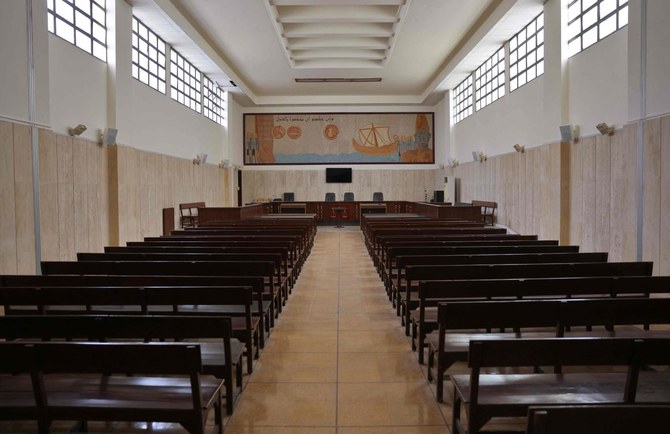
This file photo taken on August 30, 2022, shows an empty court room in Lebanon’s Justice Palace in the capital Beirut. (AFP)

AFP
December 08, 2022

Judges have suspended their work as rampant inflation eats away at their salaries, paralysing the judiciary and leaving detainees in limbo

Bureaucracy and rampant corruption have long delayed verdicts and judicial proceedings in Lebanon


BEIRUT:
 Taxi driver Youssef Daher has languished for months in prison without charge, one of scores stuck after Lebanese judges launched an open-ended strike in August to demand better wages in a collapsed economy.

Judges have suspended their work as rampant inflation eats away at their salaries, paralysing the judiciary and leaving detainees in limbo — the latest outcome of Lebanon’s years-long financial crisis.

From his jail cell in the northern city of Tripoli, Daher sends daily messages to his lawyer asking him whether judges have ended what is already the longest strike for their profession in Lebanese history.

“My family lost their sole breadwinner and must now rely on aid to survive,” he told AFP.
Daher has not seen his wife and three children since he was arrested eight months ago because they cannot afford transportation to get to the prison, he said.

Security forces arrested Daher after he gave a ride to a passenger accused of kidnapping — unbeknownst to him, he said.

Authorities did not press charges against Daher after questioning, so his lawyer requested his release. Then judges began their strike.

His request has been pending ever since.

Bureaucracy and rampant corruption have long delayed verdicts and judicial proceedings in Lebanon, where 8,000 people are estimated to be jailed, most of them awaiting a verdict.

But now, underfunded public institutions have taken a hit after the country’s economy went into free-fall in 2019, with basic state services like renewing passports or completing a real estate transaction often taking months to complete.

Although judges’ salaries are expected to triple as part of Lebanon’s 2022 budget, their wages are currently worth only around $160 on average due to soaring inflation.

“How can a judge live with his family on such a salary?” one striker asked, adding that some of his colleagues with chronic illnesses could no longer afford medication.


“Judges were forced to launch this strike because their financial situation has become unbearable,” he said.

Judges who spoke to AFP said they also wanted better working conditions as they had been forced to toil without electricity or running water and buy their own office supplies like pens and paper.

Lebanon’s state electricity provider produces an hour of daily power on average, forcing residents to rely on private generators that public institutions often cannot afford.
The judges’ strike has compounded an already bleak reality for detainees, many of whom spend months or years awaiting a verdict.

Lawyer Jocelyn Al-Rai said her client, a Syrian youth, was arrested two months ago on drug trafficking charges without a warrant and has yet to face questioning, because the public prosecutor’s office has stopped working.

Despite the strike, certain courts continue to function.

In Beirut on Thursday, a criminal court sentenced Hassan Dekko, a man known as the “Captagon King,” to seven years in prison with hard labor for producing and trafficking the stimulant, a judicial source said. Dekko had been arrested in April last year.

Yet the judges’ strike is also contributing to overcrowding in the already cramped prisons, stretching detention facilities that have seen increasing numbers of escape attempts, a source at the Palace of Justice in the Beirut suburb of Baabda told AFP.

“About 350 people used to be released from prison every month... that number has now been reduced to about 25,” said the source, adding that most are released after “mediators intervene with the judge handling the case.”

About 13 inmates who completed their sentences two and a half months ago have been stuck in the Palace of Justice’s cells because criminal courts have not met to sign off their release, he added.

A judicial source who declined to be named said detainees were bearing the brunt of the strike’s knock-on effects.

“Judges have a right to a decent life,” he said, but “detainees are also suffering from injustice, even those whose only crime was stealing a loaf of bread.”
'Black Book of Pushbacks': 'Culture of impunity' across Europe over violence against migrants'

Issued on: 08/12/2022 

01:58
Video by: Yuka ROYER

As EU ministers discuss whether to allow the bloc's newest members into the Schengen zone, a coalition of NGOs has published a report detailing how thousands of migrants and asylum seekers are facing an "unprecedented rise in violence" at the EU's border. The 3000-plus page "Black Book of Pushbacks", compiled by the Border Violence Monitoring Network, says the documented cases of violence are not sporadic actions - that they stem from "Europe-wide systems that have been reinforced from the very top".


Webb telescope spies hidden stars in stellar graveyard

Issued on: 08/12/2022 -


The Southern Ring Nebula, which is around 2,000 light years from Earth, had previously been thought to contain two stars © Handout / NASA/AFP/File


Paris (AFP) – It was one of the first famous images revealed by the James Webb Space Telescope earlier this year: a stunning shroud of gas and dust illuminated by a dying star at its heart.

Now researchers analysing the data from history's most powerful telescope have found evidence of at least two previously unknown stars hiding in the stellar graveyard.

The Southern Ring Nebula, which is in the Milky Way around 2,000 light years from Earth, had previously been thought to contain two stars.

One, nestled in the nebula's centre, is a white dwarf star which in its death throes has been casting off torrents of gas and dust for thousands of years that in turn formed the surrounding cloud.

Sapped of its brightness, the extremely hot white dwarf is the less visible of the two stars seen in Webb images released in July.

The white dwarf has offered astronomers a view of how our own Sun may die one day -- billions of years from now.

Unlike our lonely Sun, it has a companion, the brighter of the two stars in Webb's images.

However this binary system, which is common across the Milky Way, does not explain the nebula's "atypical" structure, Philippe Amram, an astrophysicist at France's Marseille Astrophysics Laboratory, told AFP.


The brighter star is the companion of the white dwarf which has ejected the gas and dust that forms the surrounding cloud © Handout / NASA/AFP/File

Amram is one of the co-authors of a study published in the journal Nature Astronomy on Thursday that has used Webb's observations to uncover more of the nebula's secrets.

Since the nebula was discovered by English astronomer John Herschel in 1835, astronomers have wondered why it has "such a bizarre shape, not really spherical," Amram said.

By analysing the data from Webb's infrared cameras, the researchers said they found evidence of at least two other stars inside the nebula, which has a diameter equivalent 1,500 times the distance from the Sun to Pluto.

While the new pair are slightly farther away from the white dwarf and its companion, all four stars -- or possibly even five -- are located in the centre of the nebula.

They are close enough to interact with each other, and their "exchanges of energy" create the nebula's strange shape, Amram said.

The Webb telescope, which has been operational since July, has already unleashed a raft of unprecedented data and scientists are hopeful it will herald a new era of discovery.

© 2022 AFP
Canada's Alberta province passes bill to ignore federal law

The opposition New Democratic Party (NDP) said the bill remains an unconstitutional "hot mess"


FRANCE 24
Issued on: 08/12/2022 - 


Alberta is pushing back at what it calls federal overreach, citing measures to cut CO2 pollution from oil sands mining facilities such as this one near Fort McKay © Ed JONES / AFP/File


Ottawa (AFP) – Canada's Alberta province passed a bill Thursday that allows its government to ignore federal laws it deems harmful -- pointing to, for example, measures to curb its oil industry's emissions.

Canada is among the world's top oil producers and much of that output comes from the oil sands in northern Alberta.

The so-called Sovereignty Act is the latest volley in a long-festering feud between Alberta and the national government, which in 2018 imposed a carbon tax and other climate measures to curb CO2 pollution.

Several provinces, including Alberta, fought unsuccessfully all the way to the Supreme Court against the levy, which is set to rise from Can$50 (US$37) per tonne of CO2 emissions to Can$170 in 2030.

Alberta's newly minted United Conservative Party leader and premier, Danielle Smith, has said the Sovereignty Act could also be used to push back against federal gun control measures.

"The way our country works is that we are a federation of sovereign, independent jurisdictions," Smith told her legislature during a late-night sitting that stretched past 1:00 am Thursday.

Provinces "have a right to exercise our sovereign powers in our own areas of jurisdiction," she said.

Before the vote, the most controversial provision of the bill -- which would have given Smith's cabinet sweeping powers to rewrite laws as it saw fit and bypass the legislature -- was stripped out.

The opposition New Democratic Party (NDP) said the bill remains an unconstitutional "hot mess" that circumvents the democratic process and risks putting a chill on investing in the province.


Indigenous leaders also expressed concern over its uncertain impact.

With an election in Alberta less than six months away and the province's NDP vowing to repeal the bill if they win, Prime Minister Justin Trudeau sought to avoid being dragged into a grudge match.

"The Alberta government is trying to push back at the federal government," he told reporters in Ottawa.

Rather than arguing with them, Trudeau said his liberal administration would seek to "work as constructively as possible" on federal priorities such as jobs, child care, dental care and help for renters.

© 2022 AFP
France to make condoms free for young adults aged 18-25


Thu, 8 December 2022 


French President Emmanuel Macron said Thursday that condoms would be made available for free in pharmacies for 18- to 25-year-olds in a bid to reduce unwanted pregnancies among young people.

"It's a small revolution for contraception," Macron said during a health debate with young people in Fontaine-le-Comte, a suburb of Poitiers in western France.

The move comes after the government began offering this year free birth control for all women under 25, expanding a scheme targeting under-18s to ensure young women do not stop taking contraception because they cannot afford it.

Condoms are already reimbursed by the national healthcare system if prescribed by a doctor or midwife, a measure intended to fight the spread of AIDS and other sexually transmitted diseases.

On sexual education overall, "we are not very good on this subject. The reality is very, very different from the theory. It's an area where we need to much better educate our teachers", Macron said.

Macron wore a face mask at the conference, saying he was following "health ministry guidelines", as the government weighs its response to a rise in Covid cases ahead of the holidays, though so far no mask mandates have been reintroduced.

"Faced with the new spread of the epidemic... I think it's good to set an example because we don't necessarily want to return to overall mandates," he said.

Officials are urging people to wear masks in crowded venues and to get Covid vaccine booster shots as winter approaches.

vl/js/adp/raz


‘Once-in-a-lifetime’ ancient necklace found in tomb of powerful Anglo-Saxon woman

Story by Kathryn Mannie • Yesterday 


A tomb that is being hailed as "one of the most spectacular" of its kind ever discovered in the U.K. is garnering international attention over a stunning, 1,300-year-old necklace that was unearthed at the sit
e.


An opulent necklace found in Harpole, Northamptonshire alongside an illustration of what it may have looked like 1,300 years ago.© MOLA

Experts believe the resting place belonged to an Anglo-Saxon woman who may have been a powerful, early Christian leader based on the sumptuous artifacts she was buried with.

The find has been dubbed the "Harpole Treasure," after the Northamptonshire parish in which it was found, and was dug up by the Museum of London Archaeology (MOLA). The day before an eight-week excavation for a housing development was meant to end, one archaeologist spotted a twinkle in the dust.

Read more:
Mysterious 24-metre structure discovered under sand on Florida beach

"When the first glints of gold started to emerge from the soil, we knew this was something significant," said MOLA site supervisor Levente-Bence Balázs. "However, we didn’t quite realize how special this was going to be."

The "once-in-a-lifetime" necklace consists of 30 pendants, made of precious gemstones, glass and Roman coins, spaced out with gold beads. The centrepiece showcases a cross motif in red garnet, set in fine gold laces.


MOLA archaeologists believe the centre pendant may have been one-half of a hinge clasp that was repurposed.

Archaeologists also discovered a large ornate cross inlaid with more garnets among the grave goods. The artifact is still being X-rayed, but researchers have been able to spot an "unusual depiction of a human face cast in silver" in the design of the cross.

The sheer size of the cross and the richness of the necklace have led researchers to suggest that the woman who was buried at the Harpole site was wealthy, devout, and "may have been an early Christian leader," according to MOLA. The only human remains found so far are tooth enamel fragments, but researchers are confident this is the tomb of a woman based on the necklace and the extravagant burial.

The burial site dates back to between 630 and 670 CE, a few centuries after Roman rule ended in Britain, and a full 400 years before William the Conqueror would eventually supplant the reigning Anglo-Saxons.

Christianity had been spreading in southern England for some decades, though intermingling with the resident pagan traditions meant that women could still hold powerful positions in the early church at this time. Later on, graves rarely featured such opulent objects as the early church took stronger root and discouraged such practices.

"The Harpole Treasure, it's not the richest (burial) in terms of the number of artifacts, but it is the richest in terms of investment of wealth ... and it has the highest amount of gold and religious symbolism," said Lyn Blackmore, MOLA's senior finds specialist, at a news briefing.

Two pots of Frankish origin (modern-day France and Belgium) were also entombed with the woman, though archaeologists have not yet been able to identify the residue left within. Their analysis so far has ruled out myrrh.

The Harpole Treasure was actually found back in April, but the discovery was made public on Wednesday following the preliminary analysis by experts. MOLA said that there is still further analysis that must be done to conserve the artifacts before they can go on display.
Canada expected to become a soccer nation as its fan base grows

Yesterday 

The 2022 World Cup of Soccer in Qatar has kicked off, and although Team Canada was the second team to be out of the match following a 4-1 loss against Croatia, the event was a golden opportunity for Canada Soccer to grow their franchise, particularly their immigrant fan base.

Soccer is growing in Canadian popularity and is carrying a bigger influence and responsibilities that come with it.

According to Canada Soccer, there were nearly 1 million registrants across 13 provincial/territorial member associations, surpassing that of Hockey Canada (600,000 active participants). At the elite level, the Canadian Premier League was launched in 2019 and it continues to expand from coast to coast. Toronto FC in Major League Soccer won their first-ever MLS Cup in 2017, and Canada’s women’s soccer team became the darlings of the nation by capturing gold in the Tokyo Olympic Games. That final game versus Sweden drew a record-breaking 4.4 million Canadians to watch the match live, setting a new record on Canadian television.

Soccer’s global fan base

As the immigrant population grows in Canada, especially from countries that already have a strong sense of allegiance to soccer, the possibility for Canada to capture the hearts of new fans is strong. Statistics Canada reported in March 2022 that nearly 80 per cent of the 1.8 million population increase in Canada — from 2016 to 2021 — was due to immigrants. The report said that India and China took top spots as the home countries of new immigrants. Soccer in these countries is highly popular, in terms of both player participation and viewership. Both India and China have held the FIFA U-17 World Cup and hold the first and second-place records for highest attendance.

Canada Soccer’s participation in the World Cup also has the potential to attract immigrant followers who were not previously soccer fans. The opening ceremony of the match was headlined by South Korean singer Jungkook alongside Qatari singer Fahad Al-Kubaisi. The ceremony also featured many aspects of Qatari culture and embraced multiculturalism by displaying flags from all over the world. All of this could resonate with immigrants from diverse backgrounds, even if they aren’t soccer fans.According to FIFA President Gianni Infantino, the 2022 World Cup is expected to pull in 5 billion viewers from around the world; few events can even come close to that viewership and potential influence.

Canada Soccer’s participation in the World Cup looks highly promising for the future of the franchise’s fan base, many fans were expecting the franchise to influence Qatar to make transformational changes following concerns about the nation’s human rights issues that continue to spark controversies

The political side of the sport

According to the Guardian’s report in 2021, more than 6,500 foreign workers have died in Qatar since the nation won the rights in 2010 to host the World Cup. In addition, Qatar has been criticized over the lack of LGBTQ+ rights, as fans were asked to remove their rainbow-coloured clothing while attending the World Cup matches.

“It is a foreign affairs issue, not Canada Soccer’s,” said Germán Camacho, technical director at Calgary City FC, who came from Colombia nearly two decades ago.

Related video: 2 teams signed on so far to new professional women’s soccer league (cbc.ca)   Duration 2:02    View on Watch

He said Canada Soccer has done a good job developing new talent, and that the federal government needs to advocate for human rights to shield Canada Soccer from controversies.

“There are consequences, you talk and you get punished by FIFA. The federal government needs to be the entity to make a statement right now,” Camacho said.

Following the 2022 World Cup, Camacho said Canada will soon become a soccer nation because it is a country of immigrants.

“It is just night and day — these young kids I coach these days know soccer, know the players, the tactics, everything, and even the parents have huge knowledge.”

Ingo Ionescu, a second-generation Canadian of Romanian descent, said: “We all know what is going on. I always tell my friends, ‘I cheer for only good football.’ In the ideal world, sports should stay away from politics but it is a business now so it’s impossible.”

Ionescu believes soccer players need to focus on the game.

“Look at how much money Cristiano Ronaldo makes, but what can he do?” he said. “Having said that, I think Canada Soccer needed to take the stance and should be a leader to fight for human rights.”

In October, many major soccer associations advocated for a Workers Compensation Fund for labourers and their families. In response to a CTV exclusive interview just a day before the opening ceremony of the World Cup, Canada Soccer’s Secretary Earl Cochrane stated he disagreed with Canada Soccer being accused of a “deafening silence” on Qatar’s human rights issues.

Cochrane also stood by a statement released on Oct 28 in which Canada Soccer “encouraged all partners to continue the efforts to implement labour reforms.” That statement drew criticism from human rights watchdogs, such as Amnesty International.

“International sport, as much as it tries to distance itself from politics, will always be tied to it,” says David Legg, a professor in the Department of Health and Physical Education at Mount Royal University in Calgary.

Legg said professional sports organizations have the right and duty, because of their stature in the public, to voice opinions and concerns about issues important to society. By refraining from making an adequate statement, some may say Canada Soccer is not showing the integrity that is expected of a major sports organization, particularly one that has not yet established itself on the world stage.

Brian Wong and Mohana Holloway, Local Journalism Initiative Reporter, New Canadian Media
Jennifer Valentyne not surprised at Corus investigation results

Story by Liz Braun • Yesterday - Toronto Sun


Jennifer Valentyne.© Provided by Toronto Sun

Q107 Radio posted on Twitter Nov. 29 that their investigation into complaints about the working environment at the show Derringer In the Morning had concluded.

Their statement described the investigation as independent and external, but as Q107 parent company Corus Entertainment hired, paid for and directed Turnpenney Milne LLP in the investigation, “independent” and “external” may be considered window dressing.

Their statement notes that though personnel matters remain private and confidential, “we understand and accept the findings and recommendations. Where not already in place, we intend to implement the investigator’s recommendations.”

Jennifer Valentyne, the media personality whose video on Twitter earlier this year sparked a closer look at an allegedly toxic workplace where at least five women had formally complained, said Tuesday that the statement came as no surprise to her or anyone else.

Valentyne had already tweeted in response to the Q107 statement:

“This statement says nothing. I didn’t participate because investigating mgmt was not included. Execs, the CEO and HR knew what was going on for years. FOUR women before me. We all begged for help. We were all denied. The women were blamed. The men were protected. #accountability.”

Valentyne declined to be part of the investigation (as did another woman) when she was given to understand that it did not involve management. She also had no faith in it.

“For all I know, they could have put it all on me. Now they’ll say I didn’t take part — I viewed it as a no-win situation. But I don’t regret what I did. It saves another woman,” she said.

Her objective was never to see Derringer get fired, she said.

Speaking of her time at the station, Valentyne said, “My whole thing was always, ‘let’s make it better.’

“I was trying to figure it out myself, and I was offering managerial advice, such as, let’s get him more anger management, let’s put an observer in the room — let’s work on this!”

Bottom line: M anagement knew what was going on but did nothing over many years, Valentyne said.

“They could have dealt with it 20 years ago but chose not to,” she said.

Early on in the Derringer debacle, attention turned from the on-air personality himself to Corus Entertainment.

Indeed, Valentyne’s complaint of gender discrimination with the Canadian Human Rights Commission is against Corus Entertainment, not Derringer.

So what about Corus management? Any accountability there?

“Maybe that’s next,” said Valentyne, “but I doubt it.”

BRAUN: Problem bigger than allegations against Q-107's John Derringer

Still, anyone observing the situation wonders why the Shaw family and the Corus board remain silent.
“They failed their employees. They failed their women,” said Valentyne.

Nobody is expected an apology from Corus, because that’s viewed as an admission of guilt. But the complaints from female staff go back many years, and what’s mystifying is that nothing was done over all those years.

It’s perhaps fair to question why so much time and money might have been spent to seemingly cover up the mess instead of trying to fix it.

(Current rumours say Derringer got $8 million when he parted company with Corus.)

Maureen Holloway, Supriya Dwivedi, Jacqui Delaney — each of these high-profile women has spoken about the alleged enablers of Derringer.

When will that be addressed?

“I never expected anything,” said Valentyne of the investigation.

“We knew what this was from the beginning. The result is no surprise to anyone.

“They just want it to go away,” she said.

A request for more information from Corus was unanswered at press time.
DEPORTATION FROM CANADA
Transgender Irish teen given chance to argue risks of his deportation after family speaks out

Story by Yvette Brend • 


A transgender teen from Ireland who had been facing removal from Canada due to an immigration error made by his family has won a short stay in his case — he can apply for a risk assessment to explain the family's concerns he could face discrimination, bullying or violence in his home country.


Adam Tyrrell Haslam's small victory comes after the 19-year-old's family began a legal fight in September to try to stop Canada from deporting the young man.

Adam had been facing removal after the Irish family, while seeking assistance at the border with their passports, permanent residency paperwork and visas that had expired by one day, made a wrong turn and crossed into the U.S. — a mishap that led to orders that they leave Canada.

For the past 21 months, they've been trapped in immigration limbo, unable to work or go to school. But the other four family members had been given the opportunity to fill out a pre-removal risk assessment, a document that allows them to make a case to stay in the country.

It wasn't until Friday, a day after the family spoke to CBC, that Adam's parents received an email from the manager of intelligence and enforcement operations division for Canada Border Services Agency's (CBSA) pacific division.

In it, was an invitation to fill out an attached pre-removal risk assessment. It also explained that anyone ordered to leave Canada at a point of entry or border did not need to be notified they are eligible for a risk assessment — an issue that had caused confusion for the family as to why only four of them were given the opportunity initially.


Haslam hugs his son. Adam was recently invited send in a pre-removal risk assessment application, which will offer him a temporary stay of deportation as it's reviewed.© Padraig Mac Roibeaird

That said, John Haslam says he's relieved his son can now make a case to stay for his safety, but he's not sure how long it will take before the application is processed and a decision about the entire family's future is made.

"I felt excited but worried at the same time," Haslam told CBC in a phone interview on Tuesday night.

"They're offering us an opportunity. It's still not a guarantee. I mean, there's still the chance they will remove us from the country. And it's quite scary."

Padraig Mac Roibeaird, who acted as a legal agent for the family, says they will now drop their civil case.

"We got what we were asking for. I was surprised at the speed at which it came through," said Mac Roibeaird. For that speed he credits CBC's story last week.

But he also believes this stops details from emerging.

"Something bad happened at the border, and they did not want to have to go through the discovery process," he said.

Zool Suleman, an immigration lawyer who did not represent the family but did review the case for CBC, says Adam will likely not face removal until the process is over, which could take weeks or months.

"[Immediate removal] now is unlikely, partly because of the work [CBC] has been doing. The moment somebody like you reports, then people get very sensitive about the process," Suleman said. "Attention on this in the media is going to make them absolutely careful on how they deal with it."

'5 steps backward'

Adam says he's eager to fill out the risk review application, hoping it will make it possible for him to return to building a life here.

"I'm thankful for the opportunity to be able to stay [for now]. But as my dad said, it's not really a guarantee that we're going to stay here," Adam said in a phone interview from Vernon, B.C.

If after a hearing, Adam is ordered to leave Canada, he says he'll feel lost.

"I really don't know what I'd do," he said. "I have pretty much everything planned for this to go right and if it doesn't, it's just like five steps backwards."

The family filed a civil lawsuit against the Attorney General of Canada last September arguing that Adam faced discrimination, bullying and stigma back in Ireland — and they've been trying to become permanent residents of Canada since 2013. They are looking to make a life in Canada for economic and safety reasons, saying it's a better environment for Adam, their eldest son, who transitioned as a teen.

In recent years, hate crime targeting the LGBT community has been on the rise in Ireland, so much so that in October Ireland's Minister for Justice Helen McEntee introduced new legislation that criminalizes the incitement of acts of hate against transgender people and others.


Ireland's Minister of Justice Helen McEntee, shown here speaking in Dublin in 2019 when she was minister for European affairs.© Clodagh Kilcoyne/Reuters

Although Adam will be able to outline the risks to him in returning to Ireland, Suleman says these risk assessment hearings are a long shot.

Criteria are strict and the success rate of such a hearing is low; between five and seven per cent of claims are approved, he says.

"A risk assessment is not a refugee claim," Suleman said. "They need to be more specific."


Minister of Immigration, Refugees and Citizenship Sean Fraser makes an announcement in Ottawa in October. Immigration lawyer Suleman suggested that ministerial intervention is the family's best chance at being able to stay in Canada now.© Patrick Doyle/The Canadian Press

A pre-removal risk assessment gives those facing a deportation or other removal order the chance to outline the risk they would face if they were returned to their home country. If the application is approved, then they may stay in Canada. Applications are assessed based on whether the applicant could face a danger, torture, a risk of death or cruel and unusual punishment, according to the federal criteria.

Applicants can also argue to stay if there is a well-founded fear of persecution based on race, religion, nationality, political opinion or being part of a particular social group.

But upon rejection, removal is swift and restarting a permanent residency application is very difficult, Suleman said.

"Their ability to restart the irregular immigration process is exceedingly low. Once you're on the enforcement track, there's a very high chance that they will be asked to leave Canada," he said.

Requests for interviews from CBSA and Immigration Canada were declined, despite the family signing consent agreements to deal with privacy concerns.

CBSA said in an email that the decision to remove people from Canada is "not taken lightly," adding that the pre-removal risk assessment applications act as a stay of removal until Immigration, Refugees and Citizenship Canada makes a final decision.

The family, who are restricted from working or studying, have been living in a hotel for 15 months with help from charities as they are barred from working or going to school in Canada. Haslam said Adam and his two younger brothers spend their days at the library or tobogganing behind the hotel.

Adam says he's looking forward to the holidays, watching the movie Elf with his family and he hopes Christmas dinner will be chicken.

"We've got a little tree and just waiting for Christmas — it's all we can do," his father said.
Swedish self-driving truck start-up Einride raises more cash

Story by By Marie Mannes • 

Handout photo shows Einride's electric self-driving truck Einride Pod© Thomson Reuters

(Reuters) - Swedish electric self-driving truck start-up Einride said on Wednesday it had agreed to raise capital of $500 million from debt, equity and the conversion of earlier loans, speeding up the company's ability to pursue new markets and customers.

A $300 million debt facility was signed with Barclays Europe, while $200 million in equity came from new and existing investors, including EQT and Northzone, Einride said in a statement.

Some $90 million of the equity came in the form of earlier debts being converted to shares. Einride declined to say how much the company was valued at following the latest share issue.

Some fast-growing tech companies have struggled to raise funds this year while others, such as Swedish payments firm Klarna Bank, have attracted investors by giving deep discounts compared to earlier valuations.

"The time is now to act on not only developing but accelerating the implementation of technology that will create a cleaner, safer and more efficient way to move goods," said Einride's founder and Chief Executive Robert Falck.

The company's business is based on self-driving technology for freight trucks, which has attracted investor attention in recent years as it is deemed to be cheaper as well as easier to roll out compared to self-driving cars.

Self-driving freight services require less mapping than other technology as they run on fixed routes between predefined points, mostly on major highways without intersections or pedestrians.

(Reporting by Marie Mannes, editing by Terje Solsvik and Louise Heavens)