Thursday, December 08, 2022

'Keeping it fresh': Greek growers use nature to clean crops

By: AFP
Published: 8 Dec, 2022


Beneath a cluster of plane trees, the crystal clear waters of a stream are mustered by Greek farmers to rinse their leek crop, a time-honoured tradition that saves money and reduces its carbon footprint.

"(The water) keeps the leeks live and fresh...and it saves us using tap water to rinse them at home," explains 48-year-old grower Costas Antoniou.

The source of the stream is just 500 metres from his village of Dorothea in the region of Pella, northern Greece.

"We learned this method from our grandparents and it is what the next generation will continue to do," he said.

Tied together in clumps with string and plastic tape, the freshly picked leeks will spend six to 12 hours in the slow-moving stream.

After that, their brushy roots -- known locally as 'moustaches' -- are mud-free and the crop is ready to market.

Dorothea, which has a population of about 500 people, has an annual leek production of some 1,600 tonnes from smallholders.

Entire families are involved in the crop from the ages of 20 to 75, says Antoniou, who is also the village chairman.

Each plant must be uprooted and cleaned by hand and tied before it can be driven to the river by truck, he said.

"It's an arduous task that requires many people. Here, the job is easier and the results are even better than from the vegetable washing machines used by large producers," says Evangelia Papadopoulou, whose family has grown leeks for the past three decades.

"The entire village gathers here," adds the 49-year-old. "This is where we work, gossip and bicker."

Using the river also avoids the stiff expense to run machines to wash the leeks.

Care is also taken to ensure the leeks don't pollute the stream, with organic pesticides and manure as fertiliser.

"We drink this water without fear," says local villager and fellow leek grower Ilias Kampadakis, 62.

The water quality is regularly tested at a trout farm downstream.
Industry lobbies against biodiversity goals: research

Roland LLOYD PARRY
Thu, December 8, 2022 


Lobbyists for pesticide and fertiliser producers are pushing "behind the scenes" against stronger protection for species and ecosystems at the COP15 biodiversity conference, research showed Thursday.

Delegates in Montreal for the meeting, which started this week and runs until December 19, aim to finalise a new framework for "living in harmony with nature", with key goals to preserve Earth's forests, oceans and species.

InfluenceMap, a think tank that monitors communications by companies and industry associations, said it "tracked lobbying between 2020 and 2022 that has sought to weaken both the targets themselves and steps toward their implementation in the EU and the US.

"As COP15 gets underway to finalise new biodiversity goals, major industry lobbyists are working behind the scenes to try to water down policy ambition," said the author of the research, InfluenceMap program manager Rebecca Vaughan.

"We've tracked efforts from industry associations representing some of the world's biggest pesticide and fertiliser producers... strongly resisting global and EU targets for reducing the use of biodiversity-harming agrichemicals."

It tracked submissions they made to the secretariat of the Convention on Biological Diversity (CBD) and communications obtained through Freedom of Information requests.

Examples included the International Fertilizer Industry Association (IFA), which the report said opposed targets for reducing losses of nutrients linked to crop production.

- 'Constructive dialogues' -

The director general of the IFA, Alzbeta Klein, said: "This report misrepresents the activities of the fertiliser industry in the area of biodiversity and in particular, the adoption of global targets.

"The industry recognizes the critical importance of biodiversity protection for the well-being of people and the future of the planet, and is mindful of its role and responsibility in helping to avoid and reverse global biodiversity losses," she told AFP.

The IFA said in a separate statement that it was "actively involved" in the CBD negotiations by providing expertise and information on agricultural practices to set a "realistic, achievable" target on sustainable resource management.

One of the companies named in the report, German chemicals giant BASF, said it took part in "constructive dialogues" at the request of policymakers, advising on ways to limit environmental impact and aid biodiversity.

"BASF supports the preservation of ecosystems and promotes the sustainable use of natural resources," a BASF communications executive, Christian Zeintl, told AFP.

"We believe that crop protection can go hand in hand with biodiversity in agriculture."

- 'Corporate capture' -


The InfluenceMap report also pointed to fishery lobby groups that oppose one of COP15's headline initiatives: to protect 30 percent of the world's land and oceans by 2030.

A previous InfluenceMap study in October documented cases of oil associations lobbying against protection for threatened species such as some bees, seals and polar bears.

The head of the CBD Elizabeth Mrema said at a briefing in November that the majority of people registering for COP15 were non-government "stakeholders, including the business and financial institutions.

"This clearly indicates the awareness of the private sector of their role of also contributing to actions to reduce the loss of biodiversity," she said.

Friends of the Earth issued a report on "corporate capture" at COP15, arguing that "the participation of big business in the CBD reveals a fundamental conflict of interest.

"The impact of corporate influence on the CBD COP15 can already be seen in the draft Global Biodiversity Framework," it said.

"Far from being transformative, it fails to address unsustainable production methods and allows for 'business as usual'".

rlp/klm/jj
COP15
'Half of the forests and coral reefs are gone, 80% of wetlands, 1m species on brink of extinction'

Issued on: 08/12/2022

05:43
Video by: Mark OWEN

UN biodiversity talks kicked off this week in Montreal, in what is being billed as the "last best chance" to save the planet's species and ecosystems from irreversible human destruction. It's a high-stakes summit calling for a "peace pact with nature." Delegates from across the world are gathering for the December 7-19 meeting to try to hammer out a new deal for nature that involves a 10-year framework aimed at saving Earth's forests, oceans and species. For more on the UN biodiversity conference, FRANCE 24 is joined by WWF Spokesperson Marco Lambertini.

Biodiversity: Ocean 'dead zones' are proliferating


A green sea turtle swims near Gorgona Island in the Pacific Ocean off the southwestern Colombian coast, on December 2, 2021. © AFP file

Text by: Lou ROMÉO

Issued on: 08/12/2022 - 

As the UN’s COP15 talks on biodiversity got under way in Montreal on Wednesday, FRANCE 24 spoke to marine biologist Françoise Gaill about marine “dead zones” and their link to global warming.

One of the main goals of the 15th UN conference on biodiversity, known as the COP15, is to ensure the protection of 30 percent of all marine ecosystems on the planet. Though conservation efforts are often focused on the species found on land, oceans and seas are home to a wide range of species whose survival is threatened by several factors.

An ongoing decrease in oxygen levels underwater is an important component of the loss of marine life. More than 400 "dead zones" – where aquatic life can no longer survive – existed in the world’s oceans in 2007, according to a study led by a scientist at the Virginia Institute of Marine Science, compared to 150 in 2003.

Deprived of essential oxygen, these marine areas span 245,000 square kilometres and threaten vertebrate animals, with more than a third of marine mammals affected. The phenomenon has been ongoing since the 1980s and is proliferating, while research on the subject lags behind.


Françoise Gaill, a French marine biologist and vice president of the Ocean & Climate Platform, who is also a scientific adviser at France’s National Centre for Scientific Research (CNRS), spoke to FRANCE 24.

FRANCE 24: What is a dead zone?

Françoise Gaill: 
Dead zones are hypoxic areas in the ocean, where the concentration of oxygen is below the norm. This can mean a decrease of up to 20 percent, which is already quite significant, but can reach up to a 50 percent drop in oxygen levels.

The lack of oxygen occurs in the ocean’s surface areas, between 50 and 400 metres deep. The shallowest waters are generally less affected since they have more contact with the air and therefore benefit from oxygenation, which is less available in deep water.

Dead zones are mostly found off the coast of the Americas, from California to Chile. West Africa is also affected, as is the western part of Indonesia in the Indian Ocean.

Although they mostly hug coastlines, we are starting to see some dead zones stretch from the Americas into the middle of the Pacific, far from the shore.

What consequences do these zones have on the planet’s biodiversity?

A lack of oxygen in the water causes a change in environment, which will naturally have an impact on marine biodiversity.

When oxygen levels are reduced, fish – who need it to breathe – may experience hypoxia and are at risk of death. If they survive, they will migrate to areas with higher oxygen levels, which affects the ecosystem at large and takes a toll on local biodiversity.

Animals like crabs and shellfish, which can’t escape from these areas as quickly, can die of suffocation. Some dead zones have even been identified after heaps of dead carcasses were found scattered across beaches.

All animals need oxygen to live, and therefore all animals are affected. Plants less so, since they are less dependent on oxygen.

What causes dead zones?

Dead zones are a naturally occurring phenomenon. Some areas are less oxygenated than others due to ocean currents, but it’s normally quite rare to come across.

At first we thought that the proliferation of these zones was caused by human activity in a process called eutrophication, when organic matter like agricultural products or fertilisers enter a body of water, leading to an increase in planktonic organisms. The organisms multiply until they exhaust the oxygen available in the environment.

But over the last 10 years, we’ve realised that human activity isn’t the only cause of declining oxygen levels. Global warming also plays a role; there is a correlation.

The rising number and amplitude of dead zones goes hand in hand with climate change. Although dead zones are mostly coastal, some now extend into open waters – indicating that falling oxygen levels are not only due to agricultural run-off. Global warming causes water temperatures to rise, and oxygen does not dissolve as well in warm water.

Will ‘dead zones’ remain dead forever?


No, not at all. It’s a dynamic phenomenon. Oxygen levels can be replenished by underwater currents or intense weather events such as storms.

Dead zones are therefore not permanent, but there is a probability they will form again in the same place due to local currents. It’s also possible to limit the impact of human activity by reducing the amount of agricultural discharge dumped into waters.

But the correlation with climate change changes things. A consequence of rising seawater temperatures is that marine currents could be stalled, making these zones “watertight” and preventing them from mixing and therefore reoxygenating.

So dead zones must be monitored for the sake of biodiversity, the fishing industry and even tourists. While it’s relatively simple to reduce the amount of discharge going into our oceans – by limiting agricultural waste, for example – global warming isn’t as reversible.

These dead zones will keep proliferating if nothing is done to curb climate change, which requires cutting back greenhouse gas emissions and limiting global warming to a maximum of 1.5 or 2 degrees Celsius.

This article is a translated version of the original in French.


ECOCIDE

'ECOLOGICAL CORRIDOR'

'Big crime': Pleas for wartime protection of Black Sea

Author: AFP|Update: 08.12.2022 


Researchers worry that Russia's war on Ukraine is also wiping out dolphins and Black Sea marine life / © AFP

One of Turkey's most influential marine biologists is pleading for the creation of an "ecological corridor" to save dolphins and other sea creatures from destruction during Russia's war on Ukraine.

Bayram Ozturk spoke to AFP one day after Ukrainian President Volodymyr Zelensky accused Russia of waging an "ecocide" that was devastating marine life across the Black Sea -- shared by Turkey on its southern end.

The war in Ukraine is currently casting a shadow over a United Nations biodiversity conference that kicked off this week in Montreal.

Russia has pushed back hard against allegations levelled in Montreal by a group of Western nations that its nearly 10-month invasion was creating an environmental disaster across the region.

Ozturk wholeheartedly agrees.

The head of the Turkish Marine Research Foundation wants the world to take a closer look at just how much damage has already been done.

"We need international surveillance. We need to know what is happening exactly," he said in a telephone interview.

"This is a big crime against nature," Ozturk said of the war's impact on the Black Sea.

His biggest immediate worry is that fighting this winter will interrupt the natural migration period of dolphins across the Black Sea.

"There should be an ecological corridor starting from the Danube River to the Odessa area, where there's a highly concentrated dolphins population," he said of a region near Ukraine's southwestern border with Romania.

"War should be stopped there for at least two or three months between January and April, during the dolphins migration period."

- 'They feel useless' -

The fate of dolphins is one of the most emotive issues on the conflict's environmental front.

Zelensky presented a Ukrainian report suggesting that at least 50,000 dolphins -- or a fifth of their estimated Black Sea population -- had died as a direct consequence of the war.

Ozturk said a lack of real research and the war's raging impact made it impossible to estimate the true number of dead dolphins in the sea.

He put the number in "at least the hundreds" -- many of them victims of the low-frequency sonars emitted by Russian warships and submarines.

"Dolphins suffer acoustic trauma because of the low-frequency sonars. It damages their orientation system and they get stranded," he said.

But "other species deserve protection as well, not only dolphins," Ozturk stressed.

"The ecosystem is a whole. You cannot protect one species and not another one."

Ozturk's foundation will organise a Black Sea conference in Istanbul on Friday at which he will continue exchanging ideas with colleagues from the sea's other lateral states.

But some of his most intriguing exchanges have come with scientists from Russia -- a nation increasingly cut off from the Western world.

"They are very cooperative and they feel ashamed about what is going on but they all say they cannot do anything," he said.

Russian President Vladimir Putin warned on Wednesday that his invasion -- initially planned to be completed in just days -- might turn into a "lengthy process".

Ozturk worries that an even more protracted conflict might leave little for the international community to save the day the war finally ends.

"If you kill everything, not only dolphins but also fish and all the coastal habitat for fish, invertebrates, birds -- who will be held to account?" he asked.

"How can the Ukrainians and others be compensated for the ecological damage? Someone should be called to account."
KAFKAESQUE
Lebanon detainees stuck in limbo as judges’ strike drags on
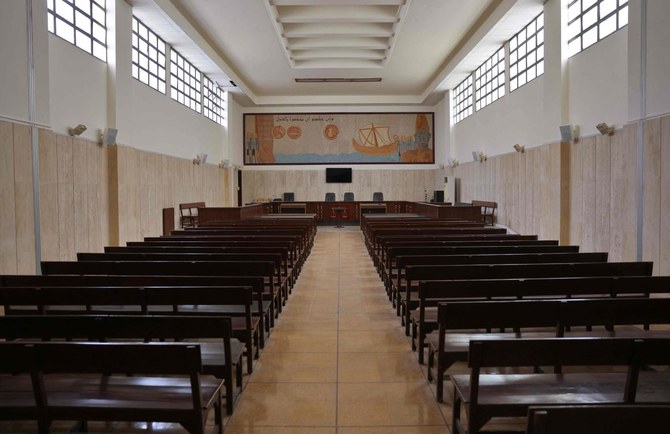
This file photo taken on August 30, 2022, shows an empty court room in Lebanon’s Justice Palace in the capital Beirut. (AFP)

AFP
December 08, 2022

Judges have suspended their work as rampant inflation eats away at their salaries, paralysing the judiciary and leaving detainees in limbo

Bureaucracy and rampant corruption have long delayed verdicts and judicial proceedings in Lebanon


BEIRUT:
 Taxi driver Youssef Daher has languished for months in prison without charge, one of scores stuck after Lebanese judges launched an open-ended strike in August to demand better wages in a collapsed economy.

Judges have suspended their work as rampant inflation eats away at their salaries, paralysing the judiciary and leaving detainees in limbo — the latest outcome of Lebanon’s years-long financial crisis.

From his jail cell in the northern city of Tripoli, Daher sends daily messages to his lawyer asking him whether judges have ended what is already the longest strike for their profession in Lebanese history.

“My family lost their sole breadwinner and must now rely on aid to survive,” he told AFP.
Daher has not seen his wife and three children since he was arrested eight months ago because they cannot afford transportation to get to the prison, he said.

Security forces arrested Daher after he gave a ride to a passenger accused of kidnapping — unbeknownst to him, he said.

Authorities did not press charges against Daher after questioning, so his lawyer requested his release. Then judges began their strike.

His request has been pending ever since.

Bureaucracy and rampant corruption have long delayed verdicts and judicial proceedings in Lebanon, where 8,000 people are estimated to be jailed, most of them awaiting a verdict.

But now, underfunded public institutions have taken a hit after the country’s economy went into free-fall in 2019, with basic state services like renewing passports or completing a real estate transaction often taking months to complete.

Although judges’ salaries are expected to triple as part of Lebanon’s 2022 budget, their wages are currently worth only around $160 on average due to soaring inflation.

“How can a judge live with his family on such a salary?” one striker asked, adding that some of his colleagues with chronic illnesses could no longer afford medication.


“Judges were forced to launch this strike because their financial situation has become unbearable,” he said.

Judges who spoke to AFP said they also wanted better working conditions as they had been forced to toil without electricity or running water and buy their own office supplies like pens and paper.

Lebanon’s state electricity provider produces an hour of daily power on average, forcing residents to rely on private generators that public institutions often cannot afford.
The judges’ strike has compounded an already bleak reality for detainees, many of whom spend months or years awaiting a verdict.

Lawyer Jocelyn Al-Rai said her client, a Syrian youth, was arrested two months ago on drug trafficking charges without a warrant and has yet to face questioning, because the public prosecutor’s office has stopped working.

Despite the strike, certain courts continue to function.

In Beirut on Thursday, a criminal court sentenced Hassan Dekko, a man known as the “Captagon King,” to seven years in prison with hard labor for producing and trafficking the stimulant, a judicial source said. Dekko had been arrested in April last year.

Yet the judges’ strike is also contributing to overcrowding in the already cramped prisons, stretching detention facilities that have seen increasing numbers of escape attempts, a source at the Palace of Justice in the Beirut suburb of Baabda told AFP.

“About 350 people used to be released from prison every month... that number has now been reduced to about 25,” said the source, adding that most are released after “mediators intervene with the judge handling the case.”

About 13 inmates who completed their sentences two and a half months ago have been stuck in the Palace of Justice’s cells because criminal courts have not met to sign off their release, he added.

A judicial source who declined to be named said detainees were bearing the brunt of the strike’s knock-on effects.

“Judges have a right to a decent life,” he said, but “detainees are also suffering from injustice, even those whose only crime was stealing a loaf of bread.”
'Black Book of Pushbacks': 'Culture of impunity' across Europe over violence against migrants'

Issued on: 08/12/2022 

01:58
Video by: Yuka ROYER

As EU ministers discuss whether to allow the bloc's newest members into the Schengen zone, a coalition of NGOs has published a report detailing how thousands of migrants and asylum seekers are facing an "unprecedented rise in violence" at the EU's border. The 3000-plus page "Black Book of Pushbacks", compiled by the Border Violence Monitoring Network, says the documented cases of violence are not sporadic actions - that they stem from "Europe-wide systems that have been reinforced from the very top".


Webb telescope spies hidden stars in stellar graveyard

Issued on: 08/12/2022 -


The Southern Ring Nebula, which is around 2,000 light years from Earth, had previously been thought to contain two stars © Handout / NASA/AFP/File


Paris (AFP) – It was one of the first famous images revealed by the James Webb Space Telescope earlier this year: a stunning shroud of gas and dust illuminated by a dying star at its heart.

Now researchers analysing the data from history's most powerful telescope have found evidence of at least two previously unknown stars hiding in the stellar graveyard.

The Southern Ring Nebula, which is in the Milky Way around 2,000 light years from Earth, had previously been thought to contain two stars.

One, nestled in the nebula's centre, is a white dwarf star which in its death throes has been casting off torrents of gas and dust for thousands of years that in turn formed the surrounding cloud.

Sapped of its brightness, the extremely hot white dwarf is the less visible of the two stars seen in Webb images released in July.

The white dwarf has offered astronomers a view of how our own Sun may die one day -- billions of years from now.

Unlike our lonely Sun, it has a companion, the brighter of the two stars in Webb's images.

However this binary system, which is common across the Milky Way, does not explain the nebula's "atypical" structure, Philippe Amram, an astrophysicist at France's Marseille Astrophysics Laboratory, told AFP.


The brighter star is the companion of the white dwarf which has ejected the gas and dust that forms the surrounding cloud © Handout / NASA/AFP/File

Amram is one of the co-authors of a study published in the journal Nature Astronomy on Thursday that has used Webb's observations to uncover more of the nebula's secrets.

Since the nebula was discovered by English astronomer John Herschel in 1835, astronomers have wondered why it has "such a bizarre shape, not really spherical," Amram said.

By analysing the data from Webb's infrared cameras, the researchers said they found evidence of at least two other stars inside the nebula, which has a diameter equivalent 1,500 times the distance from the Sun to Pluto.

While the new pair are slightly farther away from the white dwarf and its companion, all four stars -- or possibly even five -- are located in the centre of the nebula.

They are close enough to interact with each other, and their "exchanges of energy" create the nebula's strange shape, Amram said.

The Webb telescope, which has been operational since July, has already unleashed a raft of unprecedented data and scientists are hopeful it will herald a new era of discovery.

© 2022 AFP
Canada's Alberta province passes bill to ignore federal law

The opposition New Democratic Party (NDP) said the bill remains an unconstitutional "hot mess"


FRANCE 24
Issued on: 08/12/2022 - 


Alberta is pushing back at what it calls federal overreach, citing measures to cut CO2 pollution from oil sands mining facilities such as this one near Fort McKay © Ed JONES / AFP/File


Ottawa (AFP) – Canada's Alberta province passed a bill Thursday that allows its government to ignore federal laws it deems harmful -- pointing to, for example, measures to curb its oil industry's emissions.

Canada is among the world's top oil producers and much of that output comes from the oil sands in northern Alberta.

The so-called Sovereignty Act is the latest volley in a long-festering feud between Alberta and the national government, which in 2018 imposed a carbon tax and other climate measures to curb CO2 pollution.

Several provinces, including Alberta, fought unsuccessfully all the way to the Supreme Court against the levy, which is set to rise from Can$50 (US$37) per tonne of CO2 emissions to Can$170 in 2030.

Alberta's newly minted United Conservative Party leader and premier, Danielle Smith, has said the Sovereignty Act could also be used to push back against federal gun control measures.

"The way our country works is that we are a federation of sovereign, independent jurisdictions," Smith told her legislature during a late-night sitting that stretched past 1:00 am Thursday.

Provinces "have a right to exercise our sovereign powers in our own areas of jurisdiction," she said.

Before the vote, the most controversial provision of the bill -- which would have given Smith's cabinet sweeping powers to rewrite laws as it saw fit and bypass the legislature -- was stripped out.

The opposition New Democratic Party (NDP) said the bill remains an unconstitutional "hot mess" that circumvents the democratic process and risks putting a chill on investing in the province.


Indigenous leaders also expressed concern over its uncertain impact.

With an election in Alberta less than six months away and the province's NDP vowing to repeal the bill if they win, Prime Minister Justin Trudeau sought to avoid being dragged into a grudge match.

"The Alberta government is trying to push back at the federal government," he told reporters in Ottawa.

Rather than arguing with them, Trudeau said his liberal administration would seek to "work as constructively as possible" on federal priorities such as jobs, child care, dental care and help for renters.

© 2022 AFP
France to make condoms free for young adults aged 18-25


Thu, 8 December 2022 


French President Emmanuel Macron said Thursday that condoms would be made available for free in pharmacies for 18- to 25-year-olds in a bid to reduce unwanted pregnancies among young people.

"It's a small revolution for contraception," Macron said during a health debate with young people in Fontaine-le-Comte, a suburb of Poitiers in western France.

The move comes after the government began offering this year free birth control for all women under 25, expanding a scheme targeting under-18s to ensure young women do not stop taking contraception because they cannot afford it.

Condoms are already reimbursed by the national healthcare system if prescribed by a doctor or midwife, a measure intended to fight the spread of AIDS and other sexually transmitted diseases.

On sexual education overall, "we are not very good on this subject. The reality is very, very different from the theory. It's an area where we need to much better educate our teachers", Macron said.

Macron wore a face mask at the conference, saying he was following "health ministry guidelines", as the government weighs its response to a rise in Covid cases ahead of the holidays, though so far no mask mandates have been reintroduced.

"Faced with the new spread of the epidemic... I think it's good to set an example because we don't necessarily want to return to overall mandates," he said.

Officials are urging people to wear masks in crowded venues and to get Covid vaccine booster shots as winter approaches.

vl/js/adp/raz


‘Once-in-a-lifetime’ ancient necklace found in tomb of powerful Anglo-Saxon woman

Story by Kathryn Mannie • Yesterday 


A tomb that is being hailed as "one of the most spectacular" of its kind ever discovered in the U.K. is garnering international attention over a stunning, 1,300-year-old necklace that was unearthed at the sit
e.


An opulent necklace found in Harpole, Northamptonshire alongside an illustration of what it may have looked like 1,300 years ago.© MOLA

Experts believe the resting place belonged to an Anglo-Saxon woman who may have been a powerful, early Christian leader based on the sumptuous artifacts she was buried with.

The find has been dubbed the "Harpole Treasure," after the Northamptonshire parish in which it was found, and was dug up by the Museum of London Archaeology (MOLA). The day before an eight-week excavation for a housing development was meant to end, one archaeologist spotted a twinkle in the dust.

Read more:
Mysterious 24-metre structure discovered under sand on Florida beach

"When the first glints of gold started to emerge from the soil, we knew this was something significant," said MOLA site supervisor Levente-Bence Balázs. "However, we didn’t quite realize how special this was going to be."

The "once-in-a-lifetime" necklace consists of 30 pendants, made of precious gemstones, glass and Roman coins, spaced out with gold beads. The centrepiece showcases a cross motif in red garnet, set in fine gold laces.


MOLA archaeologists believe the centre pendant may have been one-half of a hinge clasp that was repurposed.

Archaeologists also discovered a large ornate cross inlaid with more garnets among the grave goods. The artifact is still being X-rayed, but researchers have been able to spot an "unusual depiction of a human face cast in silver" in the design of the cross.

The sheer size of the cross and the richness of the necklace have led researchers to suggest that the woman who was buried at the Harpole site was wealthy, devout, and "may have been an early Christian leader," according to MOLA. The only human remains found so far are tooth enamel fragments, but researchers are confident this is the tomb of a woman based on the necklace and the extravagant burial.

The burial site dates back to between 630 and 670 CE, a few centuries after Roman rule ended in Britain, and a full 400 years before William the Conqueror would eventually supplant the reigning Anglo-Saxons.

Christianity had been spreading in southern England for some decades, though intermingling with the resident pagan traditions meant that women could still hold powerful positions in the early church at this time. Later on, graves rarely featured such opulent objects as the early church took stronger root and discouraged such practices.

"The Harpole Treasure, it's not the richest (burial) in terms of the number of artifacts, but it is the richest in terms of investment of wealth ... and it has the highest amount of gold and religious symbolism," said Lyn Blackmore, MOLA's senior finds specialist, at a news briefing.

Two pots of Frankish origin (modern-day France and Belgium) were also entombed with the woman, though archaeologists have not yet been able to identify the residue left within. Their analysis so far has ruled out myrrh.

The Harpole Treasure was actually found back in April, but the discovery was made public on Wednesday following the preliminary analysis by experts. MOLA said that there is still further analysis that must be done to conserve the artifacts before they can go on display.