Wednesday, December 21, 2022

How Gen Z is using social media in Iran’s Women, Life, Freedom movement


A woman cuts her hair during a protest against the death of Iranian Mahsa Amini, in Istanbul, Turkey. (AP Photo/Emrah Gurel)

THE CONVERSATION
Published: December 19, 2022 

Iran’s attorney general recently indicated that the country’s morality police had been disbanded after protests calling for the country’s hijab mandate to be lifted. However, the government has not confirmed the attorney general’s remarks and local media have reported that he was “misinterpreted.”

The uncertainty over Iran’s morality police comes after several weeks of protests that started after the death of 22-year-old Kurdish-Iranian woman Mahsa (Zhina) Amini. Amini died in the custody of the morality police on Sept. 16 after being arrested for allegedly breaching Iran’s mandatory hijab law.

In the first three months of the protests, demonstrations have taken place in almost all of Iran’s 31 provinces. People in 160 cities and 143 universities have taken part in demonstrations against the mandatory hijab laws. Many Iranians living abroad have also taken part in protests.

These protests are part of a long history of women’s rights movements in Iran. But what makes this movement different is how young women are tapping into social media to elevate their own agency and challenge the country’s patriarchal laws.


Women’s rights movements in Iran

Iran has witnessed multiple protests since the 1979 revolution. But the Women, Life, Freedom movement has launched a new generation of young women to the forefront of the movement.

The first wave of women’s rights movements started more than a hundred years ago with the constitutional revolution in Iran. Many clerics and religious figures were opposed to such a change at the time. Although the constitutional revolution aimed to establish legal and social reforms in Iran, conservative elements “frequently made political use of "Islam” to erect obstacles to women’s demands for equity.“

After the Islamic revolution in 1979, many women’s rights, such as the family protection law, secured before the revolution were suspended.

Since April 1983, the mandatory hijab law has been enforced on all women in the public sphere in Iran. The third wave of women’s rights movements started after the 1979 revolution and various campaigns such as "one million signatures” have demanded gender equality in Iran.


Women, Life, Freedom

The latest feminist movement in Iran has changed the equation. Those taking part in the Women, Life, Freedom movement have used social media platforms like Instagram, Facebook and Twitter to amplify their message.

Campaigns like the #GirlsofRevolutionStreet and #WhiteWednesdays are a few examples of hashtags that have been used to mobilize young women on and offline against compulsory hijab laws.

In an authoritarian context where women’s bodies are being policed, social media has empowered young women to express themselves online. They learn they can be influencers and agents of a movement under the slogan Women, Life, Freedom and challenge conservative religious and patriarchal values that have been enforced onto their daily lives through education, media and policing.

Social media became “an antidote to state violence and its suppression of facts.” Protesters are using social media to connect with one another, vocalize their demands, highlight their bravery and civil disobedience tactics and show the government’s brutality.


Baraye by Iranian musician Shervin Hajipour has become one of the anthems of the protest movement in Iran.

Social media has provided a new generation of young Iranians the ability to detach themselves from the patriarchal rules of the government. Generation Z, who have grown up in the social media era, are able to educate themselves on gender equality and engage with global feminist movements online.

This includes learning about the values, beliefs and challenges that women are facing all over the world and the ways these challenges can be highlighted and addressed using online platforms.

The #MeToo movement raised awareness worldwide about the sexual abuse and violence many women continue to face. In Iran, #MeToo was more focused on ending the taboo on talking about sexual assault and violence, and increasing awareness about the issue. The movement started in the country after female journalists shared their experiences of being harassed while on the job. Many other women soon went online to expose the harassment and abuse they had experienced.

Social media has made it easier for Iranians to tap into global feminist movements and enabled feminist activists to tell their own stories. Generation Z, as the progressive leaders of the Women, Life, Freedom movement, are making their demands clear both online and offline and challenging the barriers toward achieving women’s liberty in Iran.

Author
Farinaz Basmechi
Doctoral Student, Feminist and Gender Studies, L’Université d’Ottawa/University of Ottawa
Disenfranchising Indigenous women: The legacy of coverture in Canada


Legal principles of coverture written into the Indian Act continue to negatively impact the rights of Indigenous women.
(Shutterstock)


THE CONVERSATION
Published: December 8, 2022 

The recent controversy surrounding Mary Ellen Turpel-Lafond’s claims of being Indigenous has once again shone a spotlight on the issue of “pretendians” — people who have obtained privileged positions through false claims of indigeneity.

It also points to the way Indigenous women’s identities have been determined by men throughout most of Canada’s history.

In response to the CBC report that cast doubt on Turpel-Lafond’s claims, male-dominated organizations such as the Union of British Columbia Indian Chiefs, the Federation of Sovereign Indian Nations, the Saskatoon Tribal Council and Snuneymuxw First Nation came out in support of Turpel-Lafond.

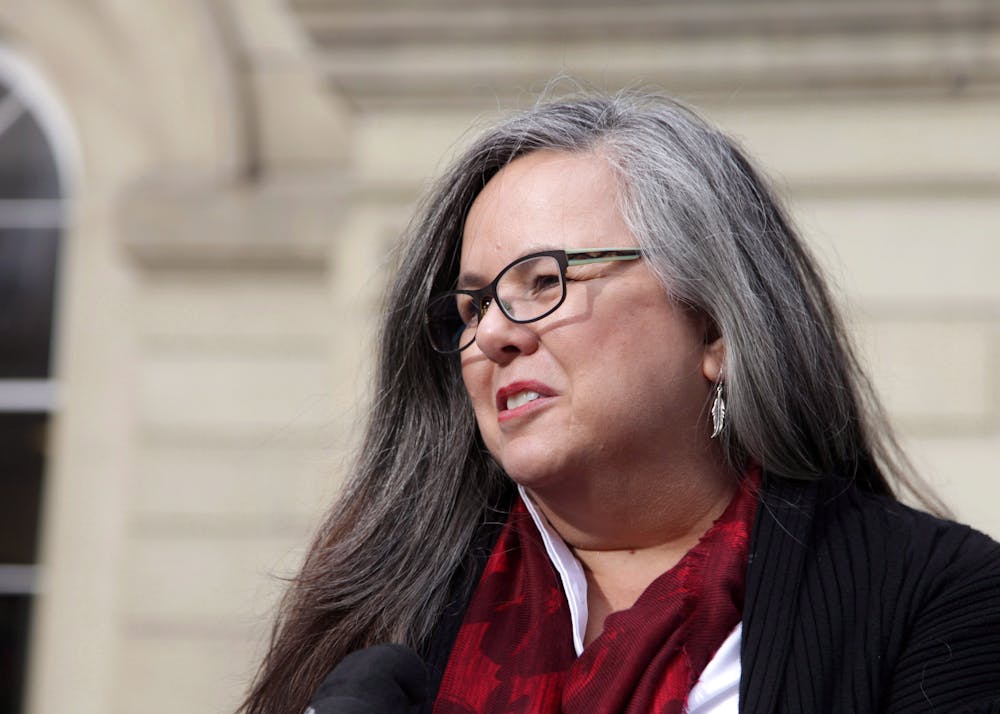
However, the response from Indigenous women has been vastly different. Many prominent Indigenous women do not support Turpel-Lafond’s claim.


Mary Ellen Turpel-Lafond is a prominent scholar and former judge. A CBC investigative report raised questions about her Cree ancestry. 
THE CANADIAN PRESS/Darryl Dyck

Women like Cindy Blackstock, who has worked with the community claimed by Turpel-Lafond. Vice-Chief Aly Bear from the Federation of Sovereign Indian Nations retracted her support after evidence came to light. Native Studies professor Kim Tallbear said she no longer believes Turpel-Lafond is Indigenous. And the Indigenous Women’s Collective is calling for the revocation of her honorary degrees.

To understand these differing responses we need to go back to the gender discrimination of the Indian Act.

What is coverture?

Since its implementation in 1876, the act created a system where Indian men were the focal point for determining Indian status. The justification for placing Indigenous men in this role was the British doctrine of coverture.

Much has been said about the legal fictions that formed the foundation of colonialism, like the doctrine of discovery and terra nullius. However, coverture and the resulting entrenchment of patriarchy within Indigenous communities does not get as much attention.

With coverture, a married woman is not viewed as a separate legal entity from her husband. This doctrine, developed in England, was brought to Canada with colonization and was used to prevent women from being recognized as persons, holding property, testifying against her husband, voting or passing on Indian status to their spouses or children.
\
Coverture was a legal doctrine in English common law which held that a married woman had no legal identity separate from her husband.
(Shutterstock)


Coverture in the Indian Act

While coverture ended in England in the 19th century, and was gradually eroded in mainstream Canadian society, it remained embedded in the status provisions of the Indian Act.

When the Indian Act was first passed in 1876, people who qualified for Indian status were those who were:An Indian male.

Children of an Indian male.

A woman married to an Indian male.

This meant that a European woman who married an Indian man could gain Indian status, as would any children she bore while married to him. However, an Indian woman who married a European man lost her status and she and her children were viewed as white. This change in status meant many Indigenous women were forced off reserves and away from their communities.

The inability of Indigenous women to keep their status after marriage only ended after decades of legal struggles by women like Sandra Lovelace Nicholas, Jeannette Corbiere Lavell, Yvonne Bedard and Sharon McIvor.

The passing of Bill C-31 in 1985 enabled Indigenous women to regain their Indian status and keep it upon marriage to a non-Indigenous man. But they were still not able to pass full status on to their children the way that Indigenous men could.

Today, their descendants are still being discriminated against. Unlike Indigenous men, Indigenous women have never been able to pass Indian status to their spouses.


In 2017, Lynn Gehl, who is Algonquin Anishinaabe-kwe, won a case before the Federal Court of Appeal after struggling for years to be registered under the Indian Act. 
THE CANADIAN PRESS/Colin Perkel

Struggle for equality

While Indigenous women were fighting for equality in status under the Indian Act, advancements towards self-governance were being made with the inclusion of Aboriginal rights in the Constitution. However, male-dominated organizations such as the National Indian Brotherhood, the precursor to the Assembly of First Nations, took the lead in constitutional amendments, to the exclusion of Indigenous women.

Discrimination continued through backlash and fear that Indian women who might want to return home would place strain on limited resources. Many First Nations established criteria that prevented the women and their descendants from becoming full members in their communities, entitled to the same benefits and privileges that Indigenous men and their descendants have always had.

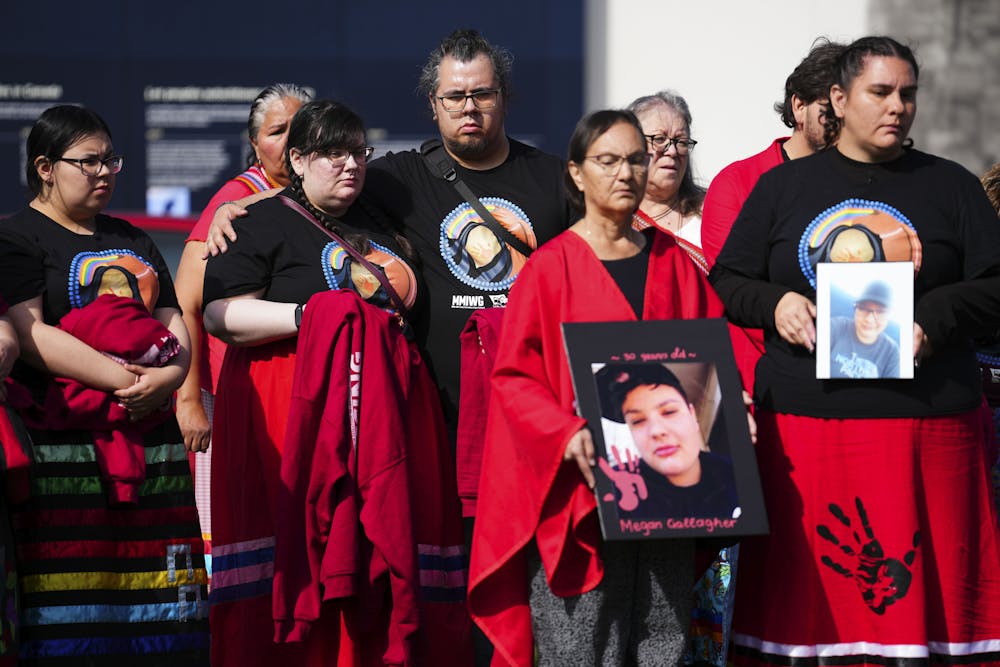
This has led to disadvantage and extreme hardship, as outlined in the report of the National Inquiry into Murdered and Missing Indigenous Women and Girls.


People gather on Parliament Hill for the National Day of Awareness for Murdered and Missing Indigenous Women and Girls on Oct. 4, 2022. 
THE CANADIAN PRESS/Sean Kilpatrick

Indigenous women and their supporters have proposed changes to the Indian Act that would neutralize the legacy of coverture by making all Indians equal. These changes did not receive sufficient support to be implemented. There has been no national campaign to allow spouses of Indigenous people to gain status under the Indian Act.

These types of issues, which are central to the advancement of self-government should be decided by nations with the full participation of Indigenous women. Instead, self-governance work often progresses without addressing the history of gender discrimination.

Discussions about the source of Indigenous identity must take place with the full involvement of Indigenous women. The history of coverture and unresolved gender discrimination must be considered when considering false claims of indigeneity. In academia, those making the false claims tend to be female, and it is Indigenous women who they are displacing.


Author
Cheryl Simon
Assistant Professor in Aboriginal and Indigenous Law, Dalhousie University
Plan to protect 30% of Earth divides and inspires at Cop15

The target is dominating at the biodiversity summit, but the problem of finding a balance between Indigenous peoples’ rights and conservation remains unresolved


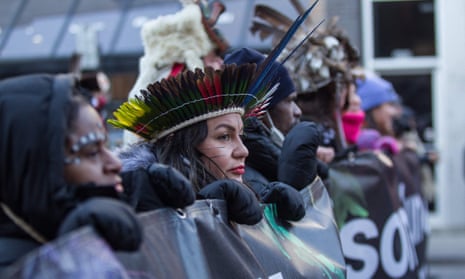
Members of the Indigenous community take part in a march for biodiversity for human rights at Cop15 in Montreal, Canada on 10 December. 
Photograph: Alexis Aubin/AFP/Getty Images

Phoebe Weston and Patrick Greenfield
Mon 12 Dec 2022 

Just as the climate conference focuses on 1.5C, the UN biodiversity conference appears to have found its north star – protecting 30% of land and sea by 2030. From the moment delegates landed at Montréal-Trudeau airport, adverts at the baggage carousel were frank about Canada’s aims for Cop15: achieving 30x30, the tagline for the proposal. The perceived success of the overall conference hangs on this single target, say those who support it.


Making sense of Cop15: what to look out for in Montreal


The science is clear that humanity must better protect key parts of the planet. The destruction of forests and other vital ecosystems must stop by 2030 if the world is to meet 1.5C, according to the IPCC. But 30x30 is actually just one of more than 20 targets being agreed at the Cop15 biodiversity conference in Montreal, and it also happens to be one of the most divisive issues on the agenda. Everyone at the summit has an opinion about the most high-profile target and what it should mean: for some it is not ambitious enough, for others it is impossible to enforce, but the main criticism is that area-based conservation violates human rights.

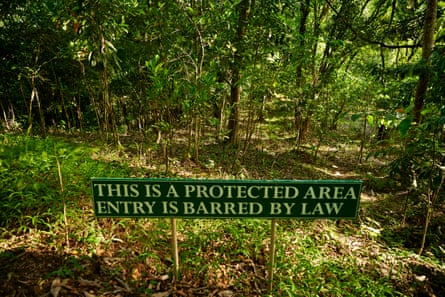
This is because of associations of “fortress conservation”, where people who had been stewards of natural spaces for thousands of years were removed from protected areas. Since the 19th century, this has resulted in human rights abuses and millions of people being displaced from their homelands.

There are very, very painful stories of how Indigenous peoples’ rights have been violated

The language around Indigenous peoples at Cop15 is positive, with a focus on “rights-based conservation”, which means Indigenous peoples and local communities (IPLCs) are seen as protectors of land. This is supported by science – so even if someone disregarded human rights, it is the most effective way of protecting the planet. Indigenous peoples make up around 5% of the world’s population but they protect 80% of its remaining biodiversity.

In the current draft of the text, which will be completed at the end of the conference over the weekend of 17 December, the exact role of IPLCs when it comes to 30x30 is still being contested. Many are cautious – and these are the people who have the most to lose.

A sign barring entrance to the conservation area of the Masungi Georeserve in the Philippines. Photograph: Jes Aznar/Getty Images

“There are very, very painful stories of how Indigenous peoples’ rights have been violated, how they have been killed, taken out of their territory and caused to become extinct because of the expansion or the establishment of protected areas,” says Jennifer Corpuz, who is part of the Kankana-ey Igorot people in the northern part of the Philippines. She represents the International Indigenous Forum on Biodiversity.

Corpuz is keen to start a new chapter, and supports the 30x30 target. “We are here as Indigenous peoples to send the message that we cannot achieve ambitious conservation targets without fully reflecting and respecting and protecting the rights of Indigenous peoples … We cannot achieve 30x30 without Indigenous peoples, I cannot overstress it,” she said.

But others question the mentality of those trying to enforce it – even if it looks good on paper. Lakpa Nuri Sherpa, who is from Nepal, and represents the Asia Indigenous Peoples Pact, questioned whether the “top-down” approach associated with 30x30 would work unless those implementing it radically changed their approach to Indigenous peoples. “That’s where the problem lies because the solution comes from the top, and they don’t really know the realities on the ground, and the ‘solution’ doesn’t become a solution,” he says, adding that it is crucial IPLCs are treated with trust and respect, with a “spirit of true partnership”.

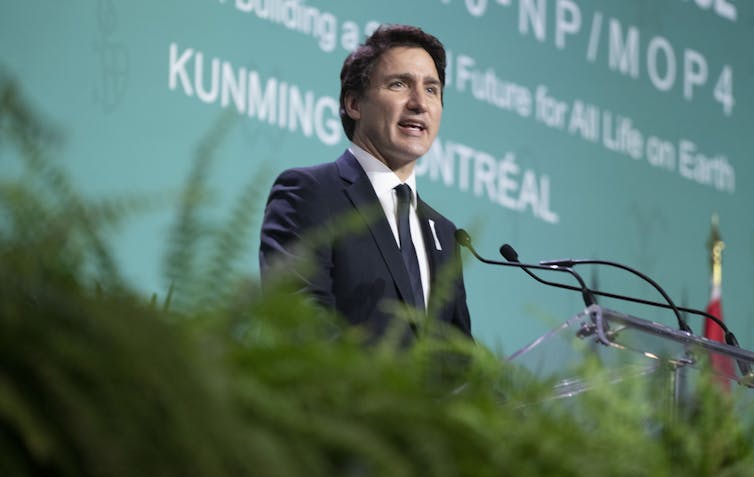
To the Canadian prime minister, Justin Trudeau, 30x30 is a crucial part of a successful agreement for protecting key ecosystems and propelling Indigenous-based conservation models, especially in large countries, such as Brazil, Russia and China. He said his country was starting a “story of reconciliation” with Indigenous peoples.

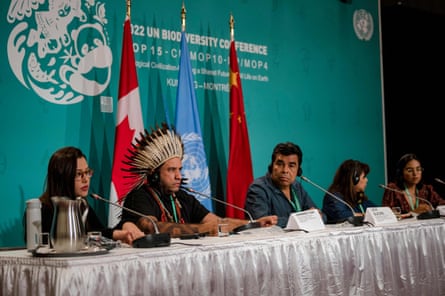
Representatives of Indigenous peoples from Latin American countries hold a press conference during Cop15. 
Photograph: Andrej Ivanov/AFP/Getty Images

In November 2021, a study contained maps of the ecosystems that humanity must not destroy in order to meet climate targets, which include the vast boreal forests and peatlands of Russia, China and the US, and the tropical forests of the Amazon, Congo basin and Indonesia. These areas hold 139bn tonnes of “irrecoverable” carbon and researchers said this is where 30x30 efforts should be concentrated.

There are a growing number of coalitions around protecting these ecosystems. At Cop27, Brazil, the DRC and Indonesia announced a big three rainforest coalition and said they would coordinate at UN climate and biodiversity talks on their conservation. The incoming Brazilian president, Luiz Inácio Lula da Silva, has said that he would convene a pan-Amazonian meeting on its conservation soon into his time in office. Indigenous groups proposed a protected area to cover the world’s largest rainforests, equivalent to the size of Mexico, to be created by 2025 at the last biodiversity summit in 2018, known as 80 by 25.

Campaign for Nature is pushing for conserving at least 30% of land and sea by 2030, seeing it as a milestone, with its director Brian O’Donnell describing it as a “floor not a ceiling”, saying the world should be pushing towards 50%, an important step to achieving Harvard biologist EO Wilson’s vision of protecting half the planet for the long-term survival of humanity. When talking about the areas that need to be preserved, it has to include the most biodiverse-rich areas, with connections between them to avoid island conservation, he says.

But another point of contention within the target is whether every country has to protect 30x30, or whether it is a global target (ie the Netherlands couldn’t make it, but countries like Brazil could do much more). In this case, richer countries with less biodiversity should be paying poorer, more biodiverse countries to not destroy their nature, as they are international – as well as national – assets.

Some countries are asking developed nations how they can be expected not to chop down their forests just as rich countries did in the past. In their opening statement at Cop15, the group of megadiverse countries, which includes Brazil, India and South Africa, said the 30% target would require significant financial and technical support

O’Donnell says: “They’re talking about a financial package for the whole framework, but a lot of people are discussing it in terms of the 30x30 target.”

Representatives of IPLCs say that even if this money is agreed, it could not reach the people stewarding the land. “It’s not for building theme parks,” one representative said at the International Indigenous Forum on Biodiversity press conference. They have reason to be worried – at Cop27, $1.7bn was pledged to Indigenous peoples in recognition of their role in protecting biodiversity, but the first year progress report found only 7% of total funding went to IPLC organisations.

Some argue that 30x30 is a distraction from the rampant overconsumption that drives biodiversity loss. Photograph: Mike Muzurakis/IISD/ENB

Another issue is whether sustainable use of resources should be allowed within these protected areas and, therefore, what it actually means for something to be protected.

In England, for example, the government says it is protecting around 28% of land for nature, but in reality it is closer to 3%, one report found. The EU – which is championing 30x30 – was accused of trying to water down the target by arguing that extractive industries, such as mining and drilling, should be allowed in protected areas, provided they do not negatively affect biodiversity.

Some argue that 30x30 is a distraction from the rampant overconsumption that drives biodiversity loss – and it is actually the endless extraction of the planet’s resources that needs to be tackled. If achieved in isolation, 30x30 would just result in more rapid destruction of the remaining 70% of the planet, not under official, state protection. This is where other targets – such as businesses taking into account their impacts on nature, rewilding subsidies, cutting down pollution and pesticides – all become important.

Achieving an agreement on 30x30 will be a milestone, but Cop15 will only have any hope of stemming biodiversity loss if all parts of the agreement work.

Find more age of extinction coverage here, and follow biodiversity reporters Phoebe Weston and Patrick Greenfield on Twitter for all the latest news and features

Delgamuukw 25 years on: How Canada has undermined the landmark decision on Indigenous land rights


Members of the Gitxsan and Wet'suwet'en First Nations hug to celebrate the Supreme Court of Canada’s decision to recognize Indigenous land rights. 
THE CANADIAN PRESS/Chuck Stoody

 THE CONVERSATION
Published: December 11, 2022 
Shiri Pasternak
Assistant Professor of Criminology, Toronto Metropolitan University

This year marks the 25th anniversary of the Supreme Court of Canada’s Delgamuukw case on Aboriginal title. In 1997, the Wet’suwet’en and Gitxsan Nations brought the watershed case before the Supreme Court, yet a countrywide battle remains over implementation of the Delgamuukw decision involving all First nations.

The Nations sought a declaration of ownership and jurisdiction over their lands. The Supreme Court agreed that Indigenous Peoples held a unique property right to their land that was held as a collective interest by a nation.

The court’s ruling addressed a number of issues including the extinguishment of Aboriginal title and the use of oral history in establishing land rights.

The case presented First Nations with new possibilities to seek legal action against the government for control over Indigenous territories.

Aboriginal title and the Crown


First Nation leaders aimed to reform the comprehensive land claims policy. The policy provides the only negotiating framework for Indigenous Peoples to resolve their outstanding territorial land claims with the Crown.

As a result of the Delgamuukw decision, Indigenous leaders argued the policy no longer aligned with Canadian law because it required Indigenous people to cede their title to the Crown.

If Delgamuukw recognized the unique proprietary rights of Indigenous Peoples to their land, why should they be forced to surrender those rights through a federal policy?

Herb George, who has served as Speaker for both the Gitxsan and the Wet’suwet’en Nations, was a key figure and strategist in the Delgamuukw case. 
THE CANADIAN PRESS/Tom Hanson

Before Delgamuukw, the concept of Aboriginal title as a property right was subject to a kind of plausible deniability.

The 1973 Supreme Court of Canada decision in Calder v. British Columbia was the first to wobble that deniability. The court found that the creation of British Columbia did not automatically extinguish “Indian title.” The decision led then-prime minister, Pierre Trudeau to reportedly observe: “Maybe you have more rights than we thought you did.”

The case led to the creation of the comprehensive claims policy. What soon became clear, though, was that the new claims policy rested on the old colonial model of sovereignty established by the British: it required Indigenous Peoples to surrender and release their title rights to the Crown. It was, in essence, a policy that extinguished Indigenous land rights.

While some nations optimistically entered negotiations, others turned to the courts, especially after the patriation of Aboriginal rights into the constitution in 1982.
Government indifference

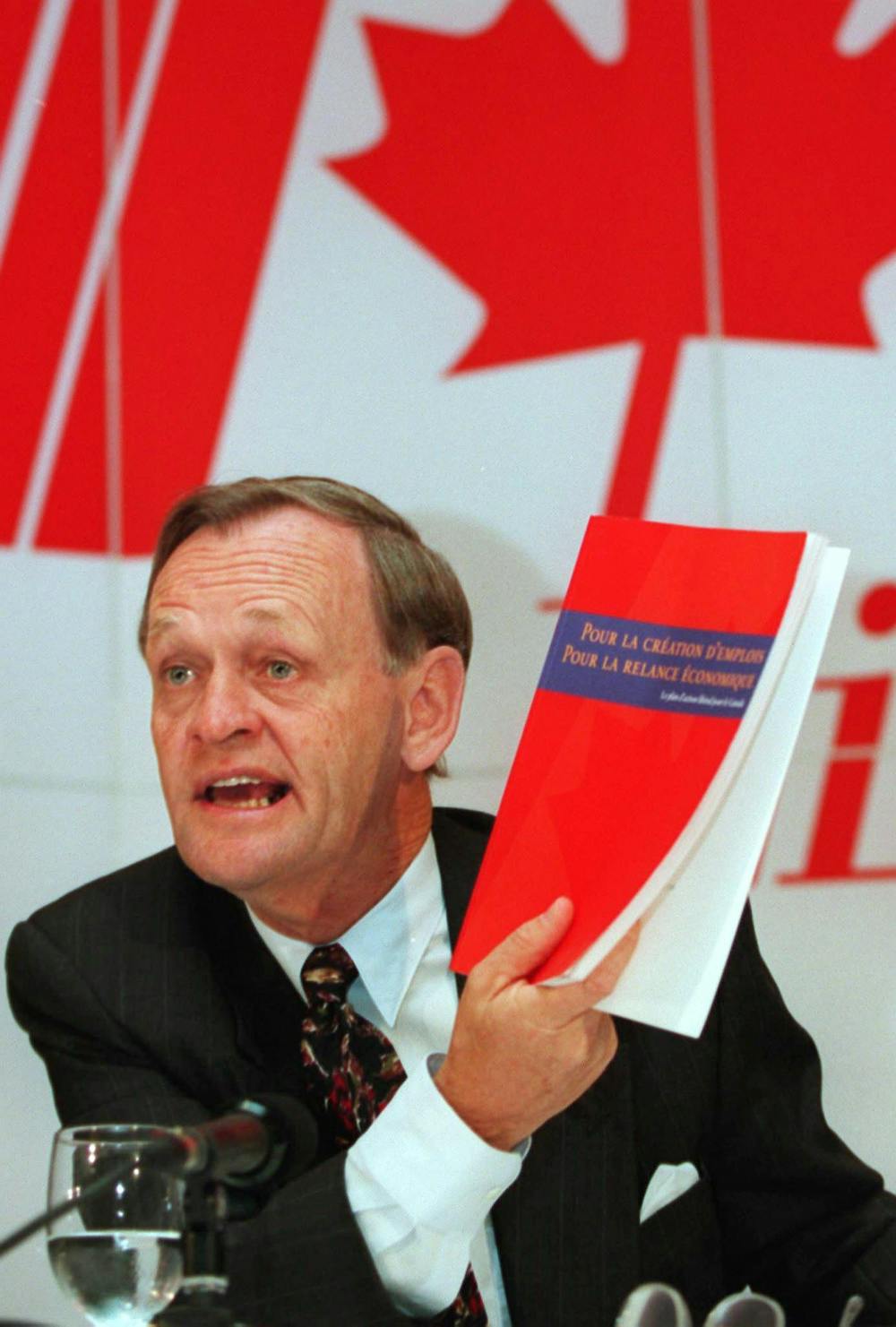
By the time Delgamuukw reached the courts, the struggle was long underway to reform the comprehensive claims policy. When the Liberals came to power under Jean Chrétien in 1993, the party’s Red Book committed to an independent claims commission to address the government’s conflict of interest in the resolution of claims
.
Jean Chrétien holds a copy of the Liberal Red Book during the 1993 election campaign. 
CP PICTURE ARCHIVE/Tom Hanson

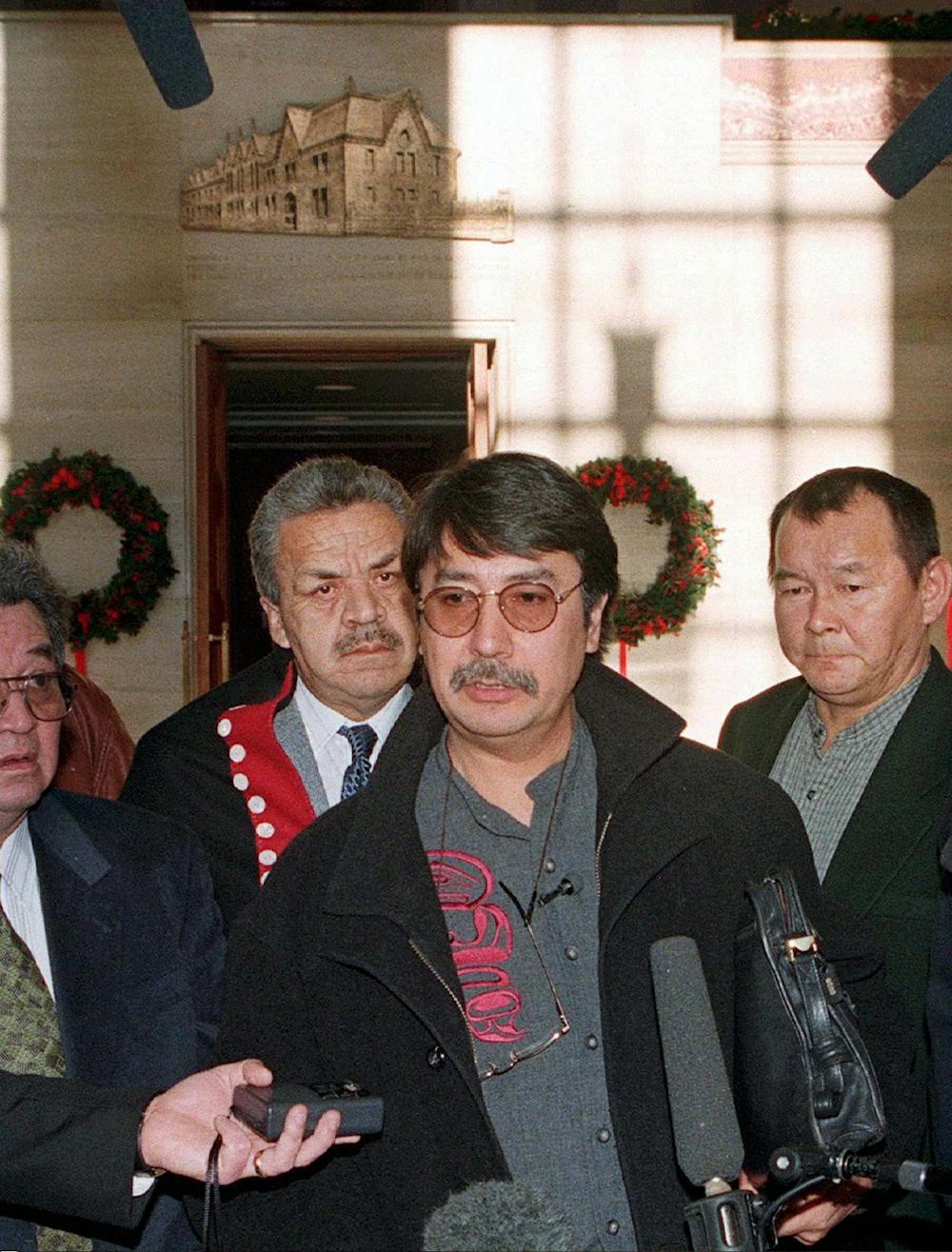
But in 1996, Assembly of First Nations (AFN) national chief, Ovide Mercredi, publicly burned the Red Book outside a Liberal convention, disgusted with the government’s failure to fulfil its promises.

Government indifference persisted. But Delgamuukw increased pressure across the country.

One AFN resolution in 1998, for example, found in archived records created by policy researcher Peter Di Gangi, called for the “complete rejection of the concept of extinguishment, and any equivalent concept, such as ‘surrender and grant back’ as the premise for settling new treaties.”

In 1998, Canada set up discussions with the AFN to undertake a Delgamuukw national review process.

But within a couple of years, documents I received as part of a Freedom of Information request from B.C.’s Ministry of Indigenous Relations and Reconciliation show that some First Nations viewed the process as a “smokescreen for the continued refusal to recognize Aboriginal title.”

The AFN created the Delgamuukw Implementation Strategic Committee (DISC) in 1998 to prepare legal briefs and recommendations for the Department of Indian Affairs to establish new mandates to review and revise the land claims policy in light of the legal decision.

The DISC made several key recommendations to Ottawa in May 2000. They included establishing a panel of experts to compare the comprehensive land claims policy to the principles contained in Delgamuukw.

However, Canadian officials instead said that “there was no Cabinet mandate to consider changes to the policy.” Others were informed that treaty negotiations are not “rights” based.

Land claims to #LandBack

The struggle over the land claims policy following Delgamuukw is a crucial chapter in the #LandBack movement. And it forecast the possibilities for land reclamation and decolonization moving forward.

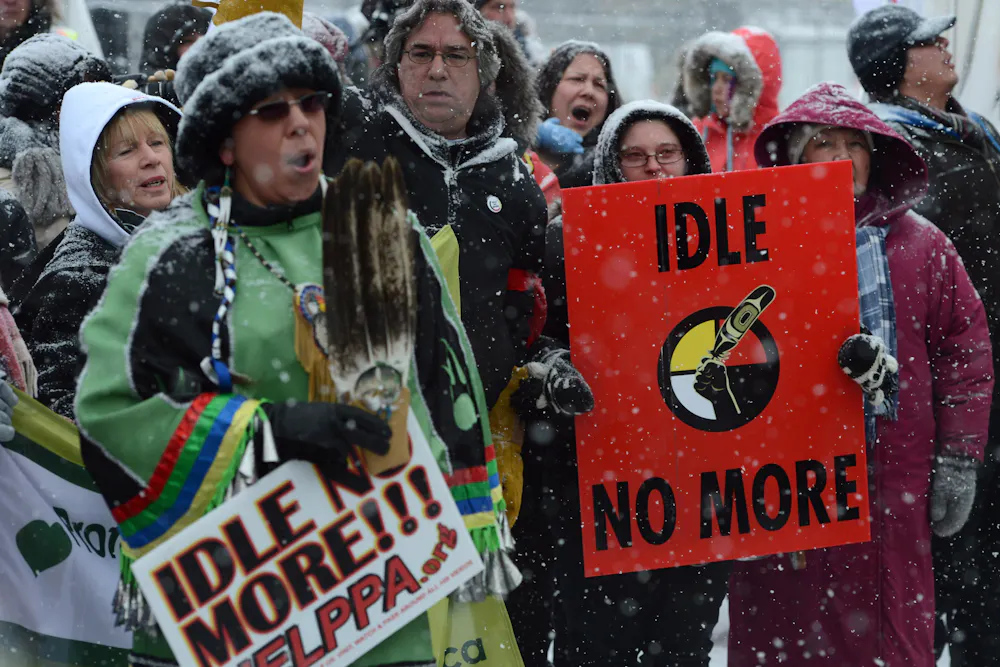
Grassroots movements brought the issue back to national attention as part of the Idle No More movement. In its wake, two senior oversight committees (SOC) were established in 2013 with First Nation representation. One on treaties and one on comprehensive claims.

\
An ‘Idle No More’ gathering on Parliament Hill in January 2013.
 
THE CANADIAN PRESS/Sean Kilpatrick

Sidelining these efforts, the then-Harper government commissioned a special report in 2015 to independently review the land claims policy. The report led to a new “results-based” approach to negotiations. But that approach maintained the same frameworks that extinguished Aboriginal title.

While First Nation leaders were pushing for fundamental reform, the government instead created off-ramps into sectoral, incremental and revenue-sharing agreements. The new generation of policies over land and resources, such as forestry and fishing specific tables, would avoid discussion of title altogether.

The Trudeau government would continue this tradition. In 2018, Prime Minister Justin Trudeau promised to develop a Recognition and Implementation of Indigenous Rights Framework. The new framework promised to “replace policies like the Comprehensive Land Claims Policy and the Inherent Right to Self-Government Policy.” Trudeau promised, instead, a co-development approach to negotiations and mandates.

But the proposed framework was never tabled. Instead, the federal government focused its energy on establishing Recognition of Indigenous Rights and Self-Determination discussion tables.

The mandates of these over 70 tables have never been made public. Whether and how Aboriginal title is recognized remains a mystery.

While extinguishment clauses no longer appear in the comprehensive land claim policy’s wording, it still requires the exchange of title lands for private property. The new policy off-ramps set aside any acknowledgment of title as the basis for negotiations.

Indigenous groups have made the best out of an impossible situation. But the #LandBack movement has shown both the possibilities and the dangers of working outside federal land claims frameworks.

Many nations have asserted Indigenous law on the ground by issuing declarations and exercising their jurisdiction to govern their territories and resources. They put the onus of “land claims” back on Canada to prove.

But this strategy for title recognition has also proved dangerous. For the Wet'suwet'en hereditary leadership, who brought the Delgamuukw case to court, asserting their rights in a coveted energy corridor has provoked one of the most violent colonial conflicts in Canadian history.

That violence reflects many things, but foremost among them: Canada’s refusal to align land claims policies with its own law.

OKA


Indigenous spiritual teaching in schools can foster reconciliation and inclusion


THE CONVERSATION
Published: December 4, 2022 

Indigenous education has become an area of growing concern for public schools across Canada. We are living in an era of reconciliation where Indigenous populations are growing and interest in confronting our shared histories continues to develop. Part of that involves focusing on how primary and secondary schools are addressing the Indigenous experience in Canada.

The way primary and secondary schools have engaged in Indigenous education has varied from province to province and across divisional jurisdictions. Some have focused on how history and social studies can incorporate Indigenous experiences. A smaller number of schools have ventured to develop mathematics and science curricula with Indigenous foci.

There are many different subjects that can benefit from the inclusion of Indigenous perspectives. Yet there appears to be one topic that is common across most school initiatives in Canada — that of spirituality.
Indigenous spirituality in schools

Indigenous spiritual activities have become more common in Canadian public schools in recent years. The Truth and Reconciliation Commission of Canada’s (TRC) final report and Calls to Action highlighted the need for improved school programming. In order to understand many aspects of the Indigenous experience, understanding the spiritual dimensions of those experiences and their associated ceremonies are necessary.


The TRC’s final report highlighted the need to improve teaching about Indigenous Peoples in Canadian schools. (Shutterstock)

The TRC’s Calls to Action on “education for reconciliation” were rightly understood as change that required collaboration with Indigenous Peoples. In this collaborative ethos, something emerged regardless of the discipline or subject being discussed — the spiritual orientations of Indigenous Peoples.

Ceremonial observances like smudging, and inclusion of Indigenous spiritual leaders and Elders, became necessary components of any educational initiative in which Indigenous perspectives are prioritized. The imperative here is clear: Indigenous perspectives in school curricula are best understood within the context of their respective Indigenous worldviews.

Say, for example, a school wanted to adjust its social studies teaching about family relationships in traditional community settings. Organizing principles espoused by Indigenous Peoples would be a necessary part of the curriculum. Students learn about kinship systems such as clans, hereditary leadership and Elders’ roles. And as they enter into these areas of experience, the spiritual elements and traditional understandings become important to consider.
School-based initiatives

One of the more publicized examples of Indigenous spirituality in public school programming comes from the Louis Riel School Division (LRSD) in Winnipeg. The LRSD aimed to develop a Minecraft world that would reflect the traditional Anishinaabe territories of Southern Manitoba for use in schools.

In the 2019-20 school year, the LRSD invited Indigenous students, staff and community members (including respected Elders) to confer on the development of the Minecraft world. The eventual product was Manito Ahbee Aki (Anishinaabemowin for “the place where the Creator sits”) which allows students to explore the traditional perspectives of the territories. The product continues to be a great resource for students
.
Schools have used games like Minecraft to teach students about Indigenous culture and spirituality. (Shutterstock)

The factual aspects of the project, such as geographical and linguistic considerations, were important. In addition, the spiritual dimensions of such things as the Seven Sacred Teachings and the role of Indigenous Knowledge Keepers as in-game characters were central to this development. When the final product was unveiled, it was done at a traditional feast led by local Indigenous Elders who led pipe ceremonies.

The LRSD Minecraft example is one of many school-based initiatives across Canada incorporating Indigenous spirituality. From customs like powwows to ceremonial activities involving smudging, Indigenous spirituality has become an important part of public schooling in much of Canada. It is seen as, among other things, an important aspect of the reconciliation journey.

Although the progress achieved by schools has been welcomed by many, and even viewed as an organic part of school activities, this progress isn’t without its challenges.

Indigenous school staff and community members who have tried to initiate activities that involve Indigenous spirituality have faced push-back from school administrators, the larger community and even the laws and policies that govern school operations.

Change is not always easy. But it is the efforts of brave advocates for Indigenous education that have helped create spaces in our schools where Indigenous students may learn and grow in a way that honours their identities. Our Canadian social fabric is all the better for it.

Author
Frank Deer
Professor, Associate Dean, and Canada Research Chair, Faculty of Education, University of Manitoba


Digital technologies for biodiversity protection and climate action: Solution or COP out?


Digital technologies like drones are being heavily promoted to address the threats of climate change and biodiversity loss.
(Unsplash)


THE CONVERSATION
Published: December 12, 2022


With biodiversity declining at unprecedented rates and less than a decade remaining to avert the worst effects of climate change, world leaders and policymakers are on the hunt for new and innovative solutions. In the halls and meeting rooms of global COP conferences, digital technologies have been heavily promoted to address these interrelated threats to our ecosystem.

At the recent COP27 climate conference in Egypt, the Forest Data Partnership — a global consortium co-ordinated by the World Resources Institute (WRI) in partnership with the U.S. Department of State, NASA, Google and Unilever — called for a “global alliance to unlock the value of land use data to protect and restore nature.” The WRI promoted its Land and Carbon Lab to measure carbon stocks associated with land use.

Nature4Climate — a coalition of 20 environmental organizations — revealed a new online platform to help implement natural climate solutions. They also exhibited a report on the “nature tech market.” At the COP15 biodiversity conference in Montréal, NatureMetrics, a provider of nature intelligence technology, launched a new digital dashboard to enable standardized measurements of the health of ecosystems.

Many, however, see such efforts as a dangerous push to get untried and untested corporate technologies accepted as “nature-positive solutions” in the Convention on Biological Diversity and climate negotiations.


As researchers examining the role of technologies in biodiversity monitoring and protected area management, we find that these digital technologies have the potential to yield positive results, if co-developed and used ethically with Indigenous Peoples.
Conservation and Big Tech

The influence of the tech industry in environmental governance has grown considerably over the past decade. Tech giants like Microsoft, IBM, Google and Amazon, as well as philanthropic counterparts like the Bezos Earth Fund, have invested significantly in technologies to address global environmental issues.Today, technologies are transforming the world’s forests and oceans into new frontiers of digital commoditization and investment. (One Earth/Wageningen University & Research), CC BY-NC-ND

Microsoft’s $50 million “AI for Earth” program, for instance, aims to “transform the way we monitor, model and ultimately manage Earth’s natural resources through grants, technology and access to data.” Such programs, including the Forest Data Partnership, have helped establish partnerships involving philanthropic, academic, non-governmental, public and private sector institutions.

They not only transform conservation, but natural environments as well. The deployment of digital technologies throughout natural environments, from satellites and aerial sensors to drones, camera traps and wearable sensors, has transformed the Internet of Things into an internet of trees, oceans and wildlife.

In our new economic context, in which data is the new oil, such technologies also transform the world’s forests and oceans into new frontiers of digital commoditization and investment.
Climate action or corporate greenwashing?

Critics warn, however, that these techno-centric solutions are simply corporate greenwashing and that they actually intensify biodiversity loss and climate change. While Microsoft, Amazon and Google tout the use of their technologies for environmental good, they continue to sell cloud computing and artificial intelligence services to oil companies around the world.
Research on Microsoft’s AI For Earth program shows that its cloud computing and AI products help oil companies better extract and distribute oil. (AP Photo/Andy Wong)

Research on Microsoft’s “AI For Earth” program shows that it greenwashes Microsoft’s corporate reputation, while its cloud computing and AI products are promoted to help oil companies better extract and distribute oil. Its vast data centres also use significant amounts of electricity, much of which comes from fossil fuels.

While Microsoft does attempt to offset its emissions by investing in California’s Klamath East project, a stretch of protected woodland managed by a forest products company, its carbon offsets have literally gone up in smoke in recent wildfires.

Similar claims have been made about Amazon and its environmental programs. While Amazon Web Services advertises its support for conservation and climate action, the company continues to drive greenhouse gas emissions by offering its cloud computing and AI services to the oil and gas sector.

In a critique of the Forest Data Partnership, the environmental organization Greenpeace argued that it is “nothing but a green light for eight more years of forest destruction, with little respect for the rights of Indigenous Peoples and local communities.” It also argued that this allows polluters to do more business as usual through “carbon trickery instead of advancing true climate action.”
Technology for a just and sustainable future

At COP15 there has been a critical parallel movement to support Indigenous-led conservation to meet global biodiversity and climate change commitments.

Making up just five per cent of the global population, Indigenous Peoples steward 36 per cent of our remaining intact forests and 80 per cent of the world’s biodiversity.

Digital technologies, however, often marginalize local and Indigenous communities in conservation by supporting a shift toward more militarized and coercive approaches to conservation that position communities as targets of surveillance and policing.

Can these digital technologies truly support community and Indigenous-led conservation? (James Stinson), Author provided

Given these concerns, it is important to think critically about the role of digital technologies in global biodiversity and climate frameworks. Can these digital technologies truly support Indigenous-led conservation, climate action and reconciliation with the Earth?

The first step to this would include monitoring new technologies in the new biodiversity and climate frameworks. Digital tools must not be used to maintain the status quo by securing carbon credits and corporate profits. Instead, they need to be co-developed ethically and used with Indigenous Peoples and land defenders to protect their rights to — and control over — the environments they cultivate, care for and protect.


Authors
James Stinson
Postdoctoral Fellow, Dahdaleh Institute of Global Health Research and Faculty of Education, York University, Canada

Disclosure statement

James Stinson receives funding from the Social Sciences and Humanities Research Council (SSHRC). He is Principle Investigator of the SSHRC-funded project "Smart Conservation and the Production of Nature 3.0 in Belize."

Lee Mcloughlin
PhD student Global Sociocultural Studies, Florida International University

Disclosure statement
Lee Mcloughlin receives funding from Social Sciences and Humanities Research Council (SSHRC). He is a research assistant for the SSHRC-funded project "Smart Conservation and the Production of Nature 3.0 in Belize".
COP15’s Global Biodiversity Framework must advance Indigenous-led conservation to halt biodiversity loss by 2030


The Parties to the Convention on Biological Diversity adopted their new post-2020 Global Biodiversity Framework on Dec.19, 2022. T
HE CANADIAN PRESS/Paul Chiasson


THE CONVERSATION
Published: December 20, 2022 

In the early hours of Dec. 19 — the last day of the 15th Conference of the Parties (COP15) conference in Montréal — the Parties to the Convention on Biological Diversity (CBD) adopted their new post-2020 Global Biodiversity Framework.

The goals and targets agreed within this framework, including the widely discussed Target 3, will guide conservation policy and investment for years to come. Target 3 — also known as the “30x30” target — calls for the conservation of 30 per cent of global land and sea areas by 2030.

The CBD has long promoted the creation of protected areas (parks) for the protection of both terrestrial and marine environments. The “30x30” target is a significant increase from the Aichi targets, set during the COP10 conference in Aichi Prefecture, Japan, which called for 17 per cent terrestrial and 10 per cent marine areas to be protected by 2020.

As researchers who study conservation governance, we have closely followed the four years of negotiations that led to this historic agreement. We believe that as protected and conserved areas increase under the framework, an equity-based approach, which respects Indigenous rights and title, is essential to help bring the transformative changes we need to halt and reverse biodiversity loss.


Challenges of ‘30x30’

In 2019, scientists called for a global deal for nature to save biodiversity, including a minimum of 30 per cent of Earth to be formally protected. The High Ambition Coalition — a group of more than 100 countries including Canada — has advocated for the “30x30” target since its launch in January 2021.

Such area-based targets, however, raise concerns. Protected areas have perpetuated colonial ideologies and violated Indigenous rights.


Some international organizations, like Survival International, campaigned against “30x30,” fearing that it would lead to further land grabs, human rights violations and dispossession of Indigenous Peoples globally, such as the recent eviction of the Maasai from the Ngorongoro Nature Reserve in Tanzania.

At COP15, many countries insisted that the ambitious “30x30” target must be matched by similarly ambitious funding. The Democratic Republic of the Congo initially rejected the framework on Monday, arguing that promised financial transfers from developed to developing countries were still insufficient. Although Congo later agreed to the framework, the tension during the meeting was high. The delegate from Namibia summarized it saying colonial injustice underlies all problems encountered in the CBD.

These concerns — regarding colonialism, global injustice and human rights violations — informed the negotiations of the Framework at COP15.

One sticking point was whether Indigenous and traditional territories should be included in Target 3 as a distinct category of conservation, separate from protected areas. The International Indigenous Forum on Biodiversity argued that incorporating Indigenous and traditional territories into existing conservation policies, like government-led protected areas, undermines Indigenous self-determination.

Ultimately, the final framework fell short of recognizing Indigenous territories as a distinct category of protection.

Some organizations are concerned this will put Indigenous Peoples at greater risk of human rights violations, while others welcomed the strong language in the framework regarding respect for the rights of Indigenous Peoples and local communities.

Canada’s role in ‘30x30’

Despite the concerns raised, the Global Biodiversity Framework creates opportunities to further Indigenous-led conservation. For example, following international guidelines, the creation and management of Indigenous Protected and Conserved Areas (IPCAs) can count towards the 30 per cent target.

Indigenous Protected and Conserved Areas are Indigenous-led, represent a long-term commitment to conservation and elevate Indigenous rights and responsibilities.

According to the Indigenous Circle of Experts, IPCAs are Indigenous-led, represent a long-term commitment to conservation and elevate Indigenous rights and responsibilities.

In Canada, there is growing recognition of the role of IPCAs in meeting conservation goals while also supporting reconciliation efforts. In August 2021, for example, the Government of Canada announced an investment of up to $340 million in new funding over five years to support Indigenous leadership in nature conservation. Over $166 million of this will be dedicated to supporting IPCAs.

During the opening ceremony of COP15, Prime Minister Justin Trudeau announced funding of up to $800 million to support Indigenous-led conservation initiatives over seven years. Later in the summit, Minister of Environment and Climate Change, Steven Guilbeault, jointly announced a new First Nations National Guardians Network with Valérie Courtois, the Director of the Indigenous Leadership Initiative.

Prime Minister Trudeau announced funding of up to $800 million to support Indigenous-led conservation initiatives over seven years during the opening ceremony of COP15 on Dec. 6, 2022. THE CANADIAN PRESS/Paul Chiasson

The federal, provincial, territorial and Indigenous governments have also announced work towards establishing new IPCAs, including one in the Seal River Watershed in Manitoba and another one around Great Bear Lake (Tsá Tué) in the Northwest Territories.

These investments demonstrate a growing recognition that Indigenous-led stewardship has equal or better conservation outcomes than government-led conservation efforts. It also shows the need for innovative forms of conservation governance beyond traditional protected areas. IPCAs present an important opportunity for transformative change, where Indigenous Peoples’ rights and responsibilities are upheld, rather than undermined, while working toward global conservation goals.
Beyond COP15

In response to the CBD’s previous Aichi targets, the percentage of the Earth’s surface covered by protected areas increased from 14.1 to 15.3 per cent on land and from 2.9 to 7.5 per cent in the marine environment between 2010 and 2019. The implementation of Target 3 could increase protected area coverage much further in the coming years.

According to COP15’s final agreement, the implementation of the Framework must follow a human rights-based approach, acknowledging the human right to a clean, healthy and sustainable environment as recognized by the UN.


Here in Canada, the federal government only recently passed the United Nations Declaration on the Rights of Indigenous Peoples (UNDRIP) Act, which recognizes and legally upholds the rights of Indigenous Peoples. The outcome of COP15, therefore, coincides with the national implementation of UNDRIP, informing the role that Indigenous rights will play in Canada’s conservation agenda.

Canada cannot meet its global commitments without centring Indigenous leadership and working in collaboration with Indigenous peoples.

This can be achieved by following the recommendations of the Indigenous Circle of Experts to provide continued — and increased — support for Indigenous-led conservation initiatives, like IPCAs. Supporting Indigenous-led conservation can help improve biodiversity outcomes while upholding our responsibility to human rights and reconciliation.

Authors
Noella Gray
Associate Professor of Geography, University of Guelph
Victoria Hodson
PhD Student, University of Guelph

Disclosure statement

Noella Gray receives funding from the Social Sciences and Humanities Research Council (SSHRC).

Victoria Hodson receives funding from the Social Sciences and Humanities Research Council (SSHRC).