It’s possible that I shall make an ass of myself. But in that case one can always get out of it with a little dialectic. I have, of course, so worded my proposition as to be right either way (K.Marx, Letter to F.Engels on the Indian Mutiny)
Thursday, December 07, 2023
Video shows Israeli soldier shooting mentally disabled Palestinian in West Bank
Kareem Khadder and Celine Alkhaldi, CNN Wed, 6 December 2023
The Israel Defense Forces has launched an investigation after a video emerged of an Israeli soldier shooting and wounding a mentally disabled Palestinian near the occupied West Bank city of Hebron.
Tarek Abu Abed, known to friends and family as “Ghazzawi,” was on his way home Tuesday when he was stopped by three soldiers and asked for identification, Tarek’s brother Diaa Abu Abed told CNN by telephone on Tuesday.
“Anybody who meets Tarek can tell immediately he has special needs,” Diaa Abu Abed said. “His brain works like a child’s does.”
When Tarek Abu Abed told the men that he did not have identification, an argument ensued that culminated in Tarek being shot, according to his brother.
The IDF confirmed to CNN that Israeli soldiers had been involved in the incident shown in the video said its military police were investigating the encounter.
“Based on the initial information available, it appears that during a check that was conducted earlier today near the city of Hebron, a Palestinian was shot in the leg and was evacuated to receive medical treatment,” the IDF said in a statement.
The video, which is filmed down a street from the incident, appears to show the moments after Tarek said he did not have identification. It shows three men in military fatigues standing over a man who is on his hands and knees, and next to a man in a red shirt, identified by Diaa as Tarek’s friend.
“The man in the video wearing red came to defend him to tell the Israeli soldiers that my brother has special needs,” Diaa Abu Abed said. “He’s known amongst the community for his mental disabilities. The soldiers refused to listen.”
The men had their rifles aimed at Tarek Abu Abed, and shouting can be heard. Abu Abed appears to be attempting to stand up as several local residents look on. He then stands up and approaches one of the men, seemingly agitated. A second man then approaches Abu Abed from behind.
A gunshot rings out, and Abu Abed collapses to the ground. He writhes in pain, as two of the men continue to point their weapons at him.
Diaa Abu Abed said that an onlooker called him, and he arrived on the scene soon after.
The Palestine Red Crescent Society said in a statement on Tuesday that it had transported a 34-year-old man with a bullet wound in his leg from Qalqas to the hospital.
Tarek Abu Abed suffered heavy bleeding and has undergone surgery on his leg, his brother said.
The Israel-Hamas war has increasingly spilled over into the West Bank with settler attacks and clashes leaving hundreds of Palestinians dead.
At least 256 Palestinians have been killed by Israeli troops or Israeli settlers in the West Bank and east Jerusalem since October 7, according to the Palestinian Ministry of Health.
This story has been updated to clarify the IDF’s statement of its role in the incident
Opinion Israel’s use of disproportionate force is a long-established tactic – with a clear aim
Paul Rogers
THE GUARDIAN Tue, 5 December 2023 Photograph: Anadolu/Getty Images
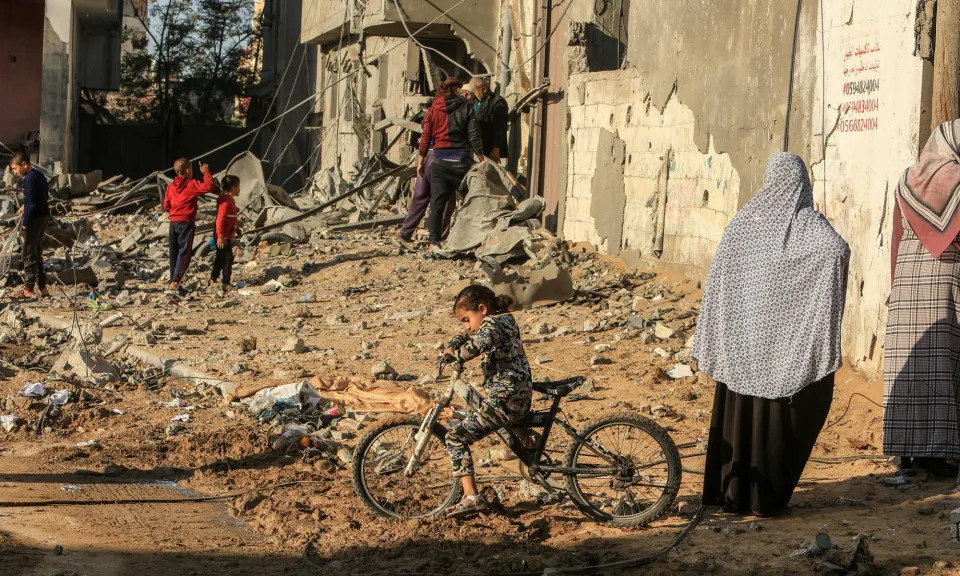
How to make sense of the sheer intensity of Israel’s war in Gaza? One understanding is that it is the result of the enduring shock of the 7 October massacre combined with a far-right government that includes extreme elements. Yet this ignores another element: a specific Israeli approach to war known as the Dahiya doctrine. It’s also one reason why the “pause” was never going to last for very long.
First, let us take stock of the state of Gaza. After a seven-day pause in the airstrikes, the war resumed on Friday. In the last three days, bombing has been heavy, and the total death toll since 7 October has risen to 15,899, according to the Gaza health ministry, with at least 41,000 wounded. Among the dead are 6,500 children, including hundreds of infants.
Physical destruction in Gaza has been massive: 60% of the territory’s total housing stock (234,000 homes) is damaged, 46,000 of which are completely destroyed. The seven-day pause may have provided limited relief from the comprehensive siege but there are still serious shortages of food, clean water and medical supplies.
Despite massive Israeli attacks backed by a near-unlimited supply of bombs and missiles and intelligence support from the United States, Hamas continues to fire rockets. Moreover, it retains a substantial paramilitary ability with 18 of the original 24 active paramilitary battalions intact, including all 10 in southern Gaza.
Palestinian support for Hamas may also be growing in the West Bank, where armed settlers and the Israel Defense Forces have killed scores of Palestinians since the war started. The Israeli government is absolutely determined to continue and is accelerating the war, despite US secretary of state Antony Blinken’s blunt warning to limit casualties and vice-president Kamala Harris confirming that “under no circumstances will the United States permit the forced relocation of Palestinians from Gaza or the West Bank, the besiegement of Gaza, or the redrawing of the borders of Gaza”.
That will count for little, given the extreme position of Benjamin Netanyahu’s war cabinet, where the aim is to destroy Hamas. How this will be attempted relates to the specific Israeli way of war that has evolved since 1948, through to its current Dahiya doctrine, which is said to have originated in the 2006 war in Lebanon.
In July of that year, facing salvoes of rockets fired from southern Lebanon by Hezbollah militias, the IDF fought an intense air and ground war. Neither succeeded, and the ground troops took heavy casualties; but the significance of the war lies in the nature of the air attacks. It was directed at centres of Hezbollah power in the Dahiya area, in the southern suburbs of Beirut, but also on the Lebanese economic infrastructure.
This was the deliberate application of “disproportionate force”, such as the destruction of an entire village, if deemed to be the source of rocket fire. One graphic description of the result was that “around a thousand Lebanese civilians were killed, a third of them children. Towns and villages were reduced to rubble; bridges, sewage treatment plants, port facilities and electric power plants were crippled or destroyed.”
Two years after that war, the Institute for National Security Studies at Tel Aviv University published Disproportionate Force: Israel’s Concept of Response in Light of the Second Lebanon War. Written by IDF reserve Col Gabi Siboni, it promoted the Dahiya doctrine as the way forward in response to paramilitary attacks. The head of the Israeli military forces in Lebanon during the war, and overseeing the doctrine, was General Gadi Eizenkot. He went on to be the IDF chief of general staff, retiring in 2019, but was brought back as an adviser to Netanyahu’s war cabinet in October.
Siboni’s paper for the institute made it crystal clear that the Dahiya doctrine goes well beyond defeating an opponent in a brief conflict, and is about having a truly long-lasting impact. Disproportionate force means just that, extending to the destruction of the economy and state infrastructure with many civilian casualties, with the intention of achieving a sustained deterrent impact.
The doctrine has been used in Gaza during the four previous wars since 2008, especially the 2014 war. In those four wars, the IDF killed about 5,000 Palestinians, mostly civilians, for the loss of 350 of their own soldiers and about 30 civilians. In the 2014 war, Gaza’s main power station was damaged in an IDF attack and half of Gaza’s then population of 1.8 million people were affected by water shortages, hundreds of thousands lacked power and raw sewage flooded on to streets.
Even earlier, after the 2008-9 war in Gaza, the UN published a fact-finding report that concluded that the Israeli strategy had been “designed to punish, humiliate and terrorise a civilian population”.
The situation now, after two months of war, is far worse. With the ground offensive in southern Gaza under way, it will not stop, exacerbated by tens of thousands of desperate Gazans repeatedly trying to find places of safety.
The immediate Israeli aim, which may take months to achieve, appears to be eliminating Hamas while corralling the Palestinians into a small zone in the south-west of Gaza where they can be more easily controlled. The longer-term aim is to make it utterly clear that Israel will not stand for any opposition. Its armed forces will maintain sufficient power to control any insurgency and, backed by its powerful nuclear capabilities, will not allow any regional state to pose a threat.
It will fail. Hamas will emerge either in a different form or strengthened, unless some way is found to begin the very difficult task of bringing the communities together. Meanwhile, the one state that can force a ceasefire is the US, but there is little sign of that – at least so far. Paul Rogers is emeritus professor of peace studies at Bradford University and an honorary fellow at the Joint Service Command and Staff College
Israel is reportedly investigating claims of anomalous stock trading ahead of the Oct. 7 Hamas attacks
Filip De Mott Updated Tue, 5 December 2023 Israel continues to deploy soldiers, tanks and armored vehicles near the Gaza border in Sderot, Israel on October 14, 2023.
Mostafa Alkharouf/Anadolu via Getty Images
Reuters reported on Monday that Israel is investigating claims of anomalous trading ahead of the October 7 terrorist attacks.
A paper by US researchers cites a significant increase in short selling activity in the days ahead of the attacks.
Short interest trades exceeded spikes in Israel's previous crises, such as the 2014 Israel-Gaza conflict.
Israel is looking into claims by researchers in the US of increased short selling activity ahead of Hamas's attacks on Israel on October 7, Reuters reported on Monday.
The Israel Securities Authority told the outlet that authorities are aware of the matter, which "is under investigation by all relevant parties."
ISA did not immediately respond to Business Insider's request for comment.
The newly published study states that in the days ahead of the October 7 assault, the MSCI Israel Exchange Traded Fund underwent a significant spike in short selling, while short interest on hundreds of Tel Aviv Stock Exchange securities also "increased dramatically."
Short selling, which occurs when investors bet that an asset's price will drop, exceeded levels seen during previous crises in Israel, the study added. This includes the 2008 recession, the 2014 Israel-Gaza conflict, and the COVID-19 pandemic.
"Our findings suggest that traders informed about the coming attacks profited from these tragic events, and consistent with prior literature we show that trading of this kind occurs in gaps in U.S. and international enforcement of legal prohibitions on informed trading," researchers Robert J Jackson Jr. and Joshua Mitts wrote.
The study referred to Bank Leumi, a TASE-listed company, as one example. The researchers say that 4.43 million of the bank's shares were sold short between September 14 and October 5. The trades yielded over 30 million Israeli shekels, or about $7.8 million based on the exchange rate in early October before the attack.
The paper says similar patterns occurred in April, when reports emerged that Hamas was planning an attack on Israel. Short volume the EIS fund peaked April 3 at similar levels to those seen on October 2.
"Taken together, this evidence strengthens the interpretation that the trading observed in October and April was related to the Hamas attack rather than random noise," the researchers wrote.
UK
COVID VICTIMS FAMILIES
People removed from COVID inquiry as Boris Johnson apologises for 'pain and suffering'
Sky News Updated Wed, 6 December 2023
Boris Johnson was interrupted by protesters as he apologised for the "suffering" caused by COVID. During his appearance at the official inquiry into the pandemic on Wednesday, four people were removed from the public gallery after holding up pictures, along with the words: "The dead can't hear your apologies."
Mr Johnson told the hearing he was "deeply sorry for the pain and loss and suffering".
But he said he hoped the probe would be able to "get answers to those very difficult questions" that victims and their families were "rightly asking".
• Mr Johnson explaining that he "can't say" whether he would have "gone earlier" in ordering the first lockdown, but that he took "full responsibility" for the decisions made;
• The former prime minister offering an apology to sufferers of long COVID, having described the condition as "b*****ks" in 2021;
• He stood by Matt Hancock, saying the then health secretary did "a good job" whatever his "defects".
Speaking on his first day of questioning at the COVID inquiry he set up to learn the lessons of the pandemic, Mr Johnson said "unquestionably" mistakes were made by his government, adding that he took "responsibility for all the decisions that we made".
Within that included the lockdown decisions and their timeliness, the circulation of the virus in the residential care sector, and the Eat Out to Help Out scheme.
The ex-prime minister, who was ousted from Downing Street in the summer of 2022, said he acknowledged that "so many people suffered, so many people lost their lives".
But he said the government was "doing our best at the time, given what we knew, given the information I had available to me at the time, I think we did our level best".
Mr Johnson placed some blame on the different messaging coming from the different governments in the devolved nations of the UK.
"There was far, far more that united us than divided us," he said. "[But] understandably they're looking to talk directly to their own electorates, there were going to be times when they differed from the main UK government message.
"And I thought that was sometimes at risk of being confusing at a time when we really needed to land messages simply."
But Hugo Keith KC, who led the questioning for the inquiry, asked Mr Johnson why he did not foresee the scale of destruction the COVID pandemic would cause in early 2020, given that the inquiry had seen evidence to suggest others in Westminster were concerned as early as February.
Mr Johnson admitted the wider government "underestimated" the threat posed by the virus, saying the "concept of a pandemic did not imply to the Whitehall mind the kind of utter disaster that COVID was to become".
He said in the "early days of March", government figures and officials "were all collectively underestimating how fast it had already spread in the UK" and thought the peak would be in May or June which turned out to be "totally wrong".
"I don't blame the scientists for that at all," he said.
"That was the feeling and it just turned out to be wrong." Long COVID
Mr Johnson was also questioned about his remarks over long COVID - a condition which, according to Oxford University, affected up to 10% of people who caught the virus.
Documents shown to the inquiry had scribbles alongside by the prime minister, referring to it as "b*****ks" and "Gulf War Syndrome stuff".
Mr Johnson said he realised the remarks had "caused hurt and offence", adding: "I regret very much using that language and should have thought about the possibility of future publication".
But he claimed he was trying to "get to the truth of the matter" and to get officials "to explain to me exactly what the syndrome was". Hancock criticism
A running theme of the inquiry has been criticism of the then-health secretary Mr Hancock, with former advisers and civil servants having revealed they called for Mr Johnson to fire him for his performance during the pandemic.
But when asked about these calls for Mr Hancock to go, the former prime minister appeared to stand by his decision to keep the secretary of state in post.
He said he was "aware" that the Department of Health and Social Care (DHSC) was "under fire from loads of people", but added: "The point is you have got a lot of very talented, sometimes super-confident, sometimes egotistical people, who are crushed with anxiety about what is happening to their country, who are wracked secretly with self-doubt and self-criticism, and who externalise that by criticising others and it is human nature.
"When you are the leader in those circumstances, your job is to work out what is justified and what is people sounding off, and what is political nonsense, and my judgement was that Matt was, on the whole, doing a good job in very difficult circumstances and there was no advantage in moving him as I was being urged to do."
Pushed again on the other calls for him to go and reports of "chaos" in the DHSC, Mr Johnson said he thought his health secretary was "intellectually able" and "top of the subject", adding: "Whatever his failings may or may not have been, I didn't see any advantage to the country at a critical time… in moving him in exchange for someone else when I couldn't be sure that we were necessary going to be trading up."
Missing WhatsApps
In the days leading up the inquiry there were reports anticipating Mr Johnson's apology and the fact that not all of his WhatsApps would be made available to the inquiry - with about 5,000 messages on his phone from January 30, 2020 to June 2020 missing.
Baroness Hallett, who is chairing the inquiry, raised the issue of people briefing the press ahead of a witnesses' appearance, arguing that a leak "undermines the inquiry's ability to do its job fairly, effectively and independently".
Mr Johnson said he did not know the "exact reason" the messages had not been located, but said it was "something to do with the app going down and then coming up again, but somehow automatically erasing all the things between that date".
"Can I, for the avoidance of doubt, make it absolutely clear I haven't removed any WhatsApps from my phone and I've given you everything that I think you need," he said.
Mr Johnson argued that plenty of successful governments have "challenging and competing characters whose views about each other might not be fit to print but who get a lot done".
The former prime minister said the tone of the private messages was a "reflection of the agony" the country was going through.
"It was a very difficult, very challenging period," he said. "People were getting - as you can see from the WhatsApps - very frazzled because they were frustrated."
Mr Johnson is the latest in a line of government ministers to have appeared in front of the inquiry, including Mr Hancock, former deputy prime minister Dominic Raab and Levelling Up Secretary Michael Gove, but by far the most anticipated.
He will return to the hearing on Thursday morning to continue to give evidence.
Opinion Lazy and fraudulent: we saw the true Johnson at the Covid inquiry – and why his like must never have power again
Martin Kettle
THE GUARDIAN Wed, 6 December 2023
François Mitterrand once said that the most essential single attribute for success in politics is indifference. France’s former socialist president possessed that quality to his core. His views could turn on a centime, from right to left to centre and back again, as the political situation and his own power required. Indifference, skilfully translated into policy and action, was an essential driver of his 14-year presidency.
Boris Johnson is blessed – which may not be the right word – with an indifference of his own. Johnson is lightly encumbered with political principles, since he believes in little except himself. He famously wobbled about which side to take on Brexit. His instinctive capacity for indifference took him right to the top of the greasy pole. If that is his blessing, his curse is that, unlike Mitterrand, he could not then turn it into effective government action.
On his first day giving evidence to the UK’s Covid-19 inquiry, Johnson wrapped himself in the cloak of indifference. In the middle of the morning, the inquiry counsel, Hugo Keith, confronted Johnson with a list of angry WhatsApp verdicts from No 10 insiders about his government’s failure to take the right decisions at the right time during the pandemic. He quoted the cabinet secretary Simon Case – Johnson’s choice for the job, remember – saying that he had “never seen a bunch of people less well-equipped to run a country”.
For any other figure facing a public inquiry of this kind, this would be a genuinely perilous moment, exposing them to charges of indecisiveness and failure to lead. Yet Johnson revelled in it. This was what politics is like, he replied, visibly relaxing after some sticky earlier exchanges. Angry views were wholly to be expected, he said. If WhatsApp had existed when Margaret Thatcher was prime minister, the mandarinate would have been revealed as equally angry and critical with her.
Except that they would not. Johnson was wrong about that. In their different ways, prime ministers such as Thatcher, Clement Attlee or Tony Blair – the trio of postwar premiers whom Keir Starmer invoked this week for their achievements – all knew their own minds, perhaps to a fault at times. If WhatsApp had existed back in Thatcher’s 1980s pomp, there might have been complaining ministers and advisers. But every one of them would have been complaining about the firmness or wrongness of her views – not that they were unclear, as they were in Johnson’s case.
Whatever else you can say about Thatcher, Attlee or Blair, they were all up to the job of being prime minister. Inside their heads, all three had an idea of Britain that they were in Downing Street to try to achieve. The same is not true of Johnson. Unlike fanatical Brexiteers, he lacked any idea of the kind of Britain he sought to create, except one that would glorify and gratify him. He was in Downing Street not because of what he wanted to do but because of what he wanted to be. He was there because he wanted to be prime minister.
Unlike Attlee, Thatcher and Blair, however, Johnson was not up to the job. Michael Gove told the inquiry last week that Johnson liked to listen to contending arguments about courses of action before coming to a decision. He called it a gladiatorial method of policymaking. It was sometimes the way Attlee governed too. But it is useless if you don’t take the decisions once the arguments have been laid out. And in a crisis like a pandemic, it is fatal.
Yet this was what happened with Johnson. Much of Wednesday’s afternoon session returned to the question of whether the first lockdown in March 2020 should have been called earlier. Keith led Johnson through the crucial days in mid-March, when the argument inside government moved more decisively towards lockdown – a moment at which, according to Matt Hancock last week, 30,000 otherwise lost lives could have been saved by an earlier imposition.
Johnson told the inquiry that he was “more or less in virus-fighting mode” by 15 March. Note the slippery language. Not so, countered Keith, you were oscillating. There was a “seemingly perennial debate in your own mind”. Dominic Cummings was still complaining on 19 March that Johnson “still won’t absorb it”. My job was to test the policy, Johnson countered. The lockdown did not start until 23 March. Perhaps it was a poor example of leadership, Keith whispered gently, as his stiletto went in.
The historian AJP Taylor once wrote that the first world war-era prime minister, David Lloyd George, could arouse “every feeling except trust”. The same is true of Johnson. The two prime ministers, a century apart, had other things in common too. “He cared nothing for the conventional rules – neither the rules of personal behaviour nor those economic rules of free enterprise,” adds Taylor. “Lloyd George lived in the moment, a master of improvisation.” He could almost be describing Johnson there.
But there is one absolutely crucial difference. Unlike Lloyd George, Johnson was lazy. Lloyd George could also take a decision. He may not have had a plan, and he certainly did not have a system. In that respect, he was quite similar to Johnson. But, as Taylor puts it: “When faced with a difficulty, he listened to the ideas of others and saw, in a flash, the solution.” It is the difference between a great national leader who saved his country in a crisis and a fraudulent one who did not.
Johnson suffers from a fatal combination of qualities in any leader. He combines indifference to principles and disregard for others with disorganisation of mind and behaviour, and indecisiveness and laziness in action. These qualities have never been hidden. They are part of the role he played in public life. Yet in the unlikely event that anyone switched on the live coverage of the inquiry to see Johnson for the first time, they will have been aghast.
Seeing him in action once again, and with more to come on Thursday, it is the reckless incompetence and manifest unsuitability that stand out most. Three-quarters of this country thinks Johnson handled Covid badly. The Conservative party members who gave Britain such a leader, and the electors who then voted him into office, will have to carry the shame of it with them to their graves. Martin Kettle is a Guardian columnist
Wednesday, December 06, 2023
Fact Check: NASA Prepares To Install 'Internet' on the Moon?
Madison Dapcevich Wed, 6 December 2023 NASA
Claim:
NASA is installing internet on the moon.
Rating: Rating: Mostly True
Context:
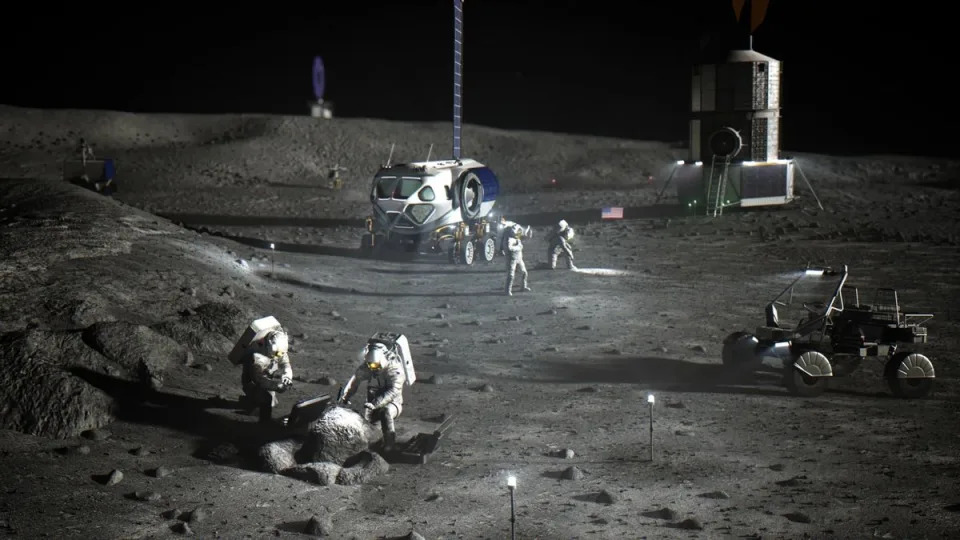
NASA is indeed bringing a celestial internet of sorts to the moon, but it is not the same internet we know on Earth. The technology employs a “protocol suite” of new networking technologies for transmitting information between astronauts in space and those on Earth. Additionally, Nokia announced plans to bring LTE/4G to the moon to support communication between the lunar lander and rover.
In March 2023, NASA took to Instagram to share the space agency’s plans to install an internet-like network in space that will connect astronauts with researchers on Earth.
Though the notion may seem like a concept straight out of a lunar-colonizing, science-fiction flick, NASA is indeed bringing a celestial internet to the moon with help from telecommunications giant Nokia. To support the space agency’s communication goals, the Finnish company also announced in 2022 plans to deploy LTE/4G communications to the lunar surface.
However, this connectivity is not the same version of the internet or LTE/4G connectivity — that is, the fourth generation (or Long Term Evolution, LTE) of broadband cellular network technology — that we know and use on Earth.
Both of the above-listed initiatives will support the objectives of the Artemis Mission, an initiative to establish a base camp on the moon to be launched by 2025. Here’s how.
Nokia To Launch LTE/4G on Moon To Facilitate Communication Between Lunar Lander and Rover
In 2022, Nokia first announced plans to launch LTE/4G connectivity on the moon to establish communication between the lunar lander and rover.
The technology will be incorporated with an LTE base station equipped with a “fully integrated cellular network” to allow the base camp lander to communicate with its lunar rover as a means to provide “lunar surface connectivity.”
Range tests will be conducted up to a .6-mile radius between the lander and rover, to have the entire system monitored and configured from Earth eventually.
Though this project supports the goals of the Artemis Mission, it is separate from NASA’s newly developed space “internet.”
NASA To Expand Its Space 'Internet' Program to Enhance Data Distribution
In a news release dated March 1, 2023, NASA detailed a new tool to overcome signal disruption: a communications networking protocol called High-Rate Delay Tolerant Networking (DTN) that employs a “protocol suite” of new networking technologies for transmitting information between astronauts in space and people on Earth. The space agency wrote: DTN automatically ensures information is delivered using a process called “store-and-forward,” which allows data to be forwarded as it is received or stored for future transmission if the signal becomes disrupted. Data store-and-forward capability enables internet-like concepts in space.
DTN is essentially the cosmic version of the internet and is described as a “similar concept of internet networks,” in which space missions will begin to use optical, or laser, communication systems that allow for more data to be communicated. The technology serves as a conduit for bringing information from space to Earth.
Spacecraft communicate using a series of relaying satellites that circle the planet. Experts estimate that up to 95% of that data is not transmitted back to Earth and will never be recovered. DTN builds on existing technology by employing a combination of radio frequency and laser communications to send information between spacecraft, astronauts, and potential planets. Data is modulated to be placed within the laser beam before it is transmitted between devices.
The technology has been in development for over a decade, and its proof of concept was unveiled during the 2013 lunar laser demonstration, in which NASA used lasers to send an image of the Mona Lisa to the moon and back to Earth.
A version of DTN is now used on the International Space Station. This transition to a more connected space internet will potentially clean up space communications for a more efficient, secure, and reliable method of communication.
“We’ve been working on developing DTN implementations that will revolutionize space communications by extending internet-like capabilities found on Earth into space,” said Daniel Raible, principal project investigator, in the news release.
“High-Rate DTN is designed with speed and efficiency to keep up with the data rates of newer laser and radio frequency communications systems.” Sources:
BEEN THERE,DONE THAT 60 YRS AGO Iran sends space capsule carrying animals into orbit
FORWARD TO THE PAST,BACKWARDS TO THE FUTURE Sky News Updated Wed, 6 December 2023
Iran said it has launched a capsule into space carrying animals as it prepares to send up astronauts in the next few years.
The capsule went 80 miles into orbit, according to a report by the official IRNA news agency that quoted telecommunications minister Isa Zarepour.
He said the launch of the 1,000lb (450kg) capsule formed part of its future plans for human missions by 2029.
He did not say what kind of animals were in the capsule.
State TV showed footage of a rocket named Salman carrying the capsule into the sky. The launch location was not disclosed.
Iran has from time to time announced successful launches of satellites and other spacecraft.
It has sent several short-lived satellites into orbit over the last decade, and in 2013 it launched a monkey into space.
In September this year, it said it sent a data-collecting satellite into space
The US and other Western countries have long been suspicious of the programme because the same technology can be used to develop long-range missiles.
The US has alleged Iran's satellite launches defy a UN Security Council resolution and has called on Tehran to undertake no activity related to ballistic missiles capable of delivering nuclear weapons.
In 2018, former American president Donald Trump withdrew the US from the 2015 nuclear agreement with world powers - drawn up to ensure Iran's nuclear programme was "exclusively peaceful" - and restored crippling sanctions.
Efforts to revive the agreement faltered more than a year ago and since then the International Atomic Energy Agency (IAEA) has said Iran has enough uranium enriched to near-weapons grade levels to build "several" nuclear weapons should it choose to do so.
Iran has always denied seeking nuclear weapons and says its space activities and nuclear programme - which has steadily advanced over the years - are purely for civilian purposes and scientific research.
Crows can use self-control to hold out for favourite food, study suggests
Sam Russell, PA Wed, 6 December 2023
Crows will hold out for their favourite food regardless of whether a rival bird is present, a study has indicated.
However, jays will settle for a less preferred food option when another bird is there rather than wait for their favourite and risk losing out, according to research by Anglia Ruskin and Cambridge universities.
Both species are capable of displaying self-control through delayed gratification, by holding out for something better, the study’s authors said.
Co-lead author Rachael Miller, senior lecturer in biology at Anglia Ruskin University, said jays tend to be less sociable than crows and rely more on hiding food for later use for survival.
She said this may be why jays appear to change their tactics and choose their less preferred, but immediately available, food option when another bird is present.
The researchers examined the behaviour of six New Caledonian crows and five Eurasian jays when presented with two food choices on a rotating tray – a high-quality and low-quality option.
Eurasian jays settled for a less preferred food option when another bird was present (Rachael Miller/ PA)
For jays, the high-quality food was mealworm and the low-quality food was bread, while the favourite for crows was meat and the less preferred option was apple.
The birds had to remove the food from under clear plastic cups.
Each bird was tested separately, and they watched as both food types were added to the rotating tray.
At the same time, a second bird – either a direct competitor or a non-competitor bird – remained in an adjacent compartment.
Just before the less preferred food option became available on the rotating tray, the door between the compartments was opened, allowing the second bird access.
The bird being tested could then choose either the immediate option or wait 15 seconds for the delayed, preferred food to become available.
The study found each jay selected the high-quality, delayed reward (mealworm) while alone, but typically chose the immediate food choice (bread) when either a competitor or non-competitor bird was present.
In contrast, each crow stood its ground and waited for the high-quality, delayed reward (meat) over the immediate, less preferred option (apple) in all three test conditions.
Dr Miller said: “Delayed gratification, in this case declining an immediate, small food reward and waiting for something better, demonstrates the ability for self-control.
“We have also used this rotating tray task to comparably measure self-control in young children.
“Both the Eurasian jay and the New Caledonian crow are capable of delaying gratification for a better reward, and we expected both species would wait for the higher-quality, preferred reward when alone and potentially with a non-competitor bird present, but would choose the lower-quality, immediate reward when a competitor was present, as waiting could risk them losing out.
“Interestingly, we found that jays were highly flexible in their use of delayed gratification, and this was entirely influenced by the presence of other birds, but the crows consistently chose the better, delayed reward, regardless of rival birds being present.
“These findings add to our understanding of self-control and the factors influencing delayed gratification in animals, which may relate to a particular species’ social tolerance and levels of competition.
“New Caledonian crows tend to be more sociable and tolerant of others than Eurasian jays, and while both hide food for later use, jays rely more on this tactic for their survival.
“This might explain why the more territorial jays altered their choosing strategy when competitors were present and selected the immediate, less preferred food to avoid missing out entirely.”
The study is published in the journal PLOS ONE.
A pregnant megamouth shark found on a Philippines beach was the first ever seen — and it solved a long-standing mystery
Marianne Guenot Wed, 6 December 2023 A stock image of a megamouth shark caught in fishing nets in the central Philippines.REUTERS/Rhaydz Barcia
A megamouth washed up on a beach in the Philippines in November.
The shark was found with a pup alongside her and six fetuses inside her body.
The finding confirms for the first time that these sharks give birth to live young.
A dead 18-foot megamouth shark that washed up on the beach in the Philippines was pregnant, confirming for the first time that these mysterious creatures give birth to live young.
The shark was found in the municipality of Aurora on November 14 with one pup and six fetuses, according to New Scientist.
The specimen is the first record of a pregnant megamouth found in the world, according to a statement from the National Museum of the Philippines published on Facebook on Friday.
The discovery solves a long-standing mystery about whether these creatures are ovoviviparous, meaning they can lay eggs inside their bodies and give birth to live young.
This is similar to the megamouth's cousin, the whale shark, that gives birth to live young.
The pup found alongside the megamouth adult could have been recently birthed as the stress of capture or stranding can cause sharks to expel their pups or eggs, said AA Yaptinchay of Marine Wildlife Watch of the Philippines who oversaw the necropsy, per New Scientist.
The six megamouth fetuses were transported to the National Museum of the Philippines for further detailed examination, per the statement. Genetic testing could now reveal whether the fetuses have different fathers, New Scientist reported.
Megamouth sharks have been particularly elusive. First found in 1976, there have been under 300 sightings of the deep sea sharks since. Fewer than 150 specimens have ever been uncovered. They are the smallest of three species of filtering sharks.
Like their cousins the basking sharks, they feed on krill suspended in seawater, sieved through their oversized mouths.
While most specimens have been found near the Philippines and Taiwan, these sharks have been spotted around the world.
A study published earlier this year reported a sighting of two megamouths swimming side by side off the coast of California. They were likely engaging in some sort of pre-copulation ritual, the study authors said.
Long thought to be extinct in Kenya, giant pangolins are now being helped back from the brink
Peter Muiruri
The Guardian Tue, 5 December 2023 Photograph: Will Burrard-Lucas/Pangolin Project
When Fred Telekwa settled on his farm inside Nyakweri forest, in western Kenya, four years ago, his main worry was how to prevent elephants and buffaloes from destroying his crops. The nearby Maasai Mara game reserve housed a huge amount of roaming wildlife.
“Two or three elephants can clear an acre of cabbages in one night. I had no choice but to put up an electric fence to ward off the animals,” he says.
But the fence had unintended consequences. One morning in November last year, Telekwa woke up to the sight of a giant ground pangolin that had been electrocuted as she tried to reach a termite mound. She was pregnant. And her death left Telekwa distraught.
“I am one of those people who have supported the conservation of pangolins in this forest. How could one die within my land? I am yet to get over the loss,” he says, stroking the wire with a wooden staff.
“That was the first and last time I ever saw a pangolin. In fact, had she not been electrocuted, chances are I would not have seen her.”
A solitary, nocturnal, scaly-clad animal that looks like a huge, slow-moving pine cone, the endangered giant ground pangolin was believed to be extinct in Kenya.
Their rediscovery, through a scattering of sightings in 2018, was cause for cautious celebration among conservationists. Now, the fight is on to ensure this tiny population survives.
Pangolins are highly endangered, and their numbers are declining rapidly. They are considered the world’s most trafficked animals – especially to Asian markets, where their meat is seen as a delicacy and their scales are sold as a cure for conditions including hangovers and liver problems, and to help mothers breastfeed.
There is no scientific evidence that pangolin scales have any medicinal value. Nevertheless, the wildlife protection organisation Traffic estimates that in 2021 alone, 23.5 tonnes of pangolins and their body parts were trafficked, and 1 million of the animals have been poached over the past decade.
In Kenya, little is known about the giant ground pangolins’ population – including how many live in the country’s forests. Before 2018, it was assumed that the pangolin was locally extinct, as the last-known sighting was in 1971 in western Kenya. Today, local conservationists estimate there are only between 30 and 80 left in the country.
Since last year, the Pangolin Project has been working with landowners around Nyakweri forest to create space for these animals, a tall order considering that most, like Telekwa, are farmers who are clearing the forest for farming and erecting electric fences to keep away wild animals.
Within the forest lie bags of charcoal, freshly felled trees, neatly arranged logs and charcoal kilns – clear indicators of the loss of forest cover, a key habitat for the giant ground pangolin in Kenya.
“There are so many threats that make the giant ground pangolin a priority,” says Beryl Makori, the project manager. “We are losing the forest ecosystem following land demarcation to individual pieces,” she says.
“There is also a measure of poaching because we have found some pangolins without scales after being electrocuted.”
Reducing or stopping deforestation is crucial if the few remaining giant ground pangolins in Kenya are to survive in the wild. Already, about 23 landowners, representing at least 60 households, have come together to form the Nyekweri Kimintet Forest Conservation Trust, covering almost 2,020 hectares (5,000 acres).
Peter Ole Tompoy, 70, heads the conservancy that protects the Nyakweri forest and hopes to persuade more landowners to sign conservancy leases and give the giant pangolins a fighting chance.
“Maasai are pastoralists. Previously, we didn’t have these land demarcations and would move all over looking for pasture. Now the demarcation has divided the land,” says Tompoy, who, despite his passion for conservation, has never seen a pangolin.
Some landowners say the lack of an alternative livelihood to farming has held them back from fully embracing conservation. Musuak Ole Kakui grows maize on 30 of his 80 acres. “An acre gives me 20 to 25 bags of maize. A bag sells for 5,000 Kenyan shillings [£27] – or 100,000 an acre,” he said. “Conservation may not earn my family a similar amount.”
According to Araluen “Azza” Schunmann, director of the Pangolin Crisis Fund, addressing the needs of local people is crucial to making conservation work. “Community-led conservation is central to saving endangered species and creating coexistence between wildlife and the people living alongside wildlife,” she says. “For wildlife to thrive, the people of the region need to thrive as well.”
In the meantime, the Pangolin Project has been raising awareness in the community with a small team of young men making the rounds of homesteads and helping landowners to remove the lowest strands of electric fences, which are the most dangerous threat to the animals.
So far, these “pangolin guardians” have spoken to about 1,800 households, says Claire Okell, founder of the Pangolin Project. “The community will have a sense of ownership if these pangolins are protected within their area.”
Although pangolins have received a lot of attention as the world’s most trafficked mammals, “this knowledge has not translated into a robust conservation drive”, she says.
Now it is a race against time to save the pangolin, says Makori. “I feel we are protecting the last of the pangolins. We will give all it takes for a protected habitat with a viable population.”
Cairngorms: Beavers to return to UK's biggest national park after 400 years
Sky News Updated Tue, 5 December 2023
Beavers are to return to the UK's biggest national park for the first time in 400 years after a licence was granted for their release.
Up to six beaver families will live in the Cairngorms in the first year of the initiative after Scotland's nature agency, NatureScot, approved an application from the park authority.
The animals will be released at agreed sites in the upper River Spey catchment.
Other sites in the park may also take the animals over the course of the five-year licence, meaning a total of up to 15 families could be allowed.
NatureScot said establishing a beaver population on the River Spey will boost biodiversity and enhance ecosystems.
The approval marks the fifth catchment in which beavers have either been officially granted permission to remain or have been released.
It comes after the Scottish government announced its backing in 2021 for translocation, which involves safely trapping and moving the animals to a more suitable area, rather than culling them when they cause problems.
Donald Fraser, from NatureScot, said the agency's decision "marks a significant milestone for beaver restoration in Scotland".
He said there was "huge potential for beavers to contribute to habitat restoration and biodiversity enhancement" in the park.
Mr Fraser added he understood the "legitimate concerns" of farmers and crofters but was "satisfied" the park authority's monitoring plans, as well as NatureScot's beaver mitigation scheme, "will sufficiently address any potential conflicts".
Some 400 years ago, the species was driven to extinction in the Cairngorms, which covers parts of Aberdeenshire, Moray, Highland, Angus and Perth and Kinross.
An initial reintroduction trial of beavers at Knapdale in Argyll began in 2009 and populations are now established there and in Tayside, on the Forth, and at Loch Lomond.
The beavers will be humanely trapped and taken under licence from areas where they are having a negative impact on prime agricultural land and where mitigation measures have not been successful or are not possible.
The first three release sites in the national park are on land owned by the Rothiemurchus Estate, Wildland Scotland and RSPB Scotland.
They will receive beavers in the coming weeks and months.
Sandy Bremner, from the Cairngorms National Park Authority, said: "This is a significant moment in the history of the national park, with the licence allowing us to return beavers to the area after an absence of 400 years."
NatureScot believes the catchment is highly favourable for beavers, with a low risk of beaver/human conflict.
Alan McDonnell, Trees for Life's head of nature restoration, said: "Allowing these habitat-creating, flood-preventing animals to be relocated across Scotland - to where they are needed, and with the right support in place for farmers - offers hope for tackling the nature and climate emergencies.
"By moving rather than shooting beavers, we can help this keystone species get to work boosting biodiversity, tackling climate breakdown, and creating wildlife tourism opportunities."