
Israel’s latest war on Lebanon is not only being waged from the air. It is being reinforced politically from within, as Beirut moves in step with US-Israeli efforts to isolate Hezbollah and weaken Iran’s negotiating position.
In a previous article, we examined the seven messages that Israeli Prime Minister Benjamin Netanyahu sought to communicate through mass killings in Lebanon.
These messages were aimed at reshaping regional dynamics, asserting deterrence, and forcing new political realities on the ground.
Those massacres have already resulted in hundreds of Lebanese killed and more than a thousand wounded, alongside vast destruction of civilian infrastructure, according to Lebanese civil defense figures.
The scale and intensity of the violence were not incidental, however. They were meant to create urgency, fear, and ultimately, compliance.
At the time, we argued that Israel’s actions were part of a broader attempt to impose a new regional order through blood. Since then, new developments have confirmed that this military escalation was coordinated with parallel political moves—specifically, an effort to separate the Iran-US negotiation track in Pakistan from the war on Lebanon.
This separation is not a technical detail. It is the core of the current geopolitical struggle.
As Israeli bombs continue to fall across Lebanon, Netanyahu announced that he had instructed his government to begin direct negotiations with Lebanon “as soon as possible,” emphasizing that these talks would focus on disarming Hezbollah and establishing “peaceful relations.”
This shift did not occur in a vacuum. It followed one of the deadliest waves of Israeli attacks on Lebanon in years, and it came at a moment when Iran had explicitly linked its participation in the Islamabad talks to a ceasefire in Lebanon.
In other words, Israel escalated militarily while simultaneously opening a political channel designed to bypass Iran’s conditions.
What makes this strategy particularly consequential, however, is not Israel’s role alone—but the response from Beirut.
From the outset of the Israeli war on Lebanon, the government of Prime Minister Nawaf Salam has taken steps that align closely with US and Israeli objectives.
Rather than framing the conflict primarily as Israeli aggression, key Lebanese officials have emphasized the need to rein in the resistance, repeatedly raising the issue of Hezbollah’s weapons and the necessity of placing all arms under state control.
This position is not neutral. It reflects a political choice. More importantly, it creates the very framework that Israel seeks to impose: one in which the central issue is no longer occupation, aggression, or civilian massacres, but rather the “problem” of resistance itself.
The Lebanese government’s willingness to engage in direct negotiations with Israel—something historically avoided outside the narrow framework of indirect or mediated contacts—marks a dangerous precedent.
Even if framed as conditional or tactical, such engagement constitutes an implicit political recognition of Israel at a moment when Lebanese civilians are still being buried under the rubble of Israeli strikes.
This contradiction is not lost on domestic actors.
According to Al Mayadeen, figures affiliated with Hezbollah have sharply criticized the government’s direction, with some describing it as a betrayal of the highest order. The criticism reflects a deeper fear that Lebanon is being pulled into a political track that will ultimately serve to delegitimize the resistance and reshape the country’s internal balance of power.
This concern is reinforced by the sequence of events itself. Lebanon has not yet received a formal date from the United States to begin negotiations, according to Al Mayadeen’s correspondent in Beirut. Lebanese officials have insisted that a ceasefire must precede any talks, yet Israel has made clear that its objective is precisely the opposite: to use negotiations as a tool to impose new realities, including Hezbollah’s disarmament.
At the same moment, Iran has made its stance unmistakably clear. Its delegation has conditioned participation in the Islamabad talks on linking any ceasefire to a full halt of Israeli operations in Lebanon. Iranian officials have gone further, emphasizing that no long-term arrangement is possible without ending Israeli aggression altogether.
This creates a direct clash of political visions. On one side, Iran is attempting to integrate Lebanon into a broader regional settlement that preserves the role of resistance as a central actor. On the other hand, the United States, Israel, and their regional allies are working to fragment that framework—isolating Lebanon, sidelining Hezbollah, and reasserting a US-led order.
In this context, the behavior of the Lebanese government cannot be understood as independent.
Beirut’s political establishment has long operated within a system shaped by external pressures, particularly from Washington and its regional allies. The current moment is no exception. The push toward negotiations, the emphasis on disarmament, and the political framing of the conflict all reflect a broader alignment with the pro-American camp.
This camp is facing a strategic dilemma. Its inability to impose a decisive outcome on Iran—whether militarily or economically—has already shifted the balance of power. The Strait of Hormuz crisis, the resilience of the Iranian state, and the failure to neutralize Hezbollah have all exposed the limits of US influence.
Allowing Lebanon to be included in an Iran-led negotiating framework would deepen that shift.
It would effectively marginalize pro-Western actors in Beirut and open the door to a new regional arrangement in which Iran holds significant leverage. For Washington, Tel Aviv, and their allies, this is an unacceptable outcome.
Thus, the current strategy: bombard Lebanon, then rush into negotiations with the Lebanese government itself.
This dual approach is not contradictory. It is deliberate. The massacres create pressure. The negotiations create an alternative political pathway—one that excludes Iran and reframes the conflict around disarmament and normalization.
Crucially, both Israel and segments of the Lebanese political establishment share a common objective: the weakening, and ultimately the defeat, of Hezbollah. Direct talks are only the first step.
In the ideal scenario envisioned by the US and Israel, this process would evolve into an international consensus—possibly through the United Nations—that formally delegitimizes Hezbollah and, by extension, all forms of armed resistance. Such a shift would not only reshape Lebanon internally but would also strike at the core of the broader resistance axis.
But such scenarios rarely unfold as planned.
The main obstacle remains Iran’s insistence on linking Lebanon to any broader agreement. As long as this linkage holds, attempts to isolate Lebanon will face significant resistance—not only from Tehran but from actors within Lebanon itself.
The outcome of this struggle will not be confined to Lebanon.
It will determine whether the region moves toward a fragmented order dominated by US-backed states, or toward a new balance in which resistance movements and their allies retain a decisive role.

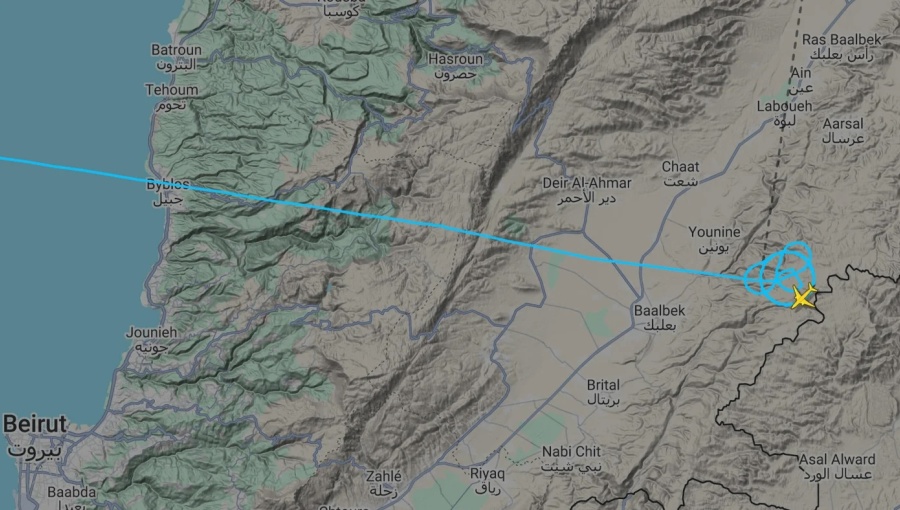
A British military drone flew over eastern Lebanon on the same day Israeli air strikes on Lebanon killed more than 300 people in less than 10 minutes, according to flight-tracking data analysed by Middle East Eye, prompting renewed scrutiny of the UK’s intelligence role in the region.
The Royal Air Force MQ-9B Protector drone departed from RAF Akrotiri in Cyprus early on April 9 and entered Lebanese airspace at about 6.20am, circling near Baalbek and Younine in the Beqaa Valley for roughly 20 minutes. The area was later hit in a wave of Israeli strikes that killed 18 people locally, part of a broader assault that struck multiple cities across the country. A two-week ceasefire had been declared and was supposed to be in force on April 9.
The drone later crossed into Syrian airspace, flying north past Homs and over Idlib, before returning to the vicinity of Baalbek at around 8.15pm. It left Lebanese airspace shortly afterwards, heading back towards Cyprus. Its activities for several hours during the day remain unclear.
The RAF describes the remotely piloted aircraft as supporting missions including “surveillance, search and rescue, and armed operations alongside Nato and US forces”. Military sources cited by Middle East Eye said the aircraft was not conducting operations over Lebanon, while the UK Ministry of Defence declined to comment on whether the flight was coordinated with Lebanese authorities or whether intelligence was shared with Israel or the US.
The timing of the flight, both before and after the Israeli strikes, has drawn attention given longstanding UK involvement in regional intelligence-gathering. A source familiar with British surveillance capabilities previously told the publication that such operations provide the UK with “a bird's-eye view of the genocide”, adding: “Britain knows exactly what is happening because of those flights. They have a better view than any journalist.”
RAF Akrotiri has been a focal point of controversy during the conflict, having launched hundreds of surveillance flights over Gaza. The Ministry of Defence has maintained these were in support of “hostage rescue”, although details of the operations have remained classified.
The UK has also deepened defence ties with Israel in recent years under a 2020 military agreement intended to “formalise and enhance the defence partnership and support the growing Israel-UK partnership”, though the accord has not been made public.
Israeli strikes have killed about 1,900 people in Lebanon and displaced more than one million since the conflict expanded beyond Iran on February 28, according to Lebanese authorities, intensifying pressure on western governments over their role in the crisis.

No comments:
Post a Comment