Tuesday, October 29, 2024

Three governors urge end to Boeing strike as suppliers suffer
JUST IN TIME PRODUCTION TO BLAME NOT UNION

David Shepardson
Tue, October 29, 2024 

FILE PHOTO: Boeing factory workers gather on picket lines in Washington state on first day of strike

(Reuters) -The Republican governors of Utah, Missouri and Montana on Tuesday urged Boeing and the union representing 33,000 striking machinists to end a nearly seven-week-old strike citing the impact to their states and the planemaker's suppliers.

"The strike has far-reaching implications in our states," wrote Governors Spencer Cox, Mike Parson and Greg Gianforte to Boeing and the International Association of Machinists and Aerospace Workers (IAM).

"Boeing has stopped buying from most suppliers, most of whom are now making the very difficult decision to furlough or lay off their own employees," they said.

Boeing and IAM declined to comment on the letter.

Separately, Ihssane Mounir, senior vice president of global supply chain for Boeing's commercial airplanes unit, told hundreds of suppliers in an email on Tuesday seen by Reuters that the planemaker will need to continue a pause on shipping components for the 737, 767 and 777 programs.

"We understand this may drive you to take additional and difficult actions for your production schedules as well as for your teams," Mounir wrote.

He added: "Our team will be in touch soon and we remain dedicated to continuing to work with you – part by part – to maintain as much stability in our shared production system as we can."

Last week's vote by 64% of Boeing's West Coast factory workers against the company's latest contract offer, further idling assembly for nearly all of the planemaker's commercial jets, has created a fresh test for suppliers.

No new talks have been scheduled since the rejection.

Boeing's vast global network of suppliers that produce parts from sprawling modern factories or tiny garage workshops, was already stressed by the company's quality-and-safety crisis, which began in January after a mid-air panel blow-out on a new Alaska Airlines 737 MAX 9.

Boeing announced earlier this month plans to cut 17,000 jobsglobally - or 10% of its workforce - a one-year delay to a key new jet and other cuts. On Tuesday, the company said it had raised at least $21 billion in new capital.

Special Report: Inside Intel, CEO Pat Gelsinger fumbled the revival of an American icon

Updated Tue, October 29, 2024 


By Max A. Cherney, Jeffrey Dastin, Dawn Chmielewski, Fanny Potkin and Stephen Nellis

(Reuters) - Pat Gelsinger took the reins as Intel (INTC) CEO three years ago with hopes of reviving the American industrial icon. He soon made a big mistake.

Intel had a sweet deal going with Taiwan’s TSMC, the giant manufacturer of semiconductors for other companies. TSMC would make chips that Intel designed but could not produce. And it was offering deep discounts to Intel, say four people with knowledge of the agreement.

Instead of nurturing the relationship, Gelsinger – who hopes to restore Intel’s own manufacturing prowess – offended TSMC by calling out Taiwan’s precarious relations with China. “You don't want all of your eggs in the basket of a Taiwan fab,” he said in May 2021, using industry jargon for a chip fabrication plant. That December, encouraging U.S. investment in U.S. chipmakers, he said at a tech conference: “Taiwan is not a stable place.”

In public, TSMC downplayed the comments, with its founder calling Gelsinger “a bit rude.” Privately, TSMC said it would no longer honor the discount, the sources said: about 40% off the $23,000, 3-nanometer wafers on which TSMC would print chips for Intel. Intel had to pay full price, shrinking its profit margin on the deal.


Asked about the previously unreported episode, Intel said TSMC is an important partner with which it has a “healthy business relationship today.” TSMC told Reuters Intel is an important customer.

Gelsinger’s affront to Taiwan was part of a series of missteps during his time as Intel CEO. He inherited a troubled company that had lost its edge in manufacturing skills and had ceded to rivals the hugely lucrative markets for chips used in mobile phones and artificial intelligence. But Gelsinger compounded those problems.


This account of his rocky tenure is based on interviews with about four dozen current and former Intel employees and executives, as well as internal company videos, supplier documents and regulatory records.

Gelsinger set sky-high expectations for Intel’s manufacturing and AI capabilities among major clients but fell short, losing or canceling contracts or unable to deliver the promised products. He issued optimistic public projections for AI-chip deals that were far higher than Intel’s own internal sales forecasts, company insiders say.

And like TSMC, Gelsinger sought to transform Intel into a "foundry," an operation that makes chips designed by other companies. But Intel’s efforts to regain manufacturing leadership with a chip-production process called 18A have faced delays and technical problems, with some customers so far declining to use it.

Intel declined to make Gelsinger available for an interview.

“Pat is leading one of the largest, boldest and most consequential corporate turnarounds in American business history,” Intel said in a statement. “3.5 years into the journey, we have made immense progress – and we’re going to finish the job.”

Intel’s revenue shriveled to $54 billion in 2023, down nearly one-third from the year Gelsinger took over. Analysts expect Intel to lose $3.68 billion this year, its first annual net loss since 1986. Its shares closed at $22.92 on Monday, off 66% from a peak hit in Gelsinger’s first months as CEO.

The crash in Intel’s share price has sparked takeover interest, Reuters has reported. Intel has vowed to restructure and to cut more than 15,000 jobs.

Intel said it won’t let merger speculation distract it from executing its five-year turnaround plan. Under Gelsinger, Intel said, it has revamped its operations, secured up to $45 billion in U.S. support, led the market for AI PC chips, and “achieved a historic pace” of innovation.

Intel told Reuters its 18A fabrication technologies are yielding good-quality chips and that it “expects to return to process leadership in 2025” with their formal launch. The company said it objects to the “usage of rumors, leaked materials, half-truths and interviews based on the widest net that can be cast for ‘sources’ to gain negative commentary on Intel.”

Customers have little incentive to bet on Intel’s manufacturing when TSMC continues to serve them well, said Goldman Sachs analyst Toshiya Hari. “If you care about performance today, tomorrow, next year, over the next couple of years, you are not making that bet,” Hari said.

Still, Commerce Secretary Gina Raimondo said in September U.S. manufacturing represents a supply-chain “insurance policy” that major chip designers would pay for. “They should want U.S.-made leading-edge chips,” she said.

Intel’s stumbles have implications for U.S. industrial policy. Gelsinger’s vow to create a foundry raised hopes in the Biden Administration that Intel would help bring chip production back under U.S. control on U.S. soil.

A White House spokesperson said that a bill championed by President Joe Biden, the CHIPS and Science Act, aims to invest in not one but dozens of companies strengthening the semiconductor supply chain. Intel has won more than $11 billion in proposed funding under the act.

Visitors visit the stand of Intel at the 2024 Apsara Conference in Hangzhou, Zhejiang province, China, on September 19, 2024. (Photo by Costfoto/NurPhoto via Getty Images)

Gelsinger’s journey at Intel started in 1979 when he was 18. He stayed for 30 years, coming under the tutelage of Andy Grove, Intel’s legendarily demanding former CEO, which Gelsinger likened to “going to the dentist and not getting Novocaine.” Gelsinger became Intel’s first chief technology officer but left in 2009 around a restructuring.

Intel changed while he was away. Its so-called “Grovian” culture of constructive confrontation – one that encouraged peers to challenge each other with data – faded away. Intel also missed huge market opportunities. It stuck to its strengths, chips for desktop computers and servers. But it passed on a chance to produce semiconductors for the iPhone and declined to fund breakthrough artificial-intelligence company OpenAI.

His return in February 2021 gave a boost to Intel. Investors cheered his appointment, sending shares up nearly 7% on the day of the January announcement. Employees said they celebrated having a technologist back in charge.

Intel, in Gelsinger’s view, needed to execute at a “torrid” pace. He at times wore a black T-shirt, available to buy at Intel’s company store, with the word “torrid” emblazoned on it. The energetic CEO did push-ups and jumping jacks before speaking at Intel events, a witness said.

The bet on which Gelsinger staked Intel’s future came less than two months into his tenure: a global foundry that could vie with TSMC. In March 2021, he promised to invest $20 billion in two Arizona factories. That July, he said Intel also would develop five manufacturing processes in four years. Among them was 18A, a bundle of technologies under development that he hoped would restore Intel’s manufacturing excellence.

Gelsinger pushed for Congress to subsidize American chip manufacturing. In January 2022, he stood with Biden to announce another $20 billion for two factories in Ohio. Gelsinger told Reuters at the time that Intel’s commitment in the state might reach $100 billion to create “the largest semiconductor manufacturing location on the planet.”


BERLIN, GERMANY - SEPTEMBER 04: David Feng, Vice President and General Manager, Client Segments, Client Computing Group at Intel, speaks about Intel microchips in Samsung laptops at Samsung's IFA 2024 presentation, where the company unveils its latest innovations and celebrates the possibilities AI can create for everyone, at CityCube on September 04, 2024 in Berlin, Germany. (Photo by Adam Berry/Getty Images for Samsung)More

‘FIVE REASONS TO BELIEVE’

Chip sales boomed in the COVID-19 pandemic, when consumers gobbled up tech gadgets. By the spring of 2022, with product prices spiking and workers returning to offices, a glut emerged. Intel’s revenue from personal computer chips dropped 25% in the second quarter of 2022. And it lost market share for chip sales in data centers to Advanced Micro Devices, while companies such as Amazon.com and Google increasingly designed silicon in-house.

Gelsinger called on staff to keep the faith. In regular video dispatches, he set out “five reasons to believe” in Intel, say four people who saw them. In an early video, seen by Reuters, he urged employees to “believe deeply in your heart and soul Intel’s best days are ahead.”

Intel said Gelsinger “consistently balanced his optimism with a clear-eyed view of the challenges inherent in getting there.”

Gelsinger was optimistic with clients, too. He oversaw a deal to build custom chips for Alphabet’s growing fleet of Waymo self-driving taxis, set to roll out across the U.S., three people familiar with the previously unreported plans told Reuters. Gelsinger personally discussed the deal with Sundar Pichai, Alphabet’s CEO, two of the people said.

But after Intel’s outlook worsened in 2022, the company canceled the Waymo deal, the two people said, and paid a fee to Alphabet after Alphabet threatened legal action.

Sandra Rivera, who formerly ran Intel’s data center group and is now CEO of Intel-owned Altera, said in an interview that her team cut the Waymo project after a corporate reorganization required her to make “decisions about the entire portfolio.”

Intel said it has a strong partnership with Alphabet and declined to discuss the project. Alphabet declined to comment on the matter.


Gelsinger announced cost cuts in October 2022 to bolster Intel while he continued to pour money into factories. The company said it would save $3 billion starting the following year from steps such as business exits and layoffs.

Under his watch, Intel’s headcount had risen to some 132,000 employees by the end of 2022 from about 111,000 when he joined. In its statement, Intel said the “unprecedented pace” at which it developed technology and capacity necessitated such hiring.

CHATGPT MOMENT

Nvidia’s graphics processing units, or GPUs, posed a new challenge in November 2022. That month, OpenAI launched ChatGPT, an AI chatbot that could conjure human-like prose on command. It became history’s fastest growing software application at the time. Nvidia’s chips power the data centers behind ChatGPT.

Originally designed for videogames, researchers discovered years ago that GPUs are useful for AI applications. They could handle vast numbers of simultaneous calculations better than central processing units, or CPUs, from Intel.

Nvidia saw its stock triple in eight months, notching a $1 trillion valuation. Intel’s stock saw choppy trading; it cut base pay for mid-level workers and restricted promotions and bonuses.

Gelsinger too would take a salary cut, Intel said. Still, his total compensation, including stock awards, rose to $16.9 million in 2023 from $11.6 million the year before, a proxy filing shows.

Around this time, Gelsinger had high hopes for Intel’s Gaudi chip, a so-called AI accelerator – a processor that improves the performance of artificial intelligence applications. Intel touted the chip – designed in-house and made by TSMC – as an alternative to Nvidia’s often scarce GPUs.

Teams at Intel estimated it could sell at most $500 million in AI chips, three people familiar with the forecast said. In a meeting with executives in the second quarter of 2023, Gelsinger said this number was not high enough. Intel needed to tell Wall Street it could hit at least $1 billion at a time when Nvidia’s comparable sales were far higher, one of the people cited Gelsinger as saying.

Intel CEO Pat Gelsinger delivers a speech at the COMPUTEX forum in Taipei, Taiwan June 4, 2024. REUTERS/Ann Wang

Gelsinger touted the $1 billion figure in public. On Intel’s July 2023 earnings-results call, he told analysts of “surging demand for AI products.” He added: “Our pipeline of opportunities through 2024 is rapidly increasing and is now over $1 billion and continuing to expand with Gaudi driving the lion's share.”

According to one of these sources and another person briefed on the matter, Intel at the time of Gelsinger's announcement had not secured anything near the supply needed from TSMC to sell $1 billion in AI-accelerator chips. After Gelsinger demanded the billion-dollar target, Intel tweaked its math to justify it, lumping in chips unrelated to its marquee AI offering, two sources said.

Intel said Gelsinger’s comments accurately reflected prospective deals, not sales. “No company converts 100% of its pipeline into revenue,” Intel said. “We make no apologies for setting ambitious internal targets for our teams – and we will always try to exceed the goals we set for ourselves.”

As recently as January of this year, Intel told investors it had more than $2 billion in possible AI chip deals in the pipeline. In April, Gelsinger revealed to analysts a much lower AI revenue goal for this year: more than $500 million.

At times, Gelsinger has told leaders at major clients that Intel could furnish alternatives to Nvidia’s GPUs, said three people familiar with the talks – including for Microsoft and Amazon Web Services, two of them said. When customers sought details, Intel managers had little to show and some deals didn’t happen, the sources said.

Microsoft declined to comment. Amazon referred Reuters to recent news about its work with Intel.

Intel has struggled to pick an AI-chip strategy. It funded three projects simultaneously by 2019: a GPU of its own, and two other chips designed to perform AI calculations from a pair of companies it acquired. None of the three made significant inroads against Nvidia or AMD, Reuters has reported.

On Intel’s GPU efforts, Rivera, the former data center chief, told Reuters: “It’s a journey, and everything looks simpler from the outside.”

Intel said the strategy anticipates how businesses will want to run AI more cheaply and how it alone can serve AI chip-design and manufacturing needs.
MANUFACTURING WOES

Gelsinger kept pushing ahead despite setbacks, with Intel trumpeting factory expansions that would cost more than $60 billion. Then, this summer, he hit the brakes on some of these construction plans.

Intel’s ambitious new process for making chips for other firms – 18A – also remains a question mark.

Some customers have been disappointed by what they’ve seen of 18A.

When one big prospect, chip and software company Broadcom, sent foot-wide wafers through Intel’s 18A process, the process was not ready for high-volume production for external customers, Reuters reported in September. No more than 20% of the chips printed via 18A passed Broadcom's early tests, two people briefed on the results said. That is low compared to TSMC’s early-stage yields.

Broadcom told Reuters it has “not concluded” its evaluation of whether to use Intel’s foundry.

On the day of the Reuters report in September, Intel issued a statement saying it was on track to launch 18A in 2025 and had released tools for partners and customers to plan chips for the process.

A recent planning document produced by an Intel supplier indicates delays, however. The document, seen by Reuters, noted the supplier is still waiting to receive another digital design kit it needs to push ahead. It also lacked access to Intel factories, a person with knowledge of the situation said. Customers have little prospect of making chips in high volume with the 18A process until 2026, two people said.

Apple and Qualcomm, among other potential clients, have passed on 18A for technical reasons, three people with knowledge of their decisions said. Both companies declined to comment.

Intel said it expects to reclaim leadership in chip-manufacturing processes in 2025 by launching 18A.

Gelsinger said in mid-September Intel had a “lot of work ahead,” but he continues to project confidence in his turnaround plan.

“I'm very confident that we're going to pull it off,” Gelsinger told Reuters in August. “Three years in, yeah. This one's going to happen, baby.”

 Researchers tortured robots to test the limits of human empathy


Mack DeGeurin
Tue, October 29, 2024 a

Boston Dynamic's Spot getting kicked in a routine test.

In 2015, a jovial three-foot-tall robot with pool noodles for arms set out on what seemed like a simple mission. Using the kindness of strangers, this machine, called “hitchBOT” would spend months hitchhiking across the continental United States. It made it just 300 miles. Two weeks into the road trip, HitchBOT was found abandoned in the streets of Philadelphia, its head severed and spaghetti arms ripped from its bucket-shaped body.

“It was quite a setback, and we didn’t really expect it,” hitchBOT co-creator Frauke Zeller told CNN at the time.

hitchBot’s untimely dismemberment isn’t a unique case. For years, humans have relished opportunities to kick, punchtrip, crush, and run over anything remotely resembling a robot. This penchant for machine violence could move from funny to potentially concerning as a new wave of humanoid robots is being built to work alongside people in manufacturing facilities. But a growing body of research suggests we may be more likely to feel bad for our mechanical assistants and even take it easy on them if they express sounds of human-like pain. In other words, hitchBot may have fared better if it had been programmed to beg for mercy.
Humans feel guilty when robots cry

Radboud University Nijmegen researcher Marieke Wieringa recently carried out a series of experiments looking at how people reacted when asked to violently shake a test robot. In some cases, participants would shake the robot and nothing would happen. Other times, the robot would emit a pitiful crying sound from a pair of small speakers or enlarge its “eyes” to convey sadness. The researchers say they were more likely to feel guilty when the robot gave the emotion-like responses. In another experiment, the participants were given the option of either performing a boring task or giving the robot a solid shake. Participants were more than willing to shake the robot when it was unresponsive. When it cried out, however, participants opted to go ahead and complete the task instead.


“Most people had no problem shaking a silent robot, but as soon as the robot began to make pitiful sounds, they chose to do the boring task instead,” Wieringa said in a statement. Wieringa will be defending the research as part of her PhD thesis at Radboud University in November.

Those findings build off previous research that shows we may treat robots kinder when they appear to exhibit a range of human-like tendencies. Participants in one study, for example, were less inclined to strike a robot with a hammer if the robot had a backstory describing its supposed personality and experiences. In another case, test subjects were friendlier to humanoid-shaped robots after they used a VR headset to “see” through the machine’s perspective. Other research suggests humans may be more willing to empathize with or trust robots that appear to be able to recognize their own emotional state.

“If a robot can pretend to experience emotional distress, people feel guiltier when they mistreat the robot,” Wieringa added.
The many ways humans have abused robots

Humans have a long history of taking out our frustrations on inanimate objects. Whether it’s parking meters, vending machines, or broken toaster ovens, people have long bizarrely found themselves attributing human-like hostility to everyday objects, a phenomenon the writer Paul Hellweg refers to as “resentalism.” Before more modern conceptions of robots, people could be seen attacking parking meters and furiously shaking vending machines. As machines became more complex, so too did our methods for destroying them. That penchant for robot destruction was maybe best encapsulated in the popular 2000s television show Battle Bots, where crowds cheered as quickly cobbled together robots were repeatedly sliced, shredded, and lit on fire before a cheering crowd.


Now, with more consumer-grade robots roaming around in the real world, some of those exuberant attacks are taking place on city streets. Autonomous vehicles operated by Waymo and Cruise have been vandalized and had their tires slashed in recent months. One Waymo vehicle was even burned to the ground earlier this year.

In San Francisco, local residents reportedly knocked over an egg-shaped Knightscope K9 patrol robot and smeared it with feces after it was deployed by a local animal shelter to monitor unhoused people. Knightscope previously told Popular Science an intruder fleeing a healthcare center intentionally ran over one of its robots with his vehicle. Food delivery robots currently operating in several cities have also been kicked over and vandalized. More recently, a roughly $3,000, AI-powered sex robot shown off at a tech fair in Austria had to be sent off for repairs after event participants reportedly left it “heavily soiled.”

But possibly the most famous examples of sustained robot abuse come from now Hyundai-owned Boston Dynamics. The company has created what many consider some of the most advanced quadruped and bipedal robots in the world, in part, by subjecting them to countless hours of attack. Popular YouTube videos show Boston Dynamics engineers kicking its Spot robot, and harassing its Atlas humanoid robot with weighted medicine balls and a hockey stick.


Research trying to understand the actual reasons why people seem to enjoy abusing robots has been a mixed bag. In higher-stakes cases like autonomous vehicles and factory robots, these automated tools can function as a reminder of potential job loss or other economic hardships that may arise from a world marked by automation. In other cases though, researchers like the Italian Institute of Technology Cognitive Neuroscientist Agnieszka Wykowska say that the non-humanness of machines can trigger an odd type of anthroposophy tribal response.

“You have an agent, the robot, that is in a different category than humans,” Wykowska said during a 2019 interview with the New York Times. “So you probably very easily engage in this psychological mechanism of social ostracism because it’s an out-group member. That’s something to discuss: the dehumanization of robots even though they’re not humans.”

Either way, our apparent propensity towards messing with robots could get more complicated as they become more integrated into public life. Humanoid robot makers like Figure and Tesla envision a world where upright, bipedal machines work side by side with humans in factories, perform chores, and, maybe even look after our children. All of those predictions, it’s worth noting, are still very much theoretical. The success or failure of those machines, however, may ultimately depend in part on tricking human psychology to make us pity a machine like we would a person.


Macron pledges French investment in disputed Western Sahara in speech to Morocco's parliament

Speaking to Morocco's parliament on the second day of his state visit to the North African country Tuesday, French President Emmanuel Macron renewed France's support for Moroccan sovereignty over the disputed Western Sahara.

 Click on the player to follow Macron's speech as it happened.


Issued on: 29/10/2024 - 
By: NEWS WIRES
41:58
France's President Emmanuel Macron delivers a speech in front of the members of Morocco's Parliament in Rabat on October 29, 2024. © Ludovic Marin, AFP


President Emmanuel Macron renewed French support for Moroccan sovereignty over Western Sahara Tuesday and pledged French investment in the largely Moroccan-controlled but disputed territory.

Deals with Morocco involving Western Sahara have been a problem for European governments with the EU's top court earlier this month upholding the cancellation of trade deals allowing Morocco to export Sahrawi products to the bloc.

In an address to the Moroccan parliament on a three-day state visit, Macron said French companies "will support the development" of Western Sahara, whose "present and future" belong under "Moroccan sovereignty".

He pledged "investments and sustainable support initiatives to benefit local populations".


10:02


This comes a day after Paris and Rabat signed several deals – including on energy and infrastructure – with a total value of "up to 10 billion euros", official sources told AFP, though specific contract details were not disclosed.

Western Sahara, a former Spanish colony, is largely controlled by Morocco but the Algerian-backed Polisario Front has campaigned for its independence since before Spanish forces pulled out in 1975.

The United Nations considers Western Sahara a "non-self-governing territory" and has had a peacekeeping mission there since 1991 whose stated aim is to organise a referendum on the territory's future.

But Rabat has repeatedly rejected any vote in which independence is an option.


France's stance on the issue has been ambiguous in recent years, which – in addition to Macron's efforts to reconcile with Algeria – strained ties between Rabat and Paris.

The two governments have also been at odds over other issues, including migration after France in 2021 halved the number of visas it grants to Moroccans.

But Macron began easing tensions when he said in July that Morocco's offer of autonomy for the territory under its sovereignty was the "only basis" to resolve the conflict.

France's diplomatic turnabout had been awaited by Morocco, whose annexation of Western Sahara had already been recognised by the United States in return for Rabat normalising ties with Israel in 2020.

Macron's visit to Rabat comes after his rapprochement efforts with Algeria seem to have hit a dead end.

He said France's new position on Western Sahara was "hostile to no one", though Paris's diplomatic shift has angered Algiers.

A state visit to Paris by Algerian President Abdelmadjid Tebboune was rescheduled multiple times before being called off by Algiers earlier this month.

After Macron endorsed Morocco's autonomy plan in July, Algeria promptly withdrew its ambassador to Paris and has yet to send a replacement.

Algeria, which cut diplomatic ties with Morocco in 2021, has recently began imposing visa requirements on Moroccans, accusing some of its passport holders of "Zionist espionage".

(AFP)


Ex-president Morales says Bolivia government has 'dark plot to destroy' him
Americas


Former Bolivian president Evo Morales claimed on Monday that Sunday's alleged gun attack on his convoy was part of the Bolivian government's "dark ploy to destroy him", elevating tensions between Morales and his former economy minister, President Luis Arce, to new heights.


Issued on: 29/10/2024 -
By: NEWS WIRES
Bolivia's former President Evo Morales looks on during a press conference in Cochabamba, Bolivia, on October 4, 2024. © Fernando Cartagena, AFP

Bolivian ex-president Evo Morales told Reuters on Monday that the government of ally-turned-rival President Luis Arce was behind an alleged gun attack on his convoy, lashing out at what he called a "dark plot to destroy" him.

On Sunday, Morales claimed his vehicle had been hit by gunfire by security forces, captured in a dramatic video he shared, in what appeared to be a major escalation in political tensions between two factions of the ruling socialist party.

Bolivia's government on Monday denied the accusations that it had led an attack on Morales, calling it "theater" and claiming that the former leader's convoy had instead fired on special anti-narcotics police who were carrying out a patrol.

In his first interview with international media since the alleged attack, Morales denied his team had been carrying any weapons, called the attack an "ambush", and said that the government's version was a "montage of lies".


"They shot at the wheels, at the tires, the car could not move forward," he said, adding he and the others in the car had crouched down in their seats which had likely "saved our lives".

"I heard three shots in a burst... there were at least seven, eight, nine shots," he said, adding that since then they had found as many as 20 bullets.

The contested claims mark a dangerous new chapter of tension within the ruling party that has been torn apart by the enmity between Morales and his once protégé Arce, economy minister during Morales' near 14-year rule which ended in 2019.

05:09


Morales, 66, resigned after a disputed election result that plunged the country into turmoil. Arce, who he called by his nickname "Lucho" during the interview, was elected the following year, but has increasingly looked to distance himself from his former boss.

"The government of Lucho Arce prepared the black plan to destroy Evo Morales politically, using various arguments, drug trafficking, corruption, terrorism and other issues," said Morales.

Morales pointed the finger at the government over the Sunday attack, though avoided directly saying he knew Arce had ordered it.

Asked if the attack could have been carried out by individuals acting alone, Morales said: "No. That's to say it was an instruction from the government." He did not provide evidence of his claim.

In a government press conference earlier on Monday, Interior Minister Eduardo del Castillo said that the FELCN anti-drug trafficking unit was carrying out a standard highway patrol when Morales' convoy shot at police and ran over an officer.

"Mr. Morales, nobody believes the theater you have staged," del Castillo said.

Bolivia, struggling with an economic crisis as foreign currency reserves dwindle, is set to hold presidential elections next year, which Morales - in a more conciliatory tone - suggested was a potential way to solve the political infighting.

"Lucho wants to be president, let us submit to internal elections, that is the best way to resolve this," he said.

(Reuters)
'Racist bile': Trump calls MSG rally a 'love fest' (LIKE JAN 6) — critics call him 'trash'

Kathleen Culliton
October 29, 2024 

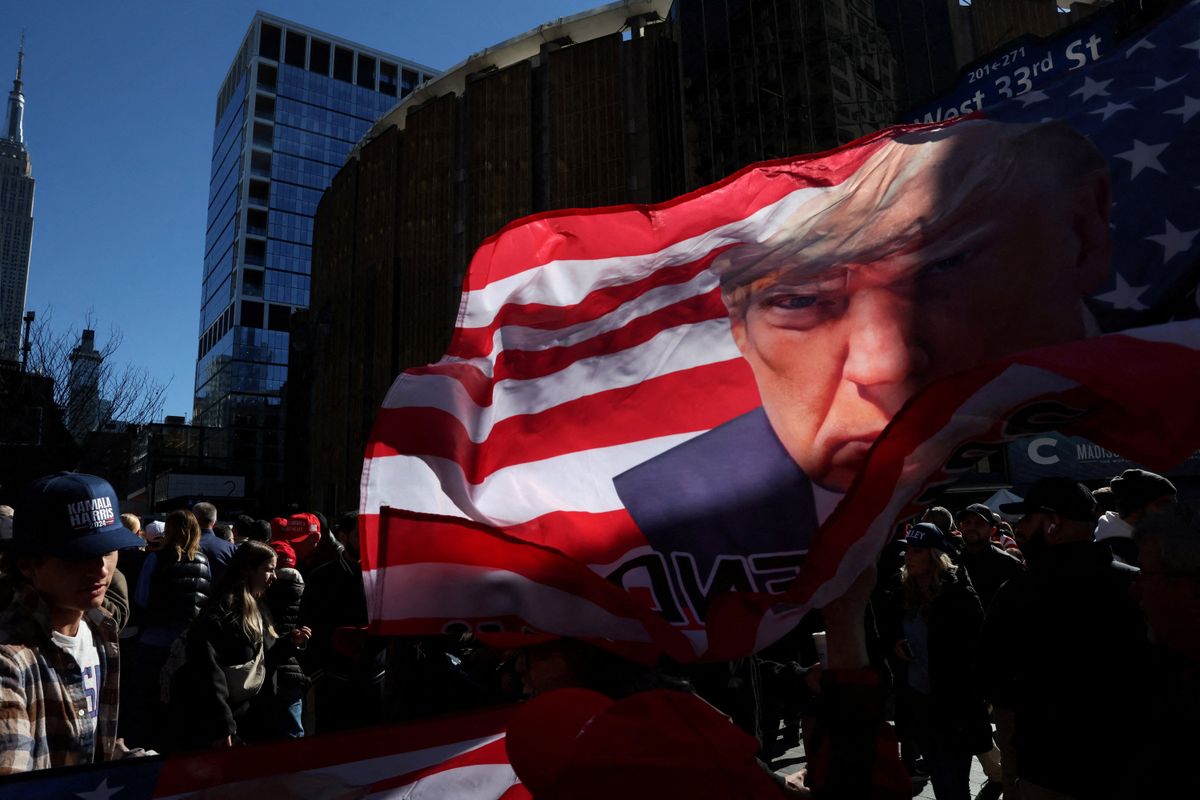
Pedestrians walk by as people wait in line outside of Madison Square Garden to attend a rally for Republican presidential nominee and former U.S. President Donald Trump in New York City, U.S., October 27, 2024. REUTERS/Leah Millis TPX IMAGES OF THE DAY

Former President Donald Trump's description of his Madison Square Garden rally as a "love fest" stunned viewers who'd witnessed its racist jokes, misogynistic insults and the many comparisons made to another political event held in the event in 1939.

Trump spurred a new wave of outrage during his press conference at Mar-a-Lago Tuesday when he championed the love and beauty of an event that has the archbishop of San Juan demanding an apology.

"Yes," political commentator S.V. Dáte wrote on X. "That would be the one where speaker after speaker said racist, authoritarian things, including, most famously, that insult to Puerto Ricans and Latinos."


Dáte was referencing multiple jokes made by comedian Tony Hinchcliffe who called Puerto Rico a "floating island of garbage," made unpublishable sexual comments about Latinos, and mocked a Black attendee by suggesting he ate watermelon.

When Vice President Kamala Harris' campaign shared Trump's comment on X, her team accused him of bragging about speakers who "spewed racist bile."

ALSO READ: 'Chosen by God': A new kind of convert is making the pilgrimage to see Trump

At the event, Tucker Carlson directed some of that commentary at Harris herself, scoffing at her heritage, which he misrepresented, and then suggesting it was absurd to think she could win an election.

“It’s gonna be pretty hard to look at us and say, ’You know what? Kamala Harris, she got 85 million votes because she’s just so impressive as the first Samoan-Malaysian, low-IQ, former California prosecutor ever to be elected president,” Carlson told the attendees.

Speaker David Rem called Harris the devil, Hulk Hogan made her the subject of an oral sex joke with crude physical gestures and Grant Cardone said she had "pimp handlers."

Independent journalist Marisa Kabas on Tuesday noted Trump, in describing this event, quietly threw himself a compliment by implying he drew more people than an infamous gathering of the American Nazi Party.

"They started to say 'Well, in 1939 the Nazis used Madison Square Garden," Trump said. "They've used Madison Square Garden many times, many people have used it, but nobody's ever had a crowd like that, and I'll tell you what right now, nobody's ever had love like that."

Trump's characterization of such comments as loving spurred CNN anchor Jim Acosta to issue a succinct verification verdict.

"One week before Election Day, Trump defends MSG rally from Sunday night as a 'love fest,'" Acosta wrote. "Fact check: It was not."

Conservative anti-Trump political group the Lincoln Project responded to Trump's comment by noting the things he had not said.

"No explanation, no apology," they wrote. "He's trash, throw him away in the dustbin of history in 7 days."


Latino voters key to US election, but not 'monolithic'

Agence France-Presse
October 29, 2024 

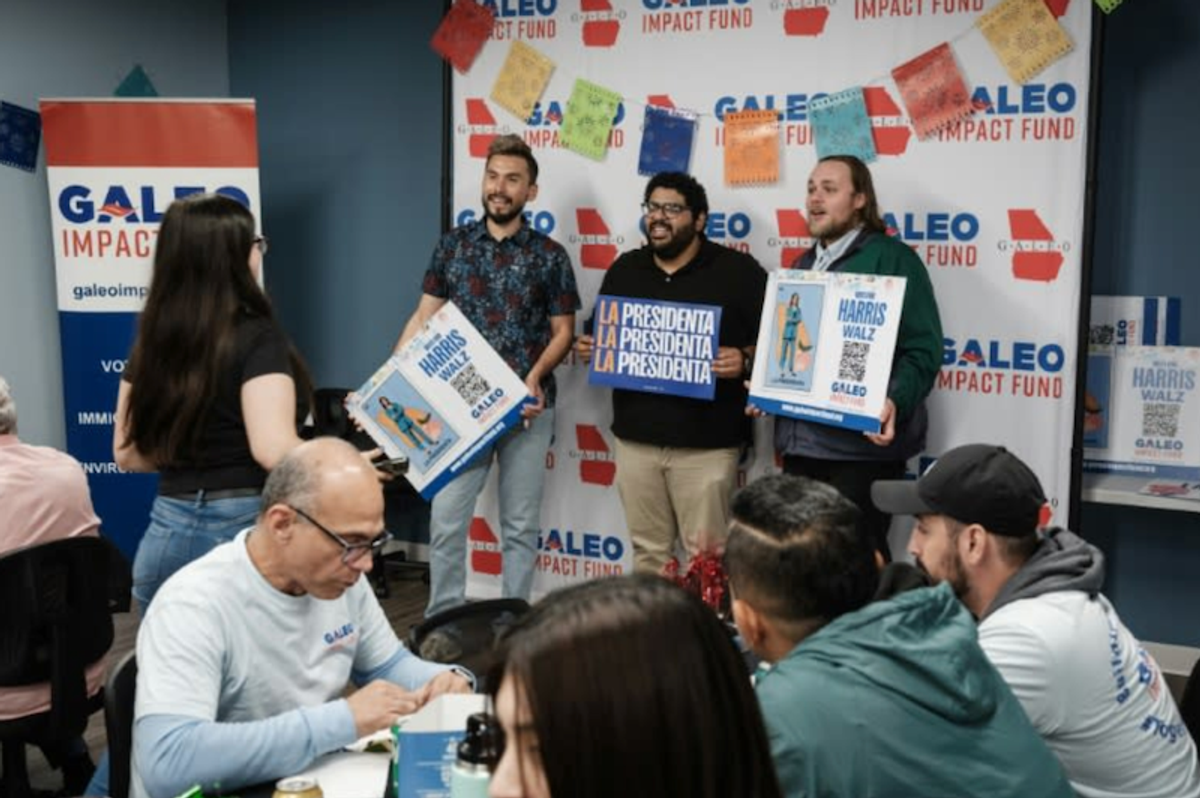
Staff and volunteers gather at the office of the Galeo Impact Fund, a voter outreach organisation, outside Atlanta (Yasuyoshi CHIBA/AFP)

Angel Ozuna can vote in his first U.S. election this year, but the 50-year-old, a naturalized citizen from Mexico, says he is unsure if he will exercise that right.

From his perfume shop in the key swing state of Georgia, Ozuna told AFP a few weeks ago that he was leaning toward Donald Trump, but the Republican ex-president's vicious attacks against Kamala Harris have left him conflicted.

"I don't think it's right for a man to attack a woman the way he does with her," said Ozuna, one of the nearly 36.2 million Hispanic Americans able to vote this year in the United States.

With analysts expecting the presidential election to be decided by razor-thin margins in a handful of key states, Latino voters like Ozuna "could be the one that tips the balance," said Rodrigo Dominguez-Villegas, research director of UCLA's Latino Policy and Politics Institute.

The impact could be decisive not only in the Southwest battlegrounds of Arizona and Nevada, where Latinos represent more than a fifth of the electorate, but also in the five other southern and Midwest swing states.

Latinos have traditionally voted more in favor of Democrats, but recent polling shows a noticeable trend toward Republicans.


The latest New York Times/Siena poll showed Harris with 52 percent of support among Hispanic voters to Trump's 42 percent.

Exit polls in 2020 showed Joe Biden with more than 60 percent support among Hispanic voters.

- Racism row -

"Unfortunately, many times the parties see Latinos as a monolithic voting bloc, and that is not the case," Dominguez-Villegas told AFP by phone.

"In addition to the diversity of countries of origin and ancestry, there is diversity of ideologies, ages and even races," he said.

For example, Ozuna said he trusts Trump to improve the economy and reduce illegal immigration, expressing a sense of unfairness that new arrivals have more rights and benefits, according to him, than he did when he came to the country 27 years ago.


In recent weeks, Harris and Trump have courted Latinos with Spanish-language advertisements and both participated in separate town hall-style discussions with Hispanic voters organized by TV network Univision.

But the Trump campaign has been in damage control over the past day, after a speaker at his New York City rally made crude jokes about Latinos and Puerto Rico that were widely condemned as racist.

The remarks were quickly seized upon by the Harris campaign, which highlighted its economic support initiative for Puerto Rico, a Spanish-speaking US territory.


"It was a great insult to the Puerto Rican people, who are citizens of this country," said Elisa Covarrubias, 42, deputy director of Galeo, a Latino non-profit in Georgia.

"It was a great political mistake, because there are many Puerto Ricans in New York, Pennsylvania and other important states like Georgia, who are watching and listening to what they say."

Javier Torres Martinez, a Puerto Rican native living near Miami, put it more bluntly: "The damage is done."


"Before I was 100 percent convinced to vote for Trump and now I am 100 percent motivated to go out and vote for Kamala Harris," the 45-year-old health insurance executive told AFP.

- 'We have power' -


Martha Arce, who was previously undecided, said the remarks "cleared my mind."

"Those racist comments have only given me the courage to go out and vote" for Harris, said the 41-year-old pediatrician, who moved from Puerto Rico to Miami after Hurricane Maria devastated the island in 2017.

On the other hand, Cesar Viera, said he did not think the jokes were offensive and that he would still be casting his ballot for Trump.

"He's just the best for the economy right now," said the 18-year-old handyman ahead of a Trump rally Monday in Georgia.


Earlier this month, organizers with Galeo's political arm were working in an office on the outskirts of Atlanta to boost Harris's showing with the Latino community.

Over the doorway was a pro-Harris sign in Spanish: "La Presidenta" (The President).

"What I always tell our community is that we have power, we have an influence," Kyle Gomez-Leineweber, director of policy and advocacy at the organization, told AFP.


"And if we are able to turn out our community, our community is going to be the one who decides who occupies the White House."
'Abusive and frightening': Trump official earned bad reputation for treatment of children

Kathleen Culliton
October 28, 2024 3:44PM ET

FILE PHOTO: Migrants are detained by U.S. Border Patrol agents after crossing into the United States from Mexico, in Sunland Park, New Mexico, U.S. August 2, 2024. REUTERS/Jose Luis Gonzalez/File Photo

A Trump administration official garnered a dark reputation among government workers as one of the world's most dangerous child abusers for the work he did for the former president, according to a new report.

Scott Lloyd, former director of the Office of Refugee Resettlement, received this criticism for his role in Trump policy that pulled more than 5,000 children from their families — 1,400 of whom remain separated, according to Politico's new report on Errol Morris' documentary "Separated."

“Separation was the purpose, prosecution was the mechanism," ORR deputy director Jonathan White says in the film. White described Lloyd as “the most prolific child abuser in modern American history.”

These details emerge from a documentary that, despite positive reviews and a topic of extreme relevance amid the 2024 presidential election, enjoyed only limited release after distributor MSNBC decided to delay airing until to avoid offending Trump, Politico reported.

The documentary details what Politico describes as "one of the most appalling initiatives of the Trump administration — splitting migrant children from their parents."

Trump was ultimately forced to back away from the policy that lasted from April to June of 2018.

But as the former president mounts his third presidential on a extreme anti-immigration platform, critics fear a second administration could see Trump blow past old barriers of political decorum.

“Trump seems to me to be a fascist,” Morris told Politico. “I don’t really believe in analogies in general, but as an American Jew whose family emigrated from Eastern Europe to this country, it’s hard not to see elements of fascism.”

Morris told Politico he was shaken by his interview with Lloyd, who received significant blame for his handling of the Trump administration's attempts to reunite separated families.

“I thought, ‘This is an utter failure,’” Morris told me. “The guy wouldn’t say anything.”

But according to Politico, "the awkward silences and evasions speak just as loudly as anything Lloyd could possibly have said in his defense."


Morris said the disturbing nature of the policies Lloyd failed to defend were what first drew him to the topic.

“They were not the same old, same old,” Morris said. "They were different in kind. They were new. They were draconian. They were abusive and frightening.”
Democracy dies in their wallets: Here's what happens when oligarchs buy the news

Thom Hartmann
October 29, 2024 

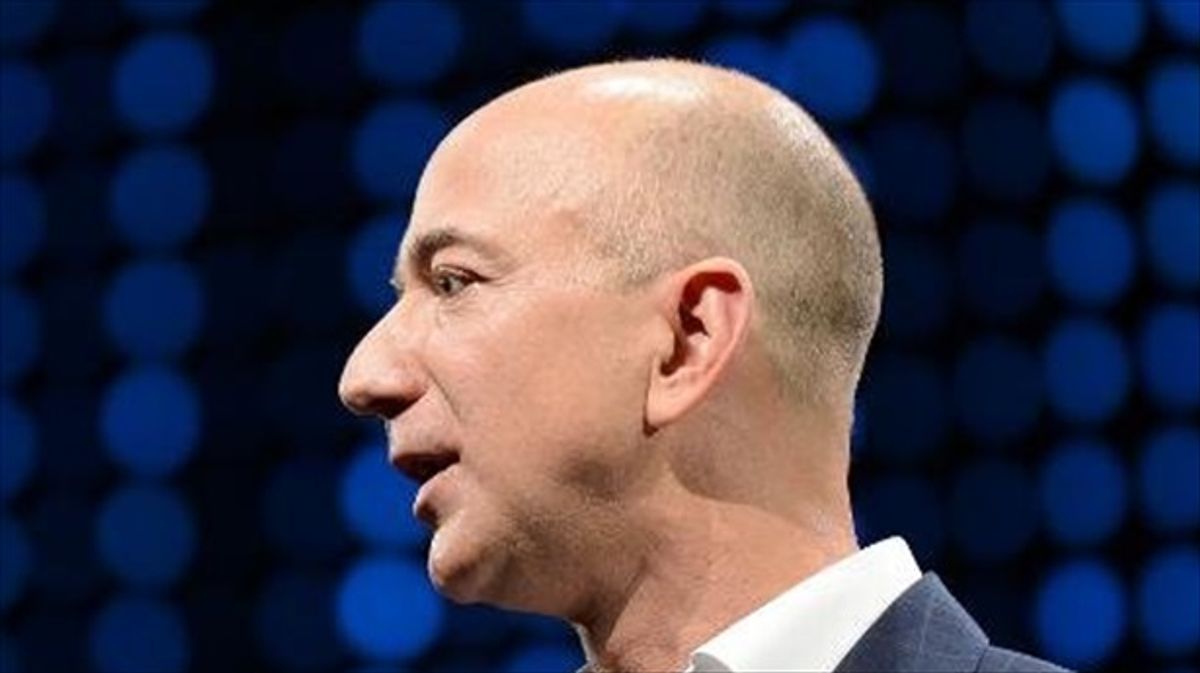
Amazon chief executive and new Washington Post owner Jeff Bezos, pictured on Sept. 6, 2013. [AFP]

Do not obey in advance. Most of the power of authoritarianism is freely given. In times like these, individuals think ahead about what a repressive government will want, and then offer themselves without being asked. A citizen who adapts in this way is teaching power what it can do.—Yale historian Timothy Snyder, On Tyranny

I cancelled my Washington Post subscription Friday evening. Jeff Bezos, Mister “Democracy Dies In Darkness” (the Post’s slogan on their masthead), by blocking his editorial staff from endorsing Harris chose darkness over his nation’s future, and I can’t support that.

The big mistake John D. Rockefeller made back in the day — that Jeff Bezos and Elon Musk appear committed to not repeating — was not buying a media outlet like a newspaper. Had John D. had that sort of a vehicle to mold public opinion, American history may be very different.

By 1880, Rockefeller’s Ohio-based company controlled over 90 percent of the nation’s oil, owned 4000 miles of pipelines, and employed over 100,000 people. As Rockefeller’s oil empire got larger and larger, eating alive hundreds of smaller operations, ruthlessly driving up prices, destroying his competitors, and throwing workers out of a job, public outrage grew

In 1887, Ohio sued him, arguing that he was operating in ways that were detrimental to the state and its citizens and businesses; in 1892 the Ohio Supreme Court ordered his company dissolved. As I lay out in detail in Unequal Protection: How Corporations Became “People,” this led Rockefeller to move Standard Oil to New Jersey after that state changed its corporation laws to allow for his monopolistic behavior.

Which brought in the federal government; in 1890, Ohio Senator John Sherman introduced and saw passed into law the Sherman Anti-Trust Act which provided not just fines but jail sentences against people like Rockefeller who were committed to destroying competition and owning entire markets. The law was flawed with a few loopholes and ambiguities, so it was amended in 1914 with the Clayton Anti-Trust Act.

Nonetheless, in 1906 progressive Republican Teddy Roosevelt’s administration filed an antitrust action against Rockefeller that went to the Supreme Court in 1911 during the administration of progressive Republican President William Howard Taft. The behemoth was broken up into 34 separate companies, an action that, like the breakup of AT&T by Jimmy Carter and Ronald Reagan, led to an explosion of competition in the marketplace and a dramatic increase in shareholder value.

But back to Jeff Bezos and his 2013 purchase of The Washington Post.

It was reporters and editors for the hundreds of independent newspapers during the First Gilded Age (1880-1900) era that led the crusades against Rockefeller and his fellow monopolists. Investigative journalism was all the rage then, and it fed public demand for a return to competition and the de-throning of that age’s oligarchs.

The vast majority of workers were struggling and they worked for a very small 10 percent of the population who controlled most of the nation’s wealth (a situation we’re at again).

The result was constant strife, strikes, and the murder of labor leaders; entire towns were in arms (and sometimes ablaze) with labor conflict. The “problem of labor”was the number one issue of the day. As President Grover Cleveland — the only Democrat elected during that period — proclaimed in his 1887 State of the Union address:

“As we view the achievements of aggregated capital, we discover the existence of trusts, combinations, and monopolies, while the citizen is struggling far in the rear or is trampled to death beneath an iron heel. Corporations, which should be the carefully restrained creatures of the law and the servants of the people, are fast becoming the people’s masters.”

There was a broad consensus across American society that those “Robber Barons” were feathering their own nests at the expense of the American public, hurting both working class people and small businesses. The Supreme Court endorsed breaking up Standard Oil in 1911, and even broke up the Associated Press in 1944.

The law was so rigorously enforced — so the game of business could be played by all comers, not just the “big boys” — that in the 1960s the Supreme Court barred the merger of the Kinney and Buster Brown shoe companies because the new combined company would control a mere 5 percent of the shoe market.

Back in the ’60s every mall and downtown in America was filled with small, locally-owned businesses; there might be a Sears to anchor the shopping center or a retail part of town, but most shops, restaurants, and hotels were family-owned.


But then Reagan, in 1983, ordered the DOJ, SEC, and FTC to stop enforcing the Sherman Act, which is why today Nike, for example, controls about a fifth of the entire nation’s shoe market. It’s the same across industry after industry, from retail to grocery stores to railroads to computer software to social media to chip manufacturing to airlines to hotels…and on and on. In virtually every industry, a handful of massive companies control 80 percent or more of the market.

The Biden administration is the first to seriously try enforcement of the nation’s anti-trust laws since Carter broke up AT&T, going after Google and blocking mergers in multiple industries. It’s led a bunch of American billionaires to demand that the Federal Trade Commission’s head, Lina Kahn, be fired.

Kahn and her FTC went after Bezos last year, suing Amazon for running a monopoly that price-gouges customers and blocks out competition. The trial is scheduled for 2026 if Kahn keeps her job; a Trump administration would fire her immediately, and pressure from major corporate donors and billionaires is building on Harris to do the same.


Bezos also must remember well when he got on the wrong side of then-President Trump because of the Post’s coverage of the orange oligarch’s lies and crimes; Trump, in a fit of pique, awarded a $10 billion Pentagon contract for cloud computing to Microsoft, shocking analysts across the industry.

Bezos is also working for his Blue Origin spaceship company to get more billions in NASA and Pentagon contracts. He and his companies also own billions in Google and AirBNB stock as well as owning outright almost a hundred other companies.

Might be a good time to own one of the two most influential newspapers in America, eh?


Similarly, billionaire oligarch Elon Musk, in addition to apparently taking orders from Russian President Vladimir Putin, is fighting numerous government efforts to regulate his companies (which exist in large part because Obama bailed out Tesla in 2010 with $465 million, and NASA is now pouring hundreds of millions into SpaceX):

— Tesla is fighting the National Labor Relations Board (NLRB) over union-related issues, with Musk taking a lawsuit to the Supreme Court alleging government protections of unions are unconstitutional.
— SpaceX is battling the NLRB over employee firings.
— The SEC is investigating Musk’s acquisition of Twitter (now X) and his “funding secured” tweets about taking Tesla private.
— The FTC is investigating X’s compliance with a $150 million privacy settlement.
— The Federal Communications Commission recently denied SpaceX’s Starlink a $886 million rural broadband award.
— The Equal Employment Opportunity Commission is suing Tesla over alleged racial harassment.
— The FAA is in conflict with SpaceX over launch licensing and environmental reviews.
— The EPA has fined SpaceX for water-related violations.
— The National Highway Traffic Safety Administration has opened multiple investigations into Tesla’s vehicle safety and Autopilot system.
— SpaceX faces scrutiny over its environmental impact at its Texas launch site.

To avoid the Rockefeller mistake, Musk — with the apparent help of two Russian oligarchs and the leader of Saudi Arabia — purchased Twitter, the online digital equivalent of our nation’s largest newspaper.


And he’s now using it to try to get Trump and Republicans into office, presumably so they can gut the FTC, FCC, SEC, NLRB, and any other regulator that might take him on to protect workers, the public, and the national interest.

We took on the superrich with success during the First Gilded Age, and our enforcement of antitrust laws lasted all the way to 1983, when Reagan blocked them, leading to the “merger mania” of the 1980s and bringing us today’s oligarchic business empires across multiple industries.

Now that we’re in America’s Second Gilded Age — with today’s billionaires vastly richer than Rockefeller’s wildest dreams — we confront a similar crossroads to that of previous generations.


Is it okay, for example, for billionaires to own media properties they can use to manipulate politics and government agencies to amplify their other business interests? Or that five corrupt Republicans on the Supreme Court have ruled that our morbidly rich plutocrats can own judges and politicians? Most Americans would probably say “No” to both.

At some point, America is going to have to confront its oligarch problem. And the sooner the better, if we don’t want darkness to entirely subsume our democracy.
Democracy's not the only thing that 'dies in darkness'

D. Earl Stephens
October 29, 2024

The Washington Post (AFP)
This article was paid for by Raw Story subscribers. 


I have been a subscriber of The Washington Post for 26 years.

I devoured it each day while riding the Metro from my home in Northern Virginia to the National Press Building in Washington D.C., where Stars and Stripes was published.

When I transferred to Stripes’ overseas headquarters in Europe in 2004, I kept a digital subscription out of loyalty, and because I believed papers like WaPo were essential to a thriving democracy.

That ended this afternoon with the newspaper’s failure to endorse the Democratic candidate for president, Kamala Harris, who is a champion for a democracy they allege to care so damn much about.

I am done with them.

As a longtime newspaperman, and reader, this is a very sad day for me, and an absolutely tragic one for our nation, as we try to withstand a fascist onslaught from the Right in America that is led by moral-less, soulless, vindictive man who has proven beyond any doubt that he means our country harm.


There have seldom been more dangerous times in this country.

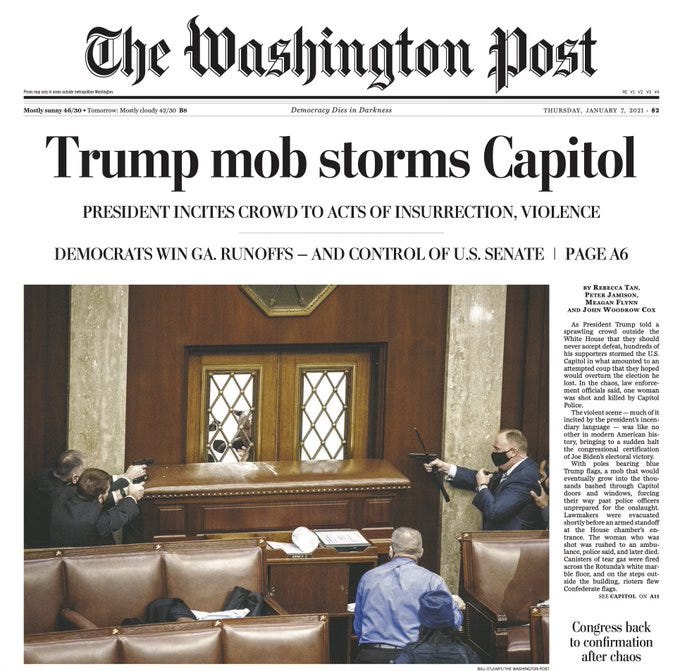
Why, just short of 46 months ago, in fact, this was the front page of their newspaper:


That “president” who “incited the crowd to acts of insurrection and violence” is now back to try it all again, and the only person standing in his way is the woman running against him.

Endorsing Harris wasn’t a hard call. It was the onlycall.

Their failure to make this endorsement goes beyond a catastrophic lack of judgment, because weknow theyknow that what they are doing is nothing but a gutless attempt to appease a would-be dictator.


Do no let them try to spin this any other way, which is what they are currently doing while they hemorrhage readers, and try to stave of the unrelenting criticism that is coming at them in waves.

Let this be the latest.

And if you don’t take my word for just how horrid this decision was, have a look at this powerful statement from former Washington Post Executive Editor Marty Baron:

"This is cowardice, a moment of darkness that will leave democracy as a casualty. Donald Trump will celebrate this as an invitation to further intimidate The Post’s owner, Jeff Bezos (and other media owners). History will mark a disturbing chapter of spinelessness at an institution famed for courage."

Read that again, because it is chilling …

I have been on the record many times saying that newspaper endorsements don’t mean a whole heckuva lot as far as moving the needle on voters’ decisions at the ballot box either way, but they do represent the values of the people who run these newspapers.

In this case, WaPo put their alleged values at the very top of the paper for everybody to see each day:

Democracy Dies in Darkness

Incredible, isn’t it?

I am also painfully aware that since the billionaire Jeff Bezos purchased the newspaper, those values have been on a slow and steady decline that accelerated with the hiring of the disgusting Will Lewis to become the CEO of the newspaper.

Among Lewis’s stops during his disreputable career were editor of conservative Telegraph in the United Kingdom; publisher of Rupert Murdoch's Wall Street Journal; and consultant to Conservative UK Prime Minister Boris Johnson.

How a guy with such a warped notion of sound editorial judgment can run any newsroom completely sickens me.

As I type this, it is Bezos who is owning this odious decision not to endorse, and it flowed like sludge down to Lewis and into the editorial offices.

Worse — and I will predict this will only get worse — it is being reported that the paper had an endorsement of Harris ready to be printed this weekend, so I am positing again that this was nothing but a reckless decision to appease the America-attacking Trump.


In closing, I want to type again that a newspaper needs two things that are absolutely critical to its success. Without them, they are worthless to their readers.

The first is accuracy. A newspaper simply must prove itself to be consistently accurate to be considered trustworthy. If a newspaper gets things wrong, they are worthless.

The second thing is credibility. Readers must believe their newspaper is credible, and worth trusting with their precious time.


When a newspaper with the logo “Democracy Dies in Darkness”fails to endorse the candidate that stands up for that Democracy, they are not being accurate or credible.

They in fact are completely worthless.

Dead.


D. Earl Stephens is the author of “Toxic Tales: A Caustic Collection of Donald J. Trump’s Very Important Letters” and finished up a 30-year career in journalism as the Managing Editor of Stars and Stripes. You can find all his work here.