Thursday, February 13, 2025


Congo: Do We Trace Genocide to Human Hatred or Corporate Profit?


Rwanda has broken international law with the visible presence of Rwandan troops in the Democratic Republic of Congo alongside Rwanda’s covert M-23 militia. M-23 is reported to have captured Goma (again) and the civilians are in a state of emergency. This is familiar because M-23 previously took over the city in 2012 but had to withdraw because it wasn’t equipped to administer the city of two million. As the M-23 rebels and their allies increase their takeover of the East Congo with reported vows of advancing to the capital of the Democratic Republic of Congo in a “liberation” of the country, it becomes clear Rwanda has invaded Congo again, possibly for keeps this time to maintain its hold on the East’s gold, copper, and coltan mines.The Congo’s government has requested international sanctions against Rwanda. But the international community has allowed an ongoing genocide of the Congolese people for thirty years. The people of the Congo live under a genocide warning.

Paul Kagame began invading the Eastern Congo after he took over Rwanda in 1994. Subsequently Uganda which sponsored Kagame’s invasion of Rwanda with U.S. funding. and Rwanda have maintained militias in the area. While genocide was brought under control in Rwanda, an insistence on mass killing was carried into the Congo by Kagame’s Rwandan troops in pursuit of Hutu refugees who fled there. This also allowed Rwandan forces to protect Tutsi groups settled in the Congo, and access and control a portion of the mining resources.

But the resources belong to the people. As they do in the Sudan and South Sudan. As they do in Gaza and Palestine. All three areas are currently threatened by genocide against the people who have lived there.

The U.S. Government’s official site for the National Library of Medicine, notes “5.4 million people have died in Democratic Republic of Congo since 1998 because of conflict, report says” (Peter Moszynski, Jan. 31, 2008, BMJ). Since the “First Congo War” in 1996 to the present, the white press underestimates the death toll at six million, civilians.

From the perspective of preventing genocide the source of the problem rests, in both the five lakes region of Africa and the Middle East, with corporate interests using national leaders to effect policy. This facile academic statement of the obvious covers the fact that millions on millions of individual innocent civilian lives are currently being sacrificed, for corporate growth and profit. This is against any sense of ethics, knowledge of right and wrong, law, religious commitments to honour life, or the people’s informed consent.

In the DRC the genocide continues because it is meant to. It works. The mines are working, The resources are taken. The peoples’ deaths are not a corporate concern. The elites are not about to stop it. They are the reason Patrice Lumumba was assassinated in 1961 and the UN’s Dag Hammarskjöld killed. And the Simba rebellion crushed. And the Eastern Congo thrown into the chaos of warring militias.

The Rwandan sudden genocide among tribes living in peace brought in an Anglo-American-backed Paul Kagame. One could say Rwanda is responsible for the genocide of Congolese except that the benefits have devolved to International corporations, stock markets, manufacturers, economies.

This is so familiar because European and American policies have used Independent Congo (Zaire, DRC) since its colonial bondage as a people enslaved to the uses of Western capital. Now the Chinese have bought-in with the purchase of many previously American owned mines. The means of effecting colonialism has shifted but the people-as-prey remains the same. The genocide continues. With respect for conscience a portion of UN peacekeepers are in place to lessen the civilian body count. But the guilty parties here are the same who engineered the “Rwanda” genocide, which the UN did not stop, and which served a policy of Western corporate expansion.

There is little hope of any justice for the Democratic Republic of Congo’s people until the ownership and control of the mineral resources in the East are in the hands of a just regulator that assures the people safety and payment for their resources. It may have to be UN administered to include Russian and China. It is an alternative to an ongoing genocide. Until then all profits from the genocide should be tracked as evidence for eventual prosecution.

Background: The continuing genocide of civilians in the Congo is noted in Nightslantern’s genocide warnings for the Congo since 2004. 12345678910. Recommended: Keith Harmon Snow’s “Merchants of Death: Exposing Corporate Financed Holocaust in Africa” (2008); my 2006 essay, “Tactical Use of Genocide in Sudan and the Five Lakes Region,” (2006).

Image: “What it’s like to watch a genocide happening,” by Julie Maas
il

John Bart Gerald is a poet/journalist living in Montreal. He writes the website nightslantern.ca concerned with the prevention of genocide. Read other articles by J. B..


Dallaire Continues to Justify Kagame’s Crimes


Romeo Dallaire has greatly enabled the “Butcher of Africa’s Great Lakes” region. The Canadian general’s fairy tale has repeatedly justified Rwandan dictator Paul Kagame who has once again unleashed horrible violence in Congo.

Two months ago a man in front of me at Salon du livre de Montréal asked Dallaire if his “opinion of Rwanda has changed since the M23 movement emerged in the Congo?” The retired general’s response to this question about a Kigali spurred force, which has recently killed thousands and displaced hundreds of thousands in capturing the Congolese city of Goma, was extreme Kagame propaganda. He said: “No because the M23 is but one group who are trying to save the lives of Tutsis, who are Congolese Tutsis, while the Kinshasa government has a dozen or so rebel forces and so on who are slaughtering them. So the M23 are defending. And then the philosophy of Kagame has always been one to be on the offensive so he’s not going to [be] waiting to cross the border into his country to fight; he’s going to sort them out on the other side. So he’s simply continuing to get rid of the threat of extremists on the Congolese side and the Rwandan extremists who are there in the Congo still seeking the elimination of the Tutsis.”

Twenty-nine years after Rwanda first invaded Congo purportedly to target genocidaires, Dallaire is promoting Kigali’s apologia for mass slaughter. The Globe and Mail, New York Times, and Financial Times no longer even promote this framing of Rwandan aggression.

It’s not a one off. Dallaire has repeatedly called Kagame an “extraordinary man” and raved about his government. In April, Dallaire stated, the past thirty years in Rwanda have stood as the most profound example of noble and brave peacemaking I have ever witnessed; perhaps that ever existed…. I join you in celebrating Rwanda and its people, who are leading all of Africa by the example of moral strength and commitment to harmony and prosperity.”

Dallaire made that statement two years into a new wave of Kigali/M23 instigated violence against its highly impoverished neighbour. Over the past three decades Rwanda’s repeated invasions have killed millions of Congolese.

Dallaire has assisted the US military college-trained Kagame since leading the military component of a UN mission designed to help end the conflict caused by the Rwandan Patriotic Front (RPF)/Uganda invasion of Rwanda. Between fall 1993 and July 1994, Dallaire is credibly accused of favouring the US-backed RPF in contravention of UN guidelines. In response to the Canadian general’s self-serving portrayal of his time in Rwanda, the overall head of the 1994 UN mission in Rwanda, Jacques-Roger Booh Booh, published Le Patron de Dallaire Parle (The Boss of Dallaire Speaks). Almost entirely ignored by the Canadian media, the 2005 book by the former Cameroon foreign minister claims the Canadian general backed the RPF and had little interest in their violence despite reports of summary executions in areas controlled by them.

Dallaire has propagated Kagali’s wildly simplistic account of the Rwandan Genocide. He has ignored the overwhelming evidence and logic that points to the RPF’s responsibility for blowing up the plane carrying the Hutu presidents of Rwanda and Burundi (and much of the Hutu-led Rwandan military command), which unleashed the mass genocidal killings in April 1994.

To align with Kagame’s claim of a “conspiracy to commit genocide,” Dallaire has changed his depiction of the Rwandan tragedy over the years. Just after leaving his post as UNAMIR force commander, Dallaire replied to a September 14, 1994 Radio Canada Le Point question by saying, “the plan was more political. The aim was to eliminate the coalition of moderates…. I think that the excesses that we saw were beyond people’s ability to plan and organize. There was a process to destroy the political elements in the moderate camp. There was a breakdown and hysteria absolutely…. But nobody could have foreseen or planned the magnitude of the destruction we saw.”

To a large extent the claim of a “conspiracy to commit genocide” rests on the much celebrated January 11, 1994, “genocide fax”. But, this fax Dallaire sent to the UN headquarters in New York is not titled, to quote International Criminal Tribunal for Rwanda lawyer Christopher Black, “‘genocide’ or ‘killing’ but an innocuous ‘Request For Protection of Informant.’” The two-page “genocide fax”, as New Yorker reporter Philip Gourevitch dubbed it in 1998, was probably doctored a year after the mass killings in Rwanda ended. In a chapter devoted to the fax in Enduring Lies: The Rwandan Genocide in the Propaganda System, 20 Year Later, Edward Herman and David Peterson argue two paragraphs were added to a cable Dallaire sent to UN headquarters about a weapons cache and protecting an informant (Dallaire never personally met the informant). The two (probably) added paragraphs said the informant was asked to compile a list of Tutsi for possible extermination in Kigali and mentioned a plan to assassinate selected political leaders and Belgian peacekeepers.

Mission head Booh-Booh denies seeing this information and there’s no evidence Dallaire warned the Belgians of a plan to attack them, which later transpired. Finally, a response to the cable from UN headquarters the next day ignores the (probably added) paragraphs. Herman and Peterson make a compelling case that a doctored version of the initial cable was placed in the UN file on November 27, 1995, by British Colonel Richard M. Connaughton as part of a Kigali–London–Washington effort to prove a plan by the Hutu government to exterminate Tutsis.

Even if the final two paragraphs were in the original version, the credibility of the information would be suspect. Informant “Jean-Pierre” was not a high placed official in the defeated Hutu government, reports Robin Philpott in Rwanda and the New Scramble for Africa: From Tragedy to Useful Imperial Fiction. Instead, “Jean-Pierre” was a driver for an opposition political party, MRND, who later died fighting with Kagame’s RPF.

Incredibly, the “genocide fax” is the primary source of documentary record demonstrating UN foreknowledge of a Hutu “conspiracy” to “exterminate” Tutsi, a charge even the victors justice at the International Criminal Tribunal for Rwanda (ICTR) failed to convict anyone of. According to Herman and Peterson, “when finding all four defendants not guilty of the ‘conspiracy to commit genocide’ charge, the [ICTR] trial chamber also dismissed the evidence provided by ‘informant Jean-Pierre’ due to ‘lingering questions concerning [his] reliability.’”

At the end of their chapter tracing the history of the “genocide fax” Herman and Peterson write, “if all of this is true, we would suggest that Dallaire should be regarded as a war criminal for positively facilitating the actual mass killings of April-July, rather than taken as a hero for giving allegedly disregarded warnings that might have stopped them.”

Thirty-one years later Dallaire continues to cover for Kagame’s crimes, claiming Rwanda has the right to destabilize and kill millions in Congo.

He’s gone beyond words. As part of his support for the most bloodstained dictator on the continent, the Dallaire Institute for Children, Peace and Security established their headquarters in Kigali. It works closely with the Rwandan military. In August 2023, Dallaire met with Kagame and Rwandan Minister of Defence Juvenal Marizamunda. The Rwandan military’s website has multiple posts about working with Dallaire’s Institute. The institute trains Rwandan forces as part of the 2017 Vancouver Principles on Peacekeeping and the Prevention of the Recruitment and Use of Child Soldiers.

Global Affairs Canada has provided over $20 million to the Dallaire Institute. According to the Globe and Mail, a Global Affairs director wrote a memo raising concerns about funding the Dallaire Institute because it worked closely with a Rwandan military using child soldiers in Congo.

When the regime in Kigali finally falls, the history books will not look kindly on Romeo Dallaire. Rather than a humanitarian who worked to stop violence, he’ll be seen as someone who enabled mass killings in Africa’s great lakes region.FacebookTwitterEmail

Yves Engler is the author of 12 books. His latest book is Stand on Guard for Whom?: A People's History of the Canadian Military</em . Read other articles by Yves.


Far from Benign: The US Aid Industrial Complex


The US aid program began in earnest in the early stages of the Cold War, with an intention to beat off the contenders from the Soviet bloc in the postcolonial world. President Harry S. Truman proposed, in his 1949 inaugural address, “a bold new program for making the benefits of our scientific advances and industrial progress available for the improvement and growth of underdeveloped areas.” In 1961, President John F. Kennedy signed the Foreign Assistance Act of 1961, enabling him to issue the executive order that created the US Agency for International Development (USAID).

In 1962, the American scholar of international relations, Henry Morgenthau, suggested that foreign aid could fall into six categories: the sort that promoted humanitarian objects, the aid that offers subsistence goals and military aims, the sort that acted as a bribe, the attainment of prestige and economic development.

To provide aid suggests a benevolent undertaking delivered selflessly. It arises from the charitable mission, an attempt to alleviate, or at least soften the blows of hardship arising from various impairments (poverty, famine, disease). But the provision of aid is rarely benign, almost always political, and, in its realisation, often self-defeating. The very transaction acknowledges the inherent victimhood of the sufferer, the intractable nature of the condition, the seemingly insoluble nature of a social problem.

Morgenthau also conceded that humanitarian aid, despite being, on the surface, non-political in nature, could still “perform political function when it operates within political context.” And the very provision of aid suggests an accepted state of inequality between giver and recipient, with the former having the means to influence outcomes.

With such views frothing the mix, it is worth considering why the attack by President Donald J. Trump on USAID as part of his axing crusade against bureaucratic waste is not, for all its structural and constitutional limitations, without harsh merit. Over the years, insistent critics have been lurking in the bushes regarding that particular body, but they have been dismissed as isolationist and unwilling to accept messianic US internationalism. The Heritage Foundation, for instance, has been wondering if the whole idea of US foreign aid should be called off. In January 1995, the body produced a report urging the termination of USAID. “Despite billions of dollars spent on economic assistance, most of the countries receiving US development aid remained mired in poverty, repressions, and dependence.”

Such a viewpoint can hardly be dismissed as a fringe sentiment smacking of parochialism. (In the United States, imperialist sentiment is often synonymous with supposedly principled internationalism.) The less rosy side of the aid industry has been shored up by such trenchant critiques as Dambisa Moyo’s, whose Dead Aid (2009) sees the $1 trillion in development aid given to Africa over five decades as a “malignant” exercise that failed to reduce poverty or deliver sustainable growth. She caustically remarks that, “Between 1970 and 1998, when aid flows to Africa were at their peak, poverty in Africa rose from 11 percent to a staggering 66 percent.” Aid, far from being a potential solution, has become the problem.

The report card of USAID has not improved. One of the notable features of the aid racket is that much of the money never escapes the orbit of the organisational circuit, locked up with intermediaries and contractors. In other words, the money tends to move around and stay in Washington, never departing for more useful climes. A report by USAID from June 2023 noted that nine out of every ten dollars spent by the organisation in the 2022 fiscal year went to international contracting partners, most of whom are situated in Washington, DC. USAID funding is also very particular about its recipient groups, with 60% of all its funding going to a mere 25 groups in 2017 alone.

In January this year, the USAID Office of Inspector General authored a memorandum noting accountability and transparency issues within USAID-funded programs. USAID, Inspector General Paul K. Martin insisted, “must enforce the requirement that UN agencies promptly report allegations of fraud or sexual exploitation and abuse directly to OIG.” While the sentiment of the document echoes a long US tradition of suspicion towards UN agencies, valid points of consideration are made regarding mismanagement of humanitarian assistance. The OIG also took issue with USAID’s lack of any “comprehensive internal database of subawardees.”

Despite these scars and impediments, USAID continues being celebrated by its admirers as a projection of “soft power” par excellence, indispensable in promoting the good name of Washington in the benighted crisis spots of the globe. A cuddly justification is offered by the Council on Foreign Relations, which describes USAID as “a pillar of US soft power and a source of foreign assistance for struggling countries, playing a leading role in coordinating the response to international emergencies such as the global food security crisis.”

Stewart Patrick of the Carnegie Endowment for International Peace discounts the politically slanted nature of US aid policies, not to mention its faulty distribution mechanism, by universalising the achievements of a body he cherishes. USAID “has contributed to humanity’s extraordinary progress in poverty reduction, increased life expectancy, better health, improved literacy, and so much more.”

A less disingenuous example can be found in the Financial Timeswhich encourages “fighting poverty and disease and enabling economic development” as doing so will improve safety, advance prosperity, curb instability and the appeal of autocracy. But at the end of the day, aid is a good idea because, reasons the editorial, it offers expanded markets for US exports. The sick and the impoverished don’t tend to make good consumers. To cancel, however “life-saving projects” at short notice was “a good way to provoke an anti-American backlash” while giving an encouraging wink to the Chinese. US Aid: far from benign, and distinctly political.FacebookTwitterReddit

Binoy Kampmark was a Commonwealth Scholar at Selwyn College, Cambridge. He lectures at RMIT University, Melbourne. Email: bkampmark@gmail.comRead other articles by Binoy.

The Demise of USAID: Few Regrets in Latin America


“Take your money with you,” said Colombia’s President Gustavo Petro, when told about Trump’s plans to cut aid to Latin America, “it’s poison.”

USAID (US Agency for International Development) spends around $2 billion annually in Latin America, which is only 5% of its global budget. The temporarily closed-down agency’s future looks bleak, while reactions to its money being cut have been wide-ranging. Only a few were as strong as Petro’s and many condemned the move. For example, WOLA (the Washington Office on Latin America), a leading “liberal” think tank which routinely runs cover for Washington’s regime-change efforts, called it Trump’s “America Last” policy.

While USAID does some good – such as removing landmines in Vietnam (themselves a product of US wrongdoing) – as an agency of the world’s hegemon, its fundamental role is aligned with projecting US world dominance.

Not unexpectedly, the corporate media have largely come to the rescue of USAID. They try to give the impression that they are mainly concerned that some countries would be badly effected by its loss. In fact, the follow-the-flag media understand that USAID is part of the imperial toolkit.

Both the Los Angles Times and Bloomberg suggested that USAID’s shutdown would “open the door” to China. The Associated Press described the withdrawal of aid as a “huge setback” for the region; the BBC echoed these sentiments. The NYT and other mainstream media point to the irony that many of its programs help stem outward migration from Latin America, an issue which is otherwise at the top of Trump’s agenda.

Weaponization of humanitarian aid

The corporate media, not surprisingly, give a one-sided picture. It’s true, of course, that an aspect of USAID’s work is humanitarian. But, as Jeffrey Sachs explained, “true, and urgent, humanitarian aid” was only one element in a larger “soft power” strategy. From its inception, USAID’s mission was more than humanitarian.

A year after President John Kennedy created USAID in 1961, he told its directors that “as we do not want to send American troops to a great many areas where freedom may be under attack, we send you.”

The organization is “an instrument of [US] foreign policy …a completely politicized institution,” According to Sachs. It has mainly benefitted US allies as with the program to limit hurricane damage in Central America, cited by the NYT which omits Nicaragua, hit by two devasting storms in 2020. Needless to say, Nicaragua is not a US ally.

Although USAID provides about 42% of all humanitarian aid globally, the Quixote Center reports that most of the funds are spent on delivering US-produced food supplies or on paying US contractors, rather than helping local markets and encouraging local providers. The Quixote Center argues that “a review of USAID is needed,” though not the type of review which Trump or Elon Musk probably have in mind.

Indeed, the dumping of subsidized US food products undermines the recipient country’s own agriculturalists. While hunger may be assuaged in the short-term, the long-term effect is to create dependency, which is the implicit purpose of such aid in the first place. In short, the US globally does not promote independence but seeks to enmesh countries in perpetual relations of dependence.

Regime change

The third and most controversial element, identified by Sachs, is that USAID has become a “deep state institution,” which explicitly promotes regime change. He notes that it encourages so-called “color revolutions” or coups, aimed at replacing governments that fail to serve US interests.

The State Department is sometimes quite open about this. When a would-be ambassador to Nicaragua was questioned by the US Senate in July 2022, he made clear that he would work with USAID-supported groups both within and outside the country who are opposed to Nicaragua’s government. It is hardly surprising that Nicaragua refused to accept his appointment. The progressive government has since closed down groups receiving regime-change funding.

The history of US regime-change efforts in Latin America is a long one, much of it attributable to covert operations by the CIA. But since 1990, USAID and associated bodies like the National Endowment for Democracy have come to play a huge role. For example, they have spent at least $300 million since 1990 in trying to undermine the Cuban Revolution.

Regime-change efforts in Cuba involved a vast organization known as Creative Associates International (CREA), later shown by Alan MacLeod to be directing similar USAID programs across Latin America. Currently, CREA is working in Honduras whose progressive government is under considerable pressure from the US government. Yet CREA is only one of 25 contractors which, in 2024, earned sums ranging from $32 million to a whopping $1.56 billion.

Culture wars

USAID’s regime-change work often foster ostensibly non-political cultural, artistic, gender-based or educational NGOs whose real agenda is to inculcate anti-government or pro-US attitudes. Examples proliferate.

In Cuba, USAID infiltrated the hip-hop scene, attempted to create a local version of Twitter, and recruited youngsters from Costa Rica, Peru and Venezuela to go to Cuba to run a particularly inept project that risked putting them in jail.

In Venezuela, USAID began work after the unsuccessful US-backed coup attempt against President Hugo Chávez in 2002. By 2007, it was supporting 360 groups, some of them overtly training potential “democratic leaders.” The Venezuelan rock band Rawayana, recent winners of a Grammy, are funded by USAID to convey pro-opposition messages in their public appearances.

In Nicaragua, after the Sandinista government returned to power in 2007, USAID set up training programs, reaching up to 5,000 young people. Many of those who were trained then joined in a coup attempt in 2018.

Astroturf human rights and media organizations

Another tactic is to undermine political leaders seen as US enemies. In 2004, USAID funded 379 Bolivian organizations with the aim of “reinforcing regional governments” and weakening the progressive national government.

It did similar work in Venezuela, including in 2007 holding a conference with 50 local mayors to discuss “decentralisation” and creating “popular networks” to oppose President Chávez and, later, President Nicolás Maduro. USAID even expended $116 million supporting the self-declared “interim presidency” of Juan Guaidó.

In a similar vein, Nicaragua was the subject of a USAID program intended to attack the credibility of its 2021 election. Likewise, after the election of Xiomara Castro in Honduras, USAID set up a democratic governance program to “hold the government to account.”

Creating or sustaining compliant “human rights” organizations is also a key part of USAID’s work. Of the $400 million it spends in Colombia each year, half goes to such bodies. In Venezuela, where USAID spends $200 million annually, part goes to opposition-focused “human rights” groups such as Provea. USAID funded all three of the opposition-focused “human rights” groups in Nicaragua, before they were closed down, and now probably supports them in exile, in Costa Rica.

Finally, USAID creates or sustains opposition media which, as Sachs put it, “spring up on demand” when a government is targeted to be overthrown. Reporters without Frontiers (RSF, by its French initials) reported: “Trump’s foreign aid freeze throws journalism around the world into chaos.” It revealed that USAID was funding over 6,200 journalists across 707 media outlets. In the run-up to the 2018 coup attempt in Nicaragua, USAID was supporting all the key opposition media outlets.

RSF, while purporting to support “independent journalism,” itself is funded by the National Endowment for Democracy (NED), George Soros’s Open Society Foundations, and the European Union – hardly neutral parties.

Few regrets

This is why there may be few regrets about the demise of USAID in Latin America among governments beleaguered by the US. Indeed, opposition groups in Venezuela and Nicaragua admit they are in “crisis” following the cuts to their funding.

Even Trump’s ally President Nayib Bukele is skeptical about USAID: “While marketed as support for development, democracy, and human rights, the majority of these funds are funneled into opposition groups, NGOs with political agendas, and destabilizing movements.”

The evidence that USAID has weaponized so-called humanitarian aid is incontestable. Yet, according to US Secretary of State Marco Rubio, it is the Latin American countries that Washington has targeted for regime change – Nicaragua, Cuba, and Venezuela – who are “enemies of humanity.” In response, Venezuelan Foreign Minister Yvan Gil retorted that the “only enemies of humanity are those who, with their war machinery and abuse, have spent decades sowing chaos and misery in half the world.”

Regrettably, USAID has been a contributor to this abuse, rather than opposing it. While temporarily shuttered at USAID, the empire’s regime-change mission will with near certainty continue, though in other and perhaps less overt forms.

Lies Too Big To Fail: The Culture of Grift


“Everything the State says is a lie, and everything it has it has stolen” 

– Friedrich Nietzsche, Thus Spoke Zarathustra, (The New Idol)

At present, according to recent polling, 52 percent of the US citizenry approve of Donald Trump’s performance in office, this is, even as Trump pulls from his bloated ass Joseph Goebbels’ grade lies e.g., Diversity hires are responsible for the recent aviation tragedy over the Potomac River. Hyperbole? The insidious declaration is right out of the Nazi era playbook. For example, the Nazi “stabbed in the back by international and internal parasitic Jews” lie, promulgated by the Nazi propaganda machine, was deployed to blame shift the cause of Germany’s defeat and the attendant economic miseries in the wake of World War I.

In my lifetime, the following varieties of shame-rancid fabulation arrived during waves of rightwing inflicted political/cultural regression. In my native city of Birmingham, Alabama, during the Civil Rights era, segregationist demagoguery went thus: The end of Jim Crow would embolden sexually feral Black men to endanger fragile flowers of southern womanhood; during the Vietnam era, pro war propaganda warned, the Vietnamese are bereft of respect for human life and will be headed westward to endanger all of freedom-loving Christendom by means of falling dominoes if the war ends before the surrender of the North Vietnamese communists; during the Reagan era, gold tooth-adored, Cadillac-driving Welfare Queens, purchasing steak, lobster, and cases of malt liquor at supermarkets, are destroying the nation’s economy; and, over the last two hideous years, Zionist propaganda warned, murderous-by-nature Palestinians must forever live with an IDF boot on their collective neck or a second Holocaust would be imminent.

“The question is precisely to know whether the past has ceased to exist, or ceased to be useful…” ― Henri Bergson, Time and Free Will

Moreover, on an historical basis, myths told by conquering Athenians wove tales of a sexually insatiable, Cretin witch queen who had carnal relations with a monstrous bull risen from the Mediterranean Sea, and as a consequence birthed a labyrinth-dwelling half bull/half man beast possessing an appetite for virgin youth. Across the Mediterranean, in the Levant, a tale went as follows, promised by their sky-father God, Israelites crossed the Jordan river, and, in a preview of horrors to come, annihilated the people of Canaan and claimed the land as their own.

Returning to the present toxic mythos of the present era, if I attempt to confront Trump’s true believers on the outright lies he and his clutch of sub-reality television grade grifters retail in, I suspect, my attempts at persuasion would carry the dismal degree of efficacy as when I attempt to reach my eleven year son old on his compulsion to be sucked into the storylines of Grand Theft Auto and attendant, dopamine-jacking narratives unfolding in the video game are an accurate depiction of how criminal activity plays out in the non-pixel world. I cannot compete against thrills freighted in the phenomenon known as the suspension of disbelief.

What are the cultural/political circumstances that allow prevarication to be perpetrated sans impunity? Will our destinies, both individual and collective, continue to be determined by pervasive deceit — by pernicious storylines, concocted by cadres of elitist fabulists, and perpetuated with the agenda of frightening and bamboozling a perpetually credulous citizenry?

Sadly, as noted above, there is not a granule of novelty in the great dismal of it all; nations, tribes, and families spin tales composed of sacred lies. Most of us are compelled to find rationales to live with ourselves and to tolerate the presence of those close to us. On a personal basis, such tales serve to repackage self-deception as self-confidence. Glaring case in point, the malevolent smirk and risible swagger of the present Manqué-in-Chief.

Jean Renoir, piquantly, put it, “You know, in this world there’s one thing that’s terrible, that everyone has their reasons.” — The Rules Of The Game
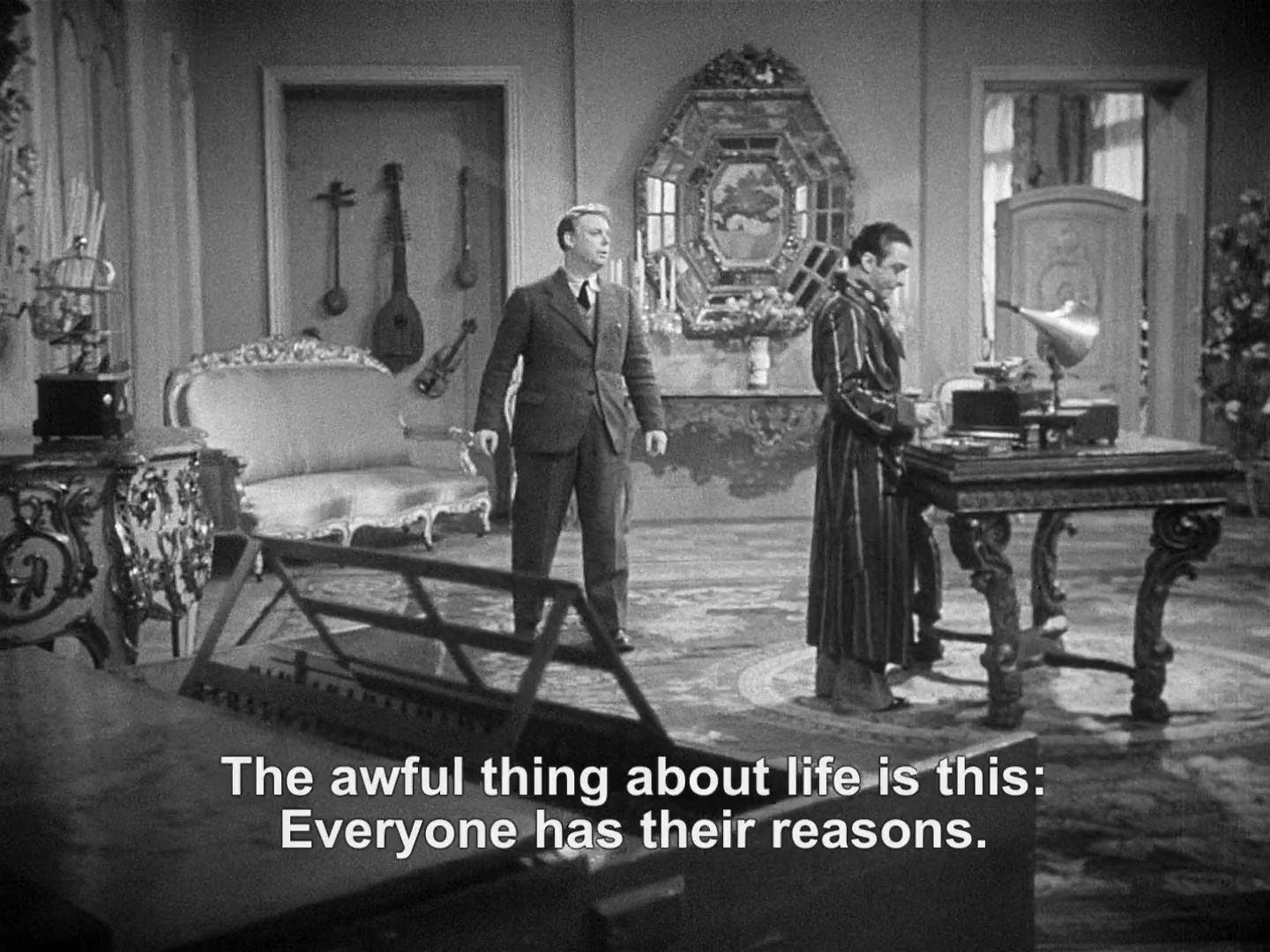
During times of trauma and uncertainty, we seek narratives of reassurance — even clinging to ones that are spurious — even preposterous. Trump’s resolute visage should be placed on Mount Rushmore for restoring confidence and purpose to the citizenry of the US. Sure thing, and Diddy should be feted for restoring dignity to drug-fueled orgies.

Thus, during my lifetime, decade after decade, the anxious minds of neoliberal conservatives have evinced a compulsive need to believe it is possible to return to a fictional past, to a golden era populated by well-turned out, obedient children, dutiful wives, and docile minorities. All of whom were lorded over by morally upright white men who wielded their righteous power guided by the grace, mercy, yet perpetually brittle temper of an All-Powerful, All-Knowing, Everlasting, Long-Bearded, Bony Ass White Man enthroned beyond the blazing blue sky.

Authoritarian rightists go round-heeled for this kind of hokum. In the 1980s, they swooned, gazing upon Ronald Reagan’s stiff, Pomade-lacquered pompadour — which he held high and steady against the changes that blew in from the odious 1960s; then, as now, with Trump, his klavern of looney muffin smitten insist The Gipper’s 1940-era coiffure should be carved into Mount Rushmore. Next, as noted, MAGA cultists swoon, Trump’s combover disaster coiffure should be chiseled in glory upon the (stolen) mountain’s rock face – where the two television grifter ubermenschs’ (closer to uberdouches’) visages would defy rain, snow, and lashing wind — and would be, axiomatically, impervious to the reality of change.

But all monuments to delusion need not be as epic in scale as the above. Even objects as quotidian and seemingly innocuous as the naming of places can and will deceive us. Moreover, these everyday — seemingly trivial — misapprehensions can waylay the citizenry into internalizing false mythos.

“Everything that deceives may be said to enchant.” — Plato

For the next case in point, I’ll travel southward and back in time, a number of decades.

I was born in the Deep South industrial city of Birmingham, Alabama, another example of a locale in possession of an origin myth as fraudulent as it was odious.

Birmingham was founded by steel and coal barons from Pittsburgh, PA, who, in an attempt to ameliorate the worldwide perception of American southerners as being dumb as dirt, backwoods, genetic retreads, too-ignorant-to-hit-the-ground-with-their-own-piss yokels, christened their colonial creation, Birmingham, in order to brand it with a proper “city of industry” cachet.

Subsequently, the bloodsucking Yankee bastards (I mean, visionary captains of capitalism) known in Birmingham as the “Big Mules” went about the business of exploiting — rather, in their words providing gainful employment — to said dumb-as-dirt, backwoods, genetic retread, too-ignorant-to-hit-the-ground-with-their-own-piss yokels — i.e., impoverished but hardy specimens who possessed the requisite physical stamina required to sacrifice their bodies and souls for the sake of substandard wages.

“Everything the State says is a lie, and everything it has it has stolen.” ― Friedrich Nietzsche, Thus Spoke Zarathustra (The New Idol)

As the riches, plundered from the Appalachian Hills, flowed northward to banks in Pittsburgh and New York, the compensation the laboring class received in return was a life of ceaseless toil and perpetual debt. These harsh realities made the people of Birmingham hard and mean. In the early 1960s, the city was unofficially re-christened “Bombingham.”

Birmingham had been transformed into a hateful, little colonial outpost. If a white man, for example, my father, complained about low wages and poor working conditions, the bosses told him, “If you don’t like your job — there are ten n-words (but they didn’t clean up their racist lexicon for public consumption) who, right now, will take your position for a fraction of your pay.” It’s self-evident why Birmingham was not exactly known as a beacon of racial harmony.
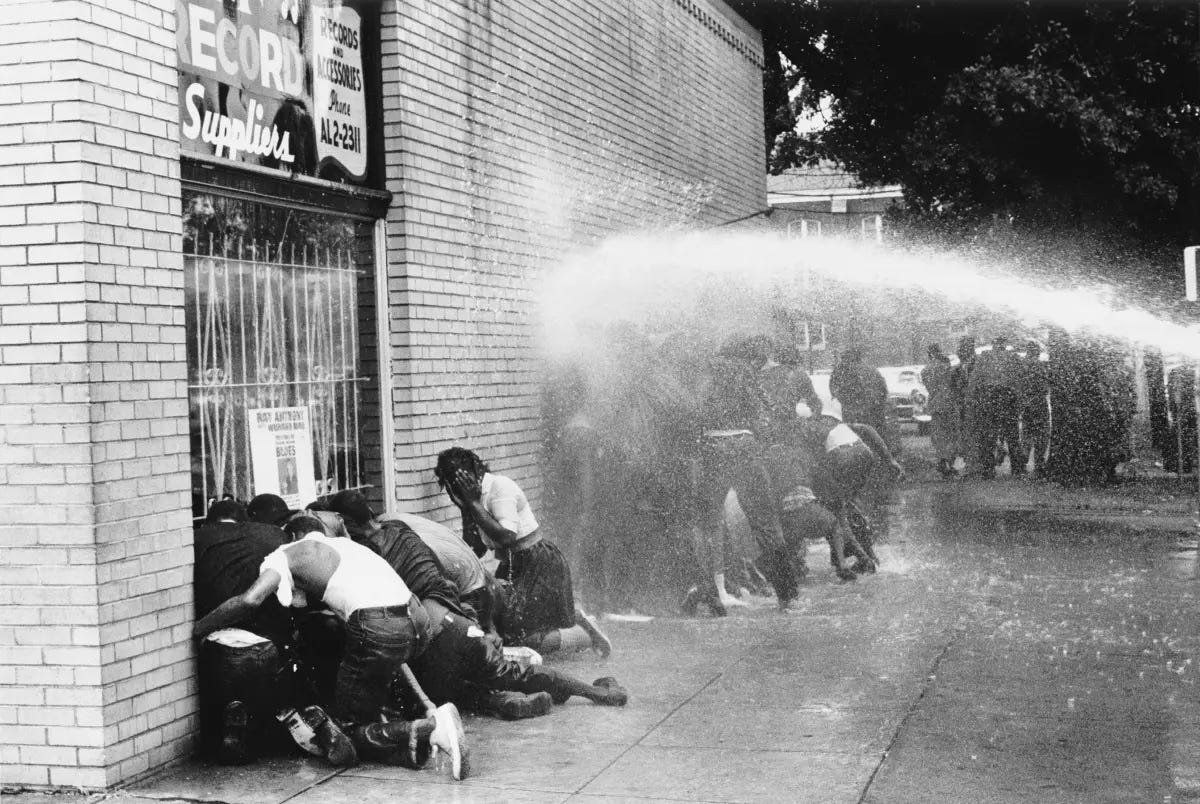
Nonviolent Black student demonstrators were met with fire hoses and dogs in May 1963 during the 10-week Birmingham desegregation campaign organized in part by Martin Luther King Jr. (Frank Rockstroh / Michael Ochs Archives / Getty Images)

When in the mid-1960s, my family moved from Birmingham to Atlanta, Georgia i.e., a city (or more precisely, a contrived collection of corrupt zoning practices and real estate developer larcenies) we settled again into a city bearing a contrived name. Whereas Birmingham’s fraudulent name was meant to evoke an aura of industry, Atlanta’s was contrived to conjure an image of the ancient grandeur of a great city of antiquity. Call the theme: Classical Age Cracker.

By illustrating the types of cultural confabulation and communal causitry defining White dominated Atlanta of the time and many still refer to “as their way of life” — I will digress, a bit. I will attempt to limn in prose the lives, fates, and legacies of two famous residents of the city: Blind Willie McTell and Margaret Mitchell, both of whom resided there in overlapping intervals during the first half of the twentieth century.

I first heard the music of Blind Willie McTell, in the mid-1960s, when in tow of my father, I visited friends of his who comprised the dozen or so members of Atlanta’s “beatnik” community.

They were flopped in a run-down, mafia-owned building at the intersection of Peachtree and Tenth Street, and bizarrely enough, in the building that contained the apartment that Margaret Mitchell had christened “The Dump” — the location where she had conceived and written Gone with the Wind.

Upon the turntable of a battered record player, belonging to the building’s resident manager, the late Bud Foote, a professor at nearby Georgia Tech, author, poet, musician, and all around Beat polymath, spun rare and exquisite LPs. It was at The Dump that I first heard the works of Mctell and other Blues, Folk, and Jazz greats. The building was located a short distance from where, on Ponce De Leon ave., according to local bohemian (all seven of them) lore an aging, increasingly disconsolate from poverty, racism, and his own obscurity, McTell used to busk for change from redneck Babbits and country-come-to-town parvenus, shortly before he gave up playing the blues and took up lay preaching and gospel music.

The Margaret Mitchell House, as it has been subsequently christened by the Atlanta Tourism Board, is now a city landmark. Both obtuse locals and gullible tourists seem oblivious or indifferent to the fact that the building, thrice burned to the ground and rebuilt by the city, doesn’t, at present, in any way, shape or form resemble the original structure where the epic racist, bodice-ripper, Gone with the Wind, was confabulated onto the page.

“We are never deceived; we deceive ourselves.” – Johann Wolfgang von Goethe, The Sorrows of Young Werther

Not far down the road exists, to this day, a bar named Blind Willy’s, a place that, on any given night, by populated who scant few would have knowledge the joint’s namesake, a man spat upon when he was busking on Ponce De Leon Avenue, a few blocks down the street.

Perhaps if we were to take a closer examination of these sorts of everyday misperceptions, distortions, and cultural based false mythos it would reveal a great deal about our present day lives within the duopolist, high-dollar hack-conjured narratives and concomitant Trump era griftathon of the present day.

But power and greed and corruptible seed
Seem to be all that there is
I’m gazing out the window
Of that old Saint James Hotel
And I know no one can sing the blues
Like Blind Willie McTell — Bob Dylan, Blind Willie McTell

So where does this leave us? Are we condemned to live out our lives in the enthralling dazzle of these glittering fragments of self-serving lies?

Is it for the bards of the extant dictatorship of wealth and attendant Trump-tide of pummeling shitwit — a psychical landscape of lies as banal as they are noxious — to wail out the blues into the obtuse face of the present era — for blues-mans, scions of their times, born of the hybrid lawn-seeded soil of our nation of vast suburban subdivisions and weaned on its pharmacological subsistence crops, perhaps going by the moniker Medicated Willie McMansion — to sing out,

“I got the medication blues/ from my iPhone head to my sweatshop-shod shoes…”

Conversely and finally, what would a soul-driven resistance look like. In what kinds of forms would a propitious mythos arrive? Where do seeds of effective defiance brood?

The poet Rainer Maria Rilke posited, I’m paraphrasing, every individual has a letter written to themself, dispatched from their own heart. The letter warns, if you fail to live the life your heart was demanded by destiny to live — you will not be allowed to read said letter before you die.

Ask yourself, is there a dead letter office within you piled with letters from your heart? Query your heart, is it mortified by the extant culture reeking of Nazi-level lies? The heart is not merely a pump — it is a reservoir of visions, that are dispatches from Anima Mundi I.e., the soul of the world. Step one: Stand up and confront believers of the lie. Crash the comfort zones of denialists. Regard the confrontation as a love letter from your heart, thus you cultivate and allow to rise from within you an elan vital serving as an antidote to the banality of normalized insanity.

Hang a hammock between Death and the Abyss, take sanctuary in the space between musical notes, greet as a steady friend the evening air, listen to the brooding of seeds and soliloquies of stone, and the parting words of dying stars…

Give deference to empty spaces; therein, the impetuous present pauses to breathe, thus the future is provided with the solace required to dream the world into existence.

When some insistent fool demands that you explain yourself, strike fear in him by brandishing flowers of infinity, their efflorescence rages into the world your true name — your immutable destiny chanted by troubadour heartbeats — and the fool, if he possesses a scintilla of dignity, will withdraw the question.

…Men do not sufficiently realize that their future is in their own hands. Theirs is the task of determining first of all whether they want to go on living or not. Theirs is the responsibility, then, for deciding if they want merely to live, or intend to make just the extra effort required for fulfilling, even on this refractory planet, the essential function of the universe, which is a machine for the making of gods.

― Henri Bergson, The Two Sources of Morality and Religion

 Affected Place [<i>Betroffener Ort</i>] (1922)

1922, Affected Place [Betroffener Ort], Paul KleeFacebook

Phil Rockstroh is a poet, lyricist and philosopher bard living now in Munich, Germany. He may be contacted at: philrockstroh.scribe@gmail.com and at Facebook: http://www.facebook.com/phil.rockstrohRead other articles by Phil.


Did Marx Have Anything Good to Say About Capitalism?


Those who assume that Karl Marx emphasized only the negative characteristics of capitalism such as alienation, crisis, and exploitation are mistaken. Indeed, throughout his intellectual career – in philosophic, journalistic, historical, and economic writings – Marx stressed the creative and progressive features of capital. His social theory makes no sense unless essential duality is retained.

For Marx, capitalism is inventive and advanced with respect to the past (pre-capitalist societies), the present (capitalism itself), and the future (post-capitalist society). First, capitalism has “revolutionizing properties” that transform all social, economic, and political relations, thus creating conditions for consolidation and universal development.

Second, capitalism has “universalizing properties”. That is, commodity production promotes the internal (intensive) and external (extensive) development of capitalist relations of production through space and time, drawing all people into a web of economically-based social contacts and dependencies. Universalization thus implies a constant revolutionizing of the present as capital strives to overcome all obstacles to its general development.

Third, capitalism has “industrializing properties”. The logic of accumulation initiates and sustains a revolution that constantly develops the forces of production, thus radically enhancing the power of social labor. Although an outspoken critic of capitalism, Marx conceded that it was at one time a progressive and even radical force. Accordingly, capital needs innovation and change as well as new and more efficient machinery and technology in order to survive.

Fourth, capitalism is said to have “liberating properties” in that the revolutionizing, universalizing, and industrializing tendencies establish the objective and subjective conditions for the transition to socialism. Moreover, the development of the productive powers of the economy provides the material abundance without which socialism would necessarily remain a “struggle for necessities.” The tendency of the system to maximize surplus labor time relative to necessary labor time holds out the promise of the appropriation of that surplus time as leisure or free time for the producing classes, thus allowing for the universal extension of civilization, and the development of humanity as a rich individuality.

Most importantly for Marx, capitalist development generated the proletariat as a universal class, in the sense that in pursuit of its particular class interests (abolition of oppression and poverty) it promotes the general interest (abolition of private property, hence, of capitalism). In addition, capitalist industry socially organizes this class in production, the basis for the realization of class consciousness as praxis (i.e., the revolutionary transformation of capitalism).

Finally, in connection with its liberating potential, Marx held that capitalism demystified, rationalized, and secularized human culture and action, freeing the human mind from that “smallest compass” of superstition, idolatry, religion, and political illusion. Through its development of science and materialism, extended human comprehension of nature, the arts, and achievements in a world-historic sense, people will be free to develop many-sided lives

Michael Hoover is Professor Emeritus of Political Science at Seminole State College in Central Florida. His writing has appeared in academic as well as non-academic publications. The former includes New Political Science and Race, Gender & Class. The latter includes Against the CurrentMROnline, and Synthesis/Regeneration. He is also the co-author of City on Fire: Hong Kong Cinema (Verso). His interests include political and popular culture, political theory, power and policy, and social movements. Read other articles by Michael.

The Fragment on Machines  Karl Marx – from The Grundrisse (pp. 690-712)   Microsoft Word - fragment on machines.doc