Tuesday, April 08, 2025


Cannabidiol therapy could reduce symptoms in autistic children and teenagers


European Psychiatric Association


Tuesday 8th April, 13:25 CEST - New research presented at the 2025 European Congress of Psychiatry reveals that the use of cannabidiol (CBD) cannabis extract can lead to meaningful benefits and improve the behaviour of children and adolescents with autism spectrum disorder (ASD). ASD affects approximately 1 in 100 children around the world and symptoms can include difficulty interpreting language, difficulty expressing emotions, and repetitive behaviour and routines.1,2 

The meta-analysis included randomised, placebo-controlled trials on the efficacy or safety of CBD cannabis extracts in children and adolescents with ASD. Three studies were used in total with 276 participants with a mean age of 10.5, ranging in age from 5 to 21. The dosage of CBD cannabis extract started at 1 mg/kg per day and was titrated up to 10 mg/kg.  

Key findings from the study include: 

  • CBD cannabis extract use shows moderate improvements in social responsiveness and small yet notable reductions in disruptive behaviours and anxiety  

  • CBD cannabis extract significantly enhanced social responsiveness, reduced disruptive behaviour and alleviated anxiety while also improving sleep quality  

  • The use of CBD cannabis extract has a favourable safety profile as it did not increase adverse events compared to placebo  

  • There were no significant differences between adverse events in CBD cannabis extract versus placebo  

Lara Cappelletti Beneti Branco, Lead Investigator, São Camilo University Center, University of São Paulo, said: “The global population prevalence of ASD diagnosis amongst children and adolescents is growing, but many treatment pathways are not effective. It is promising to see the effect of CBD cannabis extract on the study participants. However, there still needs to be considerable focus on further research with larger trials to clarify its efficacy and safety in managing ASD.” 

Professor Geert Dom, EPA President, said: “ASD can be extremely frustrating for all involved; parents of children and adolescents with the disorder, the treating clinicians and of course the children and adolescents themselves. A large part of this frustration is down to finding a viable treatment option that works to reduce symptoms. It is with delight that we see the results of this meta-analysis and we hope to see further research into this so we can move towards a solution to the unmet need within this community”.  

The European Congress of Psychiatry takes place from 5-8 April 2025 in Madrid, Spain, and represents Europe’s largest congress dedicated to psychiatry, with over 5,200 attendees from over 120 countries: epa-congress.org

+++ 

Full abstract

Efficacy and Safety of Cannabidiol Cannabis Extracts for Children and Adolescents with Autism Spectrum [EPA2025-ABS-3651] 

Disorder: A Systematic Review and Meta-Analysis of Randomized Controlled Trials 

Lara Cappelletti Beneti Branco* 1, Isabela Borja De Oliveira2, Gabriel Amorim Moreira Alves3, Masatoki Teranishi4, Débora Xavier5, Erik Sávio Schneider Motta6, Fernanda Wagner7, Murilo L. Geremias8, Anna V. de Vasconcelos9, Anna Carolina Gonçalves Tames Zambrana10, Joao P. De Aquino11, 12, 13  

1São Camilo University Center, 2School of Medicine, University of São Paulo, São Paulo, Brazil, 3Humanitas University, 4Università degli Studi di Milano, Milan, Italy, 5ECPE - PPCR Program, Harvard T. H. Chan School of Public Health, Boston, United States, 6Federal University of Espírito Santo, Espírito Santo, 7School of Medicine, Pontifical Catholic University of Rio Grande do Sul, Porto Alegre, 8University of the Joinville Region, Joinville, 9Afya College of Medical Sciences of Santa Inês, Santa Inês, 10Zambrana Clinic, Itajubá, Brazil, 11Department of Psychiatry, Yale University School of Medicine, New Haven, 12VA Connecticut Healthcare System, West Haven, 13Clinical Neuroscience Research Unit, Connecticut Mental Health Center, New Haven, United States 

Introduction: Autism Spectrum Disorder (ASD) affects approximately 3% of children and adolescents in the U.S. This condition is increasingly prevalent worldwide and presents significant treatment challenges. Preliminary evidence suggests that cannabidiol (CBD) cannabis extracts may help manage ASD symptoms, but their efficacy and potential harms have not yet been systematically investigated. 

Objectives: To systematically review and meta-analyze the evidence from clinical trials investigating the efficacy and safety of CBD cannabis extracts in alleviating symptoms of ASD in children and adolescents. 

Methods: We conducted a comprehensive search in MEDLINE, Embase, PsycINFO, and the Cochrane Central Register of Controlled Trials using MeSH terms including "Autism Spectrum Disorder," "Cannabidiol," "Cannabis," "Child," and "Adolescents." No language or publication date restrictions were applied. The search was last updated on September 8, 2024. We included randomized, placebo-controlled trials on the efficacy or safety of CBD cannabis extracts in children and adolescents with ASD. For outcomes with limited study data, we used a fixed-effects model. The risk of bias in the included studies was evaluated using the Risk of Bias 2 tool. 

Results: Three studies met our criteria, comprising 276 participants (78.3% male; mean age 10.5 years, range 5 to 21). Interventions included orally administered CBD cannabis extracts, with tetrahydrocannabinol (THC) present in minimal amounts or in ratios of 9:1 to 20:1 CBD to THC. Dosages of CBD started at 1 mg/kg per day and were titrated up to 10 mg/kg per day. CBD cannabis extracts significantly enhanced social responsiveness (SMD = -0.75 [-1.08, -0.43], p < 0.01, I² = 17%), reduced disruptive behavior (SMD = -0.36 [-0.67, -0.06], p = 0.02, I² = 0%), and alleviated anxiety (SMD = -0.33 [-0.63, -0.03], p = 0.03, I² = 59%). CBD cannabis extracts also improved sleep quality, without reaching statistical significance (SMD = -0.19 [-0.49, 0.11], p = 0.21, I² = 0%). There was no significant difference in adverse effects between interventions and placebo (odds ratio = 2.11 [1.00, 4.46], p = 0.05, I² = 38%). 

Conclusions: CBD cannabis extracts appear to provide meaningful benefits for children and adolescents with ASD, showing moderate improvements in social responsiveness and small yet notable reductions in disruptive behaviors and anxiety. They do not seem to significantly increase adverse effects compared to placebo, suggesting a favorable safety profile. These findings support the potential consideration of CBD cannabis extracts in ASD treatment plans. However, the review's limitations include a small number of studies, limited sample sizes, and significant heterogeneity. Future research with larger, robust trials is needed to clarify the efficacy and safety of CBD cannabis extracts in managing ASD. 

Disclosure of Interest: None Declared 

THE BLACK PRINCE OF MERCENARIES

Ecuador mounts anti-drug op overseen by Blackwater founder


By AFP
April 5, 2025


The operation, involving 650 police and military personnel, saw raids on homes - Copyright AFP Manzoor BALTI

Ecuadoran security forces mounted an operation against drug gangs Saturday overseen by ministers and with the founder of divisive US security contractor Blackwater Erik Prince in attendance, ahead of a knife-edge run-off election on April 13.

The operation, involving 650 police and military personnel, saw raids on homes and drug addiction rehab centers where residents were allegedly forced to extort others, said Pablo Davila, police chief in the country’s largest city Guayaquil.

Ecuadoran President Daniel Noboa announced during his election campaign a “strategic alliance” with the founder of Blackwater, whose mercenaries killed and injured dozens of civilians in Iraq, as he seeks to vanquish leftist rival Luisa Gonzalez.

Images of the operation showed Prince, a former Navy SEAL, accompanying Defense Minister Gian Carlo Loffredo and Interior Minister John Reimberg while travelling in an armored vehicle.

The so-called “Security Block” — made up of police, soldiers, and Prince — “are already on the ground confronting narcoterrorism”, the Defense Ministry said on social media.

Prince, whose company was renamed Academi after being involvement in a massacre in Baghdad, is close to US President Donald Trump, to whom he has offered help in the mass deportation of undocumented migrants.

He said in a clip posted by the Defense Ministry on X that “we are here to help combat the gangs and to provide the tools for the government to restore law and order, peace and prosperity.”

Ecuador, through which 73 percent of the world’s cocaine transits according to official figures, was until a few years ago a peaceful oasis between Colombia and Peru, the largest producers of the drug.

Facing surging drug violence, Noboa declared an internal armed conflict in 2024 and has kept the military on the streets since then.

After a record 47 murders per 100,000 people in 2023, the rate dropped to 38 in 2024.

This year started as the most violent in recent history with over 1,500 homicides in January and February alone.
Czech beer culture eyes UNESCO listing as pubs take hit


By AFP
April 5, 2025


Many beer drinkers in the central European country are turning away from pubs, often to save money - Copyright AFP Michal Cizek

Jan FLEMR

Going to a pub several times a week to meet friends, media consultant Gabriela Galetkova hopes Czech beer culture — which is taking a hit as bar visits dip — will be internationally recognised.

“I won’t buy beer to drink at home. For me, Czech beer culture is about meeting people in a typical Czech pub,” the 54-year-old told AFP in a Prague bar serving the trademark Pilsner lager with thick froth.

While many beer drinkers in the central European country are turning away from pubs, often to save money, Czech beer professionals are seeking listing by UNESCO among the world’s cultural heritage as a possible boost.

Czech beer culture deserves a place on the UN agency’s intangible heritage lists owing to its “global reputation”, said Tomas Slunecko, head of the Czech Beer and Malt Association.

“Wherever you go in Europe or the world, people ask you about Czech beer,” the former diplomat told AFP.

If Czech beer culture gets listed by UNESCO, it will be the world’s second after Belgium, listed in 2016 — which according to Slunecko “really boosted the reputation of local beer making, not only inside Belgium but also abroad”.

The Czech culture ministry already put it on the national list in January — a necessary condition for international recognition — while Slunecko and others are embarking on promoting their bid.


– No longer cheaper than water –


The Czech beer-making tradition is over a thousand years old and beer is omnipresent in Czech history and culture, while local lagers have made Czech beer-makers famous and inspired brewers worldwide.

The country has more than 550 breweries including 500 small ones that have emerged during a boom over the past two decades.

Czech breweries employ 65,000 people, make around 20 million hectolitres of beer a year and export roughly a quarter, mainly to other EU members such as Germany, Poland, Slovakia and Hungary.

But while the tradition is rich and colourful and the reputation solid, Czech drinkers are shirking their pub duty.

Beer consumption in the country of 10.9 million retained a world-leading level of 128 litres per person in 2023 but is down from 143 litres a decade ago, said Slunecko.

Beer prices have doubled over the past decade on tax hikes and higher input costs, and the popular tipple is no longer cheaper than water in Prague pubs, where a pint of Pilsner Urquell costs around CZK 70 ($3).

This has gradually led drinkers to turn to supermarkets for cheaper bottled beer, industry data have shown.

The Covid-19 pandemic made things worse as it shuttered pubs and closed borders for months, sending more drinkers to their living room sofas and reducing the number of foreign tourists who drink a hefty portion of the beer sold in Czech pubs.

The Czech Chamber of Commerce said that 15 percent of local venues closed and another 15 percent changed hands due to the pandemic.

Many small towns and villages now lack a place to go for a pint.

“The share of beer consumed in pubs and at home used to be 50-50. At present pubs only make up 30 percent,” Slunecko said.

Many Czechs also opt for a healthier lifestyle or prefer to meet their friends online, he added.

“The decline is a trend that we can see elsewhere in Europe,” said Slunecko.


– ‘Social network’ –


Meeting people is the main reason why Czechs go to pubs, said sociologist Jiri Vinopal, citing his continuous research running since 2004.

“Czech beer culture is something that helps people connect and keeps society together, create an identity, whether locally or at the national level,” he added.

Slunecko said women drinkers could help end the downtrend as an increasing number now go to pubs, attracted by their growing standard, variety of drinks on offer and quality food.

“It’s about quality replacing quantity. I think the cultured environment and the broad offer is a way to win drinkers back,” Slunecko said, likening pubs to “a social network”.

“A pub is a pleasant place to meet. And there’s nothing wrong about drinking beer,” he said.
ICYMI

‘Anxious’: US farmers see tariffs threaten earnings


By AFP
April 6, 2025


US farmers are anxious to see how planned tariffs and retaliation will be resolved - Copyright AFP/File Mark RALSTON
Beiyi SEOW

As President Donald Trump’s sweeping global tariffs took effect this weekend, US farmers hoping for a profit this year instead found themselves facing lower crop prices — and the prospect of ceding more ground in foreign markets.

“We’re already getting below break-even at the current time,” said Jim Martin, a fifth-generation Illinois farmer who grows soybeans and corn.

“We knew it was coming,” he told AFP of Trump’s tariffs. “I guess we’re anxious to see how things are going to eventually be resolved.”

The president’s 10-percent “baseline” rate on goods from most US trading partners except Mexico and Canada took effect Saturday.

And dozens of economies, including the European Union, China and India, are set to face even higher levels — tailored to each party — starting Wednesday.

With talk of retaliation, farmers, a key support base in Trump’s 2024 re-election campaign, are again in the crossfire and bracing for losses.

Prices for many US agricultural products fell alongside the stock market on Friday, following Trump’s tariff announcement and China’s pushback.

China, the third-biggest importer of American farm goods behind Canada and Mexico, is set to be hard hit, with a 34-percent US duty on its products piling on an earlier 20-percent levy.

In response, Beijing said it would place its own 34-percent tariff on American goods, stacking on previous rates of up to 15 percent on US agricultural products.

The tariffs mean businesses pay more to import US products, hurting American farmers’ competitiveness.


– Market loss –


“There is less incentive for them to purchase US soybeans. It is cheaper to get them out of Brazil by far,” said Michael Slattery, who grows corn, soybeans and wheat in the Midwest state of Wisconsin.

At least half of US soybean exports and even more of its sorghum go to China, which spent $24.7 billion on US agriculture last year, including on chicken, beef and other crops.

But the US Department of Agriculture (USDA) said China’s purchases last year dropped 15 percent from 2023 “as soybean and corn sales fell amid rising competition from South America.”

Slattery expects Chinese buyers will dial back further.

“The loss of this market is a very big deal, because it’s expensive to find other buyers,” said Christopher Barrett, a Cornell University professor whose expertise includes agricultural economics.

During Trump’s escalating tariff war in his first presidency, China was the “only target, and therefore the only country retaliating,” Barrett said.

With all trading partners now targeted, farmers will likely have a harder time finding new markets, he said.


– ‘Band-aid’ –


“More than 20 percent of farm income comes from exports, and farmers rely on imports for crucial supplies like fertilizer and specialized tools,” the American Farm Bureau Federation warned this week.

“Tariffs will drive up the cost of critical supplies, and retaliatory tariffs will make American-grown products more expensive globally,” it added.

The International Dairy Foods Association cautioned Wednesday that “broad and prolonged tariffs” on top trading partners and growing markets risk undermining billions in investments to meet global demand.

Retaliatory tariffs on the United States triggered over $27 billion in agricultural export losses from mid-2018 to late-2019, the USDA found.

While the department provided $23 billion to help farmers hit by trade disputes in 2018 and 2019, Martin in Illinois likened the bailouts to “a band-aid, a temporary fix on a long-term problem.”

“The president says it’s going to be better in the long-term so we need to decide how patient we need to be, I guess,” he added.

Martin, like other producers, hopes for more trade deals with countries beyond China.

Slattery called Trump’s policies “a major restructuring of the international order.”

He is bracing for losses this year and next.

“I’ve attempted to sell as much as I can of the soybeans and corn in advance, before Trump began to indicate the amount of tariffs he was going to charge,” he said.


Rain complicates recovery in quake-hit Myanmar as death toll rises


By AFP
April 6, 2025


The 7.7-magnitude quake struck Myanmar on March 28, razing buildings, cutting off power and destroying bridges and roads across the country - Copyright AFP Zaw Htun

Rain is compounding misery and presenting new hurdles for relief efforts on Sunday in Myanmar, where state media reported the death toll from a devastating earthquake has risen to nearly 3,500 people.

The 7.7-magnitude quake struck on March 28, razing buildings, cutting off power and destroying bridges and roads across the country.

Damage has been particularly severe in the city of Sagaing near the epicentre, as well as in Mandalay, Myanmar’s second city and home to more than 1.7 million people.

State media in the military junta-led country now say that the earthquake has caused 3,471 confirmed deaths and injured 4,671 people, while 214 remain missing.

With people either having lost their homes entirely or reluctant to spend time in cracked and unstable structures, many Mandalay residents have been sleeping outside in tents.

When wind and rain began battering the rudimentary shelters on Saturday evening, victims were forced to choose between passing the night in dry but risky buildings or outdoors in the elements.

“People are trying to rebuild their lives now,” said United Nations aid chief Tom Fletcher in a video filmed in Mandalay, posted to X on Sunday.

“They need food. They need water. They need the power back on,” he said.

Many people in the area are still without shelter, he said, describing the scale of damage in the area as “epic”.

“We need to get tents and hope to survivors as they rebuild their shattered lives,” Fletcher wrote in another post.

Aid experts warn that rainy conditions and scorching heat increase the risk of disease outbreaks at outdoor camps where victims were in temporary shelter.


– Ongoing attacks, aftershocks –


Myanmar has been ruled by junta leader Min Aung Hlaing since 2021, when his military seized power in a coup that overthrew the civilian government of Aung San Suu Kyi.

International efforts to provide quake relief in the Southeast Asian country of more than 50 million people have been complicated by unreliable communication networks and infrastructure heavily damaged by four years of civil war.

Even before the recent quake, the humanitarian crisis in the country was severe, with the persistent, multi-sided conflict displacing 3.5 million people, according to the UN.

The UN said Friday that since the earthquake, the junta continued to conduct dozens of attacks against rebel groups, including at least 16 since Wednesday when the military government announced a temporary ceasefire.

Fletcher held discussions with the foreign ministers of Thailand and Malaysia on Saturday for what he called a “practical meeting” centred on “strong, coordinated, collective action” to save lives in Myanmar.

Aftershocks have also continued as long as a week after the initial tremors, with a 4.7-magnitude quake striking just south of Mandalay late Friday evening, according to the United States Geological Survey.


Myanmar Earthquake and Tariffs Shake Rare Earths Industry

  • The 7.7-magnitude earthquake in Myanmar, coupled with existing political unrest, has raised concerns about the reliability of rare earth supplies from the region.

  • New U.S. tariffs, particularly on Chinese goods, are expected to further strain the global rare earth supply chain, given China's dominant position in the market.

  • Companies and governments are actively seeking alternative sources and investing in domestic production to mitigate risks and ensure supply chain security for rare earth materials.

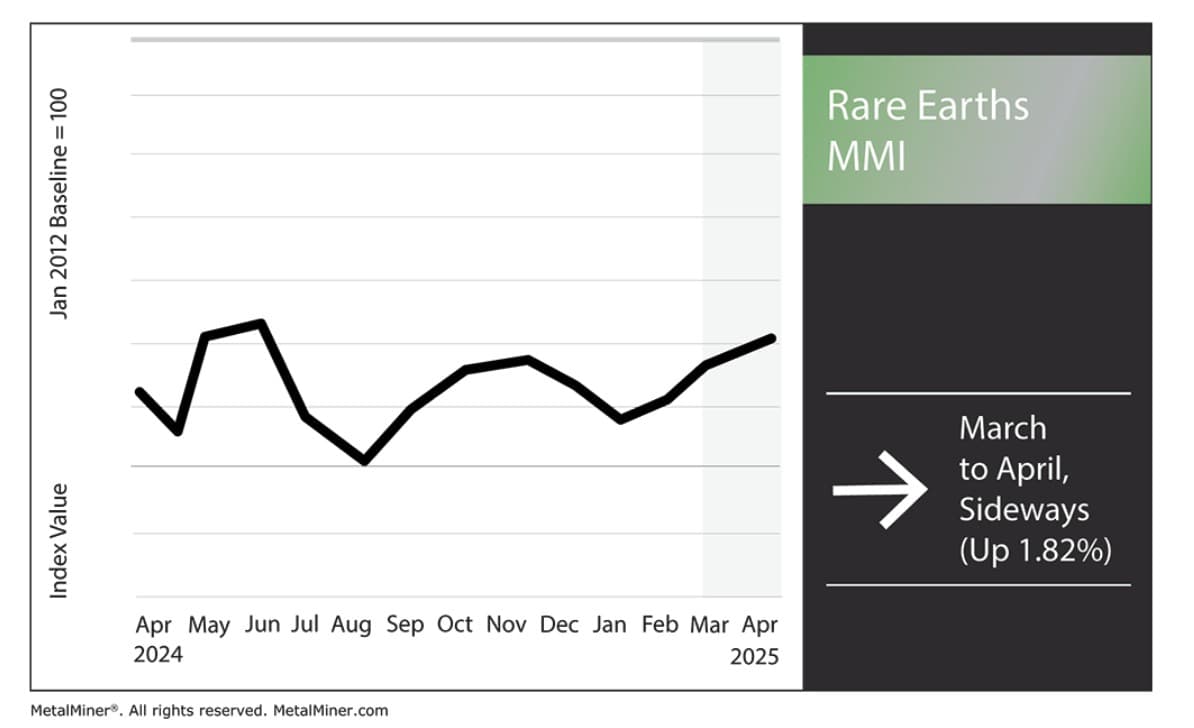
The Rare Earths MMI (Monthly Metals Index) moved sideways, edging up by a slight 1.82%. The global rare earth market has taken a significant hit lately, thanks to a combination of natural disasters and big geopolitical moves. A strong earthquake in Myanmar and the recent wave of U.S. tariffs have thrown this somewhat delicate industry into even more uncertainty.

Myanmar’s Quake: A Jolt to the Supply Chain?

On March 28, a powerful 7.7-magnitude earthquake rocked the country of Myanmar. While the tremors didn’t directly damage rare earth mining operations, the global market still took notice. The quake struck near Mandalay, about 425 kilometers from Kachin State, the location of many of Myanmar’s rare earth mines.

Despite a tragic and still-growing death toll, early reports show those key mining regions were mostly untouched. Mine operators in the Longchuan area confirmed with Metal.com that roads remain open and ore deliveries are continuing without issue.

Why buy price points for every metal type when you only need a few? Only purchase the metal price points you need with MetalMiner Select. Learn more.

Political Turmoil Was Already Causing Problems

Even before the earthquake, Myanmar’s rare earth sector was struggling. Back in October 2024, the Kachin Independence Army (KIA) took over major mining hubs like Kanpaiti, a town near the Chinese border. 

That single event disrupted operations in areas responsible for around half of the world’s output of heavy rare earths. Mining ground to a halt, and by February 2025, Chinese imports of rare earth oxides and compounds from Myanmar had dropped by a staggering 89%.

Why Myanmar’s Rare Earth Supplies Matter

Myanmar isn’t just another name on the rare earth map. The Southeast Asian country is a major supplier, which means it plays a key role in everything from smartphones to electric vehicles to rechargeable batteries. The combination of the ongoing conflict and the recent natural disaster highlights just how risky it is to rely on politically unstable nations for such critical materials.

Enter the Tariffs

Back in the United States, President Donald Trump announced sweeping new tariffs on April 2, 2025. All U.S. trading partners now face at least a 10% tariff, while some countries, particularly China, were hit even harder.

Given prior tariffsChinese goods entering the U.S. will now face a total tariff rate of 54%. Considering China dominates the global rare earth supply chain, analysts expect these new tariffs will intensify existing supply problems.

What Comes Next?

Given the news, many American companies are already taking action. Most are working to secure alternative domestic and international sources for rare earths, while the U.S. government ramps up investment in local production to strengthen supply chain security.

In the meantime, experts anticipate that rare earth prices will stay volatile, driving up manufacturing costs, potentially raising consumer prices and weakening the global competitiveness of U.S. products.

By Jennifer Kary

CENSORED

Artist of ‘distorted’ portrait says Trump complaint harming business


By AFP
April 6, 2025


A tourist looks at the empty space where a portrait of US President Donald Trump once hung in the Presidential Portrait Gallery at the Colorado Capitol in Denver - Copyright AFP/File Jason Connolly

The artist who painted US President Donald Trump in what he criticized as a “purposefully distorted” portrait has said his remarks have harmed her business.

Colorado removed the official portrait of Trump from display in the state’s capitol building last month after the president complained that it was deliberately unflattering.

“Nobody likes a bad picture or painting of themselves, but the one in Colorado, in the State Capitol… along with all other Presidents, was purposefully distorted,” Trump wrote on his Truth Social platform on March 24.

“The artist also did President Obama, and he looks wonderful, but the one on me is truly the worst,” Trump said.

The 78-year-old Republican called for the oil painting to be taken down, and said the artist, Sarah Boardman, “must have lost her talent as she got older.”

The Democrat-controlled Colorado legislature said the same day as Trump’s complaint that the painting would be removed from the gallery in the capitol’s rotunda — where it had been hung since 2019 — and placed in storage.

Boardman has responded to Trump’s critique in a statement on her website, saying she completed the work “accurately, without ‘purposeful distortion,’ political bias, or any attempt to caricature the subject, actual or implied.”

“President Trump is entitled to comment freely, as we all are, but the additional allegations that I ‘purposefully distorted’ the portrait, and that I ‘must have lost my talent as I got older’ are now directly and negatively impacting my business of over 41 years,” the British-born artist said.

Boardman added in the undated statement that for the six years that the portrait of Trump hung in the Colorado capitol, she “received overwhelmingly positive reviews” on the commissioned work.

However, since Trump’s comments “that has changed for the worst,” she said.

In addition to Trump and former president Barack Obama, Boardman was also commissioned to paint a portrait of ex-president George W. Bush.
Boeing faces new civil trial over 2019 Ethiopian Airlines crash


By AFP
April 6, 2025


Image: - © AFP/File JUSTIN TALLIS

Boeing is poised to face a jury trial from Monday over the fatal 2019 crash of an Ethiopian Airlines 737 MAX plane, the first civil case related to the disaster to reach court.

The Chicago trial, expected to last two weeks, was to feature two plaintiffs who lost family members in the calamity.

But one of the complaints was resolved in an out-of-court settlement late Sunday, a judicial source told AFP, in line with most earlier litigants.

Barring another last-minute settlement, the trial will begin Monday with the selection of an eight-person jury.

“We have had some ongoing discussion that may continue throughout the day and the ensuing days,” Robert Clifford, who represents relatives of several crash victims, told the US District court on Wednesday at a pre-trial hearing.

A deal could also be struck even while the trial is underway.


– Canadian victim –


The Boeing plane crashed on March 10, 2019, just six minutes after takeoff from Addis Ababa on its way to Kenya, killing all 157 people on board.

Relatives of 155 of the victims had sued Boeing between April 2019 and March 2021 for wrongful death, negligence and other charges.

As of late last month, there were 18 complaints still open against Boeing, a source familiar with the case told AFP.

Sunday’s deal meant that a further three cases had been settled since then, multiple judicial sources told AFP.

This week’s Chicago litigation will now examine only the case of Canadian Darcy Belanger.

Belanger, 46, who lived in Colorado, was a founding member of environmental NGO, the Parvati Foundation, and also worked in construction. He had been visiting Nairobi for a UN conference.

US Judge Jorge Alonso has split the Boeing lawsuits into groups of five or six plaintiffs, annulling a potential trial if all the suits settle.

In November, the aviation giant reached a last-minute agreement with the family of a woman killed in the crash.

The Ethiopian Airlines disaster followed another fatal crash involving a MAX plane — that of a Lion Air jet that crashed in Indonesia in October 2018, killing all 189 people on board.

Boeing also faced dozens of complaints from Lion Air family victims. Just one case remained open, as of the end of March.


– Long-running case –


Boeing’s settlements with civil plaintiffs have been confidential.

The US manufacturer has “accepted responsibility for the MAX crashes publicly and in civil litigation because the design of the MCAS… contributed to these events,” a Boeing lawyer said during an October hearing.

The MCAS (Maneuvering Characteristics Augmentation System) flight stabilizing software was implicated in both the Ethiopian Airlines and Lion Air crashes.

The disasters led to congressional hearings, with irate lawmakers demanding answers, and to leadership shake-ups at the aviation company. The entire 737 MAX fleet was grounded for more than 20 months.

Boeing later revised the MCAS program under scrutiny from the Federal Aviation Administration (FAA), which ultimately cleared the jets to resume service in November 2020.

The Chicago trial comes as Boeing also faces a potential criminal trial in June in Texas over the MAX.

That trial follows on from a January 2021 deferred prosecution agreement between Boeing and the US Justice Department over the two MAX crashes.

In May 2024, the Justice Department notified the court that Boeing had violated terms of the accord. That came after a January 2024 incident in which an Alaska Airlines 737 MAX was forced to make an emergency landing when a panel blew out mid-flight.

US District Judge Reed O’Connor last month ordered a jury trial from June 23 after earlier throwing out a proposed settlement between Boeing and the Justice Department.
New app hopes to empower artists against AI


By AFP
April 7, 2025


Artists have voiced increasing concern over the rapid growth of AI and its threats to creative livelihoods - Copyright AFP/File ANGELA WEISS

Maggy DONALDSON

In 2008, scriptwriter Ed Bennett-Coles said he experienced a career “death moment”: he read an article about AI managing to write its first screenplay.

Nearly two decades later, he and friend Jamie Hartman, a songwriter, have developed a blockchain-based application they hope will empower writers, artists and others to own and protect their work.

“AI is coming in, swooping in and taking so many people’s jobs,” Hartman said. Their app, he said, responds “no… this is our work.”

“This is human, and we decide what it’s worth, because we own it.”

The ever-growing threat of AI looms over intellectual property and livelihoods across creative industries.

Their app, ARK, aims to log ownership of ideas and work from initial brainchild to finished product: one could register a song demo, for example, simply by uploading the file, the creators explained to AFP.

Features including non-disclosure agreements, blockchain-based verification and biometric security measures mark the file as belonging to the artist who uploaded it.

Collaborators could then also register their own contributions throughout the creative process.

ARK “challenges the notion that the end product is the only thing worthy of value,” said Bennett-Coles as his partner nodded in agreement.

The goal, Hartman said, is to maintain “a process of human ingenuity and creativity, ring-fencing it so that you can actually still earn a living off it.”

– Checks and balances –

Due for a full launch in summer 2025, ARK has secured funding from the venture capital firm Claritas Capital and is also in strategic partnership with BMI, the performing rights organization.

And for Hartman and Bennett-Coles, its development has included a lot of existential soul-searching.

“I saw a quote yesterday which really sums it up: it’s that growth for growth’s sake is the philosophy of the cancer cell,” said Bennett-Coles. “And that’s AI.”

“The sales justification is always quicker and faster, but like really we need to fall in love with process again.”

He likened the difference between human-created art and AI content to a child accompanying his grandfather to the butcher, versus ordering a slab of meat from an online delivery service.

The familial time spent together — the walk to and from the shop, the conversations in between running the errand — are “as important as the actual purchase,” he said.

In the same way, “the car trip that Jamie makes when he’s heading to the studio might be as important to writing that song as what happens in the studio itself.”

AI, they say, devalues that creative process, which they hope ARK can reassert.

It’s “a check and a balance on behalf of the human being,” Hartman said.

– ‘Rise out of the ashes’ –

The ARK creators said they decided the app must be blockchain-based — with data stored on a digital ledger of sorts — because it’s decentralized.

“In order to give the creator autonomy and sovereignty over their IP and control over their destiny, it has to be decentralized,” Bennett-Coles said.

App users will pay for ARK according to a tiered structure, they said, levels priced according to storage use needs.

They intend ARK to stand up in a court of law as a “recording on the blockchain” or a “smart contract,” the scriptwriter explained, calling it “a consensus mechanism.”

“Copyright is a pretty good principle — as long as you can prove it, as long as you can stand behind it,” Hartman added, but “the process of registering has been fairly archaic for a long time.”

“Why not make progress in copyright, as far as how it’s proven?” he added. “We believe we’ve hit upon something.”

Both artists said their industries have been too slow to respond to the rapid proliferation of AI.

Much of the response, Bennett-Coles said, has to start with the artists having their own “death moments” similar to what he experienced years ago.

“From there, they can rise out of the ashes and decide what can be done,” he said.

“How can we preserve and maintain what it is we love to do, and what’s important to us?”
ANOTHER BILLIONAIRE PARASITE

Belgian prince seeks social security on top of allowance

By AFP
April 7, 2025


Belgian Prince Laurent insists his work entitles him and his family to social security coverage - Copyright AFP Richard A. Brooks
Matthieu Demeestere

An unconventional Belgian prince will learn on Monday if he has the right to social security on top of his royal allowance after he sued for coverage — the first time a royal has taken such action against the state in the country’s nearly 200-year history.

The 61-year-old Prince Laurent, youngest of three children of the former king and queen, insists his work entitles his family to social security — and that he is acting out of “principle” rather than for money.

Prince Laurent is no stranger to embarrassing the royal family. His long list of unwelcome antics includes likening his relatives to East Germany’s Stasi secret police in 2015.

In 2018, his annual state allowance was cut by 15 percent because he met foreign dignitaries without the federal government’s approval.

It was not his first faux pas, but the punishment was unprecedented.

Laurent — who received 388,000 euros ($425,000) last year from state coffers and lives in his home rent-free — insists he is not motivated by money.

“This is not about financial means but principle,” he told Belgian broadcaster RTBF.

“When a migrant comes here, he registers, he has a right to it. I may be a migrant too, but one whose family established the state in place,” he added.

Laurent has pointed to medical costs and his concerns over his family’s financial wellbeing since the royal allowance will be cut when he dies.

The prince has had an animal welfare foundation offering free veterinary care in clinics for the past 10 years.

He says the foundation work, alongside dozens of visits representing Belgium and participation on several boards, means he has a busy schedule.

The prince believes he is entitled to social security coverage for independent entrepreneurs.

He took legal action after his application was refused. A first hearing was held in November 2024.


– No ‘whim’ –


The prince did not take legal action on a “whim”, said his lawyer Olivier Rijckaert, in an article in Le Soir newspaper.

Social security is “a right granted by Belgian law to every resident, from the poorest to the biggest billionaire”, the lawyer added.

Laurent only receives a salary worth 25 percent of his allowance, since the rest covers professional expenses including travel and wages for a staff member.

This comes to a monthly net wage for the prince of 5,000 euros ($5,480), which is comparable to the “average salary of a senior executive in Belgium”, but without the usual “full social security coverage”, Rijckaert said.

Laurent and his British wife, Claire, have three children now in their twenties.

Without this coverage, Laurent cannot claim reimbursement for certain medical expenses, or sick pay if he is unable to work.

He is not the only royal to have been unhappy about money.

When King Albert II abdicated in favour of his son Philippe after 20 years of reign in 2013, the ex-monarch found his 923,000 euros ($1.25 million) a year insufficient.

Laurent has lambasted what he calls an attempt to “control” him.

“I never asked for an allowance! I always wanted to work, but I was prevented from doing so,” he said in 2023, noting his desire, at the age of 60, to “finally” be able to pursue independent projects.

The judgment will not be delivered in public but sent to the parties in the case on Monday.


PSUEDO CHRISTIAN CULTUS 

Unification Church appeals Japan’s decision to revoke legal status


By AFP
April 7, 2025


The Japanese flag flies in front of the Tokyo High and District Court building - Copyright AFP Richard A. Brooks

The Unification Church said Monday it had appealed a Japanese court’s decision to strip the sect of official recognition, in the wake of the assassination of ex-premier Shinzo Abe.

The Tokyo District Court issued a dissolution order last month for the Japanese chapter of the Unification Church, saying it had caused “unprecedented damage” to society.

The Church, which was founded in South Korea and is nicknamed the “Moonies” after its late founder Sun Myung Moon, is accused of pressuring members to make large and sometimes life-ruining donations.

It has also been blamed for child neglect among its members, although it has denied any wrongdoing.

Church official Tokushige Kondo told reporters that an appeal had been lodged on Monday with the Tokyo High Court.

The order “is not acceptable”, he said.

Former prime minister Abe was shot dead on the campaign trail in 2022, allegedly by a man who resented the Unification Church.

The alleged assassin is 44-year-old Tetsuya Yamagami whose family reportedly went bankrupt after his mother donated around 100 million yen ($1 million at the time) to the sect.

Investigations after Abe’s murder revealed close ties between the Unification Church and many conservative ruling-party lawmakers, leading to the resignation of four ministers.

The government sought permission from the courts in 2023 to have the group legally disbanded.

The court order, once enacted, will remove the Church’s tax-exempt status while branding the organisation a harmful entity, experts say.

However, the group, officially the Family Federation for World Peace and Unification, will still be able to continue religious practices.

Lawyers warn the Church could transfer its financial assets elsewhere, partly due to a lack of legislation to return money to victims.

The Church rose to global prominence in the 1970s and 80s after its foundation in 1954, becoming famous for mass weddings often held in stadiums.

Japan has long been a financial hub for the Church, which has told members they must atone for the wartime occupation of Korea and sell expensive items to obtain forgiveness from sins.

Since Abe’s murder, the Church has pledged to prevent “excessive” member donations.