Tuesday, August 05, 2025


The Green Hydrogen Hype Is Fading

THE MOST COMMON IS BLUE H2 FROM NAT GAS

  • The green hydrogen market is facing significant challenges, including high production costs and insufficient market demand, leading to the cancellation or delay of numerous multi-billion-dollar projects globally.

  • Major energy companies are withdrawing from green hydrogen ventures and returning focus to their core oil and gas businesses, while government policy measures have been insufficient to create the necessary demand for scale-up.

  • Regulatory uncertainties, financing hurdles, and operational challenges are key reasons for the slow uptake of low-carbon hydrogen, impacting projects in regions like Australia, Europe, and the United States.

The green hydrogen drive is losing momentum as start-ups face rising costs and uncertain demand while energy majors back out of multi-billion-dollar projects as they return to their core oil and gas business.  

Low-emissions hydrogen, including the “green” variety produced with electrolysis using renewable energy, remains a small portion of global hydrogen use, which currently is mostly of the type using fossil fuels to make. 

Despite the promises of zero emissions in green hydrogen use and the environmentally-friendly way of producing green hydrogen, the market has faced up to the fact that the low-carbon type of hydrogen made from renewables remains very expensive and needs a lot of subsidies, incentives, and government support to exist. 

The promise of green hydrogen is enormous—low-carbon fuels that can help decarbonize heavy industries, including refining and chemicals. 

But the reality on the ground is quite different. Green hydrogen remains too expensive to warrant multi-billion-dollar investments when demand is not there. Demand is being created by policymakers and governments, which isn’t a good sign of market demand. 

“Policy measures are still insufficient to create the level of demand needed to scale up production to meet government expectations,” the International Energy Agency (IEA), which has pushed for energy transition for years now, acknowledged in its latest report on hydrogen in October last year. 

“Stronger government action will be needed to stimulate demand for low-emissions hydrogen as an essential requirement to underpin investments on the supply side,” the agency said. 

The IEA itself admitted that green energy demand simply isn’t there—and it will not be, unless governments prop up the industry.  

World demand for hydrogen rose by 2.5% to 97 million tons in 2023, with demand concentrated in refining and chemicals, and mostly covered by hydrogen produced from unabated fossil fuels, the IEA said in its annual hydrogen review. 

Yet, “several projects have faced delays and cancellations, which are putting at risk a significant part of the project pipeline,” the agency said

According to the IEA, the main reasons for the slow uptake of low-carbon hydrogen “include unclear demand signals, financing hurdles, delays to incentives, regulatory uncertainties, licensing and permitting issues and operational challenges.”

The agency said this in October 2024, shortly after Shell and Equinor had ditched plans for low-hydrogen production and transportation in northern Europe, due to a lack of demand. 

This canceled project was the first of many that followed as the pace of abandoned projects accelerated in 2025. 

Australia, Europe, and the United States have all seen halted or canceled green hydrogen projects. Major energy firms have backed out of huge joint venture plans, too.

In the United States, President Trump’s “One Big Beautiful Bill Act” accelerated the deadline for phasing out tax credits, adding to the regulatory headwinds to green hydrogen projects, which had been struggling with economic feasibility and commercialization anyway. 

This has led to several projects being scrapped or halted. 

Australia’s energy and metals group Fortescue is now reconsidering the timeframes of its planned Arizona Hydrogen venture to produce liquid green hydrogen in the United States. Initially, the project was expected to begin production by the middle of 2026. It’s uncertain now when it would launch, if at all. 

In Australia, Stanwell has discontinued its involvement in the Central Queensland Hydrogen Project (CQ-H2) and other hydrogen development activities. The multi-billion-dollar CQ-H2 project was worth $9.1 billion (AUS$14 billion) and had planned to start exporting green hydrogen to Japan and Singapore by 2029.  

Australia, one of the world’s top LNG exporters, last year said it would develop a domestic green hydrogen industry and export clean hydrogen in a bid to become a global hydrogen leader.

Another big hit to Australia’s green hydrogen ambitions came last week, when oil and gas supermajor BP withdrew from operatorship and its majority stake in Australian Renewable Energy Hub (AREH), one of the world’s top renewable energy projects that could generate 26 GW of combined solar and wind power and would cost $36 billion (AUS$55 billion). 

“They were particularly looking to produce hydrogen, and that really was the weakness of the project,” Ray Wills, University of Western Australia adjunct professor and director of Future Smart Strategies, told Australia’s ABC News.  

By Tsvetana Paraskova for Oilprice.com 

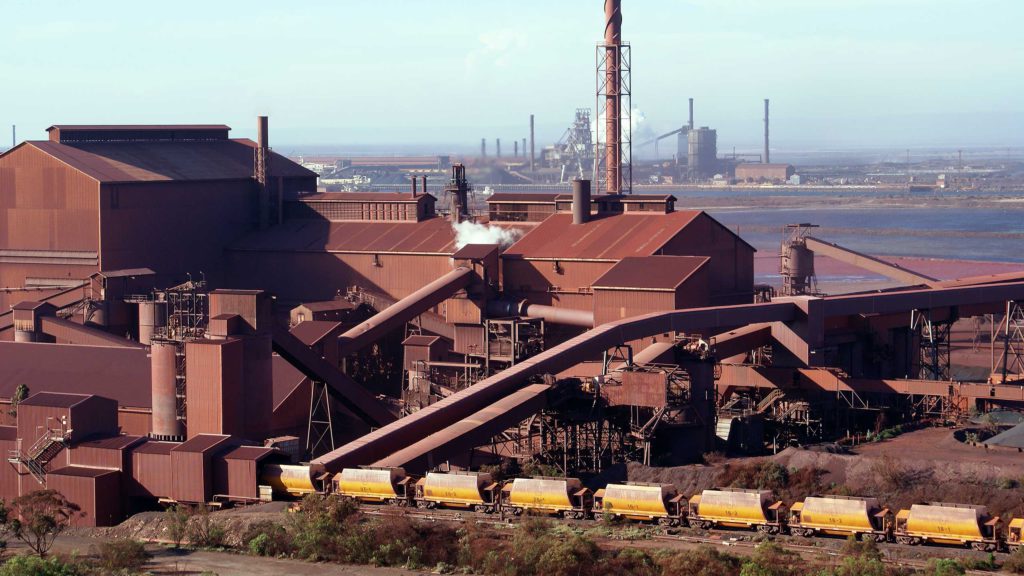
BlueScope leads global steel giants in push for Gupta’s Whyalla plant


Credit: Whyalla Steelworks

Australia’s BlueScope Steel said on Monday it has assembled a heavyweight consortium of global steelmakers to bid for Sanjeev Gupta’s troubled Whyalla Steelworks, over a month after the local government formally opened a sale process.

The group — comprising Japan’s Nippon Steel, India’s JSW Steel and South Korea’s POSCO — brings a combined market value of A$115 billion ($74.4 billion), and is eyeing the South Australian plant as a future hub for low-emissions iron production for domestic and export markets.

The consortium has lodged a non-binding expression of interest but has yet to submit a formal bid.

Whyalla Steelworks was placed in administration in February, after its operating company collapsed under tens of millions in debt. The Australian and South Australian governments stepped in with a joint A$1.9 billion rescue package to safeguard local jobs and preserve a key piece of industrial infrastructure.

Australia formally opened the sale process in June, citing strong global interest from companies seeking a foothold in the emerging green steel economy.

Gupta’s family conglomerate, GFG Alliance, was not immediately reachable for a Reuters request for comment.

($1 = 1.5466 Australian dollars)

(By Rishav Chatterjee; Editing by Sandra Maler)

Nevada Gold Mines, Komatsu launch autonomous haulage partnership in the US 

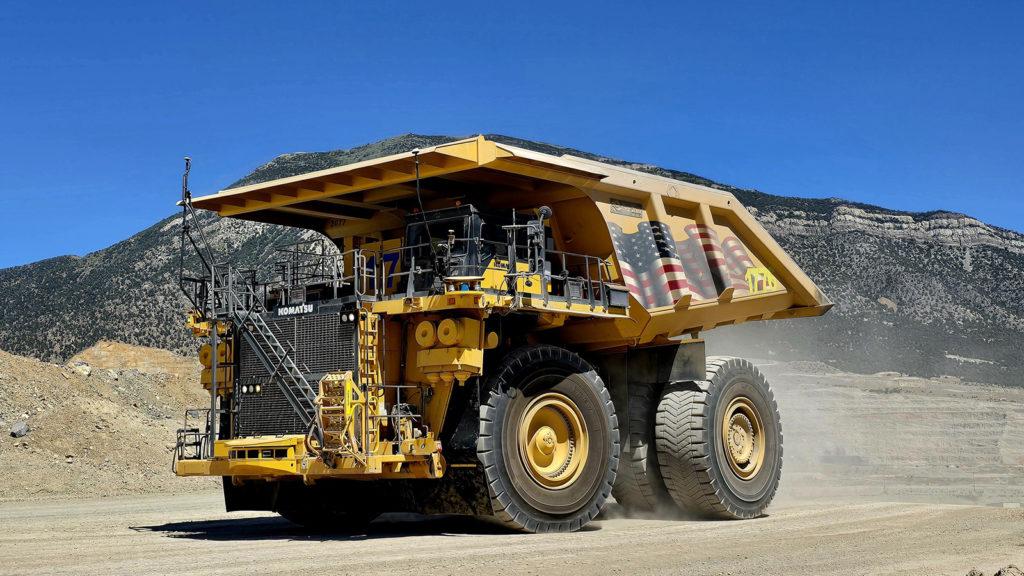
Komatsu’s FrontRunner Autonomous Haulage System at NGM. Image from Barrick.

Nevada Gold Mines (NGM) and Komatsu have partnered to elevate workplace safety and enhance operational efficiency through the deployment of Komatsu’s FrontRunner Autonomous Haulage System (AHS).  

NGM, a joint venture between Barrick Mining (NYSE: B) and Newmont (NYSE: NEM) will be automating their fleet of 300 and 230 tonne haul trucks across their surface operations.  

While visiting the company’s Cortez operations this week, Barrick chief executive Mark Bristow joined site leaders to witness a live demonstration of the FrontRunner AHS.  

The collaboration marks the first implementation of the system for both companies within the United States, Barrick said. 

“This is a strong example of how proven global solutions can be adapted to meet NGM’s specific operational needs,” Bristow said in a news release.  

“Barrick and NGM are committed to innovation that drives meaningful change. But more than that, it’s about protecting our people. By reducing the need for onboard operators, the FrontRunner system significantly minimizes employee exposure to potential hazards, while enhancing more predictable fleet performance, better fuel consumption and continuous operations — all of which contribute to a safer, more sustainable future for mining,” Bristow said.  

“The scale and ambition of this deployment mark a major milestone for autonomous mining in America,” added Braden Weisheit, GM, mining technology solutions at Komatsu.

“To support the performance and reliability of this cutting-edge system, Sedna and Nokia will deploy a customized 5G communications infrastructure. This tailored network will provide the high-speed, low-latency connectivity required for seamless system performance, real-time data exchange and safe, remote equipment operation.” 


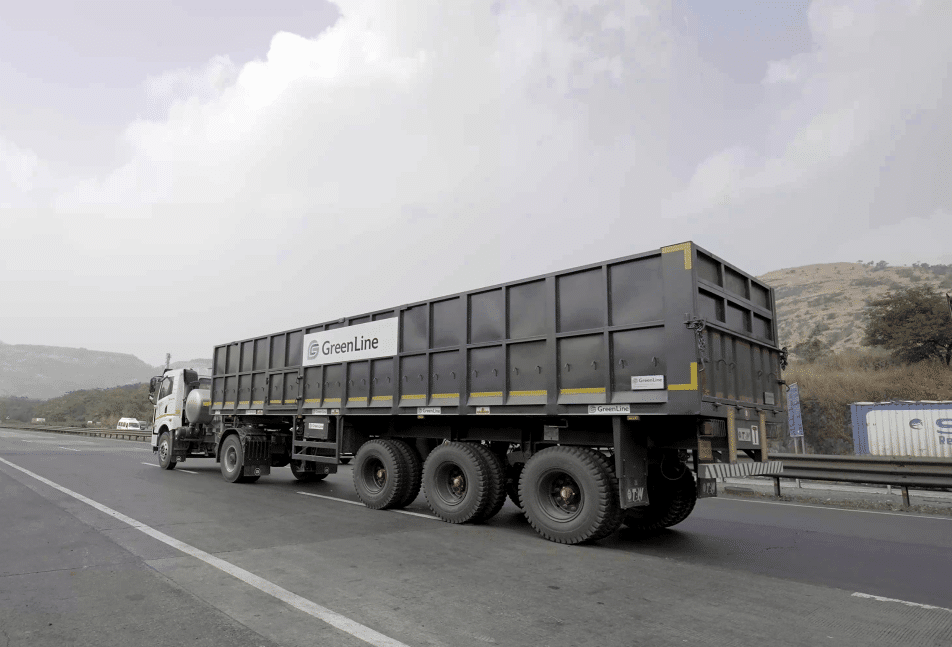
India GreenLine to invest $46 million in electric truck fleet for Hindustan Zinc


Credit: GreenLine Mobility Solutions

India’s GreenLine Mobility Solutions said on Monday it will invest 4 billion rupees ($45.7 million) to boost its electric truck supply fleet for miner Hindustan Zinc, replacing diesel vehicles.

Hindustan Zinc, which has set a 2050 net-zero carbon emission goal, will deploy electric trucks for the movement of materials between its mines and smelters, GreenLine said in a statement.

The funds will also be used to set up a commercial-scale battery-swapping infrastructure and double Hindustan Zinc’s liquefied natural gas-powered truck fleet to 200 for long-haul finished goods transport, GreenLine said.

The company had in April pledged $275 million to accelerate decarbonization of heavy trucks, in a move to cut logistics-related emissions.

($1 = 87.5910 Indian rupees)

(By Hritam Mukherjee; Editing by Nidhi Verma and Shreya Biswas)

As rescue ends in tragedy, Codelco asks experts what went wrong


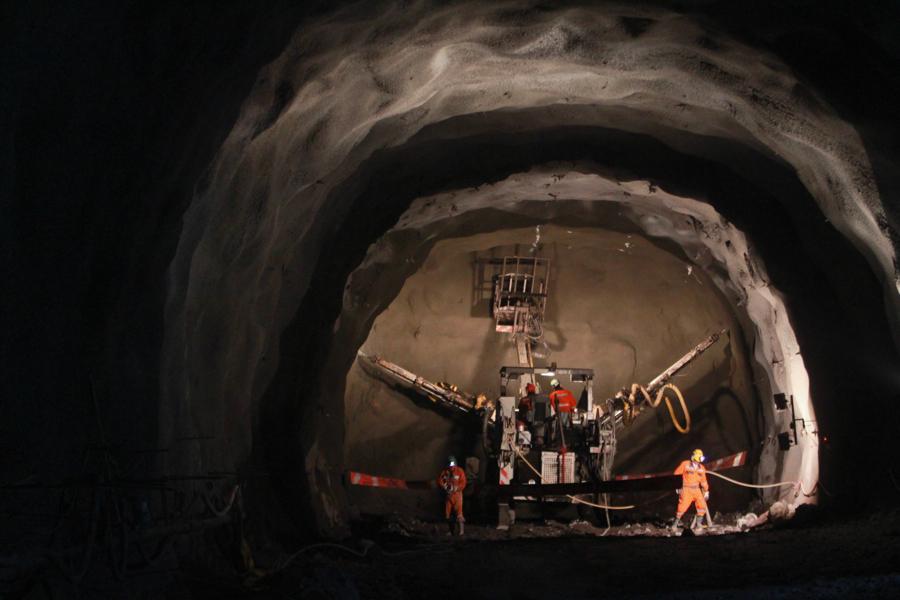
A snapshot of El Teniente’s underground dimensions

After six deaths at its biggest mine, Chile’s state-owned copper giant Codelco will now examine what caused Chile’s deadliest mining accident in decades — and how it can prevent another tragedy.

A frantic weekend rescue mission recovered the bodies of all five workers still missing since Thursday, when seismic activity caused a tunnel collapse at one of the world’s biggest underground copper mines.

The Chilean company is convening a panel of international experts to audit the El Teniente mine and establish what exactly happened, and the incident is likely to spark scrutiny over copper supply at a time of growing global demand for the wiring metal.

“We have opened an investigation to determine if there were failures,” chairman Maximo Pacheco told reporters Sunday. “If any responsibility lies with our supervisors or executives, we will apply maximum measures.”

But it was a weekend of mourning for Codelco and the country’s mining industry, which accounts for a quarter of the world’s mined copper.

A 100-person rescue team — including some who helped free 33 workers trapped in another Chilean mine 15 years ago — battled around the clock to reach the trapped workers. Unlike that successful San Jose rescue in 2010, all those missing at El Teniente were found dead.

Codelco has halted all mining at the site after the collapse, triggered by seismic activity at a new section of the complex called Andesita. It’s a major setback for the miner’s effort to recover from a yearslong output slump, and will add to delays in rolling out investments to overhaul aging operations.

El Teniente is crucial for Codelco’s aim to return to pre-pandemic production of about 1.7 million tons a year, from about 1.4 million tons now. The mine accounts for about a quarter of the company’s output.

International audit

The timing of any restart will depend on the outcome of the investigation, and what measures may be needed to reinforce the structure or adjust mining methods. Mines in Chile are generally designed to withstand much stronger seismic activity than the 4.2-magnitude event that caused the collapse.

Asked about reports that workers at El Teniente had flagged safety concerns prior to this tragedy, Pacheco said no official complaints had been received either anonymously or otherwise. Still, he vowed to get to the bottom of the accident and take the appropriate measures.

“We’re going to commission an international audit to determine what we did wrong,” Pacheco said on Sunday. Codelco delayed reporting quarterly results Friday as it dealt with the accident.

To be sure, Andesita is a relatively small part of Codelco’s multi-billion-dollar project pipeline in Chile as it plays catchup after decades of underinvestment. But it’s a key component — along with the Diamante and Andes Norte projects — in keeping El Teniente churning out copper in the years ahead as other sections of the 120-year mine deplete.

Safety issues

While Codelco has made its mines much safer in recent years as part of an industry-wide safety push, sporadic accidents continue to affect both new projects and existing operations.

Last year, its Radomiro Tomic open pit was the scene of a fatal accident that led to extended production disruptions, while a worker at its Ventanas division died in an accident while repairing a warehouse roof. In 2023, an electrical technician at El Teniente died.

In 1994, a firedamp gas explosion at the now closed Schwager coal mine claimed the lives of 21 miners. The deadliest accident in Chilean mining was a 1945 fire at El Teniente that generated a lethal cloud of smoke and carbon monoxide in the tunnels, killing 355 workers.

(By James Attwood)


Codelco must send reports to restart underground mining after El Teniente collapse


El Teniente . Image courtesy of  Coldeco  via Flickr

Chilean state-run miner Codelco must produce four reports on the collapse at its El Teniente copper mine that killed six people after an earthquake last week, according to a government document seen by Reuters on Monday, before it can restart its underground operations there.

Codelco is the world’s largest copper producer.

The firm said in a filing on Monday that it was committed to restoring operations as soon as safety conditions permitted, but that the effects of the stoppage could not yet be estimated.

A document from the government’s mining service SERNAGEOMIN showed that in order to lift the suspension, Codelco would have to hand in four reports of the collapse at El Teniente.

The reports must include an analysis of the cause of the collapse, a recovery plan and an evaluation of its fortification systems, the document said.

(By Daina Beth Solomon and Fabian Cambero; Editing by Sarah Morland and Kylie Madry)


Copper price rises with US tariffs, Codelco mine stoppage in focus


Codelco copper Fundición el Teniente Chile. Credit: Consejo Minero.

Copper edged higher as traders continued to digest US President Donald Trump’s decision to spare the most traded form of the metal from his 50% tariff, while a deadly mine accident in Chile raised supply concerns.

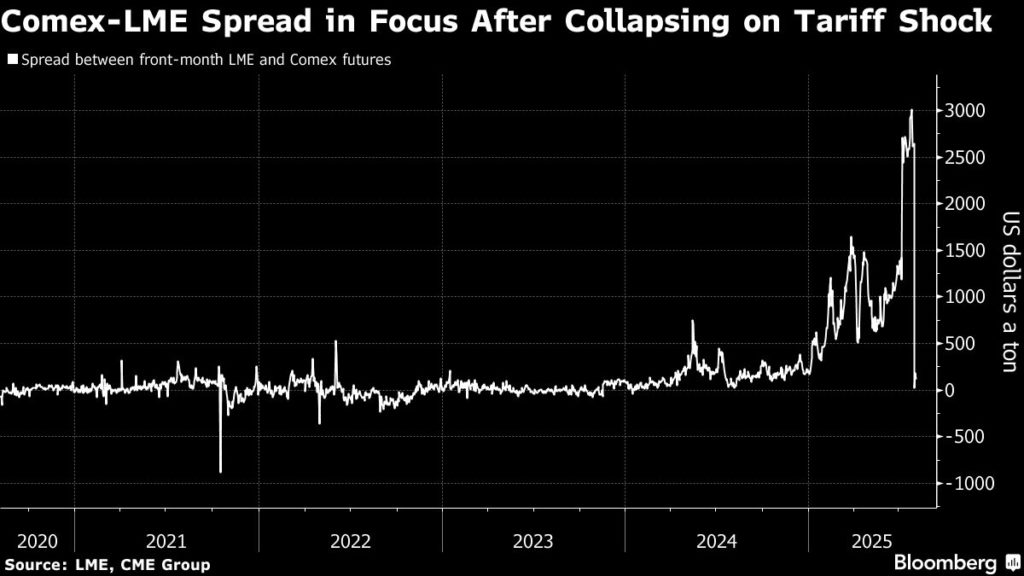
Copper rose as much as 1.1% on the London Metal Exchange, with trading conditions starting to settle after the White House’s shock move last week to exclude refined metal from the newly imposed import levy. The decision sent US prices plunging by a record 22% on Thursday, pushing them back to parity with the LME’s global benchmark.

A key question now is what will happen to the huge volume of copper that’s been shipped to the US in anticipation of tariffs, with the spreads between prices in London, New York and Shanghai likely to determine whether the metal flows back out quickly or remains in US ports. On Monday, US copper futures on CME Group’s Comex were trading about 1.5% — or $130 a ton — above those on the LME, undercutting the immediate rationale for exports.

“In the past, metal flowed between the CME and LME whenever the spread between those two prices moved outside a $100-200/t band,” Bank of America analysts led by Irina Shaorshadze said in an emailed note. “As the trade flows normalize, the LME-CME spread should revert to the historical mean-reverting relationship.”

Copper traders are also on alert for supply disruptions, after six people were killed in a tunnel collapse triggered by an earth tremor last week at El Teniente, which accounts for over a quarter of Chilean mining giant Codelco’s output. Underground operations are halted and — with the company launching an investigation into the causes — it’s unclear how long the stoppage will last or whether it will trigger changes to Codelco’s output goals.

El Teniente, one of the world’s biggest underground mines, produced 356,000 tons of copper last year. That volume is equivalent to more than a month of Chinese imports of refined copper.

The stoppage at El Teniente comes as the world’s copper smelters face intense competition to secure mine supply. Treatment fees — typically the main earner for smelters — remain at deeply negative levels on a spot basis, and plants in the Philippines and Japan have cut output or closed. Even in China, where output has remained robust, there is some speculation that production is reaching a limit.

Investors are also monitoring other unexpected mine disruptions, including at the massive Kamoa-Kakula complex run by Ivanhoe Mines Ltd. in the Democratic Republic of Congo. Still, Ivanhoe executives on Friday delivered an upbeat assessment on prospects for returning that mine to previous output guidance.

LME copper prices were 0.8% higher at $9,707.50 a ton as of 12:18 p.m. local time.

Other metals opened Monday flat to higher, gaining support from a weaker dollar. Iron ore futures in Singapore rose 1.5% to $101.50 a ton, recovering from their biggest weekly decline since April. Aluminum and zinc also rose.

Mitsubishi Materials may scale back copper smelting due to worsening margins


Credit: Mitsubishi Materials

Japan’s Mitsubishi Materials is considering scaling back copper concentrate processing at its Onahama Smelter & Refinery as falling treatment and processing charges (TC/RCs) weigh on earnings, it said on Monday.

In June, peer JX Advanced Metals said that it was also considering copper production cuts due to a significant deterioration in ore purchase terms.

Mitsubishi Materials said the worsening TC/RCs from miners were expected to further erode smelting margins.

“To maintain and improve profitability, we need to raise the ratio of recycled raw materials and accelerate the shift to feedstock less vulnerable to TC/RC fluctuations,” the company said in a statement.

It is now considering the possibility of a partial shutdown of production facilities and a reduction in copper concentrate processing at Onahama, after planned maintenance from October to November this year, Mitsubishi Materials said.

Last month, Japan Mining Industry Association Chair Tetsuya Tanaka warned that domestic copper smelters faced tough mid-year negotiations with global miners over TC/RCs, saying they could not accept the extremely low terms agreed by Chinese smelters.

Some Chinese smelters agreed TC/RCs of $0 per metric ton and 0 cents per pound with Chilean miner Antofagasta during mid-year talks. These rates are seen as an industry benchmark and far below the 2025 annual charges of $21.25 a ton and 2.125 cents per pound.

Tanaka, who is also Mitsubishi Materials president, said at the time that shrinking smelting margins were putting non-Chinese smelters under severe pressure.

(By Yuka Obayashi; Editing by Emelia Sithole-Matarise)


BAN DEEP SEA MINING

TMC releases PFS, publishes first probable mineral reserves for deep-sea nodules


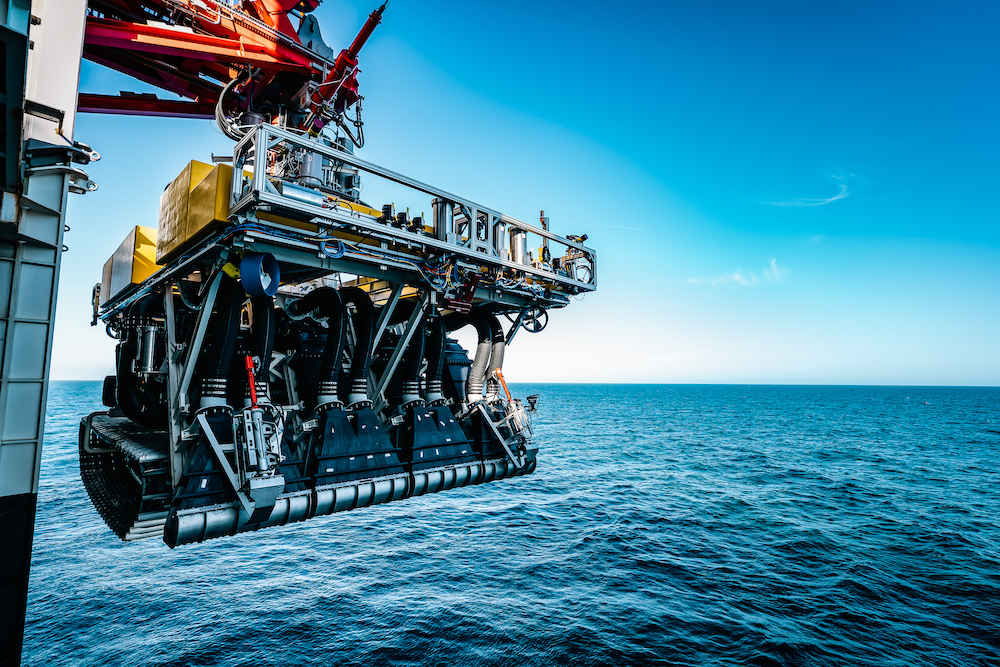
Pilot collector vehicle at NORI. (Image by The Metals Company)

The Metals Company (Nasdaq: TMC), released Monday a Technical Report Summary (TRS) of the Pre-Feasibility Study (PFS) for its proposed NORI-D Polymetallic Nodule Project in the Clarion Clipperton Zone of the Pacific Ocean.  

The report was prepared in accordance with SEC Regulation S-K (SK-1300) and The PFS marks a world-first declaration of Probable Mineral Reserves for deep-sea polymetallic nodules. 

The Canadian miner, which has exclusive access to the Nori Clarion-Clipperton Zone, in March formally initiated a process under the US Department of Commerce to apply for exploration licenses and permits to extract minerals from the ocean floor. 

Mining international waters is in the spotlight as companies and countries are looking at minerals concentrated on the ocean floor that can be used in batteries for smart phones and electric vehicles. 

Alongside the PFS, TMC announced the publication of an Initial Assessment (IA) for the remainder of its resource in the NORI and TOML blocks in the CCZ, with a measured and indicated mineral resource of 73Mt of wet nodules grading 1.30% nickel, 0.20% cobalt, 1.2% copper and 30.2% manganese with an abundance of 12.8 Kg/m2 and an inferred mineral resource of 1206 Mt of wet nodules grading 1.30% nickel, 0.20% cobalt, 1.1% copper and 28.7% manganese with an abundance of 11.6 Kg/m2 supporting an After-tax NPV of $18.1 billion and After-tax IRR of 35.6%. 

The mineral resource reports follow TMC USA’s April submission of an application for a commercial recovery permit under the U.S. Deep Seabed Hard Mineral Resources Act (DSHMRA), along with two exploration license applications.  

The reports also follow an $85 million investment from Korea Zinc in June. The deal gives Korea Zinc a 5% stake in TMC through the purchase of 19.6 million shares at $4.34 each. It also includes a three-year warrant allowing the South Korean refiner to acquire an additional 6.9 million shares at $7 apiece. 

TMC’s bid to become the first company to gain approval to develop deep sea minerals has been controversial. Environmental groups are calling for all activities to be banned, warning that industrial operations on the ocean floor could cause irreversible biodiversity loss. 

Despite the opposition, TMC CEO Gerard Barron has declared the debate over. 

“The combined net present value of $23.6 billion of the two studies should give investors a better idea of the economic potential of our total estimated resource, Barron said in a news release Monday.  

“The PFS takes our NORI-D Project economics up the confidence curve and contains the declaration of mineral reserves — these are our first 50+ million tonnes with a potential commercially viable path to production, with more to follow as we advance our mine planning work,” Barron said.  

The phased project development plan will target initial production from the Hidden Gem vessel, with an estimated $113 million of development capital expenditure each from TMC and Allseas.

The company said first production is targeted for Q4 2027.

The Metals Company’s stock was down 6.2% in mid-afternoon trading on the Nasdaq. The company has a $2.2 billion market capitalization.

Evergreen Ship Loses Boxes Closing Callao Port for Hours

containers overboard
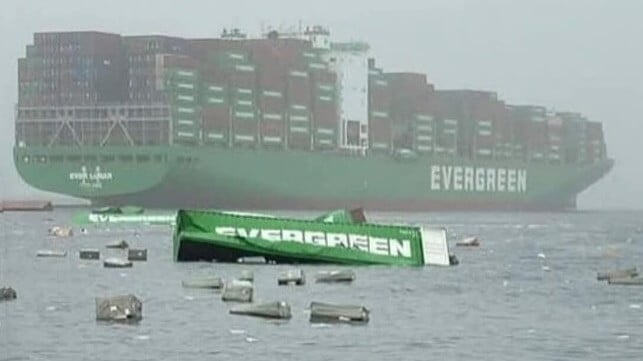
Debris in the bay outside Callao, Peru after the box loss from the anchored containership

Published Aug 4, 2025 10:44 AM by The Maritime Executive


The Port Authority in Callao, Peru, confirmed that port operations resumed Friday afternoon, August 1, several hours after they were forced to suspend all operations after an Evergreen ship lost boxes overboard while in the bay. The port was closed as a precaution due to heavy fog, which was limiting the ability to see the containers.

The Taiwan-flagged containership Ever Lunar (103,891 dwt) was inbound from Buenaventura, Colombia, and reportedly was waiting in the bay for its terminal on Friday morning. The ship, which was built in 2015, is reported to have a capacity of 8,500 TEU and was carrying approximately 7,000 containers. It was sitting outside the main shipping channel at anchor.

Evergreen Marine, in a statement, said that the ship “suddenly experienced severe rolling.” Peru had been on alert for a possible impact from the Russian earthquake and predicted tsunami. The company said the motion of the vessel may have been caused by a number of factors, including the recent tsunami triggered by an earthquake in Russia, poor winter sea conditions in South America, and the sudden swelling of waves.


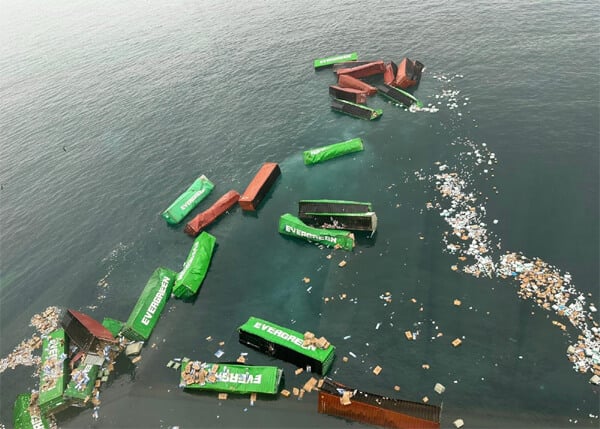
The incident happened around 9:40 a.m. local time, and according to the port authority, approximately 50 containers fell overboard. There were no injuries to the crew. They said there was no indication that there was any hazardous cargo in the containers, which could be seen floating around the bay. Pictures in the media showed plastics and electronics in the containers.

The port authority suspended all traffic in the port while a patrol boat and tugs began flagging the locations of the containers. The ban included not only all commercial traffic but also fueling, diving, fishing, and recreational activities. The ban was lifted around 4:00 p.m. local time. 

The port authority said that tugs hired by Evergreen’s insurers would begin the task of retrieving the containers. They said they would be looking into the possibility that the lashing system had broken.


Debris floating in the harbor (Congresswoman Patty Chirinos on X)

It is the second incident in days during the South American winter, with weather also being cited as the cause of a stack collapse on the Ever Feat (12,000 TEU) on July 29. The vessel arrived at the port of Montevideo, Uruguay, with the collapse happening during a trip from Brazil.

Last year, the South African winter weather took a similar toll on containers. At least four vessels reported losing boxes or stack collapses while rounding the Cape of Good Hope. However, overall, the World Shipping Council reports that container losses continue to decline and have reached a low in recent years.

Bulker Loaded with Coal for Israel Becomes Center of Controversy

bulker at sea
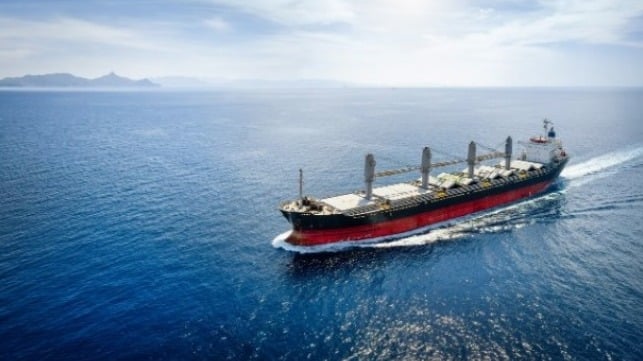
Bulker is sailing in the Atlantic as a controversy swirls over its coal cargo bound for Israel (iStock file photo)

Published Aug 4, 2025 4:28 PM by The Maritime Executive


An activist group based in Malta has identified a bulker laden with coal bound from Colombia to Israel and is demanding action from the government as the flag state of the ship. At the same time, Colombia’s government is demanding action and threatening to use its navy to stop future shipments.

The Greek-owned bulker Fortune (182,620 dwt) registered in Malta departed from Colombia’s Puerto Drummond. The vessel, built in 2016, is now mid-Atlantic with a declared destination of Israel. It is 10 days from Israel, but groups on both sides of the Atlantic are protesting its support of the Israelis.

The situation came to be known because Colombia’s mining union filed a complaint. A year ago, Colombian President Gustavo Petro issued a decree barring ships of coal and trade with Israel due to the war in Gaza. Colombia’s Minister of Labor, Antonio Sanguino, received the complaint and called for an investigation, and working with other organizations.

Petro wrote online that the shipment was a “challenge to my government,” and called for the unions and government to convene. He threatened, “The Navy will receive a written order to detain ships bound for Israel.”


The Times of Malta now reports that an activist group issued a demand to the government, saying it must intervene as the ship’s flag state. They are calling for the ship to be turned around and take the coal back to Colombia. Failing to do that, they are saying Malta must remove its flag from the ship.

The group claims Malta should emulate Antigua and Barbuda, reports the Times of Malta. They claim the Caribbean flag set a standard for preventing ships trading with Israel in its registry.

It is not the first time that activists have targeted commercial vessels carrying cargoes to Israel. Dockworkers in various ports have reportedly sought not to handle ships bound for Israel. Maersk Line Ltd. ships under contract to the U.S. government were targeted for boycotts, and recently, an Israeli cruise ship operating in the Mediterranean has been met by protestors at various ports.


First Funnel Removed as SS United States Prepares to Become a Reef

funnel being removed from ss United States
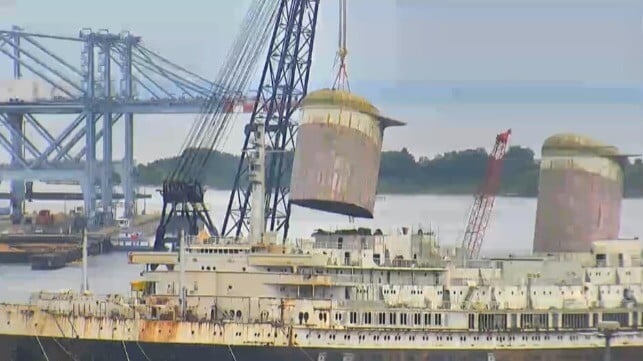
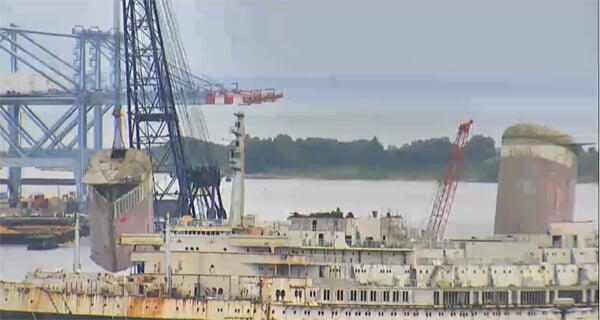
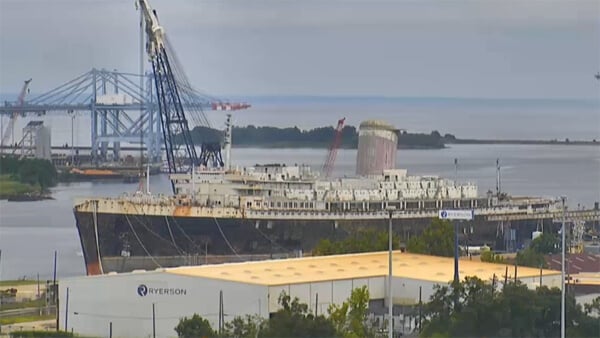
Funnel cut away from the vessel for preservation (screen captures from FOX 10 TV Mobile)

Published Aug 4, 2025 3:37 PM by The Maritime Executive

 \\


Five months after the famed ocean liner ss United States arrived in Mobile, Alabama, to prepare for her conversion into a man-made reef, the signature forward funnel was removed from the vessel on August 3. Work is proceeding with this key milestone, marking progress toward the end of the ship.

The massive forward funnel, which was the equivalent height of a six-story building (approximately 65 feet tall off the deck), was removed with a giant crane positioned alongside and lowered onto a barge. The SS United States Conservancy reports it is working with the buyer of the ship, Florida’s Okaloosa County, to protect, transport, and store the funnel.

The remediation team had earlier cleared out all the connections and equipment on the interior of the funnel. They also surgically placed cuts along the base of the funnel for its removal. 

The funnels were a distinctive element of the design of the ship, which continues to hold the title from 1952 of the fastest liner to cross the North Atlantic. Her renowned designer, William Francis Gibbs, developed what was called the “sampan” capped funnel design in the 1930s for earlier passenger ship designs as a means of keeping soot away from the decks. Subsequent designs grew larger in proportion to the ship, with the ss United States boasting she was fitted with the largest funnels on a liner.

The plan to sink the vessel off the coast of Florida’s Destin-Fort Walton Beach area calls for the removal of both funnels as well as the radar mast over the bridge, all of which the Conservancy plans to save. The cargo booms will also be removed from fore and aft. The Conservancy also plans to remove the last remaining propeller stored on the vessel’s aft deck and the stem anchor. Later today the radar mast over the bridge was also removed. The second funnel is expected to be removed in the coming days.


Fox News 10 TV Mobile broadcast the funnel removal 


Images from Mobile show that the windows of the promenade deck, portholes, and other fittings on the interior and exterior have already been stripped from the ship. Lose paint from the superstructure, and the deck covering has also been removed. Reports are that the team will begin working on the hull to remove the loose paint.

No final timeline has been released for when they expect to sink the hull of the vessel. Indications are that they hope to complete the reefing by the end of 2025.

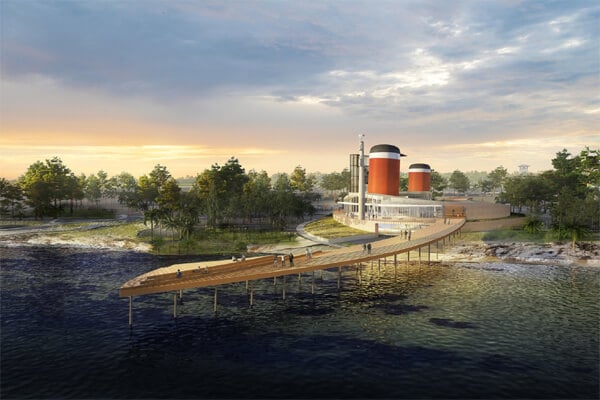
At the same time, the Conservancy reports it is moving forward with the plan to create the future SS United States Museum and Visitor Experience. They have retained the museum and exhibit design firm Thinc Design to develop the concepts. Today, they released a new rendering of the potential museum space.

Several groups have continued legal challenges attempting to block the reefing of the hull. They were trying to prevent the removal of the key structural elements, arguing the ship is on the U.S. National Register of Historic Places. 


Museum concept incorporating the funnels and mast (SS United States Conservancy)