It’s possible that I shall make an ass of myself. But in that case one can always get out of it with a little dialectic. I have, of course, so worded my proposition as to be right either way (K.Marx, Letter to F.Engels on the Indian Mutiny)
Monday, August 18, 2025
USGS Maps Out Fresh Oil and Gas Potential in the Rockies
Northwest Colorado and southwest Wyoming have an estimated 3 million barrels of oil and 666 billion cubic feet of gas that are recoverable, the United States Geological Survey (USGS) said in a recent assessment.
The Phosphoria Total Petroleum System, which has been producing oil and gas since 1920, has pumped a total of 500 million barrels of oil and 2.5 trillion cubic feet of natural gas over the past 100 years, according to the USGS estimates.
The system may be nearing depletion, the USGS assessment found, despite the volumes of still recoverable resources.
“USGS energy assessments typically focus on undiscovered resources – areas where science tells us there may be a resource that industry hasn't discovered yet,” Sarah Ryker, acting director of the USGS, said in a statement.
“In this case, after 100 years of production, we estimate the Phosphoria Total Petroleum System has relatively little remaining oil and more than 600 billion cubic feet of gas.”
However, another petroleum system in Wyoming, Colorado, and Utah has much more potential, the USGS said in an assessment earlier this year.
The Mowry Composite Total Petroleum System, spanning parts of Wyoming, Colorado and Utah, is estimated to have 473 million barrels of oil and 27 trillion cubic feet of natural gas, the U.S. Department of the Interior said in May.
These resources, identified in a USGS survey assessment, could help bolster domestic energy supply and fuel local economies, DOI said.
“Public lands in Southwestern Wyoming hold significant potential, and this science-based evaluation provides critical data to help inform responsible resource management,” said Secretary of the Interior Doug Burgum.
“We Map, Baby, Map to provide updated estimates of recoverable oil and gas and equip decision-makers, communities, and industry with the knowledge they need to support job creation, domestic energy production, and long-term economic growth.”
By Tsvetana Paraskova for Oilprice.com
U.S. and Iraq Discuss Kurdistan Oil Export Dispute
Top U.S. and Iraqi officials have discussed the potential resumption of oil exports from Iraq’s semi-autonomous region of Kurdistan and the role of the U.S. oil companies operating in the country, the Iraqi foreign ministry said on Monday.
Oil exports from Kurdistan have now been halted for two and a half years, after they were shut in in March 2023 due to a dispute over who should authorize the Kurdish exports. Despite some breakthroughs in negotiations in recent months, the disagreements have continued.
Before the halt to exports, oil supply from Kurdistan averaged more than 400,000 barrels per day (bpd).
Iraq has said exports were to resume in the middle of July, but then a wave of drone attacks on oilfields in Kurdistan forced companies to shut in production and plans for the pipeline restart were delayed.
In a meeting to discuss ways to remove barriers to restart the oil exports, Iraq’s Deputy Prime Minister and Minister of Foreign Affairs, Fuad Hussein, met this weekend with the U.S. Chargé d’Affaires of the U.S. Mission to Iraq, Steven Fagin.
The talks focused on “the outstanding issues between the oil companies operating in the Kurdistan Region, and ways to address them in a manner that allows for the resumption of oil exports from the oil fields in the Region,” the Iraqi foreign ministry said in a statement carried by the Kurdistan 24 news outlet.
The talks also addressed “the course of bilateral relations between Iraq and the United States, particularly with regard to the role of American oil companies operating in Iraq,” the ministry added.
Earlier this month, the federal Iraqi Oil Minister, Hayan Abdul Ghani, said on August 6 that crude oil exports from Kurdistan to a Turkish Mediterranean port would resume at any moment.
However, it appears there are outstanding issues that Iraq needs to resolve with the foreign oil companies operating in Kurdistan before restarting exports to the Turkish coast.
By Charles Kennedy for Oilprice.com
Brazil Extends Aram Block Deadline as Petrobras Confirms New Oil Finds
Brazil’s oil and gas regulator ANP has approved an 18-month extension of the exploration period for the Aram block in the Santos Basin pre-salt, pushing the deadline for Petrobras and China’s CNOOC to meet their commitments to June 30, 2029, according to BNamericas. The move gives the consortium more time to advance drilling in one of Brazil’s most promising pre-salt areas, seen as critical to maintaining oil supply self-sufficiency in the next decade.
The Aram block was acquired in March 2020 during ANP’s 6th production-sharing round, with state-owned PPSA as contract manager. Petrobras holds an 80% operating stake, while CNOOC Petroleum Brasil Ltda owns the remaining 20%.
Petrobras confirmed hydrocarbon discoveries in the block in March and May this year, and the consortium is currently drilling two wells with the Valaris DS-4 and West Auriga rigs in water depths of about 1,860 meters, according to BNamericas.
The regulator’s decision follows earlier adjustments to Aram’s exploration schedule. In June, Brasil Energia reported that ANP had extended the PAD Curaçao appraisal program within Aram until December 2026, citing the technical complexity of the campaign. In May, Offshore Magazine noted Petrobras had struck “high-quality oil without contaminants” in well 3-BRSA-1396D-SPS, adding that further delineation was required to confirm commercial volumes. Click Petróleo e Gás reported Petrobras CEO Magda Chambriard as calling Aram one of the company’s most strategic pre-salt prospects.
The Aram block has become a focal point of Brazil’s upstream strategy as legacy fields in the pre-salt age and decline. For Petrobras, the extension ensures time to assess one of its most significant exploration bets, while for CNOOC it secures a potential long-term source of supply in the Americas. Separately, Brazil’s largest FPSO reached its maximum production capacity ahead of schedule. The faster-than-expected ramp-up reflects the scale of new pre-salt developments being brought online, even as Petrobras and its partners continue exploration work in areas such as Aram.
Chinese automakers like BYD, Great Wall, and Chery are expanding production in Brazil and Mexico to secure a dominant position in Latin America’s EV market.
Brazil’s government is encouraging local production, while Chinese firms adapt by producing ethanol-hybrid vehicles to meet regional fuel standards.
Despite trade war uncertainty impacting nearshoring to the U.S., Chinese EV companies are strengthening their foothold in Latin America’s two largest automotive markets.
As China continues to grow its electric vehicle (EV) industry, it has expanded to several new markets in recent years, opening multiple production and assembly plants across Latin America. Chinese EV companies now offer a wide variety of EV models at competitive prices, making them well-suited to the Latin American market, with a growing uptake of Chinese EVs being seen in Brazil and Mexico. However, while its Latin America prospects might be good, developing successful nearshoring activities for the United States market is less certain due to the ongoing trade war.
The Chinese EV production capacity has boomed in recent years thanks to favourable national policies, financial incentives, and easy access to parts. Chinese automakers are now projected to contribute 30 percent of global car sales by 2030, up from 21 percent in 2024.
China is in the fortunate position of controlling most of the EV component supply chain, from lithium to semiconductors and batteries. This has led to the launch of multiple Chinese EV-makers that can produce competitive and affordable vehicles. As these companies expand beyond the Asian market, one of the places where they are doing especially well is Latin America.
The Chinese EV manufacturer Build Your Dreams (BYD) has quickly risen to compete with several EV makers from around the globe, including Tesla, thanks to its advanced capabilities. BYD promises to offer consumers a full charge in just 5 minutes, similar to the time it takes to pump petrol, as well as offers ranges like those of high-end American and European EVs at a lower cost.
As BYD and other firms, such as Great Wall Motor and SAIC, look to expand, they are developing operations in Europe and Latin America. Great Wall Motor recently took over a former Mercedes-Benz plant in the industrial town of Iracemápolis, near São Paulo in Brazil, after the automaker suspended activities in 2021 due to a decline in luxury car sales. Meanwhile, BYD took over a Ford facility in Brazil following several years of poor sales, and Chery joined forces with the Brazilian company Caoa to produce cars in the central state of Goias.
Natalie Unterstell, the president of the Rio de Janeiro-based climate research and advocacy organisation Talanoa Institute, said, “For the first time in decades, we’re seeing a real challenge to the dominance of American and European brands, not just in terms of market share, but in shaping the future of mobility.”
Brazil is the world’s sixth-largest car market. In recent years, the government has encouraged Chinese automakers to set up shop in Brazil to avoid becoming overly reliant on EV imports alone. It aims to make Brazil part of the value chain, as EV uptake in Latin America expands, which is encouraged by import duties on vehicles not produced domestically. This has come as a shock to the Asian, European, and American automakers that have long dominated the Brazilian market.
Some players in the industry criticise the Chinese automakers for flooding the market with impossibly low-priced vehicles. While others accuse Chinese automakers of assembling cars with components imported from China rather than using regional supply chains.
To adapt to the Brazilian market, Chinese automakers are producing hybrid vehicles that run partly on a gas-ethanol blend – made from sugar cane – and partly on batteries, to make the most of Brazil’s strong ethanol industry and adhere to government gasoline standards. Marcio Renato Alfonso, Great Wall’s director of research and development for Brazil, explained, “We need to produce what customers are looking for… high technology with an affordable price."
Chinese automakers have also shown an interest in Mexico, which has a strong history of automaking, for nearshoring activities. While the ongoing trade war between the U.S. and both China and Mexico means greater uncertainty for nearshoring, Chinese companies still have significant potential to solidify their regional market by developing operations in Latin America’s two biggest markets.
In 2023, China was the leading car supplier to Mexico, with vehicle exports worth $4.6 billion, according to the Mexican Ministry of Economy. Mexico’s free trade agreement with the U.S. and Canada also opened other markets, before the uncertainty of the current trade war. In 2023, BYD announced plans to develop a plant in Mexico capable of producing around 150,000 vehicles a year and generating 10,000 jobs. However, in July, the EV maker said it had cancelled plans following months of trade uncertainty.
While nearshoring activities now appear less certain, the launch of operations in Brazil and Mexico, which both have strong automaking capabilities and well-established regional supply chains, is helping Chinese EV makers to gain a solid foothold in the Latin American market. Several Chinese newcomers are rapidly rising to compete with reputable Asian, European, and American automakers by offering high-quality vehicles at a low cost.
By Felicity Bradstock for Oilprice.com
Who Will Benefit the Most From Argentina’s Shale Oil Boom?
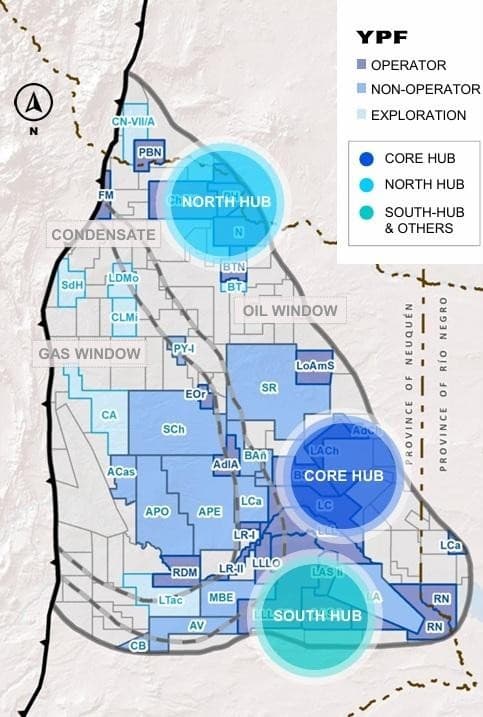
Argentina’s state-run YPF has transformed into Latin America’s leading shale developer, producing nearly half the nation’s oil from Vaca Muerta.
Vaca Muerta’s low breakeven costs and vast reserves have positioned Argentina as South America’s third-largest oil producer and a rising exporter.
With $36 billion in planned investments through 2030, YPF projects production and free cash flow will more than double, strengthening Argentina’s economy.
In a shock development, crisis-prone Argentina, South America’s second-largest economy, recently emerged as the continent’s third-largest oil producer. The surge in unconventional hydrocarbon output from Vaca Muerta, one of the world's top five shale formations, is driving significant growth in oil and natural gas production. Argentina’s national oil company YPF is leading the shale play’s development and shaping up to be one of the best run state state-owned energy companies in Latin America. Despite being nationalized in April 2012, YPF’s hydrocarbon output is soaring ever higher while operating costs are falling, giving earnings and profitability a solid boost.
Markets shunned YPF after President Cristina Fernandez de Kirchner seized 51% of the company from Spanish energy major Repsol in April 2012 as Argentina struggled with an energy shortfall and enormous trade deficit. Within days, YPF's share price plummeted to a quarter of its value prior to nationalization, as the effects of this event impacted markets and investor confidence. At the time, there were concerns the fiscal and economic issues associated with Argentina’s federal government could impact the company’s finances and operations.
Surprisingly, this did not occur with YPF taking the lead to develop the 8.6-million-acre Vaca Muerta shale, which, despite being discovered in 1927, was not fully evaluated until 2011. There are several reasons for this, the key being Repsol’s reticence to invest considerable capital in exploration activities in Argentina at a time when heavy-handed regulation sharply impacted profitability. It was the lack of development during a period of economic difficulty that saw the government decide to nationalize YPF.
For years, Buenos Aires saw the Vaca Muerta's oil reserves as a key opportunity to strengthen Argentina’s troubled economy.The Vaca Muerta formation holds about 16 billion barrels of recoverable shale oil and 308 trillion cubic feet of natural gas, making it the world's second-largest shale gas and fourth-largest shale oil resource. This is the largest unconventional hydrocarbon deposit of its kind found in South America. The Vaca Muerta was first likened to the Eagle Ford shale, but extensive development shows that it ranks among the world's top-quality shale plays.Industry analysts now say the Vaca Muerta possesses characteristics comparable to the Permian shale, the largest U.S. oil basin producing about six million barrels per day.
Analysts point to the Vaca Muerta’s key geological data, notably high reservoir pressure and superior shale thickness, which makes the formation superior to many U.S. shale plays. Data from Argentina’s Ministry of Economy shows that the Vaca Muerta is the largest hydrocarbon-producing shale region in South America and is among the notable unconventional hydrocarbon formations worldwide. For the first half of 2025, the Vaca Muerta pumped 449,299 barrels of shale oil and 2.8 billion cubic feet of shale gas daily. These figures demonstrate that the Vaca Muerta, excluding Argentina’s conventional hydrocarbon production, is exceeding the hydrocarbon output of numerous South American oil producers.
YPF secured prime shale assets in Vaca Muerta early, while private energy firms remained skeptical of the area, especially after the company’s nationalization at the hands of a fiscally unsound Peronist government. For this reason, the state-controlled energy major is now the leading driller developing South America’s largest shale play.
YPF Vaca Muerta Acreage
Source: YPF Investor Presentation June 2025.
YPF now holds the most petroleum acreage and produces the highest volume of hydrocarbons in Vaca Muerta. According to government data, for the first half of 2025, YPF lifted 243,183 barrels of shale oil and 695 million cubic feet of shale gas per day, representing year-over-year increases of 18% and 7%, respectively. For the same period, YPF’s total production reached 343,228 barrels of crude oil per day (71% weighted to shale) and 904 million cubic feet of natural gas daily (77% weighted to shale). Argentina’s state oil firm produces 46% of the nation's oil and 29% of its natural gas.
By 2024, YPF held 1.1 billion barrels of proven hydrocarbon reserves, with 78% (854 million barrels) being shale oil. The company’s proven reserves consist of 56% crude oil, 44% natural gas, and 6% natural gas liquids, with an overall reserve life is 5.6 years, while reserves in the Vaca Muerta are projected to last 8.3 years. YPF’s reserves are growing at a steady clip, expanding by a notable 19% over the last five years as development of the Vaca Muerta has proceeded. In fact, YPF’s shale hydrocarbon reserves of 854 million barrels are more than double the 356 million barrels reported for 2020.
YPF plans to boost shale oil and gas reserves and output, investing $5 billion in 2025 with $3.6 billion earmarked for upstream operations, predominantly to the company’s Vaca Muerta assets. This forms part of a $36 billion five-year investment plan starting in 2025, where nearly 80% of all spending will be directed at upstream operations. YPF recently announced plans to sell stakes in 16 conventional oil blocks to focus on developing the Vaca Muerta, which will boost shale investment and accelerate reserves and production growth.
Vaca Muerta is attractive to energy companies because of its low oil breakeven price of $36 per barrel. This amount is below the $55 to $75 per barrel estimated for Argentina’s mature conventional oil fields and other petroleum-producing regions in South America. YPF reported in its second quarter 2025 results that overall lifting costs were $15.30 per barrel, which falls to $4.60 a barrel for the company’s Vaca Muerta operations. The integrated energy major anticipates that lifting costs will fall significantly overthe coming years to $5 per barrel by 2027 as it transitions to a pure shale hydrocarbon producer. Indeed, according to YPF CEO Horacio Marín, the company’s shale operations are profitable at a Brent price of $40 per barrel.
Argentina’s national oil company expects production to reach nearly 2.1 million barrels of oil equivalent by 2030. By the end of this decade, petroleum output, which is mainly shale oil, is projected to reach 820,000 barrels per day, with natural gas hitting 1.1 million barrels of oil equivalent and natural gas liquids making up the remaining 170,000 barrels per day. YPF projects that 48% of the oil and 40% of the natural gas produced will be exported. Those numbers indicate a substantial bump in earnings is imminent, with projected 2025 EBITDA of $5.3 billion expected to more than double to $11 billion by 2029. All-important free cash flow is expected to rise significantly, reaching $3.1 billion over the same period.
YPF is now a prominent state-controlled South American energy company, following its nationalization. The integrated energy major stands to gain from the rapid development of the Vaca Muerta shale and expansion of hydrocarbon infrastructure. This also benefits Argentina, with the shale play shaping up to be the economic silver bullet long coveted by Buenos Aires. Rising oil and natural gas production means higher energy exports and fewer imports, reducing the risk of a damaging trade deficit. According to government data, petroleum exports in 2024 reached $5.5 billion, representing a 41% increase from $3.9 billion in 2023, contributing to a 2024 trade surplus of $19 billion against a $7 billion deficit a year prior.
By Matthew Smith for Oilprice.com
Texas May Have to Shut Down Data Centers to Protect Its Energy Grid
Texas is preparing to cut off power to data centers during grid emergencies, highlighting strain from storms, rapid demand growth, and outdated operations.
Nationwide, electricity demand is surging due to electrification and AI data centers, while transmission systems remain congested and inflexible.
Software-based grid intelligence, such as dynamic line ratings and advanced forecasting, could unlock hidden capacity and ease strain without waiting for new infrastructure.
Texas is preparing to cut off power to data centers during grid emergencies — a sign of just how strained the system has become.
Over the Fourth of July, deadly floods swept across central Texas, disrupting infrastructure and causing widespread outages. Meanwhile, the Electric Reliability Council of Texas (ERCOT) has already seen multiple price spikes and conservation alerts — not because there wasn’t enough power, but because we couldn’t move it where it was needed.
These aren’t isolated events. It’s not just a Texas problem.
Just days after the shutoff planning was announced, the U.S. Department of Energy warned that blackout risks across the country could rise 100-fold by 2030.
All of this points to a deeper vulnerability: We’re still running the grid with tools and assumptions built for a different era — one with fewer storms, slower load growth and no massive data centers.
Texas’s new normal demands smarter, faster and more adaptive grid operations. Long-term infrastructure investments are critical, but they won’t arrive in time to manage the next three summers.
Texas has made real progress in building new generation capacity, especially in solar, storage and wind. But the wires that carry that power haven’t changed. More importantly, the way we operate the grid hasn’t evolved to match the demands of either changing weather patterns or electrical load growth.
Now, surging demand from industrial expansion, electrification and AI data centers is doubling the strain. ERCOT’s own projections show that power demand in Texas may nearly double by 2030. And, other regions aren’t immune.
The California Independent System Operator saw renewable curtailments surge nearly?30% last year.
The PJM Interconnection anticipates 3% to 4% annual peak load growth through 2035 driven by data centers and expects up to 70?GW of demand over the next 15 years.
Nationally, U.S. demand is projected to climb about 16% in five years — a pace not seen since the 1980s.
That means more stress on an already-congested transmission system — one still being managed with decades-old assumptions about heat, wind and demand.
Those assumptions no longer hold. And in a hotter, stormier Texas, they’re becoming dangerous.
The case for operational intelligence
Utilities around the world are taking a different approach — one that doesn’t require waiting 10 years to build new lines.
In Europe, software-based tools like hardware-free dynamic line ratings, or DLR, and hyperlocal weather forecasting are safely increasing the amount of power that can flow through existing lines. These tools don’t involve new hardware or major infrastructure. They use data — from satellites, LiDAR scans, and thousands of weather stations — to help operators see where and when extra capacity is available and plan accordingly.
I’ve helped implement this approach with national grid operators overseas. In Estonia and Finland, for example, we applied AI-driven DLR across 7,000 miles of transmission lines — many in hilly, forested regions like much of America. The result: up to 40% more capacity on lines that, by traditional standards, were considered maxed out.
The same physics apply here. A mild breeze — just four miles per hour — can cool power lines enough to boost capacity by 30%. But grid operators typically don’t have access to sufficiently accurate weather forecasts. As a result they assume the worst-case weather at all times, just in case. That means we’re leaving megawatts stranded every day, even during critical hours and emergencies.
Load flexibility shouldn’t be the only emergency tool
Demand-side management is essential. But we shouldn’t have to shut down critical infrastructure just to survive a summer heat wave. If we can increase visibility into grid conditions, forecast congestion earlier, and bring in more power from further away, we can avoid triggering firm load shed in the first place.
Shutting off industrial loads like data centers should be a last resort — not the default backup plan.
This isn’t a call to stop building new lines or power generators. We need them. But they won’t arrive in time to handle the surging load coming in the next few years.
What we can do now is operate smarter with software-based operational intelligence — to reduce curtailment, ease congestion and lower consumer costs.
It’s not political. It’s practical. And it’s proven.
ERCOT has long served as a proving ground for U.S. grid innovation. But today, it’s also the canary in the coal mine. What Texas does next will shape how the rest of the country prepares for what’s coming.