Wednesday, December 03, 2025


Coal Fire Doused on Bulker Loading in India
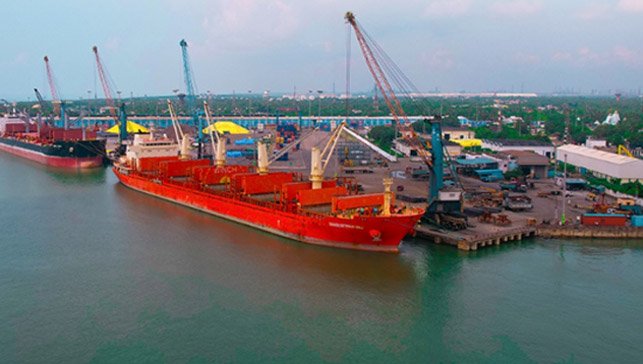
Paradip port India
Paradip, which is a busy bulker port, reported a fire as a ship was loading coal (Paradip Port Authority file photo)

Published Dec 2, 2025 4:31 PM by The Maritime Executive


Fire services responded quickly to reports of smoke billowing from a bulker that was loading in the Paradip, India, port over the weekend. They were able to successfully douse the fire without injuries to the crew, but it again raised questions about the handling of the dangerous cargo.

The Greek-owned bulker Eco Colonel, registered in Liberia, had arrived at Paradip on November 27. Over the weekend, the vessel was loading a cargo of nearly 30,000 metric tons of coal for shipment in India. According to the local media reports, smoke was observed coming from one of the vessel’s holds as the coal was being loaded by conveyor belt.

As the smoke grew thicker and more intense, the decision was made to move the vessel, which is 82,000 dwt and 229 meters (751 feet), to another berth within the port to gain better access to the hold. Fire crews began offloading and watering the coal. Port operations were also suspended.

The Paradip Fire Department at the port said that after about two hours, it believed the fire had been contained. They said it was safe to reopen the port. There was minor damage reported to both the vessel and the coal loading conveyor belt. 

The Eco Colonel, which was built in 2012, remains at the port as the investigation is ongoing. The authorities are thankful that a port worker quickly alerted the teams to the potential danger and that it could be controlled quickly. They have yet to confirm what caused the fire.

Media reports cite the high flammability of the coal and the danger of spontaneous combustion. Port officials are reportedly looking at the watering of the coal and whether there had been insufficient amounts of water sprayed before the loading. A lack of ventilation in the hold or in the stockpile could also have contributed to the fire.

The dangers of handling and shipping coal were demonstrated in August at the Port of Baltimore when an explosion tore a 30-ton hatch cover off a bulker. The vessel W Sapphire had completed loading and just departed the terminal when a massive explosion shook the ship, followed by a small fire. The force of the explosion hurled a portion of the number two hatch cover into the air and over the side of the ship. Luckily, no one was injured, and the local fire departments and Coast Guard were quickly able to stabilize the situation.


X-Press Pearl Compensation Dispute with Sri Lanka Intensifies
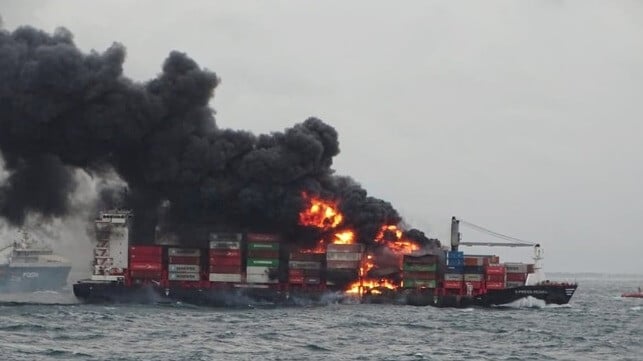
containership fire
X-Press Pearl burned for days before it sunk causing an environmental disaster while the authorities attempted to tow the hulk into deep water (Sri Lanka Ports Authority)

Published Dec 1, 2025 12:41 PM by The Maritime Executive


The London P&I Club, acting as assurer to the owners of the MV X-Press Pearl, is intensifying its approaches to the authorities in Sri Lanka over the compensation awarded to cover damage caused by the shipwreck of the vessel off Colombo.

The X-Press Pearl, a newly built containership with a capacity of 2,750 TEU, was owned by Singapore's X-Press Feeders. It was on a voyage eastward bound in May 2021 when at least one container began leaking onto the deck shortly after leaving Jebel Ali. The cargo is believed to have included 25 tons of Iranian-manufactured nitric acid, among multiple classes of other dangerous cargo. The master sought and was denied refuge first in Port Hamad, Qatar, and at its next scheduled port of call in Hazira, India, before sailing on to anchor off Colombo, Sri Lanka, its next scheduled port of call. Off Colombo, a fire broke in Number 2 Hold of the ship, but given the mix of dangerous cargo on board, it has still not been established exactly what the cause of the fire or where the seat of the fire was located. 

Reports assert that there were some delays in initially providing the ship with firefighting services and later in permitting the ship to be moved to deeper waters, by which time it was already sinking. The situation was unrecoverable by the time specialist firefighting and anti-pollution vessels and aircraft arrived on the scene, both from Sri Lanka and India. Acids, caustic soda, epoxy resin, plastic pellets, and bunker oil on board were either released or sank in containers when the ship went down, potentially creating a very large plastics spill. Officials indicate that 1,075 tons of debris have been collected from Sri Lankan beaches, along with dead turtles, whales, large numbers of fish, and at least six dolphins. But it is unclear whether what was recovered from the beaches was linked either directly or indirectly to the X-Press Pearl. As a precautionary measure, the Sri Lankan authorities halted local fishing due to fears of acid contamination and also to allow salvage operations to continue safely. 

In July 2025, Sri Lanka's Supreme Court ruled in favor of local fishermen in a human rights claim. The finding criticized both X-Press Feeders for not sharing information and the government for not responding effectively enough. Without hearing expert evidence on the quantum, the court set the value of the loss at an arbitrary figure $1 billion, to be paid by the owner as the polluter, with further sums to be calculated by a committee. 

X-Press Feeders have financed the clean-up efforts made so far, covering fisheries and beach clean-up, as well as salvage, wreck and debris removal. But, along with the London P&I Club, they have declined to make further payments, asserting that jurisdiction for environmental damage in this case lies in Singapore. Further, they contend that the cost calculations in other areas are largely based on theoretical estimates of damage using unapproved methodologies, which diverge from recorded evidence on the ground. They have referenced impartial technical advice issued by the International Tanker Owners Pollution Federation (ITOPF), which recommends internationally-accepted methodologies for assessing Oil Spill Damage, Nitrogen Added to Ocean, Human Health Air Pollution Impacts, Turtle Damage, Impacts on Whales, Microplastic Related Damages - Fisheries, Microplastic and Chemical Related Damages - Fish Consumers and Beach Users, Fisher Livelihoods, Incurred Costs and Future Monitoring.

The London P&I Club is now seeking the UK government's support to help with opening a dialogue with the Sri Lankan government, which is standing by its judiciary's finding, and is not responding to approaches. Neither the British nor the Sri Lankan government appears to be communicating with the other over the matter. 

James Bean, CEO of the London P&I Club told The Maritime Executive that the London P&I Club's position is that a negotiated settlement is in the best interests of the Sri Lankan government and the international maritime community. They report that they are working with X-Press Feeders to achieve a rules-based outcome compliant with the norms of international trade.

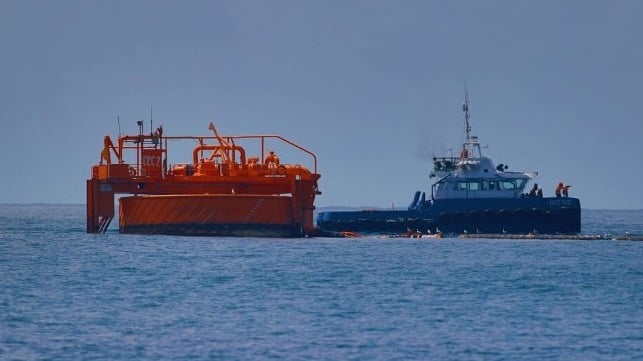
 The Caspian Pipeline Consortium (CPC) 

CPC Shuts Down Export Loadings After Attack on SPM Buoy

CPC SPM
File image courtesy CPC

Published Nov 30, 2025 7:43 PM by The Maritime Executive


The Caspian Pipeline Consortium (CPC) has ceased loading at its offshore terminal outside Novorossiysk after an apparent Ukrainian drone boat attack, its managers said in a statement Saturday. The news parallels a Ukrainian attack on two "shadow fleet" tankers in the Turkish sector of the Black Sea, and if accurate, it suggests an increasing willingness to target the Russian oil economy by all available means - even if that means attacking nominally neutral targets. 

CPC is co-owned by Chevron and Exxon, and it primarily transports Kazakh oil to market. Its main connection with Russia is geographic, as its pipeline crosses Russian soil en route to a terminal on a Russian coastline. Historically it has exported only a small quantity of Russian oil. However, it has been attacked before: CPC's operating headquarters in Novorossiysk, Russia were reportedly hit in a Ukrainian missile and drone strike in late September, and one of its pumping stations was attacked in February.  

This time, according to the consortium, a "targeted terrorist attack" took aim at the single-point moorings that are permanently anchored off the coast. These three SPMs handle about one percent of all global oil trade, and they could be attractive targets for a drone boat attack: stationary, isolated, far offshore, and of strategic importance. CPC's statement suggested that the strike caused "significant" damage to one SPM buoy. 

Ukraine has not claimed responsibility for the strike, but Kazakhstan has issued a warning to Kyiv to cease and desist attacks on "civilian" infrastructure. 

"The CPC pipeline system is an international energy project, and any forceful impact on its facilities creates direct risks for global energy security and causes substantial harm to the economic interests of the consortium’s participants," the Kazakh energy ministry said in a statement. "We regard this incident as an action detrimental to the bilateral relations between the Republic of Kazakhstan and Ukraine, and we expect the Ukrainian side to take concrete measures to prevent such incidents from recurring."

Ukraine has systematically targeted Russian petroleum export terminals in Novorossyisk and Tuapse over the past two months, leaving the CPC terminal as the last large oil export facility in operation on the Russian Black Sea Coast.

On Friday, Ukrainian forces struck and damaged two Russia-linked "shadow fleet" tankers in the southern Black Sea, disabling both and forcing the crews to abandon ship. No injuries were reported, but Turkish responders are working to prevent bunker fuel pollution from spreading. Whether by accident or by design, both vessels selected for targeting were in ballast at the time of the strike, reducing the potential for a catastrophic spill.  


Scrap Metal Fire in UK Highlights Growing Risk of Contaminated Cargoes

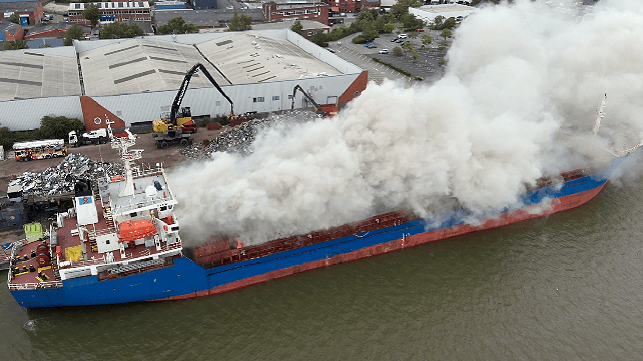
MAIB - scrap metal fire
Courtesy Humberside Fire & Rescue / MAIB

Published Nov 30, 2025 9:07 PM by The Maritime Executive


Scrap metal is among the most notorious cargoes for fire risk, not because of its inherent properties but because it is often contaminated with flammable debris and ready-made sources of ignition, like damaged lithium-ion batteries. A recent blaze at the port of Hull, UK illustrated the continuing danger to shipping, port facilities and public health from scrap-related fires. 

On June 27, 2025, the freighter Altay was alongside a scrap yard at Albert Dock in Hull, England to take on a cargo for export. At about 0945 hours, the master spotted smoke coming from the newly-loaded cargo in the hold. The captain sounded the general alarm to muster the crew for firefighting duty, and called on the shoreside stevedoring team to begin discharging the hold with a grab in order to help expose the seat of the fire. 

The crew responded quickly, and two fire teams were in place and ready within 10 minutes. Meanwhile, their crewmates cleaned out the rails on the coamings to make ready to close the hatches if needed. 

At about 1030 hours, shoreside fire teams arrived on scene and took over the job on board, allowing the crew to evacuate to the pier. The master and chief officer remained on scene to keep an eye on the vessel's stability as the shore teams added more water into the hold. The fire put out large quantities of noxious smoke, forcing the authorities to issue a shelter-in-place order to local residents and businesses. Two roads had to be closed to traffic and several businesses had to temporarily shut down because of risks related to air pollution. 

The blaze continued to burn until early in the morning of June 28. The accumulated firefighting water was deemed too dirty to discharge into the Albert Dock, so it was pumped off into tank trucks for specialized treatment. No injuries were reported, but the steel structure of the ship's after hold showed signs of fire damage; the ship had to wait for regulatory surveys, then departed to Turkey for shipyard repairs. The cargo stayed behind on the pier and was carefully scrutinized by investigators. 

In a preliminary conclusion released last week, MAIB found that the fire likely started from an undischarged battery (a common cause of scrap fires) or from another source of a spark. Once ignited, the agency asserted, there was enough flammable material present to sustain a fire. "The scrap cargo contained hazardous impurities, including batteries, oil drums, and oily residues, which posed a fire risk," MAIB reported.

According to MAIB, the scrapyard at Hull was in the practice of applying a visual check to incoming metal shipments that passed through its gates, but did not have a facility for sorting and screening to remove contaminants. Instead, the yard relied upon its suppliers to screen their own recyclables, and it classified the resulting mixed product as a Group C nonhazardous cargo - in short, a clean cargo, according to MAIB. 

Leading marine insurer Gard has noticed an unwanted trend of increasing risk of scrap metal fires, and has suggested that the Group C definition may need to be adjusted to account for current industry realities in the metal recycling trade. 

"It is . . . apparent from several serious scrap metal fires involving Group C declarations that the cargoes contained quantities of combustible and/or potentially hazardous foreign materials, such as batteries, rubber, plastics, wood, foam, oils/greases, gas bottles and rags," Gard recently observed. "In one accident report an experienced representative of the scrap facility highlighted to investigators the fire dangers associated with lithium-ion batteries and their increasingly prolific use: 'It’s becoming more of a problem every month, every year in our industry.'"


Japanese and Chinese Coast Guard Face Off in Disputed Island Chain

Japan Coast Guard
Japan and China cannot agree who expelled whom from the disputed islands after a showdown over a Japanese fishing boat (JCG file photo)

Published Dec 2, 2025 4:33 PM by The Maritime Executive


There was a new confrontation on Tuesday morning, December 2, as China continues its expansionist policies, claiming larger areas in the surrounding waters, but unlike other recent events, this one was with the Japanese. The two sides are telling different versions of the incident.

Japan and China have long been at odds over a small group of islands known by the Chinese as Diaoyu Islands, while the Japanese, who assert the administration of the area, refer to the islands as Senkaku. Similar to the disputed area with the Philippines, this group is a small area of just five uninhabited islands and three reefs. They sit just over 100 miles east of Taiwan and just over 250 miles to the west of Okinawa, Japan.

Tensions have long brewed over the region, which is reported to have oil and natural gas assets as well as rich fishing areas. The countries agreed nearly 20 years ago to jointly develop the resources of the area, but China has published new maps seeking to expand its region of control.

The long-simmering tensions, however, have increased over the past six weeks as Japan’s new prime minister, Sanae Takaichi, has vowed a strong response to the Chinese. In November, just days into her new role, she said Japan might have to militarily defend Taiwan from Chinese aggression.

The only thing the two sides agree on in today’s event is that there was a Japanese fishing boat in the area. The Japanese Coast Guard says it detected Chinese vessels on the so-called “rights-protection patrols.” China is reported to have four Coast Guard vessels on one of these patrols that began in mid-November.

The Japanese say they warned the Chinese Coast Guard not to approach the fishing boat. They report positioning between the Chinese vessels and the fishing boat and intercepting two China Coast Guard vessels. The Japanese report that they stayed with the fishing boat until the Chinese withdrew.

Official Chinese channels, however, are saying they expelled the Japanese fishing boat. They are claiming the Japanese fishing boat illegally entered China’s area and that they conducted a “rights-defending law enforcement operation.”  They assert that it is inherently Chinese territory and that they warned the Japanese to leave the area.

Japan claims China has increased the frequency of its presence in the area, conducting 350 trips around the islands last year. They report China had a presence around the islands for a total of 215 days. The previous patrol in July had also raised concerns with China saying it was acting to stop the illegal Japanese boats in the region.


Russia Reports Drone Attack on Tanker but Ukraine Denies Involvement

bridge damage
Damage to the tanker while sailing near Turkey

Published Dec 2, 2025 1:14 PM by The Maritime Executive


A small Russia-flagged product tanker was attacked early on Tuesday, December 2 sailing near the Turkish coast, with photos released showing minor damage. Ukraine was quick to say it was not involved and said the situation did not make sense, suggesting Russia might have staged the attack as propaganda.

Russia’s Federal Agency for Sea and Inland Water Transport (Rosmorrechfot) reported the attack to the TASS News Agency. Turkey’s Ministry of Transport and Infrastructure also said it had been advised of the attack, but that the vessel was not requesting assistance.

The ship was identified as the Midvolga-2 (6,573 dwt) and flying the Russian flag. Built in 2014, the ship is 140 meters (459 feet) in length with a crew of 13 aboard. The ship’s AIS signal has not broadcast in nearly two weeks since it was inbound to Ros-on-Don, Russia, on November 23. The report said it was transporting sunflower oil to Georgia.

Russia blamed the attack on a drone and reported damage to the superstructure but said the crew was unharmed. The hull was reported not to have been damaged, and the vessel was proceeding to Sinop, Turkey, under its own power. Photos were released showing damage to the bridge and debris reported to be from the drone. The ship was reported to have been 80 miles north of the Turkish coast.


A spokesperson for Ukraine’s Ministry of Foreign Affairs, Heorhii Tykhyi, posted messages on social media questioning the reports. He said Ukraine was not involved.

“We officially refute any allegations of such kind made by Russian propaganda. Furthermore, the alleged route from Russia to Georgia across Türkiye's EEZ makes no sense—and suggests that Russia may have staged the whole thing,” wrote Tykhyi.

The incident came after Ukraine took credit for attacks last week on two crude oil tankers in the Black Sea. It was believed to be part of a wider effort to impact Russia’s oil industry and to apply pressure as a new round of peace negotiations is underway.

Turkish President Recep Tayyip Erdo?an on Monday called the escalation “worrying.”  In a broadcast speech, he said, “We cannot condone these attacks, which threaten navigational safety, life, and the environment, especially in our own exclusive zone. We are issuing the necessary warnings to all parties regarding such situations.”

The Middle Volga Shipping Company, which operates the vessel in the past, has been linked to the Russian oil industry. Ukraine has sanctioned the company for its involvement in Russian exports.


Source: TRANSCEND with Cylvia Hayes

The global economy is broken and brutal. This is clearly evident in the United States. Unless you are born into some level of wealth it is extremely difficult to climb into a higher economic class. Economic mobility is determined more by a person’s zip code than merit and hard work. Estimates suggest between 52 and 67 percent of Americans are living paycheck to paycheck with little or no savings. For low-income people working full-time and often multiple jobs there is not enough space in a day to “work harder” to improve their situation. They are literally doing all they can just to meet basic needs. I know this because I’ve lived it.

The official U.S. poverty rate was listed as 10.6% in 2024, representing 35.9 million people. But in reality that number is ridiculous and highly misleading. Federal poverty rates are based on guidelines by the US Department of Health and Human Services (HHS) to determine eligibility for various federal programs. The current official poverty income line is $15,650 per year for a single person and just $32,150 for a family of four which means one must be utterly impoverished to qualify for government benefits. Can any person really make it through a year in the United States with income of $15,651 per year? Can a family of four do so on $32,151?

How much it truly costs to make ends meet varies by state, but estimates suggest the average for a family of four in 2022 was approximately $104,000 annually before taxes. For a single adult with no children, the estimated annual income needed is between $40,415 and $62,233 depending upon the state. Unlike the federal poverty rate the living wage includes the cost of transportation and childcare along with the basic food and housing.

On top of a plague of low wage jobs, another brutality is that the United States is the only industrialized nation without a universal health care system. One result is that a health crisis and medical debt is now the leading cause of bankruptcy. Due to high costs of service uninsured people often put off necessary treatment until the problem becomes so bad they wind up in the emergency room, which is the costliest form of health care. Many suffer chronically poor health due to lack of preventative care. This is only going to get worse as republicans remove subsidies for coverage under the Affordable Care Act.

On the other end of the spectrum, the current form of capitalism has led to a billionaire class that consumes resources at a mind-blowing rate and has taken control of our society through ownership of the internet, social media, corporate media, and elected officials.

A typical campaign for a seat in the U.S. House of Representatives costs over $2 million for a first-time position and over $8 million for an incumbent running for reelection. A senate reelection campaign costs over $11 million. Presidential campaigns now run into the billions (yes with a b) of dollars. According to Open Secrets the biggest chunk of campaign money for congressional races for both democrats and republicans is now individual large donors. In 2024, uber-wealthy individuals provided 46.6% of campaign funds for democratic house of representative campaigns, 36.3% for house republican races, 52.4% for senate democrat races, and 41.2% of funding for senate republican campaigns. These numbers dwarf the amounts contributed by combined smaller donors and even political action committees (PACs).* This means a tiny minority of people have massive influence over elected officials and the shaping of policy.

In addition to wielding enormous power over our political and communications systems the US’s super-rich are burning through natural resources and spewing climate change emissions at 4,000 times the speed of the world’s poorest 10%. These billionaires and multimillionaires, who comprise the wealthiest 0.1% of the US population, emit an average of 2.2 tons of CO2 every day, equivalent to the weight of a rhinoceros or an SUV. A study, conducted by Oxfam, found that 308 of the world’s billionaires had a combined CO2 tally that, if they were a country, would make them the 15th most polluting country in the world. The report also found that almost 60% of billionaire investments are in “high climate-impact sectors”, such as mining or oil and gas companies.

Our current capitalist system is structured so that millions of us are overworked and stressed about how we’ll pay for rent or groceries while a tiny, privileged few own private jets, build rockets for amusement, and buy elections. It’s a system that is also stripping our planet of forests, clean water, and wildlife in the name of economic growth (here’s a piece I wrote about this).

The U.S. claims to be the richest country in the history of the world, but the lived reality on the ground for most Americans does not portray a strong or great nation.

I have advocated for economic system change my entire career, now spanning four decades. I’ve promoted the idea of evolving past a system that chews up the planet and keeps people trapped in poverty. I cannot tell you how many times I have been criticized, even belittled for being anti-capitalism. The idea of capitalism as the only acceptable economic system has been deeply baked into American culture. Now, forty years into this work I sense a shift.

Over the past few months several mainstream media programs have started discussing, even tentatively questioning, capitalism. No doubt part of this has been driven by the unexpected success of Zohran Mamdani’s candidacy for mayor of New York. Mamdani is an outspoken Democratic Socialist. His ideas for a more communal and caring economic system have lit a fire, especially in younger voters. I believe Mamdani’s historic landslide victory was a strong statement by those of us who know the entire underlying status quo economic and political systems are failing us.

Recently on two separate occasions I found myself in conversation with Millennials. One was a young dental hygienist. In a moment when the mirrors, scrapers and fingers weren’t in my mouth I asked her how she got into dental hygiene. She explained that she had gone to college to be a journalist but changed direction when she realized how little fact-checking was taking place and how difficult it was to make a good income. She explained that she’d come out of college with significant school loan debt and decided to get into a field that would pay better. She said she was lucky because her partner was Irish and had dual citizenship. College is free in Ireland, and her partner had come out with a degree in engineering and no debt. He immediately got a good-paying job and was helping her with expenses as she paid down her school loans. She noted they were planning not to have children because they didn’t believe they’d be able to afford it.

A few weeks later I was having my car serviced at the Toyota shop. The young rep who was checking me in for my appointment noted that my car was a hybrid. He said, “You know they’re telling us we’ll all be in electric vehicles, but they know people like me will never be able to afford one. Plus, there isn’t enough lithium to make that many EVs. I think the rich people who control everything are trying to set it up so most of won’t be able to drive at all.” A little stunned I said, “Yeah it’s a broken system and a corporatocracy to be sure.” He said, “Yeah, and they don’t care. They’ll trash this planet and then what? Colonize Mars or something?” My heart went out to him when next he said, “I don’t want to wake up every morning in the dark and go out and break rocks.” He gestured to the beautiful Cascade mountains beyond the tall windows in the showroom and said, “I don’t want to live where I’ll never see another Earth sunset.”

This kind of angst, and contraction of dreams is widespread given the harshness of the current economic system which is now structured to make the rich richer and keep everyone else struggling to make ends meet.

As I write, the U.S. government is in partial shutdown with millions of federal employees going without paychecks (even while still going to work) and funds frozen for the Supplemental Nutrition Assistance Program (SNAP) low-income food assistance program. Approximately 42 million Americans rely on SNAP to get enough to eat. Many of these people work low-income jobs. In fact, studies show that 89% of SNAP households with at least one working age, non-disabled adult were in the workforce. Approximately 70% of those worked full-time.

The country is fixated on how to end the congressional budget stand-off and get SNAP benefits moving again to those who need them. But the deeper question should be why do we allow businesses to pay such low wages that even full-time employees need food stamps? SNAP is often framed as a hand-out to the lazy and undeserving, but the truth is SNAP is corporate welfare.

When people working full-time earn so little they qualify for SNAP, Medicaid, and TANF taxpayers are literally giving a handout to corporations. Employers can keep full-time employees on very low wages and no benefits and therefore maximize their own profits. What started out as programs to help the unemployed or disabled people have, in this corporatocracy, turned into billion-dollar subsidies for morbidly rich employers and massive corporations.

In my career in the New Economy movement, I’ve been ridiculed for being anti-capitalist and accused of being socialist. In truth I am neither. I am opposed to the current version of capitalism that chews up people and planet and I do think there are aspects of socialism that are beneficial. In fact, the U.S. is already partially socialist with programs like Social Security and Medicare. However, I don’t think we have yet created an economic system that is suited for our times. Whatever we wind up calling it, I am for an economy that is based on environment and resource restoration rather than extraction and consumption, measures success through the wellbeing of society rather just the size of the GDP and provides genuine opportunity for people to have basic financial security and live meaning-filled lives.

I’m encouraged by the growing frustration among Millennials and so many of the rest of us. I’m encouraged that people like young Zohran Mamdani and old Bernie Sanders (both democratic socialists who challenge the current economic system) are packing stadiums around the country. The frustration is reaching critical mass, and it will drive change. The question is what type, and direction, of change? Within that question tremendous opportunity bubbles, and now we must find the will and the way to alchemize it into a world that works better for all beings.

Cylvia Hayes is a unity minister, motivational speaker, author, and economic system change expert. She is committed to raising consciousness and redesigning civilization so all creation can thrive.


Trump is Attracting Investment to the US – but at a Huge Cost to Workers and the Environment

Source: The Conversation

Early in his second presidency, Donald Trump’s imposition of tariffs was met with widespread scepticism. Critics warned of economic decline and a global backlash. Yet the current landscape for the United States paints a more complex picture.

Less than a year into his second term in office, the White House claims that Trump is bringing manufacturing back to the US. It also proclaims that Trump has secured trillions of dollars of foreign direct investment (FDI) in 2025 alone. Other voices, however, estimate that these commitments will amount to just a fraction of that.

So what’s the true picture? Much of this FDI is going into the US’s burgeoning semiconductor sector. This inward investment is indeed a stark reversal from the post-1991 trend of outbound American capital, when US firms raced to set up factories in countries where it was cheaper to manufacture.

And the surge is bolstered by commitments of US$300 billion (£225 billion) in capital investment commitments from tech giants like Amazon, Microsoft, Alphabet and Meta. These investments reflect both Trump’s aggressive diplomacy and his close relationship with Silicon Valley’s tech elite.

Despite concerns about a tech bubble, these investments signal a deepening state-private partnership, and a reorientation of priorities with a view to coming out on top in the global AI race.

Central to this strategy is the reshaping of global supply chains. At a conference of venture capitalists in March, US vice-president J.D. Vance criticised US firms for their reliance on cheap overseas labour. He warned of the risks of losing the US’s technological advantage, especially to China.

The solution, Vance and Trump argue, is to bring investments and jobs back home. But does this logic – backed by massive domestic and foreign investment – translate into the kind of reshoring (when operations that were previously moved abroad transfer back to the country) that delivers good jobs?

In our new book Capitalist Value Chains, Christin Bernhold and I argue that global supply chains have made labour exploitation and environmental degradation worse. Efforts by both former president Joe Biden and Trump to contain China’s rise reflect not a retreat from globalisation, but a strategic reconfiguration of supply chains.

In the early days of globalisation, American administrations supported China’s rise as the workshop of the world and an exporter of low-cost consumer goods to the US. But over the last 15 years, the US has increased efforts to contain China’s technological rise, while continuing to rely on its cheap imports.

Trump’s tariffs on China represent a step change. The US’s strategy now seems to have shifted from slowing China’s advance to attempts to inflict severe economic damage on the Chinese economy in order to reduce it to a subordinate, rather than rival, trading partner.

So will these investments create quality employment? And what are the environmental consequences? The likely answers are probably not, and probably terrible.

Reshoring doesn’t mean abandoning global supply chains. Recently, Trump threatened sweeping tariffs on China in response to its restrictions on rare earth exports. Western industries – especially automotive and defence – warned that this escalation could break supply chains. US chip-dependent sectors such as electronics, defence and telecoms still rely heavily on Chinese rare earths.

Even if the US succeeds in reshaping supply chains, it doesn’t guarantee the creation of good jobs. Despite Trump’s pro-labour rhetoric, his administration’s actions tell a different story.

In March 2025, Elon Musk’s Department of Government Efficiency laid off 216,000 federal workers. Collective bargaining rights were stripped from 400,000 employees across agencies like Veterans Affairs, the Environmental Protection Agency and the Transportation Security Administration. The White House also revoked the US$15 per hour minimum wage requirement for publicly-funded businesses.

Pain for US workers

Traditional sectors are suffering. Since April, machinery giant John Deere has cut more than 2,000 jobs, citing cost increases blamed on Trump’s tariffs. The big three carmakers – Ford, GM and Stellantis – claim that tariffs will cost them US$7 billion in lost earnings in 2025, with severe consequences for pay and jobs.

Will the tech sector’s massive capital spends offset these losses? Most of the US$300 billion pledged by firms like Apple and Amazon is earmarked for AI infrastructure: high-powered data centres, custom chips, graphics processing units and cloud networks.

These are capital-intensive projects that generate short-term construction jobs but offer little in the way of long-term employment.

Simultaneously, tech companies are downsizing as they substitute AI for human labourMicrosoft announced layoffs of 6,000 and 9,000 employees from its 228,000-strong global labour force in May and July 2025, including 800 in Washington, Microsoft’s home state.

And what about the quality of the remaining jobs? At Amazon, for example, the company’s software engineers have described how it is using AI to cut jobs and speed up work. According to reports, tasks that previously took weeks are now expected to be completed in days. One engineer told journalists that his team was halved in size, but is expected to produce the same amount of code, using AI tools.

The environmental costs of AI are mounting. Researchers have found that data centres already consume 4.4% of the US’s electricity. By 2028, AI could require as much power as 22% of American households use annually.

This surge in demand, combined with federal budget cuts to green energy initiatives, is diverting renewable energy away from broader decarbonisation efforts such as hydrogen tech projects, battery plants and upgrades to the electric grid.

These figures are only set to rise if the surge continues. According to the International Energy Agency, fossil fuels – particularly coal and natural gas – are expected to supply more than 40% of the additional electricity needed by data centres until 2030.

Trump’s push towards AI, coupled with his tariff regime and alliance with Silicon Valley’s elite, may reshape the economy and global supply chains – but not in favour of workers or the planet. The promise of revitalised manufacturing and job creation masks deeper risks: automation, weakened labour protections and escalating environmental harm.