China Launches Largest Car Carrier for HMM-Hyundai Glovis Partnership
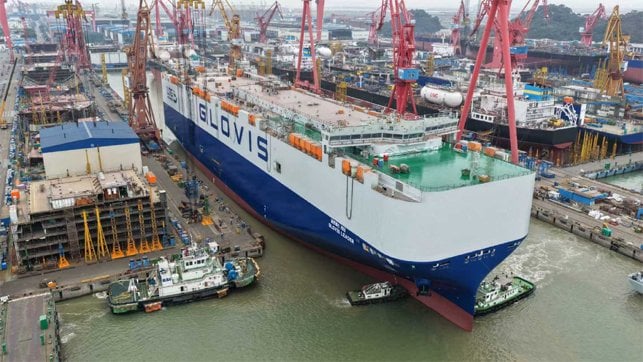
China’s Guangzhou Shipyard International last week floated out the largest car carrier in the world. The massive vessel surpasses the 10,000 unit mark, becoming the largest built in China after the yards turned out 9,500 unit vessels last year as part of the coming surge in the sector.
The new vessel is also the first vehicle carrier built for South Korea’s HMM as part of its diversification strategy. HMM entered into long-term agreements with Hyundai Glovis, which will operate the vessels.
Each of the new ships will have a capacity of 10,500 ceu, which will, for a time, give them the title of world’s largest. Wallenius Wilhelmsen, however, in 2024 reproted it was upsizing vessels in its newest class. Due to enter service starting in 2027, the last four vessels of a 12-ship class will increase capacity by 25 percent, handling approximately 11,700 vehicles, making them the largest PCTCs ever to sail.
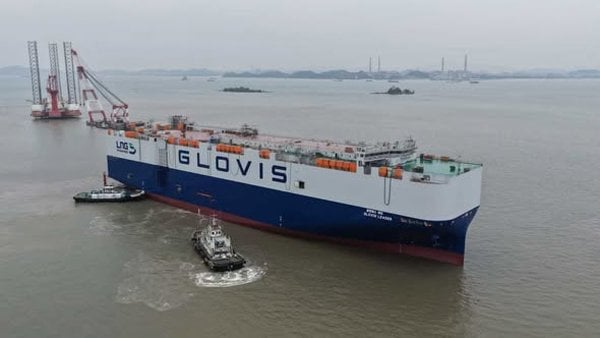
The vessels being built for HMM-Hyundai Glovis are 230 meters (755 feet) in length with a total of 14 car decks, including five movable decks. The ships also employ dual-fuel engines from MAN that will be able to use LNG or oil.
No delivery date was announced for the new ship, which is named Glovis Leader. However, the yard said many of the ramps are already in place and that the anti-slip coating on the ramps has been completed below deck 5A.
According to the builders, the ships have been specially designed to handle diverse cargo. They can accommodate both electric vehicles and hydrogen fuel cells, plus are capable of transporting heavy trucks.
The new ships are part of a surge in orders placed a few years ago in anticipation of rapid growth in the vehicle export markets. Construction orders have slowed more recently, and now analysts are questioning the markets as the U.S. and Europe have moved to put steep tariffs on Chinese cars accusing them of price dumping strategies to dominate the new vehicle markets.
India’s First Chemical Tanker Order Advances Shipbuilding Ambitions
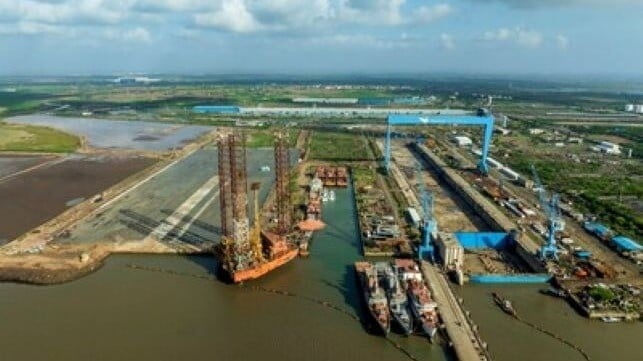
Swan Defence and Heavy Industries Limited (SDHI), located in India, confirmed that it has received its first shipbuilding order as part of the revitalization of its operations. The order, which comes from a European shipowner, is both the country’s first for a chemical tanker and aligns with India’s ambitions to develop into a leading global shipbuilder.
The order was placed by Bergen, Norway-based Rederiet Stenersen, a 50-plus year old operator of chemical/product tankers. The company currently has a fleet of 19 vessels, all equipped to operate in the harsh conditions of the North Europe trade. The order, which is valued at $227 million, is the company’s first foray into Indian shipbuilding, and they note that it was placed after a comprehensive technical and commercial evaluation. A Letter of Intent was signed in November 2025.
The order is for six tankers, each 18,000 dwt and approximately 150 meters (492 feet) in length. The first vessel is due for delivery in 33 months, and the company has an option for six additional vessels after the first group.
The vessels will be designed by Marinform AS and StoGda Ship Design & Engineering and classed by DNV. Built to Ice Class 1A standards, the tankers will feature advanced dual-fuel LNG-ready hybrid propulsion, enabling multiple operational modes supported by high levels of automation.
Swan Defence and Heavy Industries Limited (SDHI), formerly Reliance Naval and Engineering Limited, was acquired and restarted in 2024 after the bankruptcy of the prior owners. The company aspires to be a large, world-class builder of commercial vessels and other projects, including heavy fabrication. They note the revitalized SDHI shipyard, which is located in Pipavav, Gujarat, on India’s west coast, operates the country’s largest dry dock (662 meters by 65 meters) and has a fabrication capacity of 164,000 tonnes per year.
The company’s director, Vivek Merchant, highlighted that the order is a demonstration of India’s growing commercial shipbuilding ecosystem. The government of Prime Minister Narendra Modi is taking steps to realize the Prime Minister’s call for India to become a top 10 global shipbuilding nation by 2030 and a top five shipbuilder by 2047.
The government outlined its Shipbuilding Financial Assistance Scheme as part of the effort to support the industry and attract international interest. The program was amended just days ago to include product/chemical tankers.
The tanker order follows the announcement that CMA CGM intends to build containerships in India. The government and industry have also been courting other major companies, including Maersk and MSC.
Russia Cuts Funding to Build River-Sea Cargo Ships Citing Sanctions
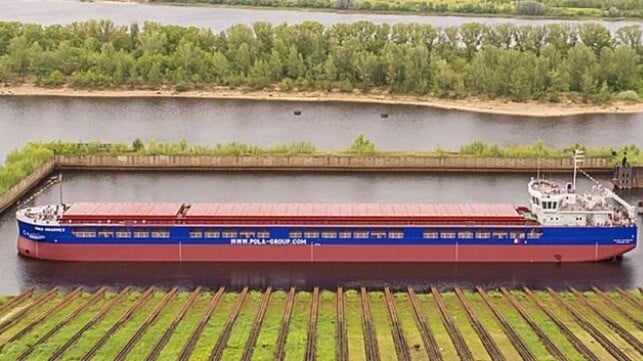
Reports from Russia indicate that an ambitious program to build a new generation of river-sea cargo ships has been reduced. The Moscow Times cites the impact of high interest rates, import substitution, sanctions, and labor shortages for cuts to the government-subsidized shipbuilding program.
The contract for the construction program was awarded in June 2023 and called for 34 RSD 59 dry cargo ships as part of an effort to modernize the Volga-Donmax service. The Krasnoye Sormovo Shipyard hailed it as the largest series in the history of JSC United Shipbuilding Corporation. The government was slated to provide most of the financing for the construction in a partnership with lender GTLK.
The Russian media outlet Vedomosti reports the budget was revised in December 2025 for a total of 18 ships, with the government providing a reduced funding of approximately $300 million. The reports said the cost per ship has risen from $16.4 million to nearly $22 million.
The Western sanctions, which included elements targeting the Russian shipbuilding industry, limit the imports of Western-made equipment. Russia’s industry has been working to substitute domestically made elements.
The shipyard said it had begun work on the new ships in September 2024, after having delivered five RSD 59 vessels in a previous series. In November 2024, it reported the keel laying for sections of the new ships, but The Moscow Times says no ships were delivered in 2024, and the project is behind schedule.
The shipyard had said it expected investments in 2025 to increase its capacity. It was targeted to be able to build up to 20 dry cargo ships per year. Delivery of the ships has been delayed to now run till 2028.
The RSD 59 class are vessels 141 meters (462 feet) in length designed to carry general and bulk cargo. This includes grain, coal, lumber, timber, scrap metal, metal products, and oversized cargo.
The Russian government had outlined in May 2025 an ambitious program to expand commercial shipbuilding. It committed to investing more than $6 billion to expand and modernize commercial shipbuilding in Russia. Reports said it was to counter the Western sanctions.

No comments:
Post a Comment