Friday, December 05, 2025

Outrage Grows as Trump Admin Quietly Weighs New ‘Tax Windfall for the Biggest Corporations’

“Apparently the Trump administration thinks the trillions they spent on tax cuts for the wealthy wasn’t enough.”


US Treasury Secretary Scott Bessent listens as President Donald Trump speaks to members of the media aboard Air Force One on October 27, 2025.
(Photo by Andrew Harnik/Getty Images)

Jake Johnson
Dec 05, 2025

The Trump administration’s quiet effort to deliver billions more in tax breaks to some of the largest companies in the United States drew fresh scrutiny and outrage this week, with Democratic members of Congress warning that a series of obscure regulatory changes could further undermine efforts to rein in corporate tax dodging.

In a letter to the US Treasury Department unveiled Thursday, Sen. Elizabeth Warren (D-Mass.) and Rep. Don Beyer (D-Va.) led a group of lawmakers in denouncing the Trump administration’s assault on the corporate alternative minimum tax (CAMT), a Biden-era measure that requires highly profitable US corporations to pay a tax of at least 15% on their book profits—the numbers reported to shareholders.

“The Trump administration has consistently chipped away at CAMT to further corporate interests,” the lawmakers wrote, pointing to rules issued in recent months exempting many corporations from the tax.

“But these massive giveaways apparently aren’t enough for billionaire corporations and their lobbyists, which are trying to further undermine CAMT,” the lawmakers continued.

The Democratic lawmakers, who were joined by Sen. Bernie Sanders (I-Vt.), specifically warned against an ongoing corporate push for a carveout to a research and experimentation (R&E) tax break included in the Trump-GOP budget law enacted over the summer.

Corporations supported the R&E tax break. But as the Wall Street Journal reported last month, the giveaway is driving some companies’ “regular taxes down so far that they are pushed into CAMT.”

“This is exactly what CAMT was designed to do, the tax’s defenders say,” the Journal noted. “Companies are pressing the Treasury Department for relief, particularly on the way that CAMT limits the deduction for research expenses. The National Association of Manufacturers, the R&D Coalition, and the National Foreign Trade Council sent letters urging the administration to write rules that would be favorable to companies.”

The Treasury Department and Internal Revenue Service are reportedly considering the corporate proposal.

Such a change, Democratic lawmakers warned in their new letter, “egregiously circumvents Congress’ intent to set a floor on corporations’ tax liabilities regardless of deductions.”

But the Trump administration’s hostility to the CAMT, cozy relationship with powerful corporations, and willingness to trample existing law have fueled concerns that it will readily bow to industry demands.

“Apparently the Trump administration thinks the trillions they spent on tax cuts for the wealthy wasn’t enough now they’re planning another huge tax windfall for the biggest corporations in the country,” Beyer said Thursday.

In a social media post, Warren wrote that “giant corporations are lobbying Donald Trump for yet another tax handout—this time for research they’ve ALREADY DONE.”

“Give me a break,” Warren added. “The last thing American families need is a tax code rigged even more for billionaires and billionaire corporations.”
Blistering dissent warns of 'serious consequences' as Supreme Court allows Texas maps

Robert Davis
December 4, 2025 
RAW STORY


Supreme Court Associate Justices Amy Coney Barrett and Elena Kagan arrive ahead of the state funeral services for former President Jimmy Carter at the National Cathedral on January 9, 2025 in Washington, D.C. Ricky Carioti/Pool via REUTERS

Three Supreme Court justices issued a blistering dissent on Thursday to yet another unsigned order from the high court.

The Supreme Court ruled on Thursday that Texas can use the new election map its Republican-controlled legislature drew during a special session during the 2026 midterm. The new map is designed to eliminate five Democrat-controlled districts, but a lower court ruled that the map was a racial gerrymander, which violates the 14th and 15th Amendments of the Constitution.

Justices Elena Kagan, Sonia Sotomayor, and Ketanji Brown Jackson issued a scathing dissent that argued the court had "lost sight of its purpose."

"And this Court’s eagerness to playact a district court here has serious consequences," Kagan wrote. "The majority calls its 'evaluation' of this case 'preliminary.' The results, though, will be anything but."

"This Court’s stay guarantees that Texas’s new map, with all its enhanced partisan advantage, will govern next year’s elections for the House of Representatives," she continued. "And this Court’s stay ensures that many Texas citizens, for no good reason, will be placed in electoral districts because of their race. And that result, as this Court has pronounced year in and year out, is a violation of the Constitution."

Read the entire dissent by clicking here.


‘MAGA Power Grab’: US Supreme Court OKs 2026 Map That Texas GOP Rigged for Trump

One journalist who covers voting rights called the decision upholding the new districts “yet another example” of how the high court “has greenlit the many undemocratic schemes of Trump and his party.”


People join a “Stop the Trump Takeover” demonstration outside the Texas State Capitol in Austin on August 16, 2025.
(Photo by Brandon Bell/Getty Images)


Jessica Corbett
Dec 04, 2025
COMMON DREAMS

The US Supreme Court’s right-wing supermajority on Thursday gave Texas Republicans a green light to use a political map redrawn at the request of President Donald Trump to help the GOP retain control of Congress in the 2026 midterm elections.

Since Texas lawmakers passed and GOP Gov. Greg Abbott signed the gerrymandering bill in August, Democratic California Gov. Gavin Newsom and his constituents have responded with updated congressional districts to benefit Democrats, while Republican legislators in IndianaMissouri, and North Carolina—under pressure from the president—have pursued new maps for their states.

With Texas’ candidate filing period set to close next week, a majority of justices on Thursday blocked a previous decision from two of three US district court judges who had ruled against the state map. The decision means that, at least for now, the state can move ahead with the new map, which could ultimately net Republicans five more seats, for its March primary elections.

“Texas is likely to succeed on the merits of its claim that the district court committed at least two serious errors,” the Supreme Court’s majority wrote. “First, the district court failed to honor the presumption of legislative good faith by construing ambiguous direct and circumstantial evidence against the Legislature.”

“Second, the district court failed to draw a dispositive or near-dispositive adverse inference against respondents even though they did not produce a viable alternative map that met the state’s avowedly partisan goals,” the majority continued. “The district court improperly inserted itself into an active primary campaign, causing much confusion and upsetting the delicate federal-state balance in elections.”


The court’s three liberals—Justices Ketanji Brown Jackson, Elena Kagan, and Sonia Sotomayor—dissented. Contrasting the three-month process that led to the map initially being struck down and the majority’s move to reverse “that judgment based on its perusal, over a holiday weekend, of a cold paper record,” Kagan wrote for the trio that “we are a higher court than the district court, but we are not a better one when it comes to making such a fact-based decision.”

“Today’s order disrespects the work of a district court that did everything one could ask to carry out its charge—that put aside every consideration except getting the issue before it right,” Kagan asserted. “And today’s order disserves the millions of Texans whom the district court found were assigned to their new districts based on their race.”

“This court’s stay guarantees that Texas’ new map, with all its enhanced partisan advantage, will govern next year’s elections for the House of Representatives. And this court’s stay ensures that many Texas citizens, for no good reason, will be placed in electoral districts because of their race,” she warned. “And that result, as this court has pronounced year in and year out, is a violation of the Constitution.”


Top Democrats in the state and country swiftly condemned the court’s majority. Democratic National Committee Chair Ken Martin called it “wrong—both morally and legally,” and argued that “once again, the Supreme Court gave Trump exactly what he wanted: a rigged map to help Republicans avoid accountability in the midterms for turning their backs on the American people.”

“But it will backfire,” Martin predicted. “Texas Democrats fought every step of the way against these unlawful, rigged congressional maps and sparked a national movement. Democrats are fighting back, responding in kind to even the playing field across the country. Republicans are about to be taught one valuable lesson: Don’t mess with Texas voters.”

Texas House Minority Leader Gene Wu (D-137) declared that “the Supreme Court failed Texas voters today, and they failed American democracy. This is what the end of the Voting Rights Act looks like: courts that won’t protect minority communities even when the evidence is staring them in the face.”

“I’m angry about this ruling. Every Texan who testified against these maps should be angry. Every community that fought for generations to build political power and watched Republicans try to gerrymander it away should be angry. But anger without action is just noise, and Democrats are taking action to fight back,” he continued, pointing to California’s passage of Proposition 50 and organizing in other states, including Illinois, New York, and Virginia. “A nationwide movement is being built that says if Republicans want to play this game, Democrats will play it better.”


Christina Harvey, executive director of the progressive advocacy group Stand Up America, said in a statement that “the right-wing majority on the Supreme Court just handed Republicans five new seats in Congress, rubber-stamping Texas Republicans’ MAGA power grab. Make no mistake: This isn’t about fair representation for Texans. It is about sidelining voters of color and helping Trump and Republican politicians dodge accountability for their unpopular agenda.”

“In America, voters get to choose their representatives, not the other way around,” she stressed. “But this captured court undermines this basic democratic principle at every turn. We deserve a Supreme Court that protects the freedom to vote and strengthens democracy instead of enabling partisan politics. It’s time for Democrats in Congress to get serious about plans for Supreme Court reform once Trump leaves office, including term limits, an enforceable code of ethics, and expanding the court.”

Various journalists and political observers also suggested that, despite Thursday’s decision in favor of politically motivated mid-decade redistricting, the high court’s right-wing majority may ultimately rule against the California map—which, if allowed to stand, could cancel out the impact of Texas gerrymandering by likely erasing five Republican districts.

Scandal-mired Republican illegally shipped arms to foreign govs while in Congress: report


Matthew Chapman
December 4, 2025  
RAW STORY


Rep. Cory Mills (R-FL). (Photo credit: Gage Skidmore)

A scandal-plagued Republican congressman was illegally running an arms-export business to foreign countries while serving in the House of Representatives, reporter Roger Sollenberger revealed in an investigative Substack post — and his company to do so was run into the ground and is now in foreclosure.

Rep. Cory Mills (R-FL) has faced a series of other allegations and controversies this year, including a physical abuse claim from a woman he was involved with; an eviction from his Washington, D.C. penthouse after defaulting on $85,000 in rent; an ongoing Congressional ethics investigation into unprofessional conduct, stolen valor, and failure to disclose gifts; and accusations he hired sex workers during a 2021 trip to Afghanistan.

This new controversy involves PACEM, a security contracting company that Mills and his wife co-founded in 2014.

Congressional inquiry into Mills involves "roughly $2 million in 'personal loans' Mills gave his 2022 congressional campaign," noted Sollenberger. "But according to legal experts and a review of court records, campaign filings, and personal and corporate financial statements, those 'personal' funds appear more likely tied to a different source: tens of millions of dollars in corporate loans Mills secured from a foreign lender to bail out his moribund weapons dealing business."

"The amount of PACEM’s debt is existential. Today, PACEM owes a whopping $66 million, according to recent court filings. That’s anywhere between six and 33 times what Mills’s disclosures say the company is worth," wrote Sollenberger. Making matters worse, Mills, who serves on the House Armed Services and Foreign Affairs Committees, has never disclosed any of this debt on his ethics forms, despite the fact that since 2019, he has been personally liable for the debt, requiring it to be disclosed.

Over the summer, Ninepoint Partners, a Canadian asset management firm that serves as PACEM's lender, terminated their debt fund and moved to foreclose on PACEM's factory.

Even further complicating all this, PACEM was not just a federal contractor but also exporting arms to foreign governments, including Ukraine, as it fights to defend itself from Russian invasion. "Legal and industry experts, citing federal statutes, told me that, as with PACEM’s government contracts, Mills’s ownership means those exports are likely illegal in the first place," said the report.

Sollenberger, who has conducted a nine-month investigation into Mills, has promised more revelations about the embattled congressman are coming.
Lawmaker lobs big accusation at Pete Hegseth over refusal to have his phone inspected

Tom Boggioni
December 4, 2025
RAW STORY


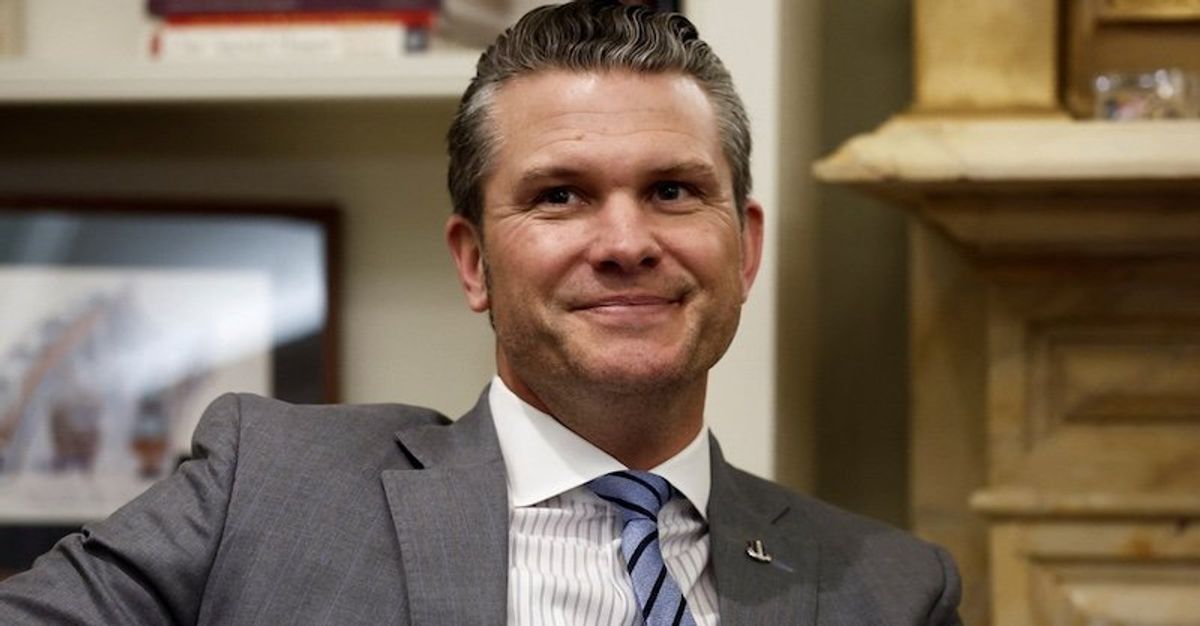
Pete Hegseth (Reuters)

Asked to respond to a report from the Defense Department inspector General that accused Pentagon Chief Pete Hegseth acted with reckless disregard and endangered U.S. troops, Rep. Suhas Subramanyam (D-VA) raised the prospect that the former Fox News personality is still breaking the law.

Speaking with MS NOW host Anna Cabrera, the Democratic lawmaker expressed disgust at the findings that demonstrated the Donald Trump appointee used a personal device to share sensitive attack details not long after he was confirmed by the Senate.

He specifically raised objections to the report notation that the embattled Defense Department head refused to turn over his phone as part of the investigation.


“If anyone else in the military had done this, they would have been fired. And let's remember, it clearly says he put troops at risk, the men and women in uniform at risk,” he told the host.

“And the second thing, and something that your team was alluding to before, I don't think this has been corrected. I don't even know if they're still using Signal or not,” he accused. “That could be true because they did not cooperate with the IG in any way.”

“He didn't hand over his phone,” he pointed out. “The DOD was — they recommended that the DOD put in place a program where they're checking whether everyone's doing this and checking whether this is being fixed. And they ignored that part. They didn't do a system-wide sort of assessment of trying to fix this problem. So for all we know, he could still be using Signal. And I think he probably is, to be honest.”


Tough guy Hegseth shows off his warrior ethos

Nick Anderson. Raw Story
December 4, 2025 


Nick Anderson is a Pulitzer Prize-winning editorial cartoonist.
Demands to Release Full Video of Deadly US Boat Strike Grow After Congressional Briefing

“The Department of Defense has no choice but to release the complete, unedited footage,” said Sen. Jack Reed.


US Sen. Jack Reed (D-RI) speaks with reporters in the US Capitol in Washington, DC on December 2, 2025.
(Photo by Tom Williams/CQ Roll Call, Inc. via Getty Images)


Brett Wilkins
Dec 04, 2025
COMMON DREAMS


Calls mounted Thursday for the Trump administration to release the full video of a September US airstrike on a boat allegedly transporting drugs in the Caribbean Sea following a briefing between Pentagon officials and select lawmakers that left some Democrats with more questions than answers.

“I am deeply disturbed by what I saw this morning,” Sen. Jack Reed (D-RI), the ranking member of the Senate Armed Services Committee, said after the briefing.“The Department of Defense has no choice but to release the complete, unedited footage of the September 2 strike, as the president has agreed to do.”


Hegseth Says 6 More Men Killed in Latest Boat Bombings

Reed’s remarks came after Adm. Frank Bradley and Joint Chiefs of Staff Chair Gen. Dan Caine briefed some members of the Senate and House Armed Services and Intelligence committees on the so-called “double-tap” strike, in which nine people were killed in the initial bombing and two survivors clinging to the burning wreckage of the vessel were slain in second attack.

Lawmakers who attended the briefing said that US Defense Secretary Pete Hegseth allegedly did not give an order to “kill everyone” aboard the boat. However, legal experts and congressional critics contend that the strikes are inherently illegal under international law.

“This did not reduce my concerns at all—or anyone else’s,” Rep. Adam Smith (D-Wash.), who attended the briefing, told the New Republic’s Greg Sargent in response to the findings regarding Hegseth’s actions. “This is a big, big problem, and we need a full investigation.”

“I think that video should be public,” Smith added.


The Trump administration has tried to justify the strikes to Congress by claiming that the US is in an “armed conflict” with drug cartels, which some legal scholars and lawmakers have disputed.

Cardozo Law School professor of international law Rebecca Ingbe told Time in a Thursday interview that “there is no actual armed conflict here, so this is murder.”

Sen. Chris Van Hollen (D-Md.), a member of the Foreign Relations Committee, said Thursday that “clearly, in my view, very likely a war crime was committed here.”

“We don’t use our military to help intervene when it comes to drug running, and what the Trump administration has done is manufactured cause for conflict with respect to going after drug boats and engaging in extrajudicial killing when the real aim is clearly regime change in Venezuela,” he added, alluding to President Donald Trump’s massive military deployment and threats to invade the oil-rich South American nation.

At least 83 people have been killed in 21 disclosed strikes on boats the Trump administration claims—without releasing evidence—were transporting drugs in the Caribbean Sea and Pacific Ocean. South American leaders and relatives of survivors say that at least some of the victims of the US bombings were fishermen with no ties to narco-trafficking.

Reed said that Thursday’s briefing “confirmed my worst fears about the nature of the Trump administration’s military activities, and demonstrates exactly why the Senate Armed Services Committee has repeatedly requested—and been denied—fundamental information, documents, and facts about this operation.”

“This must, and will be, only the beginning of our investigation into this incident,” he vowed.

After the briefing, US Rep. Jim Himes (D-Conn.)—the ranking member of the House Permanent Select Committee on Intelligence—called the footage “one of the most troubling things I’ve seen in my time in public service.”

“Any American who sees the video that I saw will see its military attacking shipwrecked sailors,” he added.

Thursday’s calls followed similar demands from skeptical Democrats, some of whom accused the Trump administration of withholding evidence.

“Pete Hegseth should release the full tapes of the September 2 attack,” Senate Minority Leader Chuck Schumer (D-NY) said on the upper chamber floor on Tuesday. “Both the first and second strike. Not a clip. Not some edited or redacted snippet. The full unedited tapes of each strike must be released so the American people can see what happened with their own eyes.”

“Pete Hegseth said he did nothing wrong,” he added. “So prove it.”


Top Intel Committee lawmaker warns strike video confirms US committed a war crime

Nicole Charky-Chami
December 4, 2025  
RAW STORY


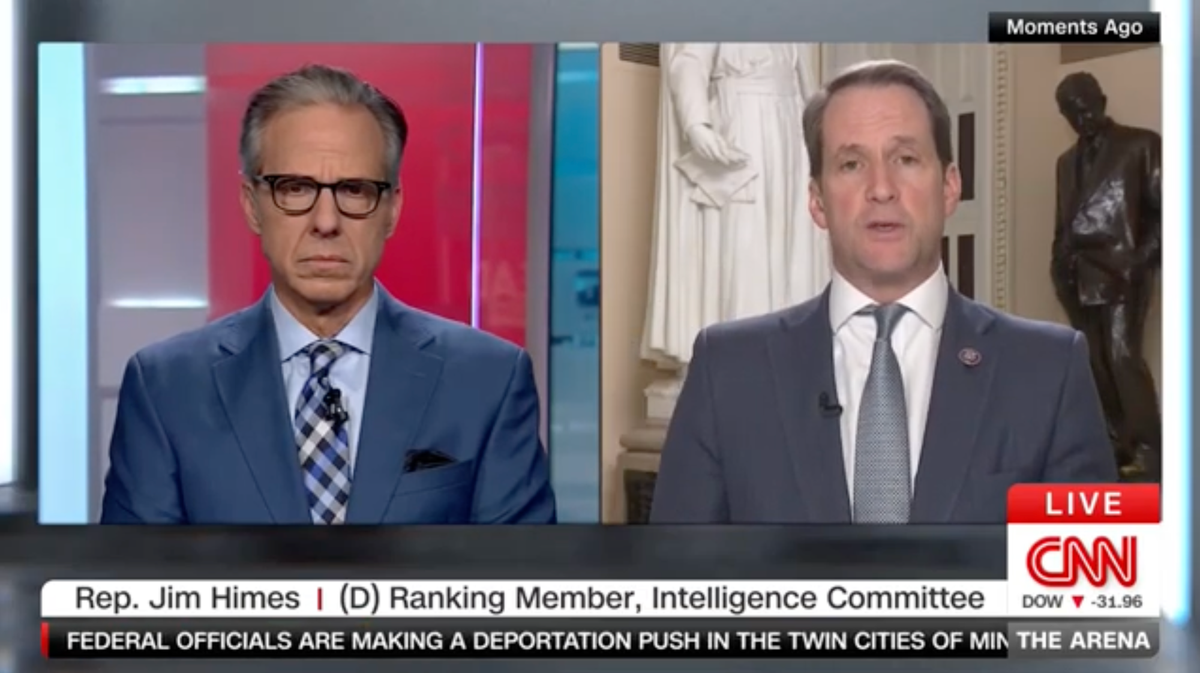
CNN anchor Jake Tapper spoke with Rep. Jim Himes (D-CT), the ranking member of the House Intelligence Committee, who said the video was one of the worst things that he has seen. (Screenshot/CNN)

A top intel committee lawmaker warned Thursday that the video showing a second strike on an alleged drug boat off the coast of Venezuela appeared to confirm the U.S. committed a war crime.

The video from a Sept. 2 attack in the Caribbean Sea was shown to lawmakers during a briefing with Admiral Frank M. 'Mitch' Bradley and Joint Chiefs of Staff Chairman Dan Caine in Washington, D.C., on Thursday.

CNN anchor Jake Tapper spoke with Rep. Jim Himes (D-CT), the ranking member of the House Permanent Select Committee on Intelligence, who said the video was one of the 

Tapper asked him if the video gave evidence that it was a war crime.

"I want to be careful with my language here. You know, we didn't get the audio. But that's sure what it looked like to me," Himes said. "And again, I don't want to get into the details, but I want you to imagine two individuals, clinging to wreckage in the middle of a vast ocean without any tools, without any weapons. Look, if this guy had had an AK-47 or an RPG or was, you know, calling in air strikes or anything else, it would be a totally different thing."

The video has been in question since reports surfaced that survivors were targeted after the first strike. The Trump administration has faced calls for answers after it was reported by The Washington Post that Defense Secretary Pete Hegseth ordered the killing of two survivors of one of the controversial drug vessel bombings.

“Any American who sees the video that I saw will see the United States military attacking shipwrecked sailors — bad guys, bad guys, but attacking shipwrecked sailors,” Himes told reporters Thursday following the briefing.

"Yes, they were carrying drugs. They were not in the position to continue their mission in any way,” he said.


Strike survivors deserved death for 'trying to flip their boat back over': GOP senator

David Edwards
December 4, 2025 
RAW STORY


C-SPAN/screen grab

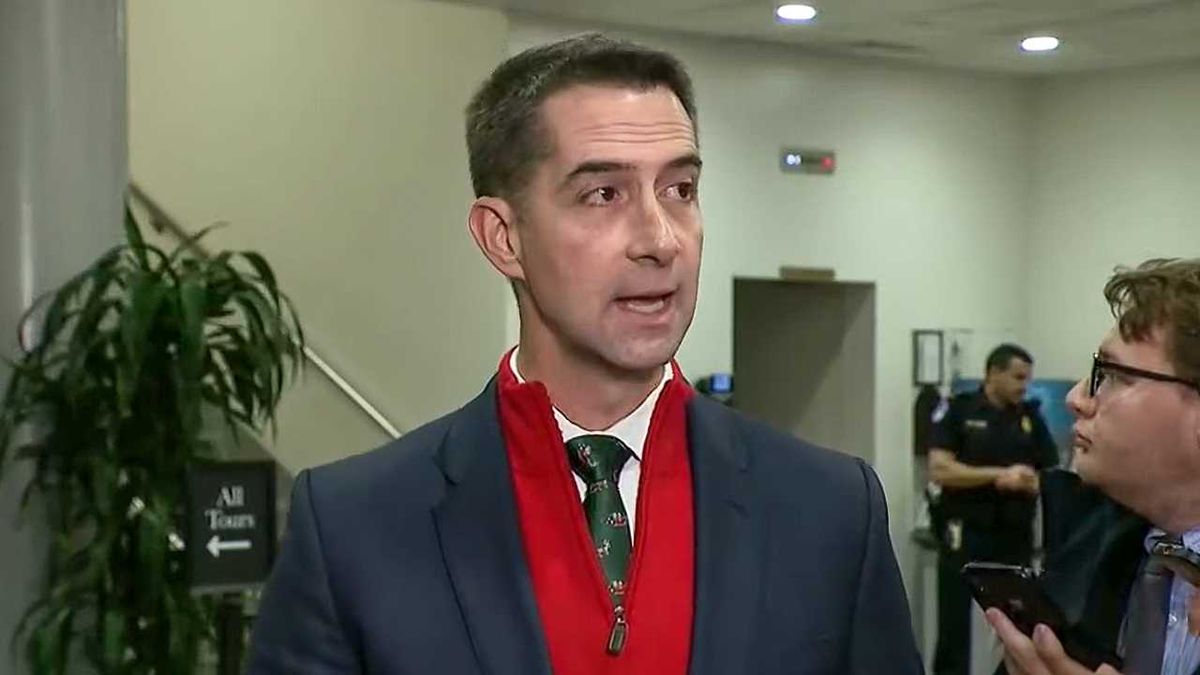
Sen. Tom Cotton (R-AR) insisted that two survivors of the strike on a small alleged drug boat deserved to die because they were trying to "flip" the vessel back over after it was hit.

Following a briefing from Adm. Frank “Mitch” Bradley on Thursday, Cotton defended the Pentagon's decision to continue firing on the boat after the first strike.

"The second strike and the third and the fourth strike on September 2nd were entirely lawful and needful, and they were exactly what we would expect our military commanders to do," the senator insisted.

"What exactly did you see in terms of the video of the second strike?" one reporter asked. "Were there survivors?"

"I saw two survivors trying to flip a boat, loaded with drugs, bound for the United States, back over, so they could stay in the fight," Cotton replied. "And potentially, given all the contacts we heard, of other narco-terrorist boats in the area coming to their aid to recover their cargo and recover those narco-terrorists, and just like you would blow up a boat, off of the Somali coast or the Yemeni coast and you'd come back and strike it again if it still had terrorists and it still had explosives or missiles."


The boat, however, did not have explosives or missiles and was too small to pose a threat to the U.S. mainland from that distance, many experts have said.


"I didn't see anything disturbing about it," Cotton told the reporters. "And we're going to continue to strike these boats until cartels learn their lesson that their drugs are no longer coming to America."

"But Congressman Himes said that according to what he saw in that video, the two people who survived trying to get back on the boat, there was no way they could have conducted further operations or anything like that?" a reporter pressed.

"He may be okay with drug boats running to America," Cotton snapped. "I just disagree with that."


"If you think these strikes are justified and righteous, as I do, and I want them to continue, then of course the second strike, when you have two survivors, who are trying to flip their boat back over and continue on their mission, remain in the battle," he added.


New US military strike on suspected drug boat heightens scrutiny of Trump anti-trafficking campaign


The US military on Thursday carried out another strike on a small boat in the eastern Pacific Ocean – its first in nearly three weeks – as congressional concern deepens over the legality and conduct of President Donald Trump’s aggressive anti-drug campaign at sea.


Issued on: 05/12/2025
By: FRANCE 24


Screen capture of a video from the US military showing a strike on a presumed drug boat in the Pacific. © Southcom

US Southern Command announced that it had conducted another strike against a small boat in the eastern Pacific Ocean on Thursday, following a pause of almost three weeks.

It is the 22nd strike the US military has carried out against boats in the Caribbean Sea and eastern Pacific Ocean that the Trump administration claimed were trafficking drugs.

There were four casualties in Thursday’s strike, according to the social media post, bringing the death toll of the campaign to at least 87 people.

In a video that accompanied the announcement, a small boat can be seen moving across the water before it is suddenly consumed by a large explosion. The video then zooms out to show the boat covered in flames and billowing smoke.

The strike was conducted the same day Admiral Frank “Mitch” Bradley appeared for a series of closed-door classified briefings at the US Capitol as lawmakers began an investigation into the very first strike carried out by the military on September 2. The sessions came after a report that Bradley ordered a follow-on attack that killed the survivors to comply with Defense Secretary Pete Hegseth’s demands.


Bradley told lawmakers there was no “kill them all” order from Hegseth, but a stark video of the entire series of attacks left some lawmakers with serious questions.

Legal experts have said killing survivors of a strike at sea could be a violation of the laws of military warfare.

Bradley spoke to lawmakers alongside the chairman of the Joint Chiefs of Staff, General Dan Caine, in a classified session. His testimony provided fresh information at a crucial moment as Hegseth’s leadership comes under scrutiny, but it did little to resolve growing questions about the legal basis for Trump’s extraordinary campaign to use war powers against suspected drug smugglers.

Lawmakers offered differing accounts of what they saw on the video.

Republican Senator Tom Cotton of Arkansas said he saw the survivors “trying to flip a boat loaded with drugs bound for United States back over so they could stay in the fight”.

Connecticut Representative Jim Himes, the top Democrat on the House Intelligence Committee, said, “What I saw in that room was one of the most troubling things I’ve seen in my time in public service.”

“You have two individuals in clear distress, without any means of locomotion, with a destroyed vessel,” he said, adding they “were killed by the United States”.

Washington Representative Adam Smith, the top Democrat on the House Armed Services Committee, said the survivors were “basically two shirtless people clinging to the bow of a capsized and inoperable boat, drifting in the water – until the missiles come and kill them.”

(FRANCE 24 with AP)


Stop The Drive To War With Venezuela – OpEd


LIBERTARIAN ANTI-IMPERIALIST WAR

December 4, 2025 
MISES
By Ryan McMaken

On October 23, the Trump administration announced to Congress that it is planning “land attacks” within Venezuelan territory. Such attacks, of course, would be acts of war, and there are no plans for Congress to declare war on any foreign state.

Moreover, on Tuesday, Trump declared that any country deemed by the administration to be making drugs for US markets is a possible target for US military attack. Trump also stated that military strikes on Venezuela territory would “start very soon.”

Meanwhile, the administration has been using the US military to engage in extrajudicial killings of persons in the Caribbean alleged to be “narco-terrorists.” The administration admits it doesn’t actually know who these people are. The US military is simply killing people without any evidence of actual crimes or of a military threat. Nor has the administration attempted to offer any evidence. The justification for the killings is simply—to use a phrase from meme culture—”trust me, bro.”

The attacks are also meant to serve as a provocation and a threat to the Venezuelan regime, and to serve as an “example” of what will be done on Venezuelan territory if the current Venezuelan president does not go into exile.

So much for the president who, while a candidate, claimed he would oppose any new wars and end existing ones.

Instead, what we have now is a president who advocates for a new war in South America—in addition to his proxy wars in Palestine and Ukraine—and has no intention of adhering to any sort of rule of law in doing so.

So, this is yet another case of “here we go again.” Every few years, no matter who is president, the US regime—i.e., the “foreign policy blob“—comes up with yet another country that we’re told requires “regime change.” And, as with all drives to war, the result is more runaway federal spending, more disregard for the rule of law, and more unmitigated power for the American executive state.


Forget about the US Constitution


By now it’s very quaint to protest the American warfare state by suggesting that presidents should adhere to the US constitution. No president has taken the US constitution seriously in decades, and Congress has done precious little about it.

Nonetheless, whatever opposition can be mustered to the untrammeled bellicosity of US presidents is a good thing. This week, a handful of members of Congress introduced legislation prohibiting Trump from launching “hostilities within or against Venezuela” without congressional approval.

Only a very small handful of Republicans have spoken out against the president on the administration’s accelerating threats and on the killings of supposed “narco-terrorists” in boats outside US territory. Unsurprisingly, Thomas Massie of Kentucky supports the war-powers legislation. Senator Rand Paul, meanwhile, has condemned the killings of passengers and operators on “drug” boats. And rightly so. As Judge Andrew Napolitano noted this week, one of the most recent “drug-boat” attacks clearly violated international law when the US disabled one boat, and then, rather than arrest the survivors, simply killed them. Napolitano correctly described this as a war crime.

Of course, even if Congress does pass legislation reining in the President’s power to commit acts of war against Venezuela, it’s unclear the legislation would have any effect. The US regime is far beyond accepting any legal limits on warmaking imposed by the US constitution—a document that is obviously defunct except in the minds of those clinging to a romantic fantasy about the state of modern American politics.

A Threat to Actual Americans?

It’s a given that the rule of law will be ignored in this conflict, just as it has been ignored for many decades. But an important political question is this: does the Venezuelan regime pose any threat to actual Americans?

With questions like these, the burden of proof is always on those who want a new war and are demanding tax dollars to do it. So where is the evidence of a Venezuelan threat? If there were one posed by the actual regime, we’d be sure to hear about it, since it would greatly help the warmongers. But, it seems the best the administration can do is deem the Venezuelan regime as a “terrorist” organization. But here they don’t even make the case for any real terrorism—such as the bombing of buildings. No, the administration has been clinging to the idea that Venezuela is sponsoring “narco terrorism.” This term is extremely flexible, and could include anything from cartel activity to the mere selling of drugs within the United States.

(The GOP, the party of “personal responsibility,” now tells us that when Americans voluntarily buy drugs, then it’s the drug dealer’s fault. I wonder if these people also think that gun crime is the fault of gun merchants.)

In any case, all of this is a very long way from “weapons of mass destruction” or “dirty bombs” or even anthrax in your mail—the sort of things that could plausibly be called terrorism. No, the new “terrorism” requiring a US bombing campaign against Venezuela is apparently some people on small boats that the regime swears—cross-my-heart-and-hope-to-die—are totally “drug boats.”

In the end, the “narco-terrorism” angle is simply political cover for helping carry out the longtime plans of neoconservatives who have dreamed for many years of installing a US puppet in Venezuela. The fact that Trump recently pardoned Honduran drug lord Juan Orlando Hernandez, who served only one year of a 45-year sentence, illustrates that the administration is not actually concerned about drug trafficking.

Trump’s neoconservative bona fides are now firmly in place, after all. This is a president who vehemently supports Senator Lindsey Graham, one of the most committed warmongering neoconservatives in Congress. The administration also has resurrected the career of Elliott Abrams who was appointed during the first Trump term as a “Special Representative” for both Iran and Venezuela. Abrams—a die-hard Zionist, of course—has been working for many years for regime change in Venezuela, and Trump may be the one to get it for him. Abram’s most recent column at Foreign Affairs shows he isn’t giving up.
Headed Toward another Regime Change “Success”?

It’s always difficult to guess any politician’s true intentions, and this is certainly true of Trump. Regime change, in any case, remains one of the worst options going forward. After all, what success has the US had with regime change in recent decades? The US spent twenty years replacing the Taliban with the Taliban in Afghanistan. After years of allying with terrorists in Syria to effect regime change, al-Qaeda and ISIS terrorists are now the dictators of Syria. Trump now invites Syrian terrorists to the White House. In Iraq, the country’s ancient Christian community was decimated in the wake of the US invasion. The standard of living there utterly collapsed, and the Iraqi regime is now far more friendly toward Iran that it was under Saddam Hussein. Libya is now a hotbed for terrorism with slave markets and a ruined economy. These are the American regime’s “success” stories.

What horrors await the people of Venezuela if the US carries out regime change there? I hope we don’t find out. But one likely outcome is this: an enormous wave of Venezuelan refugees moving north.

Nonetheless, perennial calls for regime change somewhere are now standard operating procedure in Washington, with or without Trump in the White House. Every minute of every day, the American empire is dreaming up new wars and new excuses for new wars. Trump apparently has no problem with playing along so long as it helps him spend more money on key constituents, especially his Zionist funders and the corporate welfare queens at organizations like Raytheon.

Some “MAGA” supporters have expressed disappointment in the administration’s refusal to do much to change course on this. But, as Tom Mullen recently noted:


Part of the problem is that Trump’s anti-war platform was never as radical as the true American First crowd would like to believe. He talks a good game about ending “forever wars,” but he doesn’t question the core of the empire—the global standing army, the 800-plus bases warehousing hundreds of thousands of troops overseas, and the non-defensive use of them, as long as the war isn’t a “forever war.”

Indeed, Trump’s posture reminds one of Madeleine Albright’s famous complaint to Colin Powell during the Clinton Years: “What’s the point of having this superb military that you’re always talking about if we can’t use it?”

An empire with a huge offensive military is likely to use it. And Donald Trump clearly likes the idea.


About the author: Ryan McMaken (@ryanmcmaken) is editor in chief at the Mises Institute, a former economist for the State of Colorado, and the author of two books: Breaking Away: The Case of Secession, Radical Decentralization, and Smaller Polities and Commie Cowboys: The Bourgeoisie and the Nation-State in the Western Genre. He is also the editor of The Struggle for Liberty: A Libertarian History of Political Thought. Ryan has a bachelor’s degree in economics and a master’s degree in public policy, finance, and international relations from the University of Colorado. Send in your article submissions for the Mises Wire and Power and Market, but read article guidelines first.
Source: This article was published by the Mises Institute


MISES

The Mises Institute, founded in 1982, teaches the scholarship of Austrian economics, freedom, and peace. The liberal intellectual tradition of Ludwig von Mises (1881-1973) and Murray N. Rothbard (1926-1995) guides us. Accordingly, the Mises Institute seeks a profound and radical shift in the intellectual climate: away from statism and toward a private property order. The Mises Institute encourages critical historical research, and stands against political correctness.
It's about 'to get a lot worse' for GOP as Trump preps self-destructive plan: Nobel winner

Ewan Gleadow
December 5, 2025 
RAW STORY


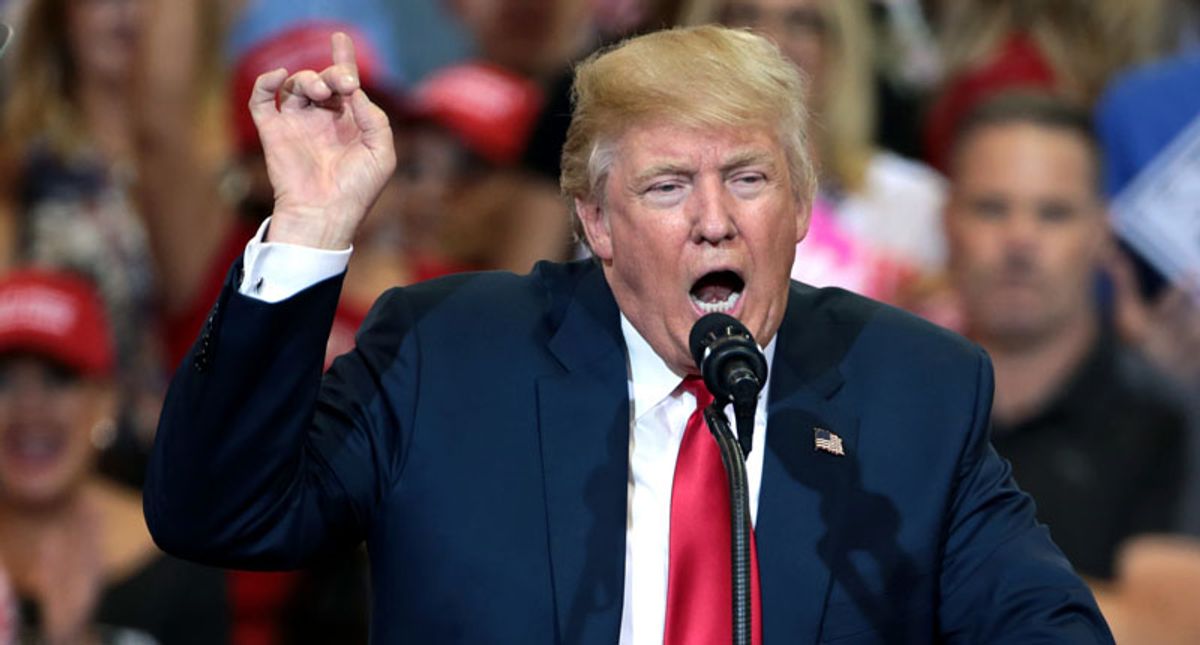
Donald Trump speaking with supporters at a campaign rally at the Phoenix Convention Center in Phoenix, Arizona. (Gage Skidmore/Flickr)

A "retribution tour" of the United States for Donald Trump will hit the GOP hard, a Nobel Prize-winning economist has warned.

The president seems set on touring the country as a way of explaining how things have never been better for people economically, and this could cause ripples of doubt through the Republican supporter base. Trump's trip around the country was confirmed by the president earlier this week, though writer Paul Krugman explained how talking about the economy to those in financial hardship will hinder both Trump's administration and the work of the GOP.

Krugman, writing in his Substack, explained, "Trump is handling this reversal with his usual style and grace: in the past few days he has repeatedly called affordability a 'hoax' and a 'con job.' According to Axios, he’s planning a nationwide retribution tour to convince voters that things are going great and that they’re wrong to be so down on the economy."

"Democratic strategists must be rubbing their hands with glee. And if you are one of those Republicans reconsidering your future career options, know that things are going to get worse. A lot worse."

Krugman would go on to suggest the "health care earthquake" on the horizon is going to hit soon and will be damaging for Republican representatives. He wrote, "Which brings us to the health care earthquake that’s soon to hit — an earthquake that, based on my read of Mettler, is going to inflict significant political damage on the Republicans."

"So let’s think about the politics of what’s about to happen: Millions of Americans are about to see a sudden rise in health care costs — not a hypothetical future rise, but a sudden jump on January 1.

"This ACA premium shock will hit as other forces are exacerbating the sense of crisis over affordability. Businesses are starting to fully pass onto consumers the cost of Trump’s tariffs. Electricity prices are soaring as data centers inflict the cost of their enormous power demands on consumers. In addition, Trump’s deportation policies are increasing the cost of food."

Krugman then added, "Trump may believe that affordability is a con job, but it isn’t. It’s going to hit him and his allies hard. And it couldn’t happen to a more deserving group of people."


Subnational income inequality revealed: Regional successes may hold key to addressing widening gap globally


Aalto University

Gini trend 1990-2023 

image: 

The new study visualises three decades of income inequality data, the most comprehensive worldwide mapping to be done at a subnational level.

view more 

Credit: Matti Kummu, Daniel Chrisendo et. al / Aalto University


A new study visualises three decades of income inequality data, the most comprehensive worldwide mapping to be done at a subnational level. Confirming worsening income inequality for areas with over 3.6 billion inhabitants, it also reveals hidden ‘bright spots’ where policy may be closing the gap.

Income inequality is one of the most important measures of economic health, social justice and quality of life. More reliably trackable than wealth inequality, which was recently given a gloomy report card by the G20, income inequality is particularly relevant to immediate economic relief, mobility and people’s everyday standard of living.

The new study, from an international team led by Aalto University and Cambridge University, is the first to comprehensively map three decades of income inequality data within 151 nations around the world. Despite finding that income inequality is worsening for half the world’s people, the study also indicates that effective policy may be helping to bridge the gap in regions such as Latin America — ‘bright spots’ in administrative areas that account for around a third of the global population.

‘This research gives us much more detail than the existing datasets, allowing us to zoom in on specific regions within countries,’ says one of the study’s lead authors, Professor Matti Kummu, from Aalto University. ‘This is significant because in many countries national data would tell us that inequality has not changed much over the past decades, while subnational data tells a very different story.’ 

‘The new data is particularly relevant in light of recent failings around wealth inequality, given that it could help shed light on what policy levers might be pulled to address inequality in the short-term,’ says co-lead author Daniel Chrisendo, now an Assistant Professor at Cambridge University.

‘We have vastly more complete data on income than we do on wealth, which tends to be much harder to uncover and track,’ explains Chrisendo. ‘Especially given that income inequality leads to wealth inequality, it’s critical to tackle both forms — but income inequality is perhaps the easiest to address from an immediate policy perspective.’

The study was published in Nature Sustainability on 5th December, and the new global subnational Gini coefficient (SubNGini) dataset, spanning 1990-2023, is publicly accessible online. Global annual data and trends can be explored visually using the Online Tool, which enables users to explore how income inequality has played out in regions around the globe and also download the data for further analyses.

Pinpointing the role of policy

There are many examples where regional efforts have shone more brightly than is revealed by national statistics, say the researchers. However India, China and Brazil all present interesting case studies that affect large swathes of the global population.

‘With regards to India, relative success in the south is linked to sustained investments in public health, education, infrastructure and economic development that have benefited the local population more broadly,’ says Chrisendo. 

Meanwhile, in China, market-oriented reforms and open-door policy have driven economic growth and dramatically reduced poverty since the 1990s. ‘But we can also see how this growth has been uneven, likely due to the Chinese government’s ‘Hukou’ policy limiting rural migrants' access to urban services,’ he explains. In response, the government has implemented various policy measures — such as regional development programs and relaxed Hukou restrictions — to address disparities and support internal migrants.

In Brazil, the mapping shows a potential correlation between reduced inequality and a regional cash transfer programme providing cash to poor families on condition of their children attending school and receiving vaccinations.

‘Overall, being able to visualise these success stories and pinpoint the changing trends in time could help decision-makers see what works,’ says Chrisendo.

Income inequality rising for half the world’s people

Relative income growth for the world’s poorest 40 percent is one of the UN’s Sustainable Development Goals (SDGs), yet the study confirms the collective failure to meet this goal by 2030. ‘Unfortunately, not only are we quite far from that goal, but the trend for rising inequality is actually stronger than we thought,’ says Kummu.

The researchers are now expanding the data visualisation to encompass a vast range of other socio-economical indicators, from how populations are aging, to life expectancy and time spent in schooling, to improved access to drinking water — with the extensive new datasets slated for public launch in 2026.

As an expert in global food systems and sustainable use of natural resources, Kummu hopes the new datasets can be used to better understand, for example, the linkages between development and environmental changes. The recent study revealed links between more unequal regions and lower ecological diversity, which he would like to explore further.

‘It’s ambitious, but to have subnational, high quality data spanning over three decades is crucial to understand different social responses to environmental changes and vice versa. It gives us the means to start understanding the causalities, not just the correlations — and with that comes the power to make better decisions,’ he concludes.


Bivar_ trend 

Around a third of the global population live in areas where income inequality is improving, according to the research.

Credit

Matti Kummu, Daniel Chrisendo et. al / Aalto University