Sunday, December 14, 2025

Opinion

To tackle child poverty the UK government must deal with parental poverty

12 December, 2025
Left Foot Forward

Labour's child poverty strategy offers some welcome measures, but it won't address the factors keeping families trapped in poverty
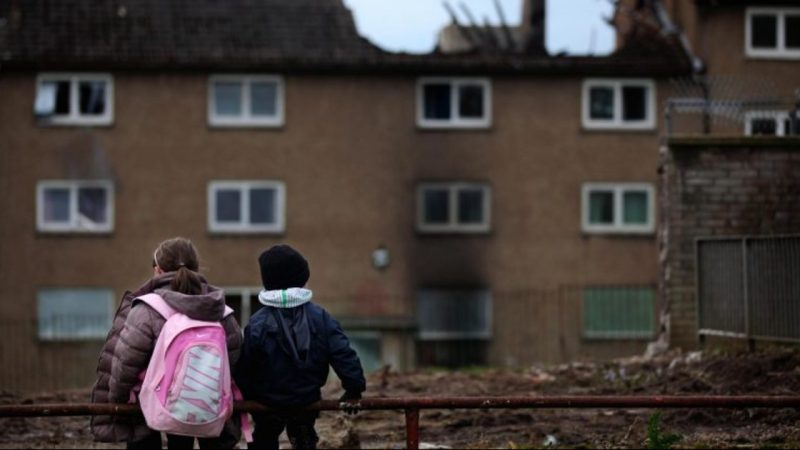


The UK government has published its long-awaited strategy on reducing child poverty. After 14 years of Conservative obsession with austerity, it is a welcome development but child poverty can’t be eradicated without dealing with parental poverty, which in return requires equitable distribution of income and wealth and universal free basic services.
Background

A major crusade of the 1979 Conservative government was to appease capital and boost rates of profitability by weakening trade union and worker rights. In 1979, some 13.2m workers were members of trade unions and by 1997 the membership declined to around 7.8m. This enabled employers to increase profits by cutting real wages. Public services and benefits were cut. There were no restraints on profiteering which reduced household disposable incomes. The government cut public spending, real wages and benefits. By 1997, some 4.5m children (34%) were living in poverty.

The Labour’s administration of 1997 promised to abolish child poverty over the next 20 years. It sought to increase greater participation in labour markets by introducing the National Minimum Wage and Working Tax Credits to ‘make work pay’. It did not reverse any of the anti-union laws and by 2010 union membership declined to 6.6m. The government wanted more parents to participate in labour markets but this was not accompanied by affordable childcare. The government had no effective programme for redistribution of income and wealth and the then Business Secretary Peter Mandelson said that he was “intensely relaxed about people getting filthy rich”. The poverty reduction project suffered a setback from the 2007-08 financial crash as the government embarked on a programme of spending cuts and wage restraints. By the time Labour left office in 2010, almost 3.6m children were living in relative poverty.

Despite some high sounding policies, the incoming coalition government (Conservatives and Liberal Democrats) in 2010 was relaxed about insecure work as the use of zero-hour contracts and fire and rehire practices expanded. The government introduced austerity, real wage and benefit cuts. To this day, the average real wage has barely moved from the 2008 level. In 2017 the government, introduced the two-child benefit cap and limit the child element of Universal Credit and Tax Credits to the first two children in a family. Due to austerity and failure to plan for the pandemic, the number of unfilled hospital appointments in England increased from 2.5m in 2010 to 4.5m in February 2020 and hit 7.62m in June 2024. Finding a dentist or a timely appointment with a family doctor became a struggle. By 2024, some 4.5m (31%) children were officially living in poverty though others estimate it to be around 5.2m children.
Government Strategy

The above brief background shows that child poverty is an outcome of policies affecting work, household incomes, workers’ bargaining power, profiteering, benefits and taxation. Household poverty is exasperated by dwindling incomes and a rising cost of living. People live in poor housing and lack nutritious food. Poor healthcare reduces parental ability to work. A lethal combination of factors manufactures higher infant mortality, child poverty, higher rates of illness, shorter life expectancy, and education and employment attainment.

A comprehensive programme of poverty reduction is needed. The government’s child poverty strategy has good elements but lacks crucial elements. Besides, policies can’t be judged by good reports they need to deliver outcomes.

Key elements of the government strategy are removal of the two-child benefit cap from April 2026. The government claims that this will lift around 450,000 children out of poverty by 2030.

From September 2026, the government will expand free school meals in England to all children in households in receipt of Universal Credit. This will lift 100,000 children out of relative low income by the end of parliament. However, free meals won’t be universal and cliff-edge means that free meals will be lost if parental income exceeds the Universal Credit limit. The free breakfast clubs for primary schoolchildren in England are already under way. The government will invest in Healthy Star programme, helping low-income families afford nutritious food and supporting breastfeeding. The number of children living in temporary accommodation will be reduced. Local councils will be required to inform schools, GPs and health visitors when a child is put in temporary accommodation with his/her family. A large number of children are in poverty because absence parent, often fathers, do not make the agreed child maintenance payments. The government has promised to overhaul the system and further details are awaited.
Need to restructure society

The above proposals are welcome but they are undermined by government policies. Child poverty is linked to parental and household poverty which can’t be tackled without redistribution of income and wealth. It is hard to discern any effective policies.

On the one-hand the government wants to reduce child poverty whilst simultaneously it is planning to plunge more into poverty through its immigration policies. To appease its right-wing, the government is planning to make legal migrants wait up to 20 years before they can settle permanently. The government is considering limiting benefits to those “making an economic contribution”. Such a policy would deny benefits to children of immigrants, UK born or otherwise, if their parents face financial hardships due to illness, disability or unemployment.

Other than the mantra of ‘growth’ there is no strategy for increasing household incomes. Trickle-down economics has failed and average real wage hasn’t moved since 2008 as workers lack bargaining power. Last month the government extended the freeze on income tax thresholds to 2030/31. As a direct result, 780,000 additional people, the poorest, will be required to pay income tax at the basic rate for the first time. Another 920,000 would be pushed into paying income tax at the higher marginal rate of 40%. Successive governments have taxed labour at a higher rate than wealth and return on wealth. Wages are taxed at marginal rates of 20% to 45%; compared to capital gains at marginal rates of 18% to 32%, and dividends at the rates of 8.75% to 39.35%. Such regressive policies hurt the poorest. The poorest 20% pay a higher proportion of income in taxes than the richest 20%. The bottom 50% of the population owns less than 5% of wealth, bottom 20% has 0.5%, and the top 10% a staggering 57%. None of this can be changed without a radical engagement with corporations and the super-rich.

The government has announced plans to force people to work or lose benefits. There is some childcare support but it is inadequate. What are lone or disabled parents to do? Despite recent rises in the minimum wage, work doesn’t pay enough to make ends meet. Some 34% of the people on Universal Credit are in employment. Around 1.17m workers are on zero-hour contracts, which is particularly prevalent in accommodation and food, transport, arts, health and social work sectors. Some 4.5m jobs in the UK pay less than the real Living Wage. Around 24m people, 36% of the population, live below socially acceptable living standards. Despite earlier promises, the Employment Rights Bill will not end zero-hour contracts, fire and rehire policies which enable employers to fire workers and rehire them on inferior pay and working conditions. Employers can shift production to secondary sites but secondary picketing by workers will remain banned.

Poverty is deepened by a poor healthcare system. In October 2025 some 6.24m individuals were waiting form 7.3m hospital appointments in England alone. Instead of expanding the NHS, the government is committed to privatising further parts of it. The NHS dentists are scarce and private equity controlled organisations such as My Dentist, PortmanDentex, Rodericks Dental, and Bupa Dental Services, dominate the private provision of dentistry. Their prices are around 3.5 times higher than the NHS dental charges, enabling them to make £1.2bn gross profit over the past two years. Parents are paying around £350 for one tooth extraction for a child.

Indeed, there is no government plan to curb profiteering. Water, energy, rail, mail and grocery prices are rising at rates faster than inflation and plunging millions into poverty. There is huge lack of social housing. The city of Liverpool has 12,764 households on its social housing waiting list. It has just five “additional social rent dwellings”, as local authorities have been starved of resources. Poverty can’t be eradicated without affordable housing.

Poverty in one of the richest countries is made by political choices. The government must chart a new course. Universal basic income and services would be a good start towards eradication of poverty. Well paid work is an essential element for reducing poverty, but not all parents are able to work or find work. Therefore, support is needed through the tax and benefit system. The government can help through scheme of apprenticeships, job training, abolition of university fees and investment in new and emerging technologies. There must be universal access to free school meals, sports and playgrounds. Improvements in healthcare and public services are needed. Workers’ rights and bargaining power must be improved by strengthening trade unions. No doubt, neoliberals would object to emancipatory change even though child poverty costs the UK economy around £40bn a year. We can and must do better.


Prem Sikka is an Emeritus Professor of Accounting at the University of Essex and the University of Sheffield, a Labour member of the House of Lords, and Contributing Editor at Left Foot Forward.
The myth of ‘overdiagnosis’: The right’s new culture war


What should be a conversation about meeting children’s needs has instead become yet another culture war battlefield.


‘Overdiagnosis’ has been a buzzword of 2025, at least within right-wing circles, who deploy it with remarkable confidence yet remarkably little evidence. What should be a conversation about meeting children’s needs has instead become yet another culture war battlefield.

“‘Out of control’ spending on ‘overdiagnosed’ special needs children threatens bin collections and pothole filling, claims Reform’s Tice,” splashed the Daily Mail last month, amplifying the right’s message that public services are failing not because of chronic austerity, but because too many children are being labelled “special needs.”

Tice’s unverified crusade

Indeed, the deputy Reform leader, who heads the party’s cost-cutting DOGE unit while spending much of his time in Dubai, has cast himself as a crusader against what he claims is rampant overdiagnosis of ADHD, dyslexia and autism. He even branded the sight of pupils wearing ear defenders, used routinely by occupational therapists and teachers to reduce sensory overload, as ‘insane.’ Tice’s criticism exposes not a problem in classrooms but an alarming ignorance about how neurodivergent pupils actually learn.

Tice also wants to scrap annual reviews for Education, Health and Care Plans (EHCPs) because they cost roughly £4,000 each. That figure is correct but the inference that the cost is therefore unjustified is not. Annual reviews are the main safeguard that ensures children get the support they need. Scrapping them would not cut ‘waste,’ it would strip away accountability.

As Anna Bird, chief executive at Contact for Families with Disabled Children and Madeleine Cassidy, chief executive at IPSEA say, getting rid of EHCPs is “not the answer.”

“(EHC) plans are a vital part of the SEND system and must be protected. They provide legally enforceable rights to support for children and young people.”

But Tice doesn’t stop at ear defenders and EHCPs. He wants councils to stop funding transport for SEND pupils and has revived the right’s long-held obsession with the Motability scheme. His accusation that parents leave their Motability car “in the drive” while “demanding a taxi” to school is presented without a shred of evidence, and, predictably, left unchallenged by the Mail.

He goes further, alleging “middle-class parents” are “playing the game” to avoid VAT on private school fees by seeking EHCPs.

“They’re employing solicitors in order to file their claims.” Again, no evidence, and no verification or balance offered by the Mail.

Some balance here would require the perspectives of relevant institutions and experts, for example, the National Autistic Society.

“Claiming there is “overdiagnosis” couldn’t be further from the truth,” said Joey Nettleton Burrows, policy and public affairs manager at the National Autistic Society….Spreading these kinds of lies stigmatises autistic people and makes life harder for them and their families.”

But why would the Mail include such comments, when ‘overdiagnosis’ fits into a political and media narrative that has spent over a decade demonising disability claimants as “scroungers,” “frauds” and “cheats.” From the Sun’s 2012 “Beat the Cheat” campaign to George Osborne’s attempted £4.4bn disability benefit cuts, this demonising narrative is long-established.

Overdiagnosis or long overdue recognition?

Of course, in the school days of Tice and Farage, at the same time little was done to stamp out bullying, dyslexia “didn’t exist,” only in the sense that nobody cared to recognise it. Children who struggled were dismissed as “thick” or “weird.”

Today, many adults who grew up in that era are finally being diagnosed with ADHD, autism and other conditions, not because they suddenly became more common, but because diagnostic criteria improved and stigma reduced.

BBC Scotland reported a seven-fold increase in adults receiving ADHD prescriptions between 2013 and 2023. Increased awareness, clearer clinical guidelines, the aftershocks of the pandemic, and adults recognising their lifelong symptoms, all help explain this rise. But to the right, any increase is proof of ‘overdiagnosis’ and the need to make cuts.

The real diagnostic scandal: underdiagnosis

The human cost of late diagnosis is palpable. Just last week, my hairdresser told me she had recently received an ADHD diagnosis and begun medication. “I’ve never felt better,” she said. “If only I had been diagnosed 30 years ago, my life would have been very different.”

Her story is common. Many women in particular report feeling unable to disclose diagnoses precisely because media narratives have framed ADHD as a trivial “trend.”

“Seeing the way the condition is treated in the media has made me even less confident in talking about potentially having ADHD with those close to me,” wrote Rachel Charlton-Dailey in Glamour.

Underdiagnosis, especially if you’re not white

If there is a diagnostic crisis, it’s underdiagnosis, especially among children of colour. Studies show that Indian, Asian and Pakistani children are less likely to be diagnosed with autism than white peers. Children who speak another language at home are also significantly less likely to get a diagnosis.

Shockingly, SEND tribunal data hasn’t recorded ethnicity since 2017, making inequalities harder to track.

And while Tice complains about too many EHCPs, more than 6,000 children had been waiting over a year for one, as of June 2025. The target is 20 weeks. Families aren’t exaggerating needs, many are begging to be believed.

SEND under the Tories

14 years of Tory rule oversaw a dramatic decline in the state of the education sector. UNISON research in 2024 showed that funding fell significantly below 2010 levels, and that a child starting school that year missed out on £5,384 of education and support due to austerity-era cuts.

The results are visible daily, with larger classes, reduced student support services, fewer extra-curricular activities, and shrinking specialist provision for SEND pupils.

This reluctance within Tory ranks to take disability and mental health seriously remains to this day. Only this week, Kemi Badenoch claimed it was time to “draw a line on what health issues the state can support people with”, particularly targeting “low level mental health issues”, such as “being diagnosed with anxiety which can be worth more than £20,000 to some families.”

As well as showing a real lack of understanding, such comments reinforce a political climate in which the needs of disabled people and vulnerable children are treated as burdens rather than responsibilities.

Labour’s softly-softly version of the same narrative

It would be comforting to say this ‘panic’ is confined to the Tories and Reform. It isn’t. Labour isn’t offering an alternative vision for SEND, only a slower, more technocratic version of the same policy trajectory. Councils are overwhelmed, families are desperate, and instead of adding funding Labour is launching an independent review into rising demand for mental health, ADHD and autism services in England.

Earlier this year, health secretary Wes Streeting told BBC’s Laura Kuenssberg that mental health conditions were being over-diagnosed and too many people were being “written off.”


But writing in the Guardian, last week, Streeting said his prior remarks had “failed to capture the complexity of this problem” and were a case of “foot-in-mouth syndrome”.

He said he decided after the interview that “this issue was too important to be left unresolved and required a proper evidence base.”

A government review is now in motion, with a white paper due in early 2026. Ministers insist it is designed to “benefit children and parents,” but as John Harris notes, its framing “has a queasy whiff” of the overdiagnosis narrative. It lumps together mental health with neurodevelopmental conditions and includes nods to “economic inactivity,” priming the ground for welfare reform by stealth.

Harris also highlights what the overdiagnosis crusaders won’t, that Britain’s hyper-competitive education system and precarious labour market are driving rising rates of anxiety and depression in young people. Add the lingering effects of the pandemic, and the idea that SEND diagnoses are a frivolous trend collapses entirely.

The return of ‘survival of the fittest’ thinking?

It is difficult to avoid wondering whether the current political assault on people with special educational needs and disabilities is really about reducing public expenditure, or whether it reflects something darker. Beneath the rhetoric of “efficiency” and “waste” lurks an older, primal belief that some lives are less valuable, less worthy, or less “fit” than others. This view echoes the discredited tenets of eugenics, which sought to “improve” humanity by excluding, sterilising or marginalising anyone who didn’t fit a narrow norm, namely disabled people, people of colour, and the working-class.

Ableism, the assumption that typical physical, intellectual, or neurological traits are inherently superior, is not the preserve of any one ideology and cuts across political lines.

Scandinavia, often held up as a model of social democracy, pursued forced sterilisation policies for decades in the twentieth century under governments that prided themselves on progress and equality. These programmes, intended to “strengthen” the Nordic population by preventing those deemed “weak” from reproducing, were not the work of a fascist dictatorship but of mainstream, elected Social Democratic administrations.

Britain’s own progressive history is not free from similar shadows. John Maynard Keynes, one of the country’s most celebrated economists, was himself a committed eugenicist at a time when the ideology held mainstream academic respectability.

Only after the Second World War, when its role in Nazi racial doctrine was exposed, did eugenics become universally discredited. The Nazi regime murdered an estimated 250,000 disabled people, framing them as burdens, “unfit,” and “life unworthy of life.”

As UNISON observed in a 2018 reflection for Holocaust Memorial Day, a “survival of the fittest” view renders disabled people worthless and disposable, a mindset that historically paved the way for atrocity. UNISON General Secretary Dave Prentis warned that we must be “aware of the disastrous consequences that can result from dehumanising a particular group and infringing their rights.”


Today, that warning feels increasingly relevant and urgent. When public figures casually frame disabled children as a drain on resources or a threat to “economic productivity,” they are not engaging in neutral policy debate. They are laying the ideological groundwork for rights to be eroded, services stripped away, and human beings treated as less than fully human.

The language deployed by Richard Tice and others must therefore be recognised for what it is. Not a conversation about budgets, but the early stages of a dangerous and familiar pattern.

Gabrielle Pickard-Whitehead is author of Right-Wing Watch and Contributing Editor at Left Foot Forward.


‘Labour’s mental health review needs to reframe overdiagnosis’


Scrabble tiles spelling mental health
©Shutterstock/chrisdorney

We’re having the wrong debate about mental health diagnosis.

Following Wes Streeting’s announcement of a review into the factors behind increased diagnosis of mental health conditions, ADHD and autism, healthcare professionals and wider society are divided over whether mental health conditions are being overdiagnosed or underdiagnosed. 

This debate misses the fundamental issue – we’ve created a system which has medicalised access to basic psychological tools. The question shouldn’t be whether we’re diagnosing too much, but why accessing support requires clinical intervention in the first place.

Divided opinion

Opinion in this debate is deeply polarised. Over half of GPs surveyed by BBC News believed mental health conditions are being overdiagnosed, with concerns about ‘over-medicalising life and emotional difficulties’, and the view that ‘life being stressful is not an illness’, while others argued the real issue was underdiagnosis, and that “people need to be accepted, helped and encouraged to live life”.

Predictably, there are staunch views on both sides in wider society too. Mind warns of a ‘paradoxical increase in cynicism about mental health…with claims of overdiagnosis’, while Spiked argues that ‘redefining everyday problems as mental-health conditions is driving a generation of Britons to despair’, and that young people ‘have been raised to interpret normal human emotions and experiences…as pathologies’.

Labour’s review should reframe this entirely, asking why isn’t there more support outside of clinical settings to manage life’s challenges?

My experience

This isn’t simply an outsider’s view. Aside from spending over a decade working in healthcare policy and education, I’ve been a mental health service user. I’ve experienced varying levels of support from primary mental health services – especially cognitive behavioural therapy (CBT) through to talking therapies.

I benefited from clinical support for some of the challenges I experienced, and clinical pathways remain essential for many cases – including when people have serious mental illnesses or complex needs. But much of what I learned were techniques that should be universally accessible. Anyone familiar with CBT will have learned some of the many strategies available for managing emotions – including tools to help people analyse worries, and reframe negative thoughts and feelings. These techniques are widely used to help millions of people – with almost two million people accessing CBT in the UK in 2021. 

The mistake the cynics make is to assume that most of those people didn’t need this CBT support, because their diagnoses aren’t valid. I’d flip this on its head: if people need support to manage their emotions, why do they have to wait weeks or months and then enter a clinical pathway in order to access it?

 Challenging the system

Of course, there are CBT resources available online and ways to access support outside of these pathways. But how aware are people that this is the case, and that these resources might help them to manage their emotions without the need for a clinician’s input?

This lack of awareness is partly driven by the overdiagnosis debate itself. Critics who claim that there is overdiagnosis often also dismiss mental health challenges, and thereby contribute to the stigma surrounding them. This prevents conversation and discourse that could normalise these emotions and challenges and make people much more aware of strategies and resources that could help them.

It’s encouraging that there is widespread support for the government’s review, including from Mind and the Royal College of Psychiatrists. Crucially, the scope of the review will include ways to ‘promote the prevention of mental ill health’ and ‘create resilience’. This government has a real opportunity to reframe mental health discourse and support, and it’s important this is done in a way that is true to Labour values. The review must not contribute to the stigma surrounding mental health, but nor will it suffice for it to reinforce the status quo. 

Instead, part of its impact must be to empower people to manage their emotions without the need for clinical pathways and waiting lists. Ensuring that people have access to coping strategies and tools for building resilience early would reduce demand on mental health services – freeing up precious clinical support for those who most need it, and helping millions of people navigate challenges without reaching crisis point. This is Labour’s opportunity to fundamentally reshape how we think about mental health support in the UK.


UK Church leader warns against exploiting Christianity for a nationalist, anti-migrant agenda

Yesterday


Since his release from prison earlier this year, where he claims to have embraced Christianity, Robinson has increasingly woven Christian imagery into his messaging.


Tommy Robinson is holding a “United for Christ this Christmas” event today (December 13), featuring Bible readings, live music, and personal testimonies, according to details posted on X.

Since his release from prison earlier this year, where he claims to have embraced Christianity, Robinson has increasingly woven Christian imagery into his messaging. Wooden crosses were a prominent feature at the first Unite the Kingdom rally in September.

In response, senior Church of England figures are urging Christians to resist attempts to appropriate the faith for political purposes. Right Reverend Arun Arora, Bishop of Kirkstall and the Church of England’s co-lead on racial justice, warned that the Church must “resist the capture of Christian language and symbols by populist forces seeking to exploit the faith for their own political ends.”

Speaking specifically about Robinson’s efforts to “reclaim” Christmas, Bishop Arora said: “I rejoice that Stephen Yaxley-Lennon has recently come to faith in prison. Having experienced the wide mercy of God’s grace, Stephen does not now have the right to deny it to others.

He continued: “We must confront and resist the capture of Christian language and symbols by populist forces seeking to exploit the faith for their own political ends. It is incumbent upon the church – in the recent words of Rowan Williams – ‘to challenge the story that every migrant approaching our shores is an unfriendly alien with unintelligible and hostile values’.”

He warned that if the Church fails to act, its risks becoming “a people who offer religious observance as an alternative to an active pursuit of justice and righteousness.”

As Christmas approaches, he said, we should remember the “Holy Family’s own flight as refugees, we reaffirm our commitment to stand alongside others in working for an asylum system that is fair, compassionate, and rooted in the dignity of being human – when Christ took on flesh – which is at the heart of the Christmas message.”

His comments come ahead of a Church of England poster campaign aimed at countering the politicisation of Christianity by the far right. Local churches have been encouraged to download and display resources designed to respond to nationalist rhetoric. Posters now appearing at bus stops proclaim, “Christ has always been in Christmas” and “Outsiders welcome.”

A coalition of denominations, including the Methodist Church, the United Reformed Church and the Baptist Union of Great Britain, has launched a Joint Public Issues Team to provide a “rapid response” toolkit for churches. Congregations are being encouraged to engage particularly on Sunday December 14, the day after Robinson’s Whitehall event.

Robinson’s “United for Christ” gathering follows his large “free speech” rally in the summer, which drew more than 100,000 people in London and featured an appearance by Elon Musk, who condemned what he called the “woke mind virus.”

Image credit: United for Christ this Christmas Facebook post
Stop Funding Hate names and shames companies still advertising with “toxic media outlets”

12 December, 2025
Left Foot Forward

Here are the UK companies on the campaign group's 'naughty' or 'nice' list

...

Stop Funding Hate has released its ‘naughty’ and ‘nice’ lists, shaming companies still advertising in “toxic media outlets” and praising those that have pulled their ads.

The campaign group named the National Lottery, Tesco, Boots, Sky and Amazon as brands that are advertising with one or more UK media outlets that are spreading anti-migrant views and climate denial.

The media outlets named included the Telegraph, the Sun, the Daily Mail, the Express and GB News.

Sky received a special mention for advertising itself in the Sun and on GB News, and also for selling ad spaces for GB News.

Other brands advertising with GB News were Dormeo, Boxt, Trailfinders, Select Specs and Staysure Insurance.

The campaign group also criticised Ofcom, accusing the regulator of failing to hold GB News accountable, even when it found that the channel had breached the broadcasting code.

In October, Ofcom ruled that GB News presenter Josh Howie had breached the broadcasting code when he used a slur linking the LGBTQ+ community to paedophilia on his show in January.

Over two weeks after the broadcast, Howie appeared on another GB News show to apologise and explain his comments.

Ofcom said that it “considered this action was adequate”, that “the matter is resolved” and it will take no further action.

Commenting on these toxic media outlets, Stop Funding Hate said that over the past year, they have “ramped up and doubled down on egregious anti-refugee and asylum seeker racism, dangerous false narratives, and climate conspiracy theories and denial.”

The group said that some of the worst offenders were Rupert Murdoch-owned Talk Radio, which it said aired anti-climate action attacks six times a day, and GB News, where there was a nine-fold increase in anti-migrant rhetoric over the summer.

On Stop Funding Hate’s ‘Nice List’ were several companies that have recently stopped advertising on such outlets.

M&S has not advertised on GB News since March, while Radisson Hotels and Mountain Warehouse swiftly pulled their ads from Paul Marshall’s channel.

The group said it has not seen any Sainsbury’s adverts on GB News since 12 November, and that Lakeland and Ocado have also withdrawn their advertising.

Vinted and Volvo have also pulled their ads from the channel.

Olivia Barber is a reporter at Left Foot Forward
ABOLISH THE HOUSE OF LORDS

Unions slam Tory Peers for ‘defying the will’ of the public after voting down the Employment Rights Bill again


11 December, 2025 


"The behaviour of the House of Lords can no longer be seen as constructive scrutiny and increasingly looks like cynical wrecking tactics"


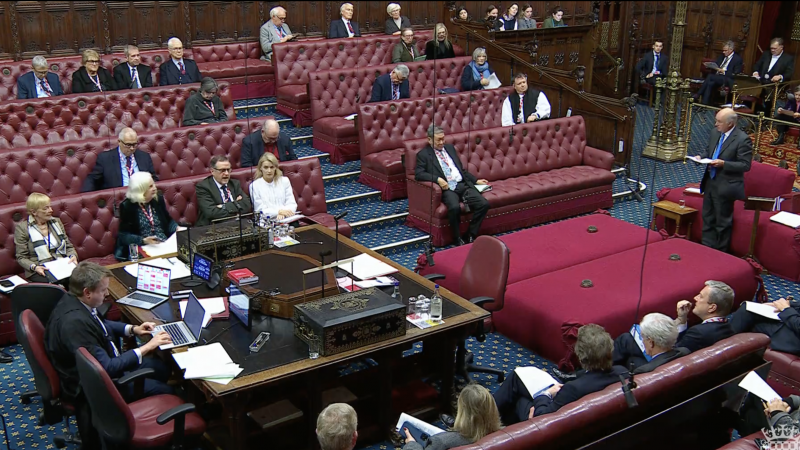
Unions have blasted Tory peers for again voting down Labour’s Employment Rights Bill in the House of Lords last night, as the “ping-pong“ between the two chambers continues.

Last month, the government ditched its election pledge to give workers day-one protection against unfair dismissal, and instead accepted a six-month qualifying period.

Alongside this, it introduced a measure to abolish the cap on compensation for unfair dismissal claims, which currently stands at £118,223 or annual salary, whichever is lower.

Yesterday, Tory peers forced a vote requiring the government to conduct a review of the cap on compensation before abolishing it.

Paul Nowak, general secretary of The Trades Union Congress, said “enough is enough”.

“Continuing to vote down the Employment Rights Bill – a clear manifesto commitment – is undemocratic. This Bill has been debated and scrutinised for months.

“Tory Peers are actively defying the will of the British public and their own supporters who overwhelmingly support measures in this Bill.”

The TUC boss added: “The unelected Lords who are holding up this landmark legislation must urgently move out the way.”

Mike Clancy, general secretary of the Prospect union, said: “The behaviour of the House of Lords can no longer be seen as constructive scrutiny and increasingly looks like cynical wrecking tactics that risk a constitutional crisis if they continue.

“Further delay is in nobody’s interests and only prolongs uncertainty, the bill must pass before Christmas including lifting the caps on compensation.”

Steve Wright, Fire Brigades Union general secretary, said: “For 14 years, the Tories hammered the living standards of working people. They are now using the unelected Lords to continue that policy. “

Wright called it “a disgraceful attempt to subvert democracy”.

He added: “The Labour government cannot allow the Tories to use their inbuilt majority in the Lords to deny workers protection against unfair dismissal and zero-hour contracts.

“There must be no more watering-down of the Bill. Keir Starmer must prioritise the urgent delivery of the legislation – and get it passed before the Christmas recess. If that means MPs must sit on a Saturday, as the Commons did during Brexit, then so be it.”

Olivia Barber is a reporter at Left Foot Forward
UK

The Institute of Economics Affairs has pocketed over £600,000 from big oil and Murdoch

12 December, 2025 

The free-market think tank has taken money from oil companies and Rupert Murdoch’s outlets while campaigning against climate action


Fossil fuel firms and Rupert Murdoch’s media companies paid anti-climate science think tank the Institute of Economic Affairs (IEA) over £640,000 between 1957 and 2005.

A new investigation by DeSmog has found that the IEA, which has campaigned for more fossil fuel extraction and against government climate action, received more than £150,000 from BP, £124,000 from Esso (owned by ExxonMobil), and £106,000 from Shell.

DeSmog has also revealed that the right-wing think tank received £164,667 in donations from News International – which Murdoch used to own – between 1991 and 2000.

Murdoch has described himself as a climate sceptic, and used his outlets to peddle climate denial.

In 2020, Murdoch’s son James criticised his outlets News Corp and Fox for describing coverage linking the Australian wildfires to climate change as “hysterical” and “silly”.

The IEA does not publicly disclose its donors, on the grounds that it respects “the privacy rights of donors”. UK think tanks are not legally obligated to declare their funding sources.

The IEA has called for increased fossil fuel extraction. It has said the ban on fracking for shale gas should be lifted, lambasted the government for banning new North Sea oil and gas licences.

It also celebrated the Conservative Party’s pledge to scrap the 2008 Climate Change Act in October, calling it “the first step back to sanity”.

“This investigation confirms one of the worst-kept secrets in Westminster,” said Ami McCarthy, Greenpeace UK’s head of politics. “This self-styled economic think tank is really a lobbying shop for the harmful and polluting industries that fund it, with fossil fuel giants chief among them.”

McCarthy added that the IEA “spent years downplaying the climate crisis while taking loads of cash from some of the world’s biggest oil and gas companies and one of its most influential climate sceptics, Rupert Murdoch.”

Olivia Barber is a reporter at Left Foot Forward


Top 10% of income-earners earn more than rest of other 90% – report shows
Today
Left Foot Forward

Wealth growth has been strongest for the world’s ultra rich.


The World Inequality Report 2026 reveals startling evidence of how steeply wealth has concentrated at the very top of the global income distribution. The report, the third of its kind, draws on research from more than 200 scholars affiliated with the World Inequality Lab and contributing to the world’s largest database tracking the historical evolution of inequality.

It shows the top 10 percent of global income earners now earn more income than the remaining 90 percent put together. Additionally, the richest 0.001 percent hold three times the wealth of the poorest half of humanity. Their share of global wealth has risen from nearly 4 percent in 1995 to more than 6 percent today. Over the same period, the wealth of multimillionaires has grown by roughly 8 percent per year, almost double the growth rate experienced by the bottom 50 percent.

“The result is a world in which a tiny minority commands unprecedented financial power, while billions remain excluded from even basic economic stability,” the authors write.

They added that while inequality had “long been a defining feature of the global economy”, by 2025 it had “reached levels that demand urgent attention.”

But the report presents evidence that inequality can be reduced when governments choose to act. Several policy areas, in particular, have shown success. It urges for public investment in education and health, that free, high-quality schools, universal healthcare, childcare, and nutrition programmes can significantly reduce early-life disadvantages and create opportunities for lifelong learning and mobility.

It argues redistribution programmes, such as cash transfers, pensions, unemployment benefits, and targeted support for vulnerable households, can directly shift resources toward the bottom of the distribution and improve living standards.

It says advancing gender equality through policies that address structural barriers, such as recognising and compensating unpaid care work and ensuring access to affordable childcare, can narrow longstanding gender gaps and broaden economic participation.

Fairer tax systems, in which those at the very top contribute at higher rates is a “powerful lever” for reducing extreme wealth concentration, say the authors.

The new findings follow an earlier 2025 report from the Fairness Foundation and researchers at King’s College London, which warned that rising wealth inequality in the UK could become a “major driver of societal collapse” within the next decade.

The study concluded the country is on a trajectory of decline, with widening wealth gaps threatening social cohesion and risking further deterioration unless meaningful interventions are adopted.

Public attitudes reflect these concerns. Nearly two-thirds of Britons now believe the very rich have too much influence over UK politics, a much higher share than those who say the same about businesses (40 percent), religious organisations (40 percent), or international bodies such as the EU and UN (38 percent).

James Perry, who participated in the Kings College study and is a member of Patriotic Millionaires UK, said:

“Wealth inequality presents a strategic risk to the UK’s economy, society, democracy and environment. The workshop organised by the Fairness Foundation and King’s College London clearly showed the breadth and depth of concern not only about the negative impacts of wealth inequality that we are already seeing, but also about the risks that these impacts could spiral out of control over the coming years. Urgent action is required.”


Tesla sales continue to plummet in UK, as Elon Musk backlash grows

11 December, 2025 

Musk, the world’s richest man, has also faced criticism for promoting far-right politics across Europe and his unwavering support for Donald Trump.


Tesla sales continue to plummet in the UK, causing yet another headache for Elon Musk, as the backlash against him for his association with Trump and the far-right grows.

According to the latest data from research group New AutoMotive, just 3,784 new Teslas were sold in November 2025, a 19% drop compared to last November, when 4,680 of the vehicles were sold.

Data from the Society of Motor Manufacturers and Traders (SMMT) showed a 17.2% year-on-year decline to 3,772 Tesla sales in the UK, lagging other legacy automakers and Chinese rivals.

It comes as Tesla faces stiff competition from cheaper Chinese competitors, as well as a backlash against Musk.

Protests outside Tesla showrooms have been taking place in the US, Australia and Europe over the past year, in response to Musk’s dismantling of the US federal government as head of the Department of Government Efficiency (Doge) which he formerly headed up.

Musk, the world’s richest man, has also faced criticism for promoting far-right politics across Europe and his unwavering support for Donald Trump.

He also recently faced condemnation for inciting violence when appearing at a rally organised by far-right thug Tommy Robinson.

He appeared via video link at the “Unite the Kingdom” rally, telling the crowd: “You’re in a fundamental situation here where whether you choose violence or not violence is coming to you. You either fight back or you die, that’s the truth.”

Basit Mahmood is editor of Left Foot Forward
Right-Wing Watch

Woke-bashing of the week: Elon Musk labels EU ‘woke Statists’ after X is fined €120m


Gabrielle Pickard-Whitehead 
Today
Left Foot Forward


For all the talk of “the people,” Musk’s position boils down to a demand that one billionaire, who’s, unelected, unaccountable, and running a global communication platform, should operate above the law. Europe, to its credit, is saying no.


Talking about throwing your toys out of the pram. After the EU imposed a €120m penalty on X for breaching the bloc’s Digital Services Act (DSA), the platform’s owner, Elon Musk, lashed out in his usual reactionary fashion. Brussels, he declared, was a “woke Stasi” that “must be abolished.”

He posted on X: “The EU should be abolished and sovereignty returned to individual countries, so that governments can better represent their people,” which rather typically ignores the fact that the EU has always ensured that ultimate sovereignty resides with the member states.

The outburst followed the EU’s two-year investigation into X’s repeated failures to comply with the EU’s Digital Services Act (DSA), which requires large online platforms to curb illegal and harmful content, from hate speech to coordinated disinformation campaigns. The objective is to prevent online environments from becoming engines of harassment, radicalisation, and large-scale deception.

But for Musk, any requirement to limit harmful content is rebranded as an existential threat to “free speech.”

Naturally, he ramped up the rhetoric, railing against Brussels’s “bureaucratic monster,” and demanding Europeans “dissolve the EU and return power to the people.” He attacked unnamed officials as “EU woke Stasi commissars,” vowed retaliation, and posted images likening the EU to the “Fourth Reich”

He then threatened that Brussels would soon “understand the full meaning of the Streisand effect, a phenomenon named for Barbra Streisand, in which efforts to censor information only bring it more attention.

EU tech chief Henna Virkkunen seemed unbothered by Musk’s theatrics. The fine, she explained, was “proportionate and calculated” based on the seriousness, scale, and duration of X’s violations.

“We are not here to impose the highest fines. We are here to make sure that our digital legislation is enforced and if you comply with our rules, you don’t get the fine. And it’s as simple as that,” she said.

But Musk was not the only American to take up the mantle of EU-bashing. US Secretary of State Marco Rubio declared the fine to be “an attack on all American tech platforms and the American people by foreign governments.”

Federal Communications Commission chairman Brendan Carr said Europe was punishing X merely “for being a successful US tech company.” And Vice President JD Vance repeated the right’s tired talking point that the EU should be “supporting free speech,” not “attacking American companies over garbage.”

Critics have also compared the DSA to the UK’s Online Safety Act, warning of creeping censorship.

In a statement in the summer, X said: “Many are now concerned that a plan ostensibly intended to keep children safe is at risk of seriously infringing on the public’s right to free expression.”

Yet these laws do not grant governments power to police opinions. They require platforms to stop amplifying illegal content and to maintain basic transparency about how their systems operate. Far from throttling democracy, they aim to protect it from manipulation and abuse.

The louder Musk rails against “woke tyranny,” the clearer it becomes that his real objection is to oversight itself. For all the talk of “the people,” Musk’s position boils down to a demand that one billionaire, who’s, unelected, unaccountable, and running a global communication platform, should operate above the law.

Europe, to its credit, is saying no.

EU says it will ‘make sure’ Elon Musk pays €120 million X fine
9 December, 2025 
Left Foot Forward

The EU Commission has fined X over its "deceptive" blue-check badge system

The European Commission has insisted Elon Musk’s X will have to pay a €120 (£105) million fine for violating EU transparency rules.

The Commission has called Musk’s blue-check badge system ‘deceptive’ and noted that paid verification makes users more vulnerable to counterfeits and fraud.

The Commission issued the penalty for breaches of transparency and deceptive design obligations under the EU’s Digital Services Act on Friday.

X was also fined for a lack of transparency around its advertising practices. Under the Act, platforms must have a public and searchable ad repository to allow anyone to see what ads have run and who funded them.

The EU Commission also found X is limiting researchers from accessing data that should be publicly available.

The US government, Musk and his allies have claimed that this is “censorship” and an “attack on freedom of speech”, with some suggesting the world’s richest man should not pay the fine.

Musk himself threatened to take action against the EU and other “individuals” on Saturday.

However, Thomas Regnier, a Commission spokesperson told journalists: “X will have to pay that fine. The €120 million will have to be paid. We will make sure that we get this money”.

The company now has to pay the fine and has 90 days to respond to the EU Commission.

Veronika Cifrová Ostrihoňová, MEP for the Progressive Slovakia party, wrote on X: “Historic first fine under the #DSA — and a clear signal to Big Tech: in Europe, rules apply to everyone, even billionaires.

“If oligarchs such as Elon Musk think this is “censorship”, they might want to learn how European democracy works. And what does it actually mean the freedom of speech.”

Olivia Barber is a reporter at Left Foot Forward
Islamabad puts drivers on notice as smog crisis worsens

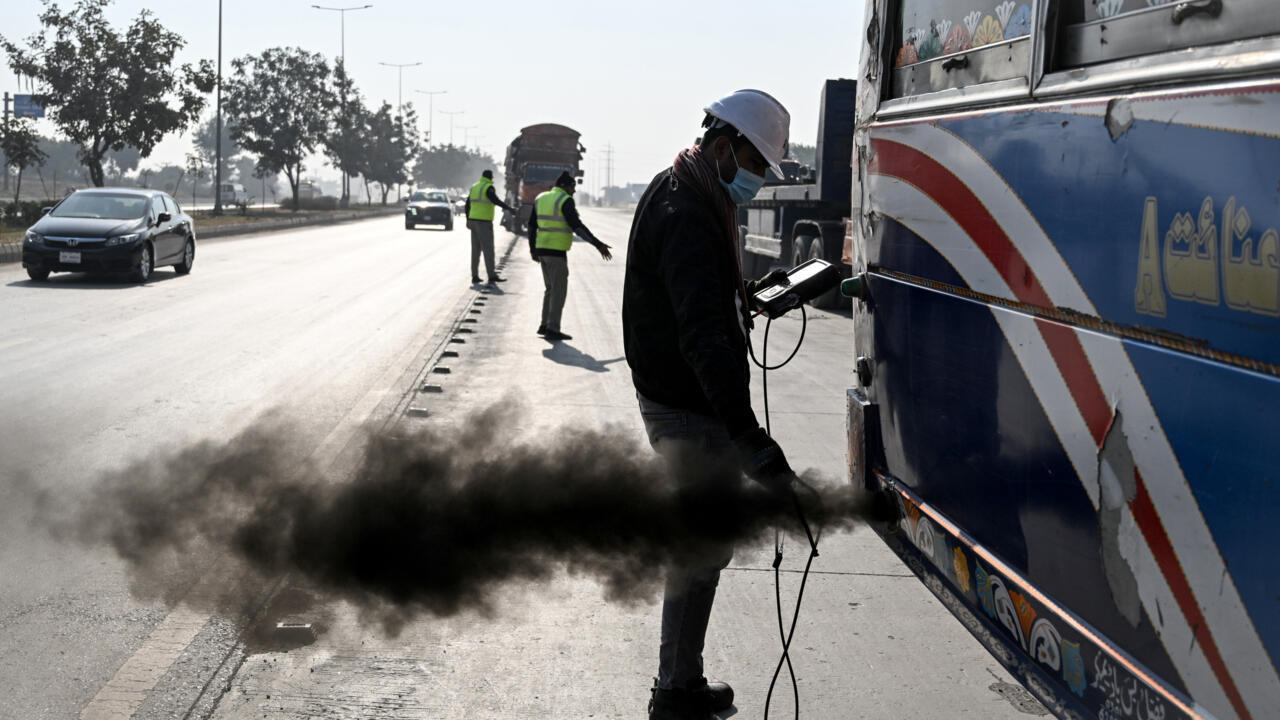
Islamabad (Pakistan) (AFP) – Truck driver Muhammad Afzal was not expecting to be stopped by police, let alone fined, as he drove into Islamabad this week because of the thick diesel fumes emanating from his exhaust pipe.


Issued on: 14/12/2025 - FRANCE24

A technician examines a vehicle to test its emissions on road, at a checkpoint on the outskirts of Islamabad © Aamir QURESHI / AFP


"This is unfair," he said after being told to pay 1,000 rupees ($3.60), with the threat of having his truck impounded if he did not "fix" the problem.

"I was coming from Lahore after getting my vehicle repaired. They pressed the accelerator to make it release smoke. It's an injustice," he told AFP.

Checkpoints set up this month are part of a crackdown by authorities to combat the city's soaring smog levels, with winter months the worst due to atmospheric inversions that trap pollutants at ground level.

"We have already warned the owners of stern action, and we will stop their entry into the city if they don't comply with the orders," said Dr Zaigham Abbas of Pakistan's Environmental Protection Agency (EPA), as he surveyed the checkpoint at the southeast edge of the capital.

Air pollution in Islamabad © Nicholas SHEARMAN / AFP


For Waleed Ahmed, a technician inspecting the vehicles at the site, "just like a human being, a vehicle has a life cycle. Those that cross it release smoke that is dangerous to human health".
'Self-inflicted crisis'

While not yet at the extreme winter levels of Lahore or the megacity Karachi, where heavy industry and brick kilns spew tons of pollutants each year, Islamabad is steadily closing the gap.
The Shah Faisal Mosque engulfed in dense smog due to severe air pollution in Islamabad © Aamir QURESHI / AFP


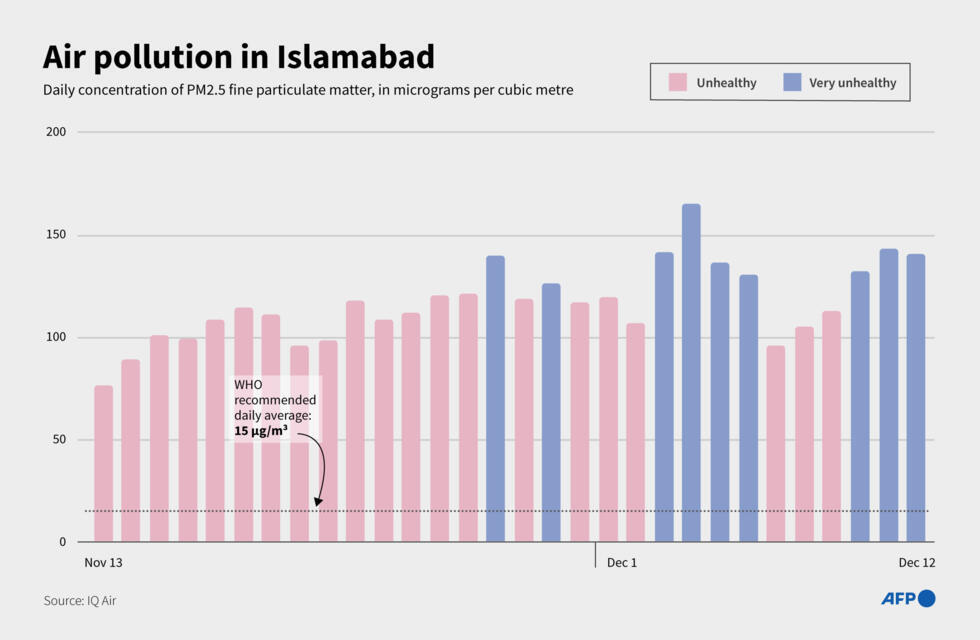
So far in December it has already registered seven "very unhealthy" days for PM2.5 particulates of more than 150 microgrammes per cubic meter, according to the Swiss-based monitoring firm IQAir.

Intraday PM2.5 levels in Islamabad often exceed those in Karachi and Lahore, and in 2024 the city's average PM2.5 reading for the year was 52.3 microgrammes -- surpassing the 46.2 for Lahore.

Those annual readings are far beyond the safe level of five microgrammes recommended by the World Health Organization.

Built from scratch as Pakistan's capital in the 1960s, the city was envisioned as an urban model for the rapidly growing nation, with wide avenues and ample green spaces abutting the Himalayan foothills.

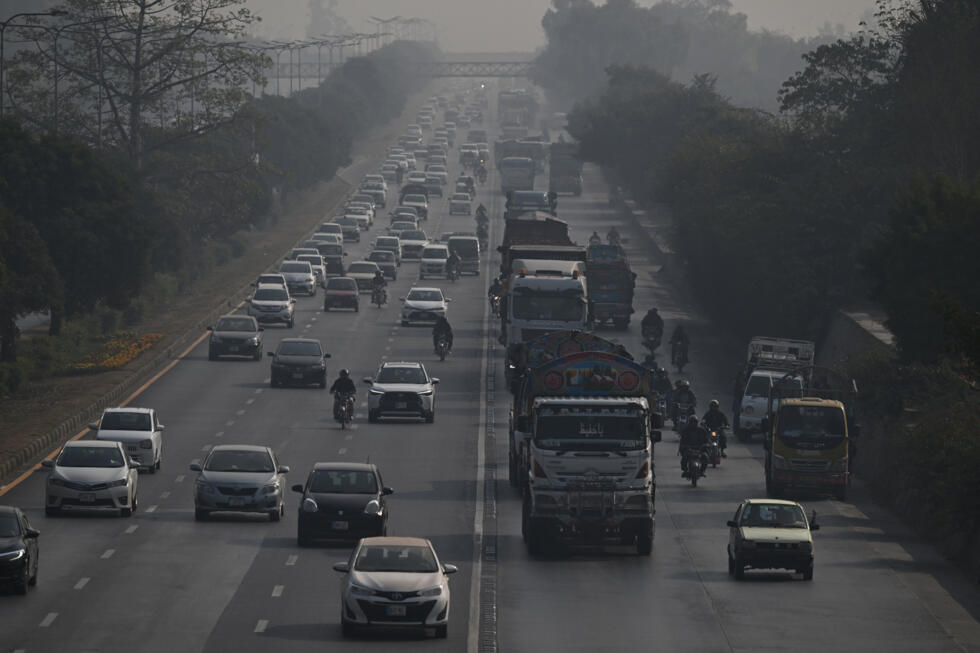
But the expansive layout discourages walking and public transport remains limited, meaning cars -- mostly older models -- are essential for residents to get around.

"The capital region is choked overwhelmingly by its transport sector," which produces 53 percent of its toxic PM2.5 particles, the Pakistan Air Quality Initiative, a research group, said in a recent report.

"The haze over Islamabad... is not the smoke of industry, but the exhaust of a million private journeys -- a self-inflicted crisis," it said.
'Her basic right'

Announcing the crackdown on December 7, EPA chief Nazia Zaib Ali said over 300 fines were issued at checkpoints in the first week, with 80 vehicles impounded.

"We cannot allow non-compliant vehicles at any cost to poison the city's air and endanger public health," she said in a statement.

Fumes from rickety vehicles are blamed for the smog affecting the Pakistan capital © Aamir QURESHI / AFP


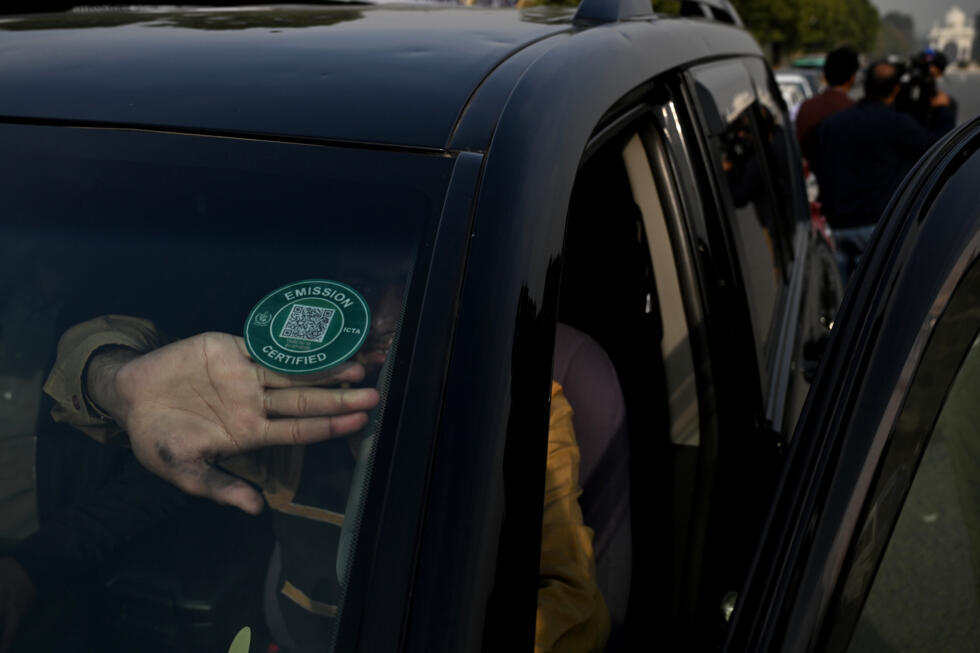
The city has also begun setting up stations where drivers can have their emissions inspected, with those passing receiving a green sticker on their windshield.

"We were worried for Lahore, but now it's Islamabad. And that's all because of vehicles emitting pollution," said Iftikhar Sarwar, 51, as he had his car checked on a busy road near an Islamabad park.

"I never needed medicine before but now I get allergies if I don't take a tablet in the morning. The same is happening with my family," he added.

A technician pastes a certified sticker on a car after it cleared an emissions test in Islamabad © Aamir QURESHI / AFP


Other residents say they worry the government's measures will not be enough to counter the worsening winter smog.

"This is not the Islamabad I came to 20 years ago," said Sulaman Ijaz, an anthropologist.

"I feel uneasy when I think about what I will say if my daughter asks for clean air -- that is her basic right."

© 2025 AFP