Friday, February 13, 2026


Japan Arrests Chinese Trawler for Refusing a Fishery Inspection
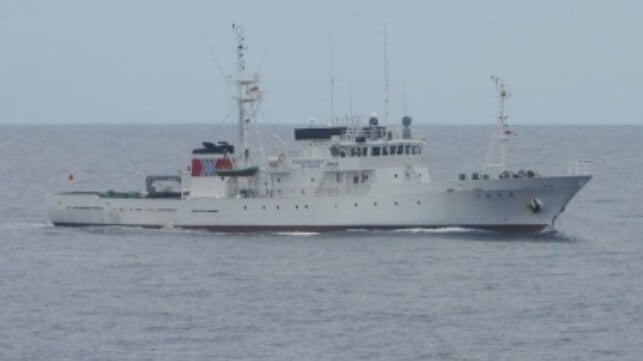
A Japanese fishery patrol vessel (file image courtesy Japanese Embassy in Palau)

Published Feb 12, 2026 8:36 PM by The Maritime Executive


Japanese authorities have boarded and detained a Chinese fishing boat in the East China Sea, the first time that Japan has conducted an at-sea arrest of a Chinese fishing vessel in years.

On Thursday, Japanese fisheries control agents attempted to intercept and board a Chinese trawler at a position about 100 nautical miles south of Goto. The vessel attempted to flee, according to the Fisheries Adjustment Office for Kyushu. It was intercepted and boarded, and the master - identified as Qian Nianli, 47 - was arrested on allegations of violating Japan's Fisheries Sovereignty Act for refusing to allow an inspection within the Japanese EEZ. 

Japanese forces have clashed with the Chinese fishing fleet before. In 2010, a Chinese trawler collided with Japan Coast Guard cutters during a hot pursuit in waters near the disputed Senkaku Islands, a frequent flash point off the coast of Taiwan. The fishing boat's captain was detained, angering Beijing and prompting the suspension of several high-level diplomatic events. In the end, the captain and crew were allowed to return to China without criminal charges filed. 

The Chinese fishing fleet is a frequent source of friction with China's neighbors and nations overseas. EEZ incursions involving Chinese vessels are a regular occurrence in some parts of the world - notably waters off Argentina - and China's state-sponsored maritime militia is a constant presence within Philippine waters of the South China Sea. Methods of enforcement vary, depending upon the state of diplomatic relations between the affected nation and China; past deterrent methods have spanned the full range from administrative warnings to boardings to vessel arrests, and (rarely) kinetic engagements for noncooperative vessels. 

Diplomatic ties between China and Japan are at an ebb. Beijing is displeased with Japanese Prime Minister Sanae Takaichi stance in favor of a more assertive, well-armed Japanese military and a clearer commitment to the defense of Taiwan; the fishing-vessel detention will likely elicit an unfavorable response from China in the days ahead. 


Japan moves against Chinese vessel as tensions come to the boil

Japan moves against Chinese vessel as tensions come to the boil
/ Knut Troim - Unsplash
By Mark Buckton in Taipei February 13, 2026

Japan has seized a Chinese fishing vessel operating inside its exclusive economic zone off Nagasaki in the south west of the country, in the latest flashpoint in what is becoming an increasingly combustible maritime stand-off with Beijing.

According to Japan’s fisheries agency, the boat attempted to flee after being ordered to halt for inspection on February 12. It was intercepted and its 47-year-old Chinese captain arrested local Japanese sources report. Eleven crew members on board were also detained. Officials described the craft as a high-capacity tiger net fishing vessel, a method often criticised for its industrial scale and environmental impact.

More important that the actual fishing method, however, is the fact that the seizure marks the first time since 2022, that Tokyo has detained a Chinese fishing boat in its waters a BBC report adds - a sign that enforcement is hardening as patience with Beijing’s grey-zone tactics wears thin.

The incident itself unfolds against a backdrop of sharpening rivalry and increased tensions between Japan and China. Friction has intensified since Prime Minister Sanae Takaichi signalled in November that Tokyo would not stand idly by if China attempted to seize neighbouring Taiwan by force. The remark triggered an expected level of orchestrated fury in Beijing, which summoned Japan’s ambassador and warned Chinese citizens to reconsider travel and study in Japan the report adds.

At the heart of much of the recent tension lies Taiwan which is claimed by the Chinese Communist Party as sovereign territory despite being run as a self-governed country and fully functioning democracy with its own currency since 1949. Regardless, Beijing has refused to rule out the use of force to achieve what the CCP calls ‘reunification’ although Taiwan has never been a part of China. For Japan, whose southwestern islands including Yonaguni lie just a short distance from Taiwan, the prospect of conflict is seen as a threat.

Chinese maritime aggression in the region in recent years has increasingly tested the boundaries of international law across the East China Sea and down into the South China Sea. Fishing fleets accompanied by coastguard cutters and quasi-militia vessels have been deployed by Beijing in ways that blur the line between civilian and state-backed operations.

Japan, like Taiwan and several Southeast Asian states including the Philippines, Vietnam and Malaysia, argue that such activity amounts to incremental coercion as China probes responses, normalises its presence and erodes established norms without triggering open conflict.

To this end, Tokyo’s latest action signals that it is no longer prepared to treat Chinese incursions as routine irritants and officials in Tokyo have now indicated that enforcement against illegal fishing by foreign vessels will remain firm.

Beijing has yet to issue a formal response to the seizure sources say, but is expected to claim accidental intrusion into Japanese waters as is often the case. In previous disputes of a similar nature, China has combined diplomatic protest with economic signalling – the most recent example of this being after Takaichi’s Taiwan comments, when Chinese authorities escalated rhetorical pressure and issued travel warnings.

The result was a marked drop in Chinese tourism to Japan which hit retail and hospitality stocks.

already grappling with fragile post-pandemic recovery.

Japanese performers touring China have seen shows cancelled, while releases of Japanese films have reportedly been delayed.

For policymakers in Tokyo though, the pattern of baiting its neighbours and threatening economic penalties if they respond used by China is all too familiar.


 

Pan Ocean Moves to Expand Tanker Ops as Korea’s SK Exits Wet Tankers

SK Shipping very large crude oil tanker
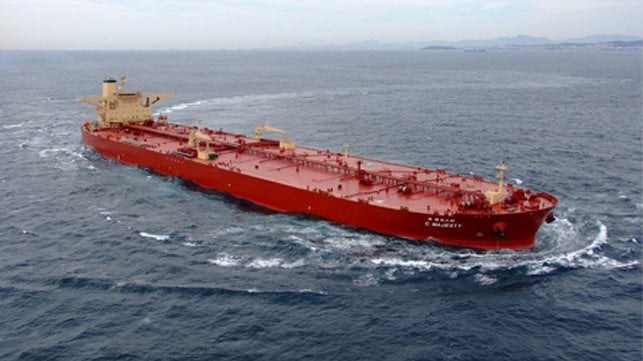
SK is selling 10 of its Very Large Crude Carriers (VLCCs) to Pan Ocean along with the existing contracts (SK Shipping file photo)

Published Feb 12, 2026 8:54 PM by The Maritime Executive


The tanker market continues to consolidate as Pan Ocean reported it has agreed to pay approximately $668 million to acquire the tanker segment of SK Shipping. Tankers had provided the historic starting point for SK Shipping in 1982 and continue to be a stable long-term business with strong contracts.

Pan Ocean reports it will acquire the segment, which consists of 10 VLCCs. The delivery of the last of the vessels is currently scheduled to be not later than April 2027.

Along with the tankers, Pan Ocean will take over the existing contracts for the vessels. It reports that the ships operate under long-term crude transport contracts with major domestic companies.

The sale of the business marks a key milestone in the turnaround of SK Shipping’s operations. Control of the company was acquired in 2018 by Hahn & Company, South Korea’s largest private equity firm. The investors reportedly paid $1 billion for just over 83 percent of the outstanding stock of the shipping company.

Hahn highlights its strategy for SK, focused on shifting the company away from segments highly sensitive to freight rate volatility toward more stable operations. In addition to the long-term crude oil transport contracts for the tankers, the company has LNG carriers and dry bulk carriers. It developed relationships with Qatar Energy, Malaysia's Petronas, and other high-quality domestic and international shippers. It got into the LNG transport business in 1994, and reports indicate the company currently has a fleet of approximately 30 ships. 

Since the acquisition, Hanh reports SK has been transformed into one of the most profitable global shipping companies. Operating profits reportedly surged more than fivefold.

Hahn had been exploring several exit routes for its investment. Reports appeared in the Korean media early in 2025 that negotiations were underway with HMM for the acquisition of the business. As part of its diversification strategy and efforts to build the non-container segments of its business, HMM was negotiating for the tankers and dry bulk carriers. HMM has a non-compete on the LNG segment with Hyundai Merchant Marine’s former LNG business, which was sold during the reorganization of the company. HMM, however, confirmed in August 2025 that the talks had broken down with SK Shipping.

According to the media reports from Korea, SK Shipping is saying that it will use the proceeds from the sale of the VLCCs to secure “new growth drivers and strengthen its future business portfolio.” It is unclear, however, if Hahn intends to continue to seek buyers for the remaining segments of the business.


IMO Ramps Up Campaign to Close Flag State "Enforcement Gap"

IMO flags
IMO file image

Published Feb 12, 2026 11:06 PM by The Maritime Executive


The IMO is doubling down on a campaign to get more member states up to speed with enforcement of international shipping regulations, using a supportive approach to encourage better adherence amongst flag state and port state authorities. 

The gap between policy and practice found at the bottom end of the global fleet - notably the "shadow fleet" of sanctions-busting tankers - makes regular headlines, and IMO is aware that the legitimacy of its international rules rests in large part upon enforcement. The agency has no statutory authority to enforce regulations directly, nor the resources to do so, and it has to rely upon flag state and port state authorities to fulfill its one-of-a-kind global mandate: to set minimum bounds for safety and environmental performance for an entire industry.

At present, the real-world minimum bounds vary by nationality, as seen on the annual Paris MOU and Tokyo MOU flag rankings. IMO can't penalize its member states for poor adherence to the rules, but it can advise member states' agencies on how to do the job, and it evaluates their performance with an audit system. 

"Audits conducted under the IMO Member State Audit Scheme (IMSAS) have found gaps in national laws and enforcement in some countries," IMO acknowledged in a statement Wednesday. "Those gaps weaken regulations and increase the risk of noncompliance and unsafe shipping."

For the next two years, IMO plans to put a focus on member state adherence to the rules. This starts with capacity building and technical cooperation, using the IMO's existing offices to work with countries that need help implementing the conventions. Small island developing states and least developed countries - the jurisdictions where the least-compliant open shipping registries may be found - will get an early focus. (It is not just about the downsides: IMO plans to highlight achievements, too.) The IMSAS audits will be used to evaluate states and drive improvements. 

IMO plans to take measures to combat fraudulent ship registration, the practice of a vessel claiming the use of a flag without authorization - often the flag of a nation without a shipping registry. 

"To make the maritime industry truly sustainable, we must ensure these high standards are felt in every port and on every deck - not selectively, not unevenly, but globally. IMO is committed to powering this transition through technical cooperation and direct support," IMO Secretary-General Arsenio Dominguez said in a statement. 

IMO has dedicated the next two World Maritime Days to the campaign, and will be highlighting efforts to close the enforcement gap with events, social media and outreach throughout the period. 


Despite Salvage Attempt, Spanish Fishing Vessel Sinks in Severe Storm

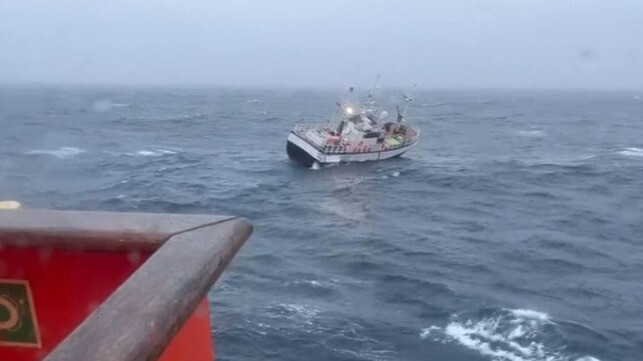
Itoitz as seen from the rescue vessel Maria Pita (Salvamento Maritimo)

Published Feb 12, 2026 11:27 PM by The Maritime Executive


An attempt to tow the stricken Spanish longliner Itoitz to safety failed when the towline parted, and the vessel has disappeared in worsening storm conditions, according to Spanish rescue authorities. 

At about 1050 hours on Monday morning, the Salvamento Maritimo rescue center in A Coruña received a distress call on VHF from a good Samaritan fishing vessel. The crew reported that they had just rescued seven people from another fishing vessel, the Itoitz, which had taken on a severe list. All seven survivors were medevaced by helicopter and delivered safely to A Coruña's local airport. No injuries were reported.

On Monday, an initial attempt to deliver a salvage crew to the fishing vessel's deck by helicopter had to be abandoned because high winds and heavy seas made the insertion unsafe. Under the direction of the Ferrol Maritime Captaincy, the response vessel Maria Pita was dispatched to the scene to provide an escort and evaluate the potential for towage. Conditions were rough: by Tuesday, winds exceeded 30 knots and wave heights were recorded up to 20 feet, too severe for the response vessel to approach Itoitz safely. Wave height moderated somewhat overnight, and Maria Pita's crew attempted to rig a tow line at about 1000 hours on Wednesday, Salvamento Maritimo sources told La Voz de Galicia. The line parted, leaving the vessel adrift once again.

Maria Pita returned to port and was replaced by the rescue tug Alonso de Chaves on scene. Weather conditions deteriorated once more as Itoitz continued to drift, now roughly 40 nautical miles to the north of Ribadeo. 

Conditions on scene Thursday (Salvamento Maritimo)

At about 2200 hours on Wednesday night, Itoitz ceased transmitting on AIS and its EPIRB beacon activated, as would be expected in the event of a sinking. The rescue tug Alonso de Chaves located the EPIRB afloat on Thursday afternoon, unattached to the Itoitz, indicating that the fishing vessel was likely lost. 

Here’s what the average asking rent in Canada was in January

ByThe Canadian Press
February 09, 2026 

A realtors sign advertises a house as for sale or for rent, in Ottawa. 
THE CANADIAN PRESS/Adrian Wyld

Asking rents in Canada fell two per cent year-over-year in January to an average of $2,057, marking the 16th consecutive month of annual rent decreases.

A report from Rentals.ca and Urbanation says that rents fell to their lowest level in 31 months in January and were down 6.3 per cent compared with two years ago — but that’s were still 12.9 per cent higher than levels before the COVID-19 pandemic.

The report says lower rents and a softer market helped improve affordability, with the average rent-to-income ratio falling slightly below 30 per cent in January for the first time in six years.

“There has been a meaningful improvement in affordability for renters in Canada, proving that more supply brings down costs,” said Shaun Hildebrand, president of Urbanation, in a news release.

“This should help draw more renters into the market this year, even as the population (growth) slows.”
A "For Rent" sign is posted outside a home in Toronto, Tuesday, July 12, 2022. THE CANADIAN PRESS/Cole Burston

The report says shrinking unit sizes have also contributed to the decrease in average rents over the past two years. The average size of rental listings fell to 857 square feet in January, from 885 square feet last year.

Asking rents for condo units fell 5.7 per cent annually to $2,093 on average, while rents for houses and townhouses fell 3.1 per cent to $2,078.

Rents for purpose-built units declined one per cent year-over-year to $2,049.

By unit type, three-bedroom rentals were the only segment to see an increase in prices, rising 1.1 per cent annually to an average of $2,506. Within the purpose-built segment, three-bedroom rental prices grew 3.9 per cent over the past year, reaching an average price of $2,756.

Across provinces, average apartment rents declined the most in B.C. at 4.7 per cent, 4.3 per cent in Alberta, 3.3 per cent in Ontario and 2.6 per cent in Quebec.

Meanwhile, all six of Canada’s largest rental markets saw annual rents decline last month. The report said apartment rents in Vancouver fell 9.2 per cent year-over year to $2,630. Calgary rents declined 5.7 per cent to $1,815 and Toronto rents declined 4.6 per cent to $2,495.

Rents in Ottawa declined 4.8 per cent during the period, 3.7 per cent in Montreal and 2.6 per cent in Edmonton.

Daniel Johnson, The Canadian Press


Montreal company recognized for AI tool to track whales from space

ByDaniel J. Rowe
Published: February 12, 2026 

A pod of narwhals surfaces in northern Canada in this August 2005 file photo provided by the National Oceanic and Atmospheric Administration. Canadian researchers are using tracking technology to learn from ocean animals. (Kristin Laidre/ The Canadian Press)

A Montreal company is being recognized for a second time for an AI-powered system that monitors whales and other marine mammal populations from space.

Whale Seeker’s Cetus is among UNESCO’s International Research Centre on Artificial Intelligence (IRCAI) top 100 projects, which includes AI programs in education, finance, agriculture, climate and other milieus.

The project has been described as “outstanding.”

“Cetus, an AI solution by Whale Seeker, revolutionizes whale conservation with satellite-based detection technology,” the IRCAI says on its site. “By harnessing AI and high-resolution satellite imagery, Cetus accurately detects and classifies whales for global monitoring.”

What does it do?


Cetus uses AI and satellite imagery to spot and classify massive marine mammals across vast and often remote ocean regions, “areas that can be difficult or impossible to cover with traditional aircraft or vessel-based surveys.”


The startup says that it will help governments, NGOs and maritime operators design protection measures and “make better, evidence-based decisions.”

A “Whale Seeker Certified Routes” initiative will thus help create mammal-safe shipping routes, which will use the Cetus platform to analyze risk-reduced routes.

“This problem of knowing in a precise space and time where those marine animals are is important for, yes, conservation, marine protected area management, but also for shipping, also for fishing,” said Tissier. “What we discovered is that we really need to look if you want to have an impact on the ocean. We need to take these tools that we’ve been using but develop a system and a community around them.”


‘Meaningful validation’

Whale Seeker CEO Emily Charry Tissier called the designation “a meaningful validation of our approach: building ethical, scalable AI that can be used in the real world to better protect marine mammals.”

“We’re particularly proud to be on this list because they’re looking at the ethical rigour as well as the technical rigour,” she told CTV News. “Being the first certified B Corp in the world to use AI in service of wildlife, we’ve maintained that. We’ve gotten recertified. We’re maintaining those ethical standards as well as the technical ones. And so we’re particularly proud to be recognized for that.”

B Corp certification means that the business meets the highest standards in social and environmental performance, public transparency and legal accountability.

Tissier was among the 100 brilliant women on the Women in AI Ethics (WAIE) list in 2023. She, along with biomedical engineer Antoine Gagné-Turcotte and field biologist Bertrand Charry, founded Whale Seeker in Montreal in 2018 to bridge “the divide between profitability and sustainability by making marine mammal detection fast, accurate, and accessible.”

Tissier explained that Whale Seeker is a signatory on the Montreal Declaration for Responsible AI. The company works to be energy efficient, diligent in acquiring images, treats employees fairly and ensures their clients use their tools appropriately.

“We work in industries that can do some harm to the environment through the actions that they’re doing (mining, off-shore drilling etc.), but we’re there to make sure that that harm is minimized and is documented, and we make sure that everyone is following the rules,” said Tissier.

It is the second time the Montreal start-up has found itself on the list.

Its 2022 aerial image analysis tool Möbius was also designated as “outstanding.”


Daniel J. Rowe

CTV News Montreal Digital Reporter

Reopening of trade negotiations a sign of hope for Canadian businesses

ByAdrian Ghobrial
February 11, 2026 

Adrian Ghobrial gauges reactions from businesses that could be affected by the opening of the Gordie Howe Bridge by U.S. President Donald Trump being blocked.

WINDSOR, Ont. - For months, trade negotiations between Canada and the United States have been stalled. This week that all changed when U.S. President Donald Trump announced negotiations were back on.

During his social media tirade about Windsor, Ont.’s Gordie Howe Bridge, and a list of other perceived transgressions, Trump wrote on his Truth Social page, “I will not allow this bridge to open until the United States is fully compensated for everything we have given them, and also, importantly, Canada treats the United States with the Fairness and Respect that we deserve. We will start negotiations, IMMEDIATELY.”

While Trump’s political speed bump threatens to derail the planned opening of the commercial corridor, some industry leaders see an opening to accelerate negotiations.

“Trade conversations have now restarted, a few weeks ago conversations weren’t happening between U.S. and Canada they were stalled. I see this as a positive,” says Executive Director of the Canadian Association of Moldmakers Nicole Vlanich.

Vlanich adds that Trump’s most recent outburst doesn’t surprise her -- even though during his first term, Trump supported the project.

A joint statement released by Trump and then-prime minister Justin Trudeau in February 2017 in part said that the two “look forward to the expeditious completion of the Gordie Howe International Bridge, which will serve as a vital economic link between our two countries.”

Vlanich agrees with that statement.

“The 2017 statement was correct, they were right, the bridge is vital. We need this second bridge, we’ve talked the importance of this bridge for over twenty years,” adds Vlanich.

Indeed, business leaders and residents in Detroit are urging the Gordie Howe International Bridge to move forward as planned, calling the project a symbol of cross-border co-operation.

Political leaders in Windsor-Essex and Michigan also say they’re united by a common goal.

“It is a really important part of our economy, the largest (commerce) crossing in North America, and so it is important that (the Gordie Howe Bridge) continues to move forward and open up on time,” said Michigan Gov. Gretchen Whitmer while answering questions at a high school in her hometown of Lansing, Mich. this week.

It’s a sentiment that echoes across the Detroit River, where Windsor’s mayor rightly points out that his city “is home to the busiest commercial border crossing between Canada and the United States, and we’re each others largest trading partners,” says Mayor Drew Dilkens, who’s called Trump’s claims about the bridge deal are “insanity and inaccurate.”

Any delay to opening the bridge would add further strain to the two border city economies on either side, according to local business leaders who spoke to CTV News.

“When we think about job growth, and potential on both side of the Canada-U.S. border, it would delay growth, it would delay our ability to increase capacity,” says Vlanich.

The bridge is expected to be an economic driver for Windser-Essex, the region already sees $1 billion in trade flow through each day, while also creating a smooth commercial alternative for trucks hauling goods that can often be stuck in long lines at the old Ambassador Bridge.

“If there’s an issue with one bridge, trucks can go and use the other one which will help with traffic delays. As someone who’s lived here my whole life I can tell you that delays on the Ambassador Bridge are a regular occurrence,” adds Vlanich.


With Trump restarting trade negotiations that he once brought to a screeching halt, business leaders in Windsor hope this will be an important first step towards paving a clearer picture for economic growth for both the Canadian and U.S. economies that relay on border trade.

One thing that does appear clear to those who spoke to CTV News, the Gordie Howe Bridge is being used as leverage by Trump to negotiate and push his America-first agenda.


Adrian Ghobrial

Senior Correspondent, CTV National News
NAFTA 2.0
Better to have separate U.S., Mexico agreements if CUSMA collapses: trade lawyer

ByAnam Khan
Published: February 12, 2026 

Lawrence Herman, international trade lawyer at Cassidy Levy Kent LLP, joins BNN Bloomberg to discuss the likelihood of U.S. ending CUSMA.

Separate bilateral agreements could still be beneficial if the Canada-United States-Mexico Agreement (CUSMA) falls apart, explains an international trade lawyer.

His comments come after reports that U.S. Trade Representative Jamieson Greer suggested this week that the U.S. is considering negotiating separate trade deals with the two countries rather than maintaining the trilateral pact up for review on July 1.

The possibility of this even happening was envisaged from the very start, when there were talks of CUSMA coming under review, Lawrence Herman, international trade lawyer at Cassidy Levy Kent LLP, told BNN Bloomberg.

Herman said separate bilateral deals would not be easy, but could be done.

“There are a lot of provisions in the CUSMA that could be used in a bilateral agreement with Canada, as well as a separate bilateral agreement with Mexico,” said Herman.

‘We will have an aggressive partner on the other side’

Negotiations will be difficult whether they are three-party or bilateral between Canada and Mexico, said Herman.

“The point is, we will have an aggressive partner on the other side,” said Herman.

“I think Canada has to be prepared to say, you know, these are the red lines, and there are certain things that Canada cannot accept.”

At the end of the day, he said Canada must decide how much longer it can remain at the table if the other party is unwilling to reach a mutually satisfactory arrangement.

“The priority is to ensure that we get out from this volatile, uncertain, unstable relationship,” said Herman.

He also said many major companies in the U.S. are dependent upon free trade and fair trade with Canada, highlighting Michigan Governor Gretchen Whitmer’s recent pushback after U.S. President Donald Trump threatened to block the opening of the Gordie Howe International Bridge. She called it “a really important part of our economy.”

‘Canada has been regrettably wedded to the U.S. market’


Canada has opportunities to expand in other markets, and the government has been looking at those opportunities to diversify its trade, but the reality is, “Canada has been regrettably wedded to the U.S. market,” said Herman.

“It is always a bad business practice to be so dependent on one customer, because that customer can turn ornery, as this customer, the U.S. has done so,” said Herman.

“There are so many things that tie Canada and the U.S. together that I cannot see things going forward without some kind of agreement.”

Canada is already in another agreement with Mexico


Herman noted that Canada and Mexico already have a trade agreement outside of CUSMA called the Comprehensive and Progressive Agreement for Trans-Pacific Partnership (CPTPP), which includes 11 Pacific Rim countries. The U.S. withdrew from the original agreement in 2017.

“Mexico is party to the CPTPP, and so there would be an ongoing arrangement between Canada and Mexico,” said Herman.

He also said it would be better to have a straight bilateral agreement if the whole trilateral CUSMA falls apart.


Anam Khan

Journalist, BNNBloomberg.ca


Former U.S. State Department official optimistic CUSMA will be renewed

ByThe Canadian Press
 February 11, 2026 

A lapel pin featuring the flags of Mexico, the United States, and Canada, is seen on the jacket of a speaker at the 2024 North American Manufacturing Conference, in Ottawa, on Wednesday, Nov. 20, 2024. THE CANADIAN PRESS/Justin Tang

CALGARY — A former U.S. State Department official says he’s optimistic the Canada-U.S.-Mexico free trade agreement will be renewed.

Edward Fishman, author of “Chokepoints: American Power in the Age of Economic Warfare” shared his outlook during a luncheon hosted by the University of Calgary’s Haskayne School of Business.

The Columbia University adjunct professor says he can imagine Canadians feel like “sitting ducks” as their closest trading partner bombards adversaries and allies alike with tariff threats.

But he says the trading relationship doesn’t just flow one way and the U.S. would suffer significant economic harm if trade with Canada were to be cut off.

Fishman says U.S. political and business leaders — even those with a conservative bent — feel strongly about the importance of cross-border trade and are likely to temper President Donald Trump’s daily whims.

He says the countries that have been best able to withstand U.S. tariffs have been the ones that have shown the most resolve, resilience and willingness to retaliate, citing India, Brazil and China as examples.

This report by The Canadian Press was first published Feb. 11, 2026.

Lauren Krugel, The Canadian Press


‘He says different things at different times’: Hillman on whether Trump wants to keep CUSMA

By Spencer Van Dyk
February 08, 2026 
Former Canadian ambassador to the U.S. Kirsten Hillman. (Allen McInnis)

Amid a year-long trade war, Canada’s outgoing ambassador to the United States says she doesn’t know whether U.S. President Donald Trump hopes to keep the Canada-U.S.-Mexico Agreement (CUSMA) in place, because his messaging around the deal has been inconsistent.

The agreement, inked during Trump’s first term, is up for review this year. In 2018, Trump called it the “most modern, up-to-date, and balanced trade agreement in the history of (the United States),” but just last month called it “irrelevant.”

“I don’t think I can answer that question,” Kirsten Hillman told CTV Question Period host Vassy Kapelos in an interview airing Sunday, when asked if she believes Trump wants to keep CUSMA in place.

“I think if the president has a strong view around the U.S. being able to do more itself, how that translates with respect to this treaty, I don’t know,” she added. “He says different things at different times.”

U.S. President Donald Trump, left, pumps his fist as he is greeted by Kirsten Hillman, Canadian Ambassador to the United States, right, as he arrives in Calgary, Alta., Sunday, June 15, 2025, to attend the G7 Leaders meeting taking place in Kananaskis. THE CANADIAN PRESS/Jeff McIntosh

The U.S. and Canada remain in the throes of a trade war, which began last February when Trump imposed a slate of sweeping tariffs on Canadian imports.


Hillman, meanwhile, announced in December she would be stepping down as ambassador to the United States. She has represented Canada in D.C. for nearly six years and played a lead role in the renegotiation of the North American Free Trade Agreement (NAFTA) before that.

“I think for Canada, what’s important is that we just keep working consistently with those — and there are so, so many of them in all three countries — that understand factually why that treaty keeps American business more competitive, creates more jobs and keeps their economy in a good place,” Hillman said of the future of CUSMA. “And I think that a lot of people are getting that message to the president.”

Goldy Hyder, President and Chief Executive Officer of the Business Council of Canada, makes remarks at the Canadian Global Affairs Institute Procurement Conference, in Ottawa, on Monday, Nov. 25, 2024. THE CANADIAN PRESS/Justin Tang

In an interview for CTV Question Period last month, Business Council of Canada president and CEO Goldy Hyder said he’s optimistic, based on his dealings with U.S. officials and business leaders, that CUSMA can be salvaged despite recent rhetoric.

“Yes, there’s a lot of noise; it’s not straight line,” he said. “Yes, it’s going to be complicated to get there. But there’s a recognition that this agreement is important for all three countries.”

And, this week, Conservative MP — and longtime friend of U.S. Vice-President JD Vance — Jamil Jivani travelled to Washington for a solo diplomatic mission to meet with senior U.S. officials, calling the conversations “productive.”

Asked if she were staying in the ambassador role, what would be keeping her up at night, Hillman said Canada has to “find a way to have serious, professional, technical trade discussions with the Americans,” while working toward making the Canadian economy more self-reliant.

“I think we need to not take our foot off the gas on either of them, while at the same time trying our best not to get knocked off course by the inevitable sort of distractions and diversions that always come up here in Washington,” Hillman said.

‘Geography can’t be undone’: Hillman

Asked to reflect on her time as ambassador and the state of the Canada-U.S. relationship, Hillman said it’s important people understand the degree of interaction and co-operation between the two countries’ administrations.

She said 13 different ministries are represented at Canada’s embassy in Washington, pointing to transport, energy, environment and finance as examples.

“Something comes up every day, and it’s not always problems,” she added. “Often it’s good things that we’re trying to celebrate, that we’re doing together.”

“I think geography can’t be undone,” Hillman also said, when asked whether that interconnectedness and interdependence is hard to undo.

Ambassador to the United States Kirsten Hillman, left, and Intergovernmental Affairs Minister Dominic LeBlanc prepare to leave following a meeting between Prime Minister Mark Carney and U.S. President Donald Trump at the White House in Washington, D.C., Tuesday, May 6, 2025. THE CANADIAN PRESS/Adrian Wyld

The outgoing ambassador said while there are “a lot of feelings” and “a lot of disruption” in the relationship because of Trump’s policies, people-to-people ties “are deep and wide.”

“I don’t think we’re going to go back to where we have been in the past with the United States,” she said. “I don’t think that’s necessarily a bad thing.”

“I think, in large part, both of our countries took each other for granted,” she added. “I don’t think that’s the case anymore, but that doesn’t mean that those relationships that are so broad and deep won’t continue to be a source of inspiration as we chart whatever this new path is with our neighbour.”

After she officially wraps up her tenure as Canada’s ambassador to the U.S. this month, Hillman is set to return to Ottawa, though she has not announced which role she’ll take on next.

Canadian ambassador to the U.S. Kirsten Hillman, Prime Minister Mark Carney and Canadian financier Mark Wiseman are shown in this combination photo.

Canadian business executive Mark Wiseman is set to take on the role of Canada’s ambassador to the United States later this month.


With files from CTV News senior political correspondent Mike Le Couteur

Spencer Van Dyk
Writer & Producer, Ottawa News Bureau, CTV News
U.S. House backs resolution to end Trump’s tariffs on Canada

By The Canadian Press
Published: February 11, 2026


U.S. President Donald Trump took aim at Canada Wednesday evening as the U.S. House of Representatives voted against his tariffs on America’s northern neighbour — a largely symbolic move that shows some wavering Republican support for the president’s massive trade agenda.

“Canada has taken advantage of the United States on Trade for many years. They are among the worst in the World to deal with, especially as it relates to our Northern Border,” Trump posted on social media Wednesday night as results of the vote became clear. “TARIFFS make a WIN for us, EASY. Republicans must keep it that way!”


Six Republicans joined Democrats in a bipartisan push against Trump’s so-called fentanyl emergency at the U.S.-Canada border, which the president used as justification for economywide tariffs against America’s northern neighbour last year.

While Wednesday’s motion passed, it did not get the two-thirds majority it would need to become veto-proof. The resolution next goes to the Senate and both chambers need to approve the tariff rollbacks before it’s sent to Trump for the president’s signature — or more likely veto.

Canada is also being hammered by separate tariffs on industries like steel, aluminum, automobiles and lumber that Trump enacted through a different presidential power.


The bipartisan support does demonstrate Republican uncertainty around Trump’s erratic trade policies directed towards Canada. Democrat Rep. Gregory Meeks, who introduced the bill, said Canada isn’t a threat.

“Canada is our friend. Canada is our ally,” Meeks said.

Trump declared the emergency in order to use the International Economic Emergency Powers Act, also called IEEPA, to hit Canada with 35 per cent tariffs. Those duties do not apply to goods compliant under the Canada-U.S.-Mexico Agreement on trade, known as CUSMA.

Meeks said U.S. government data shows a minuscule amount of fentanyl is seized at the northern border compared to the border with Mexico.

President Donald Trump listens to a reporter's question as he flies aboard Air Force One from Joint Base Andrews, Md., to West Palm Beach, Fla., Friday, Feb. 6, 2026 (AP Photo/Mark Schiefelbein)

In response to Trump’s stated concerns about fentanyl, Ottawa boosted border security measures, with more boots on the ground and drones in the air. Canadian police forces have widely promoted drug seizures in news releases.

During debate in the House earlier Wednesday, Brian Mast, a Republican from Florida, pointed to those drug seizures in Canada and Ottawa’s appointment of a “fentanyl czar” as evidence the problem is real. He also said Canada hasn’t done enough to crack down on drugs.

“Democrats don’t recognize that there is a crisis that it is killing thousands of Americans,” Mast said.

The Senate has voted repeatedly to overturn the fentanyl duties but a procedural rule allowed the House to avoid any votes on Trump’s tariff agenda. That ended Tuesday, when three Republicans joined Democrats to stop the extension of the procedural rule.

While the U.S. Constitution reserves power over taxation and tariffs for Congress, Trump’s duties have so far faced little public resistance from Republican lawmakers, despite concerns shared behind closed doors among traditional GOP free-traders.


IEEPA has become Trump’s favourite tool to impose or threaten tariffs — but its future is uncertain.

The U.S. Supreme Court is still weighing whether Trump can continue using IEEPA. The conservative-led U.S. Supreme Court appeared skeptical during a hearing on IEEPA in November

.
President Donald Trump answers a question from a reporter at the end of a news conference with Israel's Prime Minister Benjamin Netanyahu at Mar-a-Lago, Dec. 29, 2025, in Palm Beach, Fla. (AP Photo/Alex Brandon, file)

Rep. Adrian Smith, a Republican for Nebraska, said Wednesday’s vote should be delayed until after America’s top court rules on the IEEPA tool. He said Canada is a friend but Trump’s use of duties has pushed Ottawa to have difficult conversations about trade irritants. He cited the example of the digital services tax, which Prime Minister Mark Carney paused to appease the president last year.

Trump’s inconsistent use of tariffs and his claims that Canada should become a U.S. state are hurting American businesses, multiple Democrats told the House. Many also pointed to the president’s Monday social media post threatening to stall the opening of the Gordie Howe International Bridge connecting Ontario to Michigan.

Rep. Linda Sanchez, a Democrat for California, said claims that Canada is a fentanyl threat are not borne out by facts. She pointed out that CUSMA was negotiated during the first Trump administration and ratified by Congress.

CUSMA is up for mandatory review this year and Trump repeatedly targeting Canada has indicated it could be a lengthy and contentious negotiation.

Responsible governments follow the law on trade agreements and don’t negotiate through weird social media tantrums, Sanchez said.

“It’s just reckless and frankly, it’s bizarre.”

The International Association of Machinists and Aerospace Workers, which represents around 600,000 workers in both countries, said “tariffs are already causing serious disruption to the deeply integrated U.S and Canadian aerospace and manufacturing sectors.”

“Indiscriminate tariffs against allies are bad for both U.S. and Canadian workers,” International President Brian Bryant Canadian Territorial Vice-President David Chartrand said in a joint statement Wednesday.

“Our industries are connected, and any attack on our partnership only leads to job losses, higher prices, and economic instability across North America.”

Wednesday’s vote was also celebrated by Ontario Premier Doug Ford, who posted on social media that it was an “important victory with more work ahead.”

“Let’s end the tariffs and together build a more prosperous and secure future,” Ford said.

This report by The Canadian Press was first published Feb. 11, 2026

Kelly Geraldine Malone, The Canadian Press


‘We want to build cars in Brampton’: Stellantis CEO as plant sits idle

ByAnam Khan
Published: February 12, 2026 


Trevor Longley, president & CEO of Stellantis Canada, joins BNN Bloomberg to discuss the company's plans for 2026 and the impact of the Canada-China EV deal.

Stellantis Canada says it wants to restart production at its idle Brampton, Ont., plant, even as tariffs and economic pressure weigh on the country’s auto sector.

Canada’s auto industry was hit hard last year after U.S. President Donald Trump imposed a 25 per cent tariff on Canadian-made automobiles, which forced manufacturers to reassess production plans.

Stellantis Canada has been among the companies rolling back output. Its Brampton plant paused operations after the cancellation of its planned Jeep Com
pass production, which moved to Illinois, leaving 3,000 workers in limbo earlier this year.


Many Canadians depend on that facility, and its future now factors heavily into the company’s next move, Trevor Longley, president and CEO of Stellantis Canada, told BNN Bloomberg during an interview at The Canadian International AutoShow.

“The reality is that we want to build cars in Brampton,” said Longley.

“We’ve been in Canada for 100 years. We’ve been making cars in Canada for 100 years, and we want to continue making cars for the next 100.”

Cars pass along the assembly line at the Stellantis plant in Brampton, Ont., on Friday July 21, 2023. THE CANADIAN PRESS/Chris Young

His comments come as Industry Minister Mélanie Joly announced the federal government is initiating a dispute resolution process to recover hundreds of millions of dollars in subsidies previously tied to production and job guarantees in Canada.Joly says Canada serving Stellantis a notice of default after automaker shifted production to U.S.

Longley said the company is having “productive dialogue with the federal government.”

He added that Stellantis Canada extended benefits to the 3,000 laid-off employees.

“We’re working on that next solution to get as many people back to work,” said Longley.
Need volume to lower costs

A key challenge for the company is scale, explained Longley.

In the automotive sector, roughly 200,000 units per year is considered a benchmark for a high-volume assembly plant. Stellantis Canada does not currently meet that threshold in its plants, and Longley said the tariff scenario complicates the situation further.

He said increasing overall vehicle production volume is critical to lowering costs and the broader automotive sector also needs to reassess market access to identify more destinations for Canadian-built vehicles.

“Those are things that maybe hadn’t been thought of in the past, but those are things that are coming into all of our considerations,” said Longley.


Windsor plant made more cars than previous year


While Brampton remains idle, Stellantis Canada’s Windsor, Ont., plant has ramped up production of its Dodge Charger and continued production of its Chrysler minivan lineup.

“We’re actually one of the only OEMs (original equipment manufacturers) that made more cars in Canada than the previous year, and we’re going to do that again this year,” said Longley.

He said the company also hired 1,700 new Canadians to build cars and announced Thursday that it added a third shift at the facility.

He also said Stellantis Canada hired more than 600 engineers at its Automotive Research and Development Centre in Windsor.


‘Makes a lot of sense to make cars in Canada’

Longley said any policy that protects Canadian auto production is a step in the right direction, addressing Prime Minister Mark Carney’s new national automotive strategy aimed at protecting domestic jobs and reducing reliance on the U.S.

While it has historically been more cost effective to import vehicles than to manufacture them domestically, Longley said Canada has the infrastructure and talent to compete.

“This is a first world country, a great economic country,” said Longley.

“It makes a lot of sense to make cars in Canada.”

He added that the industry must also be pragmatic about Chinese electric vehicles entering the Canadian market by assessing whether domestic producers operate on an equal competitive footing in terms of market access.

“If we’re on the same competitive footprints, competition is a good thing,” said Longley.

Anam Khan
Journalist, BNNBloomberg.ca


Market Outlook: Honda and Toyota dominate Canada vehicle production

By BNN Bloomberg
Published: February 12, 2026 

David Adams, president of Global Automakers of Canada, joins BNN Bloomberg to discuss the strategy for Honda and Toyota amid U.S. tariffs.

Canada’s auto sector is undergoing another reset as U.S. tariffs, shifting trade policy and changes to federal EV rules alter the manufacturing outlook. Japanese automakers now account for the bulk of vehicle production in Ontario as Detroit Three output declines.

BNN Bloomberg spoke with David Adams, President of the Global Automakers of Canada, at the Canadian International AutoShow about tariffs, production trends, EV strategy and what’s at stake in upcoming trade talks.
Key TakeawaysToyota and Honda produced 77 per cent of cars and light trucks built in Canada last year, reflecting a sharp decline in Detroit Three output.
U.S. tariffs on non-U.S. content in Canadian-built vehicles add costs for manufacturers exporting to the United States, even with partial offsets under the trade deal.
Automakers argue North America’s integrated supply chain makes the U.S. industry more competitive globally than a fully repatriated production model.
The federal government is shifting from a zero-emission vehicle sales mandate toward stricter greenhouse gas emission targets, giving manufacturers more flexibility in compliance.
Ottawa is signalling that companies selling vehicles in Canada should demonstrate domestic investment, whether through assembly, parts production or research and development.

David Adams, president of Global Automakers of Canada

Read the full transcript below:

ROGER: Well, Canada’s vehicle manufacturing landscape has changed wildly over the past year as Canada copes with U.S. tariffs aimed at shifting manufacturing jobs south of the border. While production from American companies has fallen sharply in Canada, other international companies like Honda and Toyota have been better able to maintain their presence here. Joining us now is Andrew Bell, who is standing by with David Adams, president of the Global Automakers of Canada, down at the Auto Show. Andrew?

ANDREW: Thanks very much, Roger. Yeah, you’re dead right. In fact, incredibly, last year 77 per cent of the cars and light trucks produced in Canada were by Toyota and Honda. So I’m here with David Adams. He is president of the Global Automakers of Canada. Thanks very much for giving us the time. Your group represents Honda and Toyota and who else?


DAVID: Basically all of the European and Asian auto manufacturers. So we have 16 member companies in the association and, as you said, our two manufacturing members are responsible for more than three quarters of the production in Canada. All of our members together are responsible for more than 60 per cent of all the sales in Canada, and probably the preponderance of electric vehicle sales as well.

ANDREW: You’ve been with the association for 21 years. Tell us about the changes you’ve seen in those two decades.

DAVID: Well, I think I can sum it up and say there’s been more change that’s occurred probably in the last three to five years than in the previous 15 years that I was with the association. I think just the change in technology, from moving from an internal combustion engine to varying degrees of electrification, all of the advancements that we’ve seen in connected and automated vehicles — the technology that’s been built into the vehicle now is truly extraordinary compared to what it was even 10 years ago. So there’s lots of changes, for sure.

ANDREW: And on the manufacturing side, a retreat by the big U.S.-based automakers.

DAVID: Well, look, I mean, I think everybody has their time in the sun, I suppose. And I think one of the things that I’ve been trying to do over my tenure with the association is to help advance the message that the ones that were the biggest producers at one point in time aren’t anymore and that, frankly, policymakers need to pay attention to those that have been here — maybe not as long — but are making a real commitment to Canada, and our other members who are considering making a commitment to Canada. So one thing that’s sometimes lost is when our governments go on trade missions over to Asia or Europe, they perhaps sometimes neglect to talk to the Canadian offices that can help grease the wheels with some of those discussions and dialogues overseas.

ANDREW: About getting possibly factories here — Korean factories, European factories?

DAVID: Yeah, factories. I mean, that’s always held out as the panacea — to get a motor vehicle manufacturing facility in Canada. But I think the reality is that all these things need to be looked at through the lens that most of the production, no matter who’s producing the vehicle, goes to the United States. So the thing that we do need to get sorted out is our trading relationship with the United States. As long as that border is thick, as long as there are tariffs in place, it becomes a challenge for anybody making vehicles here to continue to do so in the face of tariffs. Government has done a good job at trying to offset those tariffs and, frankly, because we have the trade agreement with the United States, the Americans have at least given credit for American parts that are in Canadian-built vehicles, which has offset the tariff cost. But it’s still an extra cost that anybody manufacturing in Canada has to bear to move their vehicles into the U.S. market.

ANDREW: Toyota itself has been quoted as saying the current tariff regime imposed by the White House over the long term would make it unsustainable to go on making cars in Canada.


DAVID: Well, you know, we’ll see what the future brings. I think any automaker operates on a long-term planning horizon, and that planning horizon is usually longer than one administration. So I think the hope would be that we can work with this administration to come to a better trading relationship in North America, because our argument has always been that the U.S. auto industry is stronger when it’s incorporated with both its Canadian and Mexican partners — to be a more competitive industry overall to compete with the world. It’s been a challenge to help the president understand that, and he seems to think that the best course of action is to try and repatriate everything to the United States. The challenge with that is, yes, you can do it, but it just ends up costing more to repatriate everything back to the United States. Global supply chains are global supply chains for a reason, because you get the best-quality product at the lowest possible cost. That cost reduction can be passed along to the consumer.

ANDREW: In Canada, we’ve lost a lot of our production to Mexico. Mexico has seen its production rise. They’re a lower-cost country.

DAVID: Yeah, well, that was an outcome of NAFTA, for sure, is that we did see some of our production go down to Mexico. But I think the reality is that we’re not going to get anybody in Canada or the United States, for that matter, to be involved in producing really labour-intensive goods like wiring harnesses and that sort of thing. So I think where there are labour-intensive parts and components, a lot of that is done in Mexico. And I think the reality is that every regional jurisdiction around the world — whether it’s in Asia, Europe or North America — there needs to be some low-cost jurisdiction to help the other components of that region succeed as a group together. So it’s sort of the way that the world operates, I think.

ANDREW: Just on EVs, Honda has backed down or slowed down a major investment in EVs. Of course, they’re not the only car company to do that. Give us an idea, though: what is the production volume, roughly, of electric vehicles from those two big Japanese makers in Canada? Can you give us a ballpark?

DAVID: In Canada at the moment, well, I think we’re actually looking at more from my two members — Honda and Toyota — at hybrid production, of course, and plug-in hybrid production. I think that will be the next step that follows. But I think — and this is what we’ve been saying to government for a long time on these issues — is don’t prescribe what consumers have to buy by basically mandating manufacturers. I think the government has just announced an automotive strategy, and part of that strategy is to move away from what we call a ZEV mandate — so a prescribed target of EVs that manufacturers need to sell — to an approach that looks more at GHG and greenhouse gas emissions. That might not mean much to most people, but the more fuel you burn, the more greenhouse gas emissions you create. So let’s set a target for greenhouse gas emissions and let the manufacturers figure out how they’re going to meet that target. If that target gets more stringent, then a lot of manufacturers — the only way they’re going to be able to comply — is to electrify. So I think that’s ultimately what the prime minister is hoping is going to happen — that we set stringent but achievable targets, then the electrification will occur without having a prescribed mandate that was in place before last week’s announcement.

ANDREW: Just very quickly — we’re out of time, I’m sorry — but the government’s proposed policy now is you’re at risk of tariffs if you’re not making cars in Canada. What is the reaction of your group to that?

DAVID: Well, I think the government’s just simply trying to say, basically going back to Auto Pact days, if you want to sell vehicles here, then you should build vehicles here. It might not necessarily be building vehicles — it might be R&D investment, it might be doing some parts production — all sorts of different opportunities, I think, there for investment.

ANDREW: David, thanks very much. David Adams, president of the Global Automakers of Canada.

---

This BNN Bloomberg summary and transcript of the Feb. 12, 2026 interview with David Adams are published with the assistance of AI. Original research, interview questions and added context was created by BNN Bloomberg journalists. An editor also reviewed this material before it was published to ensure its accuracy and adherence with BNN Bloomberg editorial policies and standards.