Friday, February 13, 2026


DEFENSE SPENDING CUTS AIDS FUNDS

France cuts funding for Global Fund to fight AIDS, TB and malaria by more than half

France cut its contribution to the Global Fund to Fight AIDS, Tuberculosis and Malaria by 58 percent on Thursday, confirming a major reduction in funding that health organisations warn will cost lives.


Issued on: 13/02/2026 - RFI

The Global Fund says it has saved nearly 70 million lives since its inception in 2002, funding HIV, tuberculosis and malaria programmes worldwide. © AFP - CRISTINA ALDEHUELA

By: Alara Koknar

After months of uncertainty, the government said its pledge for the 2026-2028 cycle will fall from €1.6 billion in the previous funding period to €660 million.

Since its creation in 2002, the Global Fund has helped save nearly 70 million lives worldwide.

Vincent Leclercq, executive director of Coalition Plus, an international network of organisations dedicated to the fight against AIDS, told RFI that this decrease in funding will have serious consequences.

“There is a direct impact between the budget they are able to raise and the number of lives they are able to save,” he said, pointing to interventions including antiretroviral treatments for HIV, malaria prevention nets, condoms and testing services.


The Global Fund dispensed antiretroviral treatments to 25.6 million people in 2024.

World AIDS Day highlights major innovations amid decline in global funding


NGOs warn that France’s reduced contribution will directly affect access to HIV testing and treatment in vulnerable communities. AFP - YASUYOSHI CHIBA

Rural populations at risk

“This decrease [in funding] will translate directly into disaster,” Leclercq warned, adding that the first people to suffer will be vulnerable and communities and those that are harder to reach.

“If budgets are cut, community-based workers won’t be able to provide testing in rural areas,” he said. “A decrease in testing will turn into an increase in infections.”

While private foundations may increase contributions, Leclercq calls the idea that they could offset such cuts “an illusion”.

After a lull during Covid, France sees rise in tuberculosis cases

France’s overall development aid contribution is set to fall by €800 million in the 2026 budget, down 18 percent from 2025 and 38 percent compared to 2024.

In a joint statement, several NGOs – including Coalition Plus – criticised what they called a historic reduction.

Camille Spire, president of the French non-profit AIDES, said the cut amounted to a “desertion” by France in the fight against these diseases, adding that previous funding reductions have already seen “devastating effects”.

Malaria fight under threat as US funding cuts raise fears in Africa

“We are revolted by France's abandonment of the sick, its international commitments and multilateral cooperation," she said.

The organisations also noted that the move comes despite a unanimous resolution in the French National Assembly on 3 February calling on the government to strengthen support for the global fight against HIV.

SPACE/COSMOS

“It turns out Friday the 13th is a very lucky day,”

France's Adenot and international crew take off for space station

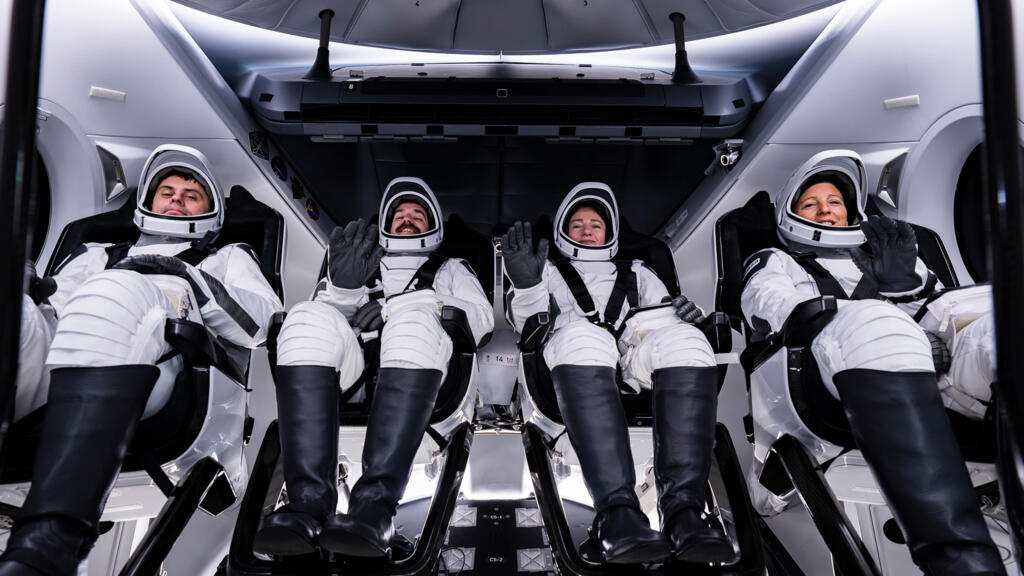
NASA’s SpaceX Crew-12 mission launched to the International Space Station on Friday, sending four astronauts, including France’s Sophie Adenot, to replace a crew evacuated early because of a medical issue.


Issued on: 13/02/2026 - RFI


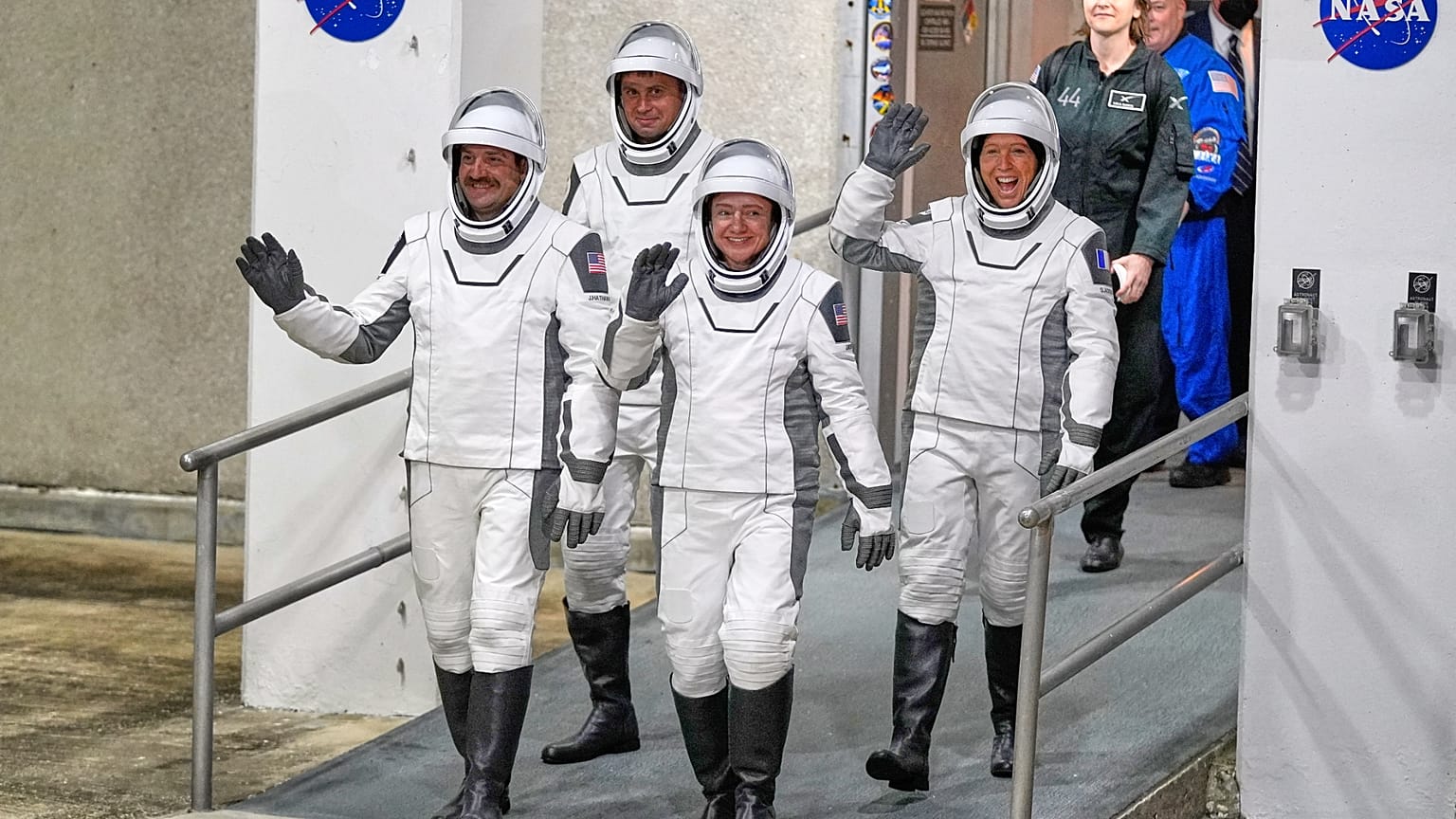
From left to right: Andrei Fedyaev, Jack Hathaway, Jessica Meir and Sophie Adenot, now bound for the International Space Station. © SpaceX via AP


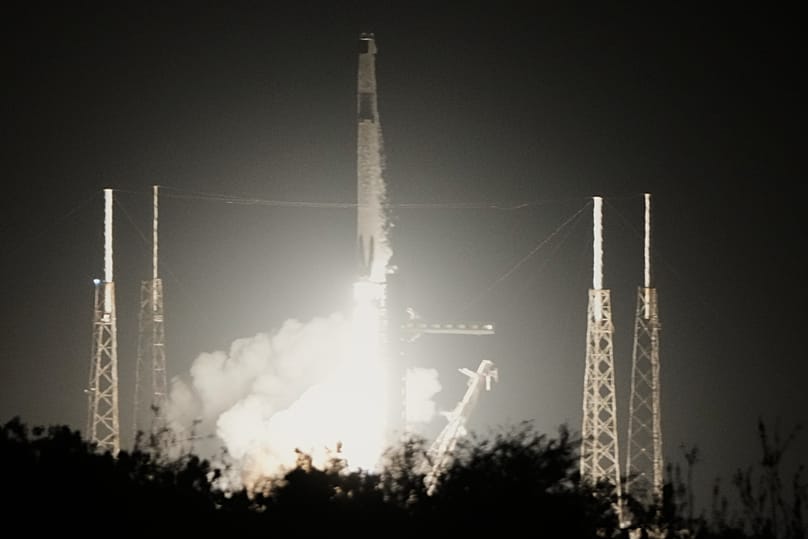
The US space agency NASA launched the Crew-12 mission aboard a SpaceX Falcon 9 rocket at 5:15am EST from Cape Canaveral Space Force Station in Florida.

The pre-dawn launch was delayed by two days because of adverse weather forecasts across the US East Coast, including high winds that could have complicated emergency manoeuvres.

The astronauts are expected to arrive at the orbiting ISS at about 3:15 pm on Saturday. They will spend nine months there.

Crew-12 is composed of Americans Jessica Meir, the mission commander, and Jack Hathaway, the pilot, along with French astronaut Sophie Adenot and Russian cosmonaut Andrey Fedyaev, a mission specialist.

They will replace Crew-11, which returned to Earth in January one month earlier than planned in the first medical evacuation in the space station’s history.

The ISS, a scientific laboratory orbiting 400 kilometres above Earth, has since been staffed by a skeleton crew of three.

NASA declined to disclose details about the health issue that cut the mission short.

All systems are go as France zeros in on space ambitions


'One day that will be me'

Once the astronauts arrive, they will be among the last crews to live aboard the football field-sized space station.

Continuously inhabited for the last quarter century, the ageing ISS is scheduled to be pushed into Earth’s orbit before crashing into an isolated area of the Pacific Ocean in 2030.

Adenot, an astronaut at the European Space Agency, will become the second French woman to fly to space, following in the footsteps of Claudie Haignere, who spent time on the Mir space station.

France's second woman in space prepares for launch after 30-year wait

When Adenot saw Haigneré’s mission launch, she was 14 years old.

“It was a revelation,” the helicopter pilot said during a recent briefing. “At that moment, I told myself: one day, that will be me.”

Adenot will carry out more than 200 scientific and medical experiments in microgravity while completing intensive training and maintenance work in space.

Among other research, she will test a system that uses artificial intelligence and augmented reality to allow astronauts to carry out their own medical ultrasounds.

(with newswires)

International astronauts launch to ISS after NASA's first medical evacuation

Crew 12 astronauts, from left, pilot Jack Hathaway, Russian cosmonaut Andrei Fedyaev, commander Jessica Meir and ESA astronaut Sophia Adenot, of France,
Copyright AP Photo/John Raoux

By Pascale Davies & AP
Published on 

“It turns out Friday the 13th is a very lucky day,” SpaceX Launch Control radioed once the astronauts reached orbit.

A fresh team of astronauts launched toward the International Space Station on Friday aboard a SpaceX rocket, set to take over for crew members who had been brought back to Earth in what marked NASA's first medical evacuation from orbit.

NASA requested the expedited launch to quickly fill the positions left vacant by the evacuated astronauts.

The incoming crew—comprising astronauts from the United States, France, and Russia—is scheduled for an eight- to nine-month stay that will extend through until autumn. They arrive on Saturday and will restore the space station to its complete crew complement.

Once the spacecraft reached orbit, SpaceX Launch Control jokingly noted, "It turns out Friday the 13th is a very lucky day." Mission commander Jessica Meir responded with enthusiasm: "That was quite a ride."


During the month-long crew shortage, NASA suspended spacewalks and postponed various tasks while awaiting the replacements. Americans Meir and Jack Hathaway, alongside France's Sophie Adenot and Russia's Andrei Fedyaev, will now join the skeleton crew of three astronauts—one American and two Russians—who maintained station operations in the interim.

NASA said it saw no need for additional pre-launch medical screenings or specialised diagnostic equipment, expressing confidence in existing protocols aboard the station. However, an onboard ultrasound machine, typically used for research purposes, was pressed into urgent service on January 7 to examine the unwell crew member.

NASA has declined to identify the astronaut or disclose details about their condition. All four returning crew members were hospitalised immediately upon their Pacific Ocean splashdown near San Diego.

A SpaceX Falcon 9 rocket with a crew of four aboard the Dragon space craft lifts off from pad 40 at the Cape Canaveral Space Force Station in Cape Canaveral, Fla., Feb 13 AP Photo/John Raoux

It marked the first instance in 65 years of human spaceflight that NASA terminated a mission early due to medical concerns.

Satisfied with medical procedures already in place, NASA ordered no extra checkups for the crew ahead of liftoff, and no new diagnostic equipment was packed.

An ultrasound machine already up there for research went into overdrive on Jan. 7 when used on the ailing crew member. NASA has not revealed the ill astronaut’s identity or health issue. All four returning astronauts went straight to the hospital after splashing down in the Pacific near San Diego.

With missions becoming longer, NASA is constantly looking at upgrades to the space station’s medical gear, said deputy programme manager Dina Contella.

“But there are a lot of things that are just not practical, and so that’s when you need to bring astronauts home from space,” she said earlier this week.

In preparation for moon and Mars trips, where health care will be even more challenging, the new arrivals will test a filter designed to turn drinking water into emergency IV fluid, try out an ultrasound system that relies on artificial intelligence and augmented reality instead of experts on the ground, and perform ultrasound scans on their jugular veins in a blood clot study.

They will also demonstrate their Moon-landing skills in a simulated test.

Adenot is only the second French woman to launch to space. She was 14 when Claudie Haignere flew to Russia’s space station Mir in 1996, inspiring her to become an astronaut. Haignere travelled to Cape Canaveral to cheer her on.

“I thought it would have been a quiet joy with pride for Sophie, but it was so hugely emotional to see her with a successful launch," Haignere said.

Hathaway, like Adenot, is new to space, while Meir and Fedyaev are making their second station trip. Just before liftoff, Fedyaev led the crew in a cry of “Poyekhali" — Russian for “Let's Go” — the word uttered at liftoff by the world's first person in space, the Soviet Union's Yuri Gagarin, in 1961.

On her first mission in 2019, Meir took part in the first all-female spacewalk. The other half of that spacewalk, Christina Koch, is among the four Artemis II astronauts waiting to fly around the moon as early as March. A ship-to-ship radio linkup is planned between the two crews.

ESA satellite finds 'inside-out' planetary system that challenges formation theories

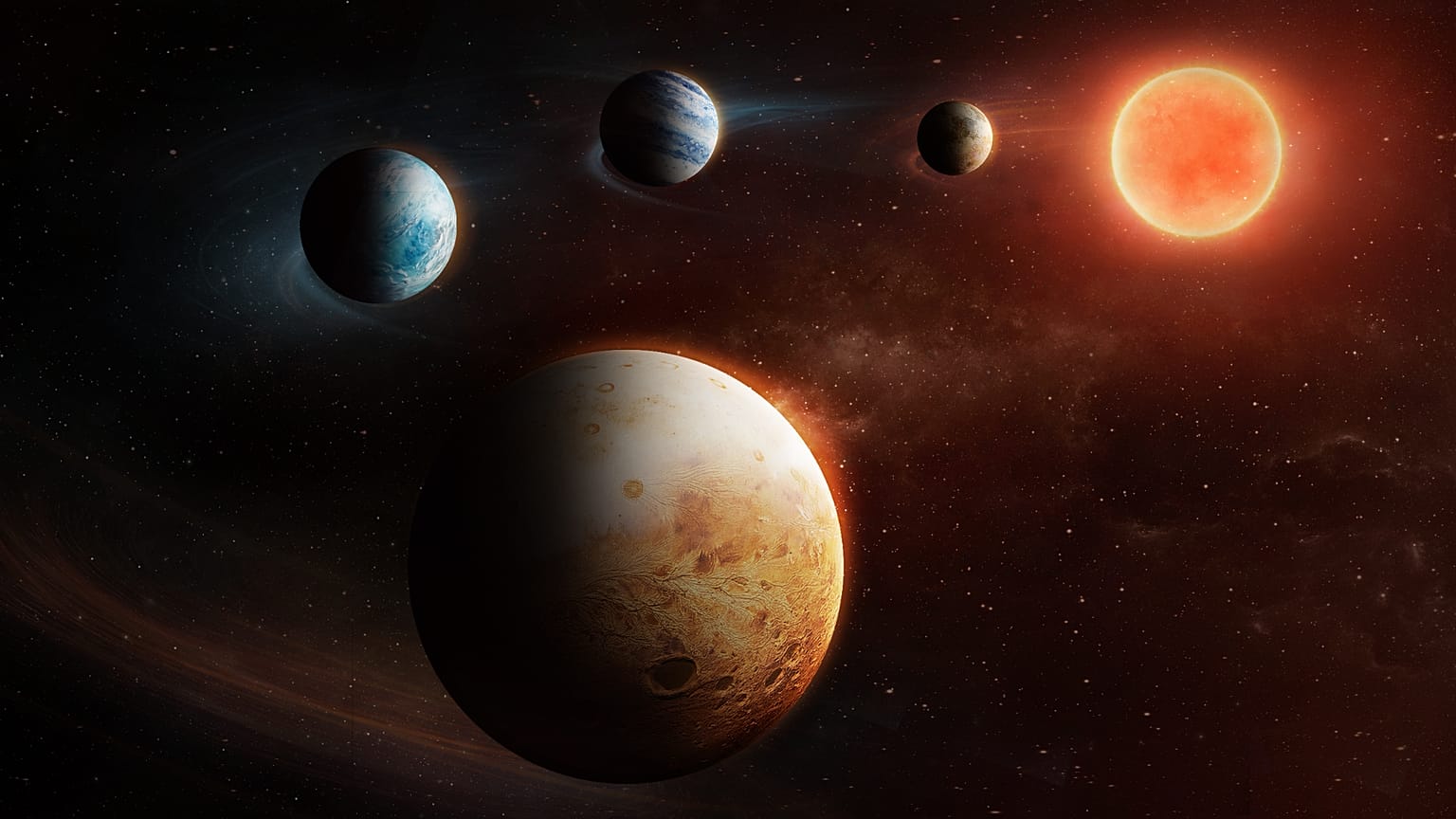
Artist impression of the planetary system around the star LHS 1903
Copyright European Space Agency

By Roselyne Min with AFP
Published on 

A newly discovered planet orbiting a distant star may change scientists’ understanding of how planetary systems form.

Astronomers say they have discovered a distant planetary system with planets arranged in a surprising order, challenging long-standing ideas about how planets form.

In our Solar System, the four planets closest to the Sun are small and rocky, while the four farther away are large gas giants. Scientists have long believed this pattern — rocky planets near the star and gaseous planets farther out — was common across the universe.

However, a star called LHS 1903 discovered in the Milky Way's thick disc suggests otherwise.

In a collaborative effort involving researchers across Europe, astronomers analysing data from several telescopes had already identified three planets orbiting the red dwarf star, which is cooler and dimmer than our Sun.

The closest planet to the star was rocky, followed by two gas giants. That is the order scientists expect.

But digging into observations made by the European Space Agency (ESA)'s exoplanet-probing Cheops space telescope revealed a fourth planet farther from the star. Surprisingly, this outermost planet also appears to be rocky.

"That makes this an inside-out system, with a planet order of rocky-gaseous-gaseous-and then rocky again," Thomas Wilson, the lead author of the study and a planetary astrophysicist from the University of Warwick in the United Kingdom, said in a statement with ESA.

"Rocky planets don't usually form so far away from their home star," Wilson added.

One planet after another

Inner planets are expected to be small and rocky because intense radiation from the nearby star blasts most of the gas away from their rocky core.

But farther out in the cold reaches of the system, a thick atmosphere can form around cores, creating gas giants.

Trying to explain the unusual LHS 1903 system, researchers tested several possibilities before proposing a new idea: the planets may have formed one after another rather than all at once.

According to the currently most widely accepted theory, planets form simultaneously in a massive ring of gas and dust called a protoplanetary disc.

This involves tiny dust grains clumping together, then snowballing into cores that eventually evolve into mighty planets.

But in this system, scientists believe LHS 1903 may have formed after most of the gas had already disappeared.

"Yet here is a small, rocky world, defying expectations," Wilson said.

"It seems that we have found the first evidence for a planet which formed in what we call a gas-depleted environment," he added.

Since the 1990s, astronomers have discovered more than 6,000 planets outside our Solar System, called exoplanets, mostly by spotting slight changes in brightness as they cross in front of their star.

"Historically, our planet formation theories are based on what we see and know about our Solar System," said Isabel Rebollido, a planetary disc researcher at ESA.

"As we are seeing more and more different exoplanet systems, we are starting to revisit these theories."


Cheops Discovers Late Bloomer From Another Era


By 


Many Vile Earthlings Munch Jam Sandwiches Under Newspapers and My Very Educated Mother Just Served Us Nachos. What sounds like gibberish half-sentences are memory aids taught to children to help remember the order of the planets in our Solar System: Mercury, Venus, Earth, Mars, Jupiter, Saturn, Uranus and Neptune.

The eight familiar planets can be sorted into two different types: rocky and gaseous. The inner planets that are closest to the Sun – Mercury to Mars – are rocky, and the outer planets – Jupiter to Neptune – are gaseous.

This general pattern, that planetary systems form with rocky planets closer to their star, followed by gaseous planets as the outer bodies, has been commonly observed across the Universe. It is what our current planet formation theories predict and what observations have widely confirmed to be true.

That was until scientists took a closer look at the planetary system around a star called LHS 1903 with ESA’s CHaracterising ExOPlanet Satellite (Cheops). What they have just discovered might flip our understanding of how planets form upside down.

The four planets of LHS 1903

LHS 1903 is a small red M-dwarf star that is cooler and shines less brightly than our Sun. Thomas Wilson from the University of Warwick in the UK and his international team combined the efforts of various telescopes in space and on Earth to classify three planets that they had spotted orbiting LHS 1903. They were able to conclude that the innermost planet seemed to be rocky, and the two that followed it gaseous.

So far, so normal. It wasn’t until Thomas and his colleagues were analysing observations made by ESA’s Cheops, that they discovered something strange: the data showed a small fourth planet, furthest from LHS 1903. And upon closer inspection, the scientists were surprised to discover that this planet seems to be rocky!

“That makes this an inside-out system, with a planet order of rocky-gaseous-gaseous-and then rocky again. Rocky planets don’t usually form so far away from their home star,” says Thomas.

Current planet formation theories predict that the inner planets in a system are small and rocky, because close to the star the radiation is so powerful that it sweeps away most of the gas around the planets’ rocky core. Further away from the star, in the outer part of a planetary system, the conditions are cool enough for a thick atmosphere to gather into a gaseous planet.

ESA’s Cheops project scientist Maximilian Günther is enthusiastic: “Much about how planets form and evolve is still a mystery. Finding clues like this one for solving this puzzle is precisely what Cheops set out to do.”

Born to be weird?

Scientists are not quick to say that an established theory needs to be reconsidered, based on a single contradictory observation. So, Thomas and his colleagues set out to explore various explanations for why this strange rocky planet breaks the familiar pattern.

Was the planet, for example, at some point in its past hit by a giant asteroid, comet, or another big object, that blew away its atmosphere? Or had the planets around LHS 1903 swapped places at some point during their evolution? After testing these scenarios through simulations and calculations of the planets’ orbital times, the team of scientists ruled them out.

Instead, their investigation led them to a more intriguing explanation: the planets may have formed one after the other, instead of at the same time. According to our current understanding, planets form from discs of gas and dust (protoplanetary discs) by clumping into planetary embryos at roughly the same time. These clumps then evolve into planets of different sizes and compositions over millions of years.

In contrast, here Thomas and his team discovered a planetary system where the star might have given birth to its four planets one after the other, instead of bearing quadruplets at once. This idea – known as inside-out planet formation – was proposed by scientists as a theory about a decade ago, but until now, never has the evidence been so strong.

A late bloomer defying expectations

This conclusion comes with an additional catch: Much like how our younger siblings are growing up in a world that is different from the one of our childhoods, this small rocky planet seems to have evolved and formed in a very different environment than its older sibling-planets.

“By the time this outer planet formed, the system may have already run out of gas, which is considered vital for planet formation. Yet here is a small, rocky world, defying expectations. It seems that we have found first evidence for a planet which formed in what we call a gas-depleted environment”, says Thomas.

The small rocky world is either an odd outlier, or the first evidence for a trend we hadn’t known about yet. Either way, its discovery begs for an explanation that lies beyond our usual planet formation theories.

Our Solar System as a one-size-fits-all

“Historically, our planet formation theories are based on what we see and know about our Solar System,” Isabel Rebollido who is currently a Research Fellow at ESA points out. “As we are seeing more and more different exoplanet systems, we are starting to revisit these theories.”

As our instruments improve, we continue to discover more and more ‘weird’ planetary systems in the vastness of space. They force us to question our understanding and make us reconsider established theories of planet formation. Ultimately, these discoveries are helping us learn about how our Solar System fits into the big family of diverse planetary systems. They make us wonder how special the order of the planets is that we teach our children, and if maybe it is our home Solar System that is the weird one after all.


Chile launches Latam-GPT in push for regional AI sovereignty

Chile launches Latam-GPT in push for regional AI sovereignty
"Latam-GPT allows Latin America to join the AI ​​revolution as an active participant, developing its own technology and demonstrating what is possible when the region works together," said CENIA Director Álvaro Soto / Chile Presidencia
By bnl editorial staff February 12, 2026

Chile has unveiled Latam-GPT, the first open-source artificial intelligence language model designed specifically for Latin America, in a strategic bid to reduce the region's dependence on US and Chinese technology and address cultural biases in existing AI systems, AFP reported.

The project, co-ordinated by Chile's National Center of Artificial Intelligence (CENIA) and supported by more than 60 institutions and nearly 200 specialists across eight countries, represents what organizers describe as a shift from Latin America being merely a consumer of AI foundation models to actively building and shaping them.

The model, which contains 70bn parameters and was developed on Meta's Llama 3.1 architecture, was trained primarily in Spanish and Portuguese, with plans to eventually incorporate indigenous languages. Unlike commercial chatbots such as ChatGPT or Google Gemini, Latam-GPT is positioned as foundational infrastructure: a public good that governments, universities, start-ups and companies can adapt and build upon.

"Artificial intelligence is the greatest technological revolution of recent times, and from Latin America and the Caribbean, it is strategic and urgent that we play a role," Chilean President Gabriel Boric said at the launch event on national television on February 10. He cited the disparity in available information between European historical events and Latin American milestones as evidence of the representation gap the project aims to address.

The initiative tackles what developers see as structural weaknesses in existing large language models, which are trained predominantly on English-language data and fail to adequately capture the region's languages, cultural nuances and real-world contexts. This can result in weaker performance on region-specific knowledge, higher bias risk and reduced policy control when deploying AI at national scale.

Development of Latam-GPT involved processing more than 8 terabytes of data—equivalent to millions of books—including private sources and synthetic datasets created to fill gaps in available information. The work was funded with $550,000 from CENIA's budget and the Development Bank of Latin America (CAF).

Initial training used Amazon Web Services cloud infrastructure, but subsequent versions will run on a $4.5mn supercomputer being installed at the University of Tarapacá in northern Chile, expected to be operational in the first half of 2026.

Álvaro Soto, CENIA's director, said models built elsewhere contain relatively little information about Latin America, limiting their effectiveness for regional applications. "The aim is to provide more accurate and culturally relevant outputs that reflect the realities of the region," he said.

Luis Chiruzzo, an engineering professor at the University of the Republic in Uruguay who participated in the project, described it as "a very important milestone for Latin America" that positions the region to engage with AI technologies on its own terms.

The open-access model is designed for use in text-intensive workflows common across public administration and services, including document drafting and summarization, translation, knowledge retrieval and customer support. Among early commercial users is Chilean firm Digevo, which is building AI-powered customer service tools for airlines and retailers that can understand regional dialects and local expressions.

Soto said the model could enable digital solutions tailored to local needs, such as tools for hospitals facing logistical challenges or resource allocation issues.

However, Alejandro Barros, an academic at the University of Chile, cautioned that Latam-GPT cannot realistically compete with large global AI models due to vast differences in economic resources and infrastructure.

The project's reliance on commercial cloud infrastructure for initial development also raises questions about long-term independence and sustainability, despite the model's framing as a sovereignty-building initiative.

Latam-GPT joins other regional AI efforts including SEA-LION in Southeast Asia and UlizaLlama in Africa, as developing regions seek to build AI capabilities that reflect their own cultural and linguistic contexts.


Loblaw and OpenAI partner to integrate PC Express into ChatGPT


ByThe Canadian Press
 February 12, 2026 

ChatGPT's landing page is seen on a computer screen, Aug. 4, 2025, in Chicago. (AP Photo/Kiichiro Sato)

Loblaw Cos. Ltd. says it is integrating its PC Express grocery delivery app into OpenAI’s chatbot ChatGPT.

The grocer says the partnership means consumers can explore menu ideas and curate a list of ingredients in the chatbot, and select suggested products to purchase on the PC Express app.

Loblaw chief digital officer Lauren Steinberg says AI has become a new avenue for how people plan, search for information and make decisions, and that this is how Loblaw is meeting its customers where they are.

She says if consumers choose to share their postal code on ChatGPT, the app can find nearby Loblaw banners, which pulls the list of ingredients from a store near them.

Steinberg says consumers can then select items to add to their cart on the chatbot and click checkout, which will take them to the PC Express app for the final step, which is paying for the items.

The company started working on the app integration last fall, soon after ChatGPT parent company OpenAI announced it was introducing third-party apps on the chatbot.

“The moment we found out that ChatGPT was going to allow apps, we built ours,” Steinberg said.

Companies such as Spotify, Canva, Expedia and Coursera are already integrated on the chatbot, OpenAI’s website shows.

This report by The Canadian Press was first published Feb. 12, 2026.

Ritika Dubey, The Canadian Press

Trump denies report that golfing buddy is carving up Venezuela for himself in frantic post


Travis Gettys
February 12, 2026 
ALTERNET


President Donald Trump denounced one of his purported golfing buddies who's being credited with steering U.S. efforts to revive Venezuela's oil industry.

The Wall Street Journal reported Wednesday night that energy magnate Harry Sargeant III, who the paper described as a 68-year-old former Top Gun pilot and sometimes Trump golfing partner, was perhaps the only American businessman with ties to the U.S. president and recently deposed Venezuelan President Nicolás Maduro.

"Sargeant is now in position to be the latest of the president’s allies to reap a windfall based on his second-term policies and actions," the Journal reported.

"Trump is pressing U.S. firms to move in fast as his aides work to loosen the sanctions restrictions that were imposed on Venezuela during his first administration," the report added. "Many U.S. companies are nonetheless proceeding cautiously, wary of investing huge sums until the country’s politics are stabilized and a legal framework is in place for foreign companies ... Sargeant, though, isn’t waiting. He met in person last week in Caracas with Maduro’s longtime deputy and economic manager Delcy Rodriguez, to discuss plans to get his businesses up and running."

The 79-year-old Trump denied the Journal's claims about Sargeant's efforts in Venezuela since U.S. forces removed Maduro and handed him over to U.S. law enforcement to stand trial on narcoterrorism and firearms charges.

"Relations between Venezuela and the United States have been, to put it mildly, extraordinary!" Trump posted Thursday morning on Truth Social. "We are dealing very well with President Delcy Rodriguez, and her Representatives. Oil is starting to flow, and large amounts of money, unseen for many years, will soon be greatly helping the people of Venezuela. Marco Rubio, and all of our Representatives, are doing a fantastic job, but we speak only for ourselves, and don’t want there to be any confusion or misrepresentation."

"There is a story about a man named Harry Sargeant III in The Wall Street Journal," the president added. "He has no authority, in any way, shape, or form, to act on behalf of the United States of America, nor does anyone else that is not approved by the State Department. Without this approval, no one is authorized to represent our Country. Thank you for your attention to this matter! PRESIDENT DONALD J. TRUMP."


US energy chief visits Venezuela to cement post-Maduro oil partnership

US energy chief visits Venezuela to cement post-Maduro oil partnership
Wright described “enormous progress” in discussions over the future of Venezuela’s oil industry and said the broader objective was to create conditions for sanctions relief and a transition towards democratic governance. / avn
By bne IntelliNews February 12, 2026

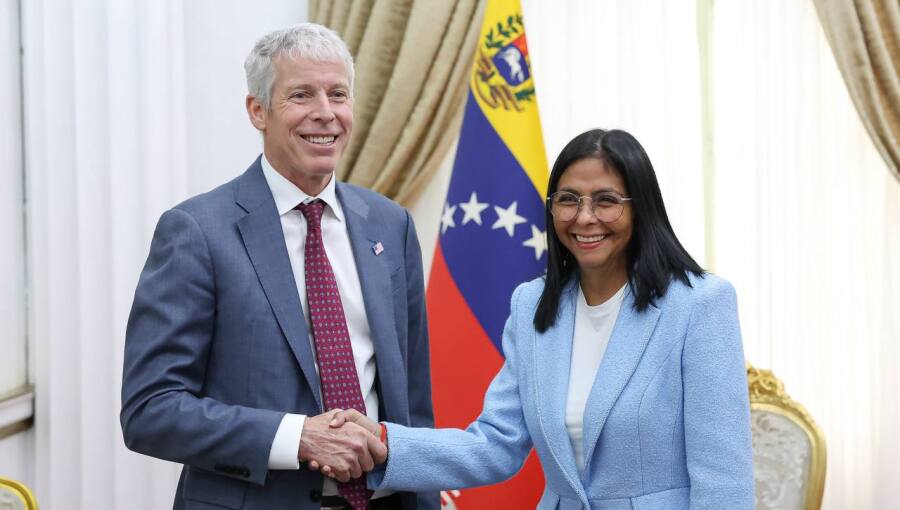
The US and Venezuela announced a long-term energy partnership on February 11 after interim President Delcy Rodríguez met US Energy Secretary Chris Wright in Caracas, in the first visit by a senior White House official since last month's dramatic ouster of Nicolás Maduro.

At the Miraflores presidential palace, Rodríguez said the two sides had agreed to establish a “productive association” built around a long-term energy agenda covering oil, gas, mining and electricity, adding that technical teams were already working to move projects forward quickly. She expressed hope the relationship would advance “without difficulties and without setbacks”, and noted the countries share more than a century of energy ties marked by political “highs and lows."

Wright described “enormous progress” in discussions over the future of Venezuela’s oil industry and said the broader objective was to create conditions for sanctions relief and a transition towards democratic governance. “We do not recognise the current government of Venezuela,” he said, while adding that the two sides were “early on in a transition period” and discussing future electoral prospects, The Wall Street Journal reported.

The visit follows a US operation on January 3 in which Maduro and his wife, Cilia Flores, were captured and transferred to New York to face drug-trafficking charges. Rodríguez, formerly vice president under Maduro, assumed interim leadership after the operation. President Donald Trump has praised her as "terrific" and claimed she is following US orders to facilitate a three-phase transition plan for Venezuela outlined by Secretary of State Marco Rubio. 

Wright's trip marked a rare high-level engagement between Washington and Caracas amid historically strained relations. Ties deteriorated after socialist leader Hugo Chavez took power in 1998, nationalising the country's vital oil industry and forging closer links with US foes such as Russia, China and Iran.

In parallel with the diplomatic outreach, the US Treasury has issued general licences permitting American companies to export and sell Venezuelan crude, provide diluents required for heavy oil production and supply oilfield equipment and services. Venezuela’s National Assembly has also amended hydrocarbons legislation to open the sector to greater private and foreign participation, as both governments seek to attract fresh capital into the industry.

Venezuela, home to the world's largest proven oil reserves, produced more than 3mn barrels per day (bpd) in the 1990s, and is currently pumping about 900,000 bpd, according to industry figures. Estimates suggest output could rise by around 50% to roughly 1.4mn bpd in the coming years if reforms take hold. But years of mismanagement, sanctions and corruption have crippled the sector's infrastructure, meaning rebuilding to earlier levels could require investments of up to $250bn over 15 years.

Trump has said more than $100bn in foreign investment could be mobilised to revitalise oil regions such as Lake Maracaibo and the Orinoco Belt. He has also stated that nearly 50mn barrels of oil have been transferred to the United States for sale at market prices under new arrangements.

During the joint appearance, Wright concluded in Spanish, “Long live Venezuela and long live the United States,” as both sides signalled their intention to deepen cooperation despite ongoing political differences.