Thursday, February 19, 2026

After Greenland, Arctic island Svalbard wary of great powers


By AFP
February 18, 2026


People in Svalbard are going about their daily lives despite speculation the Norwegian archipelago could be the next Arctic territory coveted by Washington - Copyright AFP Oriane Laromiguière


Oriane LAROMIGUIERE, with Pierre-Henry DESHAYES in Oslo 
and Jonathan KLEIN in Stockholm

There are no outward signs of jitters, at least not yet: people in Svalbard are going about their daily lives as normal despite speculation that this Norwegian archipelago could be the next Arctic territory coveted by the United States or Russia.

“Today Greenland, tomorrow Svalbard?” — Terje Aunevik, mayor of Svalbard’s main town Longyearbyen, says he has been asked the question many times.

US President Donald Trump’s expansionist ambitions have turned the global spotlight on the Arctic, where geo-strategic and financial stakes are mounting.

“The Arctic is no longer a quiet corner on the map,” the European Union’s top diplomat Kaja Kallas told a conference in Tromso in northern Norway in early February. “It is the front line of the global power competition.”

Longyearbyen is an unusual place. A former mining community turned tourist destination and academic hotspot, it lies in the fastest-warming region on the planet.

One of the northernmost towns in the world, located halfway between continental Norway and the North Pole, Longyearbyen is home to 2,500 people.

It is plunged in darkness with no sun for four months in winter, then bathed in round-the-clock daylight in summer.

Venturing outside the town means carrying a mandatory rifle in case of encounters with polar bears.


– Strategic importance –


Some political observers have suggested that Trump’s desire to control the Arctic may extend beyond Greenland to Svalbard, or that Russia may want to match his appetite and seize the archipelago.

In addition to the riches believed to lie under its seabed, Svalbard — twice the size of Belgium — is strategically located, controlling the northern part of the so-called “Bear Gap”.

The military term refers to the maritime zone where the Barents Sea meets the Norwegian Sea. It is this zone Russia’s Northern Fleet missile-launching submarines based on the Kola Peninsula must cross to disappear into the deep waters of the Atlantic.

Svalbard’s “strategic relevance does not necessarily lie in the island itself, but in the waters around it,” Barbara Kunz, director of the European Security Programme at Stockholm peace research institute SIPRI, told AFP.

“Russia wants to protect its nuclear deterrence, and so it wants to make sure that nobody can approach its northern coast”, while the United States “would like to prevent” Russian submarines from having access to the Atlantic, she said.

Longyearbyen’s residents, who hail from around 50 countries, are staying cool-headed amid the speculation.

“Maybe we talk a bit more about what’s happening in Greenland and with Trump and everything, but at the same time I feel like we’re not more anxious than we usually are,” shop employee Charlotte Bakke-Mathiesen told AFP.

“We’re just in our own bubble.”


– Svalbard treaty –


In his office, where his mayor’s chain is displayed alongside a polar bear femur, Terje Aunevik echoed that sentiment.

“The situation is as it is, but I don’t feel it as a threat,” he said.

“I strongly believe that both our allies and our neighbours are living very well with Norway having sovereignty over this island.”

By “neighbours”, he means the 350 or so Russians and Russian-speaking Ukrainians who live in the Svalbard town of Barentsburg, around 40 kilometres (25 miles) away as the crow flies.

It is hard to believe that Barentsburg, a small mining community under Russian control for almost a century, is located on NATO territory: a Lenin bust takes centre stage in the town, where all of the signs are written in Cyrillic lettering.

A treaty signed in 1920 recognises Norway’s “full and absolute” sovereignty over Svalbard, but it also gives citizens of the almost 50 signatory powers — which include China, Russia and the US — equal rights to exploit its resources.

Since Russia’s 2014 annexation of Crimea, Norway has tried to tighten its control of Svalbard, for example by blocking the sale of land to foreigners and drastically reducing voting rights.

Moscow has argued that Oslo is not respecting the Svalbard treaty and has increased its provocations in recent years.

It held a quasi-military parade in Barentsburg celebrating Russia’s victory over Nazi Germany and erected a giant unauthorised Orthodox cross in Pyramiden, another small Russian community.


– ‘Anything can happen’ –


“The Russians have other more strategic priorities right now and have no interest in an escalation beyond the hybrid actions they’ve been conducting for a long time,” polar geopolitics researcher Mikaa Blugeon-Mered said when asked about a possible Russian takeover attempt.

“For Norway, the United States is a much bigger concern today when it comes to Svalbard, because it is more likely to carry out an operation that could destabilise the territory’s precarious balance,” he said.

“With the current Trump administration, anything can happen.”

For a long time, experts spoke of “Arctic exceptionalism”: the concept that the region had its own set of unwritten rules of cooperation, a zone of peace immune to geopolitical rivalries.

But now, said Barbara Kunz, “the era of High North, low tension is over”.
Deadly Indonesia floods force a deforestation reckoning

By AFP
February 18, 2026


Flooding and landslides made worse by deforestation killed over 1,000 people in Sumatra last year - Copyright AFP Ebrahim Hamid


Sara HUSSEIN

Permits revoked, lawsuits filed, the threat of state takeovers. Deadly flooding in Indonesia has prompted unprecedented government action against companies accused of environmental destruction that worsened the disaster.

But environmentalists who have long warned about the risks of rampant deforestation fear the current response will not solve the problem, and could even make it worse.

Officials from President Prabowo Subianto down have acknowledged the role of deforestation and overdevelopment in last year’s flooding and landslides, which killed over 1,000 people in Sumatra.

Mining, plantations, and fires have caused the clearance of large tracts of lush Indonesian rainforest, removing trees that absorbed rain and helped stabilise soil.

Now, Indonesia is prioritising “protecting the environment, protecting nature”, Prabowo told attendees at this year’s World Economic Forum.

Several dozen companies have had their permits revoked, and the government will reportedly hand management of around a million hectares of land to a state enterprise.

Initially, the government said that would include the Martabe gold mine, which conservationists have regularly accused of environmental damage.

More recently, officials said they were still reviewing potential violations by the site.

But there has been no suggestion of halting development in the worst-affected and most ecologically sensitive areas, like Batang Toru, where Martabe is located.


– World’s rarest great ape –


The area is home to the world’s rarest great ape, the tapanuli orangutan, just 800 of which were believed to exist in the wild before the disaster.

“Revoking permits is not immediately a win,” said Panut Hadisiswoyo, a conservationist and orangutan specialist.

“The idea of revoking should be to stop the devastation, but by continuing these operations, this means industry will continue in this vulnerable area.”

Conservationists have lobbied for a moratorium on development in Batang Toru, where tapanuli orangutans suffered first habitat loss and then the flood disaster.

Using satellite data and information on the pre-existing tapanuli orangutan population, experts have calculated nearly 60 animals may have been killed in what they called an “extinction-level event” for the species.

Between 2001 and 2024, Sumatra lost 4.4 million hectares of forest, an area larger than Switzerland, “making the hilly forest landscapes more vulnerable to landslides and flooding”, said Amanda Hurowitz, senior director at conservation group Mighty Earth.

Much of that deforestation happened in areas with government permits, and it is not clear that transferring operations to the state will improve matters.

“It’s a concern that the state-backed takeover may not guarantee better environmental practices, and that production may be prioritised over conservation,” Hurowitz told AFP.

“We have yet to see any plans.”


– ‘Blessing in disguise’ –


Indonesia’s environment and forestry ministries did not respond to AFP’s request for comment.

Other experts have warned that revoking permits and seizing operations has disrupted plans to audit and investigate companies and determine their precise responsibility for the disaster.

And so far, the government has not outlined plans for forest recovery and environmental remediation, said Timer Manurung, executive director of Indonesian environmental group Auriga Nusantara.

“It’s not only revocation but it also has to include remediation, taking responsibility for the destruction,” he told AFP.

The government’s lawsuits are seeking close to $300 million from six companies, some of which will be set aside for environmental recovery.

But much more money would be needed for real remediation, and other companies are likely to be culpable too, experts said.

And there is no sign yet that other projects linked to large-scale deforestation, including a food and energy plantation plan in South Papua, will be halted in this drive.

The one saving grace, said Timer, has been the public’s “very significant rising awareness” of deforestation in Indonesia since the disaster.

That has been “a blessing in disguise”.
OpenAI’s Altman says world ‘urgently’ needs AI regulation


By AFP
February 19, 2026


OpenAI CEO Sam Altman at the AI Impact Summit in New Delhi - Copyright AFP Ludovic MARIN

Sam Altman, head of ChatGPT maker OpenAI, told a global artificial intelligence conference on Thursday that the world “urgently” needs to regulate the fast-evolving technology.

An organisation could be set up to coordinate these efforts, similar to the International Atomic Energy Agency (IAEA), he said.

Altman is one of a host of top tech CEOs in New Delhi for the AI Impact Summit, the fourth annual global meeting on how to handle advanced computing power.

“Democratisation of AI is the best way to ensure humanity flourishes,” he said on stage, adding that “centralisation of this technology in one company or country could lead to ruin”.

“This is not to suggest that we won’t need any regulation or safeguards,” Altman said.

“We obviously do, urgently, like we have for other powerful technologies.”

Many researchers and campaigners believe stronger action is needed to combat emerging issues, ranging from job disruption to sexualised deepfakes and AI-enabled online scams.

“We expect the world may need something like the IAEA for international coordination of AI”, with the ability to “rapidly respond to changing circumstances”, Altman said.

“The next few years will test global society as this technology continues to improve at a rapid pace. We can choose to either empower people or concentrate power,” he added.

“Technology always disrupts jobs; we always find new and better things to do.”

Generative AI chatbot ChatGPT has 100 million weekly users in India, more than a third of whom are students, he said.

Earlier on Thursday, OpenAI announced with Indian IT giant Tata Consultancy Services (TCS) a plan to build data centre infrastructure in the South Asian country.


Tech chiefs address India AI summit as Gates cancels


By AFP
February 19, 2026


Frenzied demand for generative AI has fuelled anxiety over the risks to society - Copyright AFP Arun SANKAR


Katie Forster

Indian leader Narendra Modi and tech chiefs including OpenAI’s Sam Altman will speak Thursday on artificial intelligence’s opportunities and threats at a summit in New Delhi, but Microsoft founder Bill Gates cancelled just hours before his speech.

Gates, facing questions over his ties to late sex offender Jeffrey Epstein, withdrew just hours before his speech to “ensure the focus remains on the AI Summit’s key priorities,” the Gates Foundation said.

The AI Impact Summit is the fourth annual international gathering focused on the rapidly advancing field, following previous summits in Paris, Seoul and Britain’s wartime code-breaking hub Bletchley.

Frenzied demand for generative AI has turbocharged profits for many companies, while fuelling anxiety about the risks to society and the planet.

Modi will speak on stage with French President Emmanuel Macron Thursday at the huge event that has drawn tens of thousands of attendees including dozens of world leaders and ministers.

Google DeepMind head Demis Hassabis, UN Secretary General Antonio Guterres and Meta’s Alexandr Wang also on the bill.

Another Gates Foundation official will take the place of Gates, who said this month he regrets “every minute” he spent with Epstein.

The mere mention of someone’s name in the Epstein files does not in itself imply any wrongdoing by that person.

– New investments –

As the first global AI meeting held in a developing country, the five-day summit, which wraps up Friday, has also been a chance for India to boost its position in the booming sector.

The nation expects more than $200 billion in investments over the next two years, and US tech titans have unveiled new deals, investments and infrastructure for the South Asian country this week.

On Thursday, ChatGPT maker OpenAI and Indian IT giant Tata Consultancy Services (TCS) announced a plan to build hyperscale AI data centre capacity in the South Asian country.

The previous day Google said it planned to build subsea cables as part of an existing $15 billion AI infrastructure investment.

“Since my childhood growing up in Chennai, India has undergone an incredible transformation,” Google CEO Sundar Pichai said.

“India is going to have an extraordinary trajectory with AI and we want to be a partner,” he added.

US chip behemoth Nvidia — the world’s most valuable company — also said it was teaming up with Indian cloud computing providers to provide advanced processors for data centres that can train and run AI systems.

AI data centres are under construction worldwide on a massive scale, as companies race to develop super-intelligent systems.

The huge amounts of electricity needed to power them and water to cool hot servers has sparked alarm at a time when countries have pledged to decarbonise their grids to try and slow climate change.

– Gridlock –

Last year India leapt to third place in an annual global ranking of AI competitiveness calculated by Stanford researchers, although experts say it has a long way to go before it can rival the United States and China.

Brazil’s President Luiz Inacio Lula da Silva is in town to attend the AI summit and hold talks with Modi, including on rare earths.

Leaders are expected to deliver a statement at the end of the week about how they plan to handle AI technology.

One fear is disruption to the job market, especially in India where millions of people are employed in call centres and tech support services.

“We are creating human imitators. And so of course, the natural application for that type of system is replacing humans,” leading computer science researcher Stuart Russell told AFP.

Some say the broad focus of the event and vague promises made at previous global AI summits mean that concrete commitments are unlikely.

Many researchers and AI safety campaigners believe stronger action is needed to combat issues ranging from sexualised deepfakes to AI-enabled online scams and intrusive surveillance.

Siddharth Soni, the 23-year-old founder of an Indian AI-designed jewellery startup, said he could see both sides.

“We’re losing artisans. We’re losing the value of art, using AI, actually. That is one of the sad parts,” he told AFP.

'Who are they for?' Ex-Trump lawyer appalled at buildup of MAGA prison network

Matthew Chapman
February 18, 2026
 RAW STORY

U.S. Immigration and Customs Enforcement (ICE) agents stand guard outside the Whipple Building near a U.S. flag, during a protest against the fatal shooting of Renee Nicole Good by a U.S. Immigration and Customs Enforcement (ICE) agent, and a rally against increased immigration enforcement across the city, in Minneapolis, Minnesota, U.S., January 9, 2026. REUTERS/Tyrone Siu

Former Trump administration White House lawyer Ty Cobb delivered a dire warning Wednesday on MS NOW about the growing network of Immigration and Customs Enforcement detention facilities that are planned and funded — and suggested that Trump having that much detention power and resources at his disposal is horrifying.

Cobb's warning came in the middle of a discussion with anchor Ari Melber, about the possibility ICE might try to engage in election interference by stationing agents at polling places.

"What is your legal view of the limits on ICE under current law?" asked Melber, himself an attorney. "To be out in a way that might be voter intimidation in any voting period when we get to the midterms?"

"So that's an excellent question," said Cobb. "I think we're going to see the courts gradually parse through that. You know, ICE actually has no local law enforcement authority in any of the states. They're only supposed to manage the limited number of federal crimes entrusted to them, and they shouldn't be there. But it's going to take a series of court battles, I think, to prevent them from being there. And it may come down to a conflict between, you know, state National Guards and ICE absent, absent an invocation of the Insurrection Act, which I think we will see in advance of, of the election. So I think — I think people should be very, very concerned and very, very animated about what's coming."

To understand the reason for fear, Cobb continued, consider Garry Kasparov, the Russian world chess champion turned dissident of the Putin regime.

Kasparov, he said, "has been very outspoken about, you know, the gulags that are being built around the country and the fact that they're intended not only to house, you know, illegally detained immigrants, of which we have thousands now, but also likely dissidents and people of color on a going forward basis. You know, what is happening in this country."

"You don't think that's just an international parallel gone too far?" Melber pressed him. "You believe that's something that Trump would, would try to do and get away with?

"So I'll put it this way," said Cobb. "You know, Trump is deporting people on a trajectory and at a pace that's not very different from the number of deportations that happened under Obama. However, the number of illegally detained people is extraordinarily high. And he's building, you know, dozens of prisons to house up to 8,000 people. We've never needed that before. That's — that's, you know, well over 150,000 beds. Who are they for and who are they going to be for when, when detainees are gone?"

"This is, this is — this is, as Garry Kasparov says, this is not a drill," he added.

Trump's ICE routinely lies that observers are breaking federal law: report

Daniel Hampton
February 18, 2026 
RAW STORY


DHS agents operate as people take part in a protest against U.S. Immigration and Customs Enforcement (ICE) and U.S. President Donald Trump's immigration policies outside the Metropolitan Detention Center (MDC) in Los Angeles, California, U.S., January 30, 2026. REUTERS/Jill Connelly

Federal immigration officers are routinely lying to people watching and tracking them, alleging they're violating federal law, with legal experts clapping back that the vast majority of community observers are simply exercising their constitutional rights.

A Minneapolis-area woman named Jess learned this the hard way when agents smashed her car window with a baton and detained her for eight hours for legally tracking U.S. Immigration and Customs Enforcement activity.

"We followed at a distance. We never got in front of them. We never honked our horns. We never made any sort of noise. We were just keeping an eye on them," Jess told NPR, explaining that she fears federal retaliation.

When the vehicles she was following suddenly turned around and rushed toward her with guns drawn, officers shattered her window and dragged her from the car in handcuffs. She's now waiting to learn if the feds will charge her with a crime for doing something legal.

And she's not alone.

Dozens of people told the outlet that immigration officers falsely claimed they were impeding federal investigations while engaging in perfectly lawful behavior.

Legal experts say observing officers, recording them, following at a safe distance, and even shouting at them are all constitutionally protected activities.

"A lot of the activities that the government is claiming are interfering or obstructing, in the vast majority of those examples, they're engaged in perfectly lawful conduct," Scarlet Kim, a senior staff attorney with the Speech, Privacy, and Technology Project at the ACLU, told the outlet.

The ACLU is suing the Trump administration over these First Amendment violations.

Courts across the country have thrown out charges against observers.

Civil rights attorney Will Stancil called the tactics "gross intimidation," which he experienced firsthand: three ICE vehicles once surrounded and escorted him home.
Pope snubs Trump's White House invite citing 'critical issues' with president

Nicole Charky-Chami
February 18, 2026 
RAW STORY


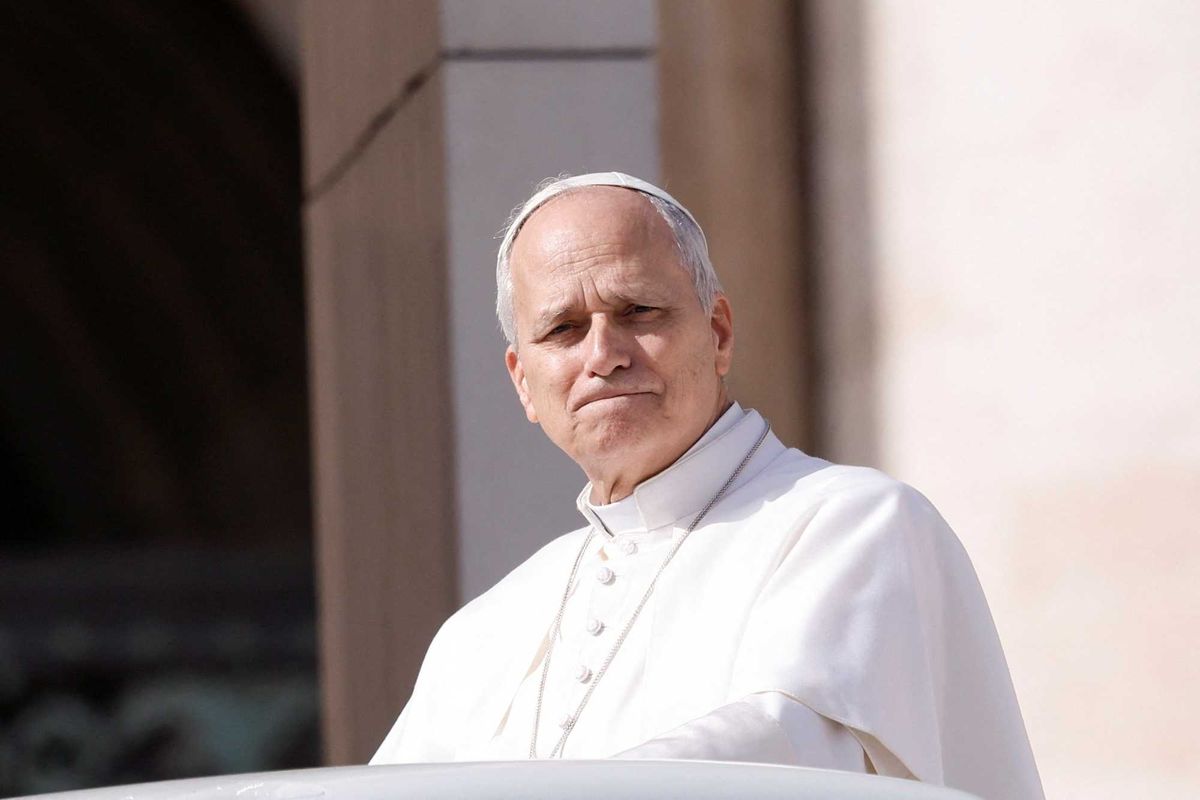
Pope Leo XIV looks on as he leaves at the end of the weekly general audience, in Saint Peter's Square at the Vatican on Feb. 18, 2026. REUTERS/Remo Casilli

Pope Leo XIV rejected President Donald Trump's invitation to join his Board of Peace with a serious response, according to reports Wednesday.

The Vatican issued a statement and declined the White House's January request, making it clear that the leader of the Roman Catholic Church does not want to be involved with Trump's Gaza project, The New Republic reported.

The Vatican’s secretary of state Cardinal Pietro Parolin said that the Pope expressed several concerns and "will not participate," The Independent reported.

“For us, there are ... some critical issues that should be resolved,” Parolin told reporters. “One concern is that, at the international level, it should above all be the UN that manages these crisis situations. This is one of the points on which we have insisted.”

The Pope has been critical of the president and his administration. He was among several world leaders invited to participate on the board and "supervise the ceasefire in Gaza and coordinate the strip’s reconstruction following the conflict between Hamas and Israel," according to The Independent. Trump has also said that the board would look to address global clashes, but some have viewed his move as an attempt to add an "alternative multilateral forum to the UN," which Trump has long complained about.

The Pope has disagreed with Trump's move. In September, he made a subtle comment calling out the president, saying “someone who says ‘I am against abortion but I am in agreement with the inhuman treatment of immigrants in the United States,’ I don’t know if that’s pro-life.”


And in November, the Pope, who is also the first American-born Vatican leader, went into further detail in his criticism.

“I think we have to look for ways of treating people humanely, treating people with the dignity that they have. If people are in the United States illegally, there are ways to treat that. There are courts, there’s a system of justice,” the Pope said.

“But when people are living good lives, and many of them for 10, 15, 20 years, to treat them in a way that is extremely disrespectful to say the least—and there’s been some violence unfortunately—I think that the bishops have been very clear in what they said,” he said. “I would just invite all people in the United States to listen to them.”

As of now, only 19 countries have joined Trump's board, including Argentina, Hungary, Saudi Arabia and the United Arab Emirates. Both Israel and Russia — countries that are both accused of war crimes — have been offered invitations but only Israel has decided to join the board so far.

"The Vatican and the pope’s rejection will hurt the board’s credibility, but that isn’t likely to change Trump’s mind," according to The New Republic.
Turkey fires up coal pollution even as it hosts COP31

By AFP
February 19, 2026


Afsin‑Elbistan is one of Turkey's most polluting power plants but the government is seeking to expand it despite its role hosting the COP31 climate summit later this year - Copyright AFP Ozan KOSE


Fulya OZERKAN

Kaddafi Polat rarely mentions his own health after decades of breathing the polluted air blanketing his village beneath the towering chimneys of a coal‑fired power plant in southern Turkey. What troubles him most is his children.

Fine dust settles on cars, laundry and the narrow streets of Cogulhan, a village in the Afsin district of Kahramanmaras province, leaving a grey film over daily life — and over the now-rotting playground where his kids once played.

Afsin‑Elbistan is one of the country’s most polluting power plants, environmentalists say, but the government is planning to expand it, even as Turkey prepares to host the COP31 UN climate summit next November.

“In the mornings, when the school bus comes, dust rises everywhere,” Polat, 52, told AFP at a local coffeehouse.

“Children breathe this in, what will happen when they’re 30 or 40? As a father, you worry.”

Once home to 10,000 people, most of the village’s residents have fled because of the pollution, locals say. Only a few hundred are left.

Crumbling houses line the streets, watched over by a solitary clock tower. The chimneys of the power plant dominate the skyline, pumping plumes of ash and smoke.

“Living here is like suicide,” Polat sighs, saying some stay because they are poor, others because they have land here.

“I’ve watched pollution change everything: people, animals, the soil, even the trees.”


– A genuine climate leader? –


One of Turkey’s largest thermal power facilities, the plant generates 2,795 megawatts of power from highly polluting lignite, or brown coal, mined in the Afsin‑Elbistan basin that holds 40 percent of the country’s reserves.

Opened in 1984, the eight-unit complex comprises privately-run Afsin-Elbistan A, and the state‑run plant B.

But plans to expand Plant A by two units have alarmed environmentalists, especially with Turkey preparing to host COP31, where the shift away from fossil fuels will be a central theme.

“If Turkey is pursuing the COP31 presidency with a claim to being a genuine climate leader yet continues to insist on fossil fuel investments, particularly coal, then this is a paradox it must resolve,” said Emel Turker Alpay of Greenpeace Turkey.

Turkey aims to reach net-zero emissions by 2053, but coal still accounted for 33.6 percent of the resources used in electricity generation last year, official data shows.

Last week, Environment Minister Murat Kurum tried to dismiss a question about hosting COP31 and Turkey’s increasing reliance on coal.

“We cannot reduce the matter solely to fossil fuels,” he told a news conference alongside UN climate chief Simon Stiell.

But Alpay said expanding one of the country’s most polluting plants contradicts both “Turkey’s climate goals and the state’s responsibility to protect public health”.

Activists link the complex and its emissions of particulate matter and sulphur dioxide to an estimated 16,530 premature deaths.

Adding two more units could cause a further 2,268 deaths and impose 88.4 billion lira ($2.6 billion) in health costs, even with improved filtration technology, they warn.

Contacted by AFP, the plant declined to comment on the expansion plans.


– Government ‘must choose’ –


Lutfi Tiyekli, who heads the Kahramanmaras doctors’ association, said the government “must choose between energy from this power plant and public health”.

“We are knowingly sacrificing people here to cancer, chronic obstructive pulmonary disease and asthma,” he told AFP.

A local environmental activist, Mehmet Dalkanat, said sickness was widespread.

“People are dying. There isn’t a single household in this village without cancer,” said Dalkanat, who suffers chronic respiratory problems.

His son, Ali, said he worked as a security guard at the plant but left in 2020 with severe bronchitis.

“Had I kept working there, my health would have taken an irreversible path,” he said.


– Danger levels –


Air pollution in the Elbistan district remains far above World Health Organization and Turkish safety thresholds, said Deniz Gumusel of the Right to Clean Air Platform.

Under Turkish limits annual PM10 particulate matter should be capped at 40 micrograms per cubic meter, she said, but Elbistan has levels of up to three times higher.

And the daily average of PM10 particle levels reached 128.3 micrograms per cubic meter in Elbistan last year — over eight times the WHO guideline of 15 micrograms.

For Dalkanat, expansion would be the final blow.

“While the world is phasing out coal, building a new power plant here means this region is being written off,” he said.

In Cogulhan, residents have largely given up.

“Look where I walked, my footprints show like walking on snow,” said 62‑year‑old Eyup Kisa of the ash that constantly falls on the village.

“If they expand this plant, we’ll all die”.
Bird flu ravaging Antarctic wildlife, scientist warns


By AFP
February 17, 2026


In a recent expedition to Antarctica, new cases of avian flu were discovered in Antarctic cormorants, kelp gulls, Adelie and gentoo penguins, and Antarctic fur seals, according to researcher Victor Neira - Copyright AFP Alain JOCARD

Scientists are sounding the alarm over the spread of bird flu across Antarctica, with a leading Chilean researcher telling AFP Tuesday of an observed strain “capable of killing 100 percent” of infected fauna.

Researchers have been warning in recent years of bird flu’s spread on the icy continent, which hosts temporary teams of scientists but no permanent residents.

But a particularly dangerous strain of the disease was detected in April 2024 by Chilean researcher Victor Neira and his team in five skuas, a type of polar seabird.

Since then, the virus has spread to other species, with cases detected along 900 kilometers (560 miles) of coastline studied by scientists.

In a recent expedition to Antarctica, new cases were discovered in Antarctic cormorants, kelp gulls, Adelie and gentoo penguins, and Antarctic fur seals, Neira told AFP.

“The virus has completely spread throughout the Antarctic region where we have the capacity to go and study,” said Neira, a scientist at the University of Chile and the Chilean Antarctic Institute (INACH).

“This disease is capable of killing 100 percent of the birds in short periods of time,” he said.

“For example, in one or two days it can kill 90 percent or 100 percent of the animals in a given area.”

Antarctic species are often small in total population, underscoring the risk of outbreaks.

Animals such as Antarctic cormorants and skuas number around 20,000 in total.

A global wave of bird flu has affected birds and mammals around the world since 2021, spread via bird migration.

In 2023, it killed thousands of Humboldt penguins in Chile.
MAGA hosts claim Barack Obama is 'reptile person' — just days after Trump's ape gaffe

David Edwards
February 17, 2026 
RAW STORY


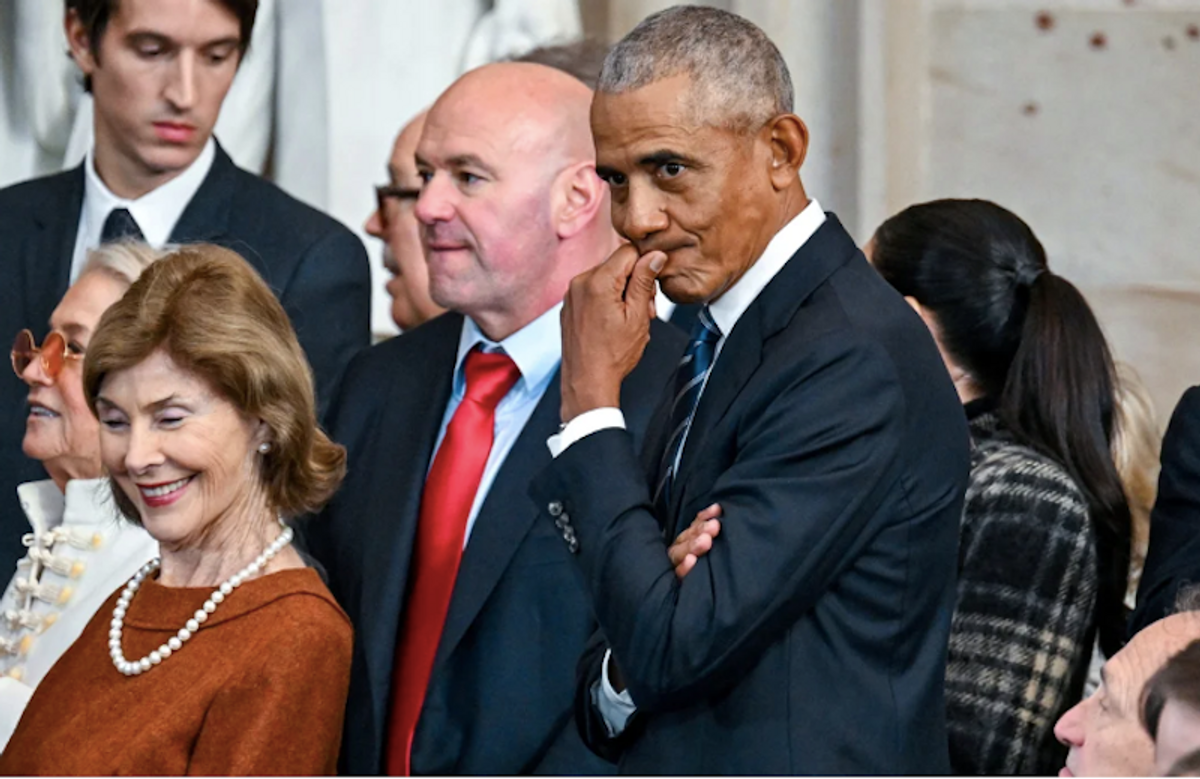
Former President Barack Obama during the inauguration of Donald Trump as the 47th president of the United States takes place inside the Capitol Rotunda of the U.S. Capitol building. Kenny Holston/Pool via REUTERS


Pro-MAGA host Emily Finn and Gina Loudon agreed that former President Barack Obama was a "reptile" alien.

During a Tuesday segment on Real America's Voice, the hosts discussed Obama's belief that there was likely alien life in the universe.

"Gina, what say you in terms of intelligent life?" co-host David Brody asked.

"I was just going to say, intelligent life is waning at this point in general," Loudon replied. "But I believe Obama's an alien. I mean, no. That's not what I'm like...."

"Oh, hello!" Brody exclaimed. "What?"

"I thought he was a reptile person, Gina," Finn said.

"Yeah, yeah," Loudon agreed. "That's right, Emily. I've seen all the apocalypse movies, and I think there's a good chance that Obama could star in one of those."

In a statement this week, Obama shared his thoughts on alien life in the universe.

"Statistically, the universe is so vast that the odds are good there's life out there," the former president said. "But the distances between solar systems are so great that the chances we've been visited by aliens is low, and I saw no evidence during my presidency that extraterrestrials have made contact with us. Really!"

President Donald Trump set off an outcry earlier this month when he posted an AI video that showed Obama and his wife, Michelle, as apes.


Wednesday, February 18, 2026

Struggling farmers find hope in India
 co-operative


By AFP
February 17, 2026


Agriculture is the backbone of India's rural-driven economy, employing more than 700 million people - Copyright AFP Punit PARANJPE


Julie FRAYSSE

Kiran Ramnath Waghchaure beams as he plucks deep-red grapes from his vines in India’s Maharashtra state, one of thousands of farmers reaping the benefits of a cooperative bringing hope to a long-suffering sector.

Agriculture is the backbone of India’s rural-driven economy, employing more than 700 million people. But the industry has been mired in crisis for decades, with slow‑moving reforms and growing vulnerability to climate change.

Often burdened by debts and crop failure, more than 3,090 farmers killed themselves in Maharashtra between 2022 and 2024.

“This new variety is better suited to the climate,” says Waghchaure, gesturing to the perfectly round, firm and sweet grapes that will soon be on European supermarket shelves thousands of kilometres away.

The 42‑year‑old credits Sahyadri Farms, a cooperative launched in 2011 by 110 small growers, which helps members cut costs and gain access to markets.

Today, Sahyadri Farms is India’s leading exporter of grapes and a major supplier of tomatoes, mangoes and cashew nuts, processing 385,000 tonnes of produce last year.

More than 95 percent of its 30,000 members own less than a hectare of land.


– ‘Compete internationally’ –


“The biggest problem in Indian agriculture is the small size of farms,” says Santosh Watpade, the cooperative’s chief financial officer.

“A producer on his own cannot compete internationally. Joining forces is the only solution.”

A trade deal with the United States announced this month angered Indian farmers’ unions, who argued that a flood of cheap US imports would rob local producers of their livelihoods. It is not clear how the agreement would impact the cooperative.

“The farmer is at the centre of our model, which offers access to markets and long‑term profitability,” Watpade told AFP.

Waghchaure used to tend a two-hectare vegetable plot before joining Sahyadri Farms in 2012.

He now manages six hectares of vineyards, employing 15 workers and cashing in 4.5 to 5 million rupees ($50,000-$55,000) profit per year.

“My income has been rising,” Waghchaure says, his eyes lighting up.

The cooperative’s origins go back to farmer Vilas Shinde, who realised that producers “can achieve so much more” by working together, after he repeatedly failed to export his grapes, Watpade told AFP.

“He invested his own capital and reinvested everything he earned.”

Pankaj Nathe joined Sahyadri Farms in the cooperative’s early days, and now heads agricultural research and certification, developing grape varieties more resilient to erratic weather.

Seedless white Thompson grapes for years dominated Indian vineyards, but shifting weather patterns, including unexpected rain at the start of this year, now cause the berries to burst, sometimes wiping out entire harvests.


– Cash injection –


“We started planting new varieties better adapted to climate extremes and foreign consumer demand,” Nathe said.

The cooperative, which also trains farmers on curbing excessive use of fertilisers and pesticides, has expanded its operations with the help of external investment.

Diane Jegam, South Asia director at Proparco — a subsidiary of the French Development Agency (AFD) — fell in love with the project during a visit to Sahyadri in 2022.

Later that year, Proparco joined a pool of investors who injected nearly $40 million into the cooperative.

The funds helped expand export markets, diversify crops, and finance a biogas plant and a microalgae facility for water recycling.

Around 6,500 staff — 40 percent of whom are women — sort, process and package fruits and vegetables in vast warehouses every day thanks to Proparco funds.

“It’s an investment perfectly aligned with our goals — protecting the planet and reducing inequalities by integrating smallholders and supporting farmer‑led enterprises,” Jegam told AFP.

The cash has “accelerated everything,” Watpade said.

“Ensuring a decent income for farmers will help curb problems like suicide and ensure that the next generation stays in agriculture.”