Sunday, February 22, 2026

Opinion

Sacred marches and sacred music in a time of empire

(RNS) — Bad Bunny's joyful Super Bowl halftime show, a group of monks walking hundreds of miles for peace, protesters singing in the streets.


Bad Bunny performs during halftime of the NFL Super Bowl 60 football game between the Seattle Seahawks and the New England Patriots, Sunday, Feb. 8, 2026, in Santa Clara, Calif. (AP Photo/Frank Franklin II)

Kaitlin Curtice
February 20, 2026
RNS


(RNS) — A combination of recent events has illuminated for me, once again, the power of sacred resistance in the face of cruelty and oppression. Sacred resistance is more than just protest, more than social media posting, more even than advocacy. Sacred resistance can include those things, but it is also embodied, it is done in community, it is aspirational in its call to joy, to the celebration of humanity, to justice. It embraces the prophetic power of art — in music, in poetry, in paintings, in film — alongside the strength of a crowd with a common purpose. Sacred resistance is subversive, but it is wholly human.

I have witnessed this sacred resistance in Bad Bunny’s defiantly joyful Super Bowl halftime show, in a group of monks walking hundreds of miles for peace, in protesters singing in the streets and in our very homes as we care for one another in a time of immense violence.

Each offers an example of how we can resist the status quo of hate, greed, colonialism, racism, xenophobia and sexism — by showing up with joy, movement, poetry, long walks, music, online and in-person presence and by holding space with one another to rest and to heal along the way.

During Bad Bunny’s halftime show — itself a stunning tribute to Puerto Rico — Ricky Martin sang the lyrics to “Lo que le paso a Hawaii,” a story of survival, grief and dreams living on despite colonialism.

Hawa’ii and Boricua, what we call Puerto Rico today, share a history of brutal colonialism. Puerto Rico has lived under colonial rule since 1493, when Columbus arrive on Taíno land. Today, the island holds the status of “territory” in the United States, with little agency and no congressional representation. The United States overthrew the monarchy of Hawa’ii in 1893, devastating the Native Hawaiian population and culture, which continues today through an extravagant and extractive tourist industry.

A few of the lyrics in Ricky Martin’s song spoke to the struggles in both Puerto Rico and Hawa’ii:

Quieren quitarme el río y también la playa (They want to take away the river and also the beach)

Quieren al barrio mío y que abuelita se vaya (They want my neighborhood and they want grandma to leave)

Que no quiero que hagan contigo lo que le pasó a Hawái (I don’t want them to do to you what they did to Hawa’ii)

Benito Ocasio’s halftime show was about more than music; it was a celebration of Puerto Rican culture and community, a celebration of the whole of the American continents, looking to the future while also speaking the truth about the past and about the present that we find ourselves in.


Buddhist monks participating in the “Walk For Peace” are seen with their dog, Aloka, Thursday, Jan. 8, 2026, in Saluda, S.C. (AP Photo/Allison Joyce)

And then there was a group of Vietnamese Buddhist monks, nuns and their dog, Aloka, who walked from Texas to Washington, D.C., for peace, marching on bruised feet because they believed the world needed to bear witness not just to violence but to the power of spiritually grounded practices. Every time I saw the monks in a reel on Instagram or in the news, I was reminded of the power we hold in our very bodies — that our spiritual life, our commitment to justice and care in the world, happens not just through prayer but through action rooted in kinship and belonging. When we begin to understand the threads of community that build webs of resistance in the world, we can prepare ourselves for whatever is next.

I was recently with an elder who is the tribal chairman of the Grand River Band of Ottawa Indians, and he talked to me about The Long Walk, a march organized by the American Indian Movement in the 1970s from Alcatraz to Washington, D.C., over five months. They gathered together with their allies who joined them along the way to protest the United States government’s broken treaty promises, especially around land sovereignty and water rights. What began with around 3,000 people ended in more than 30,000, speaking to the power of building community through movement. The march was a political statement, but, like the monks’ walk, it was also a spiritual one. Along the way they passed a peace pipe, they danced, sang and educated the masses on Indigenous rights and care for the earth.

And now, Indigenous peoples dance in the streets of Minneapolis, holding vigil, praying and caring for their community through sacred resistance. Earlier this month, a group of Indigenous peoples led by Migizi Spears of the Red Lake Nation set up a prayer camp in front of the Whipple building, a building tied to the oppression of the Dakota and Ho-Chunk people, to protest the violence and wrongful detention of people by ICE. They held vigil, prayed, sang and named the truth of history so that it won’t be repeated. It was a form of sacred protest and a vision for who we should be in this time.


Indigenous people perform during a memorial honoring Alex Pretti and Renee Nicole Good, who were both recently fatally shot by federal agents, on Sunday, Feb. 1, 2026, in Minneapolis. (AP Photo/Ryan Murphy)

In an era in which Donald Trump is president, the necessity of resistance is visceral and clear. But how do we show up to this moment in ways that will create change?

Maybe it begins with looking up the lyrics to a song in Spanish or learning about the history of places like Puerto Rico, Cuba or Hawa’ii, histories that will make clear how borders are a colonial construct. We learned this in Bad Bunny’s halftime show, and as a lesson that many Indigenous people have taught again and again. Constructed borders keep us from recognizing the humanity present in those beyond our colonial boundaries and markers.

Listen to the stories of the oppressed. Read books and celebrate art created by those on the margins, whose stories don’t often get told. When we diversify the stories we take in, especially during a time when those stories are being suppressed, we expand our perspective and grow our community.

Grieve what America isn’t — and never has been. Many people are afraid to grieve the loss of an image of America they deeply wanted to be true. We have to come to terms with the foundational violence of this country: the genocide of Indigenous peoples, the enslavement of Black people. Those violences did not simply end; they are perpetuated through racist policing strategies, discriminatory housing and lending practices, the extraction of natural resources from Indigenous lands. Grief is essential in resistance work.

But you don’t have to do it alone. Show up to a community meeting, to a vigil, to a march, get involved in resistance art (like this Philadelphia art community knitting anti-ice hats once a week). Our resistance movements fall apart if they aren’t sustained by communal care and joy.

One of my favorite elders, Choctaw teacher Steven Charleston, writes in his book “Ladder to the Light”:

“When we share our questions together, we become our own answer. We discover there is no one right way to do everything. We understand that no single plan will encompass the way forward. If we seek to bring light into darkness, then we must rely on the wisdom of us all.”

May we ask the questions we need to ask, and may we realize we are also capable of the answer.

(Kaitlin B. Curtice is an award-winning author and poet. She is the author of several books, including “Native: Identity, Belonging and Rediscovering God” and “Living Resistance: An Indigenous Vision for Seeking Wholeness Every Day.” She is also the director of the Aki Institute. The views expressed in this commentary do not necessarily reflect those of Religion News Service.)
'The divine will come': On Lord Shiva's night, Hindus channel deity's energy at the heart of creation

(RNS) — Mahashivratri, which means “the Great Night of Shiva” in Sanskrit, takes place as Lord Shiva's cosmic energies are said to be at their highest.


People attend a Mahashivratri celebration, Sunday, Feb. 15, 2026, in New York. (RNS photo/Richa Karmarkar)

Richa Karmarkar
February 16, 2026
RNS

NEW YORK (RNS) — Manirag Reddy Gaddam, a 30-year-old data analyst from Hoboken, New Jersey, said he had never anticipated his sudden turn to the Hindu faith in his 20s. Equally unexpected, he said, was pulling an all-nighter last year as he celebrated Mahashivratri, the daylong Hindu holiday dedicated to principle deity Lord Shiva.

“I was planning to exit at 2 a.m.,” said Reddy Gaddam, “but the air was so electric that I just stayed. By the time I went home, it was 8 a.m. It was crazy.”

This year’s celebration of the holiday, which fell on Sunday (Feb. 15) and ended early Monday, was no less of an exertion. “Today, I’m fasting as well, like I haven’t eaten anything today, I didn’t drink anything,” said Reddy Gaddam. “I don’t know how I’m surviving, but I have a lot of energy.”

From a rented event space in New York with nearly 300 others, Reddy Gaddam watched a Mahashivratri celebration livestreamed by the Isha Yoga Center in southern India. The celebration, hosted by the renowned guru and yoga teacher Sadhguru, drew an estimated 140 million followers around the world, who chanted, meditated and danced in remote locations for 12 hours.


Manirag Reddy Gaddam. (RNS photo/Richa Karmarkar)

Mahashivratri, which means “the Great Night of Shiva” in Sanskrit, takes place as Lord Shiva’s cosmic energies are said to be at their highest. Falling as the new moon of the lunar month of Phalguna is dark in the sky, the festival is traditionally marked by staying awake for 12 or 24 hours, as devotees deepen connection with themselves and Lord Shiva. Sometimes the 12 hours are spent in meditation, or in “marathons” of devotional singing to the deity of destruction and transformation.

“When you sit with your spine straight, there’s an upsurge of energy,” said Reddy Gaddam. “When we’re doing this whole meditation together, it is magnetic, like you can feel that energy. I was just feeling ecstatic. We kept dancing the whole night, we sat down for 30 minutes, and then we just kept dancing up until morning. We felt the presence of Adiyogi,” he said, using an alternative name for Shiva that refers to the god as the first ascetic yogi, from which all yogic wisdom arose.

Mahashivratri also marks the divine marriage of Shiva and the goddess Parvati, the embodiment of feminine energy, which is called Shakti. Devotees of Shiva, called Shaivites, worship both the masculine Shiva and feminine Shakti together as Paramashiva.

RELATED: The worship of Shiva, Hinduism’s ‘inconceivable’ deity, finds a home in the tech sector

In Los Angeles, Tripurasundari, an initiate of a Shaivite Hindu community, Kailasa USA, has been preparing for Mahashivratri for months. On the biggest night of the year for the “Hindu micro-nation,” as the group calls itself, almost 100 devotees offered milk, ghee, flowers and fruits to the Shiva Lingam — the stone obelisk that represents Shiva in his transcendent form.

Swami Nithyananda, himself considered an incarnation of Paramashiva, the union of feminine and masculine Shakti, oversees Kailasa’s temple, which is home to the largest Shiva Lingam in North America.

“It’s really easy to stay up all night,” said Tripurasundari, a California native. “You have so much bhakti because there’s so much energy,” she said, using the Sanskrit word for love of the divine. “And of course, a lot of us wake up and we do puja (ritual worship) and we do yoga, and we meditate, and our kundalinis (primal energies) are awakened. There’s so many aspects of that energy staying alive within us.”

According to many Shaivites, the ultimate goal of enlightenment in “Paramashiva’s economy” can come from connection with Shiva — the primordial energy which is not only a god, but a representation of all metaphysical existence. “So much healing can happen when we just realize that we are consciousness, that we are Shiva, and this is how we’re empowered, and how Swamiji empowers us,” she said.


People in New York City watch a Mahashivratri celebration livestreamed by the Isha Yoga Center in southern India, Sunday, Feb. 15, 2026. (RNS photo/Richa Karmarkar)

But like interpretations of Lord Shiva, Mahashivratri celebrations are diverse. Rishik Dhar, the head of the online educational community Shaivite.org, practices Kashmir Shaivism, a largely philosophical approach to Hindu life that overlaps with science and astronomy. These Kashmiri Pandits, as these devotees are called, celebrate the day of Shiva and Parvati by indulging in a feast, a “tantric” way of marking the holiday that, Dhar said, “scandalized” the many Hindus who either fast or refrain from eating meat on the day.

Despite the “surface level” differences, he said, “the philosophical idea or ideology is more similar than different. Paramashiva is that absolute consciousness of which everything else emerges, and what we are praying for is that oneness with that absolute consciousness.”

On Mahashivratri, Hindus celebrate the cosmic coming together of Shiva and Shakti, said Dhar. What’s important across many paths of devotion, is that “we worship and ask for that same realization to occur in us as well. It is the same idea that we all want to realize that we are just an extension of Shiva, basically.”

Yogiraj Utkarsh, CEO of the World Yoga Federation, which certifies yoga instructors and was founded by the modern Indian Swami Vidyanand, held his first-ever 24-hour kirtan, or devotional sing, on Sunday. A broad range of yoga teachers, Hindu and non-Hindu, celebrated at a yoga studio near Los Angeles with 30 musical artists, among them the Grammy-nominated kirtan singer and producer Dave Stringer.

Utkarsh said some people he invited had wondered if anyone would be willing to come sing and dance for 24 hours straight.

“But I said, the Divine will come,” he said. “That is enough for me. The real kirtan, you don’t do for an audience, you do for the Divine. And if you do with that intention, there is no force on the earth that can prevent the Divine from coming.”

At Brazil's Carnival, the country's religions fight for respect on a global stage

(RNS) — Carnival, a spectacle celebrating African deities and Catholic saints alike, has become a battleground for religious groups in Brazil.


A performer from the Grande Rio samba school parades on a float during Carnival celebrations at the Sambadrome in Rio de Janeiro, Wednesday, Feb. 18, 2026. (AP Photo/Silvia Izquierdo)


Helen Teixeira
February 20, 2026
RNS


(RNS) — Rio de Janeiro’s lavish Carnival parades, which burst to life in the days before Lent begins, are famous for their colorful costumes, giant floats and the driving rhythm of samba that is a hallmark of Brazilian culture and a magnet for tourists from around the globe. Each parade is produced by one of Rio’s samba schools, which work year-round to prepare them, and each has its own “plot” — enredo in Brazilian Portuguese — that guides its aesthetic. Themes range from tributes to historical figures or artists to pop culture to social and political critique.

These parades all compete on craftsmanship, choreography, rhythmic precision, narrative coherence and the poetic quality of their original song lyrics. They are broadcast nationwide and make headlines around the world.

What is less known about the samba communities behind the parades is their Afro-Catholic religiosity — Afro-Brazilian spirituality that coexists with popular Catholicism: Each school has an orixá — an African deity and a catholic saint of devotion — and at the altars found in the rehearsal halls, the schools’ spiritual guides perform rituals and Masses.

“They are recreational organizations, but religion is present in their social life throughout the year,” said Lucas Bártolo, anthropologist and author of a study titled, “On the Altar of Samba: Religion in the World of Carnival.” “Both the worship of orixás and the devotion to Catholic saints organize the religious life of carnival groups and ground their symbolic dimension.”

In Brazil, as in other Latin American countries, the Catholicism of the Iberian Peninsula arrived with colonization. The church maintained strong links with the state, setting dates and festivals that structured the calendar. Carnival begins the Saturday before Ash Wednesday and ends on Shrove Tuesday, also known as Fat Tuesday, or Mardi Gras, before Lent’s 40 days of fasting start.

“It is a festive period, deeply religious, representing an opposition between Carnival and Lent, which is very strong in Iberian culture, and has also been appropriated by African-derived groups,” Bártolo said.


Performers from the Mocidade samba school parade on a float during Carnival celebrations at the Sambadrome in Rio de Janeiro, Monday, Feb. 16, 2026. (AP Photo/Bruna Prado)

Afro-Brazilian religions have interacted with Catholicism and Christian festivals since the Portuguese arrived, reinterpreting the colonial religion through their own practices and worldviews, even observing aspects of Lent.

“The origins of Carnival in Brazil are linked to enslaved Africans who were brought here and came together to create samba using percussion instruments,” Aydano André Motta, journalist, screenwriter, writer and Carnival researcher, told Religion News Service. “Samba gave rise to samba schools as community spaces in the neighborhoods where these people settled after abolition — predominantly low-income communities, known as favelas.


“Every samba school has always included a priest or priestess from Candomblé or Umbanda,” Motta added, referring to two dominant Afro-Brazilian religions. “The social dynamics of samba schools are guided by (their) rituals.”

Before official parade competitions began in the 1930s, and before state authorities, the media, wealthy classes, corporate sponsors and tourists became involved, the samba schools were confined mostly to homes in the Afro-Brazilian community.

The rhythms of Carnival are derived from the drumming that is central to communication and spirit invocation in Africa. “The instruments used in ritual spaces are the same as those in the school’s percussion section,” said Carlos Monteiro, a journalist and sociologist from the Federal Fluminense University.

Samba brought together the descendants and the percussion of Africans with distinct languages and cultures. “What the diaspora separated, cultural diasporic practice united,” Monteiro said.


FILE – Performers from the Mangueira samba school parade with a depiction of a crucifixion during Carnival celebrations at the Sambadrome in Rio de Janeiro, Brazil, Monday, Feb. 24, 2020. (AP Photo/Leo Correa)

Of the two main branches of Afro-Brazilian traditions, Candomblé focuses on orixás, while Umbanda is more given to blending Catholic and Indigenous spirituality, religious mixing that emerged when, under slavery, African practices were forbidden. The orixás each have Catholic equivalents: “Oxum is syncretized with Our Lady of Conception, Oxóssi with Saint Sebastian, Xangô with Saint Peter, and more than any other, Ogum with Saint George. Ogum is the orixá of war and metals, and Saint George is the most popular saint in Rio, and therefore in the samba schools,” said Motta.

The Catholic Church’s relationship with Carnival and samba schools has historically involved periods of “absolute rejection and condemnation of public discourse, including attempts to prohibit and criminalize these practices,” according to Bártolo. In Rio, city laws were proposed to restrict or regulate Catholic symbols in parades, claiming they profaned sacred images, and schools have often had to modify images of Mary and other Catholic saints to avoid clashes with religious authorities.

In 1989, when a samba school called Beija-Flor planned to depict Christ as a beggar, the church prevailed, but the float entered the Sambadrome — the stadium built for viewing the parades — covered in black trash bags with a banner reading, “Even forbidden, look upon us.”

The opposition has a racial element, given that samba schools have always been predominantly Black institutions. At times, this opposition takes theological form, particularly in the demonization of Afro-Brazilian deities. Exú, a central figure in Candomblé and Umbanda, is a messenger between the human and divine worlds and has long been associated with the devil by Christian groups. But Afro-Brazilian religions, which don’t have a concept of absolute evil, see Exú as playful.

Although African-derived religiosity has been embedded in samba schools since their origins, it was only in the 1960s that they began to explicitly incorporate Black Brazilian culture into their plots. “From there, numerous parade themes highlighted Black history and figures who had previously been invisible in Brazil’s official history,” Motta said.


FILE – Priestess Laura D’Oya Yalorixa, center, takes part in an Umbanda religious ceremony at the Casa de Caridade Santa Barbara Iansa temple in Rio de Janeiro, Brazil, Saturday, Feb. 6, 2021. The faithful of the Umbanda religion, brought to the Americas by West African slaves, perform spiritual protection rituals as part of pre-Carnival traditions. (AP Photo/Bruna Prado)

Under Dom Orani Tempesta, archbishop of Rio de Janeiro since 2009, and with the election of Pope Francis, the Argentine bishop who championed the Amazon and its culture, the church came to support Catholic-themed parade narratives. “Today, it is common for Masses to be held at samba school headquarters, for Carnival groups to be received in sanctuaries and for their flags to be blessed in churches,” Bártolo said, though he added that the rapprochment still has its limits.


The growth of evangelical Christianity in Brazil since the 1980s has added a new dimension to the religious disputes over Carnival. Initially, evangelicals avoided the celebrations, organizing spiritual retreats during this period. Later, as they became more publicly active and aligned with conservative Catholics in criticizing Carnival, they drew political and social criticism from samba schools, while framing themselves as victims of religious persecution.

RELATED: Brazilian evangelical Christians disrupt pre-Lenten partying with ‘Gospel Carnival’

When Rio elected Marcelo Crivella, bishop of the Universal Church of the Kingdom of God, mayor in 2017, “he tried, very hard, to destroy samba schools and Carnival,” Motta said.

The debate intensified recently when Pastor Gil, an evangelical Rio de Janeiro legislator, proposed a bill that would ban the use of sacred images or representations deemed disrespectful to Christian, Catholic or Evangelical faith in Carnival parades and events.

Still, Carnival has served as a space for coexistence of Brazil’s wildly divergent social, racial and cultural differences, allowing marginalized groups to gain legitimacy as they express their culture. In recent years, the parades have emphasized Afro-Brazilian religions, as if to say, Bártolo said, “This is religion, too, not just Afro culture or Brazilian culture.”

“The people of samba schools are experts in resistance,” said Motta. “They survived slavery, structural racism, state violence and state repression. The schools survived and will continue surviving.”

New Orleans celebrates Mardi Gras, the indulgent conclusion of Carnival season

NEW ORLEANS, La. (AP) — Mardi Gras, also known as Fat Tuesday, marks the climax and end of the weekslong Carnival season and a final chance for indulgence, feasting and revelry before the Christian Lent period of sacrifice and reflection.


A member of the Krewe of Zulu offers up coconuts on Mardi Gras Day, Tuesday, Feb. 17, 2026 in New Orleans. (AP Photo/Matthew Hinton)

Sara Cline
February 18, 2026

NEW ORLEANS (AP) — People leaned out of wrought iron balconies, hollering the iconic phrase “Throw me something, Mister” as a massive Mardi Gras parade rolled down New Orleans’ historic St. Charles Avenue on Tuesday.

Mardi Gras, also known as Fat Tuesday, marks the climax and end of the weekslong Carnival season and a final chance for indulgence, feasting and revelry before the Christian Lent period of sacrifice and reflection. The joyous goodbye to Carnival always falls the day before Ash Wednesday.

In Louisiana’s most populous city, which is world-famous for its Mardi Gras bash, people donned green, gold and purple outfits, with some opting for an abundance of sequins and others showing off homemade costumes.

The revelers began lining the streets as the sun rose. They set up chairs, coolers, grills and ladders — offering a higher vantage point.

As marching bands and floats filled with women wearing massive feathered headdresses passed by, the music echoing through the city streets, people danced and cheered. Others sipped drinks, with many opting for adult concoctions on the day of celebration rather than the usual morning coffee.

Each parade has its signature “throws” — trinkets that include plastic beads, candy, doubloons, stuffed animals, cups and toys. Hand-decorated coconuts are the coveted item from Zulu, a massive parade named after the largest ethnic group in South Africa.

As a man, dressed like a crawfish — including red fabric claws for hands — caught one of the coconuts, he waved it around, the gold glitter on the husk glistening in the sun.

Sue Mennino was dressed in a white Egyptian-inspired costume, complete with a gold headpiece and translucent cape. Her face was embellished with glitter and electric blue eyeshadow.

“The world will be here tomorrow, but today is a day off and a time to party,” Mennino said.

The party isn’t solely confined to the parade route. Throughout the French Quarter, people celebrated in the streets, on balconies and on the front porches of shotgun-style homes.

One impromptu parade was led by a man playing a washboard instrument and dressed as a blue alligator — his paper-mache tail dragging along the street, unintentionally sweeping up stray beads with it. A brass band played “The Saints” as people danced.

In Jackson Square, the costumed masses included a man painted from head to toe as a zebra, a group cosplaying as Hungry Hungry Hippos from the tabletop game and a diver wearing an antique brass and copper helmet.

“The people are the best part,” said Martha Archer, who was dressed as Madame Leota, the disembodied medium whose head appears within a crystal ball in the Haunted Mansion attraction at Disney amusement parks.

Archer’s face was painted blue and her outfit was a makeshift table that came up to her neck — giving the appearance that she was indeed a floating head.

“Everybody is just so happy,” she explained.

The good times will roll not just in New Orleans but across the state, from exclusive balls to the Cajun French tradition of the Courir de Mardi Gras, or Fat Tuesday Run — a rural event in Central Louisiana featuring costumed participants performing, begging for ingredients and chasing live chickens to be cooked in a communal gumbo.

Parades are also held in other Gulf Coast cities such as Mobile, Alabama, and Pensacola, Florida, and there are other world-renowned celebrations in Brazil and Europe.

One of the quirkiest is an international Pancake Day competition pitting the women of Liberal, Kansas, against the women of Olney, England. Pancakes are used because they were thought to be a good way for Christians to consume the fat they were supposed to give up during the 40 days before Easter.

Contestants must carry a pancake in a frying pan and flip the pancake at the beginning and end of the 415-yard (380-meter) race.

Associated Press religion coverage receives support through the AP’s collaboration with The Conversation US, with funding from Lilly Endowment Inc. The AP is solely responsible for this content.
In Boston, US Jews envision a Judaism beyond Zionism

BOSTON (RNS) — At a ‘Jewish Left’ conference, attendees set out to build new institutions that they consider more ethically grounded in Judaism post-Oct. 7, 2023.


People attend the Conference on the Jewish Left at Boston University, Feb. 12, 2026, in Boston. (Photo by Melissa Ostrow/Boston University)


Yonat Shimron
February 19, 2026
RNS

BOSTON (RNS) — On Yom Kippur in 2024, one year after Israel began its fierce assault on Gaza, Rabbi Greg Hersh’s small Massachusetts synagogue voted to raise money to buy military gear for the Israel Defense Forces.

Hersh, a 40-year old graduate of the Reconstructionist Rabbical College, remembers feeling perplexed.

“This is the holiest day of the year,” Hersh remembers he told the synagogue’s board. “Do you really think we should be buying weapons for soldiers on this day?”


The board’s answer was a resounding yes. For Hersh, it was a sign that it was time for him to go.

Five months ago, Hersh started a new congregation called V’ahavtah, from the Hebrew, “You shall love.” Using the moniker “Judaism Beyond Zionism,” it meets in rented space, mostly in Cambridge.

Hersh’s new synagogue was among 30 mostly new Jewish organizations whose representatives came together to imagine a new Jewish future less defined by Zionism, if not entirely anti-Zionist, at the third annual Conference on the Jewish Left at Boston University last week (Feb. 12). Hosted by the university’s Institute on Culture, Religion and World Affairs, the conference drew nearly 1,000 people — 480 in person and the rest online.


Rabbi Ari Lev Fornari of Kol Tzedek, a synagogue in Philadelphia, wears a watermelon kippah, or head covering, a symbol of Palestinian solidarity, during the Conference on the Jewish Left at Boston University on Feb. 12, 2026. (RNS photo/Yonat Shimron)

Organizations like Hersh’s gathered in an exhibit hall to give out banners, books, stickers and other items to introduce participants to their post-Oct. 7 Jewish missions. The conference brochure announced, “None of us are free until all of us are free,” and participants milled about the conference wearing kippahs, or head coverings, featuring watermelons, the symbol of solidarity with Palestinians. Each of the main speakers in the big lecture hall offered a stinging rebuke of what they considered the American Jewish establishment’s unquestioning support for Israel and near complete disregard for Palestinian suffering.

But if the conference had a main theme, it was building new institutional containers for what they say is a more ethically grounded American Judaism.

In its 16 workshops, conference-goers considered building philanthropic infrastructure, creating theologies around the concept of exile and learning lessons from Jewish activists who helped build New York City Mayor Zohran Mamdani’s winning coalition.

Participants heard from Palestinian-born political activist Fadi Quran, who urged them to push ahead: “If we want to take ourselves seriously, not just to liberate Palestine, not just to liberate Jewish people from fear, but also to move towards a world that most humans everywhere truly want and yearn for, we need to build that institutional power,” he said.

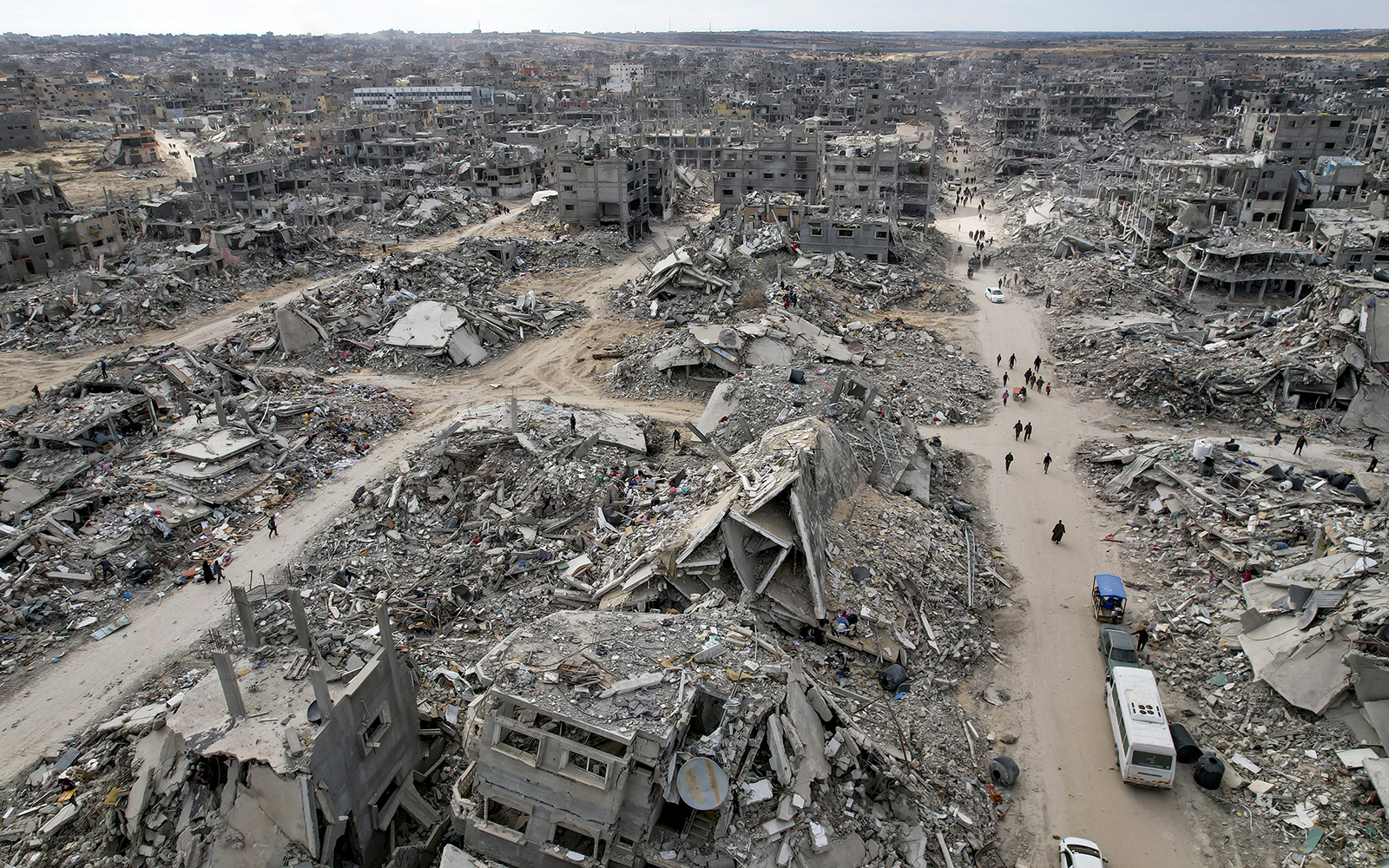
More than 70,000 Palestinians have been killed during Israel’s invasion of Gaza, and most of the southern enclave has been demolished. The war has also ruptured a Zionist consensus among the majority of U.S. Jews. While most U.S. Jews increasingly supported Israel and the Zionist cause of building a Jewish state, especially after its decisive victory in the Six Day War in the late 1960s, a growing segment no longer does. A February survey by the Jewish Federations of North America found that only one-third of American Jews identify as Zionist, although almost 9 in 10 said they supported Israel’s existence as a Jewish and democratic state. And a Washington Post poll last year showed 61% of American Jews believe Israel has committed war crimes in Gaza.


Displaced Palestinians return to Rafah, Gaza Strip, Jan. 20, 2025, a day after a ceasefire deal between Israel and Hamas went into effect. (AP Photo/Jehad Alshrafi, File)

As the JFNA poll suggests, U.S. Jews do not necessarily endorse the dismantling of Israel, but many argued at the conference that they no longer want to support what they consider a supremacist political project premised on a demographic Jewish majority that oppresses Palestinians.

Across the U.S., and especially in Boston, new institutions are slowly coming into being that reflect this change. They include dozens of budding congregations like V’ahavtah, consisting of Jews who no longer want to pray in synagogues that hoist the Israeli flag in their sanctuaries or recite the “Prayer for the State of Israel” during Shabbat services.

In Boston, there are also plans to open an alternative Jewish day school whose website proclaims it will “decouple Judaism from nationalism” and focus on the Torah’s mandate of justice. The school, which would be the first of its kind, expects to open in 2029 with a kindergarten class.

Leah Robbins, its 32-year-old founder, said she wanted to create a new model for Jewish day schools that could be replicated in Brooklyn or Berkeley, California.

“We need robust, thick Jewish education to be a real force in the conversation, to take back the monopoly on Jewish life from the mainstream, organized Jewish community,” said Robbins, who exhibited at the conference.

Nationwide, half a dozen congregations under the banner Synagogues Rising have publicly declared themselves committed to Palestinian liberation and have anti-Zionist rabbis. A new association for diasporic Jewish organizations is expected to be announced within the next few months.


Gina Coplon-Newfield of Cambridge, Mass., foreground, attends the Conference on the Jewish Left at Boston University on Feb. 12, 2026, in Boston. (RNS photo/Yonat Shimron)

Most of these new congregations say they strive for a “liberatory Judaism” that honors the inherent sacredness of all life and is rooted in core values of justice, equity and solidarity.

At the same time, many older U.S. Jews are not about to break away from their existing synagogues. Recognizing that reality, members from 26 established Massachusetts Jewish congregations formed a group to support individuals who want to open their synagogues to a more critical view of Israel. The Massachusetts Synagogue Network on Israel Palestine provides resources to help them push for change, foster respectful dialogue, start reading groups and create other learning opportunities. That group was also exhibited at the conference.

“These are folks who are not looking to blow up their relationships, but rather want to figure out how within the synagogues that they know and love, they can expand space for dialogue on this issue rather than ignoring it and turning away,” said Mneesha Gellman, one of the group’s members.

Younger Jews are not interested in fighting that battle. Rakeea Chesick Gordis, a 25-year-old program manager at a community building organization, joined Minyan Zayit, an anti-Zionist prayer group in Somerville, about 4 miles north of Boston. The group holds monthly Friday night services in a local synagogue, drawing some 70 people. It recently started a monthly Shabbat morning service. Its name uses the Hebrew word for “olive,” zayit, a symbol of Palestinian culture.

“It just feels like there’s this energy and thirst for a values-aligned community that is not exclusively about political organizing, but about being with people who hold the same truths as you,” she said.

Scholars say this younger generation is more interested in Jewish practice than their elders, many of whom disaffiliated and dropped out of Jewish institutions altogether.

“The progressive left is becoming more ritually and Jewishly engaged than a lot of the standard synagogues themselves,” said Shaul Magid, a professor of modern Jewish studies at Harvard Divinity School.

Hersh, the rabbi of V’ahavtah, sees this, too. The day after the conference, he held his monthly Friday night service — this time in a rented classroom at Massachusetts Institute of Technology. He spread out a kaffiyeh over a lectern. On top, he laid out Shabbat candlesticks and a laptop so he could livestream the service to people at home.

About 22 people showed up for the service, mostly in their 20s with a handful of retirees. They blessed the candles, the wine and two loaves of challah. They recited the traditional liturgy and some modern poems using a 25-page handout that Hersh provided. They ate a buffet-style vegan meal of Indian food: saag, tofu curry and rice.


Rabbi Greg Hersh conducts a Friday night Shabbat service on Feb. 13, 2026, in Cambridge, Mass. Hersh started V’ahavtah, a Judaism Beyond Zionism Synagogue, five months ago. It meets in various rental spaces, mostly in Cambridge. (RNS photo/Yonat Shimron)

Hersh said about a third of the participants were first-time guests who had heard about the congregation at the conference.

“The demand is so strong and the supply is so limited for communities like this,” he said. “There is this unserved Jewish population that should have the right to do Judaism, the ability, the access to Jewish ritual in the same way that every other Jew has access. And I’m really proud to be creating that.”
Ash Wednesday protests and Masses make solidarity with immigrants a Lenten theme

(RNS) — Chicago Cardinal Blase Cupich told immigrants that Trump administration deportation efforts had acquainted them with Ash Wednesday’s Scripture passage about practicing faith in secret.


Cardinal Blase Cupich participates in a procession through Melrose Park after an Ash Wednesday Mass at the Shrine of Our Lady of Mount Carmel, Wednesday, Feb. 18, 2026, near Chicago. (Video screen grab)

Aleja Hertzler-McCain
February 19, 2026
RNS

(RNS) — Christian leaders — from Catholic cardinals and Episcopal and Lutheran bishops to moderate evangelical Christians — took their faith’s day of penitence and prayer as an opportunity to speak out on behalf of immigrants and against President Donald Trump’s mass deportation campaign. Ash Wednesday began and ended with Masses led by two of the three current cardinal archbishops, with vigils at the White House and in New York’s Federal Plaza, the center of federal government in the city, in between.

In his homily at a large outdoor Mass in solidarity with immigrant families in Melrose Park, Illinois, Cardinal Blase Cupich, the archbishop of Chicago, addressed immigrants directly, saying the anti-immigrant environment has brought home to them the day’s Gospel passage about practicing one’s devotions in secret. Deploring the way they have been “treated like dust that can be swept away,” the cardinal told immigrants, “This day is made for you.”

“When you cry in secret, he sees you. When you work hard for your children while no one is watching, he sees you,” said Cupich of God. “When you sacrifice your own comfort to send money back home, you sacrifice to give alms in secret, and he sees you.”

Several Catholic prelates celebrated Mass in immigrant detention centers. Cardinal Joseph Tobin of Newark, New Jersey, was joined by Newark Auxiliary Bishops Pedro Bismarck Chau, Manuel Cruz and Gregory Studerus at Delaney Hall, an Immigration and Customs Enforcement facility. Las Cruces, New Mexico, Bishop Peter Baldacchino celebrated Mass at Otero County Prison Facility and Processing Center in his diocese.

Tobin told RNS after celebrating two Masses for women detained inside Delaney Hall, “It was sad and yet there was a serenity among them, because they’re women of great courage.”

When informed that Tobin had visited Delaney Hall, Kristina Larios, a Rutgers University-Newark student who attended the Mass that Tobin later celebrated at St. Patrick’s Pro-Cathedral in Newark, said: “It’s an issue here, so it’s a good sign that he cares about people in this area. It’s an important issue to me, too.”


Cardinal Joseph Tobin speaks during an Ash Wednesday Mass at St. Patrick’s Pro-Cathedral, Wednesday, Feb. 18, 2026, in Newark, N.J. (RNS photo/Fiona Murphy)

Sister Susan Francois, a Sister of St. Joseph of Peace, joined members of the Catholic peace organization Pax Christi USA outside the cathedral to thank Tobin for his advocacy. “I am here today at the pro-cathedral to support Cardinal Tobin, who has spoken out in the name of what Christianity and people of goodwill are about,” said Francois, who prays outside Delaney Hall several times a week and offers support to visitors to the detention center.

In some places, faith leaders’ access to detention centers was not guaranteed or simple. The Coalition for Spiritual and Public Leadership, a Christian organization, won a preliminary injunction last week allowing the group access to a nearby detention center in Broadview, Illinois, to provide ashes and Communion on Ash Wednesday. But it was noon on Wednesday before CSPL announced that the Department of Homeland Security had told the group a delegation of two priests and a sister would be able to enter Broadview at 3 p.m.

The Rev. Alex Gaitan, the Archdiocese of Newark’s immigration ministry coordinator, told RNS the process to gain clearance to celebrate Mass at Delaney Hall included a signed agreement from Tobin and the auxiliary bishops to only provide religious services in the center.

In Chicago, Cupich told RNS on Wednesday morning that the purpose of the Mass was to “express our solidarity with people who feel as though fear right now is gripping their hearts.”

Cupich said his primary motivation in crafting the homily was to preach the gospel. “The word of God gives us those images, so my job is to try to make them meaningful to the people who are coming to Mass.”


Cardinal Blase Cupich, top right, celebrates an Ash Wednesday Mass at the Shrine of Our Lady of Mount Carmel, Wednesday, Feb. 18, 2026, in Melrose Park, Ill. (Photo by Steven P. Millies)

In Manhattan, the Episcopal bishop of New York and a Lutheran bishop participated in a prayer service outside the building where immigrants have been detained and held for days before being moved to other facilities. A lawsuit last year about the facility raised serious concerns about overcrowding and unsanitary conditions.

Bishop Matthew Heyd said in a statement: “Ash Wednesday calls us to remember that we are all created in the image of God. Today’s vigil serves as a call to reclaim our shared humanity from the chaos and cruelty that ICE raids have brought to our neighborhoods.”

According to Heyd’s diocesan office, the procession to Foley Square, also known as Federal Plaza, included more than 300 people, among them Long Island Episcopal Bishop Lawrence Provenzano, New York Bishop for the Evangelical Lutheran Church in America Katrina Foster and Episcopal Bishop Suffragan Allen Shin.

The Rev. Winnie Varghese, dean of the Episcopal Cathedral of St. John the Divine; J. Antonio Fernández, CEO of Catholic Charities of New York; Ravi Ragbir, executive director of the New Sanctuary Coalition; the Rev. Paul Brandeis Raushenbush, president of the Interfaith Alliance; and the Rev. Liz Theoharis, executive director of the Kairos Center for Religions, Rights & Social Justice, were also at the Manhattan event.


Delaney Hall Immigration and Customs Enforcement detention facility on Wednesday, Feb. 18, 2026, in Newark, N.J. (RNS photo/Fiona Murphy)

In Washington, D.C., activist groups held Ash Wednesday services near the U.S. Capitol and the White House. A coalition of Catholic groups held a service across the street from the Capitol emphasizing nonviolence, where they prayed about “the horrific ICE raids and killings,” military action in Venezuela, Palestine, Iran and threats against Greenland and Cuba, as well as cuts to social services and climate change protections.

Leaders from Sojourners, Faith in Action, the Georgetown Center on Faith and Justice, the National Council of Churches and the Latino Christian National Network held a separate vigil outside the White House “to issue a moral call to repentance, love, and courageous action in a time of deep crisis for both faith and democracy.”

Several among the group outside the White House also signed onto an Ash Wednesday letter of over 2,000 faith leaders that called the current government and Trump administration “cruel and oppressive.”

“We are facing a cruel and oppressive government; citizens and immigrants being demonized, disappeared, and even killed; the erosion of hard-won rights and freedoms; and a calculated effort to reverse America’s growing racial and ethnic diversity — all of which are pushing us toward authoritarian and imperial rule,” the letter said.

Saying that silence in this moment is not neutrality, but an active choice to permit harm, the letter said, “We call on all Christians to join us in greater acts of courage to resist the injustices and anti-democratic danger sweeping across the nation.”

Fiona Murphy and Jack Jenkins contributed to this report.

Opinion

An Ash Wednesday 'mobilization' showed us a way out of our country's mess

(RNS) — Led by Cardinal Blase Cupich, the crowd prayed and marched with love and without chaos.


People begin a procession through the suburb of Melrose Park, Ill., after an Ash Wednesday Mass at the Shrine of Our Lady of Mount Carmel, Wednesday, Feb. 18, 2026, near Chicago. (Photo by Steven P. Millies)

Steven P. Millies
February 19, 2026
RNS

(RNS) — The Shrine of Our Lady of Mount Carmel is nestled among the well-kept homes of the working-class Chicago suburb of Melrose Park. On Ash Wednesday (Feb. 18), an altar had been erected under a tent outside the church surrounded by a thick crush of 2,000 people who prayed, sang and jostled our way through the ritual. (Fifteen hundred more were somewhat more comfortably inside the church.) When it came time to distribute first ashes, then the Eucharist, there were no neat lines, no aisles or pews — the church building housed only the overflow crowd who would have otherwise blocked the street.

But this was not chaos. Strangers united by faith and peaceful purpose were patient with one another, helped each other. We knew why we were there.

RELATED: Cardinal Tobin leads Ash Wednesday Masses inside New Jersey ICE facility

Illinois Sen. Dick Durbin and the local congressman, U.S. Rep. Chuy Garcia, prayed outside with us. They were not the most honored guests, however; nor was Cardinal Blase Cupich, the archbishop of Chicago, who had come to preside at the Mass. We were there to hold up the family members and other loved ones of residents of Chicago who have been detained, deported or disappeared by the Trump administration. The delegation represented all of those who have been tormented, taken and killed since last year. It was this group who came directly behind Cupich in the procession that began the Mass, the place normally reserved for the most senior cleric presiding at Mass.

That gesture identified these immigrant families and those they represented with the Jesus whose mission, death and resurrection we were there to commemorate.

The cardinal’s homily struck that same theme — uniting mistreated immigrants with God’s love. Cupich seized on the image of dust present in the reminder given on Ash Wednesday as the ashes are imposed on the foreheads of the faithful: “Remember you are dust, and to dust you will return.” Lamenting the suffering of “those who are made to feel like dust,” he observed that dust is found “in construction, in cleaning, in harvesting crops from the fields” — varieties of work that support many immigrant families.

He recalled that God “got down into the dust” when God created us. God “touched” the dust, “molded” it, breathed life into it to create each of us. “You may be undocumented in the eyes of the state,” he said, “but you were handcrafted by the creator of the universe. Your worth does not come from a visa or a permit; it comes from the breath of God inside you.”


Cardinal Blase Cupich delivers a homily in English and Spanish during an Ash Wednesday Mass at the Shrine of Our Lady of Mount Carmel, Wednesday, Feb. 18, 2026, in Melrose Park, Ill. (Video screen grab)

The Mass at Our Lady of Carmel was the latest “mobilization” organized by the Coalition for Spiritual and Public Leadership — so-called, said CSPL board chair Anthony Williams before the Mass, because they are opportunities to resist the Trump administration’s immigration enforcement strategy in an unusual, prayerful, peaceful way. They are meant to remind believers that “Our faith calls us not only to pray but to act.”

Most of all, these mobilizations unite the church to the families and others affected most by the administration. The events allow them to see and feel the presence of the whole church gathered to support them — both the swollen crowd that spilled out into the neighborhood and in the person of Cardinal Cupich, known to be close to Pope Leo XIV, who grew up in another working-class Chicago suburb.

When the Mass ended, hundreds of us processed through the neighborhood, walking behind a banner saying, in English and Spanish, “God’s Love Knows No Borders.” We moved through the streets in silence, holding candles, pausing to recite a decade of the rosary at stops along the way. Sorrowfully, we remembered all of the suffering the Trump administration has created. Many, I expect, prayed that all of this would come to an end. For my own part, I thought of something we had heard in the Ash Wednesday Mass: “Rend your hearts, not your garments.”

Those words of the Hebrew Prophet Joel are among the first we hear in the Ash Wednesday liturgy. Joel wrote amid disaster, centuries before Christ came. A plague of locusts had devastated the land, and a feeling that God had abandoned them haunted the Kingdom of Judah. Yet Joel heralds God’s promise. God waits for them. All they must do is return to God sincerely. A conversion that is inward, not just some outward show, is all God desires. God will be there when we are ready to return.

What does it mean for a people to return to the better version of themselves? What is required? How do we do it?

Anything we do together as a people, we must do both cooperatively and also each alone. Our way has to be like the thick crowd at the Mass, forgoing disorder and chaos. Uncountable individual choices to be patient, to smile, to give way to someone else made that crowd a people united to become the best version of what human beings in action together can look like. We did it each ourselves, and we did it all together.

It has to be like that procession through the streets, a protest, yet no shouting, no destruction of property. There was no disorder, no matter how angry we all were about all that has happened. That Mass and procession showed that a different way is possible.

This way is not easy. It requires a deeply felt sense of shared purpose — even faith. It demands a real change of heart, each of us singly and all of us together as a people. It cannot be forced. To turn a people into a better direction requires something else. It must be given an opportunity. It must be prompted. It must be invited. But each person must decide for change before their choices begin to make change.

This is why CSPL’s mobilizations are so effective, and so promising. Pairing prayer with action brings the witness of faith to the public square attractively, and the experience of it invites each of us to reflect on how we’re engaging the challenges we face in this moment. Not inconsiderably, these mobilizations also pose a real alternative to the anger and violence we see almost everywhere else.

For Catholics, the church is “the mystical body of Christ,” a living presence of Jesus. As much as the Eucharist, Jesus is present in his people in the communion of the church. Our social action, for one another and for justice, as effectively expresses what we believe as prayer does. The more that mystical body moves and acts among the people, enlivened by prayer and united by purpose in peace, the more effectively we will call this people through conversion to return.

For one night it seemed more than possible that, gathered as that mystical body to surround the delegation of family members with our encouragement, support and presence, we can be a better people. We can be better even than what we were before.

(Steven P. Millies is the author of “Joseph Bernardin: Seeking Common Ground” and “A Consistent Ethic of Life: Navigating Catholic Engagement With U.S. Politics.” The views expressed in this commentary do not necessarily reflect those of Religion News Service.)


400 Christian leaders urge resistance to Trump administration on Ash Wednesday

WASHINGTON (RNS) — The statement’s signers include a mix of denominational leaders, seminary presidents, scholars and leaders of prominent congregations.


Federal immigration officers deploy tear gas after the fatal shooting of a U.S. Immigration and Customs Enforcement observer on Jan. 24, 2026, in Minneapolis. (AP Photo/Abbie Parr)
February 18, 2026
RNS

WASHINGTON (RNS) — A group of nearly 400 prominent Christian leaders called President Donald Trump’s administration “cruel and oppressive” and accused the government of being corrupted by an aberrant form of Christianity, in an Ash Wednesday (Feb. 18) statement.

The statement, provided exclusively to Religion News Service in advance, has a list of signers that includes a mix of denominational leaders, seminary presidents, scholars and leaders of prominent congregations. In it, they urged fellow faithful to commit to “greater acts of courage to resist.”

“We are facing a cruel and oppressive government; citizens and immigrants being demonized, disappeared, and even killed; the erosion of hard-won rights and freedoms; and a calculated effort to reverse America’s growing racial and ethnic diversity — all of which are pushing us toward authoritarian and imperial rule,” reads the letter, which organizers said was spearheaded by a group of Christian leaders who have been meeting regularly to discuss how to respond to the administration.

The document raises concerns about “an endangered democracy and the rise of tyranny” and warns of a crisis born out of a “Christian faith corrupted by the heretical ideology of white Christian nationalism, and a church that has often failed to equip its members to model Jesus’s teachings and fulfill its prophetic calling as a humanitarian, compassionate, and moral compass for society.”

“We call on all Christians to join us in greater acts of courage to resist the injustices and anti-democratic danger sweeping across the nation,” the letter reads. “In moments like this, silence is not neutrality — it is an active choice to permit harm.”

The letter also appears to make a thinly veiled critique of House Speaker Speaker Mike Johnson, a Southern Baptist who published a theological defense of Trump’s mass deportation efforts earlier this month. Whereas Johnson argues that the biblical call to welcome the stranger is directed to individual Christians instead of governments, the signers of the letter say otherwise.


Speaker of the House Mike Johnson, R-La., gestures as he meets with reporters at the Capitol in Washington, Tuesday, Feb. 3, 2026. (AP Photo/J. Scott Applewhite)

“Jesus gives His final test of discipleship in Matthew 25:31-46, making clear that the measure of our faith is revealed in how we treat those who are hungry, thirsty, sick, strangers, or imprisoned,” the letter reads. “To say, as some do, that this passage is only about taking care of fellow Christians is an incorrect theological interpretation. It is for the nations, ethnoi, for all peoples.”

Signers include Bishop Vashti McKenzie, president of the National Council of Churches; Bishop Hope Morgan Ward of the United Methodist Church’s Council of Bishops; the Rev. Jihyun Oh, stated clerk of General Assembly of the Presbyterian Church (USA); Bishop Darin Moore, presiding prelate for the Mid-Atlantic Episcopal District of the African Methodist Episcopal Zion Church; David Emmanuel Goatley, president of Fuller Seminary; Jennifer Herdt, senior associate dean for academic affairs at Yale University Divinity School; the Rev. Corey D. B. Walker, dean of Wake Forest University School of Divinity; UMC Bishop Minerva Carcaño; the Rev. Otis Moss III of Trinity United Church of Christ; David Cortright, professor emeritus at the University of Notre Dame’s Kroc Institute for International Peace Studies; and the Rev. Randall Balmer, who holds the John Phillips Chair in Religion at Dartmouth College.

The signers also include several longtime faith-based activists, such as Bishop Dwayne Royster of Faith in Action, Pastor Shane Claiborne of Red Letter Christians, the Rev. Adam Russell Taylor of Sojourners and the Rev. Jim Wallis of Georgetown University’s Center on Faith and Justice.

The statement adds to growing faith-led resistance to the president’s agenda that has erupted over the past year, particularly in opposition to his immigration policies. In addition to statements and sermons issued by religious leaders — including Pope Leo XIV — condemning various policies, more than 100 clergy and faith leaders have been arrested while protesting Department of Homeland Security actions over the past year, and others have been pepper sprayed or shot with pepper balls and pepper rounds.

In addition, dozens of denominations, religious groups and individual houses of worship — as well as several individual faith leaders — have sued the administration over the last year claiming violations to their religious freedom.


Promotional banner for A Call to Christians. (Courtesy image)

The letter outlines a series of theological principles, such as standing with vulnerable people, saying Christians must “defend immigrants, refugees, people of color, and all who are in harm’s way.” Citing various Scripture passages, signers also called on believers to love their neighbors, “speak truth to power,” seek peace, “do justice,” strengthen democracy, “practice hope” and be “rooted and grounded in prayer and love.”

The statement closes with a call to action and a spiritual warning.

“If we as Christians fail to speak and act now — clearly, courageously, and prophetically — we will be remembered not only for the injustices committed in our time, but for the righteous possibilities we allowed to die in our hands,” the letter reads. “History and future generations will record our choices, but the God of Heaven and Earth will judge our faithfulness.”

Some of the letter’s signers — leaders from Sojourners, Faith in Action and Georgetown University — also plan to hold an Ash Wednesday vigil outside the White House on Wednesday, where organizers say they will “issue a moral call to repentance, love, and courageous action in a time of deep crisis for both faith and democracy.”

After ICE raids, Ramadan in Minnesota is somber, but some hope it offers healing

(RNS) — Interfaith leaders across the Twin Cities are organizing dinners rooted in solidarity with Somali Americans and the Muslim community.


Yusuf Abdulle, executive Director and Imam of Islamic association of North America, leads a prayer as protesters gather at a rally for immigrants outside Signature Aviation near the Minneapolis–Saint Paul International Airport, Wednesday, Dec 3, 2025, in Minneapolis. (AP Photo/Tom Baker)

Ulaa Kuziez
February 20, 2026
RNS


(RNS) — For many Muslims in the Twin Cities, Ramadan feels somber after the federal immigration enforcement surge left many immigrant families wary of gathering.

But those who spoke with RNS are hoping the Islamic sacred month of fasting and charity, which began this week, will offer a sense of communal grounding and healing.

Imam Abdisalam Adam, a leader at Dar Al-Hijrah Mosque in Minneapolis and an elementary school principal, said people are still cautious about gathering in large numbers at mosques because of the “unpredictability” of Immigration and Customs Enforcement action. He expects fewer people will attend nightly prayers at his Cedar-Riverside neighborhood mosque but said those who can participate in the month’s communal activities are seeking to process what’s happened in the state with others, leaning into spiritual practices for strength.

“The lessons of Ramadan are most relevant this year because of the fear and despair,” Adam said. “So definitely, people are tapping into their faith for grounding.”

Many mosques will hold free, near daily iftars, or fast-breaking evening meals, for their members throughout Ramadan, which will end March 19 or 20. Interfaith leaders across the Twin Cities are also organizing dinners rooted in solidarity with Somali Americans — a prominent target of President Donald Trump’s mass deportation agenda in Minneapolis— and the Muslim community.

Leading up to Ramadan, community members felt anxious about safety and “what it means to be Muslim in a time like this,” said Sarah Chebli, who organizes events with the Muslim American Society of Minnesota.

Chebli put together a series of events across MAS Minnesota’s seven mosques with a theme of holding firm to faith in the face of hate. The events also encouraged worshippers to support their immigrant community members.

“Ramadan is the month of ibadah (worship) … and also a part of worship is activism,” Chebli said. “It’s important that we keep showing up, that we don’t go back into our caves and forget everything that is happening, but contend with the moment that we’re living in.”

Amina Adan, a Somali American community organizer, said supporting people who are spending Ramadan alone is at the forefront of many people’s minds this month. She said some people in her community are hosting fewer iftar dinners and visits in their homes to create “less traffic and less possibility of anybody getting abducted.”

“There’s a little bit of sadness there,” she said. “But we are finding different ways of trying to give back and connect with others (by) accommodating kids and trying to create activities, and making sure that neighbors and family members that we know that are not able to go to work are getting fed.”

Meanwhile, close to 20 mosques are hosting interfaith dinners known as Taking Heart iftars, in partnership with the Minnesota Council of Churches and MAS Minnesota. For the past two decades, the dinners have mostly focused on educating people on the basics of the Muslim faith through presentations and genuine conversations over food.


Snacks and dates for breaking fast during Ramadan. (Photo by Rachael Gorjestani/Unsplash/Creative Commons)

The dinners this Ramadan, however, are taking on a different tone by calling on Christian communities to stand with Muslims as neighbors, said Suzanne Kelly, CEO of the Minnesota Council of Churches.

“Our Somali brothers and sisters have been under attack both related to these big fraud investigations and also the ongoing ICE activity,” Kelly said. “This small opportunity to dialogue is a way to combat hate with love and rhetoric that speaks of belonging and that we are all God’s children.”

Adam said connections formed through the Taking Heart iftars and other interfaith gatherings over the years have strengthened interfaith solidarity with Muslim Americans during the past couple months in the state.

“It has significantly contributed to the level of trust and care that we have seen from Minnesotans,” he said. “If these relationships were not there, I don’t think we would have had this much of a response.”

For example, Chelbi said that at South Metro Islamic Center in Rosemount, volunteers have stood outside during Friday prayer to watch for immigration agents and support worshippers inside. She said the iftars will be a way to thank them and continue to build their relationship.

“It’s the conversations that Muslims and non-Muslims have at the table that really builds bridges,” she said. “People are not here to learn the rules (of) Islam. They’re here to learn who their neighbors are.”

And with the rare overlap of Lent and Ramadan, religious communities are also using their shared fasting experiences to connect. Jen Kilps, network executive at the Minnesota Multifaith Network, is co-organizing a fish fry iftar that honors Ramadan, Lent and the Bahá’í month of fasting on Friday (Feb. 20). Held at Rabata Cultural Center, a Muslim women’s spiritual educational organization in Arden Hills, the interfaith dinner will feature conversations on building spiritual strength to do the work of healing and resistance.

“We have people working with the Legislature, we have people who are out protesting, we have people out leading vigils and mutual aid groups,” Kilps said. “Our spiritual disciplines and practices can be acts of resistance as well.”

Tom Homan, the Trump administration border czar, said earlier this month that 700 federal immigration officers would leave Minnesota immediately, and more than 2,000 would stay in the state.

But community leaders said the fear and disruption will not go away easily, even if all the agents leave. It will take work and time for immigrants to recover, Kelly said.

“As we look ahead, we have to think about healing, repair, reconciliation, and so events like Taking Heart help begin that process,” Kelly said. “It will take months, maybe even years, but these small steps, I think, send a message that we are resilient and that we are determined to undo the damage that’s been done.”


A look at Ramadan and how Muslims observe the holy month

CAIRO (AP) — For Muslims, it’s a time for increased worship, religious reflection and charity. Socially, it often brings families and friends together in festive gatherings around meals to break their fast.


Mariam Fam
February 17, 2026

CAIRO (AP) — Observant Muslims the world over will soon be united in a ritual of daily fasting from dawn to sunset as the Islamic holy month of Ramadan starts. For Muslims, it’s a time for increased worship, religious reflection and charity. Socially, it often brings families and friends together in festive gatherings around meals to break their fast.

Ramadan is followed by the Islamic holiday of Eid al-Fitr.

First day of Ramadan expected around Feb. 18-19

Ramadan is the ninth month of the Islamic lunar calendar; the month cycles through the seasons.

The start of the month traditionally depends on the sighting of the crescent moon. This year, the first day of Ramadan is expected to be on or around Feb. 18 or 19. The actual start date may vary among countries and Muslim communities due to declarations by multiple Islamic authorities around the globe on whether the crescent had been sighted or different methodologies used to determine the beginning of the month.

This year, the start of Ramadan is expected around the same time as Ash Wednesday, a solemn day of fasting and reflection that signals the start of Lent, the most penitential season of the church calendar for Catholics and many other Christians.

Fasting is one of the pillars of Islam

Fasting is one of the Five Pillars of Islam, along with the profession of faith, prayer, almsgiving and pilgrimage.

Muslims see various meanings and lessons in observing the fast.

It’s regarded as an act of worship to attain piety and one of submission to God. The devout see benefits, including practicing self-restraint, cultivating gratitude and empathizing with people who are poor and hungry.

The daily fast in Ramadan includes abstaining from all food and drink — not even a sip of water is allowed — from dawn to sunset, before breaking the fast in a meal known as “iftar” in Arabic.

Muslims typically stream into mosques for congregational prayers and dedicate more time to religious contemplation and the reading of the Quran, the Muslim holy book.

Charity is a hallmark of Ramadan. Among other ways of giving, many seek to provide iftar for those in need, distributing Ramadan boxes filled with pantry staples, handing out warm meals alongside such things as dates and juice or helping hold free communal meals.


Muslims eat a predawn meal, called “suhoor,” to hydrate and nurture their bodies ahead of the daily fast.

Exemptions from fasting

There are certain exemptions, such as for those who are unable to because of illness or travel. Those unable to fast due to being temporarily ill or traveling need to make up for the missed days of fasting later.

Cultural and social traditions associated with Ramadan

Muslims are ethnically and racially diverse and not all Ramadan traditions are rooted in religion. Some customs may transcend borders, while others can differ across cultures.

Many social rituals center on gathering and socializing after the daily fast. Some Muslims decorate their homes, put out Ramadan-themed tableware and centerpieces or throng to markets and Ramadan bazaars.

In Egypt, Ramadan is typically a festive time. Colorful lanterns, in different shapes and sizes, dangle from children’s hands and adorn homes. Ramadan songs may be played to welcome the month.

Ramadan’s soundscape in Egypt has traditionally included the predawn banging on drums by a “mesaharati” who roams neighborhoods, calling out to the faithful, sometimes by name, to wake them up for the suhoor meal.


New TV shows and communal meals

A lineup of new television series is another social fixture of the month in some countries, and advertisers compete for viewers’ attention.

In various regions, some Muslims worry that the month is getting commercialized, and say an emphasis on decorations, TV shows, outings or lavish iftar banquets can detract from Ramadan’s religious essence. Others say that a balance can be struck and that, in moderation, such rituals are part of the month’s festive spirit.

In Indonesia, Ramadan rituals vary across regions, reflecting the diversity of cultures. In deeply conservative Aceh province, animals are slaughtered during Meugang festivities, the meat cooked and shared with family, friends, poor people and orphans.

Hundreds of residents in Tangerang, a city outside the capital, Jakarta, flock to the Cisadane River to wash their hair with rice straw shampoo and welcome the fasting month with a symbolic spiritual cleansing.

Across the island of Sumatra, after evening prayers, many boys and girls parade through the streets, carrying torches and playing Islamic songs.

In the United States, where Muslims make up a racially and ethnically diverse minority, gathering at mosques and Islamic centers when possible for iftar meals and prayers provides many Muslim families with a sense of community. Some Muslims also organize or attend interfaith iftar meals.


___

Associated Press writer Niniek Karmini in Jakarta, Indonesia, contributed to this report.

Twin Cities Unions Planning ‘Largest US Rent Strike in 100+ Years’ as ICE Occupation Drives Eviction Crisis

“Tenants in Minnesota are in a crisis,” said Minneapolis City Council Member Aisha Chughtai. “The federal invasion forced many of our neighbors to stay home and devastated our local economy.”


Minneapolis City Council Member Aisha Chughtai speaks at a rally outside the Minneapolis Public Housing Authority alongside labor and tenant organizers in support of a statewide eviction moratorium on January 31, 2026 in Minneapolis.
(Screenshot from a video posted by Twin Cities Tenants/Instagram)

Stephen Prager
Feb 17, 2026
COMMON DREAMS

Tenant and labor unions in Minneapolis and St. Paul have announced plans to carry out what they said would be the “largest rent strike in the United States in the last 100 years.”

Beginning on March 1, if Democratic Minnesota Gov. Tim Walz does not meet their urgent demands for an eviction moratorium and rent relief, a coalition of nearly 26,000 workers has pledged to withhold rent, which they said could create a massive economic disruption.

The plans were announced on Tuesday by the tenants union Twin Cities Tenants, which is joined by five labor unions: Service Employees International Union (SEIU) Local 26, SEIU Healthcare Minnesota/Iowa, UNITE HERE Local 17, the Amalgamated Transit Union (ATU) 1005, and Communication Workers of America (CWA) 7250.

They argued that a freeze on rents is desperately needed after “nearly three months of federal occupation” under President Donald Trump’s “Operation Metro Surge,” which sent nearly 3,000 Immigration and Customs Enforcement (ICE) and other immigration agents to the area, resulting in multiple fatal shootings and a wave of civil rights violations, including explicit racial profiling.


The unions said the daily presence of militarized agents “has taken a painful economic toll on poor and working-class tenants across the Twin Cities.”

“Over 35,000 low-income Twin Cities households were already unable to afford the rent before the federal siege,” they said. “Estimates show over $47 million in lost wages among people who have not been safe to go to work, and at least $15.7 million in additional rental assistance needed due to lost household income—leaving many of those households at imminent risk of eviction.”

Evictions in Hennepin County spiked by 45% between this January and last, while requests for financial assistance have nearly doubled, according to a report this month from the Minnesota Spokesman-Recorder.

As the federal siege wore on and immigrants remained trapped in their homes, community members raised tens of thousands of dollars through GoFundMe campaigns. But it proved far too little to help the thousands of families suddenly at risk of losing their homes.


On January 30, tenant organizers, union members, and other local activists staged a sit-in at the Minneapolis Public Housing Authority and called for an immediate halt to evictions. Another group gathered outside the governor’s mansion in St. Paul.

“We’re here today because federal immigration enforcement, eviction courts, and the police power of the state are converging to terrorize the same families,” said Jess Zarik, co-executive director of HOME Line. “Housing instability is being used as a weapon, and the scale of this crisis is unlike anything we’ve seen in our 34-year history.”

While city and state leaders have fought back rhetorically against the Trump administration’s highest-profile abuses—including the shootings of Renee Good and Alex Pretti by agents last month—and called for accountability, organizers said they’ve been slow to remedy the wider effects it has had on working-class residents across the Twin Cities.

“A lot of people just can’t get to and from work because ICE has been stopping random cars on the road, largely based on what they think the skin color of the driver is,” said Klyde Warren, a Minneapolis renter and Twin Cities Tenants organizer. “How are you supposed to go to work and make money to pay your rent in those conditions? The answer is a lot of people just can’t right now, but the eviction courts are still operating as if things are normal and they’re not normal.”

Last week, Walz’s office told Axios that the governor “does not currently have the legal authority to enact an eviction moratorium.”

Walz enacted an eviction moratorium in early spring 2020, which tenant organizers said allowed renters to stay home safely to avoid risks from the Covid-19 pandemic. He did this using what is known as a “peacetime emergency” declaration, which allows the governor to circumvent typical rulemaking procedures during extraordinary circumstances.

The city councils of both Minneapolis and St. Paul voted unanimously last month for nonbinding resolutions calling on Walz to take similar action to protect vulnerable residents from displacement.

“Tenants in Minnesota are in a crisis. The federal invasion forced many of our neighbors to stay home and devastated our local economy,” said Minneapolis City Council Member Aisha Chughtai (D-10). “We need real solutions for the cliff of the rental crisis we are facing on March 1.”

“I will be going on rent strike on March 1, and I call on my constituents to join me, until we can get a real solution from our state government for this crisis,” she said.


Even as ICE’s operation draws to a close, some agents are still deployed and arresting Twin Cities residents. Organizers said that even after the surge itself ends, the economic fallout will need to be addressed.

“We absolutely need an eviction moratorium,” said Geof Paquette, the internal organizing director at UNITE HERE Local 17. “Our members were struggling to keep up with housing costs before ICE occupied our streets. It has now become an emergency as many of our members are behind in their rent. It’s well past time for some relief.”

The unions have estimated that if just 10,000 of their members withheld their rent, it could cause $15 million in economic disruption and pressure the city and state government into action.

“The people of Minneapolis and St. Paul have shown the way, fighting a federal invasion and caring for their neighbors; their fight and their care continue in this historic rent strike,” said Tara Raghuveer, director of the Tenant Union Federation. “Tenants and workers have decided that... they have no other choice but to strike. In taking this step, they join a storied tradition of struggle. The struggle can end whenever the governor steps in to do what’s right.”