Saturday, March 14, 2026

The Growing Problems of Operation Epic Fury


Costly and Depleting


The big drain on military resources has begun. A war apparently already won (and not), against an adversary supposedly without means to fight back, its air force and navy destroyed, its missile capabilities blunted, is now drawing the clumsy colossus of American power into the Middle East with embarrassing effect. The Middle East, where US President Donald Trump promised the “forever wars” would end, promises an end to his beginning.

The ledger of losses keeps rising with giddying pace. The US casualty list, for now, remains manageably low, but the military purse is being raided with manic relish. Operation Epic Fury cost US taxpayers $11.3 billion in munitions over the first six days, an estimate that excludes operating and maintenance costs of the engaged military force or the damage inflicted by Iran. The Washington-based Center for Strategic and International Studies (CSIS) claims that the first 100 hours of the war cost $3.7 billion, approximating to $891.4 million each day.

Strain is also being placed on inventories. The US prides itself on deluxe, high brand killing and extermination of targets, using chic weaponry and dull doctrine. Expensive homicidal measures do have to be eventually accounted for. According to reporting from Bloomberg, “as the conflict extends toward a third week, the US war effort is showing unexpected signs of strain against an adversary whose military budget is smaller than the GDP of Vermont – but which has an arsenal of missiles and drones unlike anything the US has ever faced.”

Critical munitions are being depleted. With the campaign barely 100 hours old, 168 Tomahawk cruise missiles had been fired. (Each unit costs a mighty $3.6 million.) This is a staggering figure when compared to the rate of procurement: the previous five years had seen the production of 322 Tomahawks. According to a source quoted in the Financial Times, “The navy will be feeling this expenditure for several years.”

While the Pentagon gloats at reducing Iranian strikes by 80% or more, Tehran has gotten more economical with its targeting, successfully striking military and energy infrastructure across the Middle East with telling effect. Ballistic missiles have hit the US Navy’s Fifth Fleet headquarters in Bahrain, destroying two AN/GSC-52B SATCOM terminals. A costly AN/FPS-132 early warning radar in Qatar – a facility estimated to cost some $1.1 billion – was successfully struck by a ballistic missile.

The AN/TPY-2 radar facilities used by the lauded yet hideously expensive Terminal High Altitude Area Defense (THAAD) system have also been struck in Saudi Arabia’s Prince Sultan Air Base, Al Ruwais in the UAE, Al Dhafra Air Base in proximity to Abu Dhabi and Jordan’s Muwaffaq Salti Air Base. A sense of how important that facility is to the operation of the battery is provided by N.R. Jenzen, a munitions specialist of Armament Research: “The AN/TPY-2 radar is essentially the heart of the THAAD battery, enabling the launch of interceptor missiles and contributing to a networked air defence picture.” Knocking out the radar blinds the system.

The outstanding feature of many of the strikes is their relative cheapness to the interceptor missiles used to destroy them. “The round’s we’re firing – Patriot rounds, THAAD rounds … these weapon systems, each around is millions of dollars,” laments Arizona Democratic Senator Mark Kelly. “The math on this doesn’t work.” Shahed-136 one-way drones, each one costing $35,000, have played a starring role in upsetting “the math”. CENTCOM commander Adm. Brad Cooper has also noted that the majority of wounded US personnel – some 140 troops – have been injured in “one-way strikes.”

This has compelled the Pentagon to pay greater attention to its own Low-Cost Uncrewed Combat Attack System (LUCAS), which is now seeing service in some instances against Iranian attacks. But the department is also set to seek more cash, expecting to ask $50 billion in additional funding from Congress. Given the sheer unpopularity of the war, some lawmakers have reservations. “You’ve got to be able to provide us with more information as […] justification,” insists Alaska Republican Senator Lisa Murkowski, member of the Senate Appropriations Committee. “Don’t just take it for granted that the Congress’s role is basically to write the cheque.”

US military power is now being drawn from other theatres of interest to feed the Moloch of war. In a recent cabinet meeting, South Korean President Lee Jae Myung confirmed that Washington might relocate air defence material to the Middle East. Multiple launchers of the THAAD system have been or are in the process of being moved to Osan Air Base in Pyeongtaek, roughly 70km south of Seoul, with the interceptor missiles destined for the Middle East.

This shifting of pieces has not been without consequence. The THAAD batteries had been sent to South Korea in 2017 to assure it against threats from its nuclear-armed neighbour to the north. Depriving them of projectiles has gotten tongues wagging about increasing vulnerability. Besides, the ostensible security provided by US power for its allies and partners has been shown to be something of a dud, as Iran’s attacks on the Gulf states has so convincingly demonstrated.

Concern from Taiwan about such moves was registered in an interview by Chen Kuan-ting, a legislator and member of the country’s Foreign Affairs and Defence Committee. As US military assets and resources could not “be deployed in two places at the same time”, it was a case of priorities. And those priorities, it was implied, should lie in Asia. “Deploying the main military assets in Asia and confronting the US’s primary competitor here is more in line with US interests.” That may well be what he hopes for, but it is clear that Washington is battling through the another malady Trump had once campaigned against: the debilitating entanglement of a foreign war with ill-defined objectives involving a resourceful, obstinate foe.

Binoy Kampmark was a Commonwealth Scholar at Selwyn College, Cambridge. He lectures at RMIT University, Melbourne. Email: bkampmark@gmail.comRead other articles by Binoy.

 The US and Israel Have No Plan: Because Collapse Is the Plan

I don’t think it’s controversial any longer to proclaim that the ruling class of the US and Israel (USrael™) are idiot psychopaths (idiopaths™). Some around the globe have noticed the two administrations sinking all of us into a possible global economic meltdown / possible nuclear war / probable really shitty 2026 don’t seem to have a “plan” or “strategy” or “inkling” for what happens next. Even the lawmakers who attended a closed-door briefing about the administration’s Persian Incursion exited the room completely baffled as to A) the reasons for this war, B) the plan for this war, and C) the plan for what comes after said war.

The reason these witless millionaire lawmakers don’t understand the true causes of this horrific invasion of Iran is because they either don’t understand or choose to ignore the petrodollar and it’s role in dollar hegemony and then dollar hegemony’s role in making sure the US oligarchs can print enough money to own whole islands where they can sexually abuse minors with abandon. (I discussed the real reasons for the attack on Iran in a recent column here.)

However, the reason our 72% male 78% white Congress can’t get a clear answer from the Trump administration as to what comes next if the USrael™ idiopaths “succeed” in Iran is quite simply because it doesn’t matter to those making the decisions. The idiopaths don’t care. Collapsing the state apparatus is the goal. Asking them what comes next is like asking an arsonist what he’s going to build after he burns down the house. Chances are his response would be nothing more than a bewildered look akin to when you ask your dog for advice on a variable-rate mortgage.

Some normal people — who don’t understand the sinister, soulless aims of the US imperial rulers — like to mention that the US hasn’t won a war since WWII. They like to say, “Every war the US has entered into over the past 50 years has been a disaster for us.” Unfortunately, that’s not true. It’s not true because “normal” people with feelings and souls and payment plans and moral cores can’t comprehend what counts as “winning” for the piping hot bags of douche who run the USraeli™ empire.

The clearest examples are Iraq, Libya, and Syria. Despite the breathless protestations of our various administrations at the time, the goals with the invasion of Iraq, invasion of Libya, and invasion of Syria were never to help the poor, suffering people in those countries. (Shock.) Our ruling psychopaths didn’t ever care about the women or the children or the innocents or the elderly or the pets. They didn’t give a shit. In fact, psychopaths are incapable of giving a shit about others.

The actual goal was to turn those nations into unstable, feeble, incapacitated, failed states. Once in that condition, they A) don’t pose a risk to Israel and B) don’t have the strength or ability to pump oil outside the petrodollar and align with other countries outside USrael’s™ sphere of influence.

  • Libya ended up with a lawless state featuring such exciting tourist attractions as open-air slave markets and violent warlords.
  • In the years following the 2003 Iraq invasion, Iraqis celebrated with extreme instability, sectarian fighting, and efforts to establish a government amidst violent insurgency.
  • Following the fall of the Assad government in Syria, the country has been led by a US-installed rebranded Al Qaeda asshole. The national sport is extreme poverty, and the national flower is ethnic cleansing.

For the people of Iraq, Libya, and Syria, it’s an absolute horror movie. And yet, Americans no longer hear our politicians or our mainstream media announcing that the people of [fill in the blank] need our help. Not any longer. They apparently only needed USraeli™ “help” when there was a risk to the petrodollar. With the safety of the petrodollar secure, USraeli™ freedom bombs are no longer necessary.

USrael™ has no plan for an imaginary post-war Iran because the arsonist does not seek to rebuild the house. Cancer does not ask how to bring the host back to life. The US imperial aim is merely… hell. Hell on earth. No more stability. No more society. No more infrastructure. Essentially no more state. And for the US and Israel, this means no more resistance, no more threat, no more competition to the petrodollar. No more Iranian alliance with China.

Collapse is the plan.

But it increasingly seems that it won’t work. Iran is not Iraq. Iran is not Libya. Iran is not Syria.

Iran is a powerful and ancient society of 90 million people. Those who understand Iran far better than I do say Iranians will fight to the end. The US will not fight to the end because the majority of Americans don’t even know why we’re fighting at all. In fact, polling shows most Americans think Trump went to war with Iran to distract from the Epstein files.

Lee Camp is an American comedian, writer, podcaster, news journalist and news commentator. Read other articles by Lee, or visit Lee's website.

 Operation Epic Folly


If America attacks … Iranians will unite, forgetting their differences with their government, and they will fiercely and tenaciously defend their country.

— Shirin Ebadi, Iran’s 2003 Nobel Peace Prize laureate1

The only thing truly epic about the current U.S.-Israeli war on Iran is the chasm between the facts on the ground and the media spectacle put forth by President Trump and his fawning aides.

Folly is the best term to capture the reality of a president who until very recently presented himself as uniquely qualified to bring peace to the world via his “Art of the Deal” genius, then turned on a dime to endlessly repeat that the U.S. would inflict maximum damage and suffering on Iran, a country he had said would be a particularly bad place to try and carry out regime change, not to mention a policy he claimed to have rejected no matter where it might be recommended, wisdom he allegedly learned from the disastrous U.S. invasion of Iraq in 2003.

After steady coaching from Benjamin Netanyahu, however, he changed his mind, becoming convinced that a quick decapitation of Iran’s leadership would lead Iran’s suffering masses to topple the mullahs and install an American-friendly government. He claimed that Iran’s clerical regime would fall in 48 hours.

That prediction failed so fast it didn’t even allow time for a G.W. Bush style “Mission Accomplished” declaration to whet the appetite for the inevitable anti-climax of disintegration and civil war a few months later. In this as in so many other areas Trump is a prodigy, failing almost as fast as he can dream up fresh lunacies to aggravate the world with. As the Ugly American, he’s way overqualified.

Since February 28 we have been treated to desperate, ever-changing, and contradictory attempts to justify the unjustifiable initiation of war, and an equally desperate, ever-changing, and contradictory attempt to define its objectives and limits, something that has proven impossible for an administration that was counting on ending the war with a single massive blow. Hence the ever-lengthening list of childish inventions: “bring the Iranians back to the negotiating table,” “obliterate the Iran nuclear program,” “liberate the people,” “strike a deal Venezuelan style,” “complete regime change,” etc. etc. None of it has anything to do with reality.

For Trump and his henchmen, where reality is not merely tinged with fantasy but subsumed by it, “nothing is impossible” is a necessary watchword. For them, thoughtlessness is a virtue, as shown by Trump’s nonchalance in admitting that they hadn’t found a replacement yet for the murdered Iranian head of state because the U.S.-Israeli attacks were so successful that all the potential replacements had also been killed. No need for woke nonsense like knowing what you’re doing.

With gas prices soaring and Americans already coming home in body bags, an obviously desperate Trump yearns to declare victory and withdraw, but he cannot do so, because the Iranian government is still very much in place. Lacking an exit strategy, his war doctrine is “flexible,” by necessity, since he has no idea how he fell into the current trap, let alone how to get out of it. Ever the narcissist, however, he gives himself an “A” for effort, assessing the initial phase of the U.S. war as a 15 on a scale of 10.

In other words, we’re watching another reality TV episode, full of kitsch and cliches, with Pete Hegseth comparing the mass killing to a football game. Iranian leaders knew the first few “plays,” said the war secretary, because they had been scripted before the war started, but once the “game” was underway they didn’t “know what plays to call, let alone how to get in the huddle.” Filled with adolescent pride at unleashing massive waves of lethality, he claimed the U.S. was “fighting to win,” even as Trump showed eagerness to negotiate a way out, an option that Tehran flatly rejected.

Badly conceived, sloppily improvised, and based on the repetition of past errors and disasters, the Trump and Bibi war moves from tragedy to farce and back again, only this time on a vaster scale and with potentially far graver consequences.2

It’s difficult to recall a greater folly.

ENDNOTES:

  • 1
    Quoted from David Barsamian (with Noam Chomsky, Ervand Abrahamian, Nahid Mozaffari), Targeting Iran, (City Lights, 2007).
  • 2
    See Maciek Wisniewski, “Operation Epic Farce,” La Jornada (Spanish), March 7, 2026.

Michael K. Smith is the author of Portraits of Empire. He co-blogs with Frank Scott at www.legalienate.blogspot.comRead other articles by Michael.

Right-Wing Watch

Far-right assault on public broadcasting backfires in Switzerland – lessons for the BBC-haters, perhaps?

Yesterday


Just imagine if Nigel Farage or his allies held meaningful influence over the BBC. A broadcaster historically associated with rigorous editorial standards could be transformed into something closer to a partisan outlet, something resembling GB News, but with vastly greater reach and influence.


Some rare good news emerged this week. Swiss voters overwhelmingly rejected a proposal backed by the right-wing Swiss People’s Party to reduce the licence fee that funds the country’s public broadcaster, the Swiss Broadcasting Corporation (SBC).

The result represents a clear public endorsement of public service broadcasting. It also acts as a message for far-right movements across Europe, which are increasingly targeting national broadcasters.

In many countries these institutions are accused of political bias or of operating with outdated funding models. Yet the real political objective behind many of these campaigns is less about reform and more about weakening independent media institutions.

BBC in the firing line

Nowhere is this debate more intense than in the UK. For years, right-wing politicians, commentators and think tanks have argued that the BBC’s mandatory licence-fee funding model is outdated and unfair. Their criticism frequently centres on alleged political bias, despite the BBC’s longstanding global reputation as one of the most respected public broadcasters in the world.

The BBC is not immune from criticism, of course. No large media institution is. It has long been accused of both left and right-wing bias. Critics on the right point to what they see as liberal, metropolitan values, while critics on the left argue it too often privileges government narratives and establishment voices. Reuters Institute research shows that, overall, the BBC is less trusted by the political right than people on the left.

But the current wave of attacks is part of a broader political strategy aimed at delegitimising public-service media altogether.

Even figures outside the UK have joined the anti-BBC chorus. In November, Donald Trump claimed he had an “obligation” to sue the BBC over the editing of a section of his speech in an episode of Panorama.

The deeper danger is not criticism itself, but what comes next. Across Europe, far-right parties seek not merely to weaken public broadcasters financially but to reshape them politically, either by forcing them into commercial dependence or by bringing them under direct political influence if they gain power.

A playbook spreading across Europe

If such forces were ever able to exert real control over the BBC, the consequences would be profound. The occasional grumble about paying the licence fee would quickly seem trivial compared with the prospect of political interference in one of the world’s most prestigious media institutions.

Just imagine if Nigel Farage or his allies held meaningful influence over the BBC. A broadcaster historically associated with rigorous editorial standards could be transformed into something closer to a partisan outlet, something resembling GB News, but with vastly greater reach and influence.

And Farage’s ideological allies across Europe are pursuing similar strategies, seeking to undermine the independence of public broadcasters in their own countries.

In France, the far-right National Rally has threatened to privatise the country’s public television and radio networks. Ahead of the snap general election in 2024, the party’s president, Jordan Bardella, said his ambition was to privatise public broadcasters “in order to make savings,” adding that they would operate under a set of specifications.


The party’s vice president Sebastien Chénu said that public television and radio needed “a bit of liberty, some oxygen,” while criticising radio programmes he claimed, “lean to the left or far left.”

Similar pressures are emerging elsewhere in Europe. Speaking to the Spanish newspaper El Pais earlier this year, Luis Menéndez, head of the development committee of the International Federation of Journalists (IFJ), warned that threats to public service media are gaining ground in Poland, Slovakia, Malta and Hungary.

“It’s a wind that brings not only cold, but also waves of disinformation, sinister gusts of espionage, bursts of hybrid-digital warfare, and gales against free journalism and democracy,” Menéndez said, warning that such conditions create fertile ground for far-right political conspiracy theories that target public media.

Hungary’s warning

Hungary offers perhaps has the most depressing and worrying example of how political power can reshape a country’s media landscape. For more than a decade, Prime Minister Viktor Orbán has presided over the expansion of a vast pro-government media ecosystem that dominates much of the national conversation.

Péter Magyar, leader of Respect and Freedom (TISZA) party, has described what he sees as the corrosive effects of what he calls Orbán’s “propaganda factory.”

“It might be very difficult to imagine from America or Western Europe what the propaganda and the state machinery is like here,” Magyar said in an interview with the Associated Press. “This parallel reality is like the Truman Show. People believe that it’s reality.”


America’s parallel crisis


Yet such pressures facing independent media are not confined to Central and Eastern Europe, or indeed the wider continent.

The dynamics echo developments in the United States. Budget cuts under Donald Trump have already led to the closure of the US Corporation for Public Broadcasting (CPB), the body created in 1967 to support the country’s public radio and television system. After nearly six decades in operation, the non-profit announced earlier this year that it would dissolve following severe federal funding reductions.

Trump and his MAGA allies have long targeted NPR (National Public Radio) and PBS (Public Broadcasting Service), the two main networks supported by the CPB. Plans to eliminate their funding were outlined in the right-wing blueprint for a second Trump administration, Project 2025.

The policy memo said: “For years taxpayers have been on the hook for subsidising [NPR and PBS], which spread radical, woke propaganda disguised as ‘news’.”

Last July, Trump wrote on social media that any Republican who voted against funding cuts “to allow this monstrosity to continue broadcasting will not have my support or endorsement.”

Announcing the organisation’s dissolution, CPB president and CEO Patricia Harrison said its “final act would be to protect the integrity of the public media system and the democratic values by dissolving, rather than allowing the organisation to remain defunded and vulnerable to additional attack.”

The growing power of media billionaires

The drawing of public broadcasters into wider political battles over information, influence and democratic accountability, comes at a time when ownership of the US media landscape is already highly concentrated in the hands of a small number of billionaires.

The world’s richest man owns X, the family of the second-richest controls Paramount, which owns CBS, the third richest owns Facebook, Instagram and WhatsApp, the fourth richest owns the Washington Post and Amazon MGM Studios, and another billionaire controls Fox News, the Wall Street Journal and the New York Post.

Many of these powerful media barons have, to varying degrees, accommodated the demands of a combative president who has simultaneously stripped public broadcasting of federal support.

As the magazine Prospect observed in a recent paper on the state of US media: “Increasingly, Americans say they no longer know who or what to believe.”

Why the Swiss vote matters

The picture is uncomfortably familiar in the UK. Here, too, a small group of wealthy owners dominates much of the national newspaper industry. The BBC remains a frequent target of political attack from the right, even as openly partisan broadcasters and new populist news websites enter the market.

Meanwhile Nigel Farage, whose far-right party is gaining ground electorally, has repeatedly pledged to abolish the licence fee and replace it with a subscription model, arguing that the broadcaster is “institutionally biased.”


It’s not difficult to see how fragile and susceptible to manipulation the information environment can become, even in countries that still like to think of themselves as stable western democracies.

Viewers may often be frustrated with aspects of the BBC’s coverage, such as disproportionate attention given to figures like Farage. But abolishing the licence fee could concentrate even greater power in the hands of wealthy private media owners, many of them based outside the UK.

Weakening public broadcasting would also accelerate a shift toward subscription-based media, forcing households to rely on multiple private platforms simply to access news and live television. By contrast, the current licence fee, around £180 a year, funds a wide range of news, cultural programming and entertainment that remains universally available.

Against that backdrop, the Swiss vote takes on wider significance. By rejecting an attempt to weaken the country’s public broadcaster, voters signalled that, when given the choice, citizens may still recognise the value of independent public-service media, and may be willing to defend it.


Gabrielle Pickard-Whitehead is author of Right-Wing Watch
Brazil

The courts convict those who ordered the murder of Marielle Franco

Saturday 14 March 2026, by Revista Movimiento


The Federal Supreme Court condemned the Brazão brothers for ordering the execution of Marielle Franco, the PSOL city councillor in Rio de Janeiro [1] and her driver Anderson Gomes. This landmark ruling highlights the links between institutional politics, militias and economic interests in Rio de Janeiro.

The Federal Supreme Court (STF) issued a landmark ruling on Wednesday, February 25, in one of the most emblematic political cases in the country’s recent history. The First Chamber of the Federal Supreme Court unanimously convicted brothers Domingos and Chiquinho Brazão as masterminds behind the murder of Rio de Janeiro city councilwoman Marielle Franco and her driver Anderson Gomes, which occurred on March 14, 2018, in the city centre. Each was sentenced to 76 years and three months in prison.

Marielle was shot dead in the Estácio neighbourhood as she left a political meeting. Besides her and Anderson, councilwoman Fernanda Chaves was also targeted in the attack and survived. From the outset, this crime has been seen as a political assassination, characterized by misogyny, racism, and an attempt to silence a Black congresswoman from a favela and a human rights advocate who opposed powerful interests in Rio.

Militias, land grabbing and political conflict

According to the Attorney General, Domingos Brazão, a former advisor to the Rio de Janeiro State Court of Auditors, ordered Marielle’s assassination due to financial interests that would have been jeopardized by the regularization of land titles in areas controlled by militias, particularly in the western part of Rio de Janeiro’s capital. His brother, Francisco Brazão, known as Chiquinho, then a city councillor and later a disgraced federal deputy, allegedly participated in the decision to eliminate the parliamentarian.

The prosecution argued that Marielle was in direct political conflict with the brothers over land-use planning programmes, urban regularization, and the fight against land grabbing, which ran counter to the interests of the militias that profited from this system. According to the federal prosecutor’s office, the Brazão brothers were part of an armed criminal organization that operated in an organized manner within political institutions and wielded significant influence over the territory.

In the deliberations that led to the conviction, the case rapporteur, Minister Alexandre de Moraes, emphasized the political and symbolic nature of the crime.

The political aspect was added to misogyny, racism, and discrimination. Marielle Franco was a poor, Black woman who, let’s say, in the working-class neighbourhood, opposed the interests of the militiamen. What stronger message could have been sent? And in the sexist and prejudiced minds of those who ordered and carried out the attack, who was going to pay any attention to it?

According to Moraes, the masterminds actually underestimated the impact of such a crime.

“In his deposition, from which I will quote some extracts here, the repentant Ronnie Lessa evokes the concern of the masterminds regarding the repercussions, which they had not anticipated ," he said.

Convictions and sentences

In addition to the Brazão brothers, the Supreme Court convicted other individuals involved. Former military police officer Ronald Paulo Alves Pereira was sentenced to 56 years in prison for the murders of Marielle and Anderson and for the attempted murder of Fernanda Chaves. Robson Calixto Fonseca, a former advisor to Domingos Brazão, was sentenced to nine years in prison for organized crime.

Former Rio de Janeiro civil police chief Rivaldo Barbosa was acquitted of direct involvement in the murder but sentenced to 18 years in prison for obstruction of justice, aggravated passive corruption, and organized crime. Ministers determined there was insufficient evidence to link him to the planning of the murder but acknowledged his role in obstructing the investigation.

Despite the harsh sentences, Brazilian law limits the maximum prison term to 30 years. All the defendants remain in prison—with the exception of Chiquinho Brazão, who is serving a sentence of house arrest—and were immediately stripped of their public offices and declared ineligible for office.

Compensation and human impact

The ruling also awarded compensation totalling 7 million reais . Marielle’s family will receive 3 million reais, divided between her mother, father, daughter Luyara Franco, and her widow, Mônica Benício. Anderson Gomes’s family will receive an additional 3 million reais, and Fernanda Chaves, survivor of the attack, will receive 1 million reais .

The trial was marked by a highly emotional atmosphere. Marielle’s daughter felt unwell during the reading of Moraes’s vote and had to be escorted from the courtroom. The city councillor’s mother, Marinete da Silva, also felt unwell. Both returned to attend the end of the session, which was also attended by the Minister for Racial Equality, Anielle Franco, Marielle’s sister.

A blow for Brazil

Following the rapporteur’s vote, Minister Cármen Lúcia emphasized the profound impact of this crime on Brazilian society:

"This trial has caused me a lot of spiritual harm, a lot of psychological harm, a lot of even physical harm these past few weeks [∞] This burst of machine gun fire that rang out in the night did not only shatter the bodies of these people, it wounded all of Brazil."

25 February 2026

Published initially on Movimento. Translated to French by ESSF.

Footnotes

[1See Fourth International statements: “One year after her murder: Justice for Marielle! Tuesday, 5 March 2019 and “Our comrade Marielle Franco murdered”, Friday 16 March 2018.

Growing Convergence of the Anti-Trump movement in the US

Friday 13 March 2026, by Kay Mann


The upcoming mass No Kings! demonstrations planned for March 28 and ambitious plans for May Day mobilizations point to the growing convergence of anti-Trump forces. This convergence takes place against the backdrop of Trumps’ destructive assault on democratic rights in the US and the sovereignty of nations abroad, most recently his reckless aerial attack on Iran, and plummeting approval ratings in the polls. [1]

Three centers of popular and working class resistance have emerged since Trump’s second election as president. The first is around the NGO dominated group -Indivisible-which organized the first two No Kings! Demonstrations in 2025 and has called for a third round of No Kings! demonstrations for March 28, 2026. There were around twenty-five million people in the streets around the country in the last demonstrations. The No Kings! demonstrations have been sites for the expression of anti-Trump sentiment on many fronts as seen by contingents and banners in the demonstrations including immigrant defense, Palestine solidarity (even if the official statements from Indivisible to do not mention Palestine/Gaza), the defense of LGBTQI+ communities, the environment, and of course general opposition to Trump’s march to authoritarianism.

The Anti-ICE Movement

The second center of resistance to Trump is the anti-ICE movement. The resistance of the Minneapolis anti-ICE networks to the surge of over three thousand ICE agents has captured the imagination of anti-fascists and antiauthoritarians around the world. The murder of Renee Good, an immigrant rights activist and US citizen murdered by ICE agents in Minneapolis, not far from where George Floyd was murdered by a Minneapolis police office in 2020, and then of Alex Pretti, also a white US citizen a few days later set into process a vast protest movement that is shaking US politics. These mass demonstrations and the networks involved amount to the rise of a new mass social movement that displays all the features of a social movement. The first of these is its mass character. In addition to the massive street demonstrations, there has been mass participation in the solidarity networks. An astounding 25% to 50% of the local population in Minneapolis and St. Paul-next to Minneapolis have participated in the protests and networks of mutual aid.

The founding of new organizations is also a feature of a social movement. The anti-ICE movement has developed new organizations and drawn in existing organizations and networks of activists like tenant unions and networks established during the George Floyd protests of 2020. In addition to the networks themselves, coalitions of new and existing anti-ICE groups have developed such as in Chicago, where a city wide coalition of approximately 100 anti-ICE groups called the Immigrant Coalition for Immigrant and Refugee Rights (ICIRR) has been founded. Those groups have coordinated with the anti-ICE activists in Minneapolis in some cases through existing networks established by unions.

The anti-ICE movement is present not just in Minneapolis and places like Los Angeles and Chicago which have already had their ICE surges, but also in cities like Milwaukee, where there has so far not been a surge, but where an anti-ICE movement is developing in anticipation of a possible ICE surge.

The movement has involved an impressive level of organization and uses classic social movement tactics such as demonstrations and boycotts and novel variations on those. Neighborhood level Rapid Response networks have used Signal chats to link activists (most of whom are new to organizing) to arrange mutual defense work to bring meals to immigrants and other forms of assistance to keep immigrants safe from ICE patrols. ICE sitings are reported on the chats and activists rush to the scene to provide support and video document ICE activity. License plate numbers of ICE vehicles are circulated, and activists follow them in their vehicles. Whistles are blown by activists to alert others to ICE presence. The organization of activists following ICE vehicles in their cars recalls the flying squadrons used in the 1934 textile general strike and more famously the 1934 Minneapolis truck drivers’ strike.

Boycotts are being organized against the car rental company Enterprise and the Hilton hotel chain, which have rented vehicles to, and housed ICE agents. These are variations of “corporate campaigns” that have been used since the 1980s to put indirect pressure on companies by targeting their customers. High school and universities student walkouts against ICE raids have taken place throughout the country and more are being planned for May Day.

Scores of big unions like the Service Employees International Union (SEIU), the United Auto workers (UAW), and many local and national teachers unions such as the American Federation of Teachers (AFT) and the National Education Association (NEA), and the union federation the AFL-CIO itself have issued statements opposing ICE. In Minneapolis, these and other unions endorsed the January 23 and January 30 demonstrations.

May Day Strong

The third center of resistance is May Day Strong (MDS)- a network of left wing-led unions and union locals such as the Chicago Teacher’s Union (CTU), and militant locals of the Service Employees International Union (SEIU) in Minneapolis-has been organizing a day of action on May Day that involves a “general strike” school walkouts and boycotts. Three thousand people participated in a recent video meeting called by MDS to discuss May 1 actions which will involve work stoppages, school walkouts, and boycotts. May Day this year will probably not be a classic strike with walkouts called by unions because of US laws against political strikes and contract agreements. But agitation for a general strike will stimulate discussion on the question of labor action including mass strikes and the necessity of opposing legal restrictions on labor protest.

It is very possible that May Day actions will resemble in some ways the 2006 May Day “Day without Latinos” which involved mass demonstrations in cities with large Mexican and Latina/o populations like Los Angeles and Milwaukee and de facto strikes attended by workers who called in sick or just missed work to demonstrate.

The US far left and the Anti-Trump movement

Beyond local anti-ICE militancy in Minneapolis and elsewhere, and the No Kings! demonstrations far left groups have organized and participated in demonstrations against Trump’s attack on Venezuela and most recently, the attack on Iran, and in solidarity with the anti-ICE movement. Groups with campist orientations like the Party of Socialism and Liberation (PSL) and the Freedom Road Socialist Organization (FRSO) have taken the lead in organizing demonstrations, with organizations like the revolutionary socialist organization Solidarity and others participating as well.

So far, the largest organization on the US left, the Democratic Socialists of America (DSA) has focused more on electoral work than mass anti-war demonstrations and mass protests in general. But this is changing. Some DSA chapters participated in actions around Venezuela and ICE and there are indications that DSA will be active in opposing Trump’s war in the Middle East.

Prospects for Unifying the Anti-Trump movement

The social and political climate in the country today has created a huge space for resistance. Neither the anti-immigrant campaign nor the war on Iraq will make the Epstein affair go away or working people forget about the high cost of living, which will be exacerbated by the rising oil prices that will result as the entire Middle East is enveloped in war. Unlike the Venezuela operation the war on Iran promises to be an extended affair. Polls already show little support and much opposition to the attack. The war will also accelerate disaffection with Trump among the MAGA base and some elected Republican party officials who were promised an end to Iraq style military engagements.

The anti-ICE movement in Minneapolis and around the country has sunk deep roots into working class communities. These experiences will make indelible marks on the consciousness of millions, opening many of their minds to radical social and political analyses and programs.

The overwhelmingly working class composition of the Latina/o immigrant population in the US creates the basis for moving mass consciousness beyond defense of one’s neighbors as many involved in the anti-ICE movement see their activity, to more class conscious based understanding of anti-Trumpism. Socialists and class struggle oriented unionists will emphasize the class nature of Trump’s attack and the working class composition of the immigrant communities under attack.

Uniting the various strands of the loose anti-Trump coalition of mass No Kings! which reflect general and sectoral resistance to Trump and the anti-ICE movement under democratic working class leadership independent of the Democratic party would be a powerful step forward for the anti-Trump movement. But there are challenges. Indivisible is a top down affair with decisions made by the NGOs rather than a democratic movement, and its leaders openly display their pro-Democratic Party (DP) sympathies and intentions to use the demonstrations in support of the DP.

May Day Strong may be able to play the role of connecting the No Kings! demonstrations and its various progressive anti-Trump elements with the anti-ICE movement in a vast anti-Trump movement with unions and the working class in the lead. The organizers of the March 28 demonstrations see that action as building towards May Day which will facilitate unity. But after May Day, there will be a strong push by Indivisible to orient the movement to support the Democrats in the November 2026 midterm elections which would have a demobilizing effect on the movement.

The potential power of the three strands of anti-Trump resistance resides in its mass character, its use of classic and novel tactics from the handbook of social protest, its deep roots in the US working class and oppressed communities, and its independence from the Democratic Party. Given the stakes in next November’s “midterm” elections, keeping the anti-Trump movement independent will be a major task indeed.

Footnotes

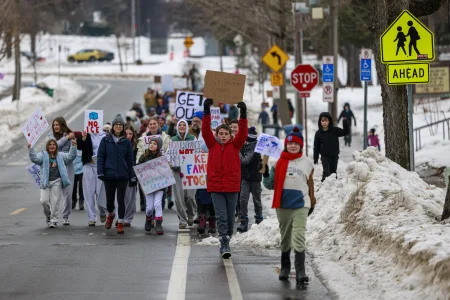
[1Photo: Young students marching in Minneapolis.