As we look toward Santa Marta, the message is both simple and profound: We cannot solve the climate crisis with the same logic that caused it.
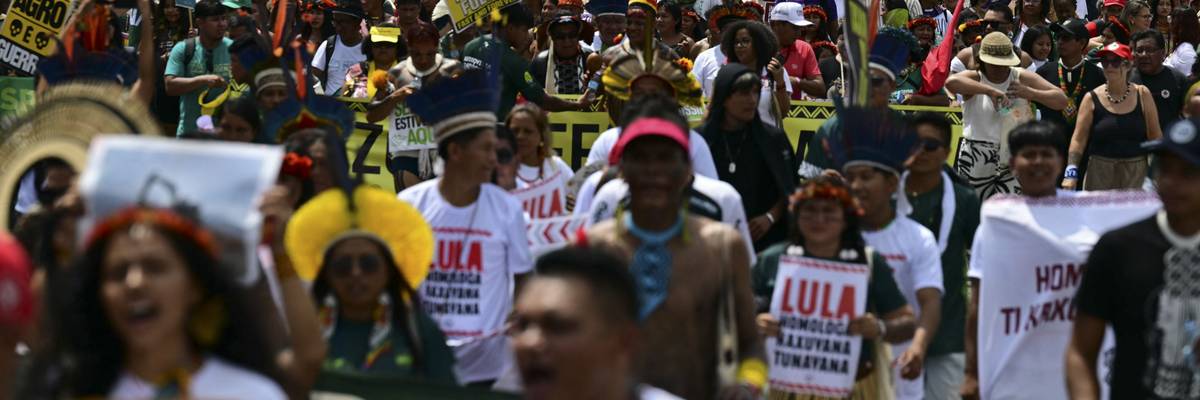
Thousands of people take part in the so-called “Great People’s March” in the sidelines of the COP30 UN Climate Change Conference in Belem, Para State, Brazil on November 15, 2025.
(Photo by Pablo Porciuncula/ AFP via Getty Images)
Theiva Lingam
Apr 21, 2026
Common Dreams
Wars, invasions, blockades, and genocide from Venezuela and Iran to Palestine have ripped the curtain off the inherent volatility and violence of the fossil energy system. We need a rapid and just scale-up of socially controlled renewables to end the era of fossil fuels. But ensuring a just transition requires deeper conversation. Who benefits from the energy transition? Who bears the cost? Who gets a say in how energy is produced? These are also feminist questions about power, labor, care, and whose lives are valued.
To answer them, grassroots leaders, Indigenous communities, trade unions, and environmental justice activists will gather in Santa Marta, Colombia for the Peoples’ Summit and First Conference on Transitioning Away from Fossil Fuels this week. For many of us in environmental and social justice movements, this gathering represents both urgency and possibility. This will be a critical space because, without justice, the energy transition will reproduce the same systems of extraction, control, and violence.
Wars, invasions, blockades, and genocide from Venezuela and Iran to Palestine have ripped the curtain off the inherent volatility and violence of the fossil energy system. We need a rapid and just scale-up of socially controlled renewables to end the era of fossil fuels. But ensuring a just transition requires deeper conversation. Who benefits from the energy transition? Who bears the cost? Who gets a say in how energy is produced? These are also feminist questions about power, labor, care, and whose lives are valued.
To answer them, grassroots leaders, Indigenous communities, trade unions, and environmental justice activists will gather in Santa Marta, Colombia for the Peoples’ Summit and First Conference on Transitioning Away from Fossil Fuels this week. For many of us in environmental and social justice movements, this gathering represents both urgency and possibility. This will be a critical space because, without justice, the energy transition will reproduce the same systems of extraction, control, and violence.
So We Must Ask: an Energy Transition for Whom?
The transition narrative sold by corporations and rich countries today tells us we can scale up corporate, market-led renewable energy technologies without questioning who controls them, who benefits, and who bears the cost. This risks the transition becoming nothing more than the old model in greener packaging. In Malaysia, for example, the energy transition policy largely rebrands the old growth-and-extraction model. It uses green rhetoric, prioritizing corporate-led false solutions like carbon capture and storage and carbon capture, utilization, and storage. Copying Western-style developments through corporate-driven trade and investment patterns sustains fossil fuel dependence and continues to entrench structural inequalities both nationally and internationally. Without systemic change, the transition becomes another chapter in a long history of resource plunder, particularly in the Global South.
Consider the surge in demand for minerals like lithium, cobalt, nickel, and rare earth elements. These are essential components of batteries, solar panels, and wind turbines. Governments and corporations in the Global North are racing to secure these materials, often greenwashing extraction as necessary for climate action, while diverting these minerals into military, aerospace, AI, and data centers. For communities across Latin America, Africa, and Asia, this rush is already translating into land grabs, water depletion, labor exploitation, and violence. Lithium extraction threatens fragile ecosystems and Indigenous Peoples’ livelihoods; cobalt mining has been linked to dangerous working conditions and child labor. As with oil before them, critical minerals are becoming objects of geopolitical competition—backed by military power and strategic control.
If this transition is not rooted in justice, it will not be a solution. It will be the next phase of the crisis.
The military is among the world’s largest consumers of fossil fuels, yet its emissions are routinely excluded from national reporting. At the same time, states and corporations work together to secure control over oil, gas, and critical minerals—profiting from war and devastation from Lebanon to Venezuela and Cuba.
These are the very predictable outcomes of a system that prioritizes profit over energy as a right for people. A just transition must go far beyond emissions reductions. It must actively confront inequality, redistribute power, and wealth, and repair historical and ongoing harms. It must center those who have been marginalized and exploited—not as victims but as leaders.
A Just Transition Must Be Based on Peoples’ Sovereignty and Energy Sovereignty
At the heart of this vision are peoples’ sovereignty and energy sovereignty: the right of communities to control their lands, resources, and energy systems, and to shape the decisions that affect their lives. This means treating energy as a common good that is managed for collective well-being rather than private profit, while building energy democracy, where communities have real decision-making power over how energy is produced and used. It also requires energy sufficiency, prioritizing meeting people’s needs over excessive and wasteful energy use. Together, these principles challenge the concentration of power in corporations and wealthy countries, and point toward energy systems that are locally rooted, democratic, and aligned with social and ecological needs.
Achieving this also requires that we confront imperialism. The current global order allows wealthy countries to externalize the social and environmental costs of their consumption to the Global South, while maintaining control over finance, technology, and trade. This imbalance shapes the terms of the energy transition, devastating communities and often locking countries in the Global South into roles as raw material suppliers rather than equal partners.
Policies that ignore power dynamics may deliver short-term emissions reductions, but they will ultimately fail as communities resist exploitation and inequity deepens. A transition rooted in justice, however, can build the broad-based support needed for transformative change.
Around the world, communities are already practicing energy sovereignty, from managing decentralized renewable systems in Palestine to asserting their rights against extractive projects in Mozambique. Alternatives are not only possible, but underway.
A feminist and just energy transition must challenge the structures that perpetuate dependency and inequality, including unfair trade agreements, debt regimes, and corporate impunity. It must also recognize and address the intersecting forms of oppression based on gender, race, class, and colonial history that shape how the climate crisis is experienced and resisted.
As we look toward Santa Marta, the message is both simple and profound: We cannot solve the climate crisis with the same logic that caused it. If this transition is not rooted in justice, it will not be a solution. It will be the next phase of the crisis.
The path forward will require confronting entrenched interests and reimagining our economies and societies. From Santa Marta and beyond, communities are showing us the way. The task now is to listen, to act, and to ensure that the transition ahead is truly just—for people, for the planet, and for future generations.
Our work is licensed under Creative Commons (CC BY-NC-ND 3.0). Feel free to republish and share widely.
Theiva Lingam is chair of Friends of the Earth International, the world’s largest grassroots environmental federation. She is also a public interest lawyer, environmental activist, and legal adviser to Sahabat Alam Malaysia-Friends of the Earth Malaysia, as well as a legal consultant at Third World Network.
Full Bio >

No comments:
Post a Comment