Sunday, March 15, 2026

NAKBA 2.0

Israeli Forces Kill Parents and 2 Children in West Bank, Beat Surviving Children

“Targeting an entire family in this savage manner reveals the true nature of the Israeli occupation and its policies based on killing and extermination, destruction and displacement,” the Palestinian Ministry of Foreign Affairs said.


Relatives bid farewell to Ali Khaled Bani Odeh, 37; his wife Waad Othman Bani Odeh, 35; and their two children, 5-year-old Mohammad and 7-year-old Othman, who were killed by Israeli occupation forces during a raid on the town of Tammun, south of Tubas, in the northern West Bank on March 15, 2026.
(Photo by Ayman Nobani/picture alliance via Getty Images)


Olivia Rosane
Mar 15, 2026
COMMON DREAMS

The Israeli Defense Forces killed a Palestinian couple and two of their children in the West Bank on Sunday, on one of the deadliest days for Palestinians in Gaza and the West Bank in weeks.

The soldiers opened fire on a car in the village of Tammun in which 37-year-old Ali Khaled Bani Odeh, his 35-year-old wife Waad, and their four sons Mohammad, Othman, Mustafa, and Khaled were traveling. Odeh, Waad, 5-year-old Mohammad, and 7-year-old Othman were shot in the head and died, leaving behind two injured children.

“We came under direct fire, we ⁠didn’t know the source. Everyone in the car was martyred, except my brother Mustafa and me,” one of the surviving children, 12-year-old Khaled, told Reuters from the hospital.

He said that after the shooting was over, the Israeli soldiers pulled him out of the car and began to beat him, telling him, “We killed dogs.”

“These crimes occur within a systematic policy pursued by the occupation authorities using lethal force against Palestinian civilians.”

The soldiers also beat his other surviving brother, according to Al Jazeera.


The Israeli military said that it had been operating in Tammun to make arrests on “terrorist” charges and that soldiers had fired on a vehicle when it accelerated toward them, according to Reuters. It said it was reviewing the incident.

Al Jazeera journalist Nida Ibrahim said that the family had been totally shocked by the shooting.

“The extended family says the father and the mother did not know that Israeli forces were there as they were in a Palestinian car,” she said.

The Palestinian Ministry of Foreign Affairs condemned the killing on social media as a “terrifying arbitrary execution crime that targeted an entire Palestinian family inside their vehicle.”

The Israeli soldiers also prevented Red Crescent workers from reaching the family, the ministry said, leading to the families’ “deliberate and cold-blooded execution.”

The ministry continued: “The Ministry affirms that targeting an entire family in this savage manner reveals the true nature of the Israeli occupation and its policies based on killing and extermination, destruction and displacement, amid a systematic impunity, and it further affirms that these crimes, concurrent with the escalation of settler crimes and their organized terrorism in the occupied West Bank, are not isolated incidents, but part of a comprehensive and systematic aggression aimed at exterminating the Palestinian people and displacing them, in clear exploitation of the escalation occurring in the region.”

In a statement issued on social media, the Palestinian Centre for Human Rights (PCHR) also blamed the deaths on the Israeli occupation of the West Bank, which has been deemed illegal by the International Court of Justice.

“This escalation in these crimes comes as a direct result of the expansion of shooting instructions in the Israeli army, the rising violence of settlers amid the prevalence of an impunity policy, and the entrenchment of ethnic cleansing amid unprecedented international silence,” PCHR said.

It continued: “While the Palestinian Centre for Human Rights condemns the unjustified murder crimes committed by occupation forces and settlers, it affirms that these crimes occur within a systematic policy pursued by the occupation authorities using lethal force against Palestinian civilians, in flagrant violation of the principles of necessity and distinction that form fundamental pillars of international humanitarian law and international human rights law. Moreover, they come as part of a pattern aimed at terrorizing citizens, intimidating them, and entrenching ethnic cleansing policies, and replicating acts of genocide, albeit in a less overt manner.”

Also on Sunday, Israeli settlers killed a Palestinian man in Nablus Governorate, making him the sixth man killed by settlers since the US and Israel launched their war on Iran. Movement restrictions imposed due the war have emboldened setters to attack, knowing that ambulances will be delayed in reaching their victims, human rights advocates and healthcare workers told Reuters.

In total, Israeli settlers and soldiers have killed 25 Palestinians in the West Bank since the beginning of the year, PCHR said.

In Gaza, where Israeli strikes at first declined following the beginning of the Iran war, the death toll is rising again. On Sunday, Israeli strikes killed nine police officers in Zawayda and a pregnant woman, her husband, and son in Nuseirat.

Trump EPA Risks Health of Millions With Giveaway to Corporate Polluters That Use Cancer-Causing Gas


“Walking back key regulations for ethylene oxide sterilizer facilities is essentially giving a highly polluting industry a get-out-of-jail-free card,” said one campaigner.


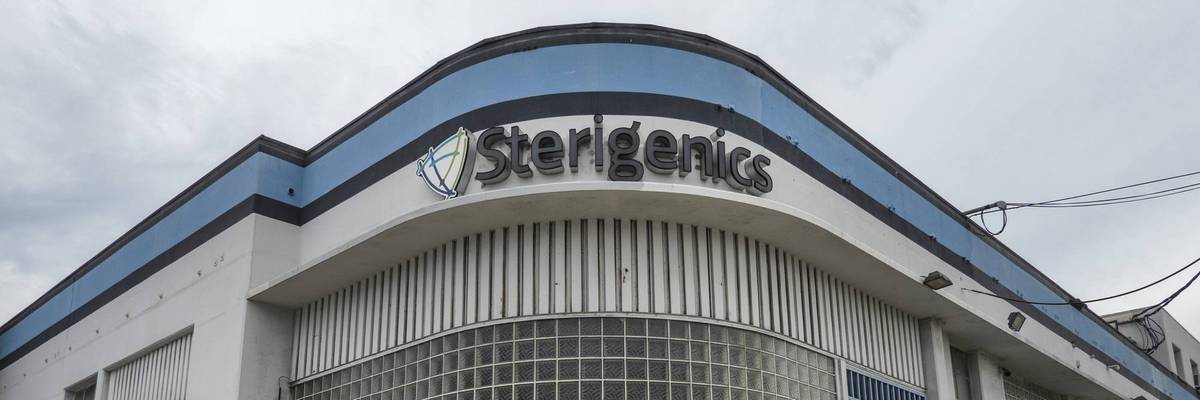
A Sterigenics facility that uses ethylene oxide is shown in Vernon, California on August 4, 2022.

(Photo by Myung J. Chun/Los Angeles Times via Getty Images)


Jessica Corbett
Mar 13, 2026
COMMON DREAMS

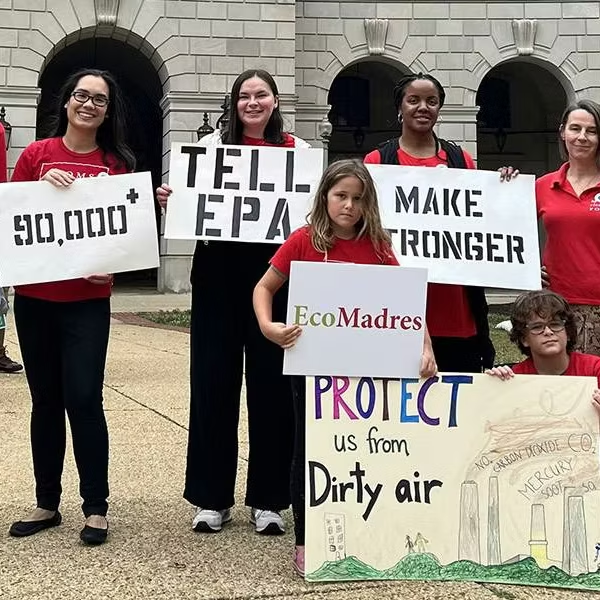
While US Environmental Protection Agency Administrator Lee Zeldin on Friday presented a proposed policy change as a demonstration of the Trump administration’s commitment to “ensuring lifesaving medical devices remain available,” public health advocates warned that relaxing rules on emissions of the cancer-causing gas ethylene oxide puts millions of Americans at risk.

As The New York Times explained: “The move revived a long-running debate about the paradoxical effects of ethylene oxide on public health. While it plays a crucial role in sterilizing lifesaving medical devices like pacemakers and syringes, long-term exposure can cause leukemia and other types of cancer among people who work in or live near medical sterilization facilities.”


‘Direct Attack on the Health of Americans’: Trump EPA Greenlights More Mercury Pollution


US Youth, Climate Coalition Sue to Stop Trump EPA ‘From Torching Our Kids’ Future’

The EPA proposal would amend the Biden administration’s 2024 National Emissions Standards for Hazardous Air Pollutants for facilities that use ethylene oxide, which the agency estimated would have eliminated over 90% of dangerous pollution from the gas. The previous policy was cheered by organizations including Earthjustice, which sounded the alarm on Friday.

“The 2024 standards would have delivered enormous public health benefits. EPA knows that ethylene oxide is carcinogenic and determined that sterilizers can install effective and affordable pollution controls,” said Earthjustice senior attorney Deena Tumeh. “EPA has no basis to repeal this well-supported rule. By rolling back the rule, the Trump EPA is bending the knee to the sterilizer industry at the expense of millions of people’s health.”

Darya Minovi, a senior analyst at the Union of Concerned Scientists’ (UCS) Center for Science and Democracy, similarly stressed that “this dangerous decision puts people across the United States and in Puerto Rico at a higher risk of breathing dangerous fumes known to cause respiratory irritation, nausea, blurred vision, headaches, and various cancers. Children are especially vulnerable to the cancer-causing harms of ethylene oxide exposure.”

As Minovi detailed:
According to UCS analysis, nearly 14 million people in the United States live within five miles of at least one commercial sterilization facility, and more than 10,000 schools and childcare facilities fall within those areas. These communities are disproportionately made up of people of color or those who do not speak English as a first language...

This decision is a reckless and self-serving handout to big industry, which asked for this rule to be rolled back. This process sidestepped community input from the start and is an affront to communities that have unknowingly lived with ethylene oxide exposure for decades. These actions show, yet again, that this administration has little to no regard for the health and welfare of working people or any interest in protecting children from exposure to toxic chemicals.

Minovi declared that “ethylene oxide emissions controls need to be strengthened—not dismantled,” an argument echoed by Jane Williams, executive director of California Communities Against Toxics and chair of the Sierra Club National Clean Air Team.

“Walking back key regulations for ethylene oxide sterilizer facilities is essentially giving a highly polluting industry a get-out-of-jail-free card. Sterilizers are some of the largest, most toxic chemical manufacturing facilities in the country,” said Williams. “Rather than regressing on key protections, these facilities need even more controls in place to ensure the safety of workers and nearby communities.”


People who live near sterilizer facilities also spoke out against the proposed rule, which now faces a 45-day public comment period.

“We understand that industry applied heavy pressure to weaken the previously finalized rule. We also understand that industry remains more concerned with their profits than the lives of those who live near sterilizer facilities, like my community in Laredo,” said Tricia Cortez, executive director of Rio Grande International Study Center in Texas.

“Sterilizer facilities like Midwest must be held accountable for their dangerous, cancer-causing emissions,” she said. “We need an EPA that works to protect us, the people, not financial interests and corporations that continue to cause so much harm to so many.”

Victor Alvarado, founder and coordinator for Comité Diálogo Ambiental, said that “I remember the EPA informing us that Steri-Tech’s ethylene oxide emissions in my hometown of Salinas, Puerto Rico, were so high that we had one of the highest rates of toxic air cancer risk in the United States... Eliminating the new protections against ethylene oxide emissions is unjust.”

The EPA proposal comes after President Donald Trump in July signed a series of proclamations easing pollution rules for over 100 facilities focused on energy, chemical manufacturing, iron ore processing, and sterile medical equipment. His “regulatory relief,” as the Republican called it, applied to dozens of sterilization plants.

The Southern Environmental Law Center and Natural Resources Defense Council responded by filing a federal lawsuit on behalf of CleanAIRE NC, Sustainable Newton, Savannah Riverkeeper, and Virginia Interfaith Power & Light.

“We always knew the presidential exemptions issued last year were part a broader plan to put the interests of corporate polluters above the health and well-being of American families,” Sustainable Newton president Maurice Carter said Friday. “But we won’t stop fighting to protect our community by demanding commonsense, reasonable measures that even the EPA has said would reduce harmful emissions by 90% and lower cancer risks by 92%.”
17 Reasons to Tell Trump: “You’re Fired!”

It is long overdue for the Democrats in Congress to lay the groundwork for impeaching President Donald Trump and removing him from office.


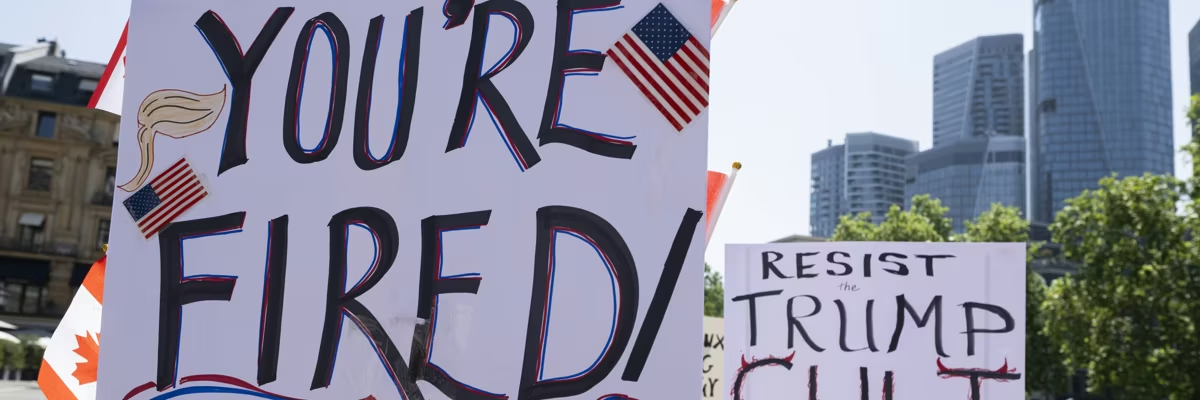
A woman holds a sign with the words “You’re fired!” in a protest by demonstrators who have gathered in the center of Frankfurt under the slogan “No Kings,” directed against US President Donald Trump and the policies of the US government on June 14, 2025.
(Photo by Boris Roessler/picture alliance via Getty Images)

Ralph Nader
Mar 15, 2026
Common Dreams

Tyrant Trump’s favorite snarl is “You’re Fired!” That was his bellow on “The Apprentice” television program. Subsequently, he told hundreds of thousands of federal civil servants and contractors, “You’re Fired!” Shame on the pitiful Democratic Party that allowed him to regain the presidency last year.

It is long overdue for the Democrats in Congress to lay the groundwork for impeaching President Donald Trump and removing him from office. Trump provides them with the impeachable evidence openly and brazenly every day. No president in history has ever declared that “then I have Article II, where I have the right to do anything I want as president.” No president has ever dared to say, as did Trump in an interview with Reuters on January 15, 2026, that “…when you think of it, we shouldn’t even have an election” and meant it.

Based on their detailed declaration against King George III in the Declaration of Independence (1776) and the congressional safeguards in the Constitution drafted in 1787, our Founders, were they members of Congress today, would unanimously vote articles of impeachment against Trump for rampant constitutional lawlessness.

Here are 17 articles of Impeachment against dictator Trump that many constitutional law scholars would endorse, drafted by constitutional law specialist and practitioner, Bruce Fein. (For the full text of the articles of Impeachment, here.)

Ask these lawmakers if they are waiting for Trump to use the Insurrection Act to order the military to seize the state voting machinery and repress the vote in the contested states or districts?

ARTICLE 1—WAR POWER-MURDER-PIRACY

ARTICLE 2—MILITARIZATION OF DOMESTIC LAW ENFORCEMENT

ARTICLE 3—SERIAL UNCONSTITUTIONAL DETENTIONS AND DEPORTATIONS

ARTICLE 4—BRIBERY

ARTICLE 5—RETALIATION AGAINST CONSTITUTIONALLY PROTECTED SPEECH OR ASSOCIATION

ARTICLE 6—ABUSE OF THE PARDON POWER—SABOTAGING THE RULE OF LAW

ARTICLE 7—ILLEGALLY CRIPPLING OR DEFUNDING PROGRAMS TO PROTECT CONSUMERS, THE NEEDY, WORKERS, AND THE ENVIRONMENT

ARTICLE 8—USURPATION OF THE CONGRESSIONAL POWER OF THE PURSE

ARTICLE 9—CONTEMPT OF CONGRESS—SECRET GOVERNMENT

ARTICLE 10—PERVERTING LAW ENFORCEMENT TO PERSECUTE POLITICAL OPPONENTS AND BENEFIT FRIENDS

ARTICLE 11—SUSPENDING OR DISPENSING WITH LAWS

ARTICLE 12—FLOUTING SECTION 1 OF THE 14TH AMENDMENT

ARTICLE 13—SPECIOUS NATIONAL EMERGENCY—FOREIGN TERRORIST ORGANIZATION DECLARATIONS

ARTICLE 14—DOMESTIC AND FOREIGN EMOLUMENTS CLAUSES

ARTICLE 15—CHRONIC DECEIT AIMING AT DICTATORSHIP

ARTICLE 16—TREASON

ARTICLE 17—MEGALOMANIA-HUBRIS

Already, a growing majority of the American people want Trump Impeached. They are feeling the impact where they live, work, and raise their families of Trump’s dictatorial, corporatist regime, which is endangering, weakening, and wrecking America! The criminal, illegal, unconstitutional war against Iran and the continuing full backing of Israeli Prime Minister Benjamin Netanyahu’s genocide against the Palestinians and the Israeli bombing of Lebanon’s civilian population and occupying southern Lebanon will only increase the hardships on the American people. US soldiers are also being ordered to illegally obey illegal orders. Six Members of Congress who served in the military issued a video statement that said, “You must refuse illegal orders.” Representatives said in the video, “No one has to carry out orders that violate the law or our Constitution.”

Send these articles of Impeachment with your own thoughts and demands to your two senators and your representative by letter, email, or voicemail. (The Congressional switchboard number is 202-224-3121). You can also call local congressional offices to voice your concerns to your member of Congress. Ask them when will they exercise their constitutional duties. What further criminal outrage, program, and police state power will move them to catch up with the demands of the people back home?

Ask these lawmakers if they are waiting for Trump to use the Insurrection Act to order the military to seize the state voting machinery and repress the vote in the contested states or districts? He has already noted this limitless power in his first term and more recently.

There are only 535 members of Congress. Flood them with your demands to literally save our Republic and the Constitution for which it stands. Otherwise, WITH TRUMP AND HIS DANGEROUSLY UNSTABLE PERSONALITY, IT IS ONLY GOING TO GET WORSE, MUCH WORSE, HERE AND ABROAD.

Take charge, people, one by one, citizen group by citizen group! Use your sovereign power under the Constitution.
‘Serious Threat to the First Amendment’ as Trump Admin Wins First Antifa Terror Charge

“A case like this helps the government kind of see how far they can go in criminalizing constitutionally protected protest,” one legal advocate said.


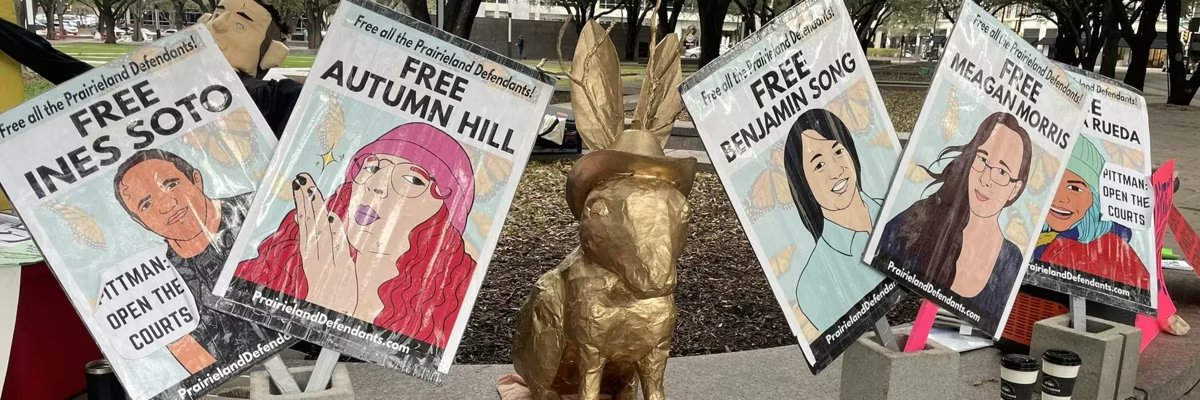
Signs supporting protesters charged with domestic terrorism over an anti-Immigration and Customs Enforcement protest are seen outside the courtroom in Fort Worth, Texas on March 11, 2026.
(Photo via DFW Support Committee/X)


Olivia Rosane
Mar 15, 2026
COMMON DREAMS

The government has largely won its first case bringing material-support-for-terrorism charges against protesters alleged to belong to “antifa,” which President Donald Trump designated as a domestic terror group in 2025 despite the fact that no such organized group exists and the president has no legal authority to designate organizations as domestic terror groups.

A federal jury in Fort Worth, Texas agreed on Friday to convict eight people of domestic terrorism because they wore all black to a protest outside Immigration and Customs Enforcement’s (ICE) Prairieland Detention Facility in Alvarado, Texas on July 4, 2025, at which one of the protesters shot and wounded a police officer. Legal experts say the verdict could bolster attempts by the administration to stifle dissent.

“A case like this helps the government kind of see how far they can go in criminalizing constitutionally protected protests and also helps them kind of intimidate, increase the fear, hoping that folks in other cities then will think twice over protesting,” Suzanne Adely, interim president of the National Lawyers Guild, told The Associated Press.

The administration promised it would be the first such case of many.

“The US lost today with this verdict.”

“Antifa is a domestic terrorist organization that has been allowed to flourish in Democrat-led cities—not under President Trump,” Attorney General Pam Bondi said in a statement Friday. “Today’s verdict on terrorism charges will not be the last as the Trump administration systematically dismantles Antifa and finally halts their violence on America’s streets.”

The trial revolved around a nighttime protest at which participants planned to set off fireworks in solidarity with the around 1,000 migrants detained inside the Prarieland ICE facility. Some participants brought guns, which is legal in Texas, as The Intercept reported.

Sam Levine explained in The Guardian what happened next:
Shortly after arriving at the facility, two or three of the protesters broke away from the larger group and began spray painting cars in the parking lot, a guard shack, slashed the tires on a government van, and broke a security camera. Two ICE detention guards came out and told the protesters to stop. A police officer arrived on the scene shortly after and drew his weapon at one of the people allegedly doing vandalism. One of the protesters was standing in the woods with an AR-15 and hit him in the shoulder. The officer would survive.

At first, the federal government charged those arrested after the event with “attempted murder of a police officer,” according to NOTUS.

However, that changed after Trump’s designation of antifa as a terror group in September and the release of National Security Presidential Memorandum 7 (NSPM-7), which directs federal law enforcement to target left-leaning groups and activities. The next month, the government’s case expanded to include terrorism charges.

“This wouldn’t be a terrorism case if it weren’t for that memo,” one defense lawyer told NOTUS on background.

The prosecution argued that the fact that the protesters wore black clothes to the protest was enough to convict them of material support for terrorism.

“Providing your body as camouflage for others to do the enumerated acts is providing support,” Assistant US Attorney Shawn Smith said during closing arguments, as The Intercept reported on Thursday. “It’s impossible to tell who is doing what. That’s the point.”

The defense, meanwhile, warned the jury about the free speech implications of the charge.

“The government is asking you to put protesters in prison as terrorists. You are the only people who can stop that,” Blake Burns, an attorney for defendant Elizabeth Soto, said, according to The Guardian.

“When the villain is a made-up boogeyman then the target becomes ‘anyone who disagrees with Trump’—and this is the result.”

Ultimately, the jury decided to convict eight defendants of material support for terrorism as well as riot, conspiracy to use and carry an explosive, and use and carry of an explosive. However, they dismissed attempts by the state to argue that the protest constituted a pre-planned ambush and charge four people who had not shot at the police officer with attempted murder and discharging a firearm during a crime. Only Benjamin Song, the alleged shooter, was charged with one count of attempted murder and three counts of discharging a firearm.

The jury also convicted a ninth defendant, Daniel Rolando Sanchez Estrada, of conspiracy to conceal documents. Sanchez Estrada, who was not at the protest, had simply moved a box of zines out of his wife’s home after she was arrested for the protest, according to The Intercept.

“The US lost today with this verdict,” Sanchez Estrada’s attorney, Christopher Weinbel, said, as AP reported.

Support the Prarieland Defendants said in a statement, “Everything about this trial from beginning to end has proven what we have said all along: This is a sham trial, built on political persecution and ideological attacks coming from the top.”

However, the group commended the solidarity that had sprung up among the defendants and their allies and vowed to continue to support them.

“We have a long journey ahead of us to continue fighting these charges along with the state level charges,” they said. “What happens here sets the tone for what’s to come. We are here and we won’t give up.”


Outside observers warned about the implication for the right to protest under Trump.

“Remember all the people who dismissed the alarm over NSPM-7 because ‘ANTIFA isn’t even a real organization’? We told you that didn’t matter. When the villain is a made-up boogeyman then the target becomes ‘anyone who disagrees with Trump’—and this is the result,” said Cory Archibald, the co-founder of Track AIPAC [American Israel Public Affairs Committee].

Content creator Austin MacNamara said: “The Prairieland trial was given almost zero media coverage because of the blatant lies by DHS [Department of Homeland Security] and Police. This verdict now sets a precedent for criminalization of dissent across the board. Noise demos, Black-Bloc, pamphlets/zines/red cards, all of this can be used to imprison you.”

Academic Nathan Goodman wrote that convicting people of terrorism based on clothing was a “serious threat to the First Amendment.”

The verdict gives new poignancy to what defendant Meagan Morris told NOTUS ahead of the jury’s decision: “If we win, I think it shows that Trump’s mandate is not working, that the people understand that you can’t criminalize, you know, First and Second Amendment-protected activities. And I think if we lose, then… a lot of the country is OK with what’s going on. And it will be a much darker time, it’ll just signify a much increased crackdown on political opposition and free speech.”


Journalists stunned after report reveals who helped shape Trump's major military operation in Venezuela

Alexander Willis
March 15, 2026 
RAW STORY


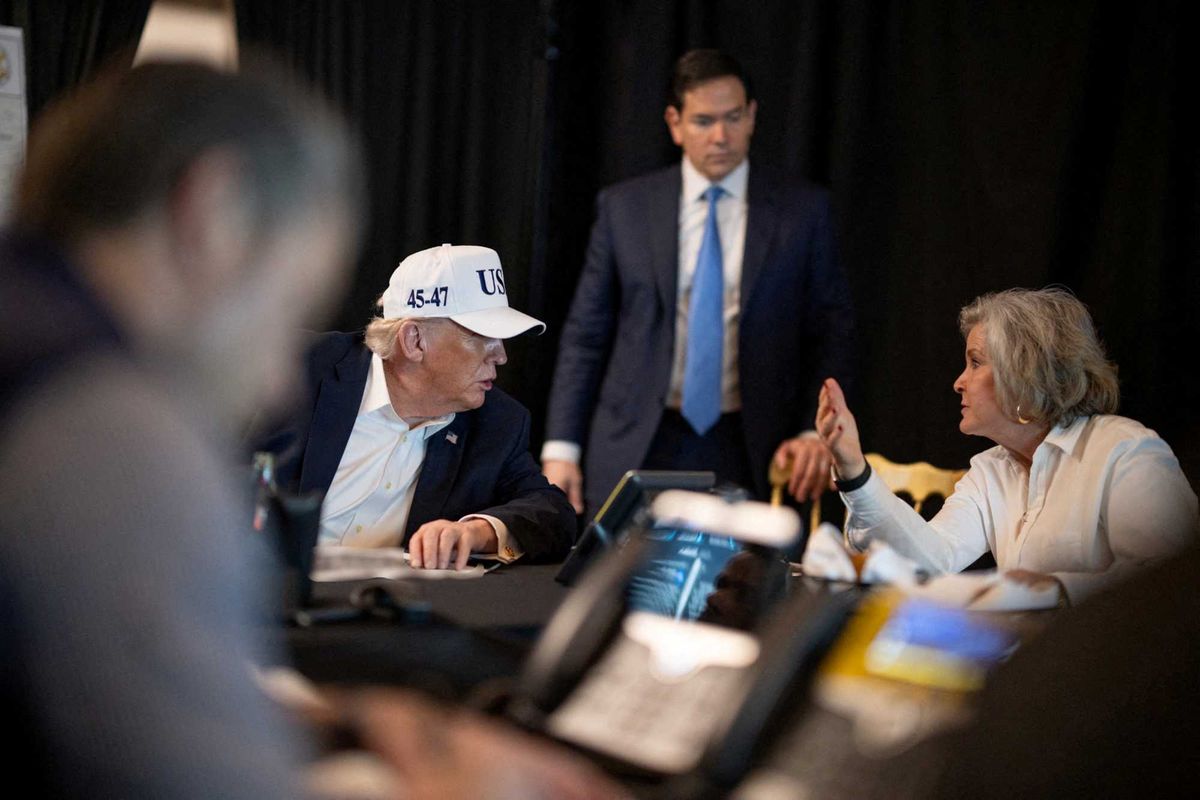
FILE PHOTO: President Donald Trump speaks with White House Chief of Staff Susie Wiles and Secretary of State Marco Rubio during military operations in Iran, at Trump's Mar-a-Lago resort in Palm Beach, Florida, on February 28 (The White House/Social Media/Handout via REUTERS)

The Trump administration’s unprecedented military operation in Venezuela earlier this year that resulted in the capturing of President Nicolás Maduro was shaped, at least in part, by former Chevron executive Ali Moshiri, The Wall Street Journal reported Sunday, a revelation that left several journalists stunned.

“Every once in a while you read a story that pulls back the curtain on how the world really works and it takes your breath away,” wrote The New York Times columnist Lydia Polgreen Sunday in a social media post on X.

Revealed for the first time by the Journal, Moshiri reportedly advised the CIA months ahead of the Trump administration’s attack and takeover of Venezuela on who should replace Maduro in his absence. Despite conservatives championing Venezuelan opposition leader Maria Machado as Maduro’s clear successor, Moshiri advised against it, and instead backed Venezuela's then-Vice President Delcy Rodríguez.

Just hours after the Trump administration had successfully captured Maduro, President Donald Trump dismissed the idea of Machado leading the country, arguing that she lacked the “support or respect within the country,” a remark consistent with the advice Moshiri had given his administration months prior.

While Moshiri left Chevron in 2017 and ended his consulting relationship with the company in 2024, his advice may still go on to generate significant revenue for the oil giant, investigative journalist Antonia Juhasz argued Sunday in a social media post on X.

“Chevron's man in [Venezuela] (a CIA informant) told Trump to ditch democracy and go for Rodriguez 'cause she'd secure the oil,” Juhasz wrote.


The New York Times investigative reporter Kenneth Vogel echoed that same sentiment, arguing on Sunday that Moshiri’s advice would likely end up enriching Chevron greatly.“The secret CIA assessment that called for Trump to side with Maduro’s longtime deputy, rather than the democratic opposition, was based on the advice of a former Chevron executive,” Vogel wrote in a social media post on X. “The oil company stands to profit from Trump’s decision to heed that advice.”


Trump’s panicked plea goes largely ignored by world leaders: 'No country stepped forward’

Alexander Willis
March 15, 2026 
RAW STORY

President Donald Trump issued a plea Saturday to several countries in the hopes that they would “send ships” to a major shipping route off the coast of Iran to help the United States’ war effort against the Middle East nation, a plea that as of Sunday afternoon appeared to go largely ignored.

In response to the U.S.-Israeli joint military siege launched late last month, Iran has vowed to attack any sea vessels aligned with the United States and its allies that attempt to pass through the Strait of Hormuz, a major shipping route through which 20% of the world’s oil trade flows. As a result, oil prices have skyrocketed, reportedly sparking panic within the Trump administration.

“Hopefully China, France, Japan, South Korea, the UK, and others, that are affected by this artificial constraint, will send Ships to the area so that the Hormuz Strait will no longer be a threat by a Nation that has been totally decapitated,” Trump wrote in a social media post on Saturday.

Well over 24 hours later, however, Trump’s plea was “met with little in the way of immediate commitments from the nations he named,” The Wall Street Journal reported Sunday.

The strongest response Trump received was from South Korea, with its Foreign Ministry saying that it “takes note” of Trump’s request and that it would “closely coordinate and carefully review” the ongoing conflict, Nikkei Asia reported Sunday.

The U.S.-Israeli siege on Iran has rattled global stability and sent “tremors” through the world economy, leading to the International Energy Agency announcing on Sunday the largest release of its emergency oil stockpiles in history.

Trump ridiculed for 'sending out invitations to WWIII' as he 'pleads' allies for Iran help


David McAfee
March 14, 2026 
RAW STORY

President Donald J. Trump spurred a variety of alarmed reactions on Saturday after he asked other countries to help the U.S. with the Iran war amid escalating tensions in the Strait of Hormuz.

"The United States of America has beaten and completely decimated Iran, both Militarily, Economically, and in every other way," Trump wrote, before shifting to call for international cooperation. He urged countries reliant on oil transit through the strait to "take care of that passage," promising substantial U.S. assistance and coordination to ensure "everything goes quickly, smoothly, and well." Trump framed the effort as a long-overdue "team" approach that would foster "Harmony, Security, and Everlasting Peace!"

The post drew immediate online backlash, with critics highlighting what they saw as a glaring contradiction: claiming total Iranian defeat while seeking help to secure the vital waterway, through which roughly one-fifth of global oil flows.

Professor Phillips P. O'Brien, a noted historian and strategist, described the message as "a work of art" worthy of preservation. He pointed out the irony: if Iran's military capability is "100% destroyed," why plead with frequently insulted allies to intervene in the Gulf?

Online reactions spread rapidly. PatriotTakes, which monitors right-wing extremism, quipped that Trump was "sending out invitations to WWIII."

MS NOW's Chris Hayes called it an "instant classic."

Detractors mocked the pivot as evidence of overreach in the ongoing U.S.-Iran conflict, where recent airstrikes—including on Kharg Island's military targets—have disrupted shipping but not fully neutralized threats like mines or asymmetric attacks. Supporters, however, viewed it as pragmatic leadership, emphasizing U.S. dominance and the need for shared burden in global security.

The statement also underscores broader challenges in Trump's foreign policy approach: bold claims of triumph paired with appeals for multilateral support in a region where unilateral action has proven costly. As oil prices surge and tanker traffic remains vulnerable, the post highlights the delicate balance between projecting strength and acknowledging real-world limitations in securing critical chokepoints.


Tense meeting looms for Trump as world leader vows to be 'candid' about US-sparked chaos

Alexander Willis
March 15, 2026 
RAW STORY


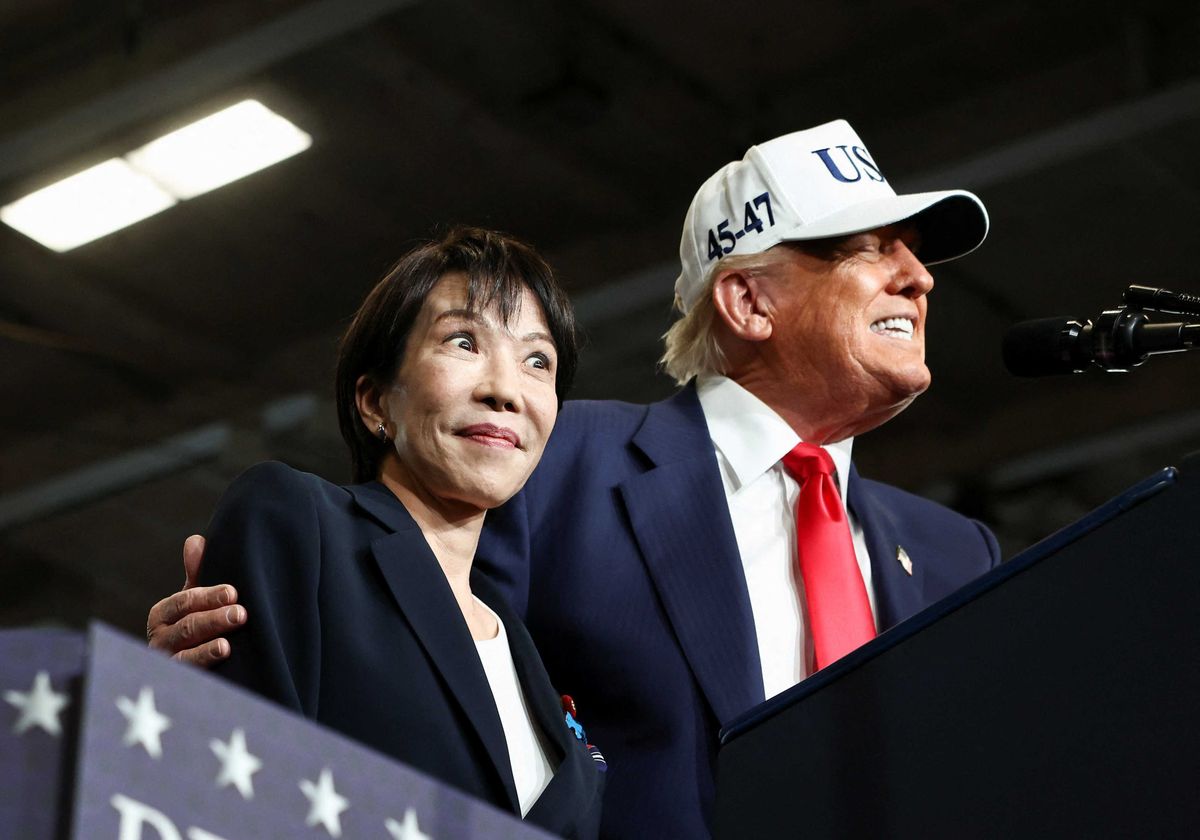
Japanese PM Sanae Takaichi reacts as Donald Trump speaks in Yokosuka, Japan. REUTERS/Evelyn Hockstein

President Donald Trump’s upcoming meeting with Japanese Prime Minister Sanae Takaichi may end up becoming a tense standoff after the newly re-elected leader vowed to be “candid” about the economic pain the Trump administration had inflicted on the East Asian nation.

“If President Donald Trump is expecting effusive praise for his war on Iran when Japan’s prime minister arrives in Washington on Thursday, he is likely to be disappointed,” wrote Bronwen Maddox, director of the British foreign-policy think tank Chatham House in the organization’s report Sunday.

“Sanae Takaichi, re-elected in February in a landslide victory, says she intends to be ‘candid’ in pointing out that Japan’s oil-dependent economy is suffering badly from the conflict.”

Oval Office visits, Maddox noted, have often “become bear traps” for foreign leaders, perhaps most notably for Ukrainian President Volodymyr Zelenskyy when he was chastised last year by Trump and Vice President JD Vance for nearly an hour. However, given the historic disruption to oil trade sparked by the Trump administration’s attack on Iran, Takaichi is expected to be blunt with Trump, Maddox wrote.

“She will want reassurance about the US’s security umbrella, the cornerstone of Japanese foreign policy since 1945,” Maddox wrote. “Trump is likely to repeat instead his demand for Japan to pay more for its own defence.”

As the world’s fifth largest importer of oil, Japan’s economy has been hit hard by the disruption in oil trade, with 95% of Japan’s oil imports coming from the Middle East. Japan’s cost of living has spiked as a result, leading Maddox to predict Takaichi may “want to use the good rapport she struck up with the U.S. president at a meeting in October to make the point about the impact of the war on other countries.”

Interview

Republicans and Democrats Are United in Their War on the Unhoused

Theo Henderson, creator of the “We the Unhoused” podcast, discusses organizing against demonization of unhoused people.
March 12, 2026

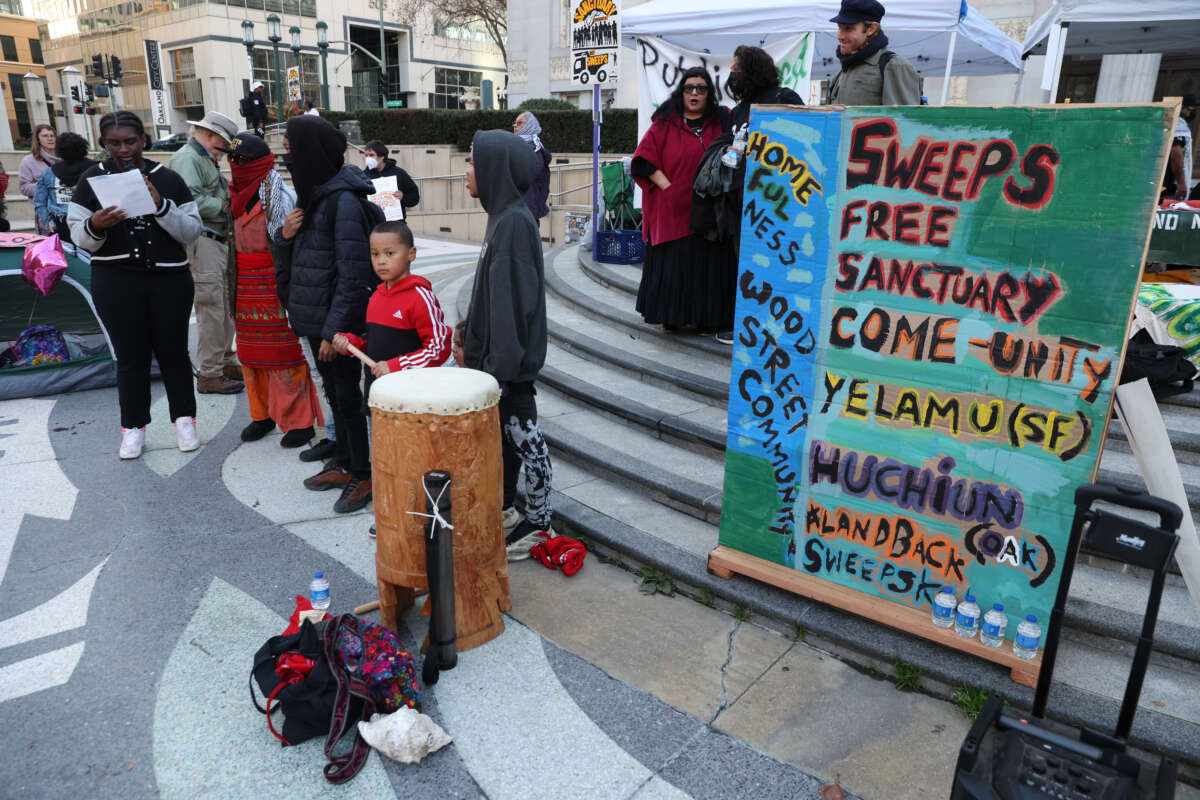
Homeless advocates attend a sweeps-free sanctuary protest outside of City Hall in Oakland, California, on December 17, 2024.Jane Tyska / Digital First Media / East Bay Times via Getty Images

Former schoolteacher Theo Henderson had been unhoused for six years when he launched the “We the Unhoused” podcast in 2019 from a park in Los Angeles’s Chinatown.

Henderson became unhoused in 2013 when he was evicted after losing his job and falling into medical debt due to spiraling costs related to his diabetes. When he began documenting his experiences and those of his unhoused neighbors back in 2019, three people were dying on the streets of Los Angeles County per day. Now, according to just-released public health data from 2024, that number has doubled to an average of six deaths per day, making questions of who gets to live and exist in public more urgent than ever.

Since Henderson started his podcast, his work has been featured in the BBC, Los Angeles Times, VICE, and CNN. In 2022 he was named activist-in-residence at the UCLA Luskin Institute on Inequality and Democracy.

In this exclusive interview with Truthout, Henderson unpacks the bipartisan machinery that perpetuates houselessness and renders unhoused people as disposable. He shares his analysis of how anti-camping ordinances like the one in Los Angeles function as “the new Jim Crow,” how Democrats and Republicans are united in their war on the poor, and how AI-powered medical diagnostics for unhoused populations echo the Tuskegee experiments. He points to J-Town Action and Solidarity as a mutual aid network that deserves our support.

Leah Harris: I’m thinking back to December 2019 when we connected on Twitter, after the first Trump regime held a mental health summit that previewed many of the policies they are trying to enact against unhoused people now. You had just started “We the Unhoused.” What led you in that moment to begin doing the podcast?


San Jose Is Displacing Its Unhoused Residents to Prepare for Super Bowl Tourism
The city’s use of temporary shelters harms affordable housing efforts and merely delays displacement of unhoused people. By Ngakiya Camara , Truthout February 7, 2026


Theo Henderson: I was literally living on the streets creating this podcast because I saw an alarming type of conversation. It relegated unhoused people to “substance users” and “mentally ill.” It didn’t cover my story or the people I knew that were living on the streets. I created the show as a way for unhoused people to feel free and safe to tell their stories without being exploited. I also felt that it was important to tell my story because I was out here due to a medical mishap. Trying to get back on your feet is not as simple as people make it out to be.

The conversations started to open up different intersections of how unhoused people are affected in every environment — from mental health to substance use, to people having medical emergencies. Like the gentleman whose wife was terminally ill and passed away. They used their savings to try to save her, but they were unsuccessful. He ended up sleeping across the street from the building that he used to work in.

Surprisingly, people listened. They were impacted. That’s one of the things mainstream media misses: the dignity of people telling their stories without being judged.

We’ve been talking for a long time about how the media and politicians demonize unhoused people to justify all manner of repressive actions, sweeps, laws, kidnapping, disappearance, and neglect.

When I first started out, it was three unhoused people dying a day. It was a number that could easily be dismissed or ignored, with the atrocities that we’re seeing in real time overseas. Now, it’s seven unhoused people that are dying a day. We are walking past people who are dying, and we don’t have the same outrage. We are very quick to criminalize. But we don’t talk about the nuances that put people in such a perilous position.


“Once you’re able to demonize people, then it’s much easier to criminalize them.”

Look at what they’re doing with the undocumented community. They’re putting them in concentration camps and calling them “detention centers,” putting children in these places, making them feel it is their fault. That is the same narrative that they use with unhoused people: “The reason you’re out here is because you refuse help or you like being out there.”

Once you’re able to demonize people, then it’s much easier to criminalize them.

What is your response to federal initiatives like Donald Trump’s 2025 executive order and Robert F. Kennedy Jr.’s STREETS Initiative at the United States Department of Health and Human Services — initiatives that are all about disappearing unhoused people into involuntary mental health and drug treatment?

We keep talking among activist circles that they want to put unhoused people in warehouses and create the most carceral type of solution. One, erasing them from their humanity, but also cutting off their ability to speak out and let everybody know what’s happening.

Trump is trying to cut off money and services for unhoused people and housing-insecure people. If you take the money from people who want to be housed and want services to get off the street, where are they going to go? They’re going to go back on the street. Now they’ve got to deal with the hostility and hatred of the state and the city.

Over the past six years we’re seeing liberals and Democrats increasingly adopt the punitive approach to houselessness embraced by the Republican right. I’m thinking specifically about Gov. Gavin Newsom and his CARE Court.

California is a Democratic state that is basically aligned with Republican policies. They just hide it because they couch it in language of care. Democrats and Republicans are united in demonizing unhoused people.

Gov. Gavin Newsom is out there attacking Trump, but he’s not talking about how he’s also OK with targeting unhoused people. Before Trump’s executive order targeting unhoused people, Newsom had his own executive order along the same lines, that if unhoused people do not accept treatment, then they can be arrested on state property.

Newsom is no friend to unhoused people. He’s got this “encampment resolution fund”: If you criminalize unhoused people, then you’re able to get funding. If you don’t, then the funding gets taken away. So cities adopt these aggressive policies. This kind of extortion is commonplace


.
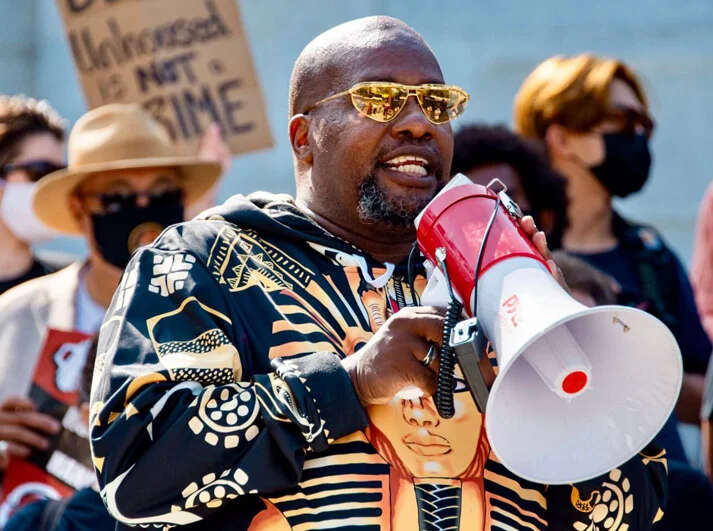
Theo Henderson, the founder of the “We the Unhoused” podcast, speaks into a megaphone at a protest in Los Angeles, California, in October 2021.WeTheUnhoused.com

You’ve long been speaking out about anti-camping ordinances, like the one created by Section 41.18 of the Los Angeles Municipal Code, and their impact on communities.

I keep saying that 41.18 is the new Jim Crow. It makes it against the law for anybody to sit, sleep, or lie in any place the Los Angeles City Council designates as a “special enforcement zone.” There is no accountability when they ticket you and put you in jail. The fine is over $2,500. An unhoused person is definitely not sitting around with $2,500. Now they’re even using this ordinance to ticket people who are protesting against ICE [Immigration and Customs Enforcement].

We also have a dichotomy between housed undocumented workers and undocumented workers who are unhoused. When we’ve seen video of housed undocumented persons being snatched up, there are people speaking out for them, fighting for them. How many cases have you heard on mainstream media about undocumented unhoused people that have been snatched? Look how easy it is to rip them away and have them disappear, because there is no formalized way to follow them.

Houselessness is this vortex that people want to avoid, but we can’t. If we’re talking about the injustices of Gaza, if we’re talking about the injustices of ICE, we have to understand that the unhoused community that you walk past in Los Angeles has skyrocketed from three unhoused people dying per day to seven [in 2023].

You just got back from an action where community members paid Los Angeles City Councilmember Hugo Soto-Martínez a visit. Can you tell us more about that?

It’s one thing when politicians are like Soto-Martínez’s predecessor, Mitch O’Farrell, who was openly anti-unhoused people. It’s another thing when you’re Soto-Martínez, campaigning against the sweeps and 41.18. You get elected by people that believe that you’re going to stop all of these harmful sweeps. And then you turn around and you just don’t say anything. For some reason, he feels it’s not effective to talk about police harassment, what they’re doing to unhoused people in his district, Echo Park. The issue is exposing the light on who we vote for, who we put our trust in, who is turning to the dark side.

I made a comment today: Dr. Martin Luther King Jr. makes it very clear that society is not going to remember the actions only of the bad people, but the appalling silence of the good people, or the “claimed” good people. So we have to ask ourselves: Which type of people are we?

Talk about how so many of these policy decisions derive from a eugenics mindset fueled by big business interests, like how the business improvement districts (BIDs) and the big city mayors are working together here to disappear folks?

Politicians and advocates keep saying that unhoused people are “service-resistant.” But we just don’t want this endless cycle of “services” that end up with us back on the street. They will offer temporary solutions where they’re going to throw people out in three months, and when they refuse, they say, “See. They don’t want help.” People actually believe that.

We don’t want to lose our belongings, only to end up back on the street. We want housing. If you are sincere, give us permanent supportive housing, so we don’t have to be in the neighborhood with these BIDs and NIMBYs [proponents of a “Not In My Backyard” mentality] running around targeting us. They go on sites like Nextdoor or Citizen. They find ways to aggressively target unhoused people to remove them from the neighborhood.

Republicans blame Democratic leaders for not doing anything. But the fact of the matter is, if they really wanted things done, they would permanently house people. They don’t want to, because they know this is a hot-button issue. They can count on people getting up in arms against the unhoused community.

Speaking of unholy alliances, how about this startup deploying AI to diagnose and provide treatment to unhoused folks in Los Angeles?

Look at the Tuskegee experiment, how they experimented on a vulnerable population that couldn’t raise a fuss. Unhoused people are a vulnerable population, so that means they can do what they want.

You have an AI machine that speaks to people, transcribes what they say, and diagnoses and prescribes medication. But just because someone may have a similar diagnosis, you have to consider other factors. I’m an African American male. I have diabetes, but my diabetes is different. The medication has to be more layered because I’ve had aggressive surgery after being stabbed. AI can’t know that. A doctor examines me and asks, “Did you have extensive surgery?” If you don’t do that and a person has a reaction or dies, who holds this agency accountable? Is there any inquiry to create justice for unhoused people?

There’s a high rate of unhoused African Americans with sickle cell anemia that AI won’t recognize. Or health issues that present as something else. Without background, it’s easy to make an error.

I wouldn’t feel OK having AI treat me. It’s already hard enough for Black people to get adequate care from living, breathing doctors.

In addition to your podcast that directly uplifts the voices of unhoused people and activists, what are other efforts that people can support?

J-Town Action and Solidarity. We’ve been working together close to six years creating direct mutual aid. There’s a huge food deficit in Los Angeles. Now, not only unhoused people come to our mutual aid meetups, there are food-insecure housed people coming. I would lean toward J-Town to get educated on the realities of what’s going on.

I think because of the ICE assassinations of Renee Nicole Good, Keith Porter Jr., and Alex Pretti, housed people are becoming more aware, more distrustful of the scripted narratives. But they don’t always know how to find help. So I would encourage them to start by listening to “We the Unhoused” — both the older episodes on YouTube and newer ones on iHeart.

Activists have told me that they don’t listen to the show because it is “long.” The reason it’s long is because you are getting people who finally have a platform to tell their story. If you can look at “Game of Thrones” or Netflix movies for two to three hours, you can take the time to listen to unhoused voices and the realities they face


This article is licensed under Creative Commons (CC BY-NC-ND 4.0), and you are free to share and republish under the terms of the license.


Leah Ida Harris

Leah Ida Harris is an abolitionist writer whose work centers on resistance to carceral policies of force and coercion. Their forthcoming book, Noncompliant: A Family History of the Asylum (Haymarket Books) details the violent history — and grim resurgence — of the asylum in America through a multi-generational story of involuntary psychiatric treatment.
In Era of Book Bans and War on History, Sinners Reveals What US Tries to Forget


Sinners deserves to win Oscars: It’s a blues poem, a freedom cry, and a love letter to powerful culture.
March 13, 2026

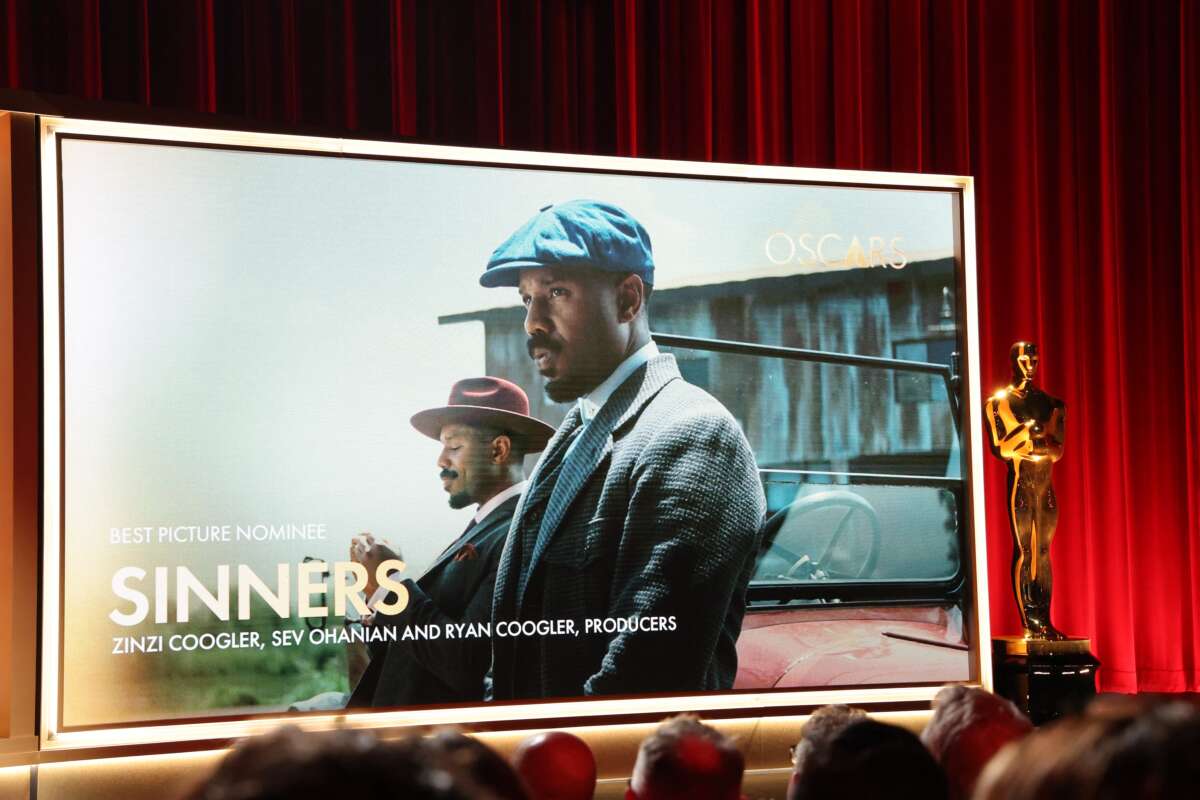
Nominee for Best Picture Sinners during the 98th Academy Awards nominations announcement at the Samuel Goldwyn Theater in Beverly Hills, California, on January 22, 2026.
VALERIE MACON / AFP via Getty Images


Warning: This article contains spoilers.


Near the end of Sinners, there is a moment that Hollywood rarely permits. The character Smoke guns down a gang of Ku Klux Klan members who have come to murder his people — and then, with hands still trembling, he cradles his newborn child in his arms.

Watching it, something strange and powerful stirred within me — as if the film were bending time, reaching across generations to reply to a story I recently learned in my journey to understand my family history.

A few years ago, my dad, Gerald Lenoir, made a stunning discovery: He found the Mississippi plantation where our family had been enslaved and the land where they lived after emancipation. In the process, he also discovered that the ancestors of the legendary bluesman J. B. Lenoir were likely enslaved on that same plantation.

That news bent me like a blue note on a National guitar.

I’ve spent much of my life devoted to the blues — I play harmonica in the band The Blue Tide — and this discovery was a revelation that bound me to the music’s tradition of protest and truth-telling in a way words can scarcely capture. After several trips there with my dad and brother, I brought my kids to Jayess, Mississippi, where we dedicated a headstone to my great-great-grandparents, Thomas and Laura Lenoir, who had been enslaved nearby.

At the ceremony, a woman in her nineties approached and told me she had once been friends with my great-great-grandmother Laura. The fact that I was talking to someone who had been friends with a person who had once been enslaved was stunning.

This history isn’t distant. It’s breathing right beside us.

Then she told us a story I will never forget. During Jim Crow, the Ku Klux Klan burned down the preschool that Black families in Jayess had built for their children in an effort to drive them off their land. But the community didn’t run. They armed themselves, rebuilt the school in a tent, and stayed. They fought back and held onto their land.

That’s why that scene in Sinners hit me so hard.

For families who have passed down stories of surviving the Klan — and the trauma and resilience of those encounters through their blood — that moment on screen was not just witnessed. It was remembered in the body.

Cultural critic bell hooks once wrote that enslaved Black people were often punished simply for looking at white slaveowners, and she wondered how that traumatic history shaped “Black parenting and Black spectatorship.” Out of that history, hooks argued, Black audiences developed what she called an “oppositional gaze” — a way of watching films critically, aware of how Hollywood has long distorted or erased Black life. Instead of forcing Black viewers to watch themselves through a white lens, Sinners centers Black memory, Black defiance, and Black love.

In doing so, the film also understands something the writer Amiri Baraka captured in his landmark study Blues People: “Blues means a Negro experience.” He understood that the blues is not merely music but the historical expression of Black life in America. Sinners takes that insight seriously.

The Blues Summons Monsters and Opens Portals

Set in 1932 Clarksdale, Mississippi, Sinners follows Smoke and Stack (both portrayed by Michael B. Jordan), twin brothers who return home from Chicago after years working in Al Capone’s criminal empire to open a juke joint.

They recruit a band of extraordinary musicians, including their cousin Sammie “Preacher Boy” Moore (played with electrifying grace by actor-musician Miles Caton in his film debut), a blues guitarist and preacher’s son; Delta Slim (poignantly portrayed by Delroy Lindo), a piano and harmonica player; and Pearline (Jayme Lawson), a blues singer who catches Sammie’s eye and lands a gig at Smoke and Stack’s juke joint.

Smoke and Stack purchase an old sawmill from a white man, who hides the fact that he is the local head of the Ku Klux Klan, and turn it into their juke joint. That evening it becomes a sanctuary for Black residents of Clarksdale — a place where music, laughter, and community create moments of magic and freedom.

Inside Smoke and Stack’s juke joint, Sammie’s music does something astonishing: It bends the space-time continuum, transforming the room into a portal. West African griots appear — playing, drumming, dancing — their sound threading across centuries. Then Sammie’s blues music opens up a portal to the future that ushers in an electric guitarist in the tradition of Jimi Hendrix or Parliament, followed by a hip-hop DJ scratching a record, a break dancer, and Black women twerking that echo the African women also on the dance floor. Even the dancing Chinese ancestors of Grace Chow (Li Jun Li) and her husband Bo (Yao) — immigrant shopkeepers in Clarksdale who help with supplies for the juke joint — are summoned into the space, showing that this musical connection has no borders.

The sequence becomes one of the great scenes in cinematic history and one of the greatest tributes to Black musical genius ever expressed. In a few electrifying minutes, the film does something that has rarely been accomplished: It makes visible the living genealogy of Black music — from African rhythms to the blues to rock to hip-hop — revealing it not as a series of separate genres but as a single river of creativity flowing through centuries of struggle and survival.

But sanctuaries can attract predators.

As the film’s opening narration proclaims, “There are legends of people born with the gift of making music so true it can pierce the veil between life and death, conjuring spirits from the past and the future … This gift can bring healing to their communities — but it also attracts evil.”

True solidarity — one capable of liberating everyone, Sinners suggests — cannot be built on colorblind fantasies. It must be forged through an uncompromising struggle against white supremacy.

Clarksdale is haunted — not only by the specter of the Ku Klux Klan, but by another terror that does not simply want to take Black life, but devour Black creativity. It is Sammie’s extraordinary gift for the blues that cracks open the veil between worlds and entices evil, drawing the cunning, complex, and sometimes sympathetic vampire Remmick (Jack O’Connell) and his followers to the juke joint — setting the stage for a night where music, history, and horror collide.

As the community resists the vampire attack, they turn to Annie (the magnetic Wunmi Mosaku), a hoodoo matriarch whose knowledge of rootwork and ancestral protection is needed in the struggle to save Black lives and Black culture.

Remmick, an Irish musician who also knows the sting of colonization and discrimination, goes to the juke joint seeking entry so he can harness the power of Sammie’s blues to reunite him with beloved ancestors he could not save centuries ago. There he makes a passionate case for the Black musicians to join his side:


We believe in equality and music. Can’t we just for one night all be family? … I am your way out. This world already left you for dead. Won’t let you build, won’t let you fellowship. And we will do just that. Together. Forever.

When the Black people in the juke joint refuse to trust Remmick and deny him entry, the scene could be read as a rejection of multiracial unity — an argument that Black culture must remain separate and that alliances across race are doomed to betrayal. But that is not the film’s message. The price of joining Remmick’s “family” and gaining immortality is that Black people relinquish the power of the blues, their memory, and their roots. It is “colorblind” racism in its most seductive form: a system that claims to see “no race” while devouring everything that makes a people distinct, powerful, and whole. Remmick’s offer is not genuine solidarity; it is a form of erasure. True solidarity — one capable of liberating everyone, Sinners suggests — cannot be built on colorblind fantasies. It must be forged through an uncompromising struggle against white supremacy.


North or South, the story was often the same: Black artists created the music that changed the world while others reaped the profits.

The use of vampires to make this point is brilliant. As China Miéville writes in Theses on Monsters, “Epochs throw up the monsters they need. History can be written of monsters, and in them.” Sinners takes that seriously. The vampires haunting Clarksdale are not generic ghouls — they are born of this place, this time, this terror. They feed not just on blood, but on Black creativity. They are the monsters that ripping off Black artists requires: elegant and seductive, yet parasitic.

Sinners refuses to forget the price Black musicians have paid for every riff, every howl, every aching note of the blues — leaving the audience wondering who is more terrifying: the vampires or the Klan. The brutality of white violence in Mississippi was perhaps best captured by blues legend J.B. Lenoir, who sang in his song “Born Dead”:


Why was I born in Mississippi
When it’s so hard to get ahead?
Every Black child born in Mississippi
You know the poor child was born dead.

In just a few lines, Lenoir captured the crushing reality of what it meant to be Black and poor in the Jim Crow South: to be born under siege, fighting for breath, with the odds stacked against you from your first cry. Lenoir knew that reality well. Like many Black southerners during the Great Migration, he left Mississippi and carried the blues north to Chicago, where the music helped transform American culture. But the promise of escape was often more illusion than liberation. Even though Lenoir had a hit song and toured Europe with many blues greats, like many Black blues artists of his era, he was never properly compensated for the songs that helped shape American music. By the late 1960s, living in Chicago, Lenoir had to work a second job as a dishwasher just to survive.

North or South, the story was often the same: Black artists created the music that changed the world while others reaped the profits — sometimes recording more lucrative versions of the very songs Black musicians wrote. As Imani Perry writes in Black in Blues, “The blues were marketed, copyrighted, and taken out of their home grounds, and heard without being listened to, as though there were neither anguish nor art, just entertainment.” As Smoke tells his younger cousin Sammie — who dreams of escaping the oppression and lack of opportunity in Mississippi — “Chicago ain’t shit but Mississippi with tall buildings instead of plantations.” Or as Malcolm X once said, “Stop talking about the South. As long as you are South of the Canadian border, you are South.”
Black Women Got Their Mojo Workin’

With the vampires at the door of the juke joint, it is Annie who shows the community how to fight back; and it is significant that in Sinners, as often in real life, it is a Black woman who carries the wisdom, strategy, and spirit needed for survival.

From Sojourner Truth to Harriet Tubman to Claudia Jones to Ella Baker to Angela Davis — and countless ordinary Black women whose names history rarely records — Black women have long stood at the front lines of the freedom struggle, providing the essential knowledge, organizing, and leadership. Annie is the embodiment of that tradition.


Sinners treats Black women’s wisdom and guidance with unmistakable reverence.

Annie’s spiritual practice of hoodoo — the African American folk spiritual tradition born from West and Central African religions, Indigenous knowledge, and the brutal necessity of survival under slavery — is shown to be sacred ancestral knowledge that protects her community. (The film’s portrayal of hoodoo was shaped by the guidance of professor Yvonne Chireau.)

Sinners treats Black women’s wisdom and guidance with unmistakable reverence. Director Ryan Coogler’s wife, Zinzi Coogler (née Evans), was a lead producer deeply involved in the development process — and it shows. The film is alive with the same electricity Black women blues singers once carried onto the stage in the early 20th century. During the 1920s — what scholars call the “classic blues” period — Black women dominated the blues stage and recording industry. As Angela Davis argues in Blues Legacies and Black Feminism, these singers were doing something radical: reclaiming their bodies and desires in public after centuries in which Black women’s bodies had been treated as property.

Under slavery, enslavers routinely raped Black women and forced them to bear children to increase the enslaved labor force. Emancipation did not end the violence. In the Jim Crow era that followed, Black women remained at the bottom rung of the social order, still vulnerable to exploitation, poverty, and sexual abuse.

Against that backdrop, blues women’s voices were revolutionary.

Artists like Ma Rainey, Bessie Smith, Mamie Smith, Victoria Spivey, and Lucille Bogan sang openly about desire, pleasure, independence, bisexuality, and lesbian love — with fearless honesty that defied white supremacist codes of respectability. As Davis explains:


Sovereignty in sexual matters marked an important divide between life during slavery and life after emancipation … Gertrude ‘Ma’ Rainey and Bessie Smith … preached about sexual love, and in so doing they articulated a collective experience of freedom, giving voice to powerful evidence that slavery no longer existed.

These women used the blues to assert sexual autonomy and emotional emancipation in a world that had long denied them both — and Sinners carries that legacy forward. The Black women in the film are not passive figures — they are agents of their own pleasure and power. Their sexuality is not hidden or sanitized; it is vibrant, joyful, rebellious. It refuses to be stolen, shamed, or silenced.


Sinners gathers what this country has tried to forget: the chain gangs, the terror of the Klan, the monstrous theft of Black creativity, the spiritual knowledge that kept a people alive, the laughter that survived, and the music that carried those memories forward.

When Annie’s husband Smoke returns after a long absence, she initiates intimacy, reaching out to reclaim love, body, and spirit on her own terms. And in one of the film’s juke joint scenes, Pearline’s voice pours into the night like a river — and after electrifying the crowd, she is later shown receiving sexual pleasure from Sammie. It is a moment of mutuality and affirmation: a celebration of Black women’s right to desire, to be desired, and to experience joy without shame.

As bell hooks observed, too often when Black women appeared in Hollywood films, “our bodies and being were there to serve — to enhance and maintain white womanhood as object of the phallocentric gaze.” In Sinners, Black women are not background figures serving a broader project of white hegemony and its intersection with sexism — they are carriers of knowledge, power, and desire, shaping the fate of their community.
Sin Verses Love

In an era of mass book bans and laws that prohibit almost half of public school students in the U.S. from learning about systemic racism and honest accounts of Black history, Sinners gathers what this country has tried to forget: the chain gangs, the terror of the Klan, the monstrous theft of Black creativity, the spiritual knowledge that kept a people alive, the laughter that survived, and the music that carried those memories forward.

In one unforgettable scene, Delta Slim rides with Sammie and Stack past a chain gang laboring by the side of the road. As the prisoners’ work song drifts through the air, he recounts the lynching of a dear friend. When the story ends, he offers no sermon or explanation. Instead, he lets out a low, aching moan and begins humming along with the rhythm of the chain gang’s song. In interviews, Lindo later revealed that the moan was spontaneous — a reminder that the blues has always sprung from improvisation, memory, and the raw expression of lived experience.

To Sammie’s father Jedidiah (played by the incomparable Saul Williams), the preacher who warns his son against the blues, the dancers, drinkers, lovers, and musicians of the juke joint are sinners. But the film ultimately rejects that judgment, insisting the real demons are white supremacy, racial violence, and the theft of Black creativity. Even though Preacher Boy leaves the confines of his dad’s church, the blues — rather than damning his soul — allows him to tell his story to the world.

As the legendary blues bassist and songwriter Willie Dixon once said, “The blues is truth.” Sinners lets that truth sing.


Sinners is a blues poem. It is a freedom cry. It is a love letter.

And the soundtrack is sizzling. In one of the film’s most beautiful surprises, legendary Chicago blues guitarist Buddy Guy appears at the end as an older Sammie — a moment that knocked me out the first time I saw it. In a closing-credits scene, Guy shares the stage with Christone “Kingfish” Ingram, the two of them representing the living history and future of the blues. The soundtrack itself features some of the greatest living blues and roots artists alive, including Rhiannon Giddens, Justin Robinson, Bobby Rush, Cedric Burnside, and Eric Gales, with Lawrence “Boo” Mitchell and Jake Blount serving as some of the film’s music consultants. The result is a soundtrack and musical world that feels like the blues itself — alive, rooted, and in conversation across generations.

Perhaps only a force as powerful as love could have created such a cinematic achievement. Ryan Coogler has said the seed for Sinners was planted by an uncle who loved the blues and spent hours sharing those records and stories with him. After his uncle passed away, Coogler made his first pilgrimage to Mississippi to learn more about the culture that produced the music his uncle cherished — a journey that echoes my own recent trips South to learn more about my family’s roots and the land where my ancestors lived and labored.

Sinners deserves to win Best Picture and every one of the record 16 Oscars for which it has been nominated. But it cannot be judged only as a film. It is a blues poem. It is a freedom cry. It is a love letter — to Coogler’s uncle, to the blues, and to ancestors like mine who endured that brutal world in Mississippi and still left behind a culture so powerful that no vampire could ever drain its lifeblood.


This article is licensed under Creative Commons (CC BY-NC-ND 4.0), and you are free to share and republish under the terms of the license.


Jesse Hagopian

Jesse Hagopian is a Seattle educator, the director of the Zinn Education Project’s Teaching for Black Lives Campaign, an editor for Rethinking Schools, and the author of the book, Teach Truth: The Struggle for Antiracist Education. You can follow him at IAmAnEducator.com, Instagram, Bluesky or Substack.