Monday, March 23, 2026

Geopolitical Turbulence In India’s North-East – Analysis

Burma  (Myanmar) on the left and India on the right bank of Tio River. Rihkhawdar is the busy trading broader town on the Chin State of Burma side and Zokhawdar on Mizoram State of India side. 

Photo Credit: Ericwinny, Wikipedia Commons

By P. K. Balachandran

India’s North-Eastern State of Mizoram and the Chin State of Northern Myanmar have a history of tribal unrest, armed rebellion, and secessionism. While the Mizo insurgency was curbed due to New Delhi’s decision to give the Mizos autonomy within the Indian Union, the Chin insurgency continues in Myanmar because Yangon’s reluctance to address the Chin’s grievances and give them a measure of autonomy.

Although the Mizos are well-integrated in India, with many of them holding high positions in the government due to their proficiency in English, there is a complication when it comes to their relations with the Chin, who live across the border with Myanmar. They are kindred tribes, sharing a language and culture. It is the British rulers who had divided them by drawing a line separating “India” and “Burma” (now Myanmar). Since the Chin are fighting the Myanmar junta with arms, they get help from the Mizo on the Indian side. People, insurgents, drugs and arms infiltrate from both sides despite the mountainous and forested terrain.

When waters are troubled anywhere, interested parties, including foreign countries, intelligence agencies, arms and drug smugglers, come to fish in them. The Mizo-Chin area is no exception. Currently, the game features Americans and Ukrainians. Their aim appears to be to help the Chin against the military junta in Myanmar, which is backed by China and Russia.

India is neutral in the fights in Myanmar, but does nothing to curb the anti-insurgency measures of the junta in Yangon. It is in India’s interest to see this area is pacified.

The foreign element in the recent imbroglio became public in March when a US citizen and six Ukrainians were arrested by the Indian National Investigation Agency (NIA) for illegally crossing into Myanmar via Mizoram, apparently to train armed ethnic groups in weapons handling and drone warfare methods.


This group had been under watch for the past several months. The accused have been identified as US national Matthew Aaron Van Dyke; and Ukrainians Hurba Petro, Slyviak Taras, Ivan Sukmanovskyi, Stefankiv Marian, Honcharuk Maksim, and Kaminskyi Viktor. They were reportedly arrested from Delhi, Lucknow and Kolkata airports in the night of March 13.

Van Dyke is “media personality” based in Ukraine. He has not hidden that simultaneously, he runs covert operations in various countries to effect regime change. In one of his posts, he said, “To the leaders of Venezuela, Burma (Myanmar), Iran and other authoritarian regimes, we are coming for you. Russia, we are coming for you as well.”

While the US embassy in Delhi would not comment on it, the Ukrainian government said the Ukrainians were innocent and demanded consular access. It also blamed the Russians for the plot to arrest them.

The foreigners were arrested for going in and out of “No Go” areas such as Mozoram with the Protected Area Permit (PAP). But the Ukrainian MFA said that it might have been an “unintentional violation”. The accuse were sent on custody till March 27, booked under Section 18 of the Unlawful Activities (Prevention) Act.


In December 2024, the Indian Home Ministry had alerted the North Eastern States of Mizoram, Manipur, and Nagaland to keep a close watch on foreigners visiting the States.

Interestingly, in March 2025, Mizoram Chief Minister Lalduhoma had told the State Assembly: “We have specific intelligence that the Ukraine war veterans travelled to Myanmar’s Chin State via Mizoram to train rebel outfits fighting the military junta. Though the State had registered close to 2,000 visitors from Western countries between June and December 2024, barely a few foreign tourists were seen in Aizawl,” raising the suspicion that they had disappeared into prohibited areas.
Peter Thang

A report in “The Quint” by V.K. Shashikumar referred to a key figure in the Chin movement, Peter Thang is the vice-president of the Chin National Defence Force (CNDF), the armed wing of the Chin National Organisation (CNO), established in 2021 in Chin State, in Myanmar.

Before the 2021 coup staged by the Myanmar junta, Thang ran a travel agency in Yangon. Now, he runs CNDF’s drug-trafficking operations and is the chief arms procurer who also organised the drone smuggling operation in which VanDyke and the six Ukrainians were involved.

Both CNDF and CNA operate under the umbrella of the Chin Brotherhood. American missionary networks support them. However, the armed struggle is financed primarily through narcotics.
American Connection

Matthew VanDyke, the US national, was born in Baltimore, holds a Master’s in Security Studies from Georgetown University and a second Master’s in War Studies from King’s College London. He is the founder of Sons of Liberty International (SOLI), a 501(c)(3) non-profit security contracting firm whose stated mission is to provide military training to forces fighting authoritarian regimes.


VanDyke fought in Libya’s 2011 civil war, spent six months as a prisoner of war in Muammar Gaddafi’s prisons, filmed an award-winning documentary in Syria, and founded SOLI after ISIS (Islamic State) beheaded his journalist friends James Foley and Steven Sotloff. Van Dyke trained Iraqi Christians to fight ISIS, and Ukrainian civilians against Russia from 2022 onwards. His operational footprint spans Libya, Syria, Iraq, Afghanistan, Ukraine, the Philippines, Venezuela, and now Myanmar.

NIA officials have told the court that their teams had been tracking the suspects in the northeast for several months before the coordinated arrests. Investigators believe the group had been making repeated trips since 2024. Eight more Ukrainian nationals, part of a larger group of 14 who entered India on tourist visas, remain untraceable.

VanDyke’s interrogation revealed that on February 12 and 20, 2026, the KIA and allied People’s Defence Forces (PDF) used suicide drones to attack Myitkyina airport. A passenger plane at the airport was reportedly damaged.

Fighting was also intense in Kachin State in January this year, with junta air strikes in Bhamo Township and clashes in Hpakant. Myitkyina airport was officially shut down on February 26.

Sources said that VanDyke admitted during interrogation that he had supplied several drones in knock-down condition — transported in dismantled parts rather than as fully assembled units – to the KIA and the PDF to supplement and augment the rebels’ military hardware stock.
Russian Tipoff

Multiple sources told “The Quint” that Russian intelligence had tipped off India. Russia and China are the Myanmar junta’s principal external patrons: Russia supplies helicopters, fighter jets, armoured vehicles, and artillery; China provides military equipment and exercises leverage through its influence over ethnic armed groups along the China-Myanmar border, such as the Wa.

According to Shashikumar, British national Daniel Newey was arrested at Aizawl airport on 19 June 2024 with ammunition while returning from Chin rebel areas. Belgian national Simon Clemente was arrested at Aizawl airport in March 2025, again with ammunition.
Bangladesh Angle

It may be recalled that before the January 2024 Bangladesh elections, the then Prime Minister Sheikh Hasina had warned—without naming anyone—that a “White man” had proposed helping her return to power if she allowed foreign forces to establish bases in Bangladesh as in St. Martin’s Island.

She also expressed concern about a possible conspiracy to create a separate Christian state involving parts of Chattogram and Myanmar. India’s North Eastern States barring Assam, Manipur and Tripura, have a Christian majority. These States could be made part of the proposed Christian State. “India Today” drew a comparison with East Timor’s separation from Indonesia.

Humanitarian Corridor

During the Interim Government period , the US wanted to create a “Humanitarian Corridor” between Myanmar and Bangladesh to help the flow of humanitarian aid to the persecuted Rohingya Muslims living in Rakhine State in Myanmar and the Rohingya refugees in Cox’s Bazaar in Bangladesh. That move was backed by the pro-US Chief Advisor Dr. Muhammad Yunus, but the Bangladesh media and the army Chief Gen. Waker-uz-Zaman shot it down on the grounds that it would facilitate Rohingya as well as foreign infiltration.

P. K. Balachandran

P. K. Balachandran is a senior Indian journalist working in Sri Lanka for local and international media and has been writing on South Asian issues for the past 21 years.

Uber Eats to enter Israeli market

#BDS BOYCOTT UBER EATS

Uber Eats to enter Israeli market
An Uber Eats delivery driver. / CC: Uber Eats
By bnm Tel Aviv bureau March 23, 2026

Uber Eats confirmed plans to enter the Israeli market via a message on its mobile app landing page, positioning itself to challenge Wolt's dominance in Israel's food delivery sector. 

A senior market source told Globes that the company is "warming up," with operations expected to begin shortly after the Iran-Israel-US war concludes. 

Iranian missile attacks resulted in nearly 200 injuries from strikes on Dimona and Arad in southern Israel on March 21, contributing to uncertainty around operational timelines.

The US food delivery giant established an initial Hebrew-language website in July 2025, updated it this month, and simultaneously launched a dedicated courier recruitment site in Hebrew to begin hiring employees.

According to market sources cited by Globes, Uber Eats' business model will offer an alternative to Wolt's commission structure, which charges restaurants 27%-30% per order.

Uber Eats' accelerated timeline could stem from both surging demand for food delivery and growing regulatory vulnerability at market leader Wolt. The Israel Competition Authority's aggressive stance against Wolt, culminating in a forced sale of its Wolt Market retail chain, has created a strategic opening for new entrants.

The sources indicate that Uber Eats recognises this vulnerability and views current conditions as an opportune moment to establish operations and challenge Wolt's market position.

The Competition Authority revoked Wolt's restrictive arrangement exemption last month after negotiations, mandating divestment of Wolt Market to another holder. Competition Commissioner Adv. Michal Cohen cited the platform's hybrid nature as problematic: Wolt operates dozens of retail branches whilst simultaneously hosting competing supermarkets, pharmacies, and retail chains on its platform.

Cohen ruled that Wolt Market's new owner must rebrand the chain following the acquisition.

The sources added that Uber Eats maintains ongoing discussions with Israeli restaurants alongside negotiations with local delivery and distribution network operators.

Current market leaders include Wolt, which commands the largest share, followed by Ten Bis and Mishloha

Interests And Armageddon: The Third Gulf War Shakes Middle East – Analysis


March 23, 2026 
 Geopolitical Monitor
By Jose Miguel Alonso-Trabanco


War has broken out in the Middle East once again, but this time the writing on the wall brings an unusually ominous message. Although the Third Gulf War is unlikely to be the last showdown between Iranian and Israeli-US forces, this ongoing conflict is heading in a dangerous direction. What both sides are fighting over is the strategic prerogative to redraw the very balance of power in West Asia, so the aftermath could produce a prolonged local ‘Cold War,’ a new hegemonic cycle, or widespread anarchy. The ripple effects are not just encouraging the proliferation of regional seismicity in multiple overlapping layers. This front is a facet of a broader chessboard in which the multipolar great game of high politics plays out. But perhaps the most troubling aspect of the war is that its politico-strategic logic of statecraft is interwoven with the incendiary grammar of religious millenarianism.

Geopolitical Outlook

The current US-Israeli Iran war is the culmination of a long-range trajectory. As the late Shabtai Shavit, former Mossad chief, noted, Israel and Iran have been locked in a low-intensity war for decades. In the multidimensional operational theatres of this dispute, both sides have relied on grey-zone tactics and mosaic warfare, but no checkmate has occurred. Unlike the Soviet-sponsored Arab armies that intended to destroy Israel through clumsily planned invasions, Iran has mobilized nonstate proxy militias, attritional tools, and sectarian violence. Even high-ranking members of the Israeli defense apparatus and intelligence community regard the Islamic Republic as a sophisticated adversary. Considering the profile of Iran as a Persian and Shiite nation, Iran’s hostility towards Israel validates its pretensions as an aspiring overlord of the Arab and Muslim worlds. Israel, in order to address Teheran’s aggressive bid for regional hegemony and the latent threat of hypothetical Iranian nukes, has counterattacked with covert operations, cyber warfare, and targeted assassinations. Based on a zero-sum logic, the Israelis have also supported Sunni militias opposed to the Iranian-led ‘axis of resistance’ to dismantle Teheran’s regional sphere of influence. As a state with little strategic depth and limited manpower, Israel has invested several assets in the development of a strong security partnership with the US against Iran.

Long gone are the days in which Israel and Iran joined forces, both openly and clandestinely, against the military and (geo)political challenge of Arab nationalism. Once the threshold of direct kinetic was crossed in the Twelve-Day War, the spectre of a wider regional war is nowadays haunting much of West Asia. The ongoing 2026 rematch is dangerous because the belligerents have incentives to double down rather than de-escalate. The Americans want to permanently degrade Iranian military capabilities and annihilate the material and infrastructure of the Iranian nuclear program, but it is unclear if this can deliver long-term satisfactory results without unpleasant blowback. Israel’s endgame goes further. Considering both the patterns of Israeli strategic thinking and recent statements made by Israeli commentators, Jerusalem wants regime change in Tehran, a de facto Balkanisation and the ignition of a civil war. The point is that Iran is never again able to threaten the survival of the Jewish state in any meaningful way. This discernible Carthaginian strategy, reflected in the implementation of the so-called Dahiya doctrine in the Iranian capital and a strong support for Kurdish separatist militias, may backfire.

When confronted with external sources of danger, nations like Iran are inclined to rally around the flag, regardless of who is in charge, rather than capitulate. This political reality means that, even if the Ayatollahs’ theocratic regime is overthrown, what comes after may be even less tractable. The fallout of a humiliating defeat (e.g. imposed with tactical nukes) would give the IRGC, the core of the Iranian deep state, an opportunity to take over as a military junta more closely aligned with China, Russia, and North Korea. The materialization of this secular military government would sideline moderates willing to negotiate some sort of détente. In a post-war revanchist Iran, there would be no place for the likes of Akbar Hashemi Rafsanjani or Mir Hossein Mousavi, let alone an organized opposition. Under these conditions, a renewed Iranian military buildup and yet another rematch would be guaranteed. On the other side of the spectrum, the fall of the Iranian state and the breakout of a Syria-like internal conflict would invite, sooner or later, the intervention of neighboring powers. States like Azerbaijan, Pakistan, Saudi Arabia, or Turkey could fill the resulting power voids, carve up buffers and advance their preferred versions of regional order. This would place them in a collision course with an Israel driven by a siege mentality. Senior Israeli politicians have already identified Turkey as “the next Iran.” In the best-case scenario, backchannel diplomacy can forge a negotiated ceasefire (which seems doubtful because the existing shadow of duplicity cannot be easily dissipated), but a long-term solution remains elusive. One way or another, the idea of Reza Pahlavi as an enlightened pro-Western king who will bring peace, reconciliation, and liberal democracy is unrealistic.


Thanks to both their nuclear arsenal and air superiority, the Americans and the Israelis have an upper hand in the battlefield, as well as escalation dominance. The targeted assassination of Supreme Leader Ali Khamenei and the destruction of both Iranian military materiel and strategic nerve centers confirm this assessment. Despite this comparative weakness, the Iranians are not powerless. Their response includes, aside from reprisals aimed at both the US forces and Israeli targets, the mobilization of proxy militias, attacks against critical infrastructure nodes in the Gulf petro-monarchies, and the sabotage of freedom of navigation through the Strait of Hormuz, a vital chokepoint for the flow of Middle Eastern oil to faraway consumer markets. Considering that advanced economies are still powered by hydrocarbons, these measures have the critical mass to dislocate energy markets, industrial cycles, interconnectedness networks, financial stability, and economic normalcy in order to increase the costs and the risks for Iran’s enemies. Tehran has also adapted to this theatre of engagement through additional measures like the de-centralization of military chains of command and drone swarms. The upcoming 2026 FIFA World Cup provides plenty of attractive targets for Iranian-led terrorist masterminds.

Neither side seems eager to peacefully settle this matter. Instead, there are structural incentives to raise the stakes. Iran is, metaphorically, a very hard nut to crack. The country’s heartland, in the Iranian plateau, is a natural fortressshielded by the Zagros and Elburz mountains. Iran’s territorial and demographic proportions are superior to those of many Middle Eastern states. Thus, expeditionary warfare with boots on the ground is hardly a palatable choice for potential invaders. In short, intensive airpower alone is unlikely to vanquish the Iranians. Another crucial factor is that Iran, unlike artificial Middle Eastern states that are byproducts of either Sykes-Picot or the injection of petrodollars, belongs to another category of political lifeforms.


Iran is a Persian civilization-state, with roots that go back to the Achaemenids and the Sassanids, whose unbroken organic evolution confers a heightened degree of resilience. The Persians have outlived extinct powerful foes like the Mongols, the Romans, and the Byzantines. Modern-day Iran is, as heir of these ancient imperial traditions, a multiethnic polity that integrates Indo-European Persians, Azeris, Arabs, Armenians, Balochis, Jews, and Kurds, amongst others. Despite some internal animosities, Iran is more cohesive than fragmentary states like Lebanon, Iraq, or Syria. As such, Iran has withstood the impact of coercive economic sanctions, regional wars, civil unrest, airstrikes, the mysterious death of President Ebrahim Raisiand the loss of proxy satrapies across the region. The Iranian system of architectural institutionalized governance is a solid and impersonal machinery. Finally, the IRGC is a dangerous force to be reckoned with, due to their irregular warfare tradecraft, foreign intelligence capabilities, and grip over the Iranian system of political economy.

Israel is, in turn, an impressive textbook example that states can come back to life. Therefore, Israeli leaders are aware of the tragic fact that, in a violent neighborhood shaped by bitter rivalries and abundant enemies, defeat in war by a powerful foe usually means annihilation and carnage. This explains Israel’s efforts to secure strategic partnerships with great powers like the United States and India, especially in a multipolar environment. Such reality explains Israel’s relentless pursuit of regional military and intelligence superiority. Whereas Israel fought various existential wars in the heyday of the Cold War against Baathist armies, the vectors of Iran’s geopolitical revisionism cross the red lines of Israeli national security in various ways. Likewise, Iranian suzerainty over much of West Asia would represent an obstacle for an eventual Israeli territorial expansion as the population of this Levantine state soars. Israel has conventionally and unconventionally engaged Iranian-sponsored militias like Hamas, Hezbollah, and the Houthis. Although no conclusive victory has been achieved, Israel has managed to turn the tables and now the enemy’s ultimate center of gravity is in the crosshairs of the IDF.


Finally, neither lacks the esprit de corps (Asabiyyah, in Ibn Khaldun’s teachings) which undergirds the strength of nationalism. Moreover, reciprocal attacks against civilian infrastructure —unlawful acts of collective punishment— encourage Iranians and Israelis to keep on fighting. As Thucydides warned, honor, along with fear and greed, can push men into the darkness of the abyss. Despite self-evident differentials in military power projection capabilities, the balance of resolve shows parity. Hence, more blood will stain the shifting Middle Eastern sands before Teheran or Jerusalem can decisively emerge as the last man standing.

Great Power Politics

This conflict is heavily embedded into the dynamics of high politics. Aside from its close ties to Israel and an intermittent mutual animosity, the US has its own reasons to attack Iran. Although the US is self-reliant in oil supplies, Washington cannot tolerate Iranian hegemony in a region whose fossil fuels are critical for global energy security, especially considering the energy-intensive needs of AI platforms and data centers. Plus, the second Trump administration is trying to undermine Chinese and Russian alliance networks. This new rollback strategy includes regime change, the beheading of adversarial governments and coercion without control, rather than military campaigns followed by nation building. The point is to alter the strategic alignment of these states without engaging in costly and unwinnable “forever wars.” Iran was also blacklisted by Washington because of its antagonism towards dollar-denominated financial circuits. Although US forces have decimated Iranian military readiness and killed the Iranian head of state, it is unclear what a strategic victory looks like.

This intervention, contrary to the logic of self-restraint is a dangerous gamble because the long-term risks and costs may be superior to the short-term benefits. As a result of US airstrikes, Iran is now weaker, but the IRGC is now getting stronger. Then again, the calculated demolition of Iran would be leveraged as an engine of chaos that would engulf Washington’s Eurasian rivals. The task of scrambling over the leftovers of Iran (natural resources, indigenous technologies, arms caches, regional enclaves, cultural treasures) would keep them busy. For US generalship, this would not be a bad outcome, as long as it is managed in a manner that does not lead to a protracted quagmire with no way out or imperial overstretch. Will Trump follow the footsteps of Alexander the Great or Crassus?

China is concerned because strategic instability in the Persian Gulf threatens its energy security, especially considering the large-scale needs of its advanced industrial sectors. The propagation of spillovers across the Greater Middle East is also problematic for the ‘Middle Kingdom,’ as some investment projects and logistical corridors related to the Belt and Road Initiative transit through this turbulent region. On the flip side, the relocation of US military assets from East Asia to frontline service in West Asia temporarily alters the balance of power in China’s geopolitical perimeter. The perspective of Russia is nuanced too. In partial compliance with an emerging bilateral defense partnership, the Russians have apparently assisted the Iranians with intelligence on US targets, but Moscow does not support bellicosity toward Israel or the GCC states. The former, due to the presence of Russian émigrés, is partially regarded as an informal member of the so-called “Russian world.” The latter are economic partners that share a common interest in overcoming the system of petrodollar hegemony. Furthermore, the Kremlin certainly does not mind both higher oil prices and a messy Middle Eastern conflict from which Washington cannot easily disengage. Despite their transactional ties to Tehran, the Russians are not interested in a strong Iran that may later challenge their geopolitical interests in corners of the post-Soviet space such as the Caucasus or Central Asia.

A Clash of Fundamentalisms


Hardcore political realism considers states to be akin to billiard balls whose behavior responds to the Newtonian laws of power politics. Nevertheless, this lens does not account for the full-spectrum complexity of this war. Complementary angles are needed to make sense of it. According to Carl Schmitt, modern political life is —despite its outward secular façade— heavily shaped by the theoretical echoes of theological concepts. Aside from its worldly dimension, this conflict shows that, far from being an archaic anachronism, the connection between statecraft and religion is alive in the 21st century, and not just based on the utilitarian logic of psychological warfare. As Machiavelli argued, whereas unarmed prophets usually perish, their armed counterparts conquer and triumph. In this case, religious providentialism is —for both sides— a source of legitimacy, driver of mutual hostility, theoretical basis to claim a moral high ground and ideological morale booster. A common denominator shared by Iran and Israel is an illiberal theocratic inclination. Accordingly, the warrior ethos of these societies is rational, but radical.

The Iranians, once on the verge of building a Shiite Crescent as a linchpin of regional hegemony, have, under the pressure of Israeli-US carpet bombing, been cornered into a reactive, but bellicose position. This asymmetric approach does not respond just to the pragmatic necessities of military statecraft and the existing correlation of forces. Said course of action is also aligned with the tenets of Shia Islam that revere the virtues of martial resistance and popular defiance. One could even argue that Tehran’s underground pursuit of nuclear weapons has been carried out under the covert umbrella of Taqiyya (public dissimulation and concealment intended to hide one’s private intentions). Therefore, it is hardly surprising that the Iranian state is not only framing the war as a Clausewitzian confrontation over relative gains and self-interests. For both domestic and international audiences, this conflict is being portrayed as a pious cosmic struggle against the earthly representatives of “demonic cabals.”

This apocalyptic worldview also reflects esoteric expectations about the redemptive arrival of Mahdi as a figure whose revelation will lead to the defeat of tyranny and evil. Such perceptions evoke an understanding of the concept of the political, the existential distinction between friends and enemies, through the lens of a religious creed. Yet, the mobilization of these Manichean archetypical representations goes beyond self-righteous propaganda and cognitive operations. The purpose of this seemingly unhinged sectarian fervor is to encourage Iranians to fight and endure hardship for the sake of a victory whose heavenly transcendence is supposedly greater than themselves as individual citizens, combatants and/or believers.

Aside from national security concerns, Israel’s moves against Iran and its regional pseudopods is, to a certain extent, also driven by religious zeal. Zionism originally arose as a secular movement which borrowed elements from Western philosophies, including liberalism, nationalism, and socialism. The establishment of Israel as a national state was officially justified based on the principles of international law, national liberation, self-determination, and sovereignty, not the fulfilment of Biblical prophecies. However, the Israeli political system and the ongoing war effort are in the hands of hardline religious Zionists like Itamar Ben Gvir and Bezalel Smotrich. Modern Israel is ideologically closer to the teachings of Rabbi Meir Kahane than to the secular ideals of Theodor Herzl and David Ben Gurion. The Israeli way of warfare is underpinned by the contents of the Pentateuch which chronicle the ruthless military prowess of the ancient Israelites, a proud warrior people, against their enemies in the Holy Land.


Unlike Western doctrines about the acceptable parameters of a just war, the Old Testament does not prescribe an operational distinction between enemy combatants and civilians, both of which are regarded as legitimate targets. Prime Minister Benjamin Netanyahu has framed the conflict as a continuation of the timeless mandate to eradicate the seed of Amalek and Haman. Netanyahu’s increasingly hawkish attitude has been fueled not just by an opportunistic intent to profit from regional chaos, but also by the growing politico-ideological influence of both the national religious movement (Dati Leumi) and Orthodox sects like Chabad Lubavitch. Unlike less politically militant Haredi groups such as Satmar (distrustful of Zionism), these factions champion the expansionist project of a Greater Israel. Notably, more than three decades ago, the late Lubavitcher Rebbe, Menachem Mendel Schneerson, asked a young Netanyahu to intervene as a herald who will hasten the promised arrival of the Messianic era. Originally created as an outreach Hassidic movement, Chabad has become an influential cultish organization whose clerics rub shoulders with world leaders in Western and non-Western societies. Even the name of operation ‘Roaring Lion’ references the royal crest of the Davidic monarchy.

The US is not immune from this phenomenon. The intent to attack Iran cannot be entirely attributed to either to politico-strategic national interests or the influence of AIPAC and similar lobbies. This war is also enthusiastically endorsed by Evangelical Christians close to both GOP senior leaders and grassroots activists. For these Christian Zionists, military intervention against Israel’s enemies is a desirable shortcut, even if it triggers Armageddon, to bring the second coming of Jesus. Ironically, this mindset contrasts with the spiritual detachment from Israel amongst younger generations of Jewish American progressives.


The views expressed in this article belong to the author(s) alone and do not necessarily reflect those of Geopoliticalmonitor.com.


Geopolitical Monitor

Geopoliticalmonitor.com is an open-source intelligence collection and forecasting service, providing research, analysis and up to date coverage on situations and events that have a substantive impact on political, military and economic affairs.
Iran’s Chokehold On Hormuz And The Limits Of Military Force – Analysis

March 23, 2026 
RFE RL
By Kian Sharifi


The Strait of Hormuz, a 33-kilometer-wide chokepoint through which roughly a third of the world’s seaborne oil passes, is effectively closed to normal commercial traffic.

Iran has not blockaded the strait with a chain or a fleet. Instead, it has made the waterway ungovernable through a combination of kinetic strikes, mines, electronic warfare, and market fear — creating a closure that is arguably harder to reverse than a conventional blockade.

“I can think of no way to reopen and keep open Hormuz militarily and easily,” Richard Allen Williams, a retired US Army colonel and former NATO Defense Investment Division official, told RFE/RL.


How The Strait Was Cl
osed

The shutdown has four interlocking layers.


The first is physical: more than two dozen drone, missile, and fast-attack boat strikes on commercial shipping since the war began, with Iran demonstrating it can reach vessels hundreds of kilometers from the strait itself, off the coast of Iraq.

The second is mines. According to US intelligence reporting, Iran has begun laying mines in the strait. Its total arsenal is estimated at around 6,000, ranging from crude contact mines to sophisticated seabed devices that respond to acoustic or magnetic signals.

Laying them is easy; it can be done from ordinary fishing boats, indistinguishable from normal Persian Gulf traffic. Clearing them is not. It took the United States and its allies 51 days to sweep 907 mines off Kuwait after the Persian Gulf War, with the advantage of Iraqi minefield maps. Even a limited Iranian mining campaign would mean a closure measured in months.

The third layer is electronic. GPS spoofing and signal jamming affected more than 1,650 vessels on a single day in March, with navigation systems showing supertankers sailing over dry land and cargo ships transiting airports. In a narrow waterway, that level of disruption creates genuine collision risk with no missile required.

The fourth and final layer is financial: War-risk insurers have withdrawn coverage across much of the commercial market. Without insurance, ships don’t move.

Michael Horowitz, an independent defense expert based in Israel, says the threat is structurally asymmetric.

“Just a few attacks per month is enough to increase insurance prices and market pressure,” he told RFE/RL, comparing the situation to the Houthi campaign in the Red Sea. “This is a battle heavily tilted in favor of the disrupter.”
What Washington Is Considering, And Why It’s Hard

The Trump administration is weighing a couple of options.

Tanker escorts — warships accompanying commercial vessels with drone and missile cover — are the lightest footprint but require roughly two warships per tanker and continuous drone patrols overhead.

But the risk is high, according to Horowitz.

“A land-based attacker, even without a proper navy, can be very effective. A US loss would be dramatic and roll back the positive impact of escort missions in an instant.”

Mines compound the problem further. The US mine countermeasure capability in the region, already limited to aging helicopters and troubled littoral combat ships, was weakened further when dedicated minesweepers stationed in Bahrain were decommissioned in late 2025.


Heavier air strikes aimed at Iranian coastal infrastructure are a second option. US Central Command says it has destroyed 16 Iranian minelayers. But Iran’s mobile launchers are designed for shoot-and-scoot operations, and years of dispersal and hardening make systematic degradation from the air enormously difficult.

A third option that has been floated in the media is a ground operation, a Marine amphibious assault to seize or repeatedly raid Iran’s southern coastline.

Williams was blunt about what that means in practice: large forces, mountainous terrain, and 190,000 Islamic Revolutionary Guards Corps (IRGC) troops with asymmetric warfare experience. “Difficult, expensive, risky,” he said, “with no assurance of success.”
The Bottom Line

Even an optimistic escort scenario would reduce traffic to 10 percent of normal volume, according to Lloyd’s List Intelligence, with a backlog of over 600 stranded vessels taking months to clear. None of the military options address the insurance and market dimension — and shippers, not the Pentagon, ultimately decide whether tankers sail.

Horowitz sees a negotiated settlement as the most realistic path, but flags two other possibilities: blockading Iran’s own energy exports to pressure both Tehran and its top buyer China, or waiting for the collapse of the Islamic republic. He’s skeptical of the latter.

“The chances of that happening quickly enough for markets to recover are low, to say the least,” he added.

What that leaves is a strait that may stay closed for the foreseeable future, not for lack of military options, but because none of them can do what only a political outcome can.


Alex Raufoglu contributed to this report.Kian Sharifi is a feature writer specializing in Iranian affairs in RFE/RL’s Central Newsroom in Prague. He got his start in journalism at the Financial Tribune, an English-language newspaper published in Tehran, where he worked as an editor. He then moved to BBC Monitoring, where he led a team of journalists who closely watched media trends and analyzed key developments in Iran and the wider region.


RFE RL

RFE/RL journalists report the news in 21 countries where a free press is banned by the government or not fully established.


A Strait Too Far? Japan’s Hormuz Dilemma – Analysis

March 23, 2026 

Observer Research Foundation
By Pratnashree Basu


Caught between mounting tensions in the Strait of Hormuz and shifting signals from Washington, Tokyo finds itself in a particularly delicate strategic position. Japan’s response to the latest crisis in the Strait of Hormuz reveals less about Tokyo’s immediate policy choices and more about the structural constraints that have long shaped its strategic behaviour. In the span of a few days, US President Donald Trump escalated pressure on allies to secure one of the world’s most critical energy chokepoints, and then abruptly reversed course, abandoning his calls for NATO, Japan, and other allies to deploy naval assets to the Strait of Hormuz. The shift highlights Trump’s volatile approach to alliance partnerships, where demands can quickly give way to unilateral assertions of US primacy. For Japan, this deepens uncertainty about Washington’s consistency and reliability.

With Prime Minister Sanae Takaichi concluding her first visit to the White House, the episode has assumed added diplomatic weight. The summit signalled the breadth of issues on the table, even as Hormuz dominated headlines. Reaffirming security cooperation while avoiding explicit Japanese commitments to naval deployment in the Strait was a key part of the discussions, and despite pressure from the United States, Takaichi emphasised that any involvement by Tokyo would have to remain within legal limits.

At the same time, the meeting expanded into economic and technological domains. Both sides discussed defence-industrial collaboration, including supply chain resilience and co-production initiatives. The outcome was deliberately measured, with no major announcements, but reflected a mutual effort to project continuity. A fresh round of Japanese investments in US energy and infrastructure, including nuclear and gas projects, is reportedly on the cards. The summit thus underscored a familiar pattern: close coordination in principle, but calibrated divergence in practice, especially on extra-regional security commitments.

Washington’s pressure stems from disruptions to shipping through Hormuz amid the escalating US–Israel confrontation with Iran. Roughly one-fifth of the world’s oil supply passes through the waterway, and any volatility has an immediate impact on economies reliant on energy imports. Japan, too, is vulnerable, with the strait serving as a vital conduit for its energy security. Reports indicate that Tokyo has already begun drawing on strategic reserves as supply concerns intensify.


Trump has argued that allied cooperation is essential to ensuring safe passage through the Strait. Accordingly, he has pressed NATO and other partners to provide naval assets to escort commercial vessels through the waterway. Framed as burden-sharing, Trump’s push also reflects a broader shift in US alliance management—one that places greater emphasis on visible contributions rather than implicit support.

Japan’s response, however, remained non-committal as Takaichi weighed her options and stated that no decision had been made yet on dispatching escort missions and that the government was still examining the legal and operational parameters of any involvement. This ambiguity is intentional as it enables Tokyo to demonstrate commitment without resorting to a course of action that would be costly from a political or strategic standpoint. While such decisions are both politically sensitive and strategically significant, Japan’s hesitation reflects more than caution; it underscores the enduring tension between alliance expectations, economic vulnerability, and domestic legal constraints.

Article 9 of Japan’s constitution, despite successive reinterpretations, continues to limit the use of force abroad. While Japan has incrementally expanded its security role, particularly through collective self-defence provisions, the deployment of the Japan Maritime Self-Defence Force into an active conflict zone remains contentious. Escorting commercial vessels in Hormuz, where US forces are already engaged militarily, risks blurring the line between defensive support and participation in hostilities.


This legal ambiguity is compounded by domestic political considerations. Japanese public opinion has, in general, supported a more active security role in the Indo-Pacific, particularly in response to China’s ascent. However, there remains very little support for involvement in conflicts beyond the region. A deployment to Hormuz could therefore expose Takaichi’s government to criticism that it is aligning too closely with US military operations in a conflict not directly linked to Japan’s territorial defence.

At the same time, the alliance dimension of the bilateral partnership cannot be ignored. The US–Japan security relationship remains the cornerstone of Japan’s defence policy. Trump’s pressure, which suggests that alliance commitments may be contingent on reciprocal contributions, revives a familiar dilemma: non-participation risks raising doubts in Washington about Japan’s reliability as an ally, while participation risks entanglement in a larger conflict.

Japan has encountered similar dilemmas before, though under less acute conditions. Tokyo’s contributions to maritime security in the Middle East, including the protection of commercial vessels and anti-piracy operations in the Gulf of Aden, have been carefully calibrated to avoid direct combat involvement. Rather than conventional military deployments, these missions were framed as global policing or security initiatives. The current crisis, however, is different. The presence of active hostilities in and around Hormuz alters the legal and political context of any potential deployment.

The significance of Japan’s decision extends beyond the immediate crisis. It raises broader questions about the geographic scope of its security role. For much of the post-war period, Japan’s strategic focus has centred on East and Southeast Asia. However, because global supply chains—especially energy flows—are interconnected, disruptions in distant regions can have immediate economic consequences at home. The Hormuz episode illustrates how vulnerabilities in West Asia can translate into strategic challenges in the Indo-Pacific. Japan’s response may therefore be closely watched as an indicator of how US allies in Asia navigate growing pressure to participate in extra-regional security operations.


What emerges from this episode is not a simple choice between action and inaction, but a more complex process of risk management. Tokyo is attempting to strike a balance between three competing demands: adherence to legal constraints, the protection of economic interests, and the preservation of alliance cohesion. The outcome is likely to be a form of limited participation that signals commitment while avoiding the most immediate risks. How the crisis evolves will determine whether such an approach remains viable. If instability in Hormuz deepens, pressure for more decisive action may grow.

Given these constraints, Tokyo may need to consider intermediate options that fall short of direct escort missions. Such measures would allow Japan to demonstrate a degree of alignment with US objectives while remaining within the bounds of its legal framework. Whether this will be sufficient to satisfy Washington remains uncertain. For now, in the wake of Trump’s swift backtracking on his earlier demands, Tokyo’s approach is likely to prioritise flexibility: keeping options open while avoiding irreversible commitments. This reflects the structural limits within which Japan’s foreign and security policy continues to operate, even as external expectations evolve.

About the author: Pratnashree Basu is an Associate Fellow at the Observer Research Foundation.

Source: This article was published by the Observer Research Foundation.
Like what your read?


Observer Research Foundation

ORF was established on 5 September 1990 as a private, not for profit, ’think tank’ to influence public policy formulation. The Foundation brought together, for the first time, leading Indian economists and policymakers to present An Agenda for Economic Reforms in India. The idea was to help develop a consensus in favour of economic reforms.


Houthi join the fight, threaten to close Red Sea straits

Houthi join the fight, threaten to close Red Sea straits
Yemen's Houthi say they will join the war in the Middle East on Iran's side. Tehran is keeping the Houthis in reserve as they can close down traffic through the Red Sea and so cut off all exports from the Gulf that will escalate the energy crisis significantly. / bne IntelliNews
By bnm Gulf bureau March 22, 2026

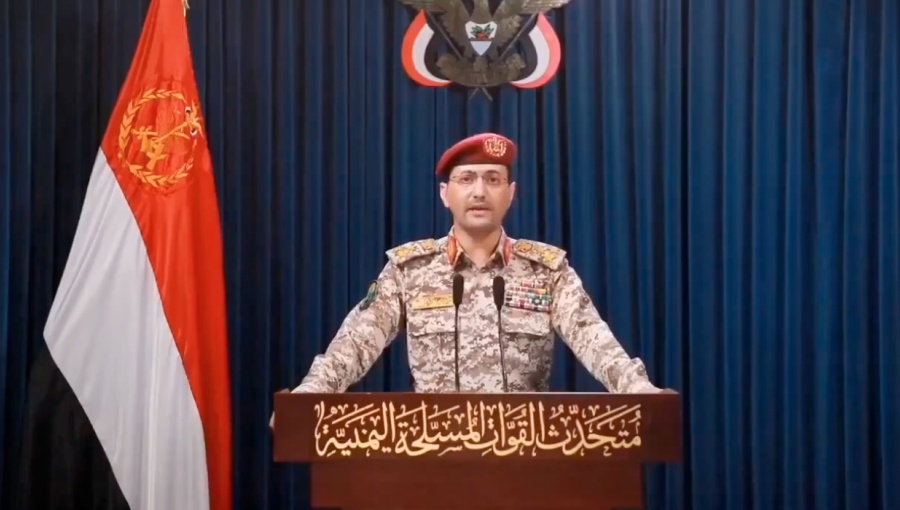
 Yemen’s Houthi movement has announced it is entering the escalating regional conflict on the side of Iran, warning it plans to target US naval assets in the Red Sea.

In a statement released by a representative of the group, the Iran-aligned movement said: “We will strike American ships in the Red Sea. This war is a fight for the entire Ummah.”

The declaration marks a further widening of tensions across the Middle East, as Iran’s network of regional allies signals a greater willingness to engage directly amid ongoing hostilities involving Israel, the US and Gulf states.

Tehran is keeping the threat of ordering Houthis to take up arms in reserve, say analysts, as they could close the access to the Red Sea and cut off all oil and gas produced in the Gulf from reaching international markets. Iranian officials told Tasnim News: if the US launches a military attack on Iran’s main export terminal on Kharg island, Iran will activate the Houthis to shut down the Bab al-Mandab Strait and block access to the Red Sea. Bab al-Mandab Strait — handles 10% of all global trade.

The US spent $1bn  trying to stop Houthi attacks on Red Sea shipping in 2024. and failed. Ships were forced to reroute around Africa and shippign costs went up 400% at that time. 

As bne IntelliNews reported, the Strait of Hormuz is partially open again under an informal permits-for-passage that is allowing Iranian tankers and some from “friendly countries” through. In addition the Kingdom of Saudi Arabia (KSA)’s westward pipelines that terminate at the port of Yanbu on the Red Sea is exporting to tankers waiting in the Red Sea. Taken together, the Gulf is still exporting somewhere between 8-10mn b/d, down from 20mn b/d pre-war. Thirty tankers are currently staged near Yanbu within Houthi strike range.

The Houthis, formally known as Ansar Allah, have previously targeted commercial shipping and military vessels in the Red Sea, citing solidarity with Palestinian groups and opposition to US and Israeli policies. Since late 2023, the group has launched drones and missiles at maritime targets, disrupting one of the world’s most important trade routes and prompting retaliatory strikes by US and allied forces.

In their latest statement, the Houthis also claimed to possess a hypersonic ballistic missile known as “Palestine-2”. According to the group, the missile has a range of up to 2,150km and can reach speeds of Mach 16. Such claims have not been independently verified, and defence analysts have previously cautioned that the group’s capabilities are often overstated, though it has demonstrated an ability to deploy increasingly sophisticated missile and drone systems.

The Red Sea, which handles roughly 12% of global trade flows via the Suez Canal, has become a focal point of the conflict, raising concerns among shipping companies and insurers over the security of transit routes. Several major shipping lines have already diverted vessels around the Cape of Good Hope, increasing costs and transit times.

US officials have repeatedly warned that attacks on naval or commercial vessels would prompt a military response, as Washington seeks to safeguard freedom of navigation in the region. The Houthis’ latest threat increases the risk of direct confrontation between US forces and Iran-aligned groups beyond the Gulf theatre.

The group said its actions were part of a broader regional struggle, stating: “This war is a fight for the entire Ummah.”

Houthi military official Abed al-Thawr told Press TV that once the decision to intervene is made, the first step could be the official declaration of a naval blockade against the United States and Israel.

Houthi leader Abdul Malik al-Houthi said his forces have their fingers on the trigger. Iran has supplied the Houthis with anti-ship ballistic missiles including the Asef with a 400-kilometre range, land-attack ballistic missiles including the Toufan capable of reaching 1,800 kilometres, cruise missiles from the Quds family reaching beyond 1,300 kilometres, and Samad-series attack drones with ranges up to 2,500 kilometres. 


Houthis operate unmanned surface vessels, naval mines, and small-boat swarms designed for exactly this kind of chokepoint denial. Between 2023 and 2025, they attacked 178 vessels, sank four ships, and caused a 90 percent decrease in Red Sea container shipping.

Maersk, Hapag-Lloyd, and CMA CGM have reportedly already paused all trans-Suez sailings through the Bab el-Mandeb. Other companies are rerouted around the Cape of Good Hope, adding 12 to 15 days and a million dollars in fuel costs to every voyage.

TACO

Trump suspends Iran power plant strikes for five days, citing 'productive' direct talks with Tehran

Trump suspends Iran power plant strikes for five days, citing 'productive' direct talks with Tehran
US president on social media announces five days of ceasefire. / bne IntelliNews
By bnm Gulf bureau March 23, 2026

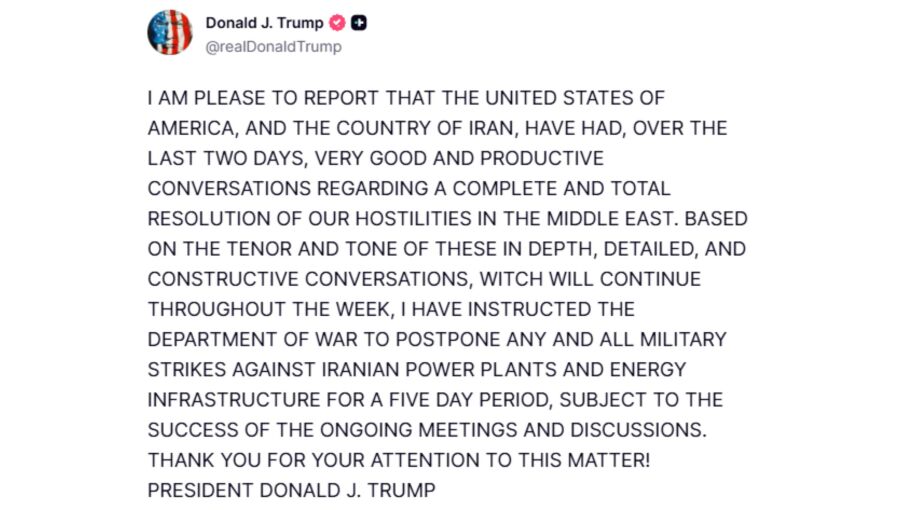
UPDATED: US President Donald Trump announced on March 23 that he had ordered a five-day suspension of planned strikes on Iranian power plants and energy infrastructure, he said on social media.

The American president said the US and Iran had held "very good and productive conversations" over the preceding two days aimed at a "complete and total resolution" of the conflict.

The announcement came just hours before Trump's 48-hour ultimatum for Iran to reopen the Strait of Hormuz was due to expire, averting what would have been a major escalation that Iran had warned would trigger "irreversible" destruction of Gulf energy infrastructure.

"Based on the tenor and tone of these in depth, detailed, and constructive conversations, which will continue throughout the week, I have instructed the Department of War to postpone any and all military strikes against Iranian power plants and energy infrastructure for a five day period, subject to the success of the ongoing meetings and discussions," Trump wrote on Truth Social.

The disclosure that the US and Iran have been in direct communication marks a significant shift. IAEA chief Rafael Grossi said on March 18 that he did not believe Iran would negotiate while the military campaign continued.

Iran's foreign minister, Abbas Araghchi, and its ambassador to Germany both said Tehran was open to diplomacy but demanded guarantees and compensation.

It was not immediately clear through which channel the talks were conducted. Belarus's President Lukashenko said on March 20 he had submitted a mediation plan to the Trump administration.

Oman, which hosted pre-war nuclear talks, has also been praised by Gulf states for its role in diplomacy.

The five-day window, if held, would expire on March 28. Military operations against other Iranian targets were not mentioned in the statement.

Oil prices and global markets will be watching closely for signs that the pause extends beyond energy infrastructure to a broader ceasefire. Brent crude had been trading above $113 per barrel, with analysts warning prices could reach $200 if the energy war intensified further.