Tuesday, April 07, 2026


Barge Catches Fire in Vancouver's Fraser River Port District
Vancouver
Via social media

Published Apr 6, 2026 6:30 PM by The Maritime Executive


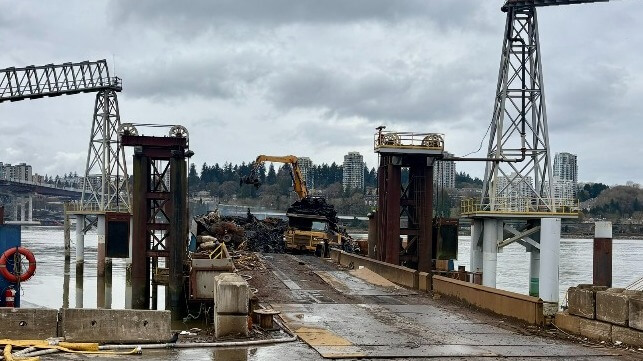
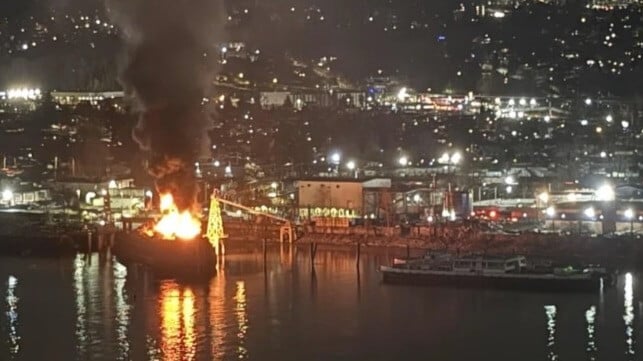
Overnight Thursday, a large fire broke out aboard a deck barge at the port of Surrey, BC, sending a dense plume of smoke into the air and startling residents who thought it was a commercial building fire. 

The fire broke out aboard a barge at a scrap metal terminal at Musqueam Drive, on the Surrey side of the Fraser River. The local fire department received a call at about 2300 hours reporting a major fire, and found a burning barge laden with scrap metal. At its peak, the blaze extended the length of the barge and engulfed the pile. 

The fire department treated it as a two-alarm fire and kept hoses on it into Friday. Metro Vancouver, the regional authority, said Friday that it was monitoring air quality given the large volume of smoke given off by the smoldering pile. 
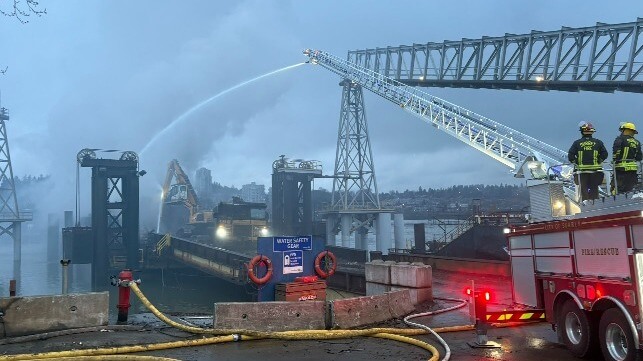
Courtesy Metro Vancouver

Scrap metal fires are all too common, and are typically ignited by unwanted contaminants - notably lithium-ion batteries, which can burst into flame when damaged. The problem has grown in recent years alongside the expanding use (and discarding) of consumer battery-powered devices. The fires grow and accelerate in the presence of flammable debris within the pile, such as oily wastes and plastics.  


Tanker Truck Blast Closes Bridge Over Panama Canal
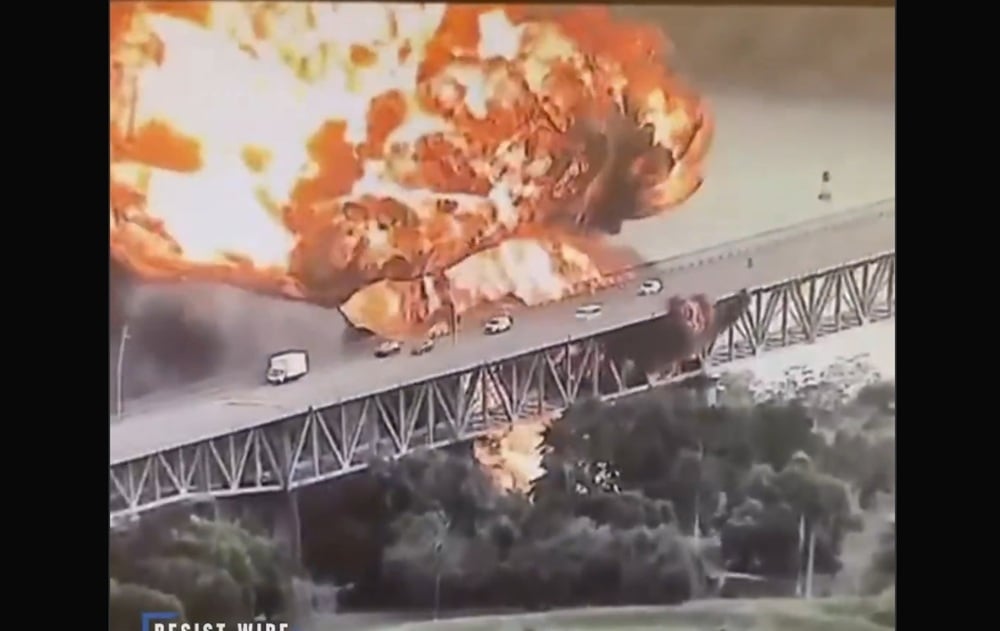
Security camera
Security camera footage via social media

Published Apr 6, 2026 10:36 PM by The Maritime Executive


An explosion at a fuel facility next to the Bridge of the Americas has killed one and injured several others, according to the fire department for Panama City, Panama. The fireball from the fuel burn-off made contact with the bridge, which spans the Panama Canal and carries logistics traffic for the port of Balboa. 

A large tank farm is located next to and beneath the bridge on the eastern bank, between the International Maritime University of Panama and a luxury hotel. A tanker truck loading fuel near the tank farm exploded Monday, igniting two other nearby trucks and sparking a massive blaze. 

One person was killed in the blast, identified by the authorities as a truck driver. Three others were injured, including one survivor with second-degree burns. The accident had potential for far greater harm: traffic was moving on the bridge at the time of the blast, and several vehicles passed right through or next to the fireball - including a bus full of passengers.

Firefighters responded to the scene, and post-casualty video shows efforts under way to extinguish spot fires directly beneath the bridge. The span remained closed to motor traffic on Tuesday while an inspection got under way to evaluate the bridge's condition. The bridge pier and girders in the area of the blast were coated with black soot from the fire. 

So far, the canal remains open to traffic, and merchant vessels continued to transit underneath the affected span on Tuesday morning. 

The cause of the blast remains under investigation, and has received additional scrutiny because of the sensitive geopolitical moment. The canal is one of the most important maritime choke points, and the most important one for U.S. energy shipping interests; any shutdown of the canal would have strategic implications for the U.S. West Coast and Asia-Pacific petroleum markets, already under significant stress.


Trident Sues Tacoma Fire Dept. for the Loss of the Kodiak Enterprise
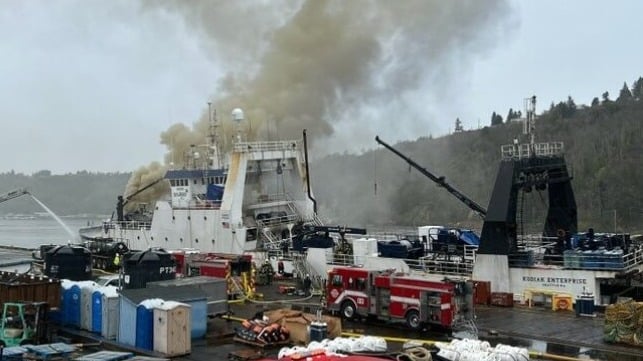
Kodiak enterprise
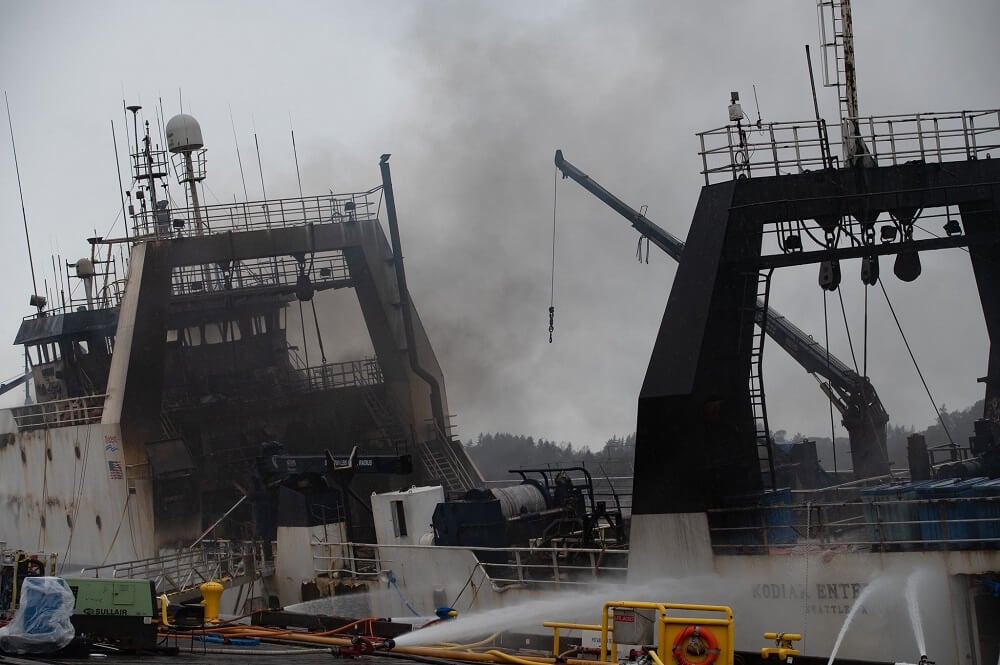
The early stages of the Kodiak Enterprise fire (Courtesy Washington Department of Ecology)

Published Apr 6, 2026 4:27 PM by The Maritime Executive


U.S. fishing company Trident Seafoods has filed a rare lawsuit against the city of Tacoma, Washington for alleged mishandling of the fire aboard the fishing vessel Kodiak Enterprise, which was destroyed in a massive blaze three years ago. A lawsuit against an emergency response agency is virtually unheard-of after a marine casualty, but Trident alleges gross negligence on the part of the Tacoma Fire Department. 

In the early hours of April 8, 2023, a fire broke out in a compartment towards the bow of the Kodiak Enterprise while the vessel was alongside at the Port of Tacoma. The point of origin was likely in a dry stores space, according to Trident. The crew evacuated onto shore, and Tacoma Fire Department responded to the scene by about 0330 in the morning. 

The fire department took command of the response and began its work. Meanwhile, Trident contracted with salvor Resolve Marine for expert marine firefighting services. Resolve has a base located in Tacoma and a strong presence in the Seattle area, and it mobilized a team to the scene beginning at about 0600 that morning. Tacoma Fire retained formal control, and Resolve's personnel acted in an advisory capacity. 

A Tacoma Fire battalion chief took over the incident commander role at about 0720 hours, and the fire was substantially under control by 1330 hours, according to Trident. Resolve recommended boundary cooling and isolation (shutting down all ventilation) in order to let the fire burn out in the forward compartments, controlling risk. 

Instead, the Tacoma Fire battalion chief insisted upon the opposite strategy, Trident alleges in its suit. Over the objections of Resolve's advisers, the incident commander allegedly ordered Tacoma Fire's responders to bring fans aboard and begin blowing large volumes of air into the space - a strategy called positive pressure ventilation (PPV) - at about 1845 hours. 

In a shoreside fire, PPV is typically used after the blaze is knocked down or extinguished in order to clear out smoke and allow fire teams to move into the space, or to decrease the imminent hazards of smoke inhalation and heat for any trapped survivors (not a factor as the space was unoccupied). These use cases make PPV a popular firefighting tool for shoreside fire departments, but the technique is deployed with care: it has the risk of potentially re-igniting smoldering materials, as by the nature of its operation it blows additional oxygen into the fire space. PPV's success depends upon setting up a controlled airflow route between the blower fan at the entryway and a designated exit point for smoke and hot air. 

PPV is controversial when applied in marine firefighting, according to the textbook IFSTA Marine Firefighting for Land-Based Firefighters, as ventilation inside a ship is harder to control. "Positive pressure ventilation is ineffective [in shipboard fires], and smoke movement is unpredictable," advised DoD civilian firefighter and consulting fire investigator Nicholas Palumbo in a recent editorial.  

When Tacoma Fire's battalion commander ordered his fire teams to use PPV aboard Kodiak Enterprise, Trident asserts, Resolve Marine recommended against it and offered to take over incident command in the morning. The Tacoma Fire battalion commander proceeded anyways, without first arranging for a controlled ventilation pathway for the smoke and hot air to safely exit the space, Trident alleged in its complaint. 

Per Trident's timeline, thick black smoke and flame emerged from the ship within a short time after Tacoma Fire commenced PPV in the fire-affected space. At about 2100, roughly 2.25 hours after ventilation began, Tacoma Fire's event chronology noted that the response was "transitioning to defensive." The agency evacuated its fire teams shortly after, and the fire burned through the rest of the ship over the course of the next several days. The Kodiak Enterprise was declared a total loss.
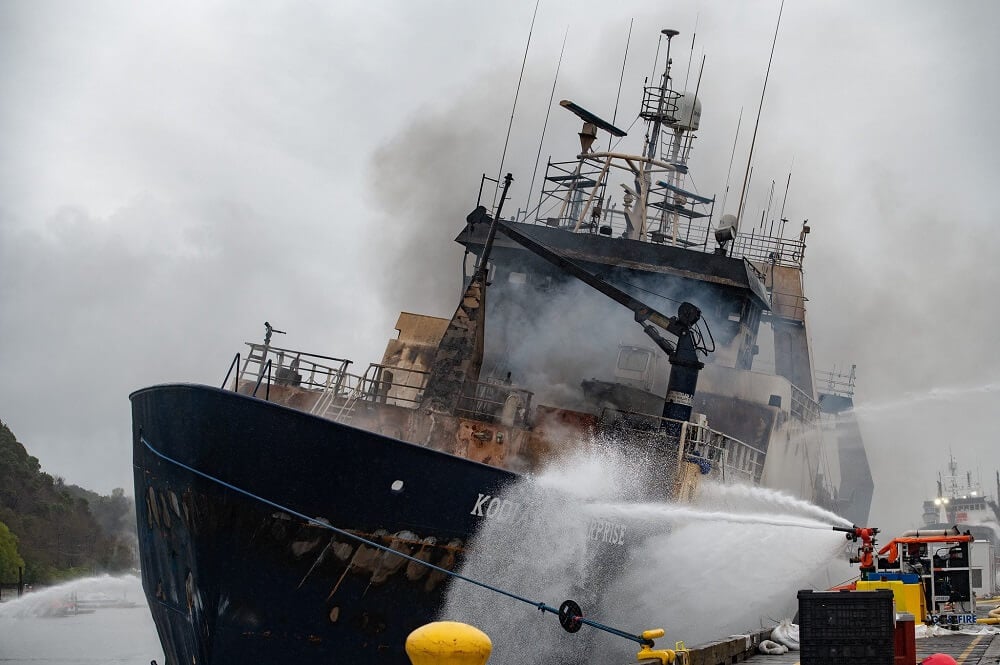
Images courtesy USCG

Trident alleges that the fire would have been contained to the forward compartment if Resolve's advice to isolate it had been followed; the company claims that the rest of the ship would have been unharmed if Tacoma Fire had not initiated positive pressure ventilation.

Trident claims that the value of the vessel was $185 million, and that the damages attributable to Tacoma Fire's decision came to at least $100 million.   

Tacoma Fire and Resolve Marine have been contacted for comment. 


When Bridge Teams Lose Control Without Realizing It
Too late: By the time the deviation becomes clearly visible, the system may already be operating beyond a recoverable threshold (SCA file image)

Published Apr 6, 2026 2:44 PM by Capt. Volodymyr Smirnov


Following recent discussions on hydrodynamic instability in confined waters, an important operational question remains: Why do experienced bridge teams sometimes lose control of a vessel — without recognizing it in real time?

In many marine casualties, loss of control is not a sudden event. It develops gradually, often while the vessel still appears manageable.

The Illusion of control

On the bridge, control is typically assessed through heading response; rudder feedback; visual alignment with the channel; and engine response. As long as these indicators appear normal, the situation is perceived as stable.

However, in confined waters, this perception can be misleading. Hydrodynamic forces — especially when combined with environmental factors such as wind and shallow water — may begin to alter vessel behavior before it becomes visibly critical. The vessel is still responding, but it is no longer behaving predictably.

Delayed recognition

One of the most dangerous aspects of confined-water navigation is delayed recognition. The transition from stable control to instability is not always obvious. There is often no single alarm, no immediate failure.

Instead, corrections become slightly less effective; rudder angles increase; and the vessel requires more input to maintain track. These changes can be interpreted as “normal variation” rather than early warning signs.

By the time the deviation becomes clearly visible, the system may already be operating beyond a recoverable threshold.

Nonlinear response

At the core of this issue is a nonlinear relationship between cause and effect. Small increases in speed, small changes in position, or moderate environmental forces can lead to disproportionately large responses in vessel behavior.

This is particularly relevant in shallow and confined waterways, where squat reduces under-keel clearance, rudder efficiency decreases, and bank interaction forces intensify.

As a result, corrective actions may begin to produce unexpected outcomes. More rudder does not always mean more control. In some cases, it produces the opposite.

Cognitive bias under pressure

Bridge teams do not operate in a vacuum. They operate under schedule pressure, pilot expectations, traffic constraints and environmental uncertainty. 

Under these conditions, there is a natural tendency to assume that the situation remains controllable — especially if it was under control moments before.

This creates a cognitive bias: “If we are still on track, we are still in control.” In reality, control may already be degrading.

The critical gap

The most dangerous phase is the gap between actual loss of controllability and recognition of that loss.

This gap can be only minutes — but it defines the difference between recovery and casualty.

Once the system crosses a nonlinear threshold, recovery options narrow rapidly.

Closing the gap

Reducing risk in such scenarios does not depend on more technology alone. It depends on operational awareness.

Three practical measures can significantly reduce exposure:

- Recognizing early signs of reduced control effectiveness

- Establishing predefined thresholds for intervention

- Maintaining active bridge team engagement during pilotage

Most importantly, bridge teams must accept that loss of control is not always visible when it begins.

From control to awareness


IRONY 

Passengers Abandon Cruise Grounded on Island from 2000 Movie “Cast Away"

cruise ship off Fiji
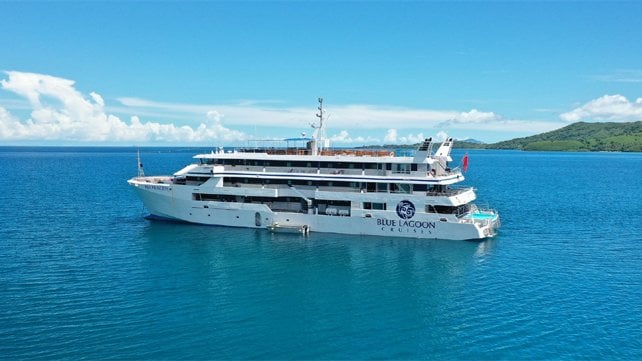
Fiji Princess grounded on a reef off an uninhabited island used to film a 2000 movie about a cast away (Blue Lagoon Cruises file photo)

Published Apr 6, 2026 5:47 PM by The Maritime Executive


Passengers aboard the Fiji cruise ship might have thought they were about to relive a scene from the 2000 movie “Cast Away,” in which Tom Hanks becomes stranded for years on an uninhabited island. Their ship, the Fiji Princess, grounded on April 4 on the same island used in the movie.

The 179-foot (55-meter) cruise ship operates cruises up to a week in length around the islands in Fiji. Built in 1998, the ship has 32 passenger cabins with a maximum capacity of 64 passengers, along with 31 crew.

According to the initial reports, the vessel was at anchor in calm waters when it was hit by a severe squall that caused it to drag anchor. It hit a reef and, according to the Maritime Safety Authority of Fiji, suffered serious damage to its port side along the stern. The hull has been damaged and was experiencing an ingress of water in an area near the steering equipment. The ship was sitting on the reef with a strong list to port.


The 30 passengers aboard this cruise were removed from the ship at first light on Sunday along with 17 crewmembers. A ferry transferred them back to Port Denarau. The authorities have not reported injuries among the passengers or crew.

The primary concern, they said, was 20,000 liters of diesel fuel aboard the vessel. There were no signs of a fuel leak or damage to the tanks, but they prepositioned containment equipment as a precaution.

The vessel’s owners, Blue Lagoon Cruises, brought in a salvage team from Australia, which reached the location on Sunday. However, due to rough seas and strong waves, the authorities reported they had been unable to send down divers to survey the underside of the hull.

A strong tropical storm was approaching Fiji, so the remaining crew was moved off the ship overnight for their safety. The plan was to begin removing the fuel as soon as possible while the salvage team surveyed the damage and determined how to remove the vessel.

Deus Noster Refugium 

ANTI WAR 

(Psalm 46)


Psalm 46

For the director of music. Of the Sons of Korah. According to alamoth. A song.

1 God is our refuge and strength, an ever-present help in trouble.
2 Therefore we will not fear, though the earth give way and the mountains fall into the heart of the sea,
3 though its waters roar and foam and the mountains quake with their surging.
4 There is a river whose streams make glad the city of God, the holy place where the Most High dwells.
5 God is within her, she will not fall; God will help her at break of day.
6 Nations are in uproar, kingdoms fall; he lifts his voice, the earth melts.
7 The LORD Almighty is with us; the God of Jacob is our fortress.
8 Come and see what the LORD has done, the desolations he has brought on the earth.
9 He makes wars cease to the ends of the earth. He breaks the bow and shatters the spear; he burns the shields with fire.
10 He says, “Be still, and know that I am God; I will be exalted among the nations, I will be exalted in the earth.”
11 The LORD Almighty is with us; the God of Jacob is our fortress.

Monday, April 06, 2026

Trump operating in a 'carnival framework' that allows rule-breaking in domestic and foreign policy


Issued on: 06/04/2026 - FRANCE24
10:46 min


US President Donald Trump's mixed messaging and conflicting signals have characterised the war in Iran. For more on the US president's increasingly bombastic rhetoric, and what's likely to happen next, FRANCE 24's Sharon Gaffney speaks with Lisa Gaufman, Assistant Professor at the Centre for Democratic Politics and Cultures at the University of Groningen and Author of 'The Trump Carnival: Populism, Transgression and the Far Right '.


White House posts then deletes Easter video of Trump insulting Macron

Issued on: 06/04/2026 - FRANCE24


The White House briefly published — then deleted — a video from Donald Trump’s private Easter luncheon in which the US president made a series of inflammatory remarks, and repeated false claims about several public figures. These extraordinarily candid comments were likely never supposed to be heard by the public. However, the closed-door footage was downloaded by a journalist before it was removed and later circulated online.

In the hour-long recording, Trump mocked the marriage of French President Emmanuel Macron and imitated him with a French accent, remarks that Macron later called "neither elegant or up to standard."

At another moment, Trump mused about being a “king," referring both to the Democrats' 'No Kings' protests held across the country against his leadership, and his $400 million project to build a ballroom in the White House.

His televangelist spiritual advisor Paula White-Cain also compared Trump's life and challenges to Jesus Christ, drawing parallels between assassination attempts and legal battles with the trials endured by Jesus. These comments have triggered backlash from Christian groups nationwide.

Trump also repeated false and xenophobic claims about US Congresswoman for Minnesota Ilhan Omar, and Algerian boxer Imane Khelif, repeating baseless statements he's previously made despite having been debunked by fact-checkers.

The president also repeated false claims about US Congresswoman Ilhan Omar and Algerian boxer Imane Khelif, among others — statements that have circulated previously online but have been debunked by fact-checkers.

Vedika Bahl goes through what the US President said in this closed-door footage in Truth or Fake.

BY: Vedika BAHL
VIDEO BY: Vedika BAHL


Could China's adoption of electric vehicles shield it from the energy crisis?

Issued on: 06/04/2026 - FRANCE24
Play (05:30 min)

As crude prices hover around the $110 per barrel mark on Monday morning, consumers worldwide are feeling the impact of the war in Iran and the closure of the Hormuz Strait when they head to the petrol pump. In China, where more than half of new car sales are for electric vehicles, that impact may be less pronounced, as France 24’s Bryan Quinn explains in his report. Also in this edition, "Super Mario Galaxy Movie" has achieved the best opening release of the year so far.


AI-generated artists break through in country music

New York (AFP) – AI-generated singers routinely rank among the top-streamed country music artists in the United States -- a trend that for now is limited to 
a genre that industry observers fear is becoming too formulaic.


Issued on: 07/04/2026 - FRANCE24

"Whiskey & Water," a song by Cain Walker featuring Cade Winslow, is one of many AI-generated country music tunes © TIMOTHY A. CLARY / AFP

Breaking Rust, Cain Walker, Aventhis, and Outlaw Gospel have more in common that cowboy hats, denim and leather. They are all completely computer-generated, from their faces to their melodies.

And they are all hitmakers.

"That's a phenomenon I didn't see coming," said Jennie Hayes Kurtz of the country music band Brother and The Hayes.

"I thought AI was going to be curing cancer or something."

Many of the AI country tunes tap into the genre's archetype of the lone cowboy: a rugged, taciturn, plain-spoken man who, above all, refuses to apologize for simply existing.

Lyrics are delivered in raspy, gravelly voices that sound as authentic as the real thing.

"It's scary as songwriters," said Kassie Jordan, who forms the singing duo Blue Honey with her husband Troy Brooks.

"We are starting to see a lot of people just putting words into these chatbots and it is writing songs for them," she said. "As a songwriter, it's kind of like, is anyone going to even think I really wrote this?"

Berklee College of Music professor Joe Bennett noted that a sampling of AI singers suggests that the words used to "prompt" AI songs were "not particularly detailed."

None of the producers behind AI-generated music projects responded to AFP's requests for comment.

So how did AI find a place in a genre that is fundamentally rooted in the human experience and storytelling, blending folk, blues, and even gospel influences?

For Bennett, the emergence of modern country music in the early 2000s -- with a highly polished, more pop sound and repeated "melodic shapes" -- is key.

AI models could become adept at replicating such a sound, when fueled with those elements, he explained.
'Superficial'

Once overshadowed by rap and Latin music, and hindered by the industry's shift to digital music formats, country music has nevertheless staged a comeback thanks to a generation of artists with stronger pop, not folk, sensibilities.

Following in the footsteps of country-turned-pop megastar Taylor Swift, today's headliners are more likely to sport baseball caps than wide Stetsons.

Their music breaks genre boundaries, while artists such as Beyonce and Post Malone win fans and sell albums with their crossover efforts.

Last year, country stars Morgan Wallen and Zach Bryan were both in the top 10 most streamed artists on Spotify.

Some in the industry believe country's rebirth signifies a dulled-down formula designed to appeal to the widest possible audience.

"The lyrics aren't as deep as they used to be," Jordan said.

"A big portion of popular country music has become kind of shallow, so that is pretty easy to duplicate."

Bennett says the industry must do a better job of identifying AI-generated music, noting that Deezer is the only major streaming platform to clearly label such material.

"We need AI detection," Bennett maintained.

"It will happen, and there is a consumer demand for it."

Hayes Kurtz said there is a large audience of "passive" listeners who don't care whether music is made by AI, but there are also "active listeners" who attend concerts, buy band merchandise, and deeply respect the integrity of the artists.

"That audience seems to really care it the music is made by the actual humans they are going to see," Hayes Kurtz said.

Jordan says she remains optimistic about the future.

"There's another wave of country artists that are coming that is really into doing it the old school way and showing emotion," she said.

"That will be harder for AI to duplicate. That might save the genre."

© 2026 AFP


AI technologies could have saved ‘thousands of lives’ during Covid, expert says


Issued on: 06/04/2026 
FRANCE24

PLAY 09:01 min


The health of humans, animals, and the entire ecosystem is inextricably linked. This message is at the heart of the One Health Summit, currently underway in France, where global health leaders are gathering. The summit aims to explore future strategies, particularly using emerging technologies like artificial intelligence, to ensure – and even improve – the delicate balance between these elements. We spoke to Antoine Tesnière, who advised the French government during the Covid pandemic, about how new technologies could have saved lives had they been available at the time.


'Vladimir Putin absolutely nervous' about Hungary's election, expert says

Issued on: 06/04/2026 -  FRANCE24


Speaking with FRANCE 24's Mark Owen, Dr Marc Roscoe Loustau, Affiliated Fellow at the Central European University, says that "next to Viktor Orban, the person who stands to lose the most in case of a Fidesz party loss is Vladimir Putin". According to press reports quoting intelligence officials, the powerful explosives found near a Serbian gas pipeline to Hungary may be part of a "false flag" operation to influence the upcoming election.

Video by:  Mark OWEN


Pro-Orbán actors accuse Meta of interference in Hungarian elections, despite lack of evidence


By Estelle Nilsson-Julien
Published on 


Meta has found itself embroiled in Hungary's tense election campaign, after supporters of the ruling Fidesz party claimed their posts are being restricted to favour opposition parties. In reality, there is no weight to the allegations.

Social media accounts backing Hungary's ruling right-wing populist party Fidesz have accused tech giant Meta of political interference in the country's upcoming elections, alleging that the party and Prime Minister Viktor Orbán are being censored.

Fidesz campaign chief Balázs Orbán also threw his weight behind the allegations.

"We have received numerous reports that some users have been unable to like Fidesz-related content on Facebook for the past few days", he said on 29 March.

However, The Cube, Euronews' fact-checking team, was not able to gather any valid evidence to back these claims.

Claims of interference

The claims emerged in an X post shared by Lebanese-Australian political commentator Mario Nawfal, who tends to align with populist leanings.

"EXCLUSIVE BREAKING: FACEBOOK RESTRICTS ORBÁN POSTS WEEKS BEFORE HUNGARY’S ELECTION," he said on 18 March.

Nawfal — who interviewed Orbán seven days later — alleged that ahead of the "crucial" elections on 12 April, Facebook was "reportedly restricting posts from the country's Prime Minister."

He suggested that this was sparked by a call from a member of the opposition Tisza Party — the pro-European conservative political party, led by former Fidesz party member Péter Magyar — who allegedly urged "supporters to mass-report" Orbán's content.

These allegations were subsequently picked up by the Polish conservative news outlet, wPolityce.pl, as well Mandiner, a Hungarian Fidesz-aligned newspaper. The Mandiner identified the "opposition member" referred to by Nawfal as Tisza MEP Dóra Dávid, a former legal adviser to Meta.

The Cube contacted Nawfal for further information about his claims, but did not receive a response at the time of publication. Meanwhile, there is no publicly available evidence that Meta targeted or censored posts shared by Fidesz or Orbán.

A Meta spokesperson told us that there were "no restrictions on the [Hungarian] Prime Minister's accounts" and that none of his posts had been removed.

"Our Community Standards and policies apply equally to everybody, and we have systems in place to detect any coordinated efforts to abuse our reporting systems," added the spokesperson.

A video taken out of context

The claims targeting Dávid appear to misleadingly take some of her prior claims out of context, including a video she published on her social media in November 2025.

In the video,Dávid told her followers that "propagandists and the 'Mi hazánk' group" — a far-right Hungarian political group — had accused her of "manipulating Meta's algorithms", which she said was "not true".

"You can do a lot to help ensure that the algorithm doesn't pick up on the lying, false, misleading, and hateful posts from Fidesz and those close to Fidesz", said Dávid in the video.

"How? Like this: report them and select the most appropriate category", she added, as video instructions detailing how to report content displayed on screen.

Users can flag content that violates Meta's community standards to the platform.

This includes "hateful content" which targets people for their "race, ethnicity, national origin, disability, religious affiliation, caste, sexual orientation, sex, gender identity and serious disease", according to Meta's guidelines.

Meanwhile, Meta labels misinformation as "different from other types of speech", arguing that there "is no way to articulate a comprehensive list of what is prohibited."

Users in Europe can flag content which they believe qualifies as fake news to Facebook, which is subsequently independently reviewed by fact-checkers.

However, things are different in the US: in early 2025, Meta announced that it would move away from professional fact-checkers to a "community notes" system similar to X, allowing users to write notes on posts deemed to be misleading.

Founder Mark Zuckerberg said at the time that, under the old system, it was moderating posts "too aggressively".

Nevertheless, such a move would be more complicated to implement across Europe, due to the Digital Services Act (DSA), which aims to combat the spread of disinformation by making sure online platforms tackle any risks to democratic processes. Any platform caught flouting the rules is subject to heavy fines.

Indeed, Meta's fact-checking process appears to have stayed the same on this side of the Atlantic, at least for now. A spokesperson for the company told us that "third-party fact-checking remains in place outside of the US. This includes Hungary, where we work with AFP, and the EU."

"We are beginning with rolling out Community Notes in the US, and will continue to improve it before expansion to other countries. Building a robust Community Notes ecosystem will take time", the spokesperson added.

Therefore, Dávid's call for users to flag "lying, false, misleading, and hateful posts" does not constitute a breach of guidelines, as they fall in line with the DSA's aim for companies to mitigate the spread of disinformation and harmful content.

The Cube contacted Dávid for comment, but she declined to respond to what content from Fidesz she was referring to.

The claim against her follows a number of other allegations that Fidesz is using underhanded tactics against its rivals.

In recent months, the party has been accused of running a smear campaign to target its political opponents by spreading AI-generated images of rivals, such as false footage of Tisza leader Péter Magyar and fake videos of Hungarian soldiers carried in caskets to discredit support for Ukraine against Russia.

While Meta stipulates that it removes "content that is likely to directly contribute to interference with the functioning of political processes", according to disinformation researchers, there are still flaws in the filtering process and some of this content is still making it online.

Members of Meta’s team targeted by interference rumours

Dávid is not the only person who has been singled out and accused of driving a campaign against Fidesz via Meta.

A series of social media posts accused Meta's government and social impact partner for Central and Eastern Europe, Oskar Braszczyński, of spearheading a campaign against Hungary's ruling party.

On 18 March, Philip Pilkington, a conservative political commentator and visiting fellow at the Mathias Corvinus Collegium — a think tank and higher education institution with close ties to Prime Minister Viktor Orbán — shared an X post which he branded as "breaking news", alleging that Braszczyński was "suppressing" Orbán's social media.

None of the accounts that picked up these claims presented any tangible evidence to support the allegations.

Instead, X users described Braszczyński's outright support for Ukraine and LGBT rights on his Facebook account as the "classic hallmarks" of "progressive liberals who are tasked with election interference in Europe".

Philip Pilkington told The Cube that he could not provide further details about his claims, but that a "senior government source in Budapest" had provided him with the information.

Meanwhile, Braszczyński did not respond to our request for comment.

Meta did not provide a comment on allegations concerning Braszczyński and Dávid.


FASCISTS OF A FEATHER...

JD Vance heads to Budapest to give final campaign push for Orban

JD Vance heads to Budapest to give final campaign push for Orban
/ Facebook/JDVanceFacebook
By bne IntelliNews April 6, 2026

US Vice President JD Vance will visit Budapest on April 7 for a joint press conference and rally with Prime Minister Viktor Orban, state news agency MTI reported on April 6. The press conference is scheduled for 1:20 PM CET at Orban’s office in the Carmelite Monastery, followed by a rally a few hours later, dubbed the "Day of Hungarian-American Friendship". 

The visit comes just days ahead of the pivotal April 12 election and is widely viewed as a demonstration of support for Orban and his Fidesz party, which is currently trailing the opposition Tisza Party.

Although polls show a substantial lead for Peter Magyar’s party, with Polymarket giving him a 70-30% chance of winning, analysts caution that it is too early to declare an opposition victory, given Fidesz’s strong mobilisation, well-organised party structure, and an election landscape that remains tilted in their favour.

Politico has dubbed the visit the "Save Viktor Orban" plan, highlighting the effort to support the US administration’s top ally in Europe. Analysts note that the campaign rally reflects Washington’s willingness to intervene in the Hungarian election. The visit comes seven weeks after US Secretary of State Marco Rubio's trip to Budapest in February.

The US secretary of state openly endorsed Orban and avoided confronting his host on sensitive issues, such as Hungary’s engagement with China or its reluctance to reduce its dependency on Russian energy.

Orban, 62, is the longest-serving prime minister in Europe and is widely regarded by radical-right figures in Washington as a model of nationalist-populist leadership. His potential defeat could deal a blow to the MAGA movement and other Eurosceptic forces, leftist daily Nepszava writes. Analysts suggest that, with Orban losing power, his vision of illiberal democracy could lose appeal elsewhere.

At the recent CPAC Hungary conference, radical right-wing leaders reaffirmed their support for Orbán, and one of the day’s highlights was a video message from US President Donald Trump, who described Orban as a strong leader.

Balázs Ablonczy, an analyst for the conservative weekly Valasz Online, called Orban’s close alignment with Trump potentially politically risky. To illustrate Hungary’s alignment with Washington, Ablonczy recalled that after the first strikes against Iran, the foreign ministry framed attacks as carried out by Israel, omitting US involvement. He noted that Hungary’s highly ideological foreign policy contrasts with its claims of pragmatism and national interest.

The government’s narrative has widely exaggerated the economic consequences of disruptions to the Druzhba pipeline while downplaying the broader geopolitical tensions and potential energy crisis stemming from the war in Iran.

Peter Magyar, in a recent interview with 444.hu, said he expects the vice president to clarify that the United States does not seek Hungary’s potential military involvement in the Iran war. Magyar referred to a comment by cabinet minister Gergely Gulyas last month, who said that the government would consider providing military assistance to the United States if formally requested. Magyar also called on the prime minister not to sign any agreements in the coming days that could compromise Hungary’s security or limit the next government’s authority.

How the Middle East war is impacting humanitarian aid to Africa

Since the outbreak of war in the Middle East, disrupted trade routes have caused delays to the delivery of medicines and other humanitarian aid to crisis zones such as Sudan and Mali.


Issued on: 06/04/2026 - RFI

Residents receive aid from the World Food Programme in the Al-Omada neighbourhood of Omdurman, Sudan on 11 March 2026. AFP - EBRAHIM HAMID

The Strait of Hormuz, which links Dubai to Port Sudan on the eastern coast of Africa, is a vital transit point for the delivery of medicines to the continent.

But this key waterway has been effectively blocked by Iran in retaliation to US-Israeli strikes which began on 28 February, with only a limited number of ships allowed through.

In recent weeks, goods have had to be diverted via the Cape of Good Hope and once they reach the West African coast, they are transported by road.

"For the few ships that are still sailing, this detour comes at a very high cost," explains Rodrigue Alitanou, a doctor and director of operations at the Dakar-based NGO Alima which provides emergency care in 13 countries in Africa.

"It adds more than €2,000 to the cost of each container. So this has an impact not only on our delivery delays, but also on the number of beneficiaries we can treat," he told RFI.
Fuel prices

Another source of pressure on the NGO’s financial resources is the rise in fuel prices due to worldwide shortages.

"Today, the price of a litre of petrol has risen by 40 percent on average across the countries where we operate," says Alitanou.

As a result, the overall cost of humanitarian operations has risen, as is the case in Sudan, for example.

"Today, the cost has almost tripled for every lorry that reaches us," laments Haruna Tarfa, the NGO’s medical coordinator in Tawila, North Darfur, where more than 630,000 displaced people live.

"In the coming days, we risk running out of maternal kits and general medicines. This also affects the malnourished children we are treating who need medication."
'Accessibility is already a challenge'

Sudan is one of the crisis zones where logistical difficulties are exacerbated by the international context.

"In North Darfur, accessibility is already a challenge," explains Tarfa.

"We have very limited options when it comes to getting medicines to people. With the current events, the impact will be such that it will be very difficult for us to adapt."

The same fear is being expressed in Mali, where the NGO has already had to scale back its activities.

With the embargo on fuel imports imposed by the JNIM jihadists, "dozens of villages no longer have access to healthcare because we can no longer get around," explains Alitanou.

If the international situation does not improve within the next three months, the NGO says it will be forced to scale back its activities significantly.

According to a report released on Saturday by the African Union and the African Development Bank (AfDB), the Middle East war "presents a serious risk to Africa."

The Middle East accounts for 15.8 percent of Africa's imports and 10.9 percent of its exports, the report noted.
Potential food disaster

"The conflict, which already has triggered a trade shock, could quickly turn into a cost-of-living crisis across Africa through higher fuel and food prices, rising shipping and insurance costs, exchange rate pressures, and tighter fiscal conditions," it added.

"The longer the conflict lasts and the more severe the disruption to shipping routes and energy and fertilizer supplies, the greater the risk of a significant growth slowdown across the continent."

Reduced deliveries of liquefied natural gas (LNG) from the Gulf will impact fertilizer production, limiting its availability during the crucial planting period up to May, it added.

Countries like Italy have called for the establishment of a "humanitarian corridor" for fertiliser and other essentials through the Strait of Hormuz to avoid a food disaster, particularly among vulnerable nations in Africa.

This article was adapted from the original version in French by RFI correspondent Pauline Le Troquier with additional reporting by AFP.