Saturday, April 18, 2026


Pope Leo XIV lands in Angola, says it is 'not in my interest at all' to debate Trump


By Manuel Ribeiro
Published on 

After visiting Cameroon, Angola is the third leg of Pope Leo XIV's 11-day tour of Africa. People hope for appeals for peace and for him to tackle the economic woes of the oil- and rare-earth-rich nation.

After visiting Cameroon, Pope Leo XIV landed in Luanda, Angola on Saturday, where he was welcomed by faithful. The Holy Father is about to become the third pontiff to visit Angola, after John Paul II (1992) and Benedict XVI (2009).

Meanwhile, during Pope Leo XIV's plane journey on Saturday he said that it was “not in my interest at all” to debate President Donald Trump about the US-Israeli war in Iran.

But the American pope also took the opportunity to set the record straight, insisting that not everything he says was directed at Trump, but reflects the broader Gospel message of peace.

As soon as Pope Leo XIV landed in Luanda he was scheduled to meet with Angola’s president, João Lourenço, and deliver a speech, the latest on a trip during which he has been stepping up his rhetoric, after becoming the target of criticism from Donald Trump.

On Sunday, the Holy Father will travel by helicopter to the village of Muxima, around 130 kilometres south-east of Luanda, where a 16th-century church built by the Portuguese has become one of Africa’s most important pilgrimage sites.

Five hundred years ago, this Marian shrine became a key point in the transatlantic trade in human beings run by the Portuguese, serving as the place where enslaved people were baptised before being shipped to the Americas.

A new basilica is currently being built in Muxima, part of a multi-million-dollar government project to turn the site into a major tourist destination.

“It is a historic moment of grace, a moment of deep emotion, with tears in our eyes and gratitude in our hearts,” said the rector of the shrine, Father Mpindi Lubanzadio Alberto, speaking to the Catholic news website ACI Africa.

The rector of the Sanctuary of Our Lady of the Conception of Muxima, in the Diocese of Viana, Angola, spoke about the planned apostolic visit of Pope Leo XIV as a decisive spiritual moment for the country.

Tens of thousands of worshippers are expected to travel there to see the leader of the Catholic Church. Pope Leo XIV calls for world peace are likely to resonate in Angola, which in 2002 emerged from a 27-year civil war that broke out after independence from Portugal in 1975.

As well as his appeals for peace, Pope Leo XIV is expected to address the issue of corruption and exploitation in the country, where, despite its vast fossil fuel reserves, a third of the population lives below the poverty line.

Angola is currently Africa’s fourth-largest oil producer and ranks among the world’s top 20, according to the International Energy Agency. It is also the world’s third-largest producer of diamonds and has significant deposits of gold and rare earths.

Yet despite its varied natural resources, the World Bank estimated in 2023 that more than 30% of the population was living on less than €1.83 a day.

Angola has a population of about 38 million, and 44% of Angolans are Catholic. The country gained independence from Portugal in 1975 but still bears the scars of a devastating civil war that began soon afterwards and dragged on, with ups and downs, for 27 years before ending in 2002. It is estimated that more than half a million people lost their lives.

During his four-day visit to Angola, Pope Leo XIV will direct his message particularly to young people, seeking to offer them hope and healing, the Vatican has said.

Pope Leo XIV's tour of the African continent included stops in Algeria and Cameroon, after he visits in Angola, Pope Leo XIV will mark his last stop in Equatorial Guinea.


White House vs the pope: What is behind the clash and Catholic just war doctrine?


Copyright AP Photo

By Aleksandar Brezar
Published on 17/04/2026
EURONEWS

Theologians Euronews spoke to believe that the escalating war of words between Washington and the Holy See has raised important questions over Catholic and Christian moral thought.

When US Vice President JD Vance converted to Catholicism in 2019, he chose Saint Augustine as his patron.

On Tuesday, speaking at a Turning Point USA event, Vance invoked the tradition of the fifth-century theologian and one of the most important Church fathers to push back against Pope Leo XIV's criticism of the war in Iran.

The White House number two warned the pontiff to "be careful when he talks about matters of theology," citing "more than a 1,000-year tradition of just war theory" in his defence.

Meanwhile, the supreme pontiff of the Catholic Church was in the Algerian port city of Annaba, paying homage at the basilica not far from where St Augustine died and was initially interred.

Hippo Regius, as it was known in the bishop's time, is where St Augustine wrote most of what became the intellectual basis of the just war principles Vance was claiming to defend. Pope Leo XIV is the first pontiff to hail from the Augustinian order.


Whether Vance knew what the Holy Father’s itinerary was that day, his office did not say.

Vice President JD Vance shakes hands with Turning Point USA spokesperson Andrew Kolvet during a Turning Point USA event in Athens, GA, 14 April 2026 AP Photo

Vance was not the first member of the administration to weigh in.


Days earlier, US President Donald Trump had posted on Truth Social and later reiterated to the press that Pope Leo XIV was “weak on crime" and "terrible for foreign policy," suggesting the pontiff believed Tehran should be allowed to develop nuclear weapons.

The pope never made any comments regarding the Islamic Republic’s right to nukes.

The post came after the pope had called Trump's threat to destroy Iran's "whole civilisation" "truly unacceptable".

Pope Leo XIV responded the following morning on board the papal plane to Algiers. "I'm not afraid of the Trump administration or of speaking out loudly about the message of the Gospel," he said.

"I will continue to speak out loudly against war, looking to promote peace, promoting dialogue and multilateral relationships among the states to look for just solutions to problems."

What the doctrine says

Just war theory, rooted in St Augustine and further elaborated on by Thomas Aquinas in his Summa Theologiae, sets out strict conditions for the moral use of military force.

The threat must be lasting, grave and certain, and success must be realistically achievable. Most importantly, all other means of resolution must be genuinely exhausted, and the harm caused must not exceed the harm it seeks to prevent.

Put simply, the purpose of this set of rules is to prevent those engaged in war from being the final judges of their own righteousness.

"The just war doctrine doesn't merely ask whether your cause feels just," Joseph Capizzi, Dean of the School of Theology and Religious Studies at the Catholic University of America, told Euronews. “As we all know, everybody thinks their situation is just."

"It understands that most people think of their causes as just. But it is a means by which you can distinguish legitimately just causes of war from illegitimate causes of war.”

Pontificial Swiss Guards enter the St Damasus Courtyard at the Vatican ahead of the arrival of French President Emmanuel Macron, 10 April 2026 AP Photo

The doctrine has also shifted in how it is applied. For most of its history, it was used by priests to authorise their rulers' wars. Spurred on by world wars and the discovery of nuclear weapons, the modern papacy has used it in the other direction.

"Before, just war doctrine was used often by national clergy to give permission to their emperor or their king to go to war," Massimo Faggioli, professor of ecclesiology at Trinity College Dublin told Euronews.

"Right now, it is used mostly — I would say almost always — to say ‘well, no, this military intervention doesn't meet those criteria.’”

Writing as the Roman Empire crumbled, St Augustine had already posed the question of what is righteous in one of the most well-known open checks on power in Catholic moral thought.

"Justice removed,” he asked in The City of God, “what are kingdoms but great bands of robbers?"

Vance has cited The City of God as “the best criticism of our modern age” he has ever read, deeply affecting his religious outlook and thoughts on domestic and foreign policy.

Vatican’s track record

The administration's framing of Pope Leo XIV as a pacifist who simply does not understand that force is sometimes necessary contradicts the pontiff’s and the Church’s track record, experts say.

Before his election just last year, the pontiff was a registered Republican voter. While he has criticised the Iran war, the Holy Father has shown support for Ukraine's right to self-defence.

In recent decades, past popes also carefully deliberated the context before commenting on any given conflict.

The Holy See quietly regarded the post-September 11 intervention in Afghanistan as meeting just war criteria, as the US went after Taliban extremists and Al-Qaeda’s Osama bin Laden.


Yet Pope John Paul II opposed both the 1991 Gulf War and 2003 invasion of Iraq not as a pacifist, but on the grounds that last resort had not been demonstrated. Pope Leo XIV’s position on Iran is in line with his predecessors, according to theologians.

Charlie Company Task Force 1-64 of the 3rd Infantry Division rolls into a major park in downtown Baghdad, 7 April 2003 Brant Sanderlin/ 2003 Atlanta Journal-Constit

"To accuse the pope of being a pacifist is really absurd," Faggioli said. "Vance and Trump are accusing the pope of thinking about war like a European Catholic. But that's not true.”

"He is using just war doctrine — and the American cardinals who have spoken against the war in Iran, they have used just war doctrine in ways that Europeans would not. So this is, in some sense, an intra-American debate."

There is also the matter of what Vance actually said — not just about just war, but about the pope's remit, after he suggested Pope Leo XIV should confine himself to morality and stay out of foreign policy, Faggioli explained.

"Vance is one of those typical Catholics who thinks that morality is only sexual morality," Faggioli said. "When he said the pope should stick only to morality, he meant sexual morality — as if war were not a matter of morality. Of course it is."

Thousand-year tradition and its tenets

The US bishops and other Catholic Church clergy indeed did not stay quiet. On Wednesday, Chairman of the USCCB Committee on Doctrine Bishop James Massa issued a statement in support of the Holy Father’s position, but also the Catholic Church as a whole.

"A constant tenet of that thousand-year tradition is a nation can only legitimately take up the sword 'in self-defence, once all peace efforts have failed,'" Massa, auxiliary bishop of Brooklyn, wrote.

"When Pope Leo XIV speaks as supreme pastor of the universal Church, he is not merely offering opinions on theology. He is preaching the Gospel and exercising his ministry as the Vicar of Christ."

A woman holds a rosary as she attends a vigil for peace led by Pope Leo XIV inside St Peter's Basilica at the Vatican, 11 April 2026 Gregorio Borgia/Copyright 2026 The AP. All rights reserved

Unlike in other public exchanges in recent times with those opposing Washington’s view, the Trump administration has struggled to find the usual levers, experts say. "It's very hard for them to use the usual tactics to delegitimise the pope, because he is American," Faggioli said.

"They can't call him a communist, they can't call him a radical leftist — his record as a theologian doesn't support that."

Euronews contacted several Catholic institutions and theologians for perspectives to further outline the Trump administration's application of just war doctrine, but none agreed to speak on the record.

‘A consistent lesson of our faith’

On Thursday, from a peace meeting in Cameroon — a country not without its own existing tensions — the pope said, “Woe to those who manipulate religion and the very name of God for their own military, economic, and political gain, dragging that which is sacred into darkness and filth."

The post on X from his official Pontifex account drew nearly 10 million views in English alone by Friday evening.

Capizzi urged against reading every papal statement as aimed at Washington, however. “You're in Cameroon, on a continent marked by severe religious conflict; that comment has a much broader application.”

Still, according to Capizzi, the Holy Father’s words are meant for all of the faithful.

"Any believer who appeals to God — as though God is on their side — ought to do so with great fear and trembling,” he said. “That is a consistent lesson of our faith: that a believer is the person who has a healthy fear of God and of God's judgment of his or her actions. And that includes the way he or she speaks about God."

Pope Leo XIV with the Archbishop Andrew Nkea Fuanya frees a white dove at Saint Joseph's Cathedral in Bamenda, Cameroon, 16 April 2026 AP Photo

The same day at the Pentagon, US Secretary of Defence Pete Hegseth led a worship service and read what he described as a prayer recited by Combat Search and Rescue crews during the Iran operation.

He introduced it as "CSAR 25:17," meant to reflect Ezekiel 25:17. What followed was nearly verbatim the monologue delivered by Samuel L Jackson's hitman in Quentin Tarantino’s Pulp Fiction, in the scene immediately before his character Jules Winnfield commits a murder.

The actual Ezekiel 25:17 is considerably shorter and less specific. Tarantino's version was itself adapted from a 1973 Japanese martial arts film.

‘Nothing against the pope’

Trump won around 55% of US Catholic votes in 2024. A poll conducted in late March, jointly by Republican pollster Shaw & Co Research and Democratic pollster Beacon Research, found his approval among Catholics had fallen to 48%, with 52% disapproving.

A Fox News poll found US Catholics opposed to military action in Iran by 10 points and against Trump's conduct toward Iran by 20. A separate NBC survey found US registered voters now view the pope more favourably than the president by a net margin of 46 points.


US President Donald Trump arrives on Air Force One at Harry Reid International Airport in Las Vegas, 16 April 2026 AP Photo

On Thursday, Trump told reporters he has "nothing against the pope" and is "all about the Gospel," while continuing to state Pope Leo XIV was in favour of Tehran having nuclear weapons.

Trump also said his preference remained with the pope's brother Louis, who lives in Florida. "Louis is all MAGA. He gets it, and Leo (XIV) doesn’t,” Trump said.

"If I wasn't in the White House, Leo wouldn't be in the Vatican,” he reiterated.

The night before, police had surrounded the New Lenox home of a different brother of the pope, John Prevost, following a bomb threat. K9 explosive-detection units found nothing. The investigation remains ongoing.

The greater picture

For Faggioli, the dispute is a symptom of something that has been building for years: not a domestic row about one war, but a contest over what Christianity means and who speaks for it.

"America always had a religious understanding of itself as a nation, but presidents were very cautious about not looking like messianic figures — at least in life,” Faggioli said.

“Trump has exploited the creation of a vacuum of secularisation in America, and he has filled that vacuum with a certain degree of messianism — and some American Christians are happy about that."

"Trumpism is a form of political messianism. He sees himself — and many people see in him — someone with a divine mission: a political Messiah who will deliver salvation to America, to Americans, to Christianity. And he is serious when he posts those things."

 US President Donald Trump and other dignitaries attend the funeral of Pope Francis in St Peter's Square at the Vatican, 26 April 2025 AP Photo

Capizzi, for his part, was more of the belief that the US president would eventually mend bridges with the Holy See. "I actually consider this a hopeful sign — that it's touching and impacting President Trump, despite what he's saying and what he's posted."

"This conversation has shown that the Church retains her moral authority,” he said.

“This is a teaching moment. Catholics and others are getting to see that these doctrines are over a thousand years old, that we have thought about these questions for a very long time, and there is a moral gravity behind these claims."

As for the pope, John Prevost said something crucial about his brother before any of this began. "I don't think he'll stay quiet for too long if he has something to say," he told the New York Times last year. "He won't just sit back."

Russia After Putin – Analysis


April 18, 2026 
Published by the Foreign Policy Research Institute
By Philip Wasielewski


(FPRI) — Vladimir Putin, 73, has been Russia’s leader for over a quarter of a century and the driving force behind Moscow’s efforts to reassert control over its former Soviet and Tsarist empire. His eventual departure from the world stage will bring hope that a new Russian leader will end these imperial impulses and behavior. However, a review of Russian history, political culture, and elite and public opinion provides a clear warning that such hopes are unlikely to be realized. Russia after Putin is likely to be very similar to Russia under Putin.

As either president or prime minister, Putin’s 27 years in power are the second-longest period of post-Tsarist rule in Russian history after Joseph Stalin’s. Should Putin remain in office, he will surpass Stalin’s record of being in power for 30 years and 11 months in July 2030. There are no indications that, as long as he lives, Putin will give up power voluntarily.

But give up power he eventually shall, if only due to actuarial realities. The average Russian male born in Putin’s birth year of 1952 has been dead for 21 years. Granted, Putin has access to superior health care and has led an active and healthy lifestyle compared to many Russian men. An apparent germophobe, he takes exceedingly strict precautions regarding his health. Yet the day will come when Russian television programming is interrupted to play Swan Lake, the warning sign of death within the Kremlin’s walls. What then for Russia?

Exact scenarios are difficult to predict due to the uncertainty of the when and how of Putin’s demise. However, based on patterns of Russian history, the realities of its political system, the correlation of international and economic forces, and social norms including a general consensus of Russia’s national identity, a broad outline can be drawn to suggest which future is more likely than others. This article proposes that there is little hope of change in a post-Putin Russia absent revolutionary change from within the Kremlin or forced on it from without. Those scenarios are unlikely barring a major geopolitical event that transforms both how Russia is governed and how its elites and society identify themselves.

Russia’s Troubled History of Political Transitions

For the past quarter of a millennium, transitions from one Russian ruler to the next have been marked with various coups, attempted coups, and assassinations or poisonings. A peaceful transition from one ruler to the next has not been the norm.

However, another regular feature of Russian political transitions is that they do bring change in governing style, oscillating between harsher and lighter forms of rule, but always within the confines of some form of autocracy and dictatorship. Assassins (impatient with the pace of reform) ended Tsar Alexander II’s liberal era, to which Alexander III’s reaction was the consolidation of a police state. This was tempered by a more progressive domestic policy under Nicholas II, if only due to the revolution of 1905. Stalin’s terror was followed by Nikita Khruschev’s de-Stalinization and efforts at domestic reforms. When these proved unsuccessful and his foreign policy became too erratic, Khruschev was overthrown in a bloodless coup by Leonid Brezhnev. The Brezhnev years brought stability as well as stagnation. This was countered by Yuri Andropov who sought to bring discipline, energy, and a revitalized belief in Communism back into Soviet society. Only in the transition between Andropov and Konstantin Chernenko was the status quo maintained, if just because Chernenko lived for less than 13 months before being replaced by Mikhail Gorbachev. Putin ended the anarchy of the Boris Yeltsin years but also Russia’s nascent democracy.


Therefore, history suggests that a post-Putin Russian leader may bring some change compared to his predecessor. However, it also indicates that any change will be within the context of measures believed necessary to maintain the current system and not replace it. This should be understood so that in the future Western observers do not misunderstand cosmetic changes for structural ones. We should not forget past misjudgments such as the initial optimistic (and false) reports that Andropov was a closet liberal who met with dissidents to discuss their differences. Russian tsars, general secretaries, and presidents have a history of tactical changes and strategic continuity. The only exception was Gorbachev, whose reforms destroyed the ruling system by a complete misunderstanding of that system. Major changes to Russia’s current system are unlikely due to the nationwide antipathy toward Gorbachev’s tenure that led to collapse and chaos. Both the Russian people and their elites will recoil from any post-Putin leader that could be considered another Gorbachev because his legacy of catastrophic failure still permeates today.


The Structure of Putin’s Russia

Putin’s successor will have to operate, at least initially, within Russia’s present political system. He will also be influenced by international factors, economic realities, and social norms of Russia’s ruling class and society, which have been heavily affected by almost three decades of Putin’s rule including at least four years of war in Ukraine. This article will examine these factors, analyze the limits they impose on Russia’s next ruler, and describe why they are likely to result in continuity or, at best, change only around the margins in a post-Putin Russia.


Russia’s constitution states that in the event of a president’s death, resignation, or incapacitation, he will be replaced by the prime minister until elections are held in ninety days. In reality, Putin has no designated successor because it is too dangerous for any dictator to name a successor and allow opposition forces to accumulate around him. Instead, Putin balances between the leaders of various elite groups who operate the levers of coercion and oversee the sources of wealth within Russia. This balancing keeps possible successors under control by not allowing them to gain too much power. A culture of corruption adds to this internal balance of power because corruption makes all political players controllable by being compromisable.

Described as a “vertical of power,” this system is maximized to maintain Putin’s control over Russia but not transfer that control. Russia’s constitution gives this system just three months to hold elections after a president’s sudden departure. Since Russia’s electoral system is controlled by the Kremlin and will only produce results predetermined by the Kremlin, there will be little time for Kremlin elites to decide upon a new leader and arrange for the façade of an election intended to signify national approval and legitimacy.

The first challenge for any future leader after Putin will be to control a system that is both centrifugal and fragmented with reins of power emanating from the Kremlin but not touching each other. While all lines of authority center on the Kremlin, none are connected, and each are designed to balance, if not challenge, the other. The strength of each major political figure has been purposefully constrained so they cannot gain power with their resources (military or financial) alone and cannot trust those with whom they would have to coordinate to do so.

Kremlin elites live under a surveillance system maintained by the Federal Security Service (FSB) and Federal Protective Service (FSO). The FSB, FSO, and other internal security organs such as the National Guard (Rosgvardia) are the primary guarantors of Putin’s system. They can also serve as a springboard for whoever wishes to gain power after Putin, and will be the new guarantors of power for whoever achieves it. Russia’s political structure is unlikely to evolve differently from the system Putin has created while these forces remain or remain unchanged.

Under these conditions, it will be difficult for a reformist leader to emerge. Since the system is not designed for shared power, the next leader will likely be someone who can move quickly to consolidate power and protect himself from competitors. This will limit his freedom of action since he cannot alienate too many Kremlin factions. As Otto von Bismarck once observed, “politics is the art of the possible, the attainable—the art of the next best.” While facing this internal political reality, Putin’s eventual successor will face other limiting factors.

International Factors


International factors for a new Russian leader will include the war with Ukraine (or its immediate legacy), uneasy relations with the West, and economic reliance on China. By illegally annexing Crimea, seizing the Donbas in 2014, and attacking Ukraine in 2022, Putin turned Ukraine into an implacable foe. Whether the war is ongoing when Putin leaves the political scene or there is a ceasefire, his successor will face a perpetually hostile Ukraine intent on recovering lost territories. Even with a ceasefire, Russia will have to maintain a sizeable army in its occupied lands and a war economy sufficient to support it. As long as Russia occupies Ukrainian territory, the European Union, the United Kingdom, most other industrial powers, and probably the United States will continue economic sanctions. Foreign investors will avoid Russia due to these sanctions and an investment climate that was deteriorating even before 2014.


Chinese oil and natural gas purchases and sales of dual-use technology for drones, missiles, and other weapons have provided Russia an economic and military lifeline. However, this aid has its limits. China purchased less Russian oil in 2025 than in previous years and overall trade fell as well from 2024. Chinese oil purchases are likely to decline further as Beijing implements an energy policy designed to boost energy self-sufficiency and diversify foreign sources of oil and gas. Furthermore, the war in Ukraine has cost Russia its lucrative European market for natural gas. This market cannot be replaced by a pivot to Asia due to sanctions and the limitations of Russia’s energy infrastructure, which is primarily oriented west and not east. While North Korea may provide weapons and ammunition, and India purchases its share of oil, war with Ukraine has left Russia with few trading partners. Additionally, Russia’s position in the Caucasus and Central Asia continues to decline and even historic, if minor, partners such as Syria, Venezuela, and Cuba are either no more or could soon be lost.

This means as long as Ukraine is a permanent enemy, a post-Putin ruler will have limited options to improve Russia’s economy by attracting international trade and investments. The amount of economic relief China will provide has probably been reached. This leads to the next challenge for a post-Putin ruler: improving the economy.


Economic Realities

Russia’s economy is beset by high inflation, high interest rates, and low to non-existent growth, but has low unemployment due to a labor shortage. The labor shortage ameliorates some of the other poor economic trends by allowing workers to find employment, but it also inhibits economic growth. What growth there has been in the economy has been war-related, creating items that will be soon destroyed or designed to explode after production. They neither improve Russia’s infrastructure nor help the economy create wealth. Alexandra Prokopenko best described Russia’s economic situation when she wrote that the economy is busier but poorer with each passing year of the war.

With the exhaustion of savings in the National Wealth Fund, Russia’s government is challenged to fund both its operations and the war. Income and business taxes increased in 2025 but oil revenues were less than expected due to falling world prices. This trend continued into 2026 until the war in Iran radically reversed oil prices. How long this windfall will last is unknown. It provides a welcome if temporary safety valve for Russia’s troubled economy, but no fix to many inherent problems. It may also be counterbalanced by Ukrainian attacks on Russian oil exports.

Because of sanctions, Russia cannot borrow on the international bond markets as most countries do to finance budget deficits. VAT increased from 20 to 22 percent on January 1, 2026, which is supposed to generate $14.3 billion (approximately what a seven-dollar drop in world oil prices costs the government’s budget). Moscow also plans to reduce by sixfold the level at which businesses must begin paying VAT.

Putin’s successor will need to choose between guns or butter since the economy cannot provide both. However, even with a ceasefire, any transition from a war economy to a peacetime economy could threaten the regime. A ceasefire with Ukraine will raise expectations in Russia that wartime economic sacrifices can end. These expectations are unlikely to be met.


As stated above, the requirement to keep a large Russian army on occupied Ukrainian territory means that Russia cannot fully move from a war economy to a peacetime one. Furthermore, even a limited transition is fraught with political peril for the Kremlin. The cancellation of defense contracts, the main agent of limited growth in the economy, and the resulting layoffs of defense workers will raise unemployment at the same time a number of men will be demobilized and looking for civilian jobs. A decrease in defense expenditures will also threaten many banks who have been coerced into providing unsecured credits to the military-industrial complex. High interest rates will make it hard for companies to find the capital to retool their industries back to producing consumer goods.

All of these factors point to a major recession, a normal occurrence in industrial economies once a war ends. For Russia today, even a partial transition to a peacetime economy could lead to bank failures, increased unemployment, continued inflation and high taxes, and negative growth. The Kremlin could face social unrest sparked by the realization that the end of the fighting has not brought an end to sacrifices.

Based on international and economic realities, it would be reasonable for Putin’s successor to attempt to improve international relations, especially vis-à-vis Ukraine, so as to end Western sanctions, remove the need for an army of occupation, and attract foreign investment to buffer the transition from a wartime to peacetime economy to improve life for the average Russian.

This is unlikely to happen for three reasons. First, this is what Gorbachev tried in the 1980s. That gambit cost Moscow its empire and the Communist Party its power. It is not a strategy likely to receive warm approval in the Kremlin. Second, it would require Moscow to give up territories considered to be Russian soil taken or “recovered” at a tremendous cost of human life. This would fly in the face of social norms accepted by most Russians today: elites and average citizens. Third, tension with the West provides the Kremlin with a useful scapegoat to justify economic sacrifices that cannot end.


Russia’s Social Norms


Social norms, the written and unwritten rules that govern acceptable behavior within a group, are a major influence on what is and is not possible within Russia’s body politic. The main norms applicable to a post-Putin Russia are how both Russia’s elites and society view who they are and what they want. This is often expressed in terms of a national idea or a national identity.

Per Ilya Prizel in his book National Identity and Foreign Policy, “a polity’s national identity is very much a result of how it interprets its history.” It can have an enormous impact on not just how a society sees itself but how its government conducts foreign policy based on that image. Russia’s current national identity is not just based on the past few decades of propaganda from Putin’s regime but on centuries of Russian history and political culture. It consists of a mix of Messianism, Imperialism, Eurasianism, and Re-Stalinization to create an image of a Russia oppressed by the West but also morally superior and distinct from it. The result is a national identity with a strong anti-Western animus, which is reinforced by the cult of the Great Patriotic War cultivated by Putin and memories of economic and national weakness during the 1990s. This mindset leaves little room for compromise over Ukraine or détente with the West.


Russian Messianism, the myth of Moscow being the Third Rome, implies both a civilizing mission for Russia and an accompanying need for a sphere of not just influence but control around its periphery. It also implies that its neighbors have a lack of agency to decide their own fates independent of Moscow. This is reinforced by Russian imperialism or at least nostalgia for Russian imperial power when, in the living memory of many Russians, Moscow exerted control from the Elbe River to Vladivostok and from the Arctic to the Oxus. Memories of empire are also memories of lost greatness that feed an identity wishing to return to that greatness.

Eurasianism, the belief that Russia is a unique civilization, neither Western nor Eastern, provides a distinct identity that rejects Western standards rooted in respect for the individual. Instead, Eurasianism emphasizes the importance of the “collective” over the individual and the uniqueness of the Russian soul. This is a message the Russian Orthodox Church also reinforces. While Eurasianism is not accepted by all Russians, it is consistent with a political culture that never experienced the influences of the Renaissance, Reformation, or the Enlightenment but did experience Mongol rule, centuries of autocracy, and Stalinism. Finally, the rehabilitation of Stalin’s image, the greatest mass murderer in Russian history, reinforces aspects of Russia’s national identity regarding the validity of autocracy, imperial rule, dehumanizing enemies, and mass violence to achieve social or political goals. Today, almost two-thirds of Russian citizens have a positive image of Stalin and many Russian politicians are inclined to speak of him in terms of a charismatic leader and strong statesman while hanging portraits of him in their offices.

This identity is reflected in such actions as constant conflict with the West including the use of assassinations, arson, subversion, and economic warfare; war in Ukraine that unapologetically features massive war crimes against civilians and massive casualties for Russia’s own citizens; and acceptance of economic hardships and a lack of personal liberties if in exchange citizens can still perceive themselves to be members of a great international power.

Per a 2014 Pew Research Center poll, nine out of 10 Russians supported the seizure of Crimea, believed Kyiv should accept its loss, and believed that there were parts of other neighboring states that should also belong to Russia. Even those who oppose the Kremlin can hold deep beliefs of Russian nationalism or chauvinism. This included the dissident Alexei Navalny who had espoused Russian nationalist themesregarding Central Asians and varied at times in his outlook on Crimea’s annexation. Alexander Solzhenitsyn resisted Communism but, just before his death, recommended annexing northern Kazakhstan into Russia and creating a Slavic union of Russia, Belarus, and Ukraine led by Moscow. Even further back in Russian history, the great poet Alexander Pushkin opposed Tsarist autocracy but was quick to pick up his pen to support Russian imperialism in Poland as evidenced by his 1831 poem, To the Slanderers of Russia.

More recent polling indicates that while most Russians would like to see the war end, they are not willing to compromise to do so. In January 2025, a joint Chicago Council on Global Affairs-Levada Center pollindicated that three-quarters of Russians expected Russia to prevail in this war. The same poll indicated that 55 percent would like to see Russia as a great power feared and respected by other countries, rather than a country with a higher standard of living (41 percent). At the end of the year, a poll by VTsIOM reported that 70 percent of Russians expected victory in 2026. In January 2026, Levada Center sociologist Lev Gudkov reported that most Russians believe the war in Ukraine was imposed by the West and that Russia would eventually prevail. Gudkov spoke of a “militarization of consciousness” in Russia since it has experienced only six years of peace since the fall of the Soviet Union. He also highlighted a 2024 Levada Center poll that found that 65 percent of Russians agreed with the statement that, “Russia had never been an aggressor or initiator of conflicts with other nations,” up from 36 percent who believed that in 1998.


While caution should be attached to any polling done in a dictatorship, these polls, other studies, and the content of Russian state television warn that there may not be much of a gap in how ordinary Russians and the ruling elites see their national idea. Additionally, support for the war and a “my country right or wrong” attitude towards it among ethnic Russians is easier to sustain when the brunt of the war’s casualties are borne by other ethnicities and society’s outcasts.

Putin’s inner circle, from whom a successor will be drawn, is aware of these public sentiments. That group is also relatively homogenous regarding its worldview, which for most developed in Soviet times while serving in the security services or military. The one member of Putin’s inner circle who showed the slightest concern about the effects of the war in Ukraine on Russia, Dmitry Kozak, was replaced by Kremlin political chief, Sergei Kiriyenko, whose domestic portfolio now includes Russia’s relations with its so-called Near Abroad. Putin, it seems, is culling the herd so after his death there will not be a repeat of the mistake the Soviet Politburo made when they appointed from their midst a successor who destroyed them.

Whoever succeeds Putin will come from a very finite pool of candidates who have similar backgrounds and beliefs and have been together in power for years. They likely have a classic Groupthink mindset. That mindset was best expressed several years ago in an article, Putin’s Long State, by then Kremlin ideologue Vladislav Surkov. In his article Surkov wrote that the current political order had passed its “stress tests” and “will be an effective means of survival and exaltation of the Russian nation for not only years, but also decades, and most likely the whole century.” For the inner circle, it is crucial that Putin’s death or removal means only a leadership change and not a regime change that threatens their own power, wealth, and lives.


Conclusion

Whoever replaces Putin will have limited options to improve Russia’s international and economic situations because to do so requires compromises that are unacceptable to most Russians, could threaten the stability of the regime, and would be incompatible with Russia’s self-image as a superpower. These factors are likely to take precedence over either world peace or a better economy.

Why cannot a new leader decide to end the war, blame it on Putin, and make major territorial concessions, hoping that propaganda and force would maintain his rule? One reason a future Russian leader might not make this decision is that he truly believes in the Russian national idea himself. Another reason is that he would immediately be accused of surrendering sacred Russian lands. This would provide the pretext for rivals to overthrow him. This action would have wide support from Russia’s veterans, military leadership, relatives of those killed in action, Orthodox clergy, ultranationalists, and ordinary citizens imbued with the belief that wherever the Russian flag is planted, it should never be taken down. The coup makers would gain legitimacy as patriots for doing so. Compromise over Ukraine is more likely to lead to a coup than peace.

Economic problems, unless they surpass those of the 1990s (which were bad, but most Russians can also remember surviving), will not force a post-Putin leader to take steps detrimental to his hold on power and contrary to the beliefs of most Russians. Whoever occupies the Kremlin next can never be seen as being dictated to by the West. He is therefore likely to stay on a path first trodden by Putin. This means policies that will continue to have the Russian people sacrifice, and be sacrificed, for the sake of national greatness. Russia’s future is most likely to be a real-world parallel to the perpetual war between Oceania and Eurasia in Orwell’s novel 1984.


Is this the only scenario possible for the future? No, but it is the most likely one, barring a revolutionary change in Russia’s national identity and domestic politics. Russia is unlikely to change its behavior externally until it changes its political culture and national identity internally.

The only other political transition, besides Gorbachev’s, that led to structural changes in modern Russia’s political system and foreign policy was the revolution of October 1917. Real change is unlikely unless preceded by some disaster that requires the Kremlin and Russian society to rethink their national idea as happened to Nazi Germany and Imperial Japan after World War II. Such an event would have to be a major catastrophe such as the loss of Asian territories to China in the event of a Sino-Russian war. This might make Russia identify more as a European state with Western values to counterbalance Chinese hegemony. However, losing the war with Ukraine could bring a different type of revolution. Since many Russians believe they are fighting the entire West and not Kyiv, losing the war could lead to political upheaval that reinforces an anti-Western national identity with a “stab in the back” excuse for losing similar to the myth propagated by Germany’s National Socialists after World War One. Therefore, barring an internal upheaval that orients Russia in a Western direction, a change in Russian national identity is unlikely. As the century moves forward, Russia will continue to be “Putin’s Russia,” which is patterned after 18th and 19th century Tsarist Russia or, as it is known to history, Imperial Russia.

This article was reviewed by CIA’s Prepublication Classified Review Board for classified information. All statements of fact, opinion, or analysis expressed are those of the author and do not reflect the official positions or views of the US Government. Nothing in the contents should be construed as asserting or implying US Government authentication of information or endorsement of the author’s views.

About the author: Philip Wasielewski is the Director of the Foreign Policy Research Institute’s Center for the Study of Intelligence and Nontraditional Warfare and a Senior Fellow in FPRI’s Eurasia Program. He is a former Paramilitary Case Officer who had a 31-year career in the Directorate of Operations of the Central Intelligence Agency.

Source: This article was published by FPRI


Published by the Foreign Policy Research Institute

Founded in 1955, FPRI (http://www.fpri.org/) is a 501(c)(3) non-profit organization devoted to bringing the insights of scholarship to bear on the development of policies that advance U.S. national interests and seeks to add perspective to events by fitting them into the larger historical and cultural context of international politics.
Turkey Cracks Down On Social Media, Detains Hundreds Following Deadly School Shootings

 Balkan Insight
By Hamdi Firat Buyuk


Turkish police announced on Friday that 1,866 URL addresses had been blocked and 411 people were detained by police for “misleading the public and undermining public order” following deadly mass shootings that left 10 dead.

“Efforts to combat provocative content and activities aimed at misleading the public and undermining public order are being carried out with determination and will continue,” Turkish police wrote in a press release on Friday.

A school shooting in the southern province of Kahramanmaras on Wednesday left 10 dead including eight children, a teacher and the shooter, who was reported to have been in the eighth grade (ages 13 to 14). The shooter used guns owned by his father, a former police officer who has been taken into custody.

This was the second school shooting in two days. The previous incident occurred at Ahmet Koyuncu Vocational and Technical High School in the Siverek district of Sanliurfa on Tuesday and left 16 wounded. The shooter in this attack, initials O.K., was born in 2007 and was a former student who had switched to distance learning education.


The Turkish government responded to the shootings with a broad crackdown on the internet and social media, with Telegram emerging as a primary target.

“One hundred and eleven channels operating on the Telegram platform, belonging to the group named ‘C31K’ which was assessed to have shared content related to these incidents, have been shut down,” Turkish police said.

Mass school shootings are a relatively new phenomenon in Turkey. However, the back-to-back attacks have shocked the country and social media posts allegedly announcing further attacks have heightened public concern and prompted a strong law enforcement response.

“A total of 411 individuals have been apprehended for making misleading posts, issuing threats and calls to action, and inciting hatred and hostility among the public,” Turkish police added.


Balkan Insight

The Balkan Insight (formerly the Balkin Investigative Reporting Network, BIRN) is a close group of editors and trainers that enables journalists in the region to produce in-depth analytical and investigative journalism on complex political, economic and social themes. BIRN emerged from the Balkan programme of the Institute for War & Peace Reporting, IWPR, in 2005. The original IWPR Balkans team was mandated to localise that programme and make it sustainable, in light of changing realities in the region and the maturity of the IWPR intervention. Since then, its work in publishing, media training and public debate activities has become synonymous with quality, reliability and impartiality. A fully-independent and local network, it is now developing as an efficient and self-sustainable regional institution to enhance the capacity for journalism that pushes for public debate on European-oriented political and economic reform.


Spain's Sánchez builds anti-Trump coalition looking for political lifeline at home

Leaders gather in Barcelona for conference of global progressives
Copyright Copyright 2026 The Associated Press. All rights reserved.

By Maria Tadeo from Barcelona
Published on 

Spanish PM led a progressive conference in Barcelona bringing together world leaders opposing MAGA politics, as Brazil's Lula lashed out at warlords and tech billionaires. "They're destroying democracy, workers and nature."

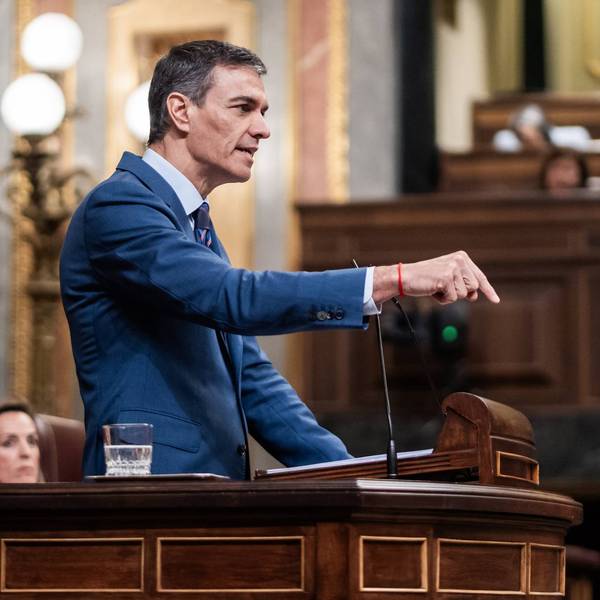
Pedro Sánchez rallied global leaders in Barcelona this weekend at a two-day convention billed as the “progressive CPAC”, crowning himself leader of the international left while grappling with mounting challenges at home.

The Spanish leader warned of an international “reactionary wave” fuelling hate speech, sexism, war and division, without explicitly naming US President Donald Trump.

"It doesn't matter how much they scream, or how many lies they spread," Sánchez said in a speech on Saturday. "The time for the reactionary, ultra-right has come to an end."

Brazilian President Luiz Inácio Lula da Silva echoed the remarks, criticising those “who call themselves patriots but put their sovereignty up for sale and call for sanctions”.

Chants of “No to war” could be heard at the Fira auditorium in Barcelona.

The guest list included South African President Cyril Ramaphosa, Colombian President Gustavo Petro and Mexican President Claudia Sheinbaum. All three have clashed with US President Donald Trump over tariffs and migration, while South Africa has also faced allegations of “anti-white” racism — claims echoed by tech billionaire Elon Musk.

A European delegation included German Vice-Chancellor Lars Klingbeil, UK Foreign Secretary David Lammy, Italy’s opposition leader Elly Schlein, and Belgian politician Paul Magnette. Tax-the-rich economist Gabriel Zucman was also in attendance.

European Council President António Costa cancelled at the last minute, citing personal reasons, and skipped a gathering perhaps considered too political for his role.

Mexico's Sheinbaum participated in an event about protecting democracies but did not join the more political rally on Saturday. A US-Mexico-Canada trade agreement is under review by the Trump administration and delicate talks about terms are ongoing.

Progressive CPAC to counter global MAGA

Sánchez said the Barcelona conference — unofficially billed as a left-wing answer to the conservative gathering CPAC — would serve to unite “progressive forces” under a single banner. A source involved in the preparations told Euronews that Brazil had asked Spain to move the event earlier to spring, with April ultimately chosen as the date.

While none of the leaders mentioned US President Donald Trump by name, references to the American leader surfaced repeatedly, alongside criticism of his policies. From tariffs to the war in Iran, officials called for a progressive response to "a reactionary wave."

Minnesota Governor Tim Walz, who ran alongside Hillary Clinton in her failed presidential bid against Donald Trump, addressed a large crowd on Saturday during the inaugural Global Progressive Mobilisation, describing Trump as “trigger-happy” with no actual plan.

Walz denounced a seemingly authoritative drift under the Trump, suggesting "we need to call that what it is. That's fascism. Or at least it's fascist curious as they would be."

Brazil's president Lula joined in the criticism of the war in Iran, and greeted Spain's decision to deny access to US forces to use Spanish military bases to strike Iran.

"I want to salute friend, Pedro Sánchez, for having the courage (to say no)," Lula added.

A difficult week for Sánchez at home

By often taking an independent stance - from Gaza to the war in Iran - the Spanish prime minister has captured a global audience, leading a bloc of left-wing leaders.

Euronews first reported about plans to organise a convention for socialist parties and the international left in March.

Euronews also reported that Sánchez sought to capitalise on public discontent over the war in Iran and the unpopularity of Trump to boost his international profile.

His stance has earned him applause, but also criticism from the White House.

Trump has repeatedly said he “wants nothing to do with Spain” and has criticised Sánchez as a bad leader who is “not paying” his fair share for NATO protection. He also threatened to impose a full trade blockade, although no measures have been announced.

The convention wraps a difficult week for the Spanish prime minister after his wife, Begoña Gómez, was charged with corruption and is set to face trial following a two-year investigation. The couple have denied any wrongdoing.

Sources close to Sánchez speaking to Euronews describe the case as politically motivated and expect Gómez to be acquitted.


Sánchez, Lula Lead ‘Work for Peace’ and Equality at Gathering of Global Progressive Leaders in Spain


“While others open wounds, we want to mend them and cure them,” said Spanish Prime Minister Pedro Sánchez.


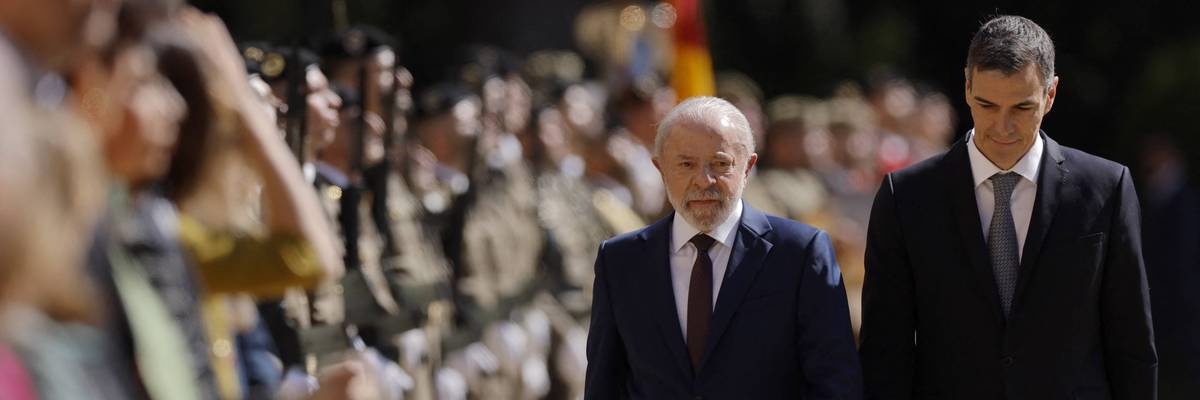
Brazilian President Luiz Inacio Lula da Silva and Spain’s Prime Minister Pedro Sánchez (R) review the troops during a welcoming ceremony upon the Brazilian president’s visit at the Palacio de Pedralbes in Barcelona on April 17, 2026.
(Photo by Oscar Del Pozo/AFP via Getty Images)


Julia Conley
Apr 17, 2026
COMMON DREAMS

Arriving in Spain on Friday for a two-day visit that will center on a gathering of progressive leaders from more than 100 political parties across five continents, Brazilian President Luiz Inácio Lula da Silva emphasized that the summit was not “an anti-Trump meeting.”

But the contrast between US President Donald Trump’s violent foreign and domestic policies and the international meeting, which will focus on wage inequality and electoral strategy for progressives, was unmistakable as Spanish President Pedro Sánchez opened the gathering at a press conference in Barcelona on Friday.


Spanish PM Says Ceasefires ‘Always Good News,’ But Trump Deserves No Praise


“We want to double our efforts to work for peace and for a reinforced multilateral order. While others open wounds, we want to mend them and cure them,” said Sánchez.

Da Silva—who is commonly called Lula—and Sánchez, as well as other leaders who will be attending the weekend event, have spoken out forcefully against Trump’s policies and the rise of the far right in the US, Germany, Italy, and other European countries.

Sánchez has refused to allow US fighter planes to use Spanish military bases for missions in the US-Israeli war on Iran and closed the country’s airspace to American military aircraft—plus doubled down on his condemnation of Trump and Israeli Prime Minister Benjamin Netanyahu’s war even after the US president threatened Spain with a trade embargo.

Lula expressed solidarity with Pope Leo this week after the pontiff denounced the Iran war, and Mexican President Claudia Sheinbaum, who will also attend the meeting, took aim last month at Trump’s claim that her country is the “epicenter of cartel violence”—blaming the US for the flow of illegal weapons into Mexico.

Lula emphasized that the 3,000 attendees of the summit, which will include the IV Meeting in Defense of Democracy as well as a gathering called the Global Progressive Mobilization on Saturday, will “discuss the state of democracy, to see what went wrong and what we have to do to repair it.”

The Brazilian president added that “Brazil and Spain are side by side in the trenches together.”

“We are an example that it is possible to find solutions to problems without giving into the empty promises of extremism,” said Lula. “Democracy must go beyond just voting and bring real benefits to people’s lives.”

Sánchez added that “in a world that doubts and fragments, Spain and Brazil open a new chapter convinced that our countries have something the world needs: the strength to build bridges where others raise walls.”


The Global Progressive Mobilization meeting will include roundtables dedicated to discussing economic inequality and other issues at a time when, as one report showed earlier this month, the richest 0.1% of people on the planet are stashing more than $2.8 trillion in tax havens—more than the wealth owned by the entire bottom 50% of humanity.

The economic hardships of working people have only been exacerbated by the war on Iran, which has sent global energy prices soaring.

US Sen. Chris Murphy (D-Conn.) is the only federal US official planning to attend the gathering, while New York City Mayor Zohran Mamdani—who has swiftly taken steps toward enacting a universal childcare program and announced a plan to tax second homes valued at over $5 million since taking office in January, is scheduled to participate virtually.

Also on Saturday, Lula and Sánchez will host the IV Meeting in Defense of Democracy, a summit first held in 2024 with the aim of combating “extremism, polarization, and misinformation.”

European Council President António Costa, South African President Cyril Ramaphosa, Colombian President Gustavo Petro, and leaders from Albania, Ghana, and Lithuania are among those attending the meeting on democracy.

Lula said the large number of attendees is evidence that progressive governments are winning more influence around the world despite the rise of authoritarian political parties.

“Our flock is growing. We must give hope to the world,” said Lula. “Otherwise, what happened with [Nazi leader Adolf] Hitler is going to happen.”

Economist Gabriel Zucman, who joined Mamdani this week in publishing an op-ed calling for an end to regressive tax systems and highlighting a proposal for a 2% tax on the wealth of those with more than €100 million, or $117 million, expressed hope that the global left is amassing power by building a cooperative international movement.

“The good news is that, from Zohran Mamdani and [Congresswoman] Alexandria Ocasio-Cortez in New York to Pedro Sánchez in Spain, from Lula in Brazil to [Green Party Leader] Zack Polanski in the UK, we may be seeing the early signs of a new cross-border alliance taking shape against global oligarchy,” said Zucman. “And I have no doubt that in this fight—the defining battle of the 21st century—democracy will prevail. See you in Barcelona this weekend to press ahead!”


President Ramaphosa Champions Trade, Democracy And Fair Multilateralism At Spain–South Africa Business Forum


President Cyril Ramaphosa at the Spain–South Africa Business Forum. 
Photo Credit: SA News


April 18, 2026 
By SA News


President Cyril Ramaphosa has called for deeper trade ties, strengthened democratic partnerships and a more equitable multilateral system at the Spain–South Africa Business Forum during his working visit to the Kingdom of Spain.

Addressing delegates at the Business Forum on Friday, President Ramaphosa said the visit underscores the shared commitment between the two nations to build a modern, dynamic and mutually beneficial economic relationship.

“This visit reflects the strength of our longstanding partnership and our shared commitment to building a modern, dynamic and mutually beneficial economic relationship,” he said.

Framing his address around trade expansion, democratic values and the importance of multilateral cooperation, the President highlighted the steady growth in economic ties between the two countries.

“In 2025, total trade between South Africa and Spain reached approximately 2.8 billion Euros. South Africa’s exports to Spain reached 1.3 billion Euros, a 10 percent increase over the previous year.


“This makes Spain our fastest-growing major trading partner within the European Union,” the President said.

He emphasised that the relationship between the two economies is complementary rather than competitive.

“Our countries do not compete. We complement each other, demonstrating how strategic partnerships can strengthen global value chains,” he said.

President Ramaphosa noted that more than 150 Spanish companies operate in South Africa, supporting over 20 000 jobs across sectors including renewable energy, infrastructure, technology and tourism.

He further pointed to Spain’s investment of over 2.1 billion Euros in South Africa’s just energy transition as a strong signal of confidence.

“It is a statement of confidence not merely in our economy, but in our future,” he said.
Diversifying trade and strengthening value chains

While acknowledging the strength of bilateral trade, the President cautioned that the relationship remains concentrated in a narrow range of exports.

“Even though our trade relationship is strong, it remains structurally imbalanced. It is concentrated in a narrow range of products,” the President said.

He said diversification is critical to building resilience, particularly as motor vehicles for the transport of goods account for nearly half of South Africa’s exports to Spain.

President Ramaphosa identified critical minerals, green industrialisation and advanced manufacturing as key areas for future cooperation, especially as the global economy transitions to cleaner energy.

“South Africa holds the world’s largest reserves of platinum group metals. These critical minerals sit at the heart of hydrogen fuel cell technology, clean energy systems and the future of electric mobility,” President Ramaphosa said.

He said Spain’s growing leadership in the hydrogen economy presents an opportunity for alignment.

“South Africa brings the resource base. Spain brings technological capability, investment and market access. Together, this creates the foundation for a new kind of partnership, a collaboration across the value chains of the future,” he said.
Call for fair global rules and inclusive multilateralism

Placing the discussion within a broader global context, the President stressed the importance of fair and inclusive rules in international trade and climate governance.

“As we expand trade, we must ensure that the rules governing global commerce are fair and support development,” President Ramaphosa said.

He cautioned that emerging regulatory measures, such as the European Union’s carbon border policies, should not disadvantage developing economies.


“But new regulatory frameworks, including the EU Carbon Border Adjustment Mechanism, must not become instruments that inadvertently punish developing economies for emissions they did not historically cause,” he said.

While reaffirming South Africa’s commitment to climate action, he called for stronger support mechanisms within global frameworks.

“We are not opposed to the principle of carbon accountability. What we ask is that climate measures be accompanied by the necessary climate finance, technology transfer and transitional arrangements that the Paris Agreement and successive COP commitments have promised,” the President said.
Investment, industrial cooperation and shared prosperity

The President used the platform to position South Africa as an attractive investment destination, highlighting a pipeline of 85 projects valued at over 62 billion Euros across key sectors such as energy, infrastructure, digital connectivity and pharmaceuticals.

“Our message to every Spanish company in this room is that South Africa is open for business,” he said.

He encouraged Spanish firms to partner with South Africa as long-term collaborators in building industries that support inclusive growth.

“We invite you to partner with us not only as investors, but as long-term industrial partners, as co-builders of industries that will serve our people and yours for generations,” President Ramaphosa said.

Concluding his address, President Ramaphosa underscored the broader significance of the partnership between the two nations.

“We have an opportunity to connect European technological strength with African growth. We have an opportunity to build supply chains that are resilient, sustainable and inclusive,” he said.


He added that such cooperation can drive shared prosperity across both regions.

“Most importantly, we have an opportunity to create prosperity that is genuinely shared in Madrid and in Johannesburg, in Seville and in Durban,” the President said.

The President arrived in Spain on Thursday for a Working Visit that runs until 18 April, where he is participating in the In Defence of Democracy Initiative and engaging with political and business leaders to reinforce bilateral relations between South Africa and Spain.

The President is also scheduled to have an audience with King Felipe VI at the Zarzuela Royal Palace today.

On Saturday, he will be in Barcelona where he is scheduled to hold a bilateral meeting with President Pedro Sánchez at the Fira de Barcelona, before delivering remarks at the plenary session on Extremism and Inequality.

The President is accompanied by the Minister of International Relations and Cooperation, Ronald Lamola, and the Minister of Trade, Industry and Competition, Parks Tau.


SA News

Government Communication and Information System (GCIS) established the SA Government News Agency to enable all media locally and abroad to have easy and fast access to fresh government information, news and current affairs at no cost.


Trump turmoil sees Spain’s Sanchez emerge as progressive star


By AFP
April 15, 2026


Spain's Prime Minister Pedro Sanchez speaks during a press conference in Beijing on April 14, 2026 - Copyright AFP Delil SOULEIMAN


Imran Marashli

Spain’s Pedro Sanchez hosts a summit of world progressives this week with greater global clout as turbulent relations with US President Donald Trump bolster his image as a left-wing hero.

Clashes with Trump, virulent criticism of Israel and a championing of immigration have set the Socialist prime minister apart in Europe, which has in the last years tilted to the right.

The latest episode was his staunch opposition to the US-Israeli war on Iran, with Trump threatening trade retaliation after Spain denied the use of its bases.

Sanchez broke with NATO allies last year by refusing to agree to Trump’s demand that alliance members hike defence spending to five percent of GDP.

He is also the highest-profile Western leader to call Israel’s devastating two-year war against Hamas in Gaza a “genocide”.

For Ignacio Molina, a senior fellow at Madrid’s Elcano Royal Institute, Sanchez has earned Spain recognition for a “coherent” stance in the Global South, particularly in the Arab world and Latin America.

“It works out well for the government, because it has gained a lot of leadership, influence and presence in many countries,” Molina told AFP.

Of the countries adopting a similar stance, Spain is the “most relevant” because others are not in NATO, such as Ireland, or outside the European Union, for example Norway, he added, citing nations who also recognised a Palestinian state in 2024.

“Spain has achieved a weight among the European Union’s big countries that it did not have before,” agreed Joan Botella, a political science professor at the Autonomous University of Barcelona.


– ‘Trump’s nemesis’ –


Sanchez has gained attention in international media, penning articles for The New York Times and Le Monde diplomatique.

“Pedro Sanchez has become the standard-bearer for Western political opposition to the US president,” The Wall Street Journal wrote in March, while the Financial Times called the Socialist “Trump’s nemesis in Europe”.

Bathing in the new-found limelight, the current president of the Socialist International will host leading leftist figures at the two-day Global Progressive Mobilisation beginning in Barcelona on Friday.

Brazil’s Luiz Inacio Lula da Silva, South African President Cyril Ramaphosa and Mexico’s Claudia Sheinbaum are due to attend alongside 400 mayors and more than 100 parties.

Sanchez and Lula will deliver the keynote address on Saturday at the gathering, which organisers say aims to rally progressives in times of turmoil marked by the rise of the far right.

Progressives must “unite, tell citizens that we belong to something that goes beyond domestic politics, our borders — and that is having a positive, humanist outlook,” Sanchez said on Tuesday during his fourth visit to China in as many years.

The rise of Sanchez’s stock abroad contrasts with his polarising image at home.

He has never commanded a parliamentary majority since taking office in 2018 and is under pressure from corruption investigations into relatives and former close political allies.


– ‘Absorb left-wing vote’ –


Botella said Sanchez was “playing the foreign policy card hard, because it’s an area he’s comfortable in, and in which a majority of Spanish public opinion is favourable to him”.

More than 68 percent of Spaniards opposed the war on Iran, including voters of the conservative main opposition Popular Party (PP), according to a March poll published in El Pais newspaper.

“Spaniards have a certain inferiority complex when they go out into the wider world. In that sense, the profile that Sanchez’s figure has acquired satisfies many people beyond his electoral base,” Botella told AFP.

On the other hand, the PP says he has used foreign policy exclusively for domestic purposes, to rally fractious left-wing forces and distract attention from the negative headlines.

Other Western leaders have preferred to handle Trump with tact on trade, defence and foreign policy.

Sanchez “is trying to use this image of a progressive leader, opposed to Trump” to “strengthen his political position” and “absorb the left-wing vote”, said Juan Tovar Ruiz, a professor of international relations at the University of Burgos.

“That has consequences at European level. Right now, I think Spain is in a clearly minority position,” he warned.

For Molina, Sanchez’s stance risked alienating some traditional allies governed by the right, such as Germany and Italy, but “in the end, what is gained is rather more than what may be lost.”