LABOUR HISTORY
The Ludlow Massacre Where 25 Miners and Family Members Were Killed During a Bitter Strike for Fair Wages and Conditions
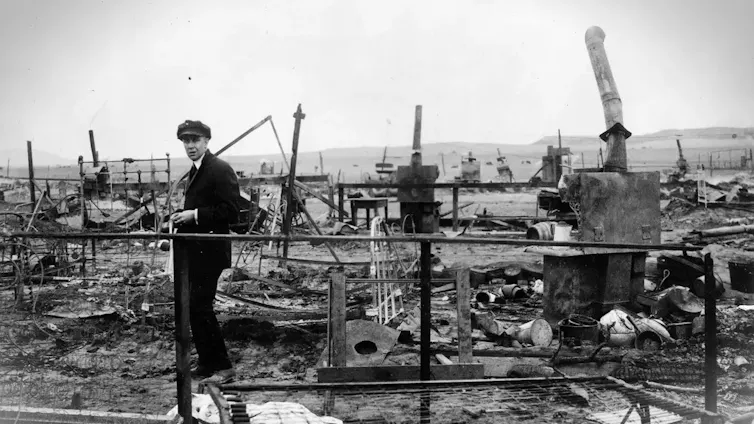
Denver Public Library
On a spring morning in 1914, miners in Ludlow, Colorado, were celebrating Greek Easter when the Colorado National Guard and a private security agency opened fire on their camp with a machine-gun-equipped armored car called the Death Special.
The miners waged a pitched battle with the National Guard for 10 days before President Woodrow Wilson ordered federal soldiers to intervene. An estimated 69 to 199 people were killed. It was the end of one of the most bitter and violent miner strikes in U.S. labor history, which had begun in September 1913. The strike and massacre prompted Congress to take a hard look at labor reform. But significant changes in labor relations and unionization didn’t come until the mid-1930s.
Some state labor laws were on the books, but in 1914 the U.S. House Committee on Mines and Mining reported: “Colorado has good mining laws and such that ought to afford protection to the miners as to safety in the mine if they were enforced, yet in this State the percentage of fatalities is larger than any other, showing there is undoubtedly something wrong in reference to the management of its coal mines.”
Once the initial shock of the violence wore off, the Ludlow strike received little public attention outside of the immediate families affected and some Colorado residents until late in the 20th century. In “Where Are the Workers,” Mary Anne Trasciatti, a professor at Hofstra University, and I edited a collection of essays written by labor historians and archivists that explore nationwide efforts to bring the history of labor and working people into mainstream narratives of U.S. history.
The Ludlow Massacre is one of the most dramatic and deadly of those stories. It rivals the West Virginia Mine Wars of the 1920s.
The Ludlow Massacre
In September 1913, roughly 10,000 mostly immigrant miners who worked for the Colorado Fuel & Iron Co. went on strike. The miners were represented by the United Mine Workers of America, which submitted a list of demands when the strike began, including implementing the eight-hour workday, being compensated for the time miners spent in the shafts, and the right to select their own housing and doctors.
Since national strikes were called in the 1880s demanding the eight-hour day, this had been a goal for workers throughout the U.S. In Colorado, voters had endorsed such an amendment to the state constitution in 1902, but it was not uniformly enforced.
Coal mining in the early 1900s was labor intensive and dangerous. Death rates were high. Workers had no say in how the mines operated. From 1884 to 1912, more than 1,708 men died in the state’s coal mines, a rate twice the national average. In 1910, explosions at two Colorado Fuel & Iron mines killed 131 people. In 1912, 125 workers lost their lives in mine accidents across Colorado. That year, the annual death rate in Colorado’s mines was 7.06 per 1,000 employees, compared to a national rate of 3.15. Every trip down a shaft was fraught, with workers paid only for the weight of the coal they mined, not for their travel time.
John D. Rockefeller, the nation’s wealthiest man at the time of the strike, was the main owner of the fuel and iron company. With about 10,000 workers and nearly 70,000 acres of land under control, Colorado Fuel and Iron was one of the most powerful mining companies of that era.
Coal companies often owned entire towns, including miners’ homes, which was the case in Ludlow. Worker protests often led to widespread evictions. As a result of the Ludlow strike, 1,200 coal miners and their families were evicted and took refuge in tent colonies around the mines during the winter of 1913-14.
Colorado Fuel & Iron hired and armed 300 members of a private security agency known as Baldwin-Felts when the strike began. The agency was founded in the early 1890s by William Gibbony Baldwin and employed by mining companies in West Virginia and Colorado to repress strikes. Their job was to keep order and – if possible – break the walkout and reopen the mines.
Members of the United Mine Workers of America armed themselves as conflicts with the mining company’s private security force intensified.
Eventually, the Colorado governor, Elias M. Ammons, ordered the Colorado National Guard to join the fray on the corporation’s side, with the Rockefellers paying their wages. The Guard arrested hundreds of strikers.
Then, on April 20, 1914, the National Guard and the private company opened fire on the tent colonies where the miners lived. After several hours of gunfire, with miners defending their camp, 25 people were dead, including two women and eleven children trapped when the camp was intentionally set ablaze.

Months earlier, miners had dug foxholes under tents so women and children could avoid bullets randomly fired through the camps. When the armored vehicle opened fire, everyone in the camps ducked into the holes. Later, women and children were found by miners huddled together at the bottoms of their burned-out tents.
Many miners’ family members were saved when the engineer on a passing train witnessed what was happening and stopped on the track to shield them from the gunfire.
This violence led to 10 more days of conflict before President Wilson finally ordered federal troops to disarm both sides.
Changes to labor law
In Congress, the House Committee on Mines and Mining conducted an investigation into the events and released a report in 1915. John D. Rockefeller Jr. was summoned before the committee, where he was questioned for several hours on May 20, 1914. There, he admitted that he had not visited the site since the incidents that led to the deaths of workers and their families.
According to a New York Times report, when asked whether he knew that thousands of his employees had been evicted from their homes and were living in tent colonies, and that the striking workers and their families were suffering without work or food, Rockefeller replied that he could not say, but that company officials could provide the facts. None were forthcoming.
A federal Commission on Industrial Relations also held hearings, determined to quell the upsurge in early 20th-century labor violence.
In 1912, the immigrant- and women-led Bread and Roses strike in Lawrence, Massachusetts, also led to a congressional investigation. In its report on the 1914 miners’ strike, the commission described the strike by workers as “against arbitrary power.” It summarized that miners “passionately felt” that they were denied “a voice in fixing working conditions in the mines” and that political democracy had been “repudiated by the owners.”
The commission determined that the strike raised a fundamental question about whether workers had a right to a voice at work. This question would animate labor struggles into the 1930s.
In 1935, Congress passed and President Franklin Roosevelt signed into law the National Labor Relations Act, which provided federal guidelines for labor union formation and stated that workers had a federal right to bargain over wages, hours and conditions of employment, the very things Colorado coal miners sought when they went on strike in 1913.
Commemorating the Ludlow strike and massacre
In 1915, officers of the United Mine Workers of America purchased 40 acres of land north of the Ludlow, Colorado, train depot, on the site where the tent colony had sheltered coal miners and their families during the 1913-14 strike.
Three years later, United Mine Workers officials dedicated a granite monument at the site where the women and children were killed. Labor historian James Green noted that of all the violence against workers at the time, none shocked the nation or troubled its collective conscience more than the Ludlow massacre because of the deaths of children. However, even incidents like the Ludlow Massacre did not become a significant part of the public discourse. This has changed some in the recent past.
Today, the tent colony site is a National Historic Landmark.
The labor movement in the United States remains a bulwark of democracy, and workers have often been a driving force for social and economic equality in their communities. Yet its stories are not widely known, even one so dramatic as this battle in the Colorado coalfields.
The recognition of the Ludlow site as a National Historic Landmark and the recent release of a Library of Congress research guide propel the history of labor and working people into the mainstream. Such place-based labor history promotes our understanding of how and why things we sometimes take for granted – such as the eight-hour workday, paid holidays or workplace safety laws – came about only because people were willing to risk their lives fighting for these rights.
This article is republished from The Conversation under a Creative Commons license. Read the original article.
LA Teachers Strike: SEIU Rising
On the eve of the 2023 Service Employees International Union Local 99 strike, Los Angeles Times Columnist Robin Abcarian wrote “I don’t blame the union one bit” and condemned Los Angeles Unified School District Superintendent Alberto M. Carvalho for “just one more slap in the face” after Carvalho “responded to the (strike) vote by comparing the union’s action to a circus.” In reference to SEIU, Carvalho had tweeted:
“Circus = a predictable performance with a known outcome, desiring of nothing more than an applause, a coin, and a promise of a next show.”
For SEIU, LAUSD’s poverty-level wages should be OK
Carvalho was hardly alone in expressing contempt for SEIU’s members, LAUSD’s lowest-paid education workers.
Criticizing SEIU’s strike, John Kobylt and Ken Chiampou, hosts of the popular, long-running John and Ken Show then on Los Angeles’ KFI AM 640, explained, “These [SEIU] jobs aren’t meant for you to have a home and a family…you can’t have families if you make so little money—it’s not responsible, it’s not practical.”
John and Ken were openly stating what many American conservatives believe but usually are too prudent to say–having kids and having a home are privileges to be reserved only for the social classes who can “afford” them.
‘My pay hasn’t really raised much since I started’
At the time of the 2023 strike, my colleague Eric Hernandez, a school custodian, was featured in the Los Angeles Times piece Three-day LAUSD strike means three days without pay. How are low-paid workers coping?:
“At one point in his life, Eric Hernandez, who has worked as a school custodian for 17 years, said he was forced to choose between sleep or increased stability.
“He worked two jobs: handling buildings, grounds and custodial duties at James Monroe High School in North Hills, while taking evening shifts at his neighborhood Target.
“But the lack of sleep ‘burned him out,’ forcing him to quit Target and return to his single salary — and the anxiety it induced.”
Hernandez notes:
“It’s unbelievable, but my pay hasn’t really raised much since I started. Guys who start tomorrow are only making a little less than me.”
Carvalho Surprised
When on March 21, 2023 SEIU–which had been working without a contract since 2020–finally struck, Carvalho seemed surprised that United Teachers Los Angeles honored their picket lines. Given his experience in the anti-union South managing Miami-Dade County Public Schools and contending with a much weaker teacher’s union–I know, I was once a member of it–Carvalho probably expected that teachers would cross the line and work.
With teachers and administrators in place and personnel brought in from Beaudry (LAUSD’s central offices) on an emergency basis, Carvalho figured LAUSD could roll right over SEIU, as school districts often do in similar situations.
Carvalho’s view wasn’t without foundation. At the time, the anti-teachers union LA School Report unwittingly paid UTLA a complement, writing:
“State law allows one bargaining unit to go on a sympathy strike with another union, but Bradley Marianno, an assistant education professor at the University of Nevada, Las Vegas, said it’s ‘highly unusual,’ for a teachers union to join a walkout with non-teaching employees.
“‘They may issue statements of support, but to join in [a] strike is a different, and relatively rare, matter…”
Labor Solidarity—an American tradition…
While our solidarity strike may have surprised LAUSD, what UTLA did was very much in line with the traditions of American labor. American labor unions were built through labor solidarity, and in recent decades unions have been undermined by the lack of it.
The 1947 Taft–Hartley Act, arguably America’s most important labor law, specifically targets sympathy strikes. President Truman denounced the bill and vetoed it, but Congress, concerned about the massive post-war US strike wave, overrode his veto.
The 1959 Landrum-Griffin Act further tightened restrictions on solidarity (aka “sympathy” or “secondary”) strikes.
UTLA’s solidarity strike served as a harbinger of the future and as an example for other unions.
Building support for the 2023 SEIU-UTLA strike
In early 2023, some UTLA members noted that SEIU did not honor our picket lines in 2019, and questioned why we should honor theirs. UTLA had to build support for honoring SEIU’s picket lines but there were good reasons to do so, both moral and practical:
+The eight unions representing LAUSD workers had long been hamstrung by the fact that our contract negotiations often did not line up, so LAUSD played us off against one another. This time our negotiations more or less lined up–if we passed up this opportunity, when would we be able to harness the joint power of our two organizations? In five or 10 years? This was a unique opportunity, and UTLA and SEIU leaders were wise to take advantage of it.
+UTLA is a union of educated professionals–we have higher social and economic status than SEIU, which is disproportionately low-income, minority, and immigrant. We are stronger than they are, and more fortunate. If one group must go the extra mile to achieve this unity–a unity which benefits both unions–it was appropriate that it was us.
+If SEIU had honored our picket line in 2019, my understanding is that this would have been illegal. We were able to legally honor their picket line in 2023 because it was an unfair labor practice/“Unfair Practice Charge” strike. I believe in honoring picket lines under any circumstances, but asking a union to carry out an illegal strike is not a small thing.
+We were both up against a common adversary. What sense would it have made for UTLA to watch 30,000 SEIU workers battle Carvalho and stand on the sidelines or, worse, actively undermine them by crossing their picket lines, when we too were in negotiations?
Breaking News: Florida Man Causes…
According to observers, on March 22, 2023, when tens of thousands of striking UTLA and SEIU members surrounded LAUSD’s downtown headquarters on Beaudry Avenue and Carvalho’s driver struggled to get him through the massive crowd, he seemed taken aback by what he had set off. One of the best picket signs at that rally was a “Florida Man” picket sign made by my Monroe Social Studies colleague Stephanie Memije–“Breaking News: Florida Man Causes LAUSD Strike”.
But Carvalho is skilled…
At the March 24, 2023 press conference with Mayor Karen Bass and SEIU Local 99 Executive Director Max Arias in which they announced the tentative agreement, Carvalho began by speaking so convincingly about the mistreatment of SEIU workers that you almost forgot he was the superintendent–he sounded more like a SEIU organizer.
He followed by subtly and skillfully working in some key talking points:
+Let’s forget how in this strike I got my head handed to me–let’s focus on the future
+Don’t blame me, it’s my predecessors’ fault.
+Let’s forget how I had to be dragged kicking and screaming into making this deal—I’m leading the way with “transformative” changes
In announcing the healthcare aspect of the agreement, Carvalho sounded like Bernie Sanders as he emphasized “healthcare as a human right.”
Carvalho also paid UTLA and SEIU union leadership a backhanded compliment by noting that “This agreement is going to make a lot of superintendents very nervous…”
Did 2026 LAUSD leadership shakeup help lead to a settlement?
In March, after a year of negotiations, UTLA Valley East Area Chair Scott Mandel said that in 41 years, he had “never seen the district so intransigent in contract negotiations.”
Carvalho felt that he had erred in his handling of the 2023 strike, had been forced to give away too much, and wanted to claw back some of it in the 2025-2026 negotiations. But the dominant figure throughout the 2025-2026 battle was LAUSD Chief of Employee Support & Labor Relations Kristen Murphy. UTLA bargaining team members described Dr. Murphy’s demeanor as disrespectful and imperious, and many felt that she, more than Carvalho, was the real hardliner in LAUSD.
By the time the SEIU/UTLA v LAUSD conflict came to a head between April 8 and April 14, both Carvalho’s and Murphy’s influence had been weakened.
Carvalho was put on administrative leave by LAUSD on February 27 after his home and office were raided by federal agents as part of a Department of Justice investigation into the failed artificial intelligence company, AllHere, that the district contracted with for a chatbot called Ed.
At the end of March, LAUSD/Murphy told UTLA they were bringing important new proposals that could settle the contract and avert a strike. Educators on the 150-member UTLA bargaining team undid their Spring Break plans and returned but, in what they must at first have thought was an insulting April Fool’s Day prank, LAUSD’s offer was only a tiny bit better than before.
LAUSD apologized to UTLA the following week, the chastised Murphy was much more respectful in subsequent negotiations, and LAUSD accepted that UTLA, a disciplined and well-organized union, was not bluffing.
LAUSD’s mulish hardline stance–“stuck on stupid”, as one UTLA leader had put it–had brought things to this point. Acting superintendent Andres Chait had less connection to LAUSD’s failed strategy and thus something of a freer hand. Two days before the unions were to strike, Chait helped make a deal with UTLA and Associated Administrators of Los Angeles, then, with only hours remaining until we struck, with SEIU.
