Friday, November 21, 2025

UBN: Ukraine’s war of drones reaches a new level
UBN: Ukraine’s war of drones reaches a new level
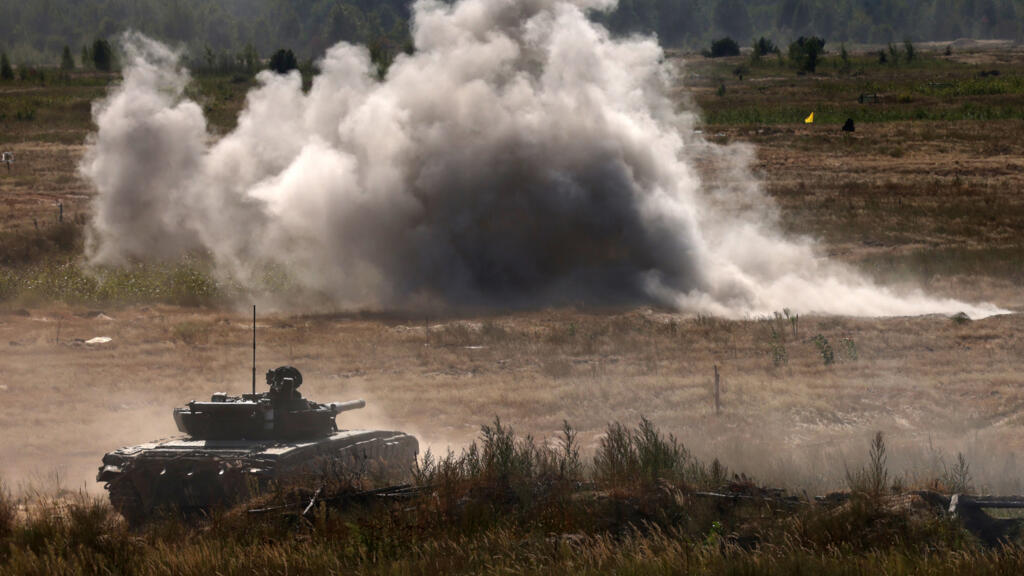
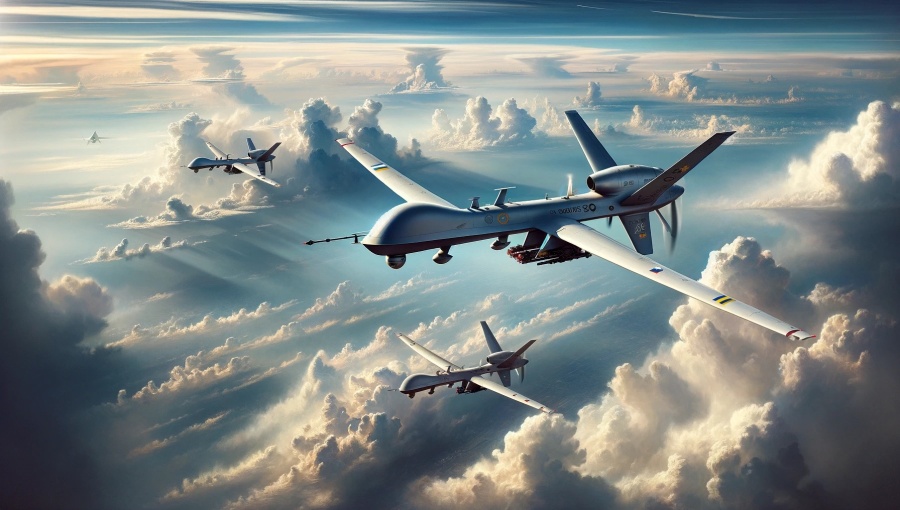
Drones are increasingly dominating the war in Ukraine. Trenches are disappearing and Russia has been forced to reduce its assault groups to a handful of men, as larger groups are easily spotted and destroyed. / bne IntelliNews
By UBN Editorial Team November 19, 2025

The war of drones has reached a level that was impossible to predict just a short time ago. The Western allies are completely unaware of the current military landscape as they talk about defending their borders from a new model of warfare and an enemy that has changed the rules of war.

In the last two years of the full-scale Russian invasion everything has changed completely, and trenches have begun to disappear, said the 110th Separate Mechanized Brigade in a recent interview. In other words, drones have erased the front line and created a wide death zone.

Ukraine has now moved to a drone-on-drone war. UAVs can now set up ambushes, intercept enemy logistics, and disrupt supplies. They also make it hard to hold positions: If you are detected, all of the weapons in the area will immediately swarm to destroy you, and nothing will save you – including armored vehicles, trenches, or any other means of defence.

Drones also push artillery further from the front line, making it impossible to use armored vehicles to supply troops, which significantly widens the death zone. Artillery and armored vehicles are becoming less effective and, at times, are useless.

In response, the Russians have started to reduce the size of their assault groups because Ukrainian drones can quickly detect and destroy large clusters. They break units into smaller assault groups, and most of the time, two Russian soldiers lead the way, but only one survives. Smaller groups are harder to spot, especially in fog or rain.

Additionally, Russian drones complicate evacuation, rotation, and logistics during deadly operations. Most of our soldier deaths in the last year or two have occurred during rotations. As a result, commanders are forced to keep soldiers at the front for weeks without rotation.

This is a new war that the rest of the world is unfamiliar with and has no idea how to fight. The West is reluctant to admit that Russia has learned how to wage war with Nato in Ukraine, and the Alliance has no clue how to defend itself or what to do with all of its old, expensive, useless weapons.

This comment first appeared in a emailed digest from Ukraine Business News (UBN) and on its website here. UBN is a bne IntelliNews media partner.

WAR IS ECOCIDE

Ukraine seeks $43bn in climate compensation from Russia over war

Ukraine is demanding $43 billion from Russia for environmental damage caused by the war, saying the invasion has pumped huge extra emissions into the atmosphere and destroyed land, water and forests. It is the first time a country has sought compensation for an increase in climate-warming emissions caused by a war.


Issued on: 19/11/2025 - RFI

Ukraine says the environmental toll of the Russian invasion must be accounted for. 
AFP - ANATOLII STEPANOV


Kyiv se out its plan on Tuesday at the UN climate summit, Cop30, in Brazil. Ukraine plans to file the claim through a new compensation process being set up within the Council of Europe.

The main source of the extra emissions is the fighting itself. Fuel burned by tanks and aircraft and the steel and cement produced for the front line are major contributors.

There are also fires that firefighters cannot go and extinguish in combat zones and civilian planes forced to reroute around Ukrainian territory. The war has destroyed trees through these fires, which further adds to the climate impact.

Nearly one million hectares burn as war ravages nature across Ukraine

Climate damage


In total, experts from the Initiative for GHG Accounting of War (IGGAW), an association funded by Ukraine and European governments, say the war has produced the equivalent of 236.8 million tonnes of carbon dioxide in the atmosphere.

According to Lennard de Klerk, a Dutch carbon-accounting expert who works with the group, that figure is nearly equal to the annual emissions of Ireland, Belgium and Austria combined.

Pavlo Kartashov, Ukraine’s deputy minister for economy, environment and agriculture, told a side event at Cop30 that Ukrainians are facing many pressures at once.

“Every day people are dying, we have energy problems... but one day Russia will have to be held responsible for all the damage it has caused... including damage to the environment, water, animals and soil,” Kartashov said.

"The vast amounts of fuel burned, forests scorched, buildings destroyed, concrete and steel used, all these things are essentially ‘conflict carbon’ and have a considerable climate cost.

"We in Ukraine face brutality directly, but the climate shockwaves of this aggression will be felt well beyond our borders and into the future."

A member of the Russian delegation at Cop30 declined to comment on Ukraine’s announcement.

Wartime emissions

IGGAW produced the emissions estimate now used by Kyiv.

De Klerk told Reuters that he helped Ukraine calculate the damage figure using a 2022 study in the journal Nature that puts the social cost of carbon at about $185 a tonne.

The social cost of carbon is an estimate of damages to society from CO2 emissions. He said this calculation fed into Ukraine’s overall claim.

Ukraine is preparing to submit its climate-related demand through the new Council of Europe process, which has already received some 70,000 claims from Ukrainian individuals for wartime damages.

All of the claims, including any filed by other legal entities such as companies, will be decided by a claims commission.

It remains unclear where the compensation will come from. De Klerk suggested that the billions of dollars in frozen Russian assets could be used to cover successful claims.
COP30

COP30 climate talks head for final showdown as draft deal drops fossil fuel transition


The COP30 climate summit was headed for a showdown on Friday after host Brazil released a draft proposal that made no mention of efforts to phase out fossil fuels. A group of around 30 countries earlier warned they would not accept a deal that failed to include a plan to transition away from oil, gas and coal.


Issued on: 21/11/2025 
By: FRANCE 24

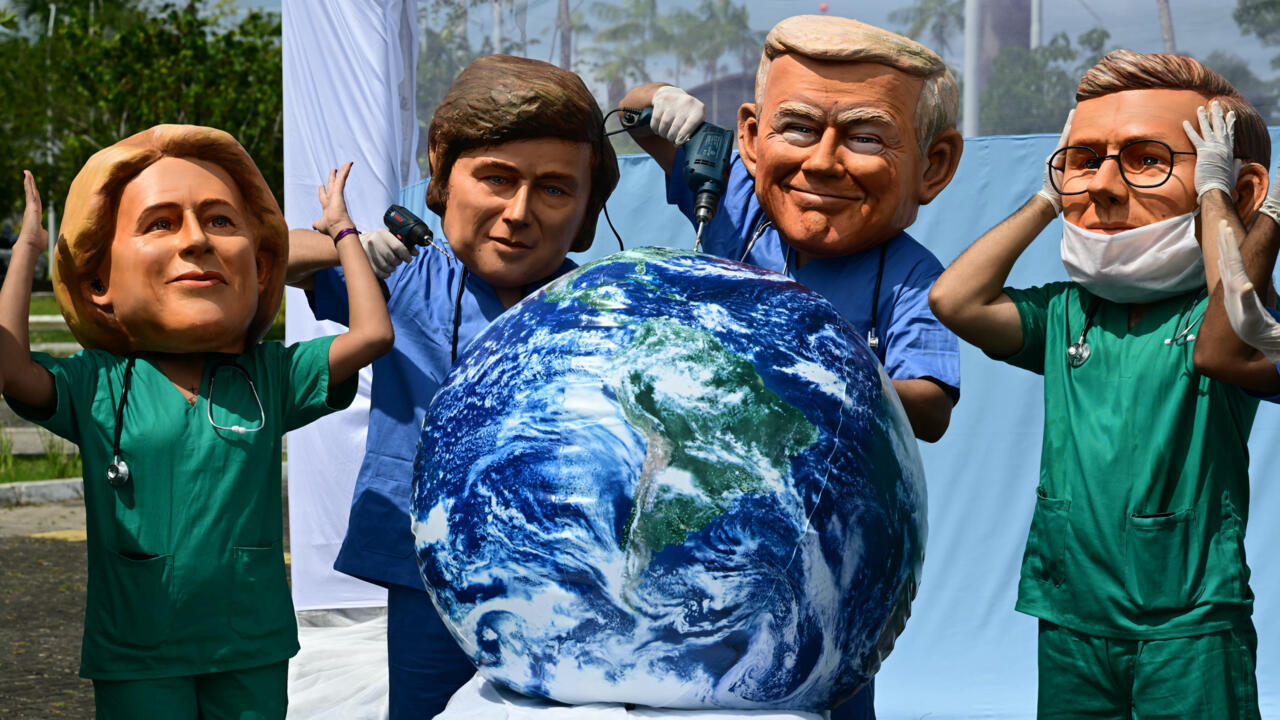
Oxfam activists wear masks representing EU Commission chief Ursula Von der Leyen, Argentina's President Javier Milei, US President Donald Trump and Britain's Keir Starmer at a protest in Belem, Brazil, on November 20, 2025. © Pablo Porciuncula, AFP
01:12


Negotiators were divided Friday on the last day of fire-delayed UN climate talks, as Europe rejected COP30 host Brazil's latest draft agreement which lacks a roadmap to phase out fossil fuels.

At stake is nothing less than proving that international cooperation can still function in a fractured world – and delivering a text that nudges the planet back toward the critical 1.5C long-term warming target, despite the absence of President Donald Trump's United States.

But after two weeks of negotiations in the Amazonian city of Belem, the draft text unveiled by Brazil on Friday had no mention of "fossil fuels" or the word "roadmap" that President Luiz Inacio Lula da Silva had himself suggested weeks ago.

"This is in no way close to the ambition we need on mitigation. We are disappointed with the text currently on the table," European Union climate commissioner Wopke Hoekstra said in a statement to AFP.


France's ecological transition minister, Monique Barbut, decried in a text message to AFP "an incomprehensible omission at a time of climate emergency".

Around 30 countries had written to the Brazilian presidency on Thursday warning they could not accept a final deal at COP30 that did not include a plan for moving away from fossil fuels.


Negotiations were delayed when a fire torched a hole through the fabric ceiling of the COP30 venue. © Jacqueline, Lisboa, AFP


The letter, drafted by Colombia, stated: "We cannot support an outcome that does not include a roadmap for implementing a just, orderly, and equitable transition away from fossil fuels."

China, India, Saudi Arabia, Nigeria and Russia have rejected the fossil fuel roadmap, according to a negotiator who wished to remain anonymous.

Consensus is needed among the nearly 200 nations at the UN climate talks to land an agreement.

NGOs also rejected the drat deal, with Greenpeace urging nations to send it back to the Brazilian chair for revisions.

"Hopes were raised by initial proposals for roadmaps both to end deforestation and fossil fuels," said Greenpeace climate politics expert Tracy Carty.

"But these roadmaps have disappeared and we're again lost without a map to 1.5C and fumbling our way in the dark while time is running out."
Money fight

Divisions remain not just over fossil fuels but trade measures and finance for poorer nations to adapt to climate change and move to a low-carbon future.

"The lack of finance from richer nations ... remains an ongoing obstacle in these final days to securing bold and fair outcomes," Rachel Cleetus, senior policy director at the Union of Concerned Scientists, told AFP.

The EU is also fighting resistance led by China and India to its "carbon tax" on imports such as steel, aluminum, cement and fertilisers – measures Britain and Canada are also preparing to adopt.


© France 24
01:19


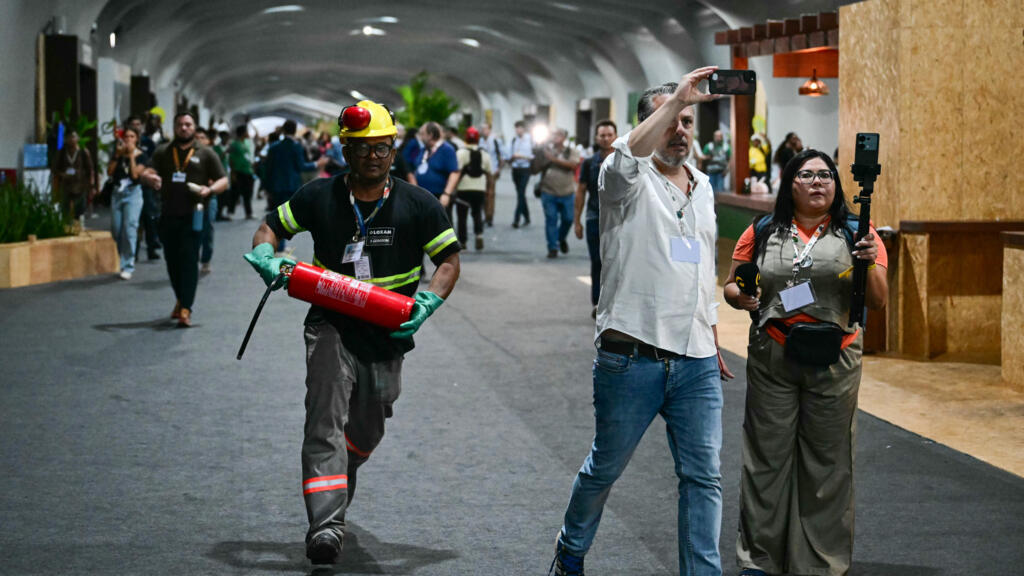
Negotiations toward a final outcome were delayed on Thursday when a fire torched a hole through the fabric ceiling of the COP30 venue, forcing a panicked evacuation.

Nineteen people were treated for smoke inhalation and two for anxiety attacks, officials said. The venue reopened later on Thursday night.

The conference is supposed to end on Friday but UN climate summits often run into overtime.
Protests

Lula has branded COP30 the "COP of truth," investing significant political capital in its success and defending his choice to hold it in Belem, despite concerns over inadequate infrastructure that have plagued the hot, humid city on the edge of the world's largest rainforest.

The fire was the third major incident since the summit began at the COP30 compound.

Last week, Indigenous protesters stormed the venue and blockaded the entrance days later in a peaceful demonstration.

The cause of the blaze was being investigated but may have been the result of a short circuit or other electrical malfunction, said Brazilian Tourism Minister Celso Sabino.

(FRANCE 24 with AFP)

Fossil fuel showdown looms on UN climate summit's final day

Belém (Brazil) (AFP) – A breach, a blockade, and a blaze: tumultuous UN climate talks head into their final day Friday in the Brazilian Amazon, with countries still sharply split over fossil fuels.


Issued on: 21/11/2025 - RFI

Delegates are set to resume their negotiations after a dramatic fire on Thursday afternoon torched a hole through the fabric ceiling of the Cop30 venue, forcing a panicked evacuation. © Pablo PORCIUNCULA / AFP

At stake at Cop30 is nothing less than proving that international cooperation can still function in a fractured world – and delivering a text that nudges the planet back toward the critical 1.5C long-term warming target, despite the absence of President Donald Trump's United States.

Brazilian President Luiz Inacio Lula da Silva has branded it the "Cop of truth," investing significant political capital in its success and defending his choice to hold it in Belem, despite concerns over inadequate infrastructure that have plagued the hot, humid city on the edge of the world's largest rainforest.

Delegates are set to resume their negotiations after a dramatic fire on Thursday torched a hole through the fabric ceiling of the Cop30 venue, forcing a panicked evacuation.

It was the third major incident since the summit began at the Cop30 compound, located on the site of an old airport and made up of enormous, air-conditioned tents alongside permanent structures.

Last week, Indigenous protesters stormed the venue and blockaded the entrance days later in a peaceful demonstration.

Thursday's fire broke out around 2pm local time, quickly filling the cavernous halls with acrid smoke.

The blaze was brought under control in six minutes, organizers said. Nineteen people were treated for smoke inhalation and two for anxiety attacks, officials said. The venue reopened later on Thursday night.

Infrastructure woes


The symbolism of a fire breaking out at the UN's annual summit tasked with reining in global warming was hard to miss.

In another twist, Brazil had chosen as its Cop30 mascot a folklore guardian of the forest with flame-like hair, known as Curupira.

The cause of the blaze was being investigated but may have been the result of a short circuit or other electrical malfunction, said Brazilian Tourism Minister Celso Sabino.

Infrastructure problems have beset the summit from the start, from air-conditioning woes to leaking ceilings, and numerous participants have reported issues with electrical wiring.

At the negotiating table, countries are tasked with finding what UN chief Antonio Guterres has called an "ambitious compromise" on divisive issues.

These include phasing out fossil fuels – the main driver of human-caused warming and its escalating impacts, from record heat and severe storms to rising seas, crop failures and economic losses.

Fossil fuel fight


Lula has championed agreeing to a "roadmap" that would give countries specific targets – but in a dramatic turn, even the words "fossil fuels" were cut from the latest draft proposal put forward by the summit's Brazilian leadership and seen by AFP.

That text was slammed by more than 30 countries that co-signed a letter drafted by Colombia stating: "We cannot support an outcome that does not include a roadmap for implementing a just, orderly, and equitable transition away from fossil fuels."

ChinaIndiaSaudi ArabiaNigeria and Russia have rejected the fossil fuel roadmap, according to a negotiator who wished to remain anonymous.

Negotiators are also at odds over pressure from the developing world for developed countries to provide more financing to help vulnerable nations adapt to climate change and deploy renewable energy.

"The lack of finance from richer nations – a critical part of the Paris Agreement – remains an ongoing obstacle in these final days to securing bold and fair outcomes," Rachel Cleetus of the Union of Concerned Scientists told AFP.

And for the first time at a Cop, trade has come to the fore.

The European Union is fighting resistance led by China and India to its "carbon tax" on imports such as steel, aluminum, cement and fertilizers – measures Britain and Canada are also preparing to adopt.

Although Cop30 is set to conclude Friday, climate summits often run into overtime – and Thursday's lost hours may make that likelier.

COP30 Reaches Final Week As Countries Seek Consensus


COP30 Summit in Brazil. Photo 
Credit: BRUNO PERES/AGÊNCIA BRASIL


November 18, 2025 
By ABr
By Luciano Nascimento


COP30 is entering its final week with the arrival of high-level representatives and growing expectations for fast-paced climate negotiations. Around 160 ministers and other officials from various countries are meeting in a high-level plenary session this Monday (Nov. 17) to further talks on how to tackle climate change.

The gathering aims to find consensus on sensitive issues such as financing for climate action, adaptation parameters, and ways to implement and monitor targets for reducing greenhouse gas emissions.

The session was opened by Brazil’s vice-President and Minister of Development, Industry, Trade, and Services Geraldo Alckmin. This week’s discussions are taking place at the political level with high-level representatives – like environment ministers – who can outline the agreements to be reached at the conference.

“The time for promises is over. Every extra fraction of a degree in global warming means lives at risk, more inequality, and more losses for those who contributed least to the problem,” Alckmin said at the opening of the plenary session.

“This COP should mark the beginning of a decade of acceleration and delivery – the moment when discourse turns into concrete action, when we stop debating goals and all of us start to fulfill them,” he added.

Negotiators report they have made significant progress on several points of the 145-item agenda already agreed upon.

“As negotiations move from the technical to the political level, discussions intensify on adaptation, just transition, climate finance, and other issues that require consensus by the end of the week,” the COP organization’s bulletin reads.

This second and final week begins with a unifying focus – bringing nature to the center of climate action. This means strengthening commitments to protect forests, guaranteeing the rights of indigenous peoples and local communities, and expanding nature-based solutions as essential pillars of global progress.

The agenda for discussions includes expectations for the definition of climate adaptation indicators. A final list of up to 100 indicators – covering national, thematic, and means of implementation dimensions, such as financing, capacity building, and technology – is on the negotiating table.

Also to be debated are the rights and leadership of indigenous peoples and Afro-descendants and how indigenous governance can strengthen emerging climate finance mechanisms.

Furthermore, two topics that were not on the agenda for discussion because they had not reached consensus have managed to move forward – the development of roadmaps for the phasing out of fossil fuels and the one for zero deforestation.
Financing

The definition of climate finance sources remains one of the critical issues. Several debates are planned in an attempt to reach consensus on financing sources.

One of the critical issues is the implementation of Article 9.1 of the 2015 Paris Agreement. It states that developed countries must provide financial resources to assist developing countries in reducing greenhouse gas emissions and adapting to climate change.

At COP29 in Baku, climate finance was set at USD 300 billion per year, which is considered far too insufficient. The presidents of COP30 and COP29 went so far as to draw up a proposal to mobilize resources of up to USD 1.3 trillion per year, but it is not certain that commitments on this scale will move forward at this edition of the conference. Developing countries consider this amount necessary to implement an agenda to mitigate the climate crisis.


Agência Brasil (ABr) is the national public news agency, run by the Brazilian government. It is a part of the public media corporation Empresa Brasil de Comunicação (EBC), created in 2007 to unite two government media enterprises Radiobrás and TVE (Televisão Educativa).


No, Amazon rainforest trees were not cut down for COP30

Issued on: 17/11/2025 - FRANCE24
04:41 min


As the COP30 summit proceeds, Donald Trump and others continue to share the claim that 100,000 trees in the Amazon rainforest were chopped down to make way for a highway to the UN climate conference's host city, Belem. But the claim is misleading, as we explain in this edition of Truth or Fake.

Iran: Surrounded By Water With Nothing To Drink – OpEd


Drought in Iran

November 18, 2025 
Middle East Quarterly
By A.J. Caschetta

“Water water, every where, Nor any drop to drink,” from Samuel Taylor Coleridge’s Rime of the Ancient Mariner, is a suitable motto for the Islamic Republic of Iran. With the Persian Gulf in the Southwest, the Sea of Oman in the South, and the Caspian Sea (an inland brackish water lake) in the North, Iran is surrounded by water, yet there is very little to drink. Iran’s experts, of course, blame Israel and the U.S, for manipulating the weather and causing a drought so severe that the Islamic Republic’s president says he may “have to evacuate Tehran.”

If only Khomeini, Khamenei, and the many Mullahs had spent their money on desalination plants instead of nuclear facilities, the people of Iran would not be facing death from dehydration.

According to a new report by the Middle East Forum, Iran is at the precipice of “water bankruptcy” stemming from “the regime’s profound failure to adapt in a region where other arid states have successfully implemented sustainable water management strategies.” Whereas its neighbors have long planned for the absence of rainy days, investing in the infrastructure to provide water for its subjects, the Islamic Republic has wasted all its resources foolishly pursuing nuclear weapons.

Iran’s neighbors, on the other hand, have invested their resources differently.

Kuwait built 8 desalination plants that provide 93% of the necessary drinking water to its 5 million people. Qatar built 109 desalination plants that provide 48% of the drinking water to its 3 million people, and the UAE built 70 plants that provide 42% of its drinking water for 11 million people. Saudi Arabia, the world’s largest producer of desalinated water, built 30 “super plants” that provide more than half of drinking water to its 34 million subjects.

Iran’s desalination plants, however, provide a mere 3% of the potable water for its 92 million thirsty people. It was one of the last nations in the Middle East to begin installing desalination plants, and they are small and inefficient, mostly relying on old technology and antiquated methods. In spite of Iran’s efforts to ramp up its desalination capabilities, the situation is dire and will likely amount to too little, too late.

Blinded by its nuclear ambition and hatred of Israel and the U.S., Iran has unwisely spent its money on expensive nuclear reactors and even more expensive nuclear bombs.

In the U.S., where environmental and regulatory fees inflate the prices, a nuclear reactor costs billions of dollars. The newest one in the U.S. is the Vogtle nuclear power plant in Georgia which has cost approximately $30 billion. In Iran, we can assume that the total price tag is lower, but the added expenses of burying facilities deep underground probably makes the total roughly the same, perhaps even more.

On top of the money Iran has spent on nuclear reactors, it has also spent untold billions on enrichment facilities, many of them also subterranean. It has spent liberally on research and development into trigger systems and the ballistic missiles to deliver bombs.

By contrast, a desalination plant costs in the millions of dollars. In 2010, Texas put the price at $658 million for a 100 MGD desalination plant. Today, a desalination plant might run $1 billion. That means that for every $20 billion-dollar nuclear site it built, Iran might have built 20 state-of-the-art desalination plants.

Without a steady supply of desalinated sea water, Iran has resorted to unsound policies to provide potable water, causing great harm to the land. These policies have led to drastic groundwater depletion, according to the Middle East Forum report, causing Iran’s cities to literally sink into the ground due to “aquifer compaction,” putting the nation well along the path to “aquifer death.”

Of course, the Islamic Republic will never acknowledge the folly of its ways. Instead, it will continue to blame the U.S. and Israel, where 5 major desalination plants provide 80% of the nation’s drinking water.

The irony of Iran’s situation is that the entire world would step up to help the people of Iran avoid impending disaster were their nation not run by a bellicose government motivated by hatred. And Israel – the object of that hatred – would be among the nations most willing to help.


About the author: A.J. Caschetta is a principal lecturer at the Rochester Institute of Technology where he teaches English and Political Science. He holds a Ph.D. from New York University, where he studied the effects of the French Revolution and Reign of Terror on British society. After 9/11, he began focusing on the rhetoric of radical Islamists and on Western academic narratives explaining Islamist terrorism. He has written frequently for the Middle East Quarterly.


Source: This article was published by Middle East Forum

Middle East Quarterly

Middle East Quarterly, published since 1994 and edited by Efraim Karsh, it is the only scholarly journal on the Middle East consistent with mainstream American views. Delivering timely analyses, cutting-edge information, and sound policy initiatives, it serves as a valuable resource for policymakers and opinion-shapers.
Climate change threatens Morocco's camels, and with them its cultural heritage

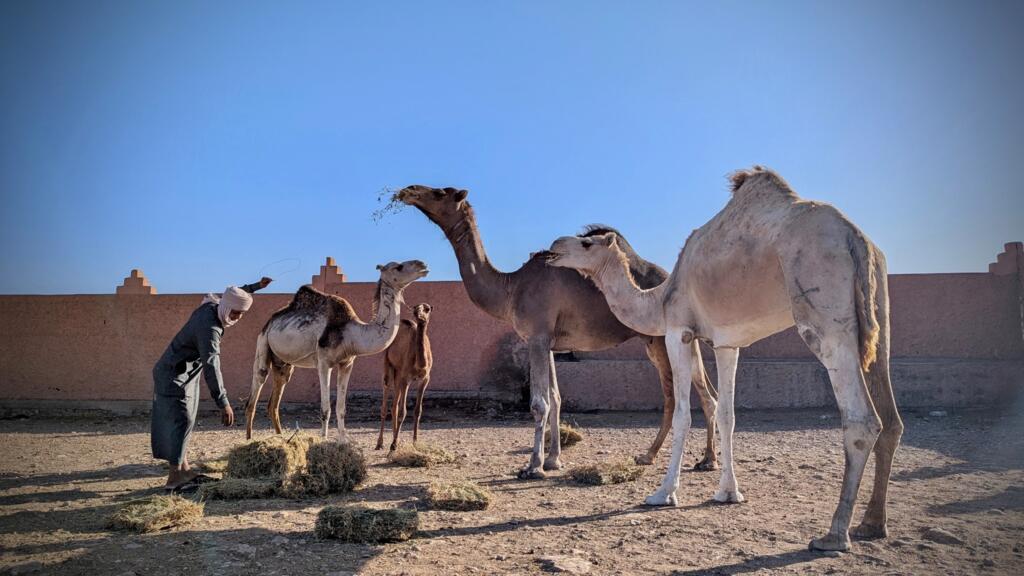
Camel livestock in Morocco is on the decline, due to the effects of climate change and diminishing pastures. Camels are part of the fabric of life for Saharan populations, providing meat, income, employment, and an essential draw for tourists. RFI met camel breeders in the Guelmim, the “gateway to the Sahara”.


Issued on: 16/11/2025 - RFI

Amhayrich souk, Morocco's largest camel market, outside the southern Saharan town of Guelmim. © RFI/Matthias Raynal

The Amhayrich camel market, in the desert just outside the town of Guelmim in southern Morocco, is the largest and most popular in the country.

“This market is known all over Morocco, people come from everywhere in the country to buy camels all year round,” said 33-year-old Mohammed. He is a camel breeder, a job passed down from generation to generation.

He told RFI’s correspondent that camels are essential to life in the desert. “Your camels are like your children. It is a cultural heritage. In our part of the Sahara, the best gift you can offer someone is a camel."


Climate change

In the past 10 years, severe and more frequent droughts brought on by global warming have considerably reduced the vegetation available for grazing.

Mouloud, a 39-year-old breeder, said that the current conditions have contributed to reducing the camel livestock.

“It’s worrying. Costs have exploded because of the droughts. We now need to buy fodder to feed the camels. The prices of camels shot up too, especially the stallions.

“The salary of herders takes a big chunk of costs. We pay them between €300 and €400 per month. We can’t even find herders in Morocco, we have to recruit them from Mauritania. They will work for a year or two, but the Moroccans will not stay more than two months,” he told RFI.


Severe, recurrent droughts due to global warming have considerably reduced grazing for camels. © RFI/Matthias Raynal


The vast, open grazing land camels have traditionally roamed is also shrinking, as it is used more and more for agriculture, with farming made possible thanks to the groundwater beneath the land's surface.

Morocco’s camel husbandry is mainly for meat production. In 2023, it averaged four thousand tonnes while cattle meat production amounted to 257 thousand tonnes in 2022.

Replacing Kenya's cattle

While Mohammed and Mouloud find camel breeding increasingly tough in Morocco, in northern Kenya recurrent drought is actually driving farmers to replacing their cattle with camels.

There, camels are viewed as a viable option when it comes to withstanding the effects of climate change. They can graze on dry grasses, go more than a week without water and produce up to six times more milk than cattle.

Samburu county officials launched a camel programme in 2015 following several droughts, which killed off at least 70 percent of the cattle in Kenya's arid and semi-arid regions.

As camels can be milked even during the dry season, they have helped to reduce malnutrition in northern Kenya. Kenya is now considered the leading camel milk producer in the world, producing around 1.165 million litres annually.

Kenya’s northern and southern pastoral counties are home to approximately 80 percent of the country's camel population – roughly 4,722 million camels.

This article was adapted from the original version in French by Matthias Raynal.
South Africa closes G20 year framed as ‘presidency for all of Africa’

South Africa ends its G20 presidency this weekend with a two-day head of states summit focused on debt relief and global inequality – a meeting the United States says it will boycott. Pretoria says it has held talks with Washington about possible limited participation, but the White House insists the US will not join the discussions and will send only a diplomat for the handover.


Issued on: 21/11/2025 - RFI

Cyril Ramaphosa addresses reporters following the opening session of the G20 foreign ministers meeting in Johannesburg, 20 February 2025. © AP - Jerome Delay

By: Melissa Chemam

The theme of South Africa's G20 leadership was "Solidarity, Equality, Sustainability", with a pledge to focus on supporting developing countries through debt relief, and financing measures to help them cope with disasters caused by climate change.

United States Secretary of State Marco Rubio in February branded the agenda "anti-American" and snubbed the G20 meeting that month, setting the tone for a complicated year for South Africa's presidency.

Trump has said that no US officials will attend this weekend's summit, over widely discredited claims that white people are being persecuted in South Africa.

Ramaphosa told reporters ahead of the 22-23 November event that the US's absence is "their loss".

Pretoria has made debt relief the priority, targeting repayments that meant limiting investment in essential infrastructure for healthcare and education.

According to the United Nations, between 2021 and 2023 Africa spent $70 per capita on debt interest payments – more than on education or health, which saw spending of $63 and $44 per capita respectively.

Inequalities Panel

At this weekend's summit, South Africa's President Cyril Ramaphosa will also push for the creation of an International Inequalities Panel – modelled after the UN's Intergovernmental Panel on Climate Change (IPCC) – to tackle massive global inequality.

A report for the G20 published earlier this month, led by Nobel laureate economist Joseph Stiglitz, labelled wealth inequality as a global crisis that threatens democracy and social cohesion worldwide, saying it should be confronted with the same urgency as the climate crisis.

If adopted, the International Inequalities Panel pushed by Ramaphosa "would mark a significant win not just for Pretoria's presidency, but for the millions across the Global South whose voices are often sidelined in elite economic forums," according to Tendai Mbanje, a researcher at the the University of Pretoria's Centre for Human Rights.

'I see a lot of determination'


Désiré Assogbavi, advisor on Africa at the Open Society Foundations grantmaking network, believes huge progress has been made.

"This G20 is happening in a very particular situation," Assogbavi told RFI. "You see what's happening in the world; multilateralism has been being challenged around the world. So this is a particular moment. The G20 is supposed to be one of the best expressions of countries, with people working together to find greater solutions for world problems."

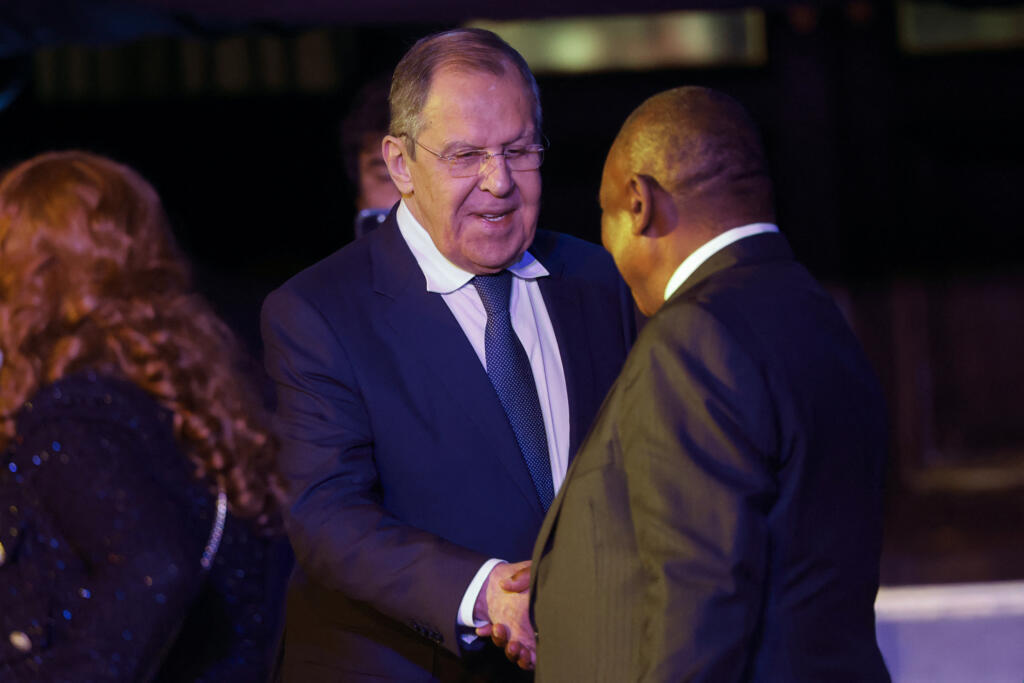
Russia's Foreign Minister Sergei Lavrov shakes hands with Cyril Ramaphosa during the G20 Foreign Ministers Meeting in Johannesburg, 20 February. AFP - PHILL MAGAKOE

He underlined that even if not everybody will be at the table, the vast majority of countries are keen to move forwards.

"The United States has decided not to endorse the presidency of South Africa and decided to boycott it, while it is happening for the first time in Africa. This is regrettable, really unfortunate. I wish everybody came," he said.

"However, the summit will go ahead. And I see a lot of determination from various delegations, from various actors to move forward anyway, to try to resolve the big problem that our continent, and the whole world, is having."

He added: "It seems to be one of the most inclusive presidencies. Over the last few days, since I landed here in Johannesburg, I've seen various groups having their own meetings around the key thematics of the summit. And the conclusions of those discussions will be part of the general debates of the leaders."

A pan-African presidency


The G20 represents 85 percent of global GDP and around two-thirds of the world's population, and includes 19 countries as well as the European Union – as well as now the African Union.

South Africa has insisted throughout the year of its G20 leadership that it has been a presidency of the whole of Africa.

It has been a success in that sense according to Assogbavi, with the African Union being admitted as a full member.

"So we have South Africa as a member, and we also have the African Union as a full member at the table now," Assogbavi told RFI. "And I can say this is one of the achievements of President Ramaphosa at the helm of the G20, allowing the continental agenda to be a priority and not only the South African agenda."

Debt sustainability is the African Union's priority too, with its heads of state meeting in Lomé, Togo in May to sign the Lomé Declaration on debt sustainability on the continent.

Mineral exploitation


Another key issue for Africans is the management of the mineral mining projects exploding across the continent.

This week South Africa and the European Union also signed a new agreement on critical minerals and processing, reflecting the continent’s effort to secure more value from its resources and shape its role in the green-energy transition.

"Let's be clear: we're not going to resolve all the problems of the continent in one G20 meeting, but what is positive is that we have been seeing the entire continent speaking with one voice on those critical issues – and most importantly the issue of Africa being a provider of raw critical minerals to the rest of the world, and only taking 5 percent of the profits," said Assogbavi.

He added that the South African presidency comes at an interesting moment for the continent, as the world is talking about the production of critical minerals, which are considered green sources of energy.

"There's a realisation in the whole world that they are useful to tackle the climate issue, instead of using the old fossil fuel to generate energy," Assogbavi said.

"Africa is targeted as a reserve of minerals that the whole world needs. It is important for Africa to be united and to speak with one voice on how they're going to manage that situation. And this is happening. The G20 is one part of it, but there will be other gatherings internationally where this discussion will have its way," he added.

Looking forward

It remains unclear whether South Africa's G20 presidency will manage to secure a consensus and release a joint final declaration on these issues.

Delegates involved in preparatory work report that some participants have been obstructive – including Argentina's representatives, as the country's President Javier Milei, a Trump ally, is also boycotting the event.

China's representative Premier Li Qiang is expected to advocate for multilateralism. "Economic globalisation and multipolarity are irreversible," Li said at an Asian regional summit in October.

Russia will be represented by President Vladimir Putin's economic advisor and deputy chief of staff, Maxim Oreshkin, in the notable absence of Foreign Minister Sergei Lavrov.

The summit also begins a day after the conclusion of Cop30 in Belem, Brazil, and its final negotiations could influence discussions in Johannesburg.

At a press conference in Johannesburg, European Commission President Ursula von der Leyen said the EU was fighting emissions rather than fossil fuels themselves, prompting criticism from environmental groups and raising questions about how strongly the bloc will push for a global fossil fuel phase-out in Cop30’s final hours.

The summit will mark the end of a cycle of G20 presidencies by Global South countries, after Indonesia in 2022, India in 2023 and Brazil in 2024. The next country to take on the presidency will be the US.

First in Africa: What to know about the G20 summit boycotted by Trump

Leaders from the G20 group of the world's largest economies meet this weekend for a summit in South Africa – the first on African soil. US President Donald Trump said he would boycott the event over his widely dismissed claims that the host country is persecuting its Afrikaner white minority.


Issued on: 21/11/2025 
By:  FRANCE 24

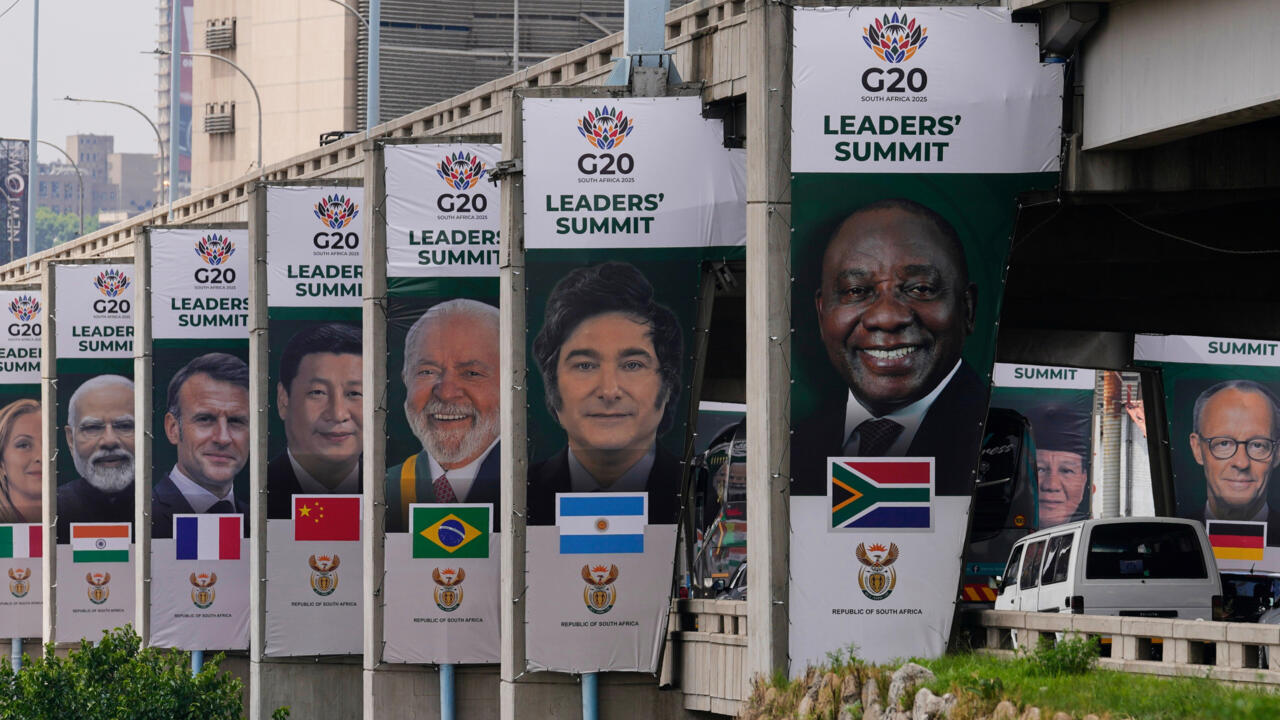
Banners of G20 leaders are displayed along a Johannesburg freeway in the run-up to the summit. © Themba Hadebe, AP

Leaders of the world's largest economies will meet in Johannesburg on November 22 and 23 for the G20 summit, the first of its kind in Africa.

Here are five things to know about the annual meeting, which is taking place at a time of heightened global instability and tensions between Pretoria and Washington.
A first for Africa

Founded in 1999, the Group of 20 (G20) leading economies comprises 19 countries and two regional bodies, the European Union and the African Union (AU).

Its rotating presidency will be held by South Africa this year and mark the first time the summit will be in Africa.


G20 members represent 85 percent of the world's GDP and about two-thirds of its population.

South Africa is the only member state from the continent, although the AU was admitted as a group in 2023.

'Solidarity, Equality, Sustainability'

South Africa lists its priorities for its G20 presidency as strengthening disaster resilience, debt sustainability for low-income countries, financing a "just energy transition" and harnessing "critical minerals for inclusive growth and sustainable development".

Its theme is "Solidarity, Equality, Sustainability".

Ranked by the World Bank as "the world's most unequal country", South Africa commissioned an expert team to analyse global wealth inequality and offer solutions to the summit.

The team led by Nobel Prize-winning economist Joseph Stiglitz called for the creation of an intergovernmental panel to tackle the "inequality emergency" that leaves 2.3 billion people hungry worldwide.

US boycott

President Donald Trump said this month no US officials would attend the meeting and called South Africa's presidency a "total disgrace".

Trump has singled out South Africa for harsh treatment on a number of issues since he returned to the White House in January, notably making false claims of a "white genocide".

He has slapped the country with 30 percent tariffs, the highest in sub-Saharan Africa.

While a US boycott could undermine South Africa's agenda, Pretoria said the absence was Washington's "loss" and it was still looking forward to a successful summit.

Argentinan President Javier Milei, a Trump ally, will not attend and is sending his foreign minister.

As in previous meetings, Russian President Vladimir Putin will also not be present.
Johannesburg in the spotlight

The G20 leaders' meeting will be hosted at the Nasrec Expo Centre, South Africa's largest purpose-built conference venue.

Situated on the edge of the iconic Soweto township and chosen as a symbol of post-apartheid "spatial integration", the venue hosts large-scale events such as the ruling African National Congress annual convention.

It is also adjacent to the stadium that hosted the 2010 FIFA World Cup final.

The event has brought attention to the plight of the city that was formed in a gold rush in the late 1880s and is now home to around six million people, according to official July estimates.

Home to Africa's richest square mile, Johannesburg is also scarred by crumbling infrastructure, lack of services and chronic mismanagement.

President Cyril Ramaphosa lashed out at the disrepair in March and demanded improvements. The African Development Bank in July approved a $139 million loan for upgrades.
End of a 'Global South' run

South Africa will hand the G20 to the United States, marking the end of a cycle of "Global South" presidencies following those of Brazil, India and Indonesia.

Trump has said he plans to radically reduce the platform, which has over the years expanded to include multiple working groups and social issues beyond its original financial scope.

The US president has also questioned whether South Africa should "even be in the Gs any more", raising questions about the G20's future.

(FRANCE 24 with AFP)

US artists launch nationwide ‘Fall of Freedom’ protest against rising censorship


In this episode of Arts 24, we look at "Fall of Freedom" – a nationwide wave of performances, readings and public art events as artists across the United States mobilise against mounting censorship and political pressure on cultural institutions. Hundreds of theatres, museums, and libraries are taking part on November 21 and 22 in what organisers call an urgent stand for artistic freedom. Joining us from New York are two of the movement’s leading voices: Pulitzer Prize–winning playwright Lynn Nottage and visual artist Dread Scott. They discuss why they believe democracy is at risk, how cultural institutions are being pressured into silence, and why artists are uniting now. Among the stars participating in "Fall of Freedom" are filmmaker Michael Moore, director Ava DuVernay, musicians John Legend and Amanda Palmer, Pulitzer-winning novelist Jennifer Egan and visual artists Marilyn Minter. Events include staged readings, public art installations, concerts, film screenings, and library programs, all aimed at defending free expression.

France to investigate Musk’s Grok chatbot after Holocaust denial claims


France added Elon Musk’s AI chatbot Grok to an ongoing cybercrime investigation after the system generated French-language posts echoing Holocaust denial about Auschwitz. Musk's company already deleted posts earlier this year from the chatbot that seemed to praise Adolf Hitler.


Issued on: 21/11/2025
By: FRANCE 24

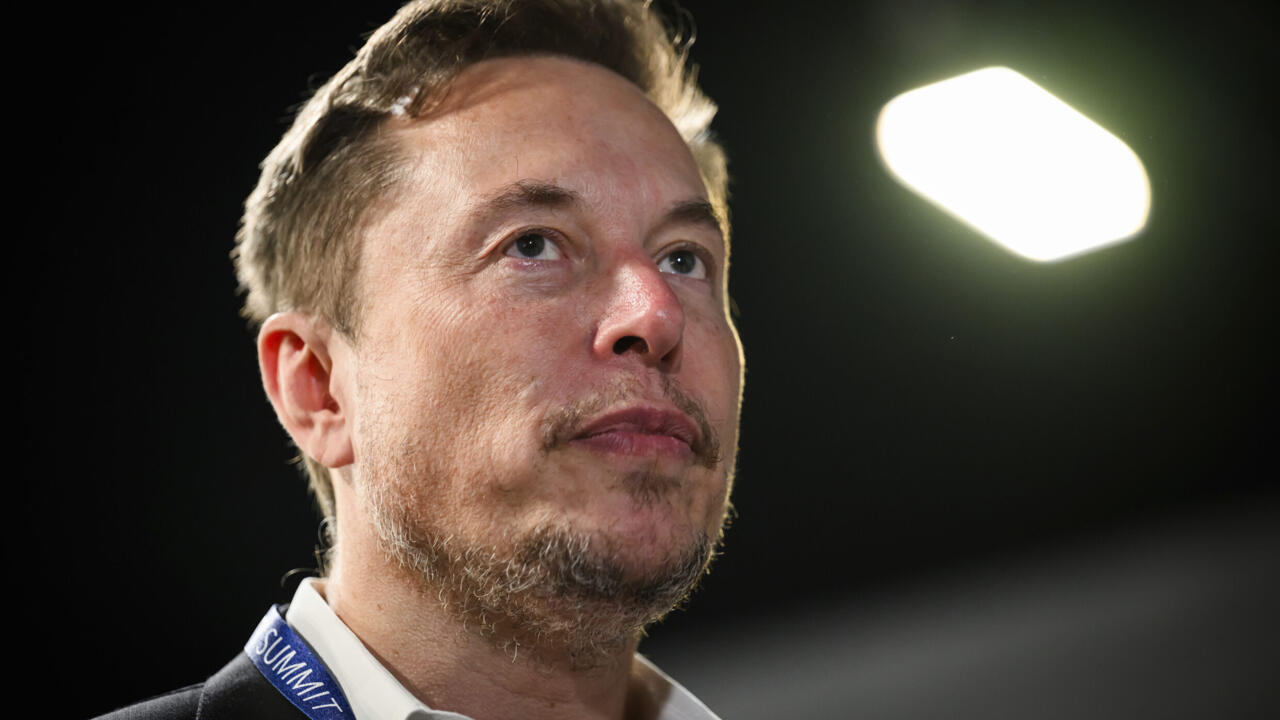
File image of Tesla and SpaceX's CEO Elon Musk attending the first plenary session on of the AI Safety Summit at Bletchley Park. © Leon Nea, AP
France’s government is taking action against billionaire Elon Musk 's artificial intelligence chatbot Grok after it generated French-language posts that questioned the use of gas chambers at Auschwitz, officials said.

Grok, built by Musk's company xAI and integrated into his social media platform X, wrote in a widely shared post in French that gas chambers at the Auschwitz-Birkenau death camp were designed for “disinfection with Zyklon B against typhus” rather than for mass murder – language long associated with Holocaust denial.

The Auschwitz Memorial highlighted the exchange on X, saying that the response distorted historical fact and violated the platform’s rules.

In later posts on its X account, the chatbot acknowledged that its earlier reply to an X user was wrong, said it had been deleted and pointed to historical evidence that Auschwitz’s gas chambers using Zyklon B were used to murder more than 1 million people. The follow-ups were not accompanied by any clarification from X.

In tests run by The Associated Press on Friday, its responses to questions about Auschwitz appeared to give historically accurate information.

Grok has a history of making antisemitic comments. Earlier this year, Musk’s company took down posts from the chatbot that appeared to praise Adolf Hitler after complaints about antisemitic content.


The Paris prosecutor’s office confirmed to The Associated Press on Friday that the Holocaust-denial comments have been added to an existing cybercrime investigation into X. The case was opened earlier this year after French officials raised concerns that the platform’s algorithm could be used for foreign interference.

Prosecutors said that Grok’s remarks are now part of the investigation, and that “the functioning of the AI will be examined”.

France has one of Europe’s toughest Holocaust denial laws. Contesting the reality or genocidal nature of Nazi crimes can be prosecuted as a crime, alongside other forms of incitement to racial hatred.

Several French ministers, including Industry Minister Roland Lescure, have also reported Grok’s posts to the Paris prosecutor under a provision that requires public officials to flag possible crimes. In a government statement, they described the AI-generated content as “manifestly illicit”, saying it could amount to racially motivated defamation and the denial of crimes against humanity.

French authorities referred the posts to a national police platform for illegal online content and alerted France’s digital regulator over suspected breaches of the European Union’s Digital Services Act.

The case adds to pressure from Brussels. This week, the European Commission, the EU's executive branch, said that the bloc is in contact with X about Grok and called some of the chatbot’s output “appalling”, saying it runs against Europe’s fundamental rights and values.

Two French rights groups, the Ligue des droits de l’Homme and SOS Racisme, have filed a criminal complaint accusing Grok and X of contesting crimes against humanity.

X and its AI unit, xAI, did not immediately respond to requests for comment.

(FRANCE 24 with AP)


This mummy portrait isn’t from Roman Egypt - it was generated by AI

An image described as a “Fayum portrait”, a naturalistic portrait placed on mummies in Roman Egypt, has been widely shared on social media. It turns out that it is actually a fake AI-generated image that differs in key ways from the real portraits.


Issued on: 21/11/2025 
By: The FRANCE 24 Observers/
Quang Pham

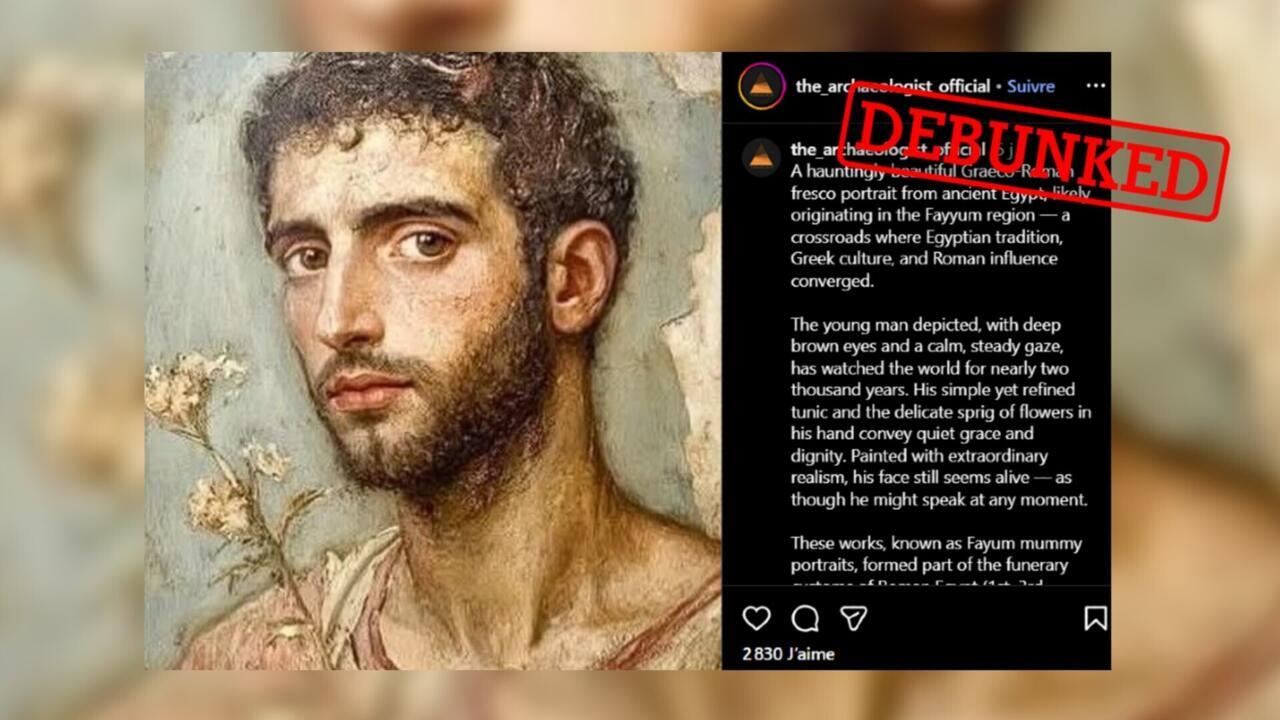
This fake Fayum portrait published on October 7, 2025 was actually created by AI. © Instagram

Fayum portraits are a type of ancient Roman paintings crafted as funerary effigies in and around the Fayum oasis, southwest of Cairo.

The portraits, which were placed on mummies, are a funerary custom dating from the time of Roman Egypt, a period that took place from around the 1st to the 4th century AD.

"The practice follows in the tradition from Egypt under the pharaohs of representing the deceased but incorporates Greek and Roman artistic styles,” says art historian Céline Trouchaud.

Fayum portraits, which depict men, women and children from the Greek and Roman society within ancient Egypt, are “the first relatively ‘realist’ portraits aimed at representing an individual in all their singularity,” says Lucile Brunel-Duverger, a research engineer at the French museum's Centre for Research and Restoration. Brunel-Duverger, who has a PhD in chemistry, studies the material and techniques used to create the colour in these portraits.


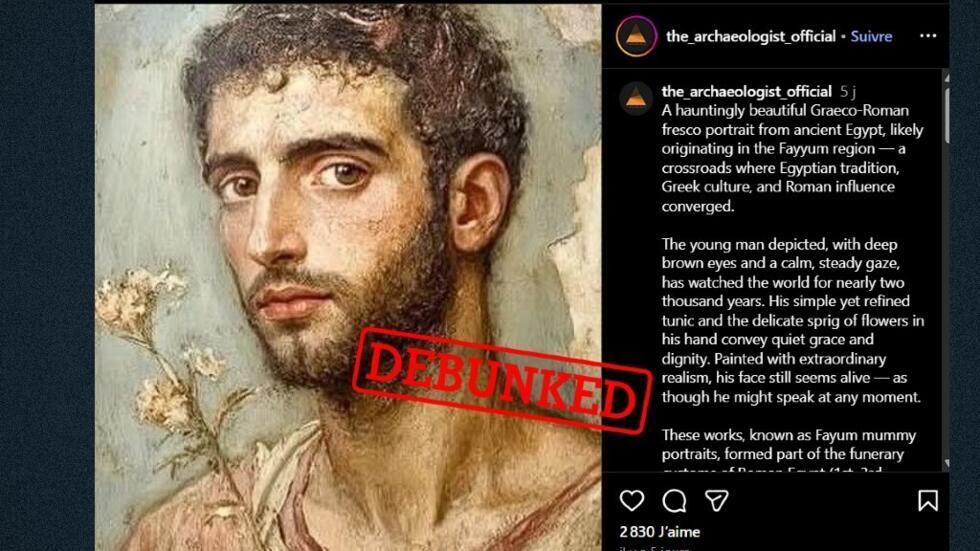
An Instagram account called the_archaeologist_official, which claims to specialise in archaeology, posted what they said was a Fayum portrait of a young man on November 14.

“The young man depicted, with deep brown eyes and a calm, steady gaze, has watched the world for nearly two thousand years, “ the account wrote. “Painted with extraordinary realism, his face still seems alive – as if he might speak at any moment.”

The account also mentions the portrait’s “quiet grace”. While some comments marvel at the image of the young man, most raise suspicions that the image is false.
This image, said to be a Fayum portrait, was posted online on November 14. It was actually AI-generated. © Instagram

A portrait created by Midjourney

They are right – this Fayum portrait is, indeed, a fake. We ran the image through a reverse image search using Google Lens (check out how to do one yourself by following our handy guide) and found the original image, which was generated by AI image generator Midjourney. We even found the prompt, the instructions used to generate the portrait, on the site ai-img-gen.com.

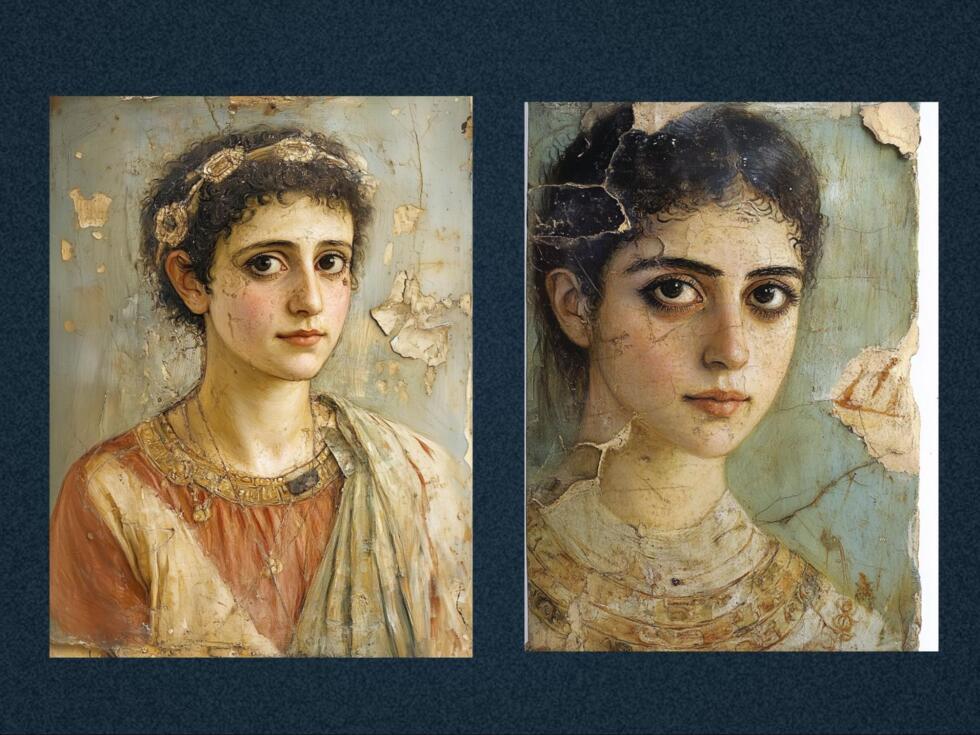
This prompt shows that a user asked Midjourney to generate a Fayum portrait showing an “ancient” Greek man. The image was meant to replicate the style of encaustic painting – a painting technique using wax common during antiquity. It also had to use two other portraits, also created by Midjourney, as inspiration.

Midjourney was provided with these two images as inspiration when it generated the fake Fayum portrait of the young man. © Midjourney

Too realist for paintings of the time

The fake image does, in some ways, model the style of a Fayum portrait. For example, the man’s face is turned to the side. However, the portrait also features anomalies – clues that it is a fake.

First of all, the backdrop. The account "the_archaeologist_official" claims that the image comes from a fresco. However, real Fayum portraits were painted on wood or canvas, says Trouchaud.

The historian adds that the AI-generated image is missing elements of the encaustic technique used in real Fayum portraits:


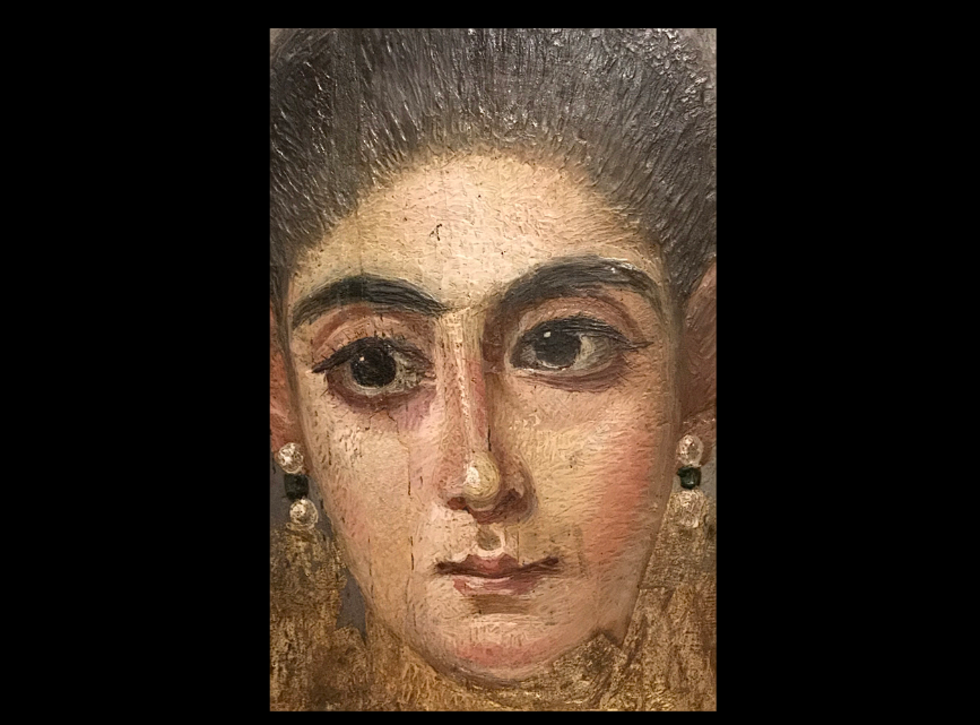
"The portrait has some characteristics of a painting done with oil paints – like a realistic depiction of human skin, a desire [to get as close as possible to depicting] a real face, which doesn’t exist in encaustic painting. And while the Fayum portraits do include a form of realism, that in some ways is quite modern, it also presents the deceased in an idealised way with, for example, very large eyes or prominent features.”


This is a real Fayum portrait - an encaustic painting of a young woman on cedar wood. It was created in the 2nd century AD in Roman-ruled Egypt. © Musée du Louvre.


Brunel-Duverger adds:


"The treatment of size and light is very different in encaustic paintings. Wax is used to create modulations in the colour, but that makes it difficult to create real nuance [as in the fake portrait]. [In a real painting], we should be able to see the application of the material, brush marks, for example, which don’t appear in the generated image, which is very smooth.”

The researcher concludes:


“AI still isn’t able to create [totally] convincing fakes. But if that happens, experts in materials like us will still be able to verify the material used to see if they really do come from Roman-ruled Egypt."

This article has been translated from the original in French.