At such a moment in history, a movement that connects the dots between our many struggles is certainly the way forward. The plight of refugees—and how we treat them as a society—is a story that connects us all.
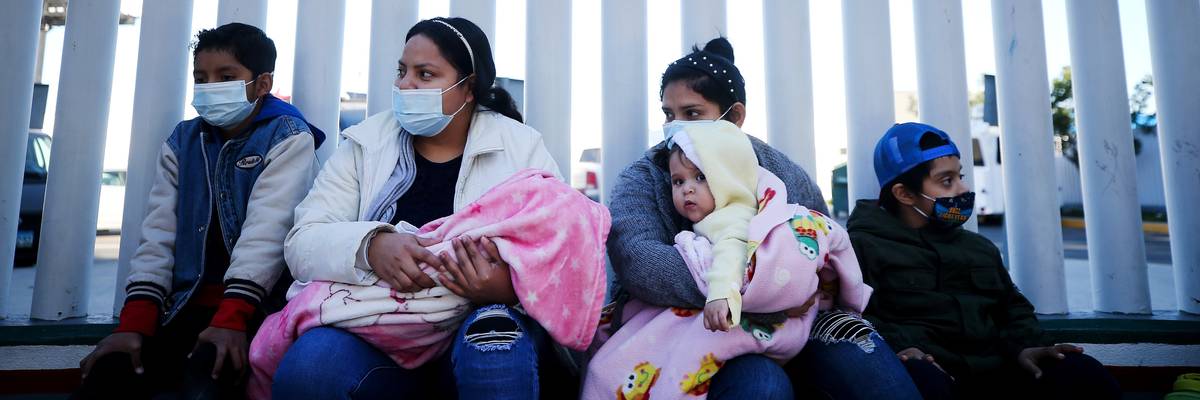
People from El Salvador and Honduras who are seeking asylum in the United States sit outside the El Chaparral border crossing in Tijuana, Mexico.
(Photo by Mario Tama/Getty Images)
Rev. Dr. Liz Theoharis
Apr 20, 2026
TomDispatch
In late March, I sat in the gallery of the Supreme Court for the first time in my life. Throughout my 30 years of grassroots anti-poverty work, I’ve joined countless protests and vigils outside the Court. In 2018, I was even arrested and held in detention for praying on its palatial steps. Now, I was seated with a clear view of the nine justices of the nation’s highest court. I was there as a guest of immigrant rights lawyers, as their team made oral arguments in Noem v. Al Otro Lado, the most significant case on the right to asylum in decades.
In February, the Kairos Center (the organization I direct) authored an interfaith amicus brief on that very case, alongside 31 denominations and organizations representing faith traditions practiced by billions worldwide. Those groups, including the Alliance of Baptists, the Council on American-Islamic Relations, the Episcopal Church, the Evangelical Lutheran Church in America, Hindus for Human Rights, the Latino Christian National Network, the Presbyterian Church (U.S.A.), Reconstructing Judaism, the Union for Reform Judaism, the Unitarian Universalist Association, the General Synod of the United Church of Christ, and the General Board of Church and Society of the United Methodist Church, joined together to declare that our societal obligation to provide for persecuted outsiders is a universally shared moral principle.
Although the case has largely flown under the public radar, there is indeed a lot at stake. Filed on behalf of asylum seekers, Noem v. Al Otro Lado focuses on the legality of a 2018 Trump border policy blocking access to the U.S. asylum process for people arriving at the border with Mexico. Immigrant rights advocates argue that such a turnback policy, under which immigration officers physically stop people seeking safety at official border crossings from setting foot on U.S. soil, flouts decades of settled federal immigration law and our society’s most deeply held legal and moral values.
For more than a century, the government has been required to undertake a legal process of inspection when people seek asylum at official ports of entry along the U.S.-Mexico border (as they must inspect all noncitizens seeking admission to the United States). That requirement is supposed to ensure that this country doesn’t send vulnerable people back into danger without first allowing them to seek protection. A wide range of immigration lawyers and legal experts argue that the first Trump administration’s turnback policy, euphemistically called “metering,” directly undermined the government’s responsibility to process such asylum claims. As a result, vulnerable children, families, and adults were regularly forced to remain indefinitely stranded in perilous conditions in Mexico.
Although the turnback policy has not been in effect since 2021, when the Ninth Circuit Court of Appeals declared it unlawful, the Trump administration has asked the Supreme Court to review the case. Should the government win (which is all too possible given the hyperpartisan nature of the current Court), the consequences are sure to be grave and far-reaching. The Department of Homeland Security would have the legal backing to turn away untold thousands of desperate people at the border, potentially clearing the way for even more expansive border closures, while further intensifying the jingoistic nationalism that defines the Trump administration. Alongside other landmark cases this term, like Trump v. Barboza, in which the government seeks to undo the constitutional right to birthright citizenship, the results of Noem v. Al Otro Lado are likely to reveal the lengths to which the Supreme Court is willing to backstop the president’s assault on democracy, including accelerated attacks on the rights of vulnerable populations.
The day I was there, the existential stakes of that case and the larger societal crisis in which it was unfolding did not seem to concern the court’s conservative justices. I had the words of George Washington (written in 1788 to the radical Dutch republican Francis Van der Kemp) in my mind as I sat in the gallery: “I had always hoped that this land might become a safe & agreeable asylum to the virtuous & persecuted part of mankind, to whatever nation they might belong.”
Unfortunately, having heard the statements and reactions of some of the judges, I fear that the majority of the Supreme Court may no longer agree with that foundational vision for this country.
Courtroom Friezes and Draconian Law
The first thing that struck me on entering the Supreme Court gallery were the stone friezes on the walls of the room. Designed by Adolf Weinman more than a century ago, those large marble reliefs, featuring what he called the “great lawgivers of history,” tower over the space. Among them are prominent religious figures like Moses (holding a scroll of the Ten Commandments), King Solomon, Confucius, and a rendition of the Prophet Muhammad (that is entirely unrecognizable). The friezes also include Roman Emperor Octavian (otherwise known as Caesar Augustus, Jesus’s great nemesis), French King Louis IX (leader of the seventh and eighth crusades), and Draco (a Greek jurist whose legacy lurks in the word “draconian” because of the extreme measures he took to punish minor offenses).
As I stared at those figures, I reflected on the message they convey about the complex civilizational lineages from which the Supreme Court and our legal system derive their authority. In our amicus brief, we reflected on those varied lineages as they pertain to the right to seek asylum:
“Our asylum laws are the modern embodiment of a deeply rooted religious, cultural, and historical heritage that has consistently affirmed society’s obligation to provide refuge for those seeking safety. Asylum reaches back to some of the earliest moments of recorded human history. It was practiced throughout the ancient civilizations that forged the foundation of Western society. This tradition can also be found in the form of church sanctuary asylum, a mainstay of European culture for over a millennium.
“Our very nation began as a haven for persecuted political and religious minorities. This tradition is present throughout our history, from the practices of Native Americans to the Underground Railroad to modern times. Congress adopted our current asylum laws in significant part due to the efforts of faith-based groups seeking to uphold deeply held societal, moral, and cultural principles.”
Despite such deeply held and ancient principles, I couldn’t shake a sense of impending doom as I scanned the faces on the friezes and those of the justices. I thought of the awesome and awful power of Rome, depicted throughout the gallery, and its draconian reign of “peace” (or what Secretary of War Pete Hegseth recently termed “delivering peace through strength”). And I recalled the worsening anti-democratic and pro-oligarchic turn our own Supreme Court has taken in the Trump era.
Just consider the rulings from the past few years: the Court has essentially given immunity to the executive branch (although the Court is supposed to be a critical part of a federal system of checks and balances), criminalized homelessness (although the U.S. claims to be a nation of opportunity and prosperity for all), and degraded voting rights (cutting off the legs of our democracy).
Before oral arguments began in Noem v. Al Otro Lado, I was under no illusion that the Supreme Court delivers equality, freedom, and justice for all. And yet, on an issue as basic and legally sound as the right to seek asylum, I was still shocked by the flippancy of the court’s conservative judges. For hours, they rocked in their chairs, physically broadcasting their disinterest in the case. Rather than take seriously more than 100 years of legal precedent and hundreds more of long-established societal practice, they seemed to enjoy getting into hyper-specific and cherrypicked semantic and rhetorical arguments with Kelsi Brown Cochran, our lawyer.
In preparation for that day, I had brushed up on the history of U.S. asylum law. An important story in that history is the S.S. St. Louis, a ship that in 1939 was carrying 930 refugees from Hamburg, Germany, fleeing the Nazi regime, who were first denied entry to Cuba and then to the United States, only to be returned to Europe, where many of them were taken to the Nazi death camps.
Reflecting on that story at a pre-hearing press conference, Nicole Elizabeth Ramos, border rights project director at Al Otro Lado, a plaintiff in the case, offered this explanation:
“The right to seek asylum is not a policy preference or a loophole — it is a legal right and a moral commitment forged in the aftermath of the Holocaust. Seeking asylum is not like taking a number at a deli counter and waiting for your turn. You cannot ask someone fleeing rape, torture, or death threats to wait in danger indefinitely because a government has decided their lives are inconvenient. We filed this case because the United States has an obligation to follow its own laws — laws duly enacted by Congress. The question before the Court is whether those laws can be set aside by executive action, or whether they remain binding at the border, as written.”
In their apparent willingness to flout precedent and condemn modern-day asylees to harm or even death, the conservative justices unselfconsciously aligned themselves with American nativism and European fascism of the 1930s. If, in their final decision, they uphold Trump’s turnback policy, they will be affirming that, were the S.S. St Louis to sail again today, the ship would still be denied entry and its passengers asylum.
The Moral Crisis Is Not “Border Surges” But the Closing of the Border
The morning of those oral arguments, the Kairos Center and other faith organizations held an interfaith prayer vigil on the steps of the Supreme Court to call attention to the case. Reverend Michael Neuroth, director of the United Church of Christ’s Washington D.C. office, put the matter vividly: “Welcoming and protecting the stranger is not a minor tenet of our faith but is a foundational moral obligation in each of our traditions. Dismantling the right to asylum is morally wrong, strategically short-sighted, and increases insecurity here in our nation. We must be a nation of compassion, a place of refuge to those in need.”
The vigil was organized in the heart of the “holy season” amid Ramadan, Passover, and Easter. As billions of people globally engage in rituals of remembrance, repentance, deliverance, and liberation, our prayers and petitions focused not only on the legal precedent for the right to seek asylum, but on the moral imperative to do so. For Christians, protecting and welcoming the immigrant is one of Jesus’s first and most powerful teachings. It’s also among the highest moral commands of the Torah. As the prophet Jeremiah reminds us, “Do no wrong to the foreigner and do not shed innocent blood.” Asylum and societal hospitality are well-recognized rights within Islamic law and theology, a fundamental Hindu and Buddhist tenet, and part of Native American spiritual teachings.
In our interfaith amicus brief, we wrote: “As the many faiths practiced by this country’s citizens teach, a society that does not protect the least among us is a failed society.” As faith leaders, we had in mind not only the right to seek asylum, but the many ways the Trump administration has deepened and intensified a moral crisis at the heart of our society. We were thinking about the ongoing attacks on immigrant communities — from ICE-led campaigns of terror to family and child detention in places like Dilley, Texas. There was also the stripping of life-saving healthcare and food support from millions of Americans through cuts to Medicaid and the Supplemental Nutrition Assistance Program (SNAP); the criminalization and forced deprivation of LGBTQ+ people; and the prosecution of anillegal war that threatens the lives of so many in Iran and the broader region, as well as the livelihoods of billions of us across this globe.
In Noem v. Al Otro Lado, the Trump administration is attempting to mask its cruelty and despotism through banal legal arguments. By focusing semantically on when protections start for asylum seekers and debating the meaning of the term “arrives in” (as in this country, of course), its lawyers were ignoring the illegality and immorality of border agents blocking asylum seekers from crossing the U.S.-Mexican border and the larger question of whether the United States can any longer be a place of safety and protection for all families “yearning to be free” of violence and persecution.
The government is, of course, hoping that we don’t make the connections between the stripping away of asylum rights, the larger issue of immigrant rights, and the many other ways that it’s targeting “the least among us.” That’s a mistake we can’t make and where the teachings of our many faith traditions have encouragement to offer. In Buddhism, Christianity, Hinduism, Islam, Judaism, and more, love, justice, and peace are not parceled out only for certain people in certain places. Across our religions, all life is sacred, full stop!
No Turning Back for Anyone
Intermixed with the important lawgivers of history in that marble frieze in the Supreme Court gallery are engraved winged personifications of “Peace,” “The Rights of Man,” “History,” “Authority,” “Fame,” and more. Those winged characters form what looked to me like a Greco-Roman “choir of angels,” proclaiming “law and order” at the expense of rights and dignity for us all.
Sitting there, I reflected on just who was not in that room listening to those arguments or forcing the Supreme Court justices to face the very lives impacted by their decision. I thought about all those who will never have access to that courtroom, or justice of any sort for that matter, the millions of people struggling to fight for their communities and a future where everybody is in and nobody is out.
Those people are — or at least should be — our hope. They are the true “choir of angels” who came out for the recent No Kings Day demonstrations and are standing up for the rights and dignity of communities all over the country. They are also the people who are increasingly giving Donald Trump historically low approval ratings. And here’s the truth of these times: this administration has nothing to offer everyday people, other than hardened borders and wars that nobody wants.
At such a moment in history, a movement that connects the dots between our many struggles is certainly the way forward. Therefore, it seems fitting that the coalition that came together to fight this case and protect the rights of asylum seekers calls itself “No Turning Back.” It reminds me of a song by Emma’s Revolution that I’ve sung many times at protests and gatherings. Its key lines are a reminder of what we all need to keep in mind in this deeply disturbing Trumpian moment of ours:
In late March, I sat in the gallery of the Supreme Court for the first time in my life. Throughout my 30 years of grassroots anti-poverty work, I’ve joined countless protests and vigils outside the Court. In 2018, I was even arrested and held in detention for praying on its palatial steps. Now, I was seated with a clear view of the nine justices of the nation’s highest court. I was there as a guest of immigrant rights lawyers, as their team made oral arguments in Noem v. Al Otro Lado, the most significant case on the right to asylum in decades.
In February, the Kairos Center (the organization I direct) authored an interfaith amicus brief on that very case, alongside 31 denominations and organizations representing faith traditions practiced by billions worldwide. Those groups, including the Alliance of Baptists, the Council on American-Islamic Relations, the Episcopal Church, the Evangelical Lutheran Church in America, Hindus for Human Rights, the Latino Christian National Network, the Presbyterian Church (U.S.A.), Reconstructing Judaism, the Union for Reform Judaism, the Unitarian Universalist Association, the General Synod of the United Church of Christ, and the General Board of Church and Society of the United Methodist Church, joined together to declare that our societal obligation to provide for persecuted outsiders is a universally shared moral principle.
Although the case has largely flown under the public radar, there is indeed a lot at stake. Filed on behalf of asylum seekers, Noem v. Al Otro Lado focuses on the legality of a 2018 Trump border policy blocking access to the U.S. asylum process for people arriving at the border with Mexico. Immigrant rights advocates argue that such a turnback policy, under which immigration officers physically stop people seeking safety at official border crossings from setting foot on U.S. soil, flouts decades of settled federal immigration law and our society’s most deeply held legal and moral values.
For more than a century, the government has been required to undertake a legal process of inspection when people seek asylum at official ports of entry along the U.S.-Mexico border (as they must inspect all noncitizens seeking admission to the United States). That requirement is supposed to ensure that this country doesn’t send vulnerable people back into danger without first allowing them to seek protection. A wide range of immigration lawyers and legal experts argue that the first Trump administration’s turnback policy, euphemistically called “metering,” directly undermined the government’s responsibility to process such asylum claims. As a result, vulnerable children, families, and adults were regularly forced to remain indefinitely stranded in perilous conditions in Mexico.
Although the turnback policy has not been in effect since 2021, when the Ninth Circuit Court of Appeals declared it unlawful, the Trump administration has asked the Supreme Court to review the case. Should the government win (which is all too possible given the hyperpartisan nature of the current Court), the consequences are sure to be grave and far-reaching. The Department of Homeland Security would have the legal backing to turn away untold thousands of desperate people at the border, potentially clearing the way for even more expansive border closures, while further intensifying the jingoistic nationalism that defines the Trump administration. Alongside other landmark cases this term, like Trump v. Barboza, in which the government seeks to undo the constitutional right to birthright citizenship, the results of Noem v. Al Otro Lado are likely to reveal the lengths to which the Supreme Court is willing to backstop the president’s assault on democracy, including accelerated attacks on the rights of vulnerable populations.
The day I was there, the existential stakes of that case and the larger societal crisis in which it was unfolding did not seem to concern the court’s conservative justices. I had the words of George Washington (written in 1788 to the radical Dutch republican Francis Van der Kemp) in my mind as I sat in the gallery: “I had always hoped that this land might become a safe & agreeable asylum to the virtuous & persecuted part of mankind, to whatever nation they might belong.”
Unfortunately, having heard the statements and reactions of some of the judges, I fear that the majority of the Supreme Court may no longer agree with that foundational vision for this country.
Courtroom Friezes and Draconian Law
The first thing that struck me on entering the Supreme Court gallery were the stone friezes on the walls of the room. Designed by Adolf Weinman more than a century ago, those large marble reliefs, featuring what he called the “great lawgivers of history,” tower over the space. Among them are prominent religious figures like Moses (holding a scroll of the Ten Commandments), King Solomon, Confucius, and a rendition of the Prophet Muhammad (that is entirely unrecognizable). The friezes also include Roman Emperor Octavian (otherwise known as Caesar Augustus, Jesus’s great nemesis), French King Louis IX (leader of the seventh and eighth crusades), and Draco (a Greek jurist whose legacy lurks in the word “draconian” because of the extreme measures he took to punish minor offenses).
As I stared at those figures, I reflected on the message they convey about the complex civilizational lineages from which the Supreme Court and our legal system derive their authority. In our amicus brief, we reflected on those varied lineages as they pertain to the right to seek asylum:
“Our asylum laws are the modern embodiment of a deeply rooted religious, cultural, and historical heritage that has consistently affirmed society’s obligation to provide refuge for those seeking safety. Asylum reaches back to some of the earliest moments of recorded human history. It was practiced throughout the ancient civilizations that forged the foundation of Western society. This tradition can also be found in the form of church sanctuary asylum, a mainstay of European culture for over a millennium.
“Our very nation began as a haven for persecuted political and religious minorities. This tradition is present throughout our history, from the practices of Native Americans to the Underground Railroad to modern times. Congress adopted our current asylum laws in significant part due to the efforts of faith-based groups seeking to uphold deeply held societal, moral, and cultural principles.”
Despite such deeply held and ancient principles, I couldn’t shake a sense of impending doom as I scanned the faces on the friezes and those of the justices. I thought of the awesome and awful power of Rome, depicted throughout the gallery, and its draconian reign of “peace” (or what Secretary of War Pete Hegseth recently termed “delivering peace through strength”). And I recalled the worsening anti-democratic and pro-oligarchic turn our own Supreme Court has taken in the Trump era.
Just consider the rulings from the past few years: the Court has essentially given immunity to the executive branch (although the Court is supposed to be a critical part of a federal system of checks and balances), criminalized homelessness (although the U.S. claims to be a nation of opportunity and prosperity for all), and degraded voting rights (cutting off the legs of our democracy).
Before oral arguments began in Noem v. Al Otro Lado, I was under no illusion that the Supreme Court delivers equality, freedom, and justice for all. And yet, on an issue as basic and legally sound as the right to seek asylum, I was still shocked by the flippancy of the court’s conservative judges. For hours, they rocked in their chairs, physically broadcasting their disinterest in the case. Rather than take seriously more than 100 years of legal precedent and hundreds more of long-established societal practice, they seemed to enjoy getting into hyper-specific and cherrypicked semantic and rhetorical arguments with Kelsi Brown Cochran, our lawyer.
In preparation for that day, I had brushed up on the history of U.S. asylum law. An important story in that history is the S.S. St. Louis, a ship that in 1939 was carrying 930 refugees from Hamburg, Germany, fleeing the Nazi regime, who were first denied entry to Cuba and then to the United States, only to be returned to Europe, where many of them were taken to the Nazi death camps.
Reflecting on that story at a pre-hearing press conference, Nicole Elizabeth Ramos, border rights project director at Al Otro Lado, a plaintiff in the case, offered this explanation:
“The right to seek asylum is not a policy preference or a loophole — it is a legal right and a moral commitment forged in the aftermath of the Holocaust. Seeking asylum is not like taking a number at a deli counter and waiting for your turn. You cannot ask someone fleeing rape, torture, or death threats to wait in danger indefinitely because a government has decided their lives are inconvenient. We filed this case because the United States has an obligation to follow its own laws — laws duly enacted by Congress. The question before the Court is whether those laws can be set aside by executive action, or whether they remain binding at the border, as written.”
In their apparent willingness to flout precedent and condemn modern-day asylees to harm or even death, the conservative justices unselfconsciously aligned themselves with American nativism and European fascism of the 1930s. If, in their final decision, they uphold Trump’s turnback policy, they will be affirming that, were the S.S. St Louis to sail again today, the ship would still be denied entry and its passengers asylum.
The Moral Crisis Is Not “Border Surges” But the Closing of the Border
The morning of those oral arguments, the Kairos Center and other faith organizations held an interfaith prayer vigil on the steps of the Supreme Court to call attention to the case. Reverend Michael Neuroth, director of the United Church of Christ’s Washington D.C. office, put the matter vividly: “Welcoming and protecting the stranger is not a minor tenet of our faith but is a foundational moral obligation in each of our traditions. Dismantling the right to asylum is morally wrong, strategically short-sighted, and increases insecurity here in our nation. We must be a nation of compassion, a place of refuge to those in need.”
The vigil was organized in the heart of the “holy season” amid Ramadan, Passover, and Easter. As billions of people globally engage in rituals of remembrance, repentance, deliverance, and liberation, our prayers and petitions focused not only on the legal precedent for the right to seek asylum, but on the moral imperative to do so. For Christians, protecting and welcoming the immigrant is one of Jesus’s first and most powerful teachings. It’s also among the highest moral commands of the Torah. As the prophet Jeremiah reminds us, “Do no wrong to the foreigner and do not shed innocent blood.” Asylum and societal hospitality are well-recognized rights within Islamic law and theology, a fundamental Hindu and Buddhist tenet, and part of Native American spiritual teachings.
In our interfaith amicus brief, we wrote: “As the many faiths practiced by this country’s citizens teach, a society that does not protect the least among us is a failed society.” As faith leaders, we had in mind not only the right to seek asylum, but the many ways the Trump administration has deepened and intensified a moral crisis at the heart of our society. We were thinking about the ongoing attacks on immigrant communities — from ICE-led campaigns of terror to family and child detention in places like Dilley, Texas. There was also the stripping of life-saving healthcare and food support from millions of Americans through cuts to Medicaid and the Supplemental Nutrition Assistance Program (SNAP); the criminalization and forced deprivation of LGBTQ+ people; and the prosecution of anillegal war that threatens the lives of so many in Iran and the broader region, as well as the livelihoods of billions of us across this globe.
In Noem v. Al Otro Lado, the Trump administration is attempting to mask its cruelty and despotism through banal legal arguments. By focusing semantically on when protections start for asylum seekers and debating the meaning of the term “arrives in” (as in this country, of course), its lawyers were ignoring the illegality and immorality of border agents blocking asylum seekers from crossing the U.S.-Mexican border and the larger question of whether the United States can any longer be a place of safety and protection for all families “yearning to be free” of violence and persecution.
The government is, of course, hoping that we don’t make the connections between the stripping away of asylum rights, the larger issue of immigrant rights, and the many other ways that it’s targeting “the least among us.” That’s a mistake we can’t make and where the teachings of our many faith traditions have encouragement to offer. In Buddhism, Christianity, Hinduism, Islam, Judaism, and more, love, justice, and peace are not parceled out only for certain people in certain places. Across our religions, all life is sacred, full stop!
No Turning Back for Anyone
Intermixed with the important lawgivers of history in that marble frieze in the Supreme Court gallery are engraved winged personifications of “Peace,” “The Rights of Man,” “History,” “Authority,” “Fame,” and more. Those winged characters form what looked to me like a Greco-Roman “choir of angels,” proclaiming “law and order” at the expense of rights and dignity for us all.
Sitting there, I reflected on just who was not in that room listening to those arguments or forcing the Supreme Court justices to face the very lives impacted by their decision. I thought about all those who will never have access to that courtroom, or justice of any sort for that matter, the millions of people struggling to fight for their communities and a future where everybody is in and nobody is out.
Those people are — or at least should be — our hope. They are the true “choir of angels” who came out for the recent No Kings Day demonstrations and are standing up for the rights and dignity of communities all over the country. They are also the people who are increasingly giving Donald Trump historically low approval ratings. And here’s the truth of these times: this administration has nothing to offer everyday people, other than hardened borders and wars that nobody wants.
At such a moment in history, a movement that connects the dots between our many struggles is certainly the way forward. Therefore, it seems fitting that the coalition that came together to fight this case and protect the rights of asylum seekers calls itself “No Turning Back.” It reminds me of a song by Emma’s Revolution that I’ve sung many times at protests and gatherings. Its key lines are a reminder of what we all need to keep in mind in this deeply disturbing Trumpian moment of ours:
“Gonna keep on moving forward
Keep on moving forward
Keep on moving forward
Never turning back
Never turning back”
© 2023 TomDispatch.com
Rev. Dr. Liz Theoharis
Rev. Dr. Liz Theoharis is co-chair of the Poor People's Campaign. She is the author of "Always with Us?: What Jesus Really Said about the Poor" (2017).
Full Bio >