It’s possible that I shall make an ass of myself. But in that case one can always get out of it with a little dialectic. I have, of course, so worded my proposition as to be right either way (K.Marx, Letter to F.Engels on the Indian Mutiny)
Saturday, May 02, 2026
Citing Bogus ‘Threats’ to US, Trump Expands Already Devastating Sanctions on Cuba
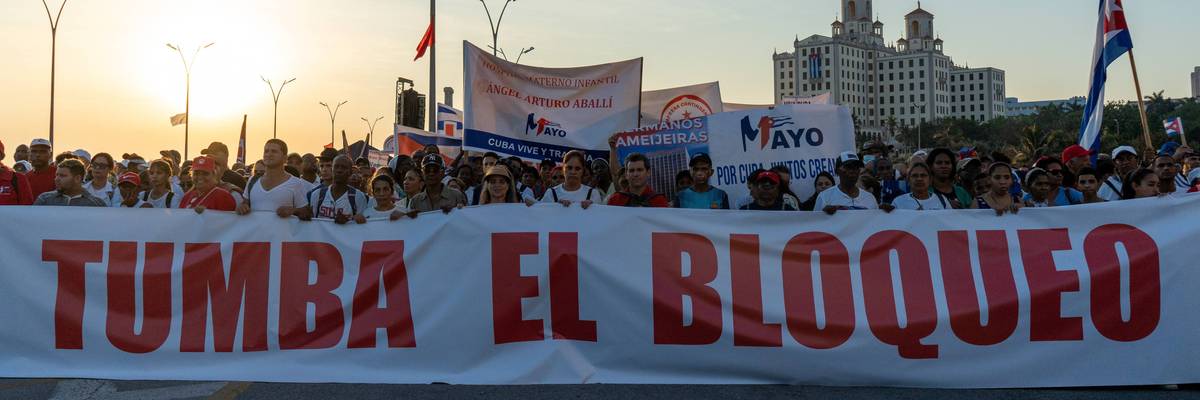
The president’s latest aggression toward Cuba comes amid his repeated threats to “take” the island. Cubans hold a banner reading, “Knock Down the Blockade” during an International Workers’ Day rally near the US Embassy in Havana on May 1, 2026. (Photo by Magdalena Chodownik/Anadolu via Getty Images)
Citing Cuba’s ties with its ally Iran, President Donald Trump on Friday signed an executive order expanding the already crippling US sanctions regime against Cuban officials, as the US administration has the island in its crosshairs after ousting Venezuela’s socialist leader.
The directive “imposes new sanctions on entities, persons, or affiliates that support the Cuban regime’s security apparatus, are complicit in government corruption or serious human rights violations, or are agents, officials, or material supporters of the Cuban government,” without identifying any of the affected groups or individuals.
For 65 years, the US has imposed an economic embargo on Cuba that has adversely affected all sectors of the socialist island’s economy and severely limited Cubans’ access to basic necessities including food, fuel, healthcare, and medicines—with disastrous results. The Cuban government claims the blockade cost the country’s economy nearly $5 billion in just one 11-month period in 2022-23 alone. United Nations member states have perennially—and overwhelmingly—condemned the embargo.
The Trump administration also imposed a fuel blockade and reinstated Cuba on the US State Sponsors of Terrorism list, from which former President Joe Biden removed the country before leaving office in 2021. Cuba was initially added to the list during the Reagan administration amid a decadeslong campaign of US-backed Cuban exile terrorism, failed assassination attempts, economic warfare, and covert operations large and small in a futile effort to overthrow the revolutionary government of longtime leader Fidel Castro.
Cuba says US-backed terrorism has killed or wounded more than 5,000 Cubans and cost its economy billions of dollars.
The Cuban government—which was celebrating International Workers’ Day on Friday—did not immediately respond to the expanded sanctions.
Experts warned that the new sanctions are worryingly broad, with Georgetown Law visiting scholar Peter Harrell writing on X that “basically any non-US person or company doing any business in/with Cuba could be sanctioned.”
Harrell noted that the edict “gives the Trump administration a fair amount of easy-to-deploy firepower to drive remaining international businesses out of Cuba.”
“The questions will be in implementation,” he added. “For example, will Trump sanction a Chinese firm installing renewable energy in Cuba?”
Trump’s edict comes months after the president ordered the invasion of Venezuela and abduction of socialist President Nicolás Maduro and amid the ongoing US-Israeli war on Iran, the 10th country bombed during the course of Trump’s two terms in office.
Trump last month declared that “we may stop by Cuba after we’re finished with this,” referring to war on Iran that’s left thousands of people dead or wounded, including hundreds of children. The president has also said that he believes he’ll “be having the honor of taking Cuba,” language echoing the 19th century US imperialists who conquered the island along with Puerto Rico, Guam, and the Philippines from Spain in another war waged on dubious pretense.
“Whether I free it, take it—I think I can do anything I want,” Trump said of the island and its 11 million inhabitants.
Dismantling the Voting Rights Act Sets American Democracy Back Decades
While the Supreme Court is right to acknowledge that the situation today is different from past decades, it errs drastically in concluding that the proper path forward is to gut one of the key pieces of legislation that made that progress possible.
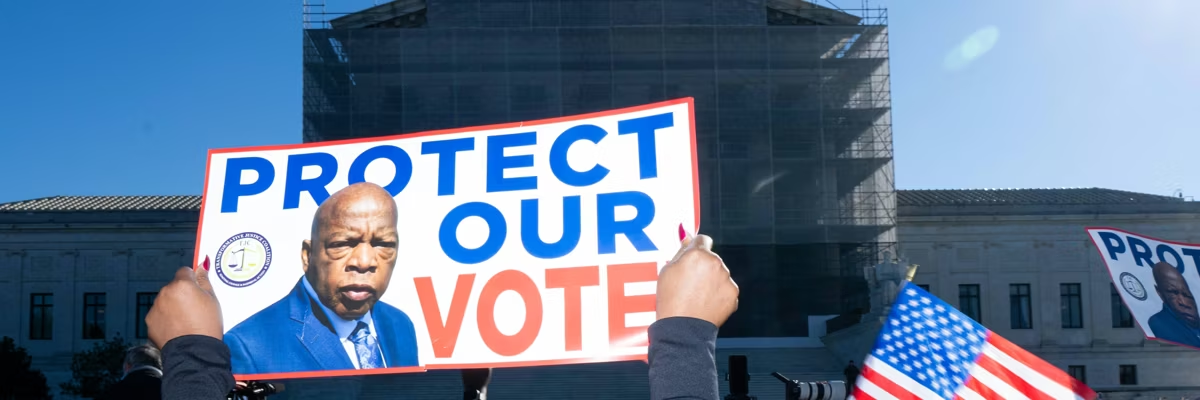
Voting rights activists protest outside the US Supreme Court as the court prepares to hear arguments in a case challenging Louisiana’s congressional map in Washington on Wednesday, October 15, 2025. (Photo by Bill Clark/CQ-Roll Call, Inc via Getty Images)
On April 29, the Supreme Court voted 6-3 along ideological lines to weaken Section 2 of the Voting Rights Act, which prohibits voting practices that discriminate based on race, color, or membership in a “language minority group.” Under this provision, states were allowed to consider race in drawing district maps for the purposes of protecting the voting power of people of color. That is, until now.
In Louisiana v. Callais, the Supreme Court struck down a Louisiana congressional map that created a second majority-Black district as “an unconstitutional gerrymander.” The map was created after the Fifth US Circuit Court of Appeals found that an earlier redistricting attempt with only one such district violated Section 2. The circuit court argued that the state unjustly divided Black communities in a way that “deprive[d] them of the opportunity to form effective voting blocs.” In response, Louisiana created a second majority-minority district, which Rep. Cleo Fields (D-La.) won in 2024. RECOMMENDED...
This new map was later challenged by a group of self-described “non-African Americans” who contended that it violated the Constitution’s equal protection clause. The Supreme Court concurred. Writing for the majority, Justice Samuel Alito remarked, the new map “would violate the plaintiffs’ constitutional rights.”
Notably, the Supreme Court did not rule that Section 2 itself was unconstitutional. Rather, they determined that the framework used to determine whether a map violates the provision must be updated “so it aligns with the statutory text and reflects important developments” in the decades following the passage of the Voting Rights Act (VRA). These “great strides” include abolishing voting tests, erasing disparities in voter registration and turnout due to race, as well as greater shares of people of color elected to political office. For the Supreme Court, these developments warrant a higher bar for Section 2 violations.
The Supreme Court misunderstands the present. It pretends that we live in a nation largely free of the very kinds of racial prejudices and issues that gerrymandered maps like Louisiana’s allow Congress to overlook.
This is a reckless conclusion. While recent decades have seen sizable progress in addressing racial discrimination, the court ignores two key points: Fiirst, progress does not mean that the problem is gone. Anti-voter bills designed to undermine the political power of people of color continue to be introduced and passed across the country. This is especially true in red states. As the Brennan Center of Justice notes, “Racially diverse states controlled by Republicans are far more likely to introduce and pass restrictive provisions than very white states with Republican control; in other words, it’s states like Texas and Arizona, not Wyoming or Utah, that are passing the most restrictive legislation.” In fact, on April 27, the Supreme Court issued a shadow docket ruling that allows Texas to implement a gerrymandered map that a Trump-appointed judge had previously found to be “racially discriminatory.”
Second, and as this very ruling indicates, progress can always be undone. Prior to this ruling, the Supreme Court had already undermined core aspects of the VRA. This includes eliminating “preclearance” requirements which mandated that states with histories of racist voting practices must have new election laws or procedures reviewed by a federal court or the Department of Justice. Since then, multiple states previously covered by those requirements, including Alabama, Georgia, and Louisiana, have seen their congressional maps challenged in federal court over concerns of racial discrimination.
Becoming complacent, as the Supreme Court would have us, puts the hard-fought victories that people of color have achieved at risk. Their emphasis on racial progress overlooks that even seemingly colorblind policies can set us back decades. Consider for instance the nominally race neutral SAVE America Act. It requires proof of citizenship, such as a US passport or birth certificate, to vote. This is effectively a poll tax that will disproportionately harm poor people and people of color. According to a 2023 YouGov poll, only about a third of Black Americans have a current passport. Moreover, some Black people may face more novel challenges. The Center on Budget and Policies Priorities reports that elderly Black people who were born under Jim Crow may never have been issued a birth certificate at all. As Senate Minority Leader Chuck Schumer (D-NY) put it, the SAVE America Act is “Jim Crow 2.0. […] What they’re trying to do here is the same thing that was done in the South for decades to prevent people of color from voting.” In short, the past is not simply history; if we are not vigilant, it can become our future.
The multigenerational, centuries-long issues of race will require more than 60 years to solve. While the Supreme Court is right to acknowledge that the situation today is different from past decades, it errs drastically in concluding that the proper path forward is to gut one of the key pieces of legislation that made that progress possible. More fundamentally, the Supreme Court misunderstands the present. It pretends that we live in a nation largely free of the very kinds of racial prejudices and issues that gerrymandered maps like Louisiana’s allow Congress to overlook. Importantly, by diluting the voting power of people of color and by extension their congressional representation, it undermines their efforts to combat racism, colorism, and xenophobia.
Nevertheless, under this court’s decision, future plaintiffs will have to show that “the State intentionally drew its districts to afford minority voters less opportunity because of their race.” Simply demonstrating that a congressional map dilutes a minority group’s voting power will not be sufficient. As Justice Elena Kagan writes in her dissenting opinion, requiring “vote-dilution plaintiffs” to prove a “race-based motive” will “make success in their suits nearly impossible.”
Intentionality is an incredibly difficult legal standard to meet. Proving intent is among the core reasons why hate crimes are so difficult to convict in court. As such, it is no surprise that Kagan believes this ruling effectively renders Section 2 “all but a dead letter.”
Justice Clarence Thomas, in his concurring majority opinion, wrote that the Supreme Court should never have interpreted Section 2 “to effectively give racial groups ‘an entitlement to roughly proportional representation.’” In his view, Section 2 “does not regulate districting at all.” Thomas’ opinion is not only inconsistent with the legislative and judicial history of the VRA, but it is inherently contrary to the ideals of a democracy. Proportional representation is not a mere “entitlement”—it is a constitutionally mandated guarantee that ensures that communities have their unique concerns addressed and their interests protected.
The Supreme Court’s decision, in conjunction with the Trump administration’s unrelenting assault on the Constitution, have set American democracy back decades. Yet, this is no time to despair. Now more than ever, we must organize, build broad multi-state coalitions, protest, and demand that our rights be recognized.
Our work is licensed under Creative Commons (CC BY-NC-ND 3.0). Feel free to republish and share widely.
Jordan Liz Jordan Liz is an Associate Professor of Philosophy at San José State University. He specializes in issues of race, immigration and the politics of belonging. Full Bio >
In a devastating blow to what John Lewis called “the most powerful non-violent tool we have in a democracy,” a right-wing, illegitimate SCOTUS finally gutted the Voting Rights Act they’ve long been chipping away at, ensuring communities of color will increasingly be denied “a voice in their own destiny.” By striking down a new Louisiana voting map as a bogus “racial gerrymander,” the court’s extremist hacks betrayed generations who fought and bled, said Fannie Lou Hamer, “to live as decent human beings.”
The court’s 6-3 decision in Louisiana v. Callais kneecapped “our nation’s most important federal civil rights law,” effectively voiding the last remaining provision of the landmark 1965 Voting Rights Act’s Section 2 that allowed voters of color to legally challenge racially discriminatory electoral maps. Specifically, they rejected Louisiana’s redrawn 2024 Congressional map that created a second majority-Black district - in a one-third Black state - aimed at righting the GOP’s racist wrongs of the past, defying precedent, context and common sense to argue the move, already upheld by two courts, was “an unconstitutional racial gerrymander.”
In another outlandish opinion, Samuel Alito, the hackiest of a cabal of hacks, didn’t directly strike down Section 2, which prohibits voting practices that discriminate on the basis of race; writing for the majority, he argued he was simply “properly” re-interpreting it to require proof of intentional discrimination - which Congress didn’t write into the law, which defies past rulings that redistricting must only result in discrimination, intended or no, and which is almost impossible to prove. Thus, wielding “sleight of hand and legal gibberish,” did Alito give license for corrupt politicians to further rig the system by silencing entire communities of color.
The potential death knoll for a vital law that’s curtailed racial gerrymandering and discrimination for 60 years comes, of course, after years of whittling away by Roberts Court zealots, using tactics from voter ID laws to limiting registration. One advocate: “This ruling isn’t about the law, it’s about power, and giving Republicans more seats they (could) win at the ballot box.” One “pernicious” result, writes Rick Hasen: To “bleach the halls” of Congress, state legislatures and city councils, the life’s work of judges who see their constituency as aggrieved white men hostile to the rights of minorities - a stance that puts them “at odds with democracy itself.”
In a fiery dissent, Justice Elena Kagan charged the majority “straight-facedly holds the Voting Rights Act must be brought low to make the world safe for partisan gerrymanders.” The law they “eviscerate”, she wrote, “is - or, now more accurately, was - one of the most consequential, efficacious, and amply justified exercises of federal legislative power in our Nation’s history. It was born of the literal blood of Union soldiers and civil rights marchers, and repeatedly, and overwhelmingly, reauthorized by the people’s representatives in Congress. Only they have the right to say it is no longer needed - not the Members of this Court.”
Above all, critics decry the hubris and perfidy of those heedless Court members blithely stripping from millions of Americans the elemental rights so many of their descendants struggled, suffered and died for. The Rev. William Barbereviscerated a court, ignorant of the painful history of “the rights that cost our people so much,” that has “decided their job is to enable extremism and systemic racism by arguing that race has no place in the American Democratic process. Race has always had a place in the process. And claiming that partisan decisions are not racist is a form of racism.” “Some of us,” John Lewis humbly noted of his lifetime of good trouble, “gave a little blood for (that) right.”
John Lewis called the fight for voting rights "the struggle of a lifetime, or maybe even many lifetimes."Photo from Getty Archives
So did Fannie Lou Hamer, who fought against a Jim Crow South she’d grown up in because, “I was sick and tired of being sick and tired.” The granddaughter of slaves and youngest of 20 children of sharecroppers, she was 45 in 1962 when she went to a SNCC meeting at a church in Sunflower County, Mississippi and learned Black people could register to vote. The next day, she took a bus with 17 others to the county seat in Indianola. Police only let her and another person take the literacy test; she failed, but kept going back until she passed: “If I’d had any sense, I’d a been scared. But the only thing (whites) could do was kill me, and it seemed they’d been trying to do that a little bit at a time since I could remember.”
On the way back, police stopped them and brought them back to Indianola, where the bus driver was fined for “driving a bus the wrong color.” Back at the plantation, her children said the owner was angry she’d gone to vote; he told her to leave that night “because we are not ready for that in Mississippi.” “I didn’t try to register for you,” she said.. “I tried to register for myself.” Then she left: “They set me free. It’s the best thing that could happen. Now I could work for my people.” For the rest of her life, she did. She joined the voter registration campaign, helped organize Freedom Summer, became SNCC’s oldest field secretary, ran for Congress.
Left with a limp after surviving childhood polio, she embraced her identity as a Black working-poor woman with a disability and little formal education, upending preconceptions of both Black colleagues and white foes. When Rep. Adam Clayton Powell Jr. once challenged her expertise, she retorted, “How many bales of cotton have you picked?” In 1963, she became more disabled after she was arrested with other activists in Winona MS, taken to jail and brutally beaten by cops and, on their order, other black prisoners, suffering permanent damage to her eyes, legs and kidneys. She was still in jail when Medger Evers was murdered.
In August 1964, she recounted that ordeal at the Democratic National Convention in Atlantic City, days after the funerals of murdered Freedom Riders Chaney, Schwerner and Goodman. Testifying to the Credentials Committee, she challenged the seating of Mississippi’s all-white delegation - from still-all-white primaries - demanding the party seat Black members of an integrated Mississippi Freedom Democratic Party she’d helped found. In the end, MFDP delegates were not seated - party leaders offered a compromise of 2 seats, which she declined - but she had confronted them on a national stage about their own discrimination, famously asking, “Is this America?”
During Hamer’s testimony, then-president Lyndon Johnson had hastily called a news conference to divert attention for white Dem voters alarmed by her insistence on true equality. Cameras duly cut away from Hamer, but networks later showed her speech. “Hamer had pulled back the curtain,” read one account. “The United States could not claim to be a democracy while withholding voting rights from millions of its citizens.” Ultimately, Hamer’s inclusive political vision, along with a groundswell of civil rights activism, led to Johnson’s finally signing the 1964 Civil Rights Act and the 1965 Voting Rights Act, ensuring government could not “deny or abridge the right of any citizen to vote on account of race or color.”
Hamer remained active through the 1960s and 1970s. She spoke with Malcolm X in Harlem, at the ‘68 and ‘72 DNC, at 1969’s Vietnam War Moratorium rally in Berkeley. In 1971, she helped found the National Women’s Political Caucus, aimed at recruiting, training and supporting women to run for office. The titles of her speeches reflected her resolve, her anger, her fierce hope: “We’re On Our Way,” “Nobody’s Free Until Everybody’s Free,” “The Only Thing We Can Do Is Work Together,” “”What Have We To Hail,“ ”America Is A Sick Place,“ ”To Make Democracy A Reality,“ and, in 1976, ”We Haven’t Arrived Yet.“
Clearly, sorrowfully, we damn sure still haven’t. Unlike so many others, Hamer lived to do her work and tell her story, for a while. She died in Mississippi on March 14, 1977, aged just 59, of breast cancer exacerbated by high blood pressure, diabetes, and complications from her jail beatings. She died, too, “from being poor, Black, and an activist in Mississippi at a time when all of that was lethal.” Andrew Young gave her eulogy, telling mourners “the seeds of social change in America were sown here by the sweat and blood of you and Fannie Lou Hamer.” Then they sang her favorite song: “This little light of mine.” Her gravestone reads, “I am sick and tired of being sick and tired.” May we honor her labors, and may she rest in well-earned peace and power.
“The wrongs and the sickness of this country have been swept under the rug. But I’ve come out from under the rug, and I’m going to tell it like it is.” - Fannie Lou Hamer
“To the Justices Who Took What Others Bled For: History will have its say. But so will the bridge. So will the blood on the pavement. So will the people who were told to wait, then beaten for praying, then buried for believing the Constitution meant what it said....You’ll wear this shame for the rest of your lives.” - Derek Penwell
Our work is licensed under Creative Commons (CC BY-NC-ND 3.0). Feel free to republish and share widely.
Abby Zimet Abby Zimet has written CD's Further column since 2008. A longtime, award-winning journalist, she moved to the Maine woods in the early 70s, where she spent a dozen years building a house, hauling water and writing before moving to Portland. Having come of political age during the Vietnam War, she has long been involved in women's, labor, anti-war, social justice and refugee rights issues. Email: azimet18@gmail.com Full Bio >
Trump Approval of ‘Keystone Light’ Pipeline Blasted as Yet Another Gift to Big Oil
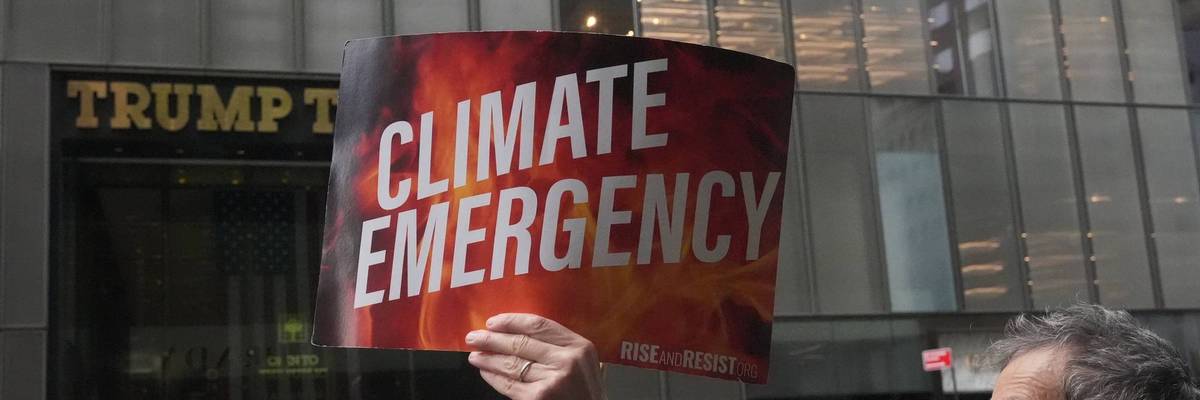
“More pipelines mean more drilling, more waste, and more spills. And when spills happen, it’s communities, landowners, and tribes who are left dealing with the contamination, not the companies profiting from it,” said one critic. Demonstrators gather outside Trump Tower to raise awareness about climate change, environmental protection, and sustainability, in New York City on Earth Day, April 22, 2026. (Photo by Selcuk Acar/Anadolu via Getty Images)
“We know that if this project goes through, our land and our water are in danger. Our future is in danger,” warned Krystal Two Bulls, one of many community, conservation, and Indigenous group leaders speaking out after President Donald Trump granted a cross-border permit to what critics called “nothing more than an attempt to resurrect the unpopular Keystone XL pipeline.” Trump’s permit for the Bridger Pipeline Expansion Project authorizes various “petroleum products, including gasoline, kerosene, diesel, and liquefied petroleum gas,” The Associated Press reported Thursday, but Bridger spokesperson Bill Salvin said the company is currently focused on crude oil—550,000 barrels of which could flow daily from Canada, through Montana, to Guernsey, Wyoming, if the pipeline is completed.
“Water protectors are standing up again, like we have always done against all those who threaten Mother Earth,” Two Bulls, an Oglala Lakota and Northern Cheyenne organizer from Lame Deer, Montana, and executive director of Honor the Earth, said Friday. “We fought against the Keystone XL pipeline proposed for these very same lands and won back in 2021. We will fight and win again against the Bridger pipeline.”
Shortly after entering office in 2021, then-President Joe Bidenrevoked the presidential permit for Keystone XL—which Trump had signed during his first term—as part of the Democrat’s efforts to combat the fossil fuel-driven climate emergency.
While Biden faced criticism from climate advocates for the oil and gas projects he did allow, Trump took a swipe at him on Thursday, telling reporters: “Slightly different from the last administration. They wouldn’t sign a pipeline deal, and we have pipelines going up.”
Trump—who campaigned on a pledge to “drill, baby, drill” and returned to the White House last year with financial help from Big Oil—also dismissed safety concerns about pipelines, saying: “By the way, they’re way underground. They’re not a problem. Nobody even knows they’re there. It’s so crazy. But they wouldn’t approve anything having to do with a pipeline.”
As the AP detailed: Bridger Pipeline and other subsidiaries of True Company have been responsible for several major pipeline accidents including more than 50,000 gallons (240,000 liters) of crude that spilled into the Yellowstone River and fouled a Montana city’s drinking water supply in 2015, a 45,000-gallon diesel spill in Wyoming in 2022 and a 2016 spill that released more than 600,000 gallons (2.7 million liters) of crude in North Dakota, contaminating the Little Missouri River and a tributary.
Subsidiaries of True agreed to pay a $12.5 million civil penalty to settle a federal lawsuit over the North Dakota and Montana spills.
Salvin said Bridger Pipeline in the years since the Yellowstone spill developed an AI-based leak detection system that allows it to be notified more quickly when there are problems. It also plans to bore 30 to 40 feet (9 to 12 meters) beneath major rivers including the Yellowstone and Missouri to reduce the chances of an accident. The 2015 accident occurred on a line that was constructed in a shallow trench at the bottom of the river.
A public comment submitted to the Trump administration by the legal group Earthjustice on behalf of Honor the Earth, Sierra Club, WildEarth Guardians, and a dozen other organizations acknowledges concerns about this pipeline’s potential impacts to water, land, the climate, air quality, cultural resources, recreation, and more—and called for an intense federal review of the project.
“We know how this system works: More pipelines mean more drilling, more waste, and more spills. And when spills happen, it’s communities, landowners, and tribes who are left dealing with the contamination, not the companies profiting from it,” Rebecca Sobel, climate and health director at WildEarth Guardians, said Friday. “Oil and gas infrastructure fails every day in this country, and expanding that system only increases the likelihood of spills and long-term contamination.”
Sierra Club Montana chapter director Caryn Miske stressed that “while the Trump administration kills affordable energy projects and jobs across the country, it is continuing to side with wealthy corporations and oil executives looking to increase profit regardless of the risks to Montana’s treasured waterways and to families and businesses struggling with high energy costs. These policies aren’t about fair or free markets, it’s welfare for corporations and pollution for everyone else.”
Earthjustice is also representing 350 Montana, Center for Biological Diversity, Families for a Livable Climate, Montana Environmental Information Center, Montana Health and Climate, Mountain Mamas, Red Medicine LLC, Western Environmental Law Center, Western Organization of Resource Councils, Western Watersheds Project, Wild Montana, and Wyoming Outdoor Council.
“The proposed Bridger tar sands pipeline is an environmental disaster waiting to happen,” declared Jenny Harbine, managing attorney with Earthjustice’s Northern Rockies office. “The Trump administration appears more than willing to limit public engagement to force this project through.”
“Communities and tribes in the Northern Rockies have a right to know how this could impact their water sources, historic resources, and ways of life,” Harbine added. “If the administration attempts to sidestep that legal obligation, we’ll see them in court.”
Separately on Friday, Anthony Swift, a longtime leader in the fight against the pipeline and current senior strategist for global nature at Natural Resources Defense Council, said that “no matter what you call the project, the environmental concerns that animated the fight over Keystone XL are no less acute today. Keystone Light will threaten water supplies and exacerbate climate change. This is the moment to get off the oil roller coaster, not double down on the dirtiest oil on the planet.”
“The Trump administration has been lobbing gifts to Big Oil since its first day in office. This is the latest in a long, long, long list of favors that show the oil industry is getting a great return on its billion-dollar investment in the president’s campaign,” Swift added. “President Trump has repeatedly said that America does not need Canada’s oil, so we certainly don’t need Keystone Light.”
‘Sweeping and Dangerous’: US Appeals Court Blocks Mailing of Abortion Pills
The “politically driven” ruling, warned one campaigner, “overrides medical expertise and years of research, and threatens to upend how abortion care is delivered nationwide.”
An abortion rights advocate holds a box of mifepristone outside the US Supreme Court in Washington, DC, on March 26, 2024. (Photo by Shuran Huang for The Washington Post via Getty Images)
Rights advocates swiftly sounded the alarm on Friday after the infamously far-right US Court of Appeals for the 5th Circuit temporarily blocked a federal rule allowing mifepristone to be dispensed by mail, dramatically curtailing access to the medication—commonly used for abortion and early miscarriage care—nationwide, particularly in states with policies hostile to reproductive freedom.
Just months after the US Supreme Court’s right-wing supermajority reversedRoe v. Wade, the Food and Drug Administration permanently lifted mifepristone’s in-person dispensing requirement in early 2023, under then-President Joe Biden. Louisiana—which has among the nation’s most restrictive abortion policies—challenged the FDA’s move.
A federal judge in Louisiana paused that lawsuit last month while President Donald Trump’s administration conducts an FDAreview that seems “designed to manufacture an excuse for further restricting medication abortion across the country,” as Julia Kaye, senior staff attorney for the ACLU’s Reproductive Freedom Project, warned at the time.
After a panel from the appellate court overturned that decision and revived the in-person dispensing rule on Friday, Kaye declared that “anti-abortion politicians have just made it much harder for people everywhere in the country to get a medication that abortion and miscarriage patients have been safely using for more than 25 years.”
“Louisiana’s legal attack on mifepristone shamelessly packaged lies and propaganda as an excuse to restrict abortion—and the 5th Circuit rubber-stamped it,” she continued. “This decision defies clear science and settled law and advances an anti-abortion agenda that is deeply unpopular with the American people. For countless people, especially those who live in rural areas, face intimate partner violence, or live with disabilities, losing a telemedicine option will mean losing access to this vital medication altogether.”
Brittany Fonteno, president and CEO of the National Abortion Federation (NAF), similarly stressed that “this ruling is a sweeping and dangerous rollback that disregards the well-established safety and efficacy of the use of mifepristone via telehealth, and will create immediate, medically unnecessary barriers to care for patients across the country.”
“Make no mistake: This ruling is not grounded in science or patient safety,” she said. “It is a politically driven decision that overrides medical expertise and years of research, and threatens to upend how abortion care is delivered nationwide. Through this litigation, Louisiana seeks to impose its cruel abortion ban across the nation—including in states with legal protections for abortion—and today the court has taken an extreme step toward that end.”
While pledging that “NAF and our allies will continue to advocate to restore full access to medication abortion,” Fonteno reminded patients that mifepristone “remains available in doctors’ offices, clinics, and hospitals.”
After Roe‘s reversal, the anti-choice movement and its allies in elected offices ramped up efforts to impose state-level restrictions on reproductive healthcare. A significant majority of abortions in the United States involve a two-drug regimen of mifepristone and misoprostol, and a quarter of those patients receive care via telemedicine.
“Telehealth has been the last bridge to care for many seeking abortion, which is precisely why Louisiana officials want it banned,” said Nancy Northup, president and CEO of the Center for Reproductive Rights, which joined over 100 other reproductive health, justice, and rights groups, including the ACLU and NAF, that filed an amicus brief in this case.
“This isn’t about science—it’s about making abortion as difficult, expensive, and unreachable as possible,” Northup added. “Telehealth has transformed healthcare. Selectively stripping that away from abortion patients is a political blockade.”
The drug companies Danco Laboratories, which makes the brand-name version of mifepristone, Mifeprex, and GenBioPro, which makes the generic, have intervened in Louisiana v. FDA. GenBioPro is represented by the law firm Arnold & Porter and Democracy Forward, whose president and CEO, Skye Perryman, declared Friday that “this is the anti-abortion extremists’ playbook in action once again: Weaponize the courts to serve their political interests, ignore decades of scientific evidence proving mifepristone’s safety, and put women directly in harm’s way.”
“Even as this assault defies the will of the overwhelming majority of the American public, these ideologically extreme politicians and organizations are determined to impose a narrow, autocratic agenda—no matter the cost,” she continued, emphasizing that “our fight is not over.”
The effects of the 5th Circuit’s decision are expected to be immediate absent a quick intervention from the Supreme Court, and Nourbese Flint, president of All* Above All, warned that “as always, the people most impacted will be Black and brown communities and those already navigating systemic barriers to care.”
Serra Sippel, executive director of the Brigid Alliance, a national abortion support group that helps coordinate and fund travel, said that “we expect to see an immediate increase in patients forced to travel hundreds or even thousands of miles for care. That includes many who are later in pregnancy—when care is more complex and more expensive.”
“Over the past several years, we’ve seen a dramatic rise in abortion travel and a growing reliance on practical support networks like ours, particularly in states where patients already travel long distances for care,” Sippel noted. “We will continue to monitor the impact of this ruling and are committed to ensuring abortion patients who need to travel can safely get to the care they need, regardless of where they live.”
Watchdog exposes Republicans' quiet sabotage of Social Security
Last week, I visited three chronically understaffed Social Security “ghost offices” in Ohio. These are Social Security field offices with too few staff to meaningfully serve the local community. That means people have to wait months for an appointment, if they can get one at all. It is getting harder and harder for Americans to claim their hard-earned benefits.
Kelly Phillips Erb recently wrote in Forbes about the five-month long ordeal her widowed 77-year-old mother went through to claim Social Security benefits. Stories like that are playing out across the country.
This is no accident. The Trump administration engineered the ghost office crisis. Elon Musk’s Department of Government Efficiency (DOGE) forced thousands of workers, including many of the most experienced, out of the Social Security Administration. Thousands more workers were reassigned away from field office work to answer the 1-800 number, without proper training. In 2025 alone, Social Security offices lost an estimated 20% of staff.
Ghost offices are now beginning to turn into closed offices. Over a dozen Social Security offices around the country are currently closed due to lack of staff. It simply isn’t possible to run Social Security properly without the dedicated, experienced staff that Musk forced out.
The three Ohio Social Security field offices I visited were in Painesville, Middleburg Heights, and Columbus. Each of these areas is represented by a Republican congressman who is helping to decimate Social Security.
Donald Trump and Elon Musk are wrecking our Social Security system so they can rob it. And every Republican in Congress is complicit. They’ve all voted for budgets that underfund Social Security, while cheering on DOGE’s cuts.
That includes Senator Jon Husted (R-Ohio), who is on the ballot this November. His opponent is longtime Social Security champion Sherrod Brown, who is running to return to the US Senate. Brown has always fought to protect and expand Social Security, and to fully fund the system’s customer service. Meanwhile, Husted and his fellow Republicans are demolishing Social Security brick by brick.
Last November, Husted introduced a so-called “Balanced Budget Amendment.” That would have forced cuts to Social Security, making it illegal to pay promised benefits. Husted wants to deny you the benefits you’ve earned, so that billionaires can buy more golden yachts.
He isn’t alone. The three Ohio Social Security field offices I visited were in Painesville, Middleburg Heights, and Columbus. Each of these areas is represented by a Republican congressman who is helping to decimate Social Security.
The Columbus office is in Ohio’s 15th district, currently represented by Republican Rep. Mike Carey. Carey’s likely Democratic opponent, Adam Miller, joined me at the rally outside the office, where he railed against the Trump administration’s cuts and vowed: “We need to expand Social Security staffing, outreach, and hours. That’s what a Democratic Congress is going to do!”
The Middleburg Heights office is in Ohio’s 7th district, currently represented by Republican Rep. Max Miller—one of the most vulnerable incumbents in the country. The district has a staggering 7,161 Social Security beneficiaries for every field office worker. Like Husted, Max Miller supports a Balanced Budget Amendment that would make it illegal for Social Security to pay promised benefits.
I also visited an office in Painesville, which is in Ohio’s 14th district, currently represented by Rep. David Joyce. The district has lost 16% of its Social Security staff in the last year. Like the other Republicans, Joyce has consistently voted for budgets that underfund Social Security.
During my time in Ohio, I met field office staffers who are struggling to keep up with the workload. They are dedicated public servants who work relentlessly every day, but one person simply can’t do the jobs of five, 10, or 15 people forever. I also met Americans who are struggling to access their hard-earned benefits because of the Trump sabotage.
For the sake of Social Security’s future, we need to vote Republicans out of office this November, and replace them with Democrats who will hold the Trump administration accountable. My trip to Ohio was just the beginning.
Alex Lawson is the Executive Director of Social Security Works, the convening organization of the Strengthen Social Security Coalition -- a coalition made up of over 340 national and state organizations representing over 50 million Americans.
'Tough spot': CNN host pities astronauts having to endure fawning president
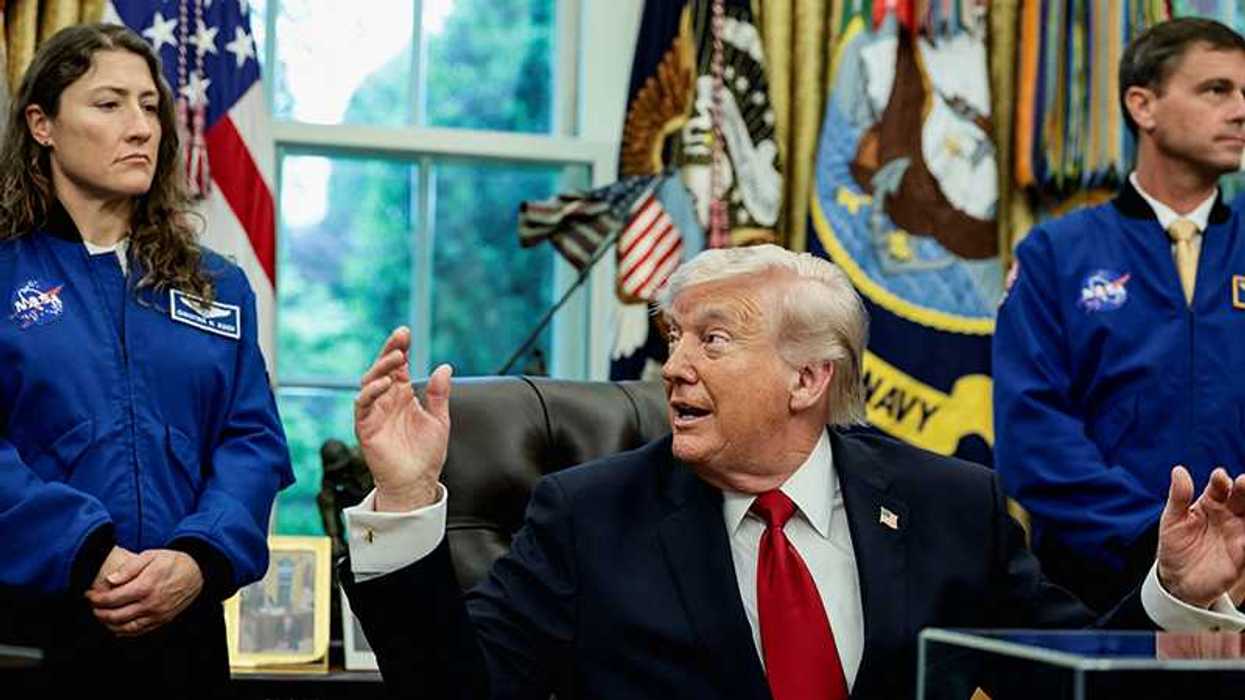
Artemis II astronauts, NASA Commander Reid Wiseman and NASA Mission Specialist Christina Koch, with President Donald Trump in Washington, D.C., U.S., April 29, 2026. REUTERS/Evelyn Hockstein
President Donald Trump welcomed the Artemis II astronauts to the White House after their incredible trip farther than any other human has traveled. He didn't want to talk about that, however.
CNN host Brianna Keilar noted that Trump talked about former FBI Director James Comey, crime in Washington, D.C. It was anything but a conversation about the Artemis II crew standing beside him.
"I think we should just also point out what a tough spot for these incredibly accomplished astronauts who have just renewed so much interest in space travel with their incredible achievement of this Artemis II mission," said Keilar. "You know, two of them are active duty military, one of them Canadian, by the way. So, you can understand being in the middle of a situation like this, where some of this is getting politicized. It's just it's extraordinary. It's bizarre."
She noted that the whole purpose of the Artemis crew being at the White House was to celebrate their accomplishments.
After a short conversation about Trump's latest threats on Iran, the anchors returned to the awkward astronauts.
Co-host Boris Sanchez said the president appeared to recognize the position he was putting the astronauts in by turning to complain about politics, among other issues.
"I don't want to get you guys involved. I can't imagine what you're thinking," Trump told the astronauts.
When Trump did get a question about NASA and moving the headquarters, Trump didn't appear to understand the question and asked the reporter to "rephrase" it. After she asked it again, he called on the NASA administrator and then made fun of his ears.
"Yeah, he said, I know [they're] in a tough spot. And then he made it tougher by kind of saying ... I know what you're thinking. Which also can be read as, 'you agree with me. I'm not going to have you speak about that," said longtime CNN broadcaster Tom Foreman.
Foreman mentioned the astronauts' accomplishments again, saying that what they did was a big deal for the United States, but the win-hungry president glossed over it.
"This flight of Artemis II is, honestly, I think, one of the few things that we can point to in a big way in this country in the past several months or whatever, where a lot of people left and right would agree, this was an amazing accomplishment," Foreman said. "And isn't it great that they went out there. This was an accomplishment that was built over many years, not just Donald Trump's years."
He explained that they were there to be honored, but Trump spent no time honoring them.
"He talked to the astronauts much longer in space than he did when they were in the room with him!" said Foreman.
Meanwhile, the Trump administration is making drastic cuts to NASA programs that made the Artemis II mission possible. Foreman called it, embracing his guests at the party while having their cars towed.
Republicans and Democrats have tried to convey to the White House that the U.S. will lose the space race to Chinese dominance and they will beat the U.S. to building a moon base and landing on Mars.
Foreman said that it could have very easily been a normal photo-op with a handshake and a wave, " But it turned into something very different."
Republicans have said that they will not allow Trump to make the 25 percent cuts to NASA that were proposed.
Science.org reported that the draft of the budget bill "is an early sign that Congress again thinks Trump has gone too far in cutting research."
Seth Rogen's new film shows children how tyrants like Trump manipulate the masses Animal Farm/ Screenshot
Editor's Note: The story has been updated to include additional information about the "Animal Farm" animators.
In the age of President Donald Trump, American children need to see "Animal Farm."
Based on satirist George Orwell's classic 1945 novella of the same name, “Animal Farm” loosely adapts the original’s plot into an age-appropriate animated film. Directed by Andy Serkis, written by Nicholas Stoller and starring Seth Rogen, Gaten Matarazzo, Woody Harrelson, Glenn Close and Laverne Cox, it tells the story of a livestock rebellion in which pigs, sheep, chickens, cows and other animals overthrow their farmer and take over his farm. When Orwell first wove this tale more than 80 years ago, it reflected his disillusionment with left-wing politics: A democratic socialist himself, Orwell was dismayed and horrified as the Soviet Union descended into tyranny after the corrupt Joseph Stalin ran Leon Trotsky out of the government.
Flash forward to the 21st century and it’s shocking: The exact same dynamics that Orwell despised in the leftist anti-establishment define the right-wing populism promulgated by Trump. Given that the main filmmakers and stars are explicitly anti-Trump themselves, it is reasonable to surmise that these parallels are deliberate.
As depicted in the Angel Studios version, a boar named Napoleon (Rogen) orchestrates a coup against a pig named Snowball (Cox), a liberal-coded pig (and a character that, in Cox's hands, seems more like Hillary Clinton than Trotsky) who is smart and sincerely means well but cannot conceal her patronizing attitude toward the masses. Discovering and resenting her condescension, the other animals turn on Snowball and follow Napoleon’s lead, who panders to them while secretly plotting to sell them out for his personal profit.
If all of this reminds you of Trump, again, I doubt that was an accident. Just as Orwell criticized Stalin and his supporters for being no better than the aristocrats they deposed, Serkis and Stoller recognize that Trump’s appeal similarly depends on their supporters failing to see how their supposed liberators are exactly like other oppressors. In true Trump-ian fashion, Rogen’s Napoleon wheedles, bribes, gaslights and bullies as necessary to convince a population which craves economic and social justice that he will provide it. Behind the scenes, however, Napoleon ruthlessly funnels all of the farm's wealth and power to himself and his cronies.
I enjoyed everything about "Animal Farm": It's clever, colorful and well-served by its talented cast, especially Rogen as a Napoleon who mixes Trumpist values with Rogen-esque shtick. My positive view on “Animal Farm," however, is not the consensus opinion. Most of my fellow Rotten Tomatoes critics panned “Animal Farm,” complaining (to quote The Wrap’s William Bibbiani) that “the changes [from the book] aren’t an improvement. Most of them only call attention to the power of Orwell’s novella, and the comparative powerlessness of this new version.” To an extent, Bibbiani is correct: Orwell wrote his book for adults while Serkis made his film for young people, and therefore the book is more incisive, layered and thought-provoking than the motion picture.
Yet just because a movie doesn’t live up to a great book, that doesn’t mean the movie itself isn’t also great. Indeed, in this case, trying to faithfully adapt the source material would likely have backfired. I think of Victor Hugo's novel "The Hunchback of Notre Dame," which in my opinion is superior to the nevertheless-excellent animated Disney film. While I won't spoil the book's plot by revealing the changes, suffice to say that they are both substantial and justifiable, as the Disney film had to remove much of the dark source material so the final product would be suitable for young people. Serkis and Stoller faced the same challenge and rose to it, thereby achieving something quite impressive with this motion picture. For “Animal Farm,” the filmmakers needed to tell an entertaining and kid-appropriate story that nevertheless, like Orwell's novella, effectively explains through its plot how tyrants manipulate their citizens. “Animal Farm” accomplishes this so deftly that I suspect some of critics are taking that feat for granted. Unlike the two previous cinematic iterations of "Animal Farm" — a 1954 animated film and a 1999 live-action adaptation — this one works overtime to be appropriate for kids of all ages.
So yes, Rogen’s Napoleon and his goons are broadly characterized, their machinations easy for all but the tiniest tots to comprehend. Yes, the movie is full of cutesy images, catchy songs, toilet humor and other accoutrements one usually sees in mainstream animated family fare. This is as it should be: “Animal Farm” can appeal to children as much as any “Despicable Me" movie (and, like that franchise, this one looks like it was drawn by Illumination, although Aniventure and Imaginarium Productions made it, with Angel Studios distributing). Importantly, though, "Animal Farm" is crystal clear in transmitting Orwell’s main message: That one should distrust charismatic leaders who promise to help the masses, then manipulate and bully so that they can become dictators themselves.
We live in an era in which Americans need to trust their brains, eyes and ears instead of listening when told to respect corrupt and self-aggrandizing leaders. At a time when Trump is using every conceivable tool to become an American Napoleon — trying to steal elections, exacerbate racial divisions, profit from power and silence critics (especially after the attempts on his life) — kids need to watch “Animal Farm" so they can learn its crucial lesson: Think for yourself, not as the powerful want you to.
Frankly, their parents should learn that lesson too. Democracy depends on it.
Not Just an Abstract Moral Appeal: Ending the Nuclear Age Is a Requirement for Survival
Humanity faces a choice, whether consciously or not, to continue down a path of conflict that leads toward ultimate destruction or to renounce its old ways and center peace at the heart of all its efforts. "The World Is No Place For Nuclear Weapons" was projected onto the side of Queen Elizabeth House, the new flagship UK Government Hub, in Edinburgh, to celebrate that the Treaty on the Prohibition of Nuclear Weapons (TPNW) enters into force as international law on January 22, 2021. (Photo by Jane Barlow/PA Images via Getty Images)
This speech was delivered to the 11th Review Conference of the Treaty on the Non-Proliferation of Nuclear Weapons on May 1, 2026.
Honorable President, Distinguished Delegates, Colleagues, and Friends,
We are living in a decisive moment. Humanity faces a choice, whether consciously or not, to continue down a path of conflict that leads toward ultimate destruction or to renounce its old ways and center peace at the heart of all its efforts.
International law, built painstakingly over decades and even centuries to prevent such an unfathomable catastrophe, is under brazen and relentless attack today. At the heart of this divergence lies a fundamental question: whether states may claim a right to wage war without restraint, and whether use and even possession of weapons with potential to end human civilization can ever be justified. These are precisely the issues at the core of the Treaty on the Non-Proliferation of Nuclear Weapons (NPT)—whose future we have gathered to discuss at this Review Conference.
Nuclear disarmament and nuclear non-proliferation are not separate tracks toward a safer world—they are intertwined and inseparable paths.
Our world is a time-ticking bomb. There are more than 12,000 nuclear warheads in existence—each capable of killing hundreds of thousands, some even millions of people, and any one of which could trigger a chain reaction leading to full-scale nuclear war in less time than this session will last.
More than 40 years ago, Presidents Ronald Reagan and Mikhail Gorbachev reminded us that “a nuclear war cannot be won and must never be fought.” And yet today, we hear renewed calls to use nuclear weapons in the name of “saving lives,” alongside threats that contemplate the destruction of entire societies.
The five nuclear-weapon states recognized under the NPT, the United States, the Russian Federation, the United Kingdom, France, and China, possess over 95% of the world’s nuclear arsenal. With that power comes not only a moral responsibility, but a clear legal obligation under Article VI of this Treaty: to pursue negotiations in good faith to achieve not only nuclear disarmament, but also total and complete general disarmament.
Nuclear disarmament and nuclear non-proliferation are not separate tracks toward a safer world—they are intertwined and inseparable paths. As Joseph Rotblat warned in his 1995 Nobel Peace Prize acceptance speech: “If the militarily most powerful and least threatened states need nuclear weapons for their security, how can one deny such security to countries that are truly insecure? The present nuclear policy is a recipe for proliferation. It is a policy for disaster.”
We join the voices of hibakusha and countless others who have come before us in urging all NPT States Parties to take immediate and meaningful action:Condemn and cease all military combat, including wars that risk escalation toward nuclear conflict, and reaffirm the primacy of international law and peaceful resolution of disputes.Unequivocally renounce the use or threat of use of nuclear weapons under any circumstances, and reject policies such as “launch on warning” and “first-use” that heighten, rather than reduce, the risk of nuclear war.Commit to a concrete, time-bound path toward a world free of nuclear weapons, including by joining the Treaty on the Prohibition of Nuclear Weapons. The first step in this journey must be clear to all: The United States and the Russian Federation, which together possess more than 85% of the world’s nuclear arsenals, must urgently restart bilateral negotiations to reduce and ultimately eliminate their stockpiles. The remaining nuclear-armed states must pause all modernization and arsenal increase programs, and commit to a transparent, verifiable, and irreversible process of disarmament.Recognize and assist all victims of the nuclear age, including survivors of the atomic bombings of Hiroshima and Nagasaki, those impacted by more than 2,000 nuclear explosions during the so-called nuclear testing period, and uranium miningworkers and others harmed by the the development of nuclear weapons, ensuring justice, support, and environmental remediation.
This call is not just an abstract moral appeal; it is a prerequisite for human survival. The credibility of the NPT and the future of humanity depend on the actions we take over the next three weeks.
In the words of Joseph Rotblat: “The quest for a war-free world has a basic purpose: survival. But if in the process we learn how to achieve it by love rather than by fear, by kindness rather than by compulsion; if in the process we learn to combine the essential with the enjoyable, the expedient with the benevolent, the practical with the beautiful, that will be an extra incentive to embark on this great task.”
Thank you, Honorable President.
Our work is licensed under Creative Commons (CC BY-NC-ND 3.0). Feel free to republish and share widely.
Ivana Nikolić Hughes Ivana Nikolić Hughes is President of the Nuclear Age Peace Foundation and a Senior Lecturer in Chemistry at Columbia University. Her work on ascertaining the radiological conditions in the Marshall Islands has been covered widely. Her writing has appeared in the Bulletin of Atomic Scientists, The Hill, Scientific American, The Diplomat, Truthout, Transcend Media Service, and elsewhere. Full Bio >
Chart Shows How Trump 2.0 Is ‘Most Brazenly Self-Enriching’ Administration in US History
Buying Trump’s meme coin is like investing in “a pet rock, except you don’t even get a rock” out of the deal, said economist Steve Rattner.
A Donald Trump coin is pictured alongside Bitcoin and various other cryptocurrencies in this photo illustration in Brussels, Belgium, on August 5, 2025. Photo by Jonathan Raa/NurPhoto via Getty Images
Since returning to office a little more than a year ago, President Donald Trump has nearly tripled his net worth, driven in large part by investments in his family’s cryptocurrency ventures.
Appearing on MS NOW on Friday morning, economist Steve Rattner broke down how Trump’s net worth has exploded from $2.34 billion in 2024 to an estimated $6.5 billion in 2026.
“So where did the money come from? He had $4 billion, he and his family, of profits,” Rattner said. “$3 billion of it came from crypto, and I will tell you, there are so many transactions here, so many structures, that made my head hurt trying to understand it.”
In addition to the crypto ventures, Rattner pointed to Trump son-in-law Jared Kushner raising money from investors in the Middle East through his investment firm Affinity Partners; increased revenue that came from raising admission fees to his Mar-a-Lago resort; and money he’d obtained from lawsuits against assorted media companies.
Rattner then explained the finances of the Trump meme coin, which he described as investing in “a pet rock, except you don’t even get a rock” out of the deal.
“He sold them initially at $7, it went up to $45, not surprisingly it crashed,” Rattner said.
However, Rattner said that early investors in the cryptocurrency, whom he described as “whale wallets,” managed to profit handsomely from the venture by buying up large numbers of Trump coins and then selling them to retail investors, who were left holding the bag when the coin’s value fell precipitously shortly after its launch.
“Let me just emphasize, it’s not like [the retail investors] got anything,” he added. “All they got, in effect, was like a little note, a little email or something, saying, ‘Congratulations, you own 10 Trump meme coins.’ But there’s nothing they can do with it. They were buying nothing, they were buying air.”
The economist did note that Trump made $600 million in trading fees that investors paid to carry out transactions of the coin.
After his appearance on MS NOW, Rattner posted a photo on social media of a graph he made to document the rise in Trump’s wealth over the last two years.
“[Trump’s] administration,” Rattner commented, “is the most brazenly self-enriching in American history.”
New Infowars owner bids merciless 'good riddance' to 'rubbish' Alex Jones
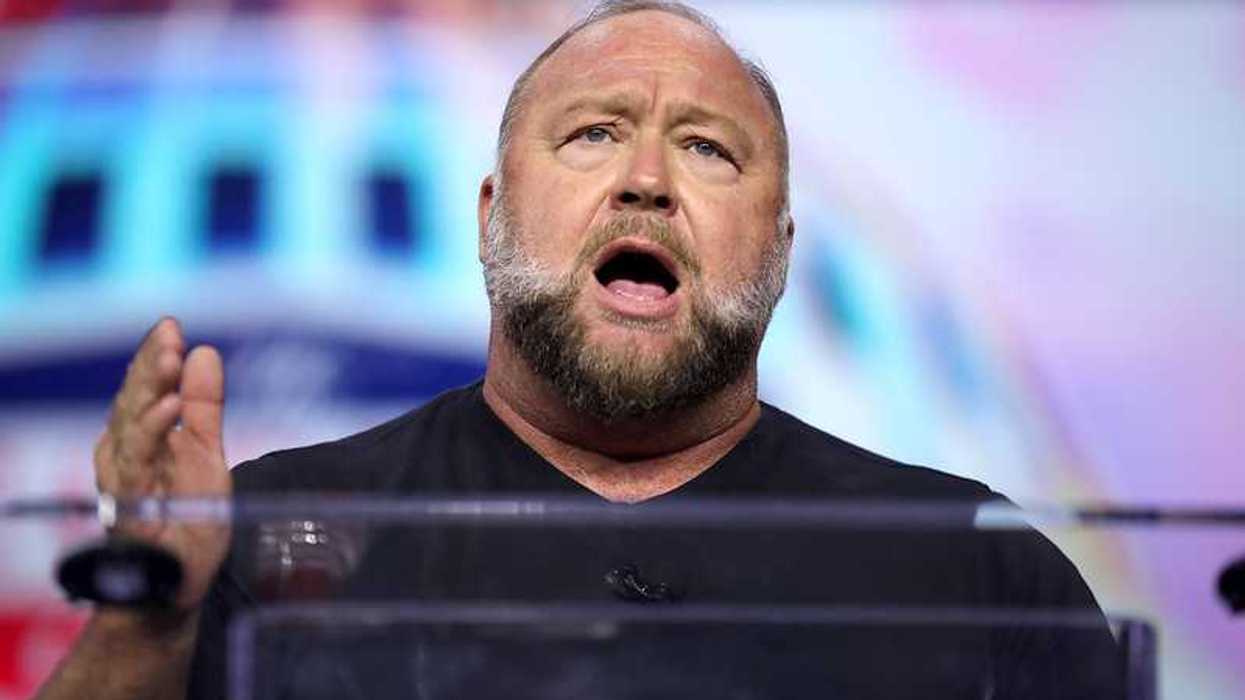
Alex Jones speaking with attendees at The People's Convention at Huntington Place in Detroit, Michigan. Flickr/Gage Skidmore
After almost 30 years of broadcasts and MAGA-style conspiracy theories, MS NOW reports the lights are off at Infowars on Friday. And the new company owner couldn’t be more pleased to see founder Alex Jones bump the door on the way out.
“Good riddance to the world’s worst rubbish,” The Onion’s CEO, Ben Collins, wrote in a text to MS NOW. “The second this man is disallowed from abusing these courts, from paying out the $1.4 billion he owes to these families, we are ready to take over with something that will make you forget about what was ever there before.”
MS NOW reports the legal dismantling of one of President Donald Trump’s most reliable propaganda networks — at least until recently — is far from over, but it began with a group of defamation lawsuits filed in Connecticut and Texas by family members of Sandy Hook victims, who argued Jones had damaged them with years of claims that the school shooting was a hoax.
With Jones’ conspiracy claims plastered across the internet, there was no place to deny it, so the judge slapped him with a historic billion-dollar judgement. MS NOW reports Jones has “made good on his promise not to pay the families,” having filed for bankruptcy in 2022 and in 2024. But a judge ordered the liquidation of his assets, which opened the door to comedy site The Onion gathering the pieces under ownership.
“The Onion, helmed by Collins, a former NBC News reporter on the disinformation beat, came forward with a bid, supported by many of the Sandy Hook families,” reports MS NOW. “The Onion initially won, but a judge granted Jones’ request to block the sale, arguing that another offer by a company that happened to operate Jones’ online supplements store had been higher. But in April, there seemed to be a workaround — Jones’ estate had run out of money and instead of buying it in an auction, The Onion could just pay rent in a licensing deal. On Wednesday, a Texas appeals court stopped the transfer again, temporarily blocking the asset handover.”
But unable to afford rent, Jones closed up shop.
“The hell we’ve been through has only made us stronger,” Jones told his staff during his last appearance on Thursday.
But Collins has his own plan for Jones’ “hell.”
“We have a deal with both the Sandy Hook families and the court-appointed receiver, and we look forward to taking over this hellhole imminently,” Collins told MS NOW.