Sunday, December 13, 2020


Sikh farmers have been great ambassadors of India's agri skills 

In the last two decades, farming in Punjab has become increasingly unremunerative and with hardly any other industry in the state, there are no jobs for the young, who face a bleak and hopeless future. 

Agricultural reforms, with the right motive and intention, are the crying need of the state.

SUNDEEP KHANNA
DEC 14, 2020 /
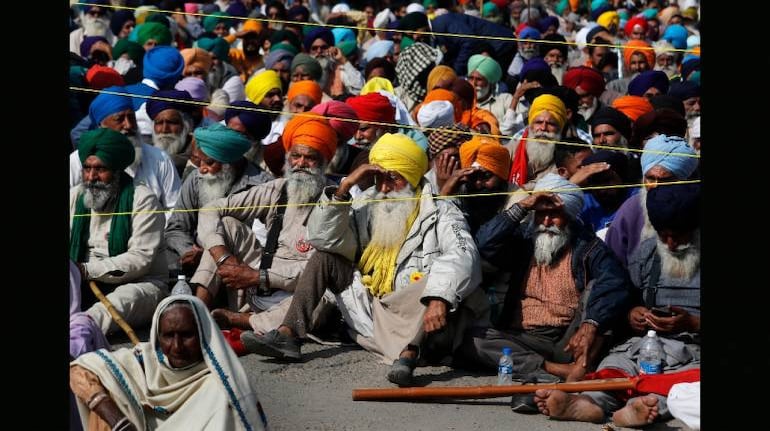
The Indian government and protesting farmers were unable to reach common ground in talks held on December 1, with the farmers saying their demonstrations against new agriculture laws will continue as will their blockades of key highways. (Image: AP)

Whatever be the politics of the current farm agitation there’s no denying the high esteem the Indian farmer from Punjab is held in across agricultural hubs of the world. Much like the country’s IT professionals who have carved a niche for themselves in the world of computing, Sikh farmers have used their skills gained from tilling the fields at home to make a mark in various parts of the world ranging from Argentina to Italy.

Their contribution to the dairy industry in Italy, is too recent and too well-known to need recounting. The headlines alone will suffice. ‘In Italian Heartland, Indians Keep the Cheese Coming’, wrote The New York Times (NYT), while Al Jazeera kept it to a simpler: ‘The Indians saving Italy’s traditional cheese industry’, and the BBC gave them a precise name: ‘The Sikhs who saved Parmesan’.

Through the 1980s and 1990s, so many of them made their way to the country’s agricultural zones that the term Sikh Route came into prevalence. Today, their hard work and expertise in dairy farming has made them integral to the Italian cheese industry.

It is a journey they have been taking for over a 100 years now. In his punjabi book ‘Unfole Warke’, Baba Bhagat Singh Bilga, a member of the legendary Gadar Party who passed away in 2009 at the ripe old age of 102, writes about the journey of the Sikhs to Argentina in 1910-11 to work in the sugar mills and railway workshops of Buenos Aires and Rosario.

Soon enough their labours took them to the farms and eventually led to owning many of them. A delightful article quoted by the Sikh Global Village, talks about Jiwa Singh and Tara Singh of village Boparai Khurd in Jalandhar district, who migrated to Argentina in 1958 and became one of the leading farm owners of Rosario de la Frontera.

In Canada too, Sikhs who first migrated to the country in the first few decades of the 20th century have proven themselves as ace farmers adept at picking up newer and more lucrative crops to cultivate. In fact, in Richmond, Vancouver, they were responsible for a revolution in cranberries. A few years ago Peter Dhillon, a Canadian Sikh farmer, who is the country’s biggest cranberry grower, was inducted into the country’s prestigious Agricultural Hall of Fame.


According to The Tribune, ‘Dhillon is also the current chairman of Ocean Spray — a marketing cooperative of cranberry farmers in the US and Canada. Ocean Spray sells its products in over 90 countries, with annual sales of over $2.5 billion.’


In their endeavours to leave their shores for better prospects abroad, they have had institutional help at home. When 10 years ago the Canadian government, facing a shortage of farmers following the retirement of many locals, started recruiting trained farmers from around the world to migrate to the country, the Ludhiana-based Punjab Agricultural University (PAU) devised special courses which included training in Canadian agri practices.

When states like Manitoba launched special schemes such as the ‘Young Farmer Nominee Programme’ (YFNP) for those below the age of 40, many Sikh farmers were well placed to take advantage of the opportunities.


Overseas success has come on the back of advances at home. For almost 20 years following the green revolution, Punjab was India’s most prosperous state and a beacon for others looking to increase the productivity of its land and people. In 1982, some 15 years after the Green Revolution, a report in The New York Times hailed the efforts of the which saw the state being held up by the World Bank as an outstanding example of how agricultural transformation might occur in the developing world.

For its achievements, the NYT pointed to the ‘Punjabi character’ and quoted MS Sra, the director of Punjab Department of Agriculture, who attributed the success to the Sikh farmers, ‘renowned for their enterprise, mechanical skill, appreciation of profit and willingness to experiment.’In the last two decades, farming in Punjab has become increasingly unremunerative and with hardly any other industry in the state, there are no jobs for the young, who face a bleak and hopeless future. Agricultural reforms, with the right motive and intention, are the crying need of the state. But none of this can deflect from the sterling reputation of the Sikh farmers.

SUNDEEP KHANNA is a senior journalist. Views are personal.

FIRST PUBLISHED: DEC 13, 2020 11:0
Farmers’ Protest Live Updates: 
Farmer leaders to observe 9-hour hunger strike tomorrow

Farmers' Protest Today Live News Updates: 
Delhi Chief Minister Arvind Kejriwal said he will be holding a one-day fast Monday in support of the protesting farmers.

By: Express Web Desk | New Delhi |Updated: December 13, 2020 9:46:58 pm


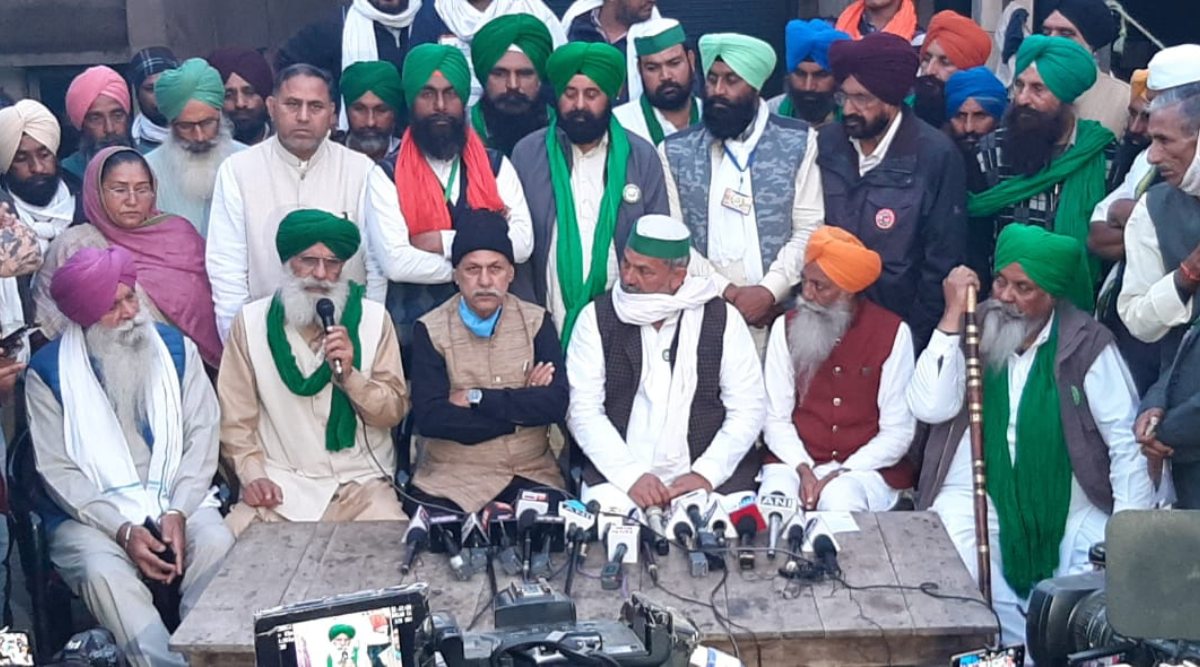
Farmer leaders at Singhu border on Sunday. (Express photo)

Farmers’ Protest Live Updates: The heads of all farmer unions protesting against the Centre’s new agri laws for over two weeks now will observe a one-day hunger strike on Monday, farmer leader Gurnam Singh Chaduni said on Sunday. The hunger strike between 8 am to 5 pm on Monday is part of the farmers’ plan to intensify their agitation from December 14. Addressing a press conference at the Singhu border, where the farmers have been camping in agitation, Chaduni said the leaders will observe the hunger strike at their respective places. “Also dharnas will be staged at all district headquarters across the country. The protest will go on as usual,” he told PTI.

Earlier in the day, Union ministers Narendra Singh Tomar and Som Parkash met Home Minister Amit Shah on Sunday amidst farmers’ protests against the Centre’s three agriculture laws, news agency PTI reported. The ministers were accompanied by BJP leaders from Punjab. Tomar and Parkash, along with their ministerial colleague Piyush Goyal, had led the government’s negotiations with the protesting farmers.

Meanwhile, Delhi Chief Minister Arvind Kejriwal today said he will be holding a one-day fast Monday in support of the protesting farmers. He also urged all Aam Aadmi Party (AAP) workers and supporters to observe one-day fast in solidarity with the farmers. Addressing a virtual press briefing, the chief minister said the Centre should immediately accept all demands of the farmers who have been protesting on Delhi’s borders for the past two weeks. He also asked the BJP-ruled Centre to shun “arrogance” and scrap three farm laws as demanded by agitating farmers, and bring a Bill to guarantee minimum support price (MSP) for agricultural produce.

Farmers from Rajasthan and some other places gathered in large numbers on the Haryana-Rajasthan border near Rewari on Sunday for their march towards Delhi and sat in protest on side of the Delhi-Jaipur national highway as the Haryana police put up barricades to stop them. The farmers were sitting in protest at Jaisinghpur Kheda area in Rewari along Rajasthan-Haryana border (NH-48). Gurgaon is over 70 km from the site while Delhi is nearly 80 km away. Swaraj India chief Yogendra Yadav, who was at the site, said since the barricades have been put, the farmers had no option but to stage a sit-in.

Farmers’ stir: 19-year-old NRI*** from Australia protests at Singhu border, says here to join ‘patriotic movement’

Moose Jattana, who has her roots in Punjab, is known on social media for being outspoken on social issues especially related to women.


Written by Kamaldeep Singh Brar | Amritsar | Updated: December 13, 2020 1:34:32 pm
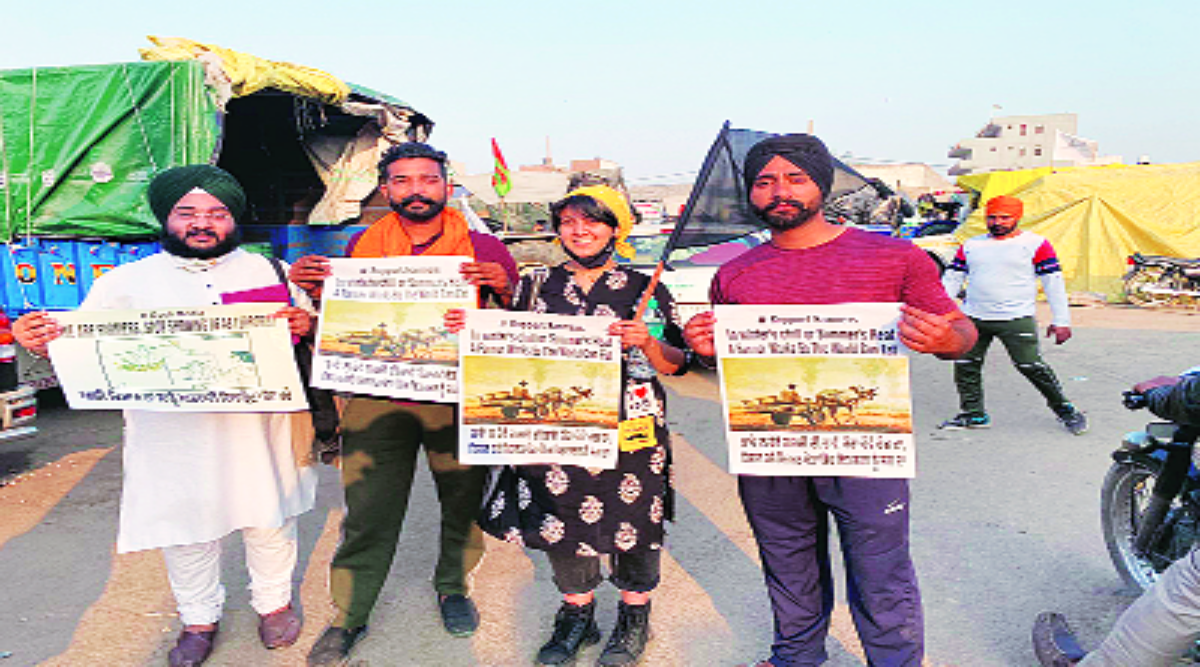
Moose Jattana at the protest site on Singhu border. (Express Photo)

Among the protesters who have joined the farmers’ fight against Centre’s farm laws at Delhi borders is an Australian girl of Indian origin, Moose Jattana. For the last four days, the 19-year-old from Melbourne has been protesting at the Singhu border, doing volunteer service and assisting photographers on ground to record the ongoing agitation.

She said, “I am protesting here for most of the time of the day. I also do volunteer service here. I am studying filmmaking. Here I have been assisting photographers like Akshay Kapoor, Naveen Macro, who are capturing the farm agitation. I am going to stay put here till the victory is achieved.”

Talking about her Punjab connect, Moose added: “I was born and brought up in Australia. My mother is from Sangrur. I spent some time in Mohali as a child. I used to come to Punjab every year but now I have come after two years to be part of this protest.”

Moose said that she is “surprised the way government is dealing with the protesters”. “Government should be for the people. But here government is not ready to listen. It didn’t consult with farmers before passing bills and now when farmers are asking for their rights, government wants to paint them as traitors. I think it is the patriotic moment and this is why I am here,” she said.

Moose is known on social media for being outspoken on social issues especially related to women.

“I feel connected with Punjab for many reasons though I also see the limitations of Punjabi society when it comes to women and Dalits. Women and Dalits don’t have that space in Punjab that is enjoyed by upper caste men. I point out such discrimination in my videos on social media,” she said.

Asked why NRI Punjabis were concerned about the protest despite leaving the country, she said: “People go out of Punjab because there are less opportunities here and less stability. So they have to go to western countries and send money back home. Sometimes you can’t change the country and so you have to change your country. Because bringing change to country is not that easy. As we are seeing that how badly farmers have been treated when they want to change the country for good.”

*** NON RESIDENT INDIAN
Sunday Lounge | Meet the faces behind farmers' protest
The farmers’ protest is like no other. People are reaching Delhi with clothes, a few thousand rupees, and the confidence that their fellow protesters will take care of the rest


Women farmers during a march in Greater Noida, Uttar Pradesh, on 27 November, the first day of protests. (HT)

By Pooja Singh
LAST UPDATED 12.12.2020 

"We might not be there but our voices are reaching Dilli,” Pratibha Shinde shouts over the phone from Maharashtra’s Jalgaon city. It’s the afternoon of 8 December and slogans of “Bharat zindabad”, “Kisan zindabad” and “Humara bhaichara zindabad” behind her drown out our conversation. It’s the day farmer unions across the country have called for a Bharat Bandh, following protests that started late November in Delhi over three farm laws rushed through Parliament in September.

Shinde, like her 2,000-odd fellow farmers, had been at the Jalgaon protest site since 9am. “How much longer will the farmer stay quiet? Bas ho gaya ab (enough is enough),” she says, after finding a quiet corner. Her voice sounds hoarse. She blames sleepless nights. “I was making arrangements for the protest, finishing housework and getting ready for Dilli,” explains the president of the Lok Sangharsh Morcha, which represents farmers from Maharashtra and Gujarat. That evening, she was leaving for Delhi to join hundreds of thousands of protesting farmers, with a bag containing eight saris and no return train ticket. “God knows till when Modiji (Narendra Modi) will ignore our demands. Till then, I am not coming back.” Over 1,000 farmers from the two western states were set to join her.

On 27 November, when the Centre allowed farmers to enter Delhi and protest over a set of laws ushering in market-oriented “reforms” they see as inimical to their interests, nobody thought the agitation would take the shape it has. Some commentators argued the protests were limited to farmers from states like Punjab, where over 90% of them depend on government purchase of crops. Within two weeks, however, the protests have taken the form of a national movement.

Thousands of farmers from states like Himachal Pradesh, Madhya Pradesh, Assam, Tamil Nadu, Andhra Pradesh and Gujarat are trickling in every day to join those already stationed at several points of entry to Delhi, with no intention of returning till their demands—officially, the repeal of the three laws—are met. Those who can’t visit Delhi are holding protests in their villages and cities. The fear is the same: The “kala kanoon (black laws)”, as farmers describe them, will effectively eliminate the safety net of minimum support price, do away with mandis and leave farmers at the mercy of big companies.

“It’s a farmer’s fight. Not a state’s. And it has an all-India character,” says Avik Saha, secretary of the All India Kisan Sangharsh Coordination Committee, an umbrella body of over 200 farm organisations. “There’s a deep distrust within the farmers, and it’s out in the open. They are tired of authorities not listening to them.”

BREAKING BARRIERS

Farmers from Haryana with their 'hookah' at the Singhu border. (Pooja Singh)

Jasmeet “Vicky” Singh, 20, is ready to wait six months, if that’s what it takes to get a decision in favour of farmers. At the Singhu border, the 30km stretch between north-west Delhi and Haryana that has been occupied by protesters, the lanky Singh is famous as the “barricade breaker”. “Not three. Eight,” the Ambala resident corrects me when I ask about the number of police barricades he has run over with his blue tractor since the protests started.

Are you a farmer? I ask. “No. We have land but we don’t farm. But after completing my studies this year, I have decided to become a farmer. Friends tell me to move to Delhi and find a job but I want to be a farmer. It’s my way of serving India.”

Singh then asks me if I have had langar. A beggar who has been overhearing our conversation interjects: “Madamji kha lo. Humne ek hafte se bheek hi nahi mangi hai. Yeh log kabhi hatne hi nahi chahiye (Do eat. We haven’t had to beg for the past one week; food is available in abundance. These people should never leave).”

That’s the other reason this farmers’ protest is like no other in recent times. People are reaching Delhi via trains, buses or trucks, with a bag of clothes, a few thousand rupees, and confidence that their fellow protesters will take care of the rest.

The Singhu border, especially, has turned into a village. After crossing barricades and barbed wire spread over half a kilometre under the watchful eyes of the police, you reach a crowded space where people seem to have forgotten all about the pandemic. They are milling about without masks or physical distancing. The aroma of kada prasad (halwa, a gurdwara offering, is served through the day) wafts across. Truckloads of vegetables and rice, contributions by relatives and friends of farmers, are lining up in the service lane. When I reached Singhu at 11am on 6 December, two tankers of milk had just rolled in. One of the drivers said they were offerings from a gurdwara nearby.

Every 100m, a farmer invites you with folded hands to have langar. If you decline, they insist on offering tea. Some are distributing food to the police. Many are cutting vegetables for the 24x7 community kitchen, while others are giving away biscuits, sanitary pads, blankets or Odomos, for free. The elderly, lying on beds of mattresses and hay inside their tractor trolleys-turned-mini caravans, are talking about revolution and singing songs of freedom. Youngsters are shouting slogans. You are surrounded by at least 100 people, mostly men, at any point but there’s a sense of security.

“People are saying it’s only Punjab and Haryana farmers who are protesting. They should come and see, it’s Little India here,” says Shariq Husain, 29, who has put his construction business on hold for the protest. Every morning, he, along with 10-15 friends from Old Delhi, Nizamuddin and Okhla, reaches the border with 1,000-2,000 packets of mutton pulao and vegetable pulao. “We offer our namaz there only. Often, we end up staying at night also. This is what India is all about—looking after guests, feeding people with love, making room for every religion.”

In many ways, the farmers’ movement is a reminder of the Citizenship (Amendment) Act protests a year ago, when millions came together to show their support for a cause that may not have affected them directly. Yashwant Singh, 47, a sugar-cane farmer from Uttar Pradesh, has been sitting at north-west Delhi’s Tikri border protest site even though he personally may not be hit as badly as others by the laws. He says: “I’m here for the farmers. We’ve been suppressed for too long.”

Protestors at Delhi's borders have turned their trucks into temporary homes. (Reuters)

Even non-farmers are volunteering. Dianne N., a Delhi University student, has been distributing medicines for the past week at Tikri, where the number of protesters is growing. “We thought there are so many older people here and it’s cold…. So we offer some balms and over-the-counter medicines,” says Dianne, who returned from her Bengaluru home two weeks ago so she could volunteer.

Unlike young Vicky Singh, Ramesh Antil, a Sonipat farmer in her 50s, is praying for the protests to end quickly. “My old bones are troubling me in this cold,” she says, who was sitting in the women’s tent at Singhu. “Media talks about how rich Punjab and Haryana farmers are, that there’s constant supply of food, but they forget how hard we work. Are we enjoying sitting under the open sky in such cold weather? Corona won’t kill us but these laws will. Modiji is like our baap (father figure) but he should understand, how will we survive if he exposes us to the corporates?” she says, in Hindi.

NEAR, YET TOO FAR

Santosh Sharma, 37, wanted to join his 1,000-plus farming community from Madhya Pradesh at Tikri but couldn’t because of his elderly parents. “They have not been keeping well; corona is everywhere. We are regularly holding protests here,” says Sharma over the phone from his home in Harda, on 7 December. Two days later, he calls to say he has taken the train to Delhi. “We will anyway die of debt if the government won’t listen. I will have to be there to fight for my rights.”

Not everyone who wanted to has been able to reach the Capital. Maheriya Laxmiben Ranchhodbhai, a Dalit farmer from Gujarat’s Saroda village in Dholka taluk, was supposed to leave for Delhi on 8 December but the police detained her that morning. “They said I would have protested (since it was Bharat Bandh) and caused nuisance,” she tells me from the police station. The police inspector at the Dholka station, A.B. Ansari, said, “She would have caused destruction of public property.” By 6pm, Ranchhodbhai had been released.


About 1,300km away, in Tamil Nadu’s Erode, Kannaiyan Subramaniam is content with protesting within the state. “You don’t have to be in Delhi to show your support. It will be too cold for me there,” he laughs. He believes farmers from other states were delayed in reaching Delhi owing to lack of transportation and resources.

Over the past two weeks, Prashant Jha, a small farmer from Chhattisgarh, has been walking 14km every day to a chowk in Korba where protests are being held. “11am-3pm, we are here,” he says. “We have only two options if these laws are not repealed, die under the burden of debt or kill ourselves. When we are the ones who bring food to everyone’s table, why are we being tortured like this? It’s the same fight my grandfather was fighting, then my father was fighting, and now I am fighting. I don’t want my son to fight it.”

A farmer in Assam, who doesn’t wish to be named, wants to come to Delhi but can’t since train services haven’t restarted. “We also have to look after our crops because elephants will eat them,” says the 30-year-old, who has been participating in protests against the laws and land pattas for three months in Dibrugarh. “I will leave (for Delhi) as soon as the train starts. Till then, we are strengthening our front here.”

I speak again with Pratibha Shinde after she has reached Delhi. Her first task? “Meet the farmers at the borders,” she says. “We are at a crucial time in history. This is the first time people are seeing farmers’ issues as a national issue and not just a farmer issue. We are finally being seen as what we really are, ann daata (god of food).”
Indian farmers intensify protests amid govt attempts to crush movement
Reuters-December 13, 2020

A farmer (right) gets his head tonsured as a mark of protest against new farm laws, near the Delhi-Uttar Pradesh state border yesterday. (AP pic)

MUMBAI: Tens of thousands of Indian farmers on Sunday intensified their protests against three new agricultural laws aimed at overhauling food grain procurement and pricing rules by allowing private companies direct access to the vast agrarian sector.

Angry farmers staged demonstrations near New Delhi after rejecting Prime Minister Narendra Modi’s assurances that the laws would double farmers’ income.

Six rounds of talks between government officials and farmer union leaders have failed to resolve the challenge faced by Modi’s government.

“Hundreds of farmers will launch a tractor trolley march to New Delhi to voice our grievances against the new laws,” said Kamal Preet Singh Pannu, a leader of Sanyukta Kisan Andolan (United Farmers’ Protest), one of 30 groups against the laws.

“Government wants to discredit and crush our movement, but we will continue to protest peacefully,” Pannu said.

Local authorities increased security measures, deploying police and putting up barricades to prevent farmers from entering New Delhi in large numbers. Opposition parties and some senior economists have lent support to the protests.

“I’ve now studied India’s new farm bills & realize they are flawed and will be detrimental to farmers,” Kaushik Basu, a former chief economic adviser to the federal government, wrote on Twitter.

“Our agriculture regulation needs change, but the new laws will end up serving corporate interests more than farmers. Hats off to the sensibility & moral strength of India’s farmers,” Basu said.

The farmers are protesting the three laws that the government says are meant to overhaul procurement procedures and grant them more options to sell their produce.

Ministers from Modi’s government at an industry event on Saturday in New Delhi appealed to leading industrialists and businesses to explain the benefits of the new laws to farmers.
Kerala farmers start indefinite protest in solidarity with farmers agitating in Delhi

The joint farmers council will also hold similar protests across various Kerala districts in the coming days in support of the farmers protesting at Singhu border.
SCREENSHOT / FB - CPI(M) KERALA
NEWS PROTEST SUNDAY, DECEMBER 13, 2020 - 12:2


TNM Editorial Follow @@thenewsminut

Farmers under the joint farmers council in Kerala started an indefinite protest in the state capital Thiruvananthapuram on Saturday in solidarity with the farmers agitating at the Delhi-Haryana Singhu border against the contentious farm laws passed by the Union government. The indefinite strike, launched in front of the Palayam Martyr’s column, was inaugurated by S Ramachandran Pillai, CPI(M) Polit Bureau member and national vice-president of the All India Kisan Sabha.

Members of the joint council will stage a protest every day in front of the Martyr’s column from 10 am to 7 pm, reported the Times of India. The council will also reportedly hold similar protests across various Kerala districts in the coming days in support of the farmers protesting at Singhu border.

The farmers have been protesting indefinitely at Singhu against the three recently passed laws – Farmer’s Produce Trade and Commerce (Promotion and Facilitation) Act, 2020, the Farmer (Empowerment and Protection) Agreement of Price Assurance and Farm Services Act, 2020 and the Essential Commodities (Amendment) Act, 2020 – raising concerns that these laws would suppress the Minimum Support Price (MSP) and procurement system.

00:0304:00


Extending solidarity to the farmers in Singhu, Ramachandran Pillai said that the Union government will have to accede to the demands of the hardworking farmers of the country. This fight by farmers is for the right of life, he said. He added that hundreds of farmers will everyday join the lakhs of farmers already gathered in Delhi.

Ramachandran also added that the laws passed by the Union government will not only affect farmers but also adversely affect all those who utilise agricultural products. All the three laws ultimately aim to hand over farm products into the hands of corporates, Ramachandran says as per Malayala Manorama report.

CPI Assistant Secretary K Prakash Babu said that about 600 farmer unions have joined the protests so far. This shows how deep-rooted the farmers’ concerns are, he added. The joint council members also urged all farmers in the state to come out and extend their support to the ongoing protests.

Read:

Why Telugu farmers have not joined the protests against farm laws in a big way

Kerala will not implement new farm laws, to approach SC against it

Watch video from the farmers protest in Delhi


As farmers pitch in at Delhi borders, families take charge of farming back home. 


Farmers from different parts of the country, including Haryana and Punjab, have been camping at various border points of Delhi for two weeks now, demanding the repeal of three recent farm laws of the Centre. (PTI)

Updated: 12 Dec 2020

Farmers from different parts of the country, including Haryana and Punjab, have been camping at various border points of Delhi for two weeks now, demanding the repeal of three recent farm laws of the Centre.

CHANDIGARH : With a majority of Punjab farmers pitching in at Delhi borders in protest against the new central farm laws, their family members have been left taking care of standing wheat crop and other allied activities back home.

In absence of adult males, women have taken the charge of irrigating fields, sprinkling fertilizers in them, tending cattle, milking cows and chopping fodder for them with their children’s help, while keeping their spouses and adult sons assured all the while not to worry about the chores back home and focus on their protests.

“With children’s help, we are taking care of wheat crop, cattle and other jobs," said 44-year-old Paramjit Kaur, a resident of Jhita Kalan village in Amritsar district. Kaur's husband, Harjit Singh, is a farmer leader, currently engaged in farmers' stir at Delhi border. The couple’s two children, Manmeet Kaur and Yuvraj Singh, having nothing to do with farming earlier, are now enthusiastically helping their mother in agricultural and allied activities. Both have cleared their IELTS (International English Language Testing System) exams and aspire to study abroad, Kaur told PTI over the phone.

Yuvraj is now irrigating wheat fields and taking care of cattle. “I have sown wheat for the first time," said Yuvraj who has cleared his 12th standard. Yuvraj's 20-year-old Manmeet Kaur who wishes to study in Canada, said, “We never did these jobs. We were involved in our studies. My job was limited to the kitchen but now we are doing agricultural work as well. I am taking care of vegetable fields and other errands now."

Jaspreet Kaur, 35, the wife of another farmer camping at Delhi border, said she was taking care of the cattle at her village Jethuke in Bathinda district. “I am now milking cows and buffaloes in absence of my husband," said Kaur, whose family sell milk for their livelihood. She said they have roped in some labourers for watering fields and sprinkling urea. “The problems are there but we have to face them," said Kaur, a mother of three.

Bhartiya Kisan Union (Ekta Ugrahan) general secretary Sukhdev Singh said in several areas, villagers and labourers have come forward to irrigate fields of farmers pitching in at Delhi borders in protests of farm laws. Committees have also been formed in several villages where fellow villagers irrigate crops of those who are at the protest site.

Farmers from different parts of the country, including Haryana and Punjab, have been camping at various border points of Delhi for two weeks now, demanding the repeal of three recent farm laws of the Centre. Farmers are protesting against the farm laws, which they fear will dismantle the minimum support price system, leaving them at the "mercy" of big corporates. They have rejected the government offer to amend the farm laws.


CITIZENSHIP TANGLE
‘We were here’: What the anti-CAA protests meant to this law student
At what point do you stop trying to be a good cog in a hostile machine?
Demonstrators attend a protest against a new citizenship law, outside the Jamia Millia Islamia university in New Delhi on December 22, 2019. | Danish Siddiqui/Reuters

On December 11, 2019, Parliament passed amendments to the Citizenship Act that sparked an unprecedented nationwide protest movement against the legislation and other government policies that discriminate against Muslims and violate Constitutional norms. One year later, after riots in Delhi and the Covid-19 pandemic put a halt to public sit-ins, Scroll.in considers the impact of this remarkable moment in Indian history.

For me, winter mornings before dystopia meant the ritual performance of magpie robins staged on the br?>anches of the backyard moringa. But winter mornings changed on December 10, 2019. The fears we had carried since the general elections of 2014 had materialised.

India tipped over into authoritarianism as the Parliament passed the Citizenship Amendment Act, which made non-Muslim undocumented migrants from Bangladesh, Afghanistan and Pakistan eligible for Indian citizenship. Together with the proposed nationwide National Register of Citizens, the Act seemed to be a step towards stripping thousands of Indian Muslims of citizenship.

As a starry-eyed law student, I had been hopeful that the proposed citizenship laws were mere rhetoric and even if legitimised by Parliament, they would not stand in a court of law. I was destined to be disappointed.


One Year After CAA

What has happened since the controversial law was passed?
READ HERE

For some years, Indian Muslims had lived in a collective nostalgia which contrasted with the humiliations of the present. This was now blended with a sense of imminent doom. Months before the bill was passed, I was combing the streets of Old Delhi, looking for the poet, Zauq, in his neglected shrine, and for Ghalib in his achkan and cap and beard, paired with his trademark air of rebellion. I wondered whether they, too, could be pulled by their beards or made to pull their pants down in their Dilli in “New India”.

My longings for the past do not feature sultanates and caliphates but something far more scarce to my kin: dignity. Struggling for this scarce resource, and bearing a colonially dictated version of identity, India’s Muslims have always simmered in its margins. That was until last year, when the mundane streets of Okhla became boundless, celestial spaces of reclamation. Spaces like this soon sprung up across the country.

To the streets

As the nation erupted in protest and we all discovered courage, the police wreaked vengeance on students of Jamia Millia Islamia demonstrating peacefully in Delhi on the night of December 14, 2019. What was evident, and this was perhaps more frightening than the violence itself, was that this establishment did not seem to care about disguising its cruel excesses. It did not bother to build a plausible premise for injustice, and the country did not seek one. That is when an apathetic government graduates into an authoritarian one. Majoritarianism and the carefully calibrated indifference of the judiciary made one thing quite clear: the solution did not lie within the establishment, but without.

This realisation was where the personal met the political for me. I had been a civil services aspirant, the way most Indian middle-class students are enchanted into being. But this realisation proved to be the fork in the road for me: being a good cog in a hostile machinery was not an alternative. I wondered if this would be my slide into anarchism.

I was surrounded by upper-class ideas of revolution; people who truly believed that listening to Pink Floyd and cheering for Jane Fonda getting herself arrested was resistance. But the turmoil that replaced the collective sense of disbelief could only unravel in the streets, and many were soon to discover that revolution did not resemble its romanticised image.

The public fury in response to the police action at Jamia Millia Islamia in Delhi and the Aligarh Muslim University was driven by the spontaneous sentiment: “you will never touch our children again”. But on December 19, a more synchronised protest was held across the country.

It was a cloudy day and the apocalyptic Delhi haze hung over the slowly kindling streets. At Kashmere Gate, a horde of khaki burst out of the haze and descended downhill towards the protesters. The bulk detentions had begun. As metros stations shut down one after the other, young and old alike left on foot to join the crowds at various sites. The detained returned from where they were dropped off and others set out from their homes to join the ranks. The hopelessness that had nearly settled in the face of repression was thwarted by the assemblies of protestors who gathered over and over again, until the authorities were left with no choice but to let it happen. It felt almost miraculous.The elderly women who became the face of the Shaheen Bagh protests. Picture credit: Rakhi Bose via Instagram.

Shaheen Bagh miracles

But Shaheen Bagh, the locality near Jamia Millia where women first set up a sit-in protest, was not a miracle. Shaheen Bagh was a survival instinct, the only possible alternative in the face of impending disenfranchisement. However, Shaheen Bagh was not devoid of its many miracles.

Gender roles were no longer being challenged in doctoral dissertations. As women from the locality stepped out to protest, men took care of the household. The movement mobilised women in Delhi’s Shaheen Bagh, Lucknow’s Ghantaghar and Mumbai Baug but also spilled into the smallest towns. The loudest and the clearest were women in the most conservative pockets of Vidarbha, some of whom told me they had never spent so much time outside their homes before.

As women claimed political spaces, personal spaces were also reshaped. By the end of the protests, I knew women who were putting off the idea of marriage to chase newfound pursuits, a woman who finally found in her comrades the support system that she needed to quit an unhappy marriage; all of them claiming azadi in its most wholesome form.

Shaheen Bagh itself, a gathering of eclectic creatures, changed. A friend told me how, on the first day, young women lighting cigarettes near a tea stall raised eyebrows. When I went to Shaheen Bagh 40 days later, a group of men in beards, flaming red and majestic white, carelessly passed a lighter to a huddle of young women. Cultural and generational divides had gone up in smoke.

Other prejudices evaporated in other Shaheen Baghs across India. In Ahmedabad, a young boy, tutored by some of the older boys, chanted a slogan using a transphobic slur. His sister, no older than 12, knew instantly that that was no insult. She had met and befriended plenty of trans people at the protests that month. She came running to me to protest and I could not have been prouder of this 12-year-old “madrassa” girl from a poor locality on the fringes of the city, far from the politically correct halls of academia.

Revolution, traditionally imagined in masculine metaphors and pronouns, was reimagined in “mother tongues”. The gendered structures of language were dismantled to radically rewrite cultural scripts. As poet Nabiya Khan wrote – “Aayega Inquilab, pehen ke bindi, choodiyan, burqa, hijab.” Revolution will arrive, wearing bindi, bangles, burqa and hijab.
The poetry of protest

Shaheen Bagh and its sister sit-ins in other cities also became known for the incredible elderly women who came out to protest in the biting cold night after night. As proud as I am of them, I wish they did not have to.

I remember a woman over 80 in Ahmedabad watching the sun sink into the boom of the Maghreb azaan, the call for evening prayers. With glistening eyes and a dry smile, she told me how she had always thought that 1947, when she left her hometown in Uttar Pradesh and moved to Gujarat, would be the worst moment of her life. But the riots of 1969 lit up Gujarat like never before. And in 1992, the country erupted. After Godhra 2002, she truly believed that she had seen her share of despair for a lifetime. Then she turned to the mic to sing in a cracking voice, “Meri aankhon ne yeh manzar na dekha hota toh kitna achchha hota – How good it would have been if my eyes had not witnessed this scene”. I could sense how disappointed they were in the country they call home.

But I shall draw strength from them. It has been a year since the protests but they are not dead. To those losing hope and to myself, I shall repeat: Revolution is not a two-hour movie. It takes decades of pushes, pulls, bruises, amputations, bandages and healing. I no longer know if the poetry of resistance has any value beyond soothing and strengthening ourselves. Yet, we write a collective message of defiance, to document for the world and for the last of the world: We were here.

Iqra Khan is a recent law graduate and bilingual poet.


Deputy Inspector General (Prisons) Lakhminder Singh Jakhar said ‘I am a farmer first and a police officer later’.
A file photo of Punjab Deputy Inspector General (Prisons) Lakhminder Singh Jakhar. | Lakhminder Singh/Facebook

Punjab Deputy Inspector General (Prisons) Lakhminder Singh Jakhar resigned from his position on Saturday to show support for the farmers protesting against the Centre’s agricultural laws, ANI reported.

Jakhar wrote a letter to Punjab’s principal secretary (home), asking to be considered for premature retirement from service. “I’d like to inform you of my considered decision to stand with my farmer brothers who’re peacefully protesting against farm laws,” he said.

Jakhar added that he was a farmer first and a police officer later, The Indian Express reported. “Whatever position I have got today, it is because my father worked as a farmer in the fields and he made me study,” he was quoted as saying by the newspaper. “Hence, I owe my everything to farming.”

The top police officer said that his 81-year-old mother, who looks after farming activities in her village, encouraged him to resign and join the farmers’ protest near Delhi. “I am likely to visit Delhi soon,” he told The Indian Express.

Jakhar was suspended in May over corruption allegations, but was reinstated to his position in October.

The farmers’ agitation against the Centre’s agricultural laws entered its 18th day. They started a tractor march from Shahjahanpur on the Rajasthan-Haryana border, causing the Delhi-Jaipur highway to shut down.

Also read: Farm laws: Former Punjab CM Parkash Singh Badal returns Padma award to protest ‘betrayal’ of farmers

Several eminent personalities have also returned their awards over the last few days to register their solidarity with the farmers. On Monday, Punjab agriculturalist Dr Varinder Pal Singh refused to accept an award from the Centre at an event as a gesture of support for the farmers.

Last week, former Punjab Chief Minister and Shiromani Akali Dal leader Parkash Singh Badal returned his Padma Vibhushan, the second-highest civilian award in India. A group of top sportspersons and coaches from Punjab also said they will return their awards.

Olympic medalist boxer Vijender Singh had said on December 5 that he would return the Rajiv Gandhi Khel Ratna Award, the country’s highest sporting honour.

Tens of thousands of farmers, mostly from Punjab and Haryana, have been protesting at key entry points to Delhi for 18 days against the laws. The farmers fear the agricultural reforms will weaken the minimum support price mechanism under which the government buys agricultural produce, will lead to the deregulation of crop-pricing, deny them fair remuneration for their produce and leave them at the mercy of corporations.

The government, on the other hand, maintains that the new laws will give farmers more options in selling their produce, lead to better pricing, and free them from unfair monopolies.
INDIA 
Farmers occupy toll plazas in Haryana

SPECIAL CORRESPONDENT
CHANDIGARH, DECEMBER 12, 2020 

Police personnel stand along a highway on the Haryana-Rajasthan border to stop farmers from joining protests in Delhi against the recent agricultural reforms, in Rewari district on December 12, 2020. | Photo Credit: AFP

Prevent fee collection at National, State highways

Stepping up their protests for the repeal of the Centre’s recent agriculture laws, farmers affiliated to different unions on Saturday staged a dharna, or sit-in, at several toll plazas on National and State highways in Haryana, and stopped the authorities from collecting fees from commuters.

Also read: Voices of protest: what farmers have to say

Agitating farmers squatted on the road at toll-plazas and shouted slogans against the BJP-led government at the Centre, accusing it of implementing “anti-farmer” policies.

“Farmers are staging dharna at almost all the toll plazas in Haryana. Group of farmers have gathered at toll plazas on Ambala-Hisar highway. Besides we are picketing toll plazas in Hisar district roads leading to Delhi, Rajgarh, Sirsa and Chandigarh. Also, Karnal-Jind highway farmers are protesting,” Rattan Mann, president of the Haryana Bharatiya Kisan Union (Tikait) told The Hindu.

Explainer | Why are the Agriculture Bills being opposed

“Most of the toll plaza on the Chandigarh-Delhi highway have also been taken over by farmers and we are not letting authorities collect any fees from commuters, plying their vehicles. We are staging this protest for one day,” he said.

Meanwhile, thousands of farmers and farm labourers under the banner of Kisan Mazdoor Sangarsh Samiti, who are on their way from Punjab to Delhi, started to move towards the national capital on Saturday after a night halt in Haryana’s Shahbad.

“We are on our way to Kundi on tractor-trolleys, cars, vans and will reach by today evening. Over 2000 vehicles are participating in our march,” Sarvan Singh Pandher, general secretary of the Punjab unit of the Samiti, told The Hindu.

In a bid to ensure law and order situation a large number of police personnel have been deployed at toll plazas to maintain law and order.

In neighbouring Punjab, farmers have been squatting with ‘pucca morcha’ (permanent protest-site) on all toll plazas since October 1 as a part of their agitation. They have not allowed the authorities collect any charges from commuters.


INDIA
"Farmers' Voices Must Be Heard": Indian-American Lawmaker On Protests

"I hope there's a peaceful and fair solution so they can provide for their families," Ro Khanna said in a tweet on Saturday.

Indians Abroad Press Trust of India
Updated: December 13, 2920

"I am encouraged by the ongoing dialogue," Ro Khanna


Washington: 

Indian-American Congressman Ro Khanna has hoped for a peaceful and fair solution to the farmers' issues in India, saying he is encouraged by the ongoing dialogue between the protesting farmers and the government.

Mr Khanna, 44, was recently elected for a third consecutive term from the congressional district representing Silicon Valley.

"India and the US share a rich tradition of democracy and peaceful protests. Farmworkers are the backbone of both our nations and must have their voices heard. I hope there's a peaceful and fair solution so they can provide for their families," Mr Khanna said in a tweet on Saturday.

"I am encouraged by the ongoing dialogue," he said, joining other American lawmakers who have expressed their views on the ongoing farmers' protest in India, several of whom have expressed their concerns.

India & the US share a rich tradition of democracy & peaceful protests. Farmworkers are the backbone of both our nations & must have their voices heard. I hope there's a peaceful and fair solution so they can provide for their families. I am encouraged by the ongoing dialogue.- Rep. Ro Khanna (@RepRoKhanna) December 13, 2020

"As Co-Chair of the American Sikh Caucus in Congress, my office has received first-hand accounts of the horrific crackdowns on protestors who are trying to peacefully express their disapproval of India's recent agricultural reform legislation," said Congressman John Garamendi, who along with two other lawmakers wrote a letter to India's Ambassador to the US, Taranjit Singh Sandhu early this week.

According to the letter, "hundreds of thousands of farmers from the states of Punjab and Haryana that have made their way to New Delhi to peacefully protest these new agricultural laws, and the Indian government has met these peaceful protestors with tear gas, water cannons, barricades, baton attacks, and more.

"Many of these farmers have children, relatives, and friends who are US citizens, many of whom have reached out to us to share their concerns about these developments. We urge the Indian government to demonstrate its respect for these crucial democratic freedoms, and to be a model of democratic values in the vital Indo-Pacific region".


The letter, dated December 4, was released this week. The two other lawmakers who have expressed their concern on the protest were congressman Jim Costa and congresswoman Shelia Jackson Lee, members of the American Sikh Caucus.

Thousands of farmers are currently staying put at Delhi's borders with Haryana and Uttar Pradesh in protest against the Farmers' Produce Trade and Commerce (Promotion and Facilitation) Act, 2020, the Farmers (Empowerment and Protection) Agreement on Price Assurance and Farm Services Act, 2020 and the Essential Commodities (Amendment) Act, 2020.

They have expressed apprehension that these laws would pave the way for the dismantling of the minimum support price system, leaving them at the "mercy" of big corporations.

However, the government has maintained that the new laws will bring farmers better opportunities and usher in new technologies in agriculture.

There have been multiple rounds of talks between representatives of the protestors and the government but the logjam continues.

Thousands of people are protesting with farmers in India. This is why you should care

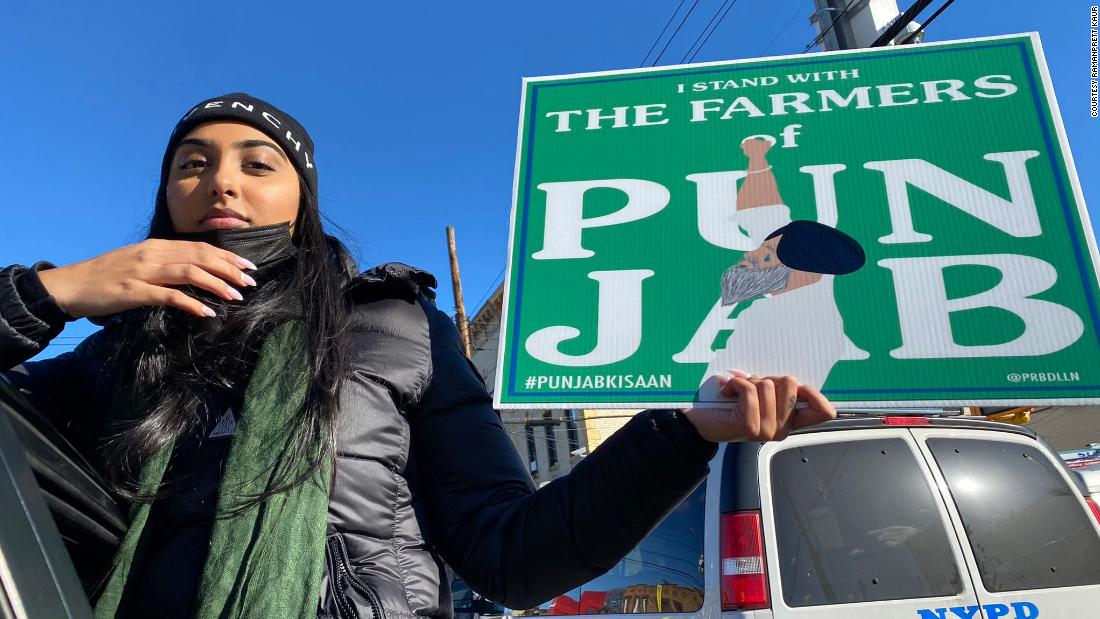
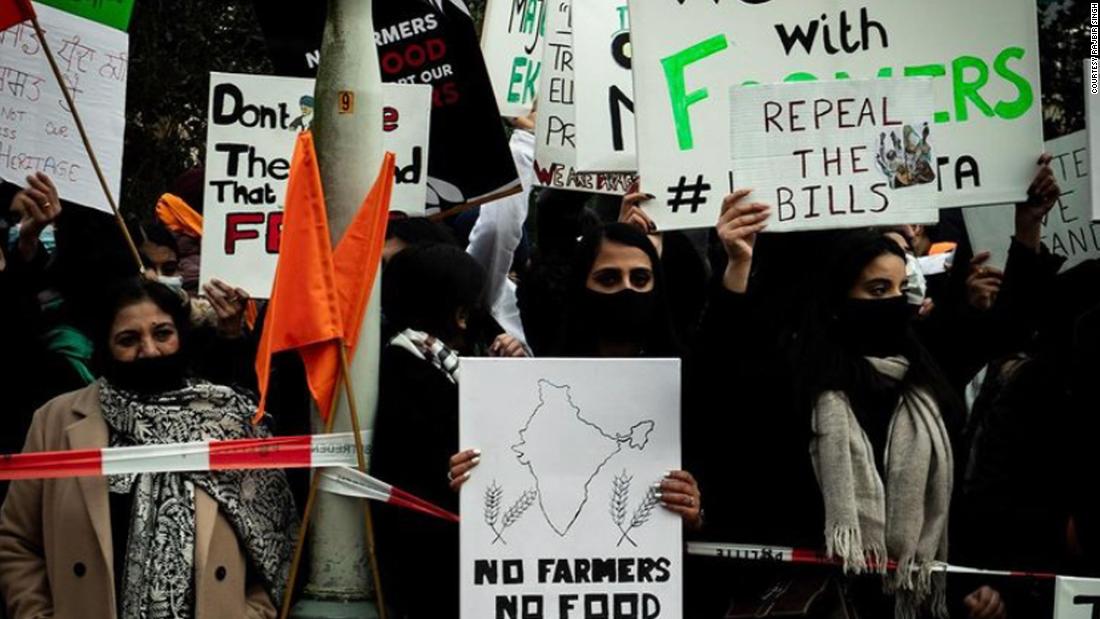
Ramanpreet Kaur demonstrated on December 5 in Queens, New York and estimates around 150 others joined her.

By Alisha Ebrahimji, CNN
 Fri December 11, 2020

(CNN)Farmers in India have reached a stalemate with the government over its proposed amendments to laws the farmers feel will ravage their livelihoods and create an opportunity for large, private companies to enter and exploit the entire agriculture sector.

The laws directly impact the farmers in India, but they could also have a significant impact to consumers globally, who rely on India for many key items such as turmeric, chili and ginger.
To fight against three laws passed in September, farmers from all across the country have been protesting for days just outside New Delhi -- despite the capital being a hotspot for Covid-19 in a country that has already reported more than 9.4 million cases.

More than half of India's working population comes from the agricultural sector, according to India's most recent Census in 2011. From 2018-2019, the average Indian farmer earned 10,329 rupees (about $140) per month, according to data from a Hindustan Times analysis. Of these 263.1 million workers, many solely rely on farming to put food on their own table and roof over their head.

Farmers from Punjab, Haryana and Uttar Pradesh arrived by tractors and on foot in New Delhi last month where they blocked roads and set up makeshift camps, according to protest leaders. Some slept on the road or in their tractors, and several places of worship offered protesters food.


Tens of thousands of farmers swarm India's capital to protest deregulation rules

VIDEO
Here's why tens of thousands of Indian farmers are protesting 01:51

It affects your pantry

The protests haven't been exclusive to India.


People around the world have been protesting to show support and stand with the farmers because the protests are about "the people who feed all of us" and their fair treatment, said Simran Jeet Singh, a scholar of religion and history currently teaching at Union Seminary and a Stephen M. Keller Term Member for the Council on Foreign Relations.

"The pandemic has shown us that there are two economies," he said. "Essential workers across the world are suffering. The farmers in India represent all of them, and their resistance to unjust legislation that privileges the uber-wealthy corporations is a resistance that speaks to so many of us all over the world."

India is the world's largest producer, consumer and exporter of spices -- producing about 68% of the world's spices, according to Spices Board India, Ministry of Commerce & Industry, Govt. of India.

In 2019, the top 10 importers of Indian spices were the US, China, Vietnam, Hong Kong, Bangladesh, Thailand, UK, UAE, Malaysia, and Sri Lanka, data shows.

Items like pepper, cardamom, chilli, ginger, turmeric, coriander, cumin, garlic, curry powder and fennel are among the exports.

India is the leading exporter of Basmati rice and world's largest milk producer to the global market, according to India's Agricultural & Processed Food Products Export Development Authority, with the main production happening in states like Punjab, Haryana, and Delhi -- where the farmers are also protesting.

The country is also the world's second-largest producer of rice, wheat and other cereals, ranking second in fruits and vegetable production in the world just under China.
Herbs and medicine go hand-in-hand for those practicing homeopathy or Ayurveda, an ancient Hindu system of medicine based on the idea of balance within your body, built on the foundation of herbal treatment, yoga and breathing.

At times, ginger is served for arthritis and digestion, cinnamon to boost circulation and lower blood sugar, and fenugreek to fight infection -- all top exports of the country.

India is home to thousands of plants but 7,500 of them are known and used for medicinal uses, according to data from the Journal of Ethnobiology and Ethnomedicine. The same data says approximately 25% of drugs are derived from plants.

It affects your closet

Chances are something in your closet was made in India -- and that's because India is the world's leading producer of cotton, surpassing China, according to the United States Department of Agriculture.

"Although yields in India are well below the global average, cotton area in India dwarfs that of any other country, accounting for approximately 40 percent of the world total," the department said.

What do the laws say?

For decades, the Indian government has offered guaranteed prices to farmers for certain crops, creating a stable guide to make decisions and investments for the following crop cycle.
Under the previous laws, farmers had to sell their goods at an auction at their state's Agricultural Produce Market Committee. A government-agreed minimum price was set for items and the auction was regulated by restrictions on who could buy along with price caps on essentials.

India's Prime Minister Narendra Modi says the new laws give farmers a chance to decide their own prices and sell directly to private businesses, like grocery chains, cutting the middle man, who in this case, is the state's Agricultural Produce Market Committee.

Farmers argue Modi's new laws help big companies drive down prices. While farmers could sell crops at higher prices if the demand is there, conversely, they could struggle to meet the minimum price in years when there is too much supply in the market.

"In the past, when Indian agricultural workers have protested for fair prices and working conditions, the Indian government has responded with violent crackdowns that include documented torture, human rights abuses, and extrajudicial killings," Simran Singh said.
"It is critical that, in this moment of peaceful protest, we keep our eyes trained on India's response, and ensure that they do not again resort to repressive tactics as a way to thwart free speech and protest."

Voices on the ground

Police attempted to block demonstrators from entering New Delhi when protests first began -- they fired tear gas and water cannons, after protesters pelted police officers with stones and damaged public property, according to Manoj Yadav, a senior police official from Haryana.
From France, Germany, California, New York, Texas, Canada, Netherlands and London -- people have shown up in solidarity over the last two weeks.

As a Sikh Punjabi woman, the fight for Ramanpreet Kaur in New York is about her "grandparents and parents who have lived through so many hardships and kept the farming culture alive in our families to provide for us."

"Even if you don't feel a personal connection to India or the farmers out there like many of us do, as a human being who lives on earth you should be concerned about exploitation of the people who feed you everyday," she said.

Manveer Singh said he feels the impact of India's new laws all the way in Vancouver, Canada, through his cousins in Punjab who still farm today.

"The entire world should care about this issue, because in a globalized society we are all connected," he said. "Everything from turmeric to Basmati comes from Indian farmers."


Manveer Singh joined a demonstartion on December 5 outside the Indian consulate in downtown Vancouver.

"And above personal interests, we need to value human beings over corporations. That in itself is the central ethos of what has become one of the biggest protests in human history."

Rajbir Singh, from Amsterdam, said farming has always been the only way his family has made money -- and for some of them, it still is.


Protests in front of the Den Haag in front of the Indian Embassy on Tuesday, December 8.

"For me to see that all Indian farmers now indirectly have to work for these big corporations is unacceptable," he said. "That's why I am protesting and urge the rest of the farming communities in the world to stand with the Indian farmers."

What happens now and how to help

On Wednesday, Indian farmers rejected the government's proposed amendments, according to an Indian farmers union.

Darshan Pal, President of the Krantikari Kisan Union, a farmer's union said protests will intensify and farmers plan to block the highway between New Delhi to Jaipur, the capital of western Rajasthan state, on December 12, which will lead up to a nationwide protest by December 14, with calls to gather outside the regional offices of India's ruling Bharatiya Janata Party.

Organizations like Khalsa Aid, an international humanitarian relief group, has a team on the ground working with protest organizers.

Sahaita, a volunteer-based humanitarian non-profit, is collecting monetary donations to help families affected.

And cultural clothing brands, like Reignfull and ZHK Designs, are donating profits from their merchandise and art to organizations focused on rendering aid.

CNN's Julia Hollingsworth, Swati Gupta, Esha Mitra and Manveena Suri contributed to this report.
A popular upsurge against neoliberal arithmetic in India

The farmers’ strike in India has become about much more than controversial farm legislation.


Navyug Gill
Assistant Professor in the Department of History at William Paterson University.
11 Dec 2020
AL JAZEERA
Farmers sit on a tractor during a protest against recently passed farm bills at the Singhu border near Delhi, India on December 5, 2020 [Reuters/Adnan Abidi]

On November 26, tens of thousands of Indians marched on foot, trolley and tractor from the states of Punjab and Haryana to the capital, New Delhi. To try to stop them, the Bharatiya Janata Party (BJP)-led state government in Haryana blocked the main highways with metal barriers, shipping containers and concrete pillars, and even dug up parts of the road. They also unleashed legions of riot police armed with batons, tear gas canisters and water cannon.

Undeterred, the protesters pushed forward, casting aside the barriers and batons and ploughing over the ditches. Rather than end up at the designated protest grounds – where they would have been corralled – they halted with months of supplies at the outskirts of New Delhi in order to shut down the main arteries to the city. At the moment there is a tense standoff with no clear end in sight.

Organised by more than 31 trade unions, the protest has drawn in a diverse group of farmers, labourers and their supporters from nearly all segments of Punjabi society. The demographics of the march cuts across caste, class and religious lines – predominantly Sikh women and men, young and old, rural as well as urban have come together in solidarity.

This impressive mobilisation was triggered by the passing of three controversial farm bills into law in late September. This legislation is designed to commercialise agricultural procurement and distribution and allow private corporations to purchase crops at market prices while removing key government controls.


The farmers argue these neoliberal changes will effectively dismantle the most important safeguards of the existing public system in Punjab, Haryana and western Uttar Pradesh states, leading to greater volatility and poverty for the bulk of the population dependent on agriculture. They see this as a direct threat to their livelihoods and a danger to the stability of the entire regional economy. The slogans of the protests refer to a fight for rights (hakk) and existence (hond).

The march on Delhi was a dramatic escalation of months-long peaceful agitation. It began over the summer with farmers gathering in public squares and outside government offices. Leaders gave impassioned speeches, processions were taken out to nearby villages and a mass education campaign was launched to inform people about the effects of the new laws.

When this had no effect on the government, the protesters then blocked the railways and toll booths, surrounded the homes of politicians and boycotted corporations such as Ambani and Adani that are poised to profit most from the changes.

Throughout they scrupulously avoided violence or damage to public property. Yet apart from a few fitful rounds of talks with officials, this too yielded nothing. Indeed, not only did the government fail to consult farmers when devising the bills, but it thereafter consistently refused to meaningfully negotiate.

These protests are no ordinary expression of grievance. What the world is witnessing in Punjab is a grassroots popular upsurge that has the potential to transform the political landscape of India.


The implications can be gleaned from an unlikely source, the reactions and arguments of the government and its supporters. Rarely do they discuss the content of the laws in detail or try to counter the farmers’ claims.

Instead, proponents have maintained that those protesting are either disgruntled elites who fear the erosion of their privileges, or uneducated simpletons who fail to understand how these laws will be to their benefit. Another conspiratorial angle – invoked by segments of the mainstream Indian media – is that separatists bent on dividing the country are misleading the farmers.

Beyond such dismissals and delusions lies a more pernicious argument. Supporters of the BJP insist these laws were passed by a duly elected government following the proper procedure, and are therefore justified regardless of the opposition. According to this line of thinking, since the BJP won 303 out of 543 seats in the 2019 parliamentary election, the decisions it makes are inherently legitimate because they reflect the general will of the people.

This perception of a blanket mandate presumably extends to other controversial measures, such as the bungled demonetisation of high-value currency notes, the revocation of special status in the disputed state of Jammu and Kashmir, and the imposition of an exclusionary refugee law and national citizen registry. In other words, the merits of an issue matter not in the arrogant logic of majority rule.

The overriding power of the central government thus reveals a deeper contradiction in the very structure of the Indian state. Technically the BJP supporters are not wrong when they claim a procedural right to pass legislation. That is why the government has thus far rejected calls to annul the laws.

However, by being so obstinate in the face of unanimous and sustained regional opposition, they have inadvertently provoked the question of the limits of democracy itself. With only 13 and 10 seats in parliament respectively, Punjab and Haryana will hardly ever matter electorally. The combined population of these two states is over 53 million people with large global diasporas – a small proportion of India’s total of 1.3 billion, but more than the populations of Spain, Columbia or South Korea.

Also, the two states are of major importance to India’s food security. For the past five decades, Punjab alone has on average produced over two-thirds of the wheat and rice that made India food self-sufficient. Should its fate be decided by politicians elected from other, more populous states? What does it mean to be a forever minority in a country claiming to be the world’s largest democracy? Is the rule of the people nothing more than a crass tally of numbers?

What the BJP and its supporters fail to realise is that their intransigence is having the opposite of its intended effect. Rather than weaken the protesters, it has invigorated many of them beyond demanding a repeal of the laws to debating the meaning of democracy and the purpose of federalism. It has not only drawn in vast numbers of people from across India, but has become an international issue, with massive support rallies in cities across the world and concerns raised by politicians in the United States, United Kingdom, Canada and Australia, and at the United Nations.

This upsurge proves that governance cannot be conducted at the point of a ballot any more than at the point of a baton. Electoral mandates are not the sole means to decide the future of diverse peoples with distinctive histories, economies and cultures. Only when democracy is reduced to an arithmetic tyranny are people compelled to demonstrate the creative power of their own numbers. This is indeed a global lesson for leaders elsewhere blinded by majoritarian clout.

The views expressed in this article are the author’s own and do not necessarily reflect Al Jazeera’s editorial stance.


Navyug Gill
Assistant Professor in the Department of History at William Paterson University.
Navyug Gill is a historian of modern South Asia and global capitalism. His current research explores questions of labour, caste and agrarian politics in colonial Panjab.
India harrowed by ‘black law’ agricultural reforms


NEHA BHATT
GURUGRAM, INDIA
SPECIAL TO THE GLOBE AND MAIL
DECEMBER 11, 2020
Open this photo in gallery
Indian farmers listen to speakers as they sit in a protest against the new farm laws on December 11, 2020 at the Delhi-Haryana state border, India.

YAWAR NAZIR /GETTY IMAGES

The protest against three big agricultural reforms in India has entered a third week, swelling into a historic, politically polarizing movement that has swept hundreds of thousands of farmers from their lands in the states of Punjab and Haryana to march to the borders of Delhi.

More than 300,000 farmers, camping along the highways at five major entry points to the capital city, have been demanding the rollback of “black laws” that were passed by the central government in September. The reforms, meant to liberalize agriculture, will allow farmers to sell crops to anyone, loosening the prevailing state-controlled market model to deregulate crop pricing, procurement and storage of agricultural produce. But farmers say the laws favour corporate interests by dismantling their bargaining power and will destroy their livelihoods. The government insists the laws are progressive and will double farmer income in two years.

Beyond the barricades put in place along the borders by the police, hundreds of makeshift tents pitched over trolleys and tractors and Sikh community kitchens have sprung up on long stretches of the highways, where the farmers gather, holding discussions and rallies, waving flags and raising slogans. “We will camp here as long as it takes for the government to scrap the laws, six months, a year … ,” said Onkar Singh, general secretary of the Bharatiya Kisan Union, one of the farmer groups from Punjab leading the protest. “There is no dearth of food or blankets to protect us from the cold. It is a collective movement with support pouring in from everywhere.”

The two sides are deadlocked. At first, as the farmers crowded around the borders of the capital city last month, the police used tear gas shells and water cannons to disperse them. The farmers called for a nationwide strike on Dec. 8. After multiple rounds of negotiations, farmers’ union leaders rejected the government’s proposal to amend the laws. The farmers said they will settle for no less than a repeal and are intensifying the movement, with thousands more joining in from the bordering states of Rajasthan and Madhya Pradesh. A nationwide protest is planned for Dec. 14, along with a blockade of railway tracks.

The agitation has steadily gained national and global attention, sparking protests in several Indian cities and in Canada, the United States and the United Kingdom, led by the Punjabi diaspora.


Extending support, Prime Minister Justin Trudeau recently said “Canada will always be there to defend the right to peaceful protest.” The Indian foreign ministry called his comments “unacceptable interference in our internal affairs” adding, “We expect the Canadian Government to ensure the fullest security of Indian diplomatic personnel and its political leaders to refrain from pronouncements that legitimize extremist activism.”

Politicians belonging to the ruling Bharatiya Janata Party have attempted to discredit the protest publicly on multiple occasions. They’ve claimed the protests have “extremist Khalistani elements” (the Khalistan movement consists of Sikh separatists), and that the dissent is backed by Pakistan and China. Sections of the media and public have been distrustful too, calling it a “Punjab farmers’ protest” and not a national issue. A delegation of the major opposition parties, meanwhile, has stepped up support to the movement, officially asking for the laws to be struck down.

“What the farmers are demanding is Minimum Support Price (MSP), or an assured price, for 23 crops to be made a legal right, said food policy analyst and researcher Devinder Sharma, referring to commodities such as cereals, pulses, commercial crops, oilseeds.

“Only 6 per cent of farmers get the minimum pricing at the moment – most of them from Punjab and Haryana. The rest of the 94 per cent of farmers are not aware of it and are dependent on private markets already. So the benchmark, which is the assured price, must have a legal stamp.”

To add to the concerns, deregulating markets in states such as Bihar hasn’t shown any increase in farmer income.

Agriculture is the largest employer in India, taking up 50 per cent of the labour force and accounting for 17 per cent of the GDP.

“The cost of agricultural production has increased, and so has farmer debt, which is why MSP is very important to farmers,” said Inderjit Singh, Haryana vice-president of All-India Kisan Sangharsh Co-ordination Committee, which represents 250 farmers’ organizations. “Though the government has said MSP will remain, the fear is that the new laws will dilute the existing model and that agriculture will be taken over by the private sector, with a corporate takeover of farm land.”

Farmers have questioned the policy of “contract farming”, wherein they will have to produce what private companies demand, which they said will leave them at the mercy of corporations. Addressing the media, agriculture minister Narendra Singh Tomar said, “It is being projected that the land of farmers will be occupied by industrialists. Contract farming has been going on for long in Gujarat, Maharashtra, Haryana, Punjab, Karnataka,” but, he said, so far this has not come to pass in those regions.

“The farm bills are not an issue isolated to farmers,” said Preeti Sharma Menon, national spokesman for the Aam Aadmi Party, which is currently in power in the Delhi government. “Once the prices of commodities go up, it will affect all of us. The government has already sold all public-sector companies to corporates like the Adanis and Ambanis, and is now in the process of selling farmland.”

The anger on the streets, added Mr. Sharma, isn’t merely against the new legislation. “Agriculture has been deliberately impoverished and kept economically unviable, to push eople out from rural areas to provide cheaper labour in the cities. The Economy Survey 2016 found the average income for a farming family is 20,000 rupees [$345] a year. It tells you that over the years farmers have been deprived of the right price for their produce, and the anger has built up and is being channelled [toward] these central laws.”


© Copyright 2020 The Globe and Mail Inc. All rights reserved.


INDIA
Bid to label farmers as 'separatists', says British MP Dhesi

Chandigarh, Dec 13 (IANS): British Labour parliamentarian Tanmanjeet Singh Dhesi, who has been a vocal supporter of the protesting farmers in India, has slammed the media for spreading 'misinformation' in a bid to label protesting farmers as 'separatists or terrorists'.

The outspoken Sikh MP for Slough, who earlier wrote to British Foreign Secretary Dominic Raab along with 35 other cross-party MPs asking to raise the issue of farmers' agitation with New Delhi, tweeted on Saturday, "Your abuse and intimidation won't deter me from speaking the truth".


In a series of tweets, Dhesi said, "Some in the media have begun misinformation of labelling peaceful farmers, or those speaking up for them, as separatists or terrorists.

"You do a disservice to your nation and profession."

"Hater troll factory: your abuse and intimidation won't deter me from speaking the truth," he said.

He shared screenshots of media outlets that had made attempts to defame the protesting farmers.

"Can't take credit for attending a protest, let alone organising one. Please stick to the facts, rather than weakening one of the key pillars of a democracy," he added.

Dhesi last week asked Prime Minister Boris Johnson in Parliament to comment on the farmers' protests and asked to convey concerns about the force being used against them and a speedy resolution to the current deadlock to the Indian Prime Minister.

In a response, Johnson, who misheard the question and confused the protest with Indo-Pak dispute, replied, "Our view is that of course, we have serious concerns about what is happening between India and Pakistan but these are pre-eminently matters for those two governments to settle and I know that he appreciates that point."

In his earlier tweets, Dhesi said: "Many constituents, especially those emanating from the Punjab, have contacted MPs to express solidarity with the farmers opposing farmers Bill 2020 in India.

"Dozens of MPs duly deliberated and signed a cross-party letter, seeking justice for the peacefully protesting farmers."

The development comes as farmers, largely from Punjab, Haryana and Uttar Pradesh, have continued their protests at the Delhi-Haryana and Delhi-Uttar Pradesh borders.

The agitated farmers are demanding the repeal of the three farm laws passed by Parliament in September and have expressed apprehension that they would pave the way for the dismantling of the minimum support price system, leaving them at the mercy of big corporate houses.

The government has maintained that the new laws will provide farmers with better opportunities. It has also accused the opposition parties of misleading farmers.