Tuesday, December 15, 2020

ANTI-RACISM
How Racial Injustice And The Climate Crisis Are Inseparable Emergencies

BY NYLAH BURTON BRITISH VOGUE JUNE 2020


Black, brown, and indigenous people around the world are already bearing the brunt of the environmental crisis, showing how racial and climate justice are intertwined.

For many people, the climate crisis is a modern-day phenomenon. But for black and indigenous people, as well as other colonised people of colour, we know that the roots of the environmental crisis go back much further and are inseparable from racial injustice

The exploitation of our planet’s natural resources has always been closely linked to the exploitation of people of colour. My 72-year-old grandmother, Clara, was a sharecropper in Alabama during the late ’50s. From the age of 11, she was forced to work the same fields her enslaved ancestors had, pricking her finger on the boll of the cotton, sucking the blood out as she fearfully looked down, worried about poisonous snakes striking her heels. She tended to the land, helping white folks extract everything that could be sold. As she grew up, eventually leaving Alabama, she never wanted to touch the land again. It was full of too much pain and too much fear.

Attempting to dismantle the main drivers of climate change, including fossil fuel industries, is impossible if we do not dismantle the systems that uphold white supremacy, built to make a profit off the backs of black, brown and indigenous people. For it is this evil, which stretches back to when colonisation began, that has led humanity to its greatest existential crisis yet.

An everyday reality for people of colour

Climate change is already an everyday reality for people of colour; it’s not something that’s going to happen in the distant future. We’re the ones more likely to be facing severe droughts or floods, or have our homes destroyed by hurricanes and cyclones.

What will it take to convince people that racial justice and climate justice are inseparable? Even if they do not feel it in their bones, as I and so many of my black, brown and indigenous siblings do, why do they not hear it screaming from the newspaper headlines? 


Residents look on as flames burn through the bush in Lake Tabourie, Australia, January 2020.

© Photography Getty Images


The most recent Australian wildfire crisis, from June 2019 to March 2020, caused outrage around the world. But you’re unlikely to have read about how the fires have affected Indigenous Australians. Cyclone Amphan, which led to at least 98 deaths and millions of people across Bangladesh and India being displaced in May, in the middle of the pandemic, also received less attention worldwide with western media continuing to put more value on white lives over those of people of colour.

There are countless other examples of how black, brown and indigenous people are already bearing the brunt of the climate crisis. We’ve seen severe droughts in Southern Africa, leading to food shortages for millions of people. We’ve seen black people in Louisiana’s ‘Cancer Alley’ die as a result of the toxic chemicals released by the large number of industrial plants located in or near their communities.

We’ve seen Indigenous land guardians in the Amazon such as Paulo Paulino Guajajara slaughtered by extractive loggers. We’ve seen the US and Canadian governments give the go-ahead for oil pipelines — harming protesters in the process — to be built through indigenous lands, not caring about the numerous health and food sovereignty risks to the people who live there.

We need to tackle racism to tackle climate change and vice versa

During the Covid-19 pandemic, we’ve also seen black and Hispanic people die at much higher rates in the US, with similar findings for black and minority ethnic communities in the UK. It’s likely that air pollution in the most marginalised neighbourhoods has put poorer communities and people of colour at greater risk of hospitalisation and death from Covid-19.

Environmental racism is undoubtedly a huge issue all over the world. It’s why people living in black communities in the US are three times more likely to die from exposure to pollution than white people. It’s why waste from the US, UK and Australia is sent overseas to countries including Thailand, the Philippines and Malaysia, creating a health hazard for the people living there. It’s why garment workers in countries such as Bangladesh, India and Cambodia are more likely to be exposed to hazardous chemicals, which pollute their waterways.


READ MORE“Racism Is A Global Issue”: Edward Enninful On The Importance Of Cultivating An Anti-Racist Agenda
BY EDWARD ENNINFUL



The global uprising we now see against racism, following the death of George Floyd in the US, is also a global uprising against the forces that put our planet and our existence as humans at risk. We must dismantle every system that oppresses each of us if we are to end the climate crisis and ensure that our communities are resilient and strong.


Quintella Williams feeds her baby whilst she awaits evacuation in New Orleans following Hurricane Katrina, September 2005.

© Photography Getty Images

Institutional racism in the criminal justice system (which sees black people incarcerated at five times the rate of white people) means that black and brown prisoners are disproportionately impacted by the climate crisis, too; during Hurricane Katrina in 2005, incarcerated people in the Orleans Parish Prison were left chest-deep in water, without any of the supplies they needed. Meanwhile, New York City had no evacuation plan for Rikers Island jail during Hurricane Sandy in 2012, despite the fact that the jail was in an evacuation zone.

Citizens of New Orleans photographed on an overpass where they waited for days for evacuation following Hurricane Katrina, August 2005.

© Photography Getty Image

Maybe it’s overwhelming for people to see just how many injustices are linked to the climate crisis. But Earth is our only home. Everything we are, or will be, stems from it. And so much of the injustice that this world contains was created by racism and colonialism, of feeling the need to own or destroy another’s body so that one could take from Earth.

The land has been weeping tears of our blood for a long time. Maybe now, in this global moment of reckoning, we will be able to wash those tears away.
China to open giant telescope to international scientists

Issued on: 15/12/2020 - 
The five-hundred-metre Aperture Spherical radio Telescope (FAST) in southwestern China's Guizhou province is the only significant instrument of its kind Handout National Astronomical Observatories of the Chinese Academy of Sciences (NAOC)/AFP

Pingtang (China) (AFP)

Nestled among the mountains in southwest China, the world's largest radio telescope signals Beijing's ambitions as a global centre for scientific research.

The Five-hundred-metre Aperture Spherical Telescope (FAST) -- the only significant instrument of its kind after the collapse of another telescope in Puerto Rico this month -- is about to open its doors for foreign astronomers to use, hoping to attract the world's top scientific talent.

The world's second-largest radio telescope, at the Arecibo Observatory in Puerto Rico, was destroyed when its suspended 900-tonne receiver platform came loose and plunged 140 metres (450 feet) onto the radio dish below.

Wang Qiming, chief inspector of FAST's operations and development centre, told AFP during a rare visit by the foreign press last week that he had visited Arecibo.

"We drew a lot of inspiration from its structure, which we gradually improved to build our telescope."

The Chinese installation in Pingtang, Guizhou province, is up to three times more sensitive than the US-owned one, and is surrounded by a five-kilometre (three-mile) "radio silence" zone where mobile phones and computers are not allowed.

Work on the FAST began in 2011 and it started full operations in January this year, working mainly to capture the radio signals emitted by celestial bodies, in particular pulsars -- rapidly rotating dead stars.

The 500-metre giant satellite dish is easily the world's largest -- covering the area of 30 football pitches -- and cost 1.1 billion yuan ($175 million) to build, as well as displacing thousands of villagers to make room for it.

China has been rapidly boosting its scientific credentials to become less reliant on foreign technology.

The world's most populous country has so far only won one scientific Nobel Prize -- awarded in 2015 to chemist Tu Youyou.

But in the past two decades, China has built the largest high-speed train network in the world, finalised its Beidou geolocation system -- a competitor of the American GPS -- and is now in the process of bringing lunar samples back to Earth.

China is pouring billions into its military-run space programme and has published a plan to become by 2035 a world leader in artificial intelligence, space, clean energy and robotics.

The data being collected by FAST should allow for a better understanding of the origins of the universe -- and aid in the search for alien life.

- Talent hunt -

Closer to home, China has said it will accept requests in 2021 from foreign scientists wishing to carry out measurements.

"Our scientific committee aims to make FAST increasingly open to the international community," said Wang.

Sun Jinghai, an engineering manager at the site, predicted there would be a lot of take-up.

John Dickey, professor of physics at the University of Tasmania in Australia, said the results so far had been impressive.

"China is certainly a global centre for scientific research, at the same level as North America or Western Europe," he said.

"The community of researchers is as advanced, as creative, and as well organised as in any advanced nation in the world."

Improvements in scientific innovation have been rapid, said Denis Simon, an expert on Chinese science policy, adding that "China was viewed as an innovation laggard" only a few years ago.

"More and more discretion and intellectual freedom have been given to the scientific and engineering community to explore new ideas and take bigger risks in the research environment," he said.

"The risk-averse culture that was once predominant has given way to a more entrepreneurial culture."

This has included education reforms for new generations of scientists and engineers, he said.

A sign of the change in China's mentality is that since 2018, foreign scientists have been able to lead state-funded projects.

"In many ways, the competition between China and the US is about a race for talent -- and this race promises to build momentum as the competition between the two countries heats up," he added.

© 2020 AFP
Rohingya trafficking network sells dreams, delivers violence and extortion

Issued on: 15/12/2020 - 
A months-long AFP investigation uncovered mobile phone images taken by a smuggler aboard a boat - Cox's Bazar (Bangladesh) (AFP)

Auto rickshaws slip easily past barbed-wire checkpoints at the world's biggest refugee camp, their drivers among the smallest players in a complex human trafficking network involving high-seas extortion gangs, corrupt police and drug lords.

Aboard the spluttering rickshaws are small groups of young men, women and children hoping to escape the misery of life with other members of their stateless Rohingya group who are crowded into shanties in Bangladesh.

Nineteen-year-old Enamul Hasan was aboard one of the rickshaws early this year, taken to the coast and then by small boat into a bigger fishing vessel anchored in the Bay of Bengal where he joined hundreds of other Rohingya hoping to reach Malaysia.

"I was told I'd get the opportunity to finish my studies and earn money to get my family out of poverty," Hasan told AFP, recounting the promises of the low-level smuggler in the camp who was his main contact for organising the trip.

Instead, after enduring beatings by crew members and watching others die during more than six weeks at sea, Hasan's boat returned to Bangladesh and he is back in his squalid home.

"I will never forget what I've been through. The traffickers, the brutality of the sailors... I'd never do it again," Hasan said.

AFP spoke to Hasan as part of an in-depth investigation into the people smuggling network that included dozens of interviews with refugees in Bangladesh and Indonesia, where hundreds arrived this year after months at sea.

AFP also interviewed fishermen involved in the trade, police, government officials, community leaders and aid workers.

The investigation revealed a sophisticated and always-evolving operation worth many millions of dollars in which members of the Rohingya community play a key role in trafficking their own people.

Thai-registered fishing boats capable of holding 1,000 people, satellite phones, a mini-armada of smaller supply vessels and corrupt officials across Southeast Asia, as well as in the Bangladeshi camp, are also integral to the network.

"It's a big business that uses humanity as its cover," said Iskandar Dewantara, co-founder of the Geutanyoe Foundation, an Indonesia-based refugee advocacy group.

It can also be brutal.

Hasan provided to AFP footage from a mobile phone he said had belonged to one of the Burmese crew members showing them beating the passengers.

In the video, a trafficker uses what appears to be a whip to repeatedly strike shirtless men huddled together, with rake-thin children and women crowded around them.

The sailor who owned the phone left it when the crew abandoned the boat following a mutiny at sea, according to Hasan.

- Brides -

Muslim Rohingya have for decades endured persecution in Buddhist-majority Myanmar, where they are not recognised as citizens, and smuggling routes out by land and sea have long existed.

Relatively affluent and Muslim Malaysia has been the main destination.

More than 100,000 Rohingya now live on the margins of society in Malaysia, registered as refugees but not allowed to work, forcing the men into illegal construction and other low-paid jobs.

A Myanmar military crackdown in 2017, which UN investigators said amounted to genocide, turbo-charged the exodus, forcing 750,000 Rohingya to flee across the border into Bangladesh’s southeast coastal district of Cox's Bazar.

That is now a sprawling refugee camp of one million people from where the only way out is the dangerous boat journeys.

Spurring the demand are the Rohingya men in Malaysia who pay smugglers to bring over families, or new brides from arranged marriages, according to advocacy groups and women involved.

Malaysian authorities frequently turn back boats, and fears over Covid-19 have amplified their intolerance for more refugees.

However, nearly 500 Rohingya made it to Malaysia in three vessels this year, according to an AFP tally from the landings.

Since June, about 400 Rohingya have also landed in northern Indonesia -- all trying to reach neighbouring Malaysia -- in the biggest wave of arrivals there in five years.

Hundreds more are believed to have died at sea from beatings, starvation or dehydration, while other boats have returned to Bangladesh.

Many of the boat people who arrived in Indonesia were women.

Among them was 18-year-old Janu, who told AFP at a makeshift refugee camp in Lhokseumawe, a coastal town in Indonesia's Aceh province, that her family had arranged for her to marry a Rohingya man working as a labourer in Malaysia.

"I had been waiting in the camp for two years, it was worth the risk," Janu said, hoping that like some others had already done she may now be able to find a way to Malaysia.

- Escape -

Escaping the Bangladesh camp starts with a down payment that can reach the equivalent of $2,000, often paid by a refugee's husband or other relatives in Malaysia using mobile banking applications.

Refugees then get a phone call typically from someone they do not know.

"The call came after a few days and a man instructed us to go to the rickshaw stand in the main food market area of the camp," said 20-year-old Julekha Begum, who married a Rohingya man in Malaysia via a video chat app.

Rickshaw drivers hired by traffickers take refugees to several barbed-wire security checkpoints, where security forces typically wave them through for a bribe.

Then it is a few hours' drive to half a dozen take-off zones identified by AFP that line the coast and where thousands of fishing boats make their way out to sea for nightly expeditions.

The Rohingya wait until small boats that hold about a dozen people fill up before they're taken to much bigger ships far out at sea -- sometimes two-storey fishing vessels capable of holding 1,000 people.

The big boats, usually piloted by crews from Myanmar, are equipped with GPS equipment, mobile communications as well as food and drinking water.

"Many fishing boats nowadays carry people to the deep sea where bigger vessels wait for the victims," said Hemayetul Islam, a refugee camp police battalion commander.

"When we go and check these boats, we see fishing nets and other fishing gear. It is very difficult for us to differentiate between actual fishermen and smugglers."

Once on their way to Malaysia, smaller boats regularly bring food and water to the big vessels.

Rohingya interviewed by AFP said they were told they would arrive in Malaysia -- roughly 4,000 kilometres (2,500 miles away) in a week.

In reality, the trip takes months -- if they make it at all.

Refugees who made it to Indonesia told stories of beatings and torture, near-starvation rations and threats to hold passengers hostage until their relatives paid more money.

They told varying accounts of the main boats sailing near Malaysia and some passengers being unloaded onto smaller ones for their final destination after relatives paid more money in what were essentially ransom demands.

Asmot Ullah, a 21-year-old man who landed in September, said smugglers "usually beat people on the boat if their relatives don't make payments or can't pay more".

Another passenger, Mohammad Nizam, said he was kept off a smaller, Malaysia-bound boat because of a lack of money.

"They were asking for more money than we had agreed earlier, but my parents couldn't afford it," said 25-year-old Nizam.

"If you pay more you will be brought (directly) to Malaysia."

One boatload of up to 1,000 passengers can be worth up to $3 million for the smugglers, according to authorities.

- Fake 'rescue' -

Indonesian fishermen initially claimed they had rescued the first boatload of about 100 Rohingya in June.

However, the purported "rescue" was in fact a coordinated effort by the smugglers to avoid the tighter border controls in Malaysia, authorities and traffickers involved in the operation said.

"They created this public perception that the fishermen had found them after their boat capsized," said Sony Sanjaya, director of the general crime division for Aceh's police.

"But their arrival here wasn't an accident."

Once in Indonesia, the smugglers hope to get the Rohingya into Malaysia via a narrow sea crossing that separates the two countries, according to local authorities.

However, most remain stuck in the Lhokseumawe camp, two former school buildings that local authorities have set aside for the new arrivals.

Three local fishermen were among a handful of alleged traffickers arrested in October in connection with the June landing.

Interviewed by AFP at a lockup in Aceh, the men said they were hired by a Rohingya man living in Indonesia -- who was also arrested -- to rent a boat and later to pick up a vessel filled with refugees.

"I desperately needed money then so I took the job," said father-of-six Faisal.

The fishermen were given location coordinates and instructed to flash packages of popular clove-infused cigarettes so the boat traffickers would recognise them, authorities said.

- Compassion, greed -

Inside the camps in Bangladesh, a complex mix of compassion, desperation and greed appears to drive the people trafficking network, which has links to the illicit drug trade.

The region is a well-known manufacturing hub of yaba, a cheap methamphetamine popular across Southeast Asia.

AFP spoke with a 25-year-old man who said he was born in one of the oldest refugee settlements in Bangladesh and started working for a Rohingya organised crime leader at the age of 14.

He asked only to be identified by his first name, Mohammed.

"I worked for him for two years and managed to get at least 200 Rohingya willing to go to Malaysia and away from the madness of these camps," Mohammed said, adding he was paid the equivalent of $550 a month for finding people.

Mohammed said Bangladeshi security forces eventually shot his boss dead, and after a few years out of the trade he is scouting for another way to get back in.

"If I can't find an opening here, I'll start doing it myself using my own contacts (overseas)," he said, talking about the money he hoped to make.

But other Rohingya involved in the trafficking in Cox's Bazar describe their work as a moral duty.

"If someone wants to get out of this hellish place, as a sensible brother, I think it's my duty to show them the way ou
Exclusive video: Smugglers beat Rohingya on trafficking boat

Issued on: 15/12/2020 -
A video from onboard a boat trafficking Rohingya refugees shows a smuggler beating people with what appears to be a whip - AFP

VIDEO https://www.france24.com/en/live-news/20201215-exclusive-video-smugglers-beat-rohingya-on-trafficking-boat

Cox's Bazar (Bangladesh) (AFP)

Smugglers mercilessly beat rake-thin refugees crowded onto a fishing boat, in a video obtained by AFP that shows rarely seen images from the frontlines of the Rohingya trafficking network.

Filmed on a mobile phone by a smuggler who later fled the vessel, the video shows dozens of asylum seekers, including children, sitting in the hull and on the deck as smugglers stand among them.

An argument starts and one of the traffickers, holding a thick rope in one hand, pushes a Rohingya man back and kicks him.

He then uses what appears to be a whip with his other hand to repeatedly lash a group of shirtless men who scramble to avoid the beating.

"They started beating us because we complained about the food," Mohammad Osman, a 16-year-old passenger, said in an interview at a Bangladesh refugee camp conducted as part of a months-long AFP investigation into the people-smuggling network.

"They randomly beat us just because we were asking for more rice and water."

Osman's neighbour, Enamul Hasan, 19, who was also on the ship, said he grabbed the phone after one of the traffickers left it behind when fleeing onto another vessel during what amounted to a mutiny.

The footage was shot several days before the group's Malaysia-bound boat returned to Bangladesh in mid-April, he said. It had departed in February.

Earlier beatings, which were not captured on video, saw some Rohingya die at the hands of the smugglers, Hasan told AFP at the refugee camp.

"They beat us mercilessly -- hitting our heads, tearing at our ears, breaking hands."

Hasan and Osman said 46 people on their vessel died from beatings, starvation and illness, giving breakdowns of men, women and children who perished.

AFP could not independently verify all of the specifics of their accounts, but a third surviving passenger separately retold similar events.

AFP also confirmed that Hasan and Osman were in the video footage. They could be seen huddling among the group of men who were being hit.

- Mutiny -

Hasan described how the crew, ethnic Burmese from Myanmar, eventually fled after some of the passengers began to resist.

The refugees had initially kept pleading to be taken to land as they tried to survive on starvation rations of rice and water, he added.

"But the smugglers told us to shut up and that there was no land for us. They said they'd kill us if we kept talking," Hasan said.

"We realised if this continues, we all would die. We needed to do something. We felt like we were in hell.

"So we attacked the crew since we had nothing to lose. It was a life-or-death situation... we threatened to kill the smugglers if they didn't drop us on land."

The crew responded to the mutiny by threatening to set the boat on fire, according to Hasan.

"They kept saying they'd burn us alive so we became silent again," Hasan said.

"Those two traffickers told us not to rebel, that they would drop us where they could," Hasan said.

"A couple of days later they left us back near Bangladesh and fled."

Over 570,000 Uighurs involved in Xinjiang cotton coerced labour: report

Issued on: 15/12/2020 - 
Xinjiang is a global hub for the crop, producing over 20 percent of the world's cotton 
STR AFP/File
3 min
ADVERTISING


Beijing (AFP)

Hundreds of thousands of ethnic minority labourers in China's northwestern Xinjiang region are being forced into picking cotton by hand through a coercive state labour scheme, a report has said.

Rights activists have said the northwestern Xinjiang region is home to a vast network of extrajudicial internment camps that have imprisoned at least one million people, which China has defended as vocational training centres to counter extremism.

A report by Washington-based think tank the Center for Global Policy published Monday -- which referenced online government documents -- said that in 2018 three majority-Uighur regions within Xinjiang sent at least 570,000 people to pick cotton as part of a state-run coercive labour transfer scheme.

Researchers estimate that the total number involved in coerced Xinjiang cotton-picking -- which relies heavily on manual labour -- exceeds that figure by "several hundred thousand".

Xinjiang is a global hub for the crop, producing over 20 percent of the world's cotton, with the report warning of the "potentially drastic consequences" for global supply chains.

Around a fifth of the yarn used in American comes from Xinjiang.

Beijing said that all detainees have "graduated" from the centres, but reports have suggested that many former inmates have been transferred to low-skilled manufacturing factory jobs, often linked to the camps.

But the think tank report said labour transfer scheme participants are heavily surveilled by police, with point-to-point transfers, "military-style management" and ideological training, citing government documents.

"It is clear that labour transfers for cotton-picking involve a very high risk of forced labour," Adrian Zenz, who uncovered the documents, wrote in the report.

"Some minorities may exhibit a degree of consent in relation to this process, and they may benefit financially. However... it is impossible to define where coercion ends and where local consent may begin."

The report also says there is a strong ideological incentive to enforce the scheme, as the boost in rural incomes allows officials to hit state-mandated poverty alleviation targets.

China has strongly denied allegations of forced labour involving Uighurs in Xinjiang, and accused the US of wanting to "suppress Xinjiang companies".

Beijing also says training programmes, work schemes and better education have helped stamp out extremism in the region.

Earlier this month, the US banned imports of cotton produced by the Xinjiang Production and Construction Corps, a major paramilitary entity, which covers about a third of the crop produced in the entire region.

Another proposed bill banning all imports from Xinjiang has yet to pass the US Senate.

Several international brands including Adidas, Gap and Nike have been accused of using Uighur forced labour in their textile supply chains, according to a March report by the Australian Strategic Policy Institute.

© 2020 AFP
Asteroid samples leave Japan scientists 'speechless'

Issued on: 15/12/2020 - 
Scientists in Japan said they were speechless at how much asteroid dust was delivered by the Hayabusa-2 probe   Handout JAXA/AFP

Tokyo (AFP)

Scientists in Japan said Tuesday they were left "speechless" when they saw how much asteroid dust was inside a capsule delivered by the Hayabusa-2 space probe in an unprecedented mission.

The Japanese probe collected surface dust and pristine material last year from the asteroid Ryugu, around 300 million kilometres (200 million miles) away, during two daring phases of its six-year mission.

This month it dropped off a capsule containing the samples, which created a fireball as it entered the Earth's atmosphere, and landed in the Australian desert before being transported to Japan.

Scientists at the Japanese space agency JAXA on Tuesday removed the screws to the capsule's inner container, having already found a small amount of asteroid dust in the outer shell.

"When we actually opened it, I was speechless. It was more than we expected and there was so much that I was truly impressed," said JAXA scientist Hirotaka Sawada.

"It wasn't fine particles like powder, but there were plenty of samples that measured several millimetres across."

Scientists hope the material will shed light on the formation of the universe and perhaps offer clues about how life began on Earth.

The scientists have not yet revealed if the material inside is equal to, or perhaps even more, than the 0.1 grams they had said they hoped to discover.

Seiichiro Watanabe, a Hayabusa project scientist and professor at Nagoya University, said he was nonetheless thrilled.

"There are a lot (of samples) and it seems they contain plenty of organic matter," he said.

"So I hope we can find out many things about how organic substances have developed on the parent body of Ryugu."

Half of Hayabusa-2's samples will be shared between JAXA, US space agency NASA and other international organisations.

The rest will be kept for future study as advances are made in analytic technology.

But work is not over for the probe, which will now begin an extended mission targeting two new asteroids.

Press freedom: Journalists end up in jail for reporting on coronavirus crisis

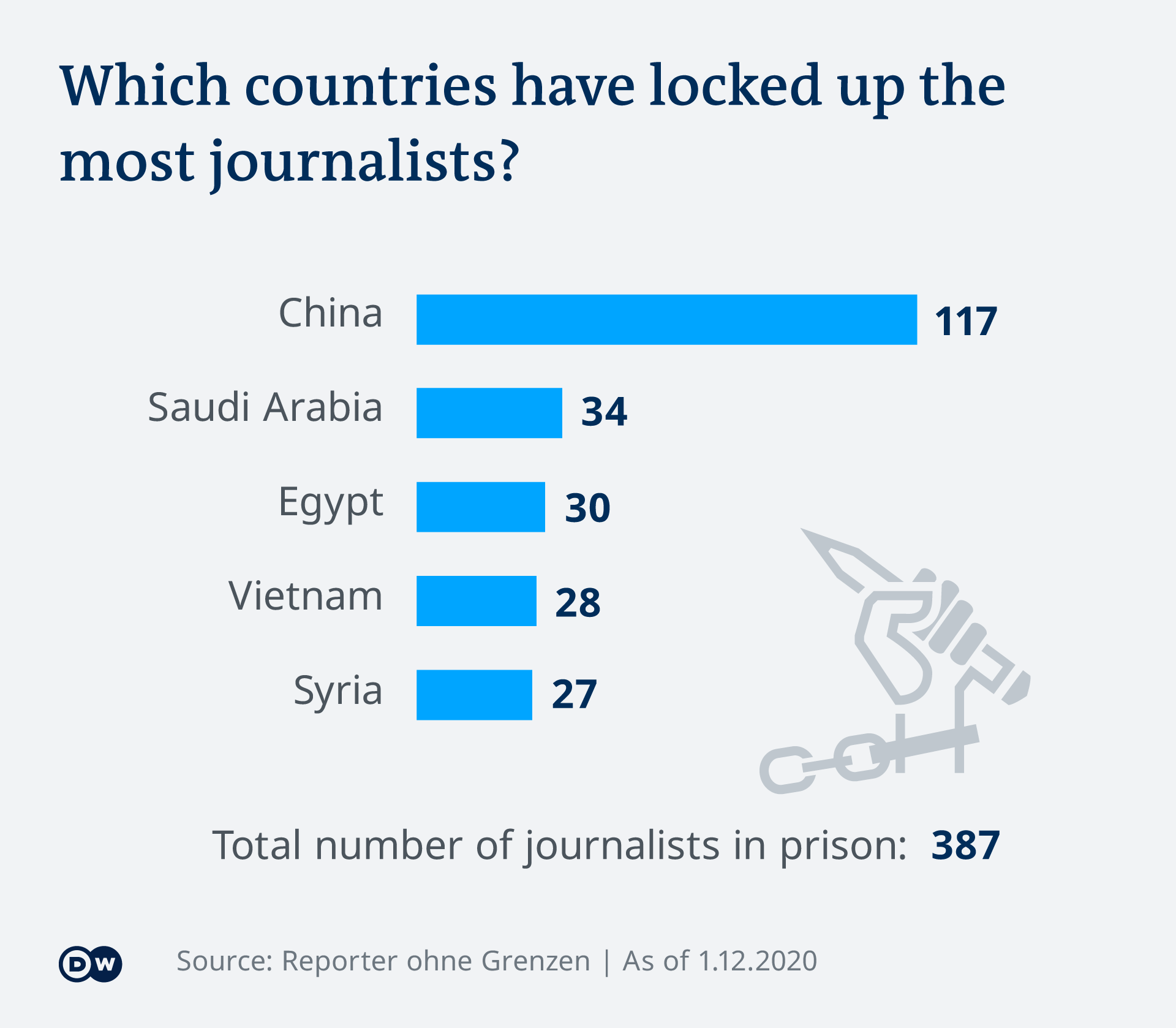
Hundreds of journalists are in prison worldwide for not giving in to government censorship, according to the German chapter of Reporters Without Borders. The findings were published in its annual report on press freedom.


Five countries were responsible for more than half of the jailed journalists recorded by RSF in 2020

At least 387 people working in the media industry around the world had been imprisoned by December 1 of this year, the German office of the press freedom NGO Reporters Without Borders (RSF) announced in its annual report on Monday.

Five countries were responsible for over half of all convictions: China led the pack with 117 jailed journalists, followed by Saudi Arabia (34), Egypt (30), Vietnam (28) and Syria (27).

While the majority of imprisoned press workers were still men, the number of women arrested in 2020 increased by a third to 42.

Dangers of reporting on the COVID pandemic

Since the outbreak of the global coronavirus pandemic early in the year, over 130 members of the press, be they journalists or otherwise, have been arrested for reporting on the crisis. Some 14 of those were still in jail at the time of the report's publication, said the report.


"The high number of imprisoned journalists worldwide throws a harsh spotlight on the current threats to press freedom," said Katja Gloger, the head of the RSF German office.

Gloger condemned the response of far too many governments to protests, grievances or the COVID-19 crisis with repression against the "bringers of bad news."

"Behind every single one of these cases is the fate of a person who faces criminal trials, long imprisonment and often mistreatment because he did not submit to censorship and repression," she added.

Her colleague, Sylvie Ahrens-Urbanek, highlighted one particular example of reprisals for reporting on the coronavirus pandemic — the case of investigative journalist Hopewell Chin'ono from Zimbabwe, who was arrested for reporting on the government's sale of overpriced COVID-19 medication. He was "brutally arrested," said Ahrens-Urbanek, and spent a month and a half in prison. Release on bail was repeatedly refused.
Worsening situation in wake of restrictions

Reporters Without Borders gave particular attention to Belarus, where at least 370 journalists have been arrested in the wake of the contested presidential election on August 9. Although most of those were released after a short period, the crackdown on journalists represents a reduction in press freedom.

Watch video Press freedom falls victim to pandemic


The report also highlighted the detention of the Australian WikiLeaks founder Julian Assange, currently in Belmarsh high-security prison in the UK. RSF claimed that the conditions had become much worse following a coronavirus outbreak in the prison and that Assange had been placed in de facto isolation.

The report expressed concern for the health of those imprisoned journalists who have not received proper medical attention during the pandemic and who have been subjected to the psychological effects of increased isolation.

Five journalists were facing death sentences as of December 1, one of whom — Iranian journalist Ruhollah Zam — was executed on December 12. The other four were in the custody of the Houthi rebels in Yemen.

Watch video Murder highlights plight of female reporters in Afghanistan


RSF counted 54 media workers who had been kidnapped in Syria, Iraq and Yemen; some of them have not been heard from in years. Another four journalists disappeared under unexplained circumstances in 2020 — one in Iraq, one in Congo, one in Mozambique and one in Peru.

The NGO began issuing its yearly report in 1995. It includes cases of journalists and other professionals working in the field of journalism. The compilers only include data if it can be carefully confirmed, which sometimes leads to certain countries, such as Turkey, showing lower numbers than reported elsewhere.
EU's rights agency warns on AI threat to rights

Fundamental human rights could be at risk if AI technologies are used without due caution, the EU's rights agency says. It said AI can lead to discriminatory biases and perversions of justice if safeguards are lacking.


Artificial intelligence technologies are being employed more and more across the world

More attention should be paid to the possible negative effects on people's fundamental rights of technologies based on artificial intelligence, the EU's rights agency said in a report issued on Monday.

"AI is not infallible; it is made by people — and humans can make mistakes," said Michael O'Flaherty, director of the Fundamental Rights Agency (FRA), in comments cited on the agency's website.

"The EU needs to clarify how existing rules apply to AI. And organizations need to assess how their technologies can interfere with people's rights both in the development and use of AI," O'Flaherty said.
Neglected rights aspect

The FRA report, entitled "Getting the future right — Artificial intelligence and fundamental rights in the EU," identifies areas where it feels the bloc must create safeguards and mechanisms for holding businesses and public administrations accountable in their use of AI.

It points out the many sectors in which AI is now already widely used, including in decisions on who will receive social benefits, predicting criminality and risk of illness and creating targeted advertising.

The report says that much of the focus in developing AI has been on its "potential to support economic growth" while the aspect of its impact on fundamental rights has been rather neglected.

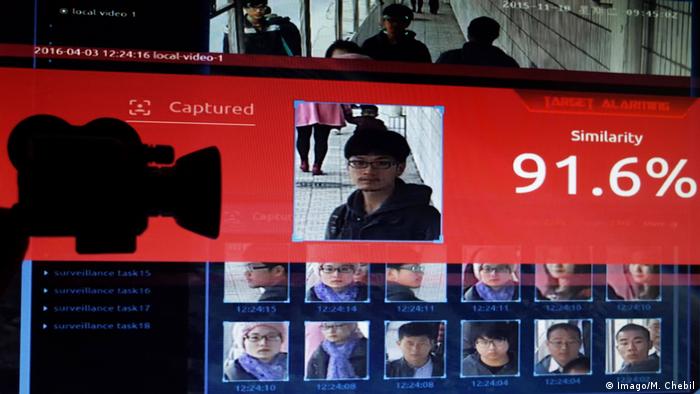
Facial recognition technology is one use of AI that has aroused considerable controversy


Call for accountability

It is possible that "people are blindly adopting new technologies without assessing their impact before actually using them," David Reichel, one of the experts behind the report, told the AFP news agency.

Reichel told AFP that even when data sets did not include information linked to gender or ethnic origin, there was still "a lot of information than can be linked to protected attributes."

One example used in the report is employing facial recognition technology for law enforcement. It says even small error rates could lead to many innocent people being falsely picked out if the technology were used in places where large numbers are scanned, such as airports or train stations. "A potential bias in error rates could then lead to disproportionately targeting certain groups in society," the report says.

The report calls for more funding into the "potentially discriminatory effects of AI" and for any future legislation on AI to "create effective safeguards."

Above all, it says, the use of AI needs to be more transparent, more accountable and include the possibility of human review.

VIDEO The two faces of automatic facial recognition technology https://p.dw.com/p/3mi0X


Australia says China coal ban would be clear 
WTO breach

Issued on: 15/12/2020 - 
Australia's economy has seen solid growth in recent decades on the back of supplying the raw materials for China's emergence as a modern economy WILLIAM WEST AFP/File
3 min
ADVERTISING


Sydney (AFP)

Australia on Tuesday decried China's reported ban on its coal exports as an obvious breach of World Trade Organisation rules, as tensions between the two countries flared again.

Prime Minister Scott Morrison said the Chinese government had yet to confirm state media reports that Australia's multi-billion-dollar coal exports are now subject to an informal ban.

Nationalist state-run tabloid the Global Times reported on Sunday that Chinese power plants are being steered toward buying their coal domestically, as well as from countries other than Australia.


"If that were the case, then that would obviously be in breach of WTO rules," Morrison said. "It would be obviously in breach of our own free trade agreement and so we would hope that is certainly not the case."

"We are seeking clarification on this," Morrison said, although ministerial-level contacts between the two countries are said to be non-existent.

Ties between the two countries are at the lowest ebb since the Chinese government's 1989 killing of pro-democracy protesters at Tiananmen Square, with Beijing rolling out a string of economic sanctions against Australian products.

Each dispute has been billed as a technical issue, but many in Canberra believe the sanctions are retribution for Australia pushing back against Chinese influence at home and in the Asia-Pacific.

At least 13 Australian sectors have been subjected to tariffs or some form of disruption, including barley, beef, copper, cotton, lobsters, sugar, timber, tourism, universities, wine, wheat and wool.

Suggestions of a coal embargo had been the subject of rumours for some time, with many Australia shipments reportedly already blocked at Chinese ports.

But even an informal ban would be a dramatic escalation, targeting one of Australia's most valuable exports -- worth up to US$3 billion a year -- and a sector that Morrison's conservative government has been keen to champion, despite objections from environmentalists.

Australia has long hinted that it may seek WTO intervention in the disputes, but a resolution could take years, open Australia up to retaliatory claims and worsen relations with Beijing further.

There has so far been little indication that Australia's political allies in the United States or Europe have been willing to step in and offer support.

The dispute with China has called into question Australia's decades-old model for stellar economic growth -- namely supplying the raw materials for China's breakneck emergence as a modern economy.

Morrison said both nations had benefited from close trade relations over previous decades and called for "mature discussions" about the disputes.

"Australia has always participated in China's economic development," he said. "We always have been a proponent of China's economic growth. We are not one of those countries that have sought to contain their growth."

© 2020 AFP

Monday, December 14, 2020

Japan's wasabi producers farm 'green gold'

Issued on: 15/12/2020 
Fresh wasabi is known as 'green gold' in Japan; it is difficult to farm, and therefore an expensive delicacy Charly TRIBALLEAU AFP

Izu (Japan) (AFP)

If you've eaten sushi, you might assume you've tried wasabi. But chances are it was an artificial version that Japanese growers say is a world away from their 'green gold'.

Unlike the spicy neon concoction familiar to many fans of Japanese cuisine -- which is in fact made from horseradish -- real wasabi is pale-green and offers a complex, mildly piquant flavour.

But even in Japan, it's not common fare. That's because the knobbly root is so difficult to grow, and consequently expensive to buy, with most of it snapped up by wholesalers

"The most important requirement is crystal-clear water, in abundance," Yoshihiro Shioya, 62, told AFP as he pulled a wasabi root from the sodden soil at his lush, green mountainside farm on Shizuoka province's Izu peninsula.

"It's absolutely necessary that the water temperature stays between 10 and 15 degrees Celsius, year-round," added Shioya, whose family has cultivated wasabi in the region for seven generations.

Patience is key -- each wasabi crop can take a whole year or even 18 months to mature in the large man-made terraces, which serve a particular design purpose.

"The water flows down from the top of the mountain, which has terraces built into it covered with layers of pebbles and sand that filter and purify it," explained Yasuaki Kohari, of Izu's agricultural cooperative.

Once ready, the long roots, topped with a plume of round green leaves, are harvested by hand. The leaves are stripped off and the root, known as a rhizome, is carried away in baskets.

About half of the 550 tonnes of fresh wasabi grown in Japan last year came from Shizuoka, southwest of the capital Tokyo.

Wasabi grows naturally there and has been used in local cuisine for centuries.

Legend has it that it was especially loved and popularised by 17th century shogun Ieyasu Tokugawa, a military ruler who was one of the unifiers of Japan.

These days it is mostly purchased by high-end restaurants in Tokyo and Osaka.

- 'Spicy, but with sweet notes' -

Wasabi is prepared by grating the root, usually on a small square device with fine metal teeth or topped with coarse sharkskin -- a process done almost immediately before consumption, as its piquancy fades after about 20 minutes.

Its spiciness is produced by a chemical called allyl isothiocyanate, which also gives mustard, radish and horseradish their pungency, and which scientists say has antibacterial properties.

It is usually served as a complement to raw fish, or alongside buckwheat soba noodles.

Toshiya Matsushita, a sushi chef at a restaurant in central Tokyo with a month-long waiting list, would never dream of using imitation wasabi.

"It feels powdery in your mouth and doesn't have much flavour," he said.

"Fresh wasabi not only masks the smell of the raw fish, but also heightens its flavour. It is spicy, but with sweet notes."

But it doesn't come cheap. He spends more than $700 a month on wasabi and uses one whole root a day, which he grates freshly for each order at his restaurant, Sushi Matsushita.

"The taste, the texture and the spiciness are different according to the way it is grated," he said.

- Not just a condiment -

Despite its enthusiasts, wasabi remains largely the preserve of restaurants like Matsushita's -- but these have suffered along with the rest of the hospitality industry during the coronavirus pandemic.

So wasabi growers have been prompted to think of ways to expand their market.

Wholesalers have been selling their stock to supermarket chains, hoping to acquaint new customers with the taste of the unique product. But the high price continues to be a barrier, the farmer Shioya says.

Others, like Yamamoto Foods, around an hour's drive from Shioya's farm, offer wasabi-based products that go beyond the root's status as a condiment.

"You can also eat the stalks, the flowers, the leaves. We use all the parts, so people can really get to know this delicious product," said store manager Mayumi Yasumori.

The firm offers wasabi-infused olive oil, salt and mayonnaise, as well as shavings of wasabi to sprinkle on rice -- and even wasabi-flavoured ice cream.

"Wasabi shouldn't just play a cameo in the kitchen," said Yasumori. "It can also take the leading role."

© 2020 AFP
California wants pandemic cases info from Amazon

Issued on: 15/12/2020 -
The state of California has accused Amazon of failing to adequately comply with subpoenas demanding details about coronavirus cases and protocols at its facilities
 David Becker AFP/File

San Francisco (AFP)

California on Monday accused Amazon of failing to adequately comply with subpoenas demanding details about coronavirus cases and protocols at its facilities here.

State attorney general Xavier Becerra filed a petition calling on a California judge to order the e-commerce colossus to provide the information being sought, according to his office.

"It's critical to know if these workers are receiving the protections on the job that they are entitled to under the law," Becerra said, referring to Amazon employees in California.

"Amazon has delayed responding adequately to our investigative requests long enough."

The petition to the court argues that the e-commerce giant has not provided information being sought as part of an investigation into Amazon's coronavirus protocols and the status of COVID-19 cases at its facilities.

Subpoenas were issued by the California department of justice four months ago, according to Becerra.

"We're puzzled by the Attorney General's sudden rush to court because we've been working cooperatively for months and their claims of noncompliance with their demands don't line up with the facts," Amazon said in response to an AFP inquiry.

"The bottom line is that we're a leader in providing COVID-19 safety measures for our employees – we've invested billions of dollars in equipment and technology, including building on-site testing for employees and providing personal protective equipment."

Information sought by state attorneys included Amazon sick leave policies and cleaning procedures, as well as raw data on the number of infections and deaths at their facilities in the state.

Seattle-based Amazon has seen sales, and pressure on its logistics network to deliver, soar during the pandemic as people shop online to reduce health risk.
'Terrified' survivors recount attacks on civilians in Tigray


Issued on: 15/12/2020 
Shelling from both sides tore open the walls of concrete homes 
and destroyed mud homes altogether EDUARDO SOTERAS AFP

Bisober (Ethiopia) (AFP)

The first shells landed before dawn, crashing through tin-roofed mud homes and sending Jano Admasi's neighbours fleeing for the cacti-dotted hills around her village in Ethiopia's northern Tigray region.

Jano, a soft-spoken woman in her sixties, tried to escape as well, running with her eldest son, 46-year-old Miskana, along a dirt road leading out of the village.

But on the way, she says, they encountered Ethiopian government soldiers who turned them around, forcing them into a nearby house with two other terrified families.

What happened next, described by three eyewitnesses but denied by the Ethiopian government, casts doubt on Prime Minister Abiy Ahmed's claim that his military offensive in Tigray has been prosecuted with special care for civilian lives.

In an apparent rage, the soldiers accused Miskana and two other men in the group of aiding the Tigray People's Liberation Front (TPLF), whose leaders are the target of the military operations ordered last month.

"They asked us who we were, and we said we are just farmers and elderly women," Jano told AFP. "They came back again and said 'Get out', and separated the men from the women."

The soldiers made the men including Miskana sit down and, before Jano fully realised what was happening, shot them dead with Kalashnikov rifles.

A 15-year-old boy who leapt in front of a bullet in a futile bid to save his father was also killed.

The killings -- which took place on November 14, 10 days after Abiy announced the offensive -- represent just one incident of civilian suffering in Bisober, a farming village home to roughly 2,000 people in southern Tigray.

In the three days it took federal forces to wrest control of the village from the TPLF, 27 civilians died, according to local officials and residents: 21 from shelling and six in extrajudicial killings.

The government has tightly restricted access to the region, making it difficult to assess the toll of a conflict the UN warns is "spiralling out of control".

But AFP recently obtained exclusive access to southern Tigray, where residents of multiple towns and villages accused both government and pro-TPLF combatants of, at best, putting civilians in harm's way -- and, at worst, actively targeting them.

Survivors told AFP they dreaded how many civilians could have died across Tigray.

"If in just this one area you have this much destruction," said Bisober resident Getachew Abera, "then imagine what might have happened generally."

The military did not respond to a request for comment.

Ethiopia's democratisation minister Zadig Abraha told AFP that any claims that Ethiopian soldiers killed civilians were "false".

- Village warfare -

In retrospect, Bisober residents say, the first sign of the conflict came seven months ago, when members of the Tigray Special Forces took over the village's elementary school, which had been emptied because of the coronavirus pandemic.

By early November, when the first shots were fired, some 250 pro-TPLF troops were encamped there, digging trenches behind classrooms and storing weapons in what was once the principal's office.

The Tigrayan fighters' decision to base themselves in the centre of Bisober helps explain the carnage that ensued, said Getachew Nega, the village administrator.

"The TPLF lost hope and they came and put heavy weapons and other weapons in this village. They shouldn't have done this," Getachew said.

Once the fighting started, Tigrayan combatants broke into abandoned homes from which they fired on Ethiopian soldiers, witnesses said, inviting massive damage.

Across Bisober, shelling from both sides tore open the walls of concrete homes and destroyed mud homes altogether, leaving only metal roofs behind.

"The conflict was a sudden act. Both parties had their missions, and we were caught in between," said Said Idriss, a member of a newly-formed command post trying to restore order in the area.

"They could have asked the people to leave earlier."

- 'Like spilt water' -

Today Bisober is relatively calm, with many residents labouring in nearby sorghum fields, trying to salvage this year's harvest.

Security is provided by special forces from the neighbouring Afar region, who use rags to clean their guns while lazing under acacia trees in a makeshift camp on the outskirts of the village.

Abiy declared victory in Tigray in late November after federal forces reportedly seized the regional capital Mekele, but the TPLF has vowed to fight on and the UN has recently reported persistent clashes throughout the region.

Human rights organisations are calling for thorough, independent investigations of the violence -- though Abiy is resisting the idea.

Government spokesman Redwan Hussein told a press conference last week that outside investigators would be allowed in only "when the Ethiopian government feels that it failed to investigate" on its own.

Ethiopia "doesn't need a babysitter," he added.

Jano, for her part, has little time for such debates.

She can't shake the memory of watching soldiers shoot her son in front of her, and of waiting in the street with his body for two full days, unsure what to do.

"We didn't cry. We were too terrified. We were trembling with fear," she said.

Instead of worrying about whether the perpetrators will be held to account, she said she is focused on trying to rebuild her life and care for Miskana's three children.

"I already lost my son and he's not coming back," she said.

"It's like spilt water, you cannot get it back."

© 2020 AFP
Most in Japan oppose holding Olympics in 2021: polls

Issued on: 15/12/2020 -
\
A majority of Japan's public continues to oppose holding the coronavirus-postponed Olympics next year Philip FONG AFP/File

Tokyo (AFP)

A majority of Japanese people oppose holding the coronavirus-postponed Tokyo 2020 Olympics next year, favouring a further delay or outright cancellation of the massive event, new polling showed Tuesday.

The new data shows public sentiment has shifted little since the summer, when surveys in Japan also found only a minority backing plans to hold the Games next year, despite the imminent arrival of new vaccines.

A poll released Tuesday by national broadcaster NHK found just 27 percent of respondents support holding the Games next year, with 32 percent backing cancellation and 31 percent favouring a further postponement


The remaining respondents said they were unsure or gave no answer.

Olympic organisers and Japanese officials have ruled out any further delay of the Games, which are the first in history to be postponed during peacetime.

They have insisted Tokyo 2020 can be held even if the pandemic is not under control by the new opening date of July 23, 2021.

But the Japanese public do not appear convinced.

A poll published on Monday by the Jiji press agency similarly found 21 percent favouring a cancellation and nearly 30 percent a further delay.

And a Kyodo news agency poll published December 6 also found a total of 61.2 percent opposed to holding the Games next year.

The figure comes with just over seven months to go until the postponed Games are scheduled to open.

The start of vaccination campaigns in some parts of the world has boosted the confidence of organisers that the Games can go ahead, though innoculation will not be mandatory for athletes or spectators.

But even as the vaccines are being rolled out, new waves of the virus are surging in many places, including Japan, which has seen a comparatively low toll from the outbreak, recording fewer than 2,600 deaths so far.

Postponing the Games and devising coronavirus countermeasures has proved a logistical nightmare for organisers, and carries a steep price tag.

The delay and health measures will add at least an extra $2.4 billion to the existing $13 billion budget for the Games.

Organisers are due to release an updated budget later this month, but their figures for the cost have been hotly disputed, with an audit report last year estimating the national government spent nearly 10 times its original budget between 2013-2018.

Organisers countered that the estimate included items not directly related to the Games.
Overcoming war and disability: Yemen's women basketball players hit the court

Issued on: 15/12/2020 - 
Five all-women teams were part of in the wheelchair basketball competition in the capital Sanaa this month Mohammed HUWAIS AFP

Sanaa (AFP)

In Yemen's capital Sanaa, women in long-sleeved athletics shirts raced down a basketball court in wheelchairs, dribbling and passing as a small crowd cheered them on.

"If the Yemeni people are suffering from the war, then those with disabilities are suffering twice as much," said Amal Hizam from the sidelines, herself also in a wheelchair.

The Arab world's poorest country is devastated by conflict, the novel coronavirus and a humanitarian crisis that the United Nations has called the world's worst.

But all that didn't stop a local wheelchair basketball championship going ahead in Sanaa this month.

Five all-women teams were part of the competition, only the second of its kind, including Al-Erada -- Arabic for "The Will", and Al-Mustaqbal, or "The Future".

Tens of thousands have been killed in Yemen since 2015, when a Saudi-led coalition intervened to support the government after Huthi rebels took control of Sanaa the year before.

A UN-brokered agreement reached two years ago between the government and the Iran-backed Huthis offered some hope, but a peaceful settlement has yet to materialise.

The female players, some wearing face coverings as well as their headscarves, jostled and shot baskets from sports wheelchairs painted red and light-green at the indoor court.

Hizam, assistant director of Yemen's sports federation for people with disabilities, said initiatives such as the tournament were "practically non-existent".

- 'A gift, not an obstacle' -

"I wish society wouldn't look down on those who are disabled, and that it would see our capabilities," said one of the Al-Erada players, 28-year-old Tahani al-Omari.

"Disability is a gift, not an obstacle," she told AFP, wearing her team's striped orange vest.

Teenage girls in the bleechers squirmed with excitement, throwing their arms into the air to cheer on the players.

Yemen's conflict has displaced some 3.3 million people, and around 80 percent of the population needs humanitarian aid and protection, according to the UN.

There are estimated to be around four million people with disabilities in Yemen, according to World Health Organization data.

"Millions of people with disabilities in Yemen have not only endured years of armed conflict but are also among those most excluded," rights group Amnesty International said last year.

"What we want is inclusion and support, and we can be involved in any field," Omari said.

"We need special wheelchairs equipped for playing and, most importantly, moral support."

A coach of multiple teams, Abdo Mohammed Zayed, said Yemen's lack of clubs and facilities for players with disabilities presented another challenge.

The goal of the tournament, he said, was to "offer social and moral support to those with disabilities, and allow them to showcase their capabilities and creativity."


The pandemic has taken surveillance of workers to the next level


Monitoring people while they do their jobs is creepy, and can even be counterproductive – but it has a long history

‘Companies that offer remote monitoring software have reported a surge of interest in their products.’ 
Photograph: Andriy Popov/Alamy Stock Photo
Mon 14 Dec 2020 
Rachel Connolly

One of the worst jobs I have ever had was made particularly bad by the micromanaging efforts of my manager’s boss. He seemed to spend all day skulking around, peering over the shoulders of junior staff to check that whatever we were doing looked like work. If he spotted someone doing something he considered untoward (usually reading the news or, on slow days, perhaps online shopping) he would come up behind them, point at the screen, wag his finger and say: “Not work!”

Sometimes it actually was work, but there was no point in arguing. It was a frustrating and corrosive environment, and not conducive to getting things done. His measure of productivity was clearly a blunt instrument and, instead of fostering a motivated workplace, he created an atmosphere of jittery paranoia and low-level resentment.

I think of him often (much more than I would like to), especially when I read anything about workplace surveillance. This term usually arises in the context of some new technology with alarming privacy implications that allows managers to track whatever employees are doing on their computers. But the concept is not a new one; the idea that people need to be constantly observed if they are to work efficiently dates back to Taylorist theories from the early 1900s about the best way to organise factory staff.

During the pandemic, there has been a renewed sense of panic about the implications of companies monitoring their employees. Most office work has been conducted online, and surveillance methods have adapted accordingly. Companies that offer remote monitoring software have reported a surge of interest in their products. Issues have been raised about things such as where the data collected from Zoom calls is stored, and which other companies it might be shared with.

The latest outcry happened last month, when it transpired that Microsoft 365, a software package released in 2019 that gives managers an overall rating of their team’s productivity by measuring things such as how many emails people are sending and who they are communicating with, also allows you to zero in on individuals. It’s possible to see how much people participate in group chats, and how much they contribute to shared documents.

Software that measures things such as what (and how fast) people are typing and what they are looking at on their screens would (or at least should) give most people the creeps. But in focusing primarily on these methods, partly because they seem new, we can miss how ingrained the instinct to watch and measure workers is.

Surveillance isn’t created by technology, but rather facilitated by it. It has been said that Covid has accelerated these practices, but perhaps the pandemic has simply highlighted the extent to which they always went on.

Employers have long correlated workers’ efficiency with their visibility, and this logic has followed through to the modern workplace. As far back as 1915, a contraption called the “modern efficiency desk” (a flat metal desk that could be installed in rows) was designed so that clerks, who had previously used wooden desks surrounded by stacks of paper, were more exposed while working, and could therefore be more easily monitored.

My old boss was an extreme example, but in any open-plan office it is normal to be watched almost constantly by your superiors. In fact, one of the selling points of this layout is that it facilitates surveillance. Hence, a common experience is trying to orientate the appearance of your productivity around what you think is being measured, rather than trying to do your work to the best standard; dragging out tasks to stay late so your boss will not think you are shirking your responsibilities by leaving early, for example.

Lots of white collar jobs (law and accountancy are two examples) make employees record how they spend their time (even down to the minute) so they can bill clients. This same system is used for non-billable time too; certain things that are presented as perks (such as having key cards, clock-in systems for flexible hours, company phones that you can also use for personal communication and in-office socialising) also have monitoring possibilities built in. Meanwhile, digital forms of communication, such as Slack chats, generate an automatic record of everything people say, even in conversations that feel casual.

Away from the white collar world, Amazon workers operate under regimes of extreme surveillance, with networks of security cameras and hourly productivity goals for moving packages. And in many call centres, information is collected on everything from the length of calls and the number of call transfers, to the time people spend on their toilet breaks. This is, of course, significantly more invasive than a programme that monitors inter-office email communication, but the purpose is much the same.

All of this measuring is done in the name of maximising productivity. But the best measure of productivity is simply the quality and quantity of a person’s work. Monitoring what people are doing is not the same thing as measuring their work output. Indeed, a Harvard Business Review report from earlier this year argued that needlessly monitoring employees can erode trust. It exalted the benefits of new tracking options from a manager’s perspective, but stressed that not everything that can be tracked is relevant or useful; sometimes it is just a thing that can be tracked.

We are inured to the idea that professional environments have a built-in layer of surveillance, and now that this environment has merged with the home for many workers, some of these practices have started to look more extreme. But the discussion about surveillance should not start and end with the tools employers use to monitor people working from home. We should instead be asking: how necessary is any of this?

• Rachel Connolly is a London-based journalist from Belfast


CRIMINAL CAPITALI$M BIG BUSINESS UNION
UAW agrees to monitor, voting changes after corruption probe
LIKE THE TEAMSTERS BEFORE THEM 

DETROIT — An independent monitor will watch the United Auto Workers’ finances and operations, and members will decide how they pick future leaders under a reform agreement with the U.S. Attorney’s office
.
© Provided by The Canadian Press

The deal was announced Monday in the wake of a wide-ranging federal probe into corruption that reached into the upper ranks of the 400,000-member union.

It forestalls a possible federal takeover of the UAW due to the probe into bribery and embezzlement that has lasted more than five years.

The monitor, to be nominated by the union and approved by the Justice Department, will stay in place for six years unless all sides agree to end or extend the term. The deal, spelled out in a federal court consent decree, still must be approved by a U.S. district judge.

Matthew Schneider, the U.S. attorney in Detroit, said Monday that the probe of the union has ended, but investigators still are pursuing unspecified individuals.

But he said that current UAW President Rory Gamble is not a target of the investigation. “I don't have any reason to investigate Mr. Gamble,” Schneider said.

Gamble said the settlement, while painful, takes the union another step toward “restoring the full faith and confidence of our members.”

He said it puts in place safeguards that go beyond what the union already has done, including a review of financial controls, hiring an ethics officer and retaining a third-party firm to review finances.

“The UAW going forward is clean, and we are a better union for it,” Gamble said.

The probe has led to 11 convictions of union members, including two former presidents. Schneider said it uncovered embezzlement of over $1.5 million in dues money, kickbacks to union officials from vendors, and $3.5 million in illegal payments from executives at Fiat Chrysler who wanted to corruptly influence contract talks.

The union, he said, already has repaid $15 million in improper charges to joint training centres set up with General Motors, Fiat Chrysler and Ford. It also agreed to pay $1.5 million to the Internal Revenue Service to settle a tax investigation.


Under the deal, union members will decide by secret ballots whether they will vote directly to pick the union's future leaders, within six months of when the monitor is appointed.

Schneider, whose office has been investigating union corruption since 2015, had floated the idea of a government takeover and has advocated for direct voting by members to elect union leadership. Currently the union’s members vote on delegates to a convention, who then vote on a president.

The monitor will administer the election, will have the power to approve hiring or discharges of union employees, and can end or approve contracts, the agreement says.

Lee Harris, a worker at a General Motors engine and transmission factory in Romulus, Michigan, near Detroit, said the union needs additional oversight because of the scandal.

He said he would love to see members directly vote on leaders because the old method was unfair to workers.

“I, as a dues-paying, rank-and-file member, have no say whatsoever,” he said.

Many of the union officials were accused by federal authorities of conspiring with others to cover up the use of union cash for boozy meals, premium cigars, golf and lodging in Palm Springs, California.

Former UAW President Dennis Williams in September pleaded guilty in the government’s investigation, and his successor as president, Gary Jones, pleaded guilty in June.

Williams, 67, was president from 2014 until he retired in 2018. He was accused of conspiring with others to cover up the source of cash for lavish meals, cigars and large expenses.

The union’s Region 5 leadership, which was based in Missouri and headed by Jones, would hold weeklong retreats in Palm Springs and invite Williams along. He said he stayed beyond “what my union business required.”

Williams told a judge that he wondered if money was being misused but that he was assured by Jones that “everything was above board.”

More than $53,000 in union money was used to rent a villa for Williams for months long stays in 2015-18, according to a court filing.

He faces a likely prison sentence of 18 to 24 months.

The Detroit-based UAW is best known for representing 150,000 workers at Detroit's three automakers.

Williams has repaid $55,000 in inappropriate travel expenses, the union said. Separately, the UAW is selling a lakefront house built for him at a union conference centre in northern Michigan.

Eleven union officials and a late official’s spouse have pleaded guilty since 2017, although not all the crimes were connected. The first wave of convictions, which included some Fiat Chrysler employees, involved taking money from a Fiat Chrysler-UAW training centre in Detroit.

Tom Krisher, The Associated Press