Bosnian Serb strongman claims election win, thanks Trump and Putin
Sarajevo (AFP) – The former president of Bosnia's Serb statelet, Milorad Dodik, said his party had retained power in the entity and its seat on the shared presidency, as preliminary results showed a drop in turnout for Bosnia's general elections.
Issued on: 04/10/2026 - RFI

Dodik led the declarations for a dizzying number of posts to be decided in the general elections in a complex system that has held the partitioned Balkan country together since the 1995 peace deal.
The key race was for the tripartite presidency, split between Bosnian Muslims or Bosniaks, and the Serb and Croat ethnic groups. Dodik's Serb nationalists ran on a platform of greater autonomy and secessionist rhetoric.
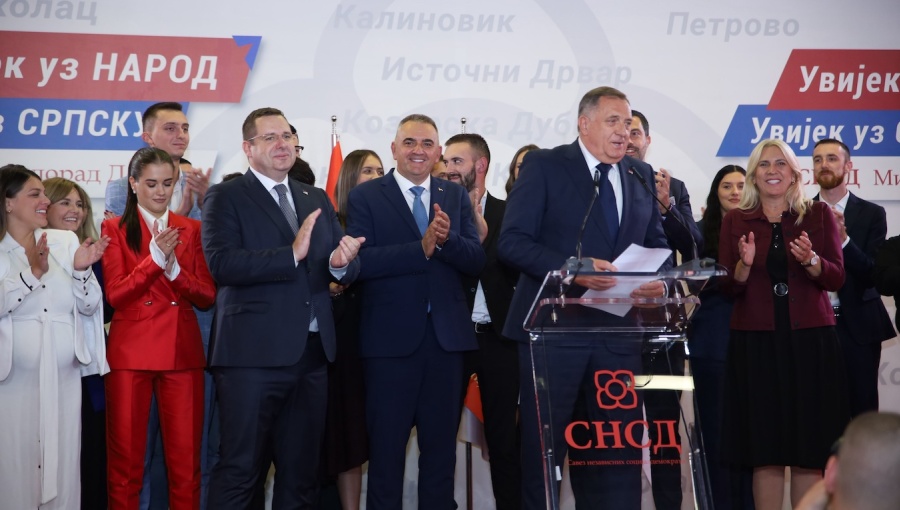
"If it had not been for Donald Trump's magnificent victory... we would probably be political corpses today," he told supporters in Banja Luka, in a speech that also thanked his close ally, Russian President Vladimir Putin.
"But now, thanks to the new environment, we are political winners," he added.
The 67-year-old was not on the ballot after being convicted of overstepping his powers and banned from the presidency for six years.
But he remains a central figure in the Bosnian Serb Republika Srpska entity.
With 95 percent of the ballots counted, according to electoral officials, his candidate, Zeljka Cvijanovic, was firmly on track to retain her spot in the presidency.
Meanwhile, Bosniak presidential incumbent Denis Becirovic also claimed victory after results showed him leading a tighter race for his seat.

"A freedom-loving, anti-fascist and civic Bosnia and Herzegovina is alive," Becirovic, from the Social Democrats party, told supporters in Sarajevo.
Bosnian Croat nationalist candidate Darijana Filipovic also claimed victory in her bid for the Croat presidential seat.
Dodik's party was also projected to retain power in the Serb entity's parliament and local presidency by a large margin.
The US-brokered Dayton agreement ended the 1992-1995 conflict but entrenched divisions that often paralyse decision-making.
It divided Bosnia into two semi-autonomous entities -- the Serb-run RS and a Muslim-Croat federation -- linked by a weak central government.
Low turnout
The major parties' repeated focus on war-era rhetoric of ethnic division frustrated some voters, who hoped for candidates to address economic concerns in one of Europe's poorest countries.
Economist Merima Cerim Karisik, voting in a northern Sarajevo suburb, told AFP she hoped for change and a turn away from the tired politics of the past.
"That what we have seen over the past 30 years will finally come to an end," she said.

Amela Hadzic, after casting her ballot at the same polling station, said it felt like the country had gone backwards recently.
"I hope people have seen that things cannot go on like this. I doubt there will be any major changes, but hopefully things will at least get better, however little," Hadzic said.
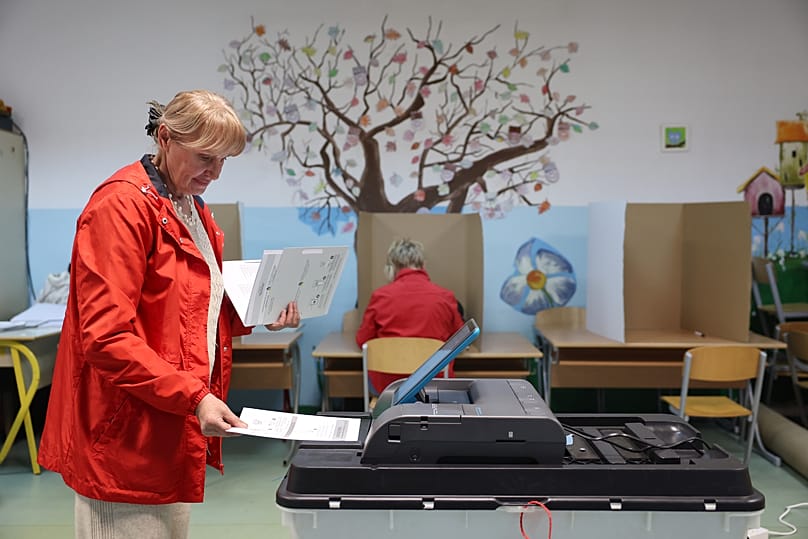
With the debut of biometric identification and the scanning of paper ballots at thousands of polling stations, authorities said technical issues had caused voting to be extended at some stations, but there were no reports of major incidents.
Turnout dropped nearly 10 percentage points from the last election in 2022, to around 42 percent, according to official figures.
- No progress on EU goals -
In the Muslim-Croat federation, Becirovic advocates a path toward the European Union and NATO.
But if Dodik's party returns to the presidency, it would almost certainly mean the political deadlock that has blocked the necessary reforms for years would remain.
After two decades in power, Dodik and his party have repeatedly clashed with the country's central authorities and vocally oppose EU membership.
Croat nationalist parties are also pushing for electoral reform. They want a greater say in choosing the Croat member of the presidency in the entity they share with the more numerous Bosniaks.
© 2026 AFP
Bosnia's main ethnic parties appeared to be strengthening their grip on power in the October 4 elections, preliminary results showed, potentially complicating the country's bid to join the European Union and prolonging a political deadlock that has frustrated voters and Western powers alike.
With 92.3% of polling stations processed, the Bosniak nationalist Party of Democratic Action (SDA) was the largest party in the race for the House of Representatives of the Parliamentary Assembly of Bosnia and Herzegovina, taking 19.89% of the vote, or 240,762 ballots, according to preliminary data from the Central Election Commission.
The Alliance of Independent Social Democrats (SNSD), the dominant party among Bosnia's Serbs and led by Milorad Dodik, was second nationally with 16.44%, followed by the multi-ethnic Social Democratic Party (SDP) with 9.39%.
The coalition around the main Bosnian Croat party, HDZ BiH, was fourth with 8%, while a list led by Republika Srpska opposition politician Draško Stanivuković took 5.99%. The results are preliminary and votes are still being processed.
In the race for the three-member presidency, Denis Bećirović, representing the United for the State coalition, led with 38.03% for the Bosniak seat, ahead of SDA leader Bakir Izetbegović on 34.25%. Bećirović is a staunch advocate of Bosnia's EU and Nato integration.
SNSD candidate Željka Cvijanović had a strong lead for the Serb seat, with 55.6% of the vote after 80% of polling stations were processed. HDZ BiH candidate Darijana Filipović was leading for the Croat seat with 48.19%, convincingly ahead of rival candidates.
SNSD victories
Dodik declared victory for his SNSD across all levels of government after the first preliminary results were released, also indicating a victory for the party's candidate for the presidency of Bosnia's Serb entity Republika Srpska.
"I declare victory at all levels. Thank you to everyone. This is a result similar to that of 20 years ago," Dodik said, reported Klix.ba.
He also linked the result to the political climate in the United States, saying that without Donald Trump's return to the White House, his party might have been in a weaker position.
In Republika Srpska, the Serb entity that makes up one of Bosnia's two autonomous regions, the SNSD was on 38.93% with nearly 87% of votes counted for the entity's parliament, and Dodik's son Igor Dodik topping the list. Stanivuković's Movement for a Safe Srpska was second on 14.19%, followed by SDS on 12.27%. The party's candidate Savo Minić is on track to secure the entity's presidency.
Complex political system
Bosnia's complex political system was established under the 1995 Dayton peace agreement, which ended the 1992-95 war and divided the country between the Serb-dominated Republika Srpska and the Bosniak- and Croat-majority Federation of Bosnia and Herzegovina. A weak central government and a three-member presidency link the two entities.
The arrangement has frequently produced political stalemate, with leaders from the two entities and the country's three main ethnic groups often unable to agree on decisions at the state level.
That paralysis has become a major obstacle to Bosnia's EU ambitions. The country received EU candidate status in December 2022 and the bloc agreed in 2024 to open accession negotiations. But formal talks have yet to begin because Bosnia has not completed key reforms, including measures to strengthen judicial oversight and anti-corruption legislation.
A stronger showing by the established ethnic parties could make it harder to overcome those divisions, particularly if the new parliament reproduces the confrontations that have repeatedly blocked state-level decisions.
The election also took place against a backdrop of competing foreign influence. The EU wants to bring Bosnia and other Western Balkan countries into the bloc, while Russia has maintained close ties with the leadership of Republika Srpska and supported its political autonomy. The United States remains a major player in Bosnia, both through its role in the Dayton peace settlement and its broader efforts to limit Russian influence.
Washington is also backing a proposed $1.5bn gas pipeline intended to connect Bosnia to Croatia and provide an alternative to Russian energy supplies. The project has become part of a wider contest over Bosnia's future energy orientation, with the EU raising concerns about the transparency of the selection of the US-linked investor.
Tech issues
Election day was marked by some problems with the introduction of new voting technology. The election watchdog coalition Pod Lupom said it had recorded 46 serious violations by 9:30 a.m., including problems involving election materials, polling procedures and access for observers. Only 52.1% of polling stations opened at exactly 7 a.m., while another 37% opened within 15 minutes. The new technology was nevertheless operational before voting began at 99% of the polling stations observed, Pod Lupom said.
Turnout was 28.8% by 3 p.m., 8.12 percentage points below the level recorded at the same time in the 2022 elections, according to the election commission. The relatively low participation reflected the frustration of many voters with a political system that has changed little despite years of promises of reform.
Bosnia awaits for final general election results as preliminary count remains unclear
Around 3.4 million eligible voters in Bosnia headed to the polls to choose the three members of the country’s multi-ethnic presidency, lawmakers for the national Parliament, and heads of institutions for the country’s two entities.
Polls have now closed in Bosnia’s general election on Sunday, where preliminary results remain unclear, and the country is waiting for further updates in the coming hours to get a clearer picture of the outcome.
Some 3.4 million voters were eligible to choose the three members of the multi-ethnic presidency, national lawmakers, and leaders of the country's two entities: the Muslim-majority Federation of Bosnia and Herzegovina and the Serb-dominated Republika Srpska.
The complex system of institutions was created by the US-brokered 1995 peace agreement to manage divisions among Muslim Bosniaks, Orthodox Serbs and Catholic Croats.
Early reports show voting was delayed at several polling places due to problems with new digital voting technology, which was introduced to address earlier concerns about vote tampering. Bosnia's Election Commission made this decision to prolonge the 7 p.m. voting cutoff at polling stations that experienced problems.
The election comes as many citizens in the multiethnic Balkan state face everyday problems, while some leading politicians stoke the war-era tensions that have kept the country divided since the 1992-95 conflict.
By 3 p.m. around 27% of voters had cast their ballots, according to the commission, a decrease from 35% at the same time during the last national election.
New election security measures
For the first time, authorities were using electronic voter identification and ballot scanning to curb the irregularities and organised manipulation that undermined confidence in earlier elections.
Most of the 75 parties running are organised along ethnic lines. The Bosniak nationalist Party of Democratic Action has campaigned on keeping Bosnia united against Serb separatism, while many Bosnian Croats back ethnic parties such as the local branch of Croatia's ruling Croatian Democratic Union.
Izetbegovic, who was beaten by Becirovic in 2022, is seeking a third term as president of the centre-right SDA, the largest Bosniak party in the nation.
Many disillusioned citizens say politicians use nationalism to avoid tackling real problems like low living standards and the exodus of young people. Mostar voter Ivan Silic said nothing has improved since he first voted and that politicians live well while everyone else's situation stays the same.
Dodik looms large despite not being on the ballot
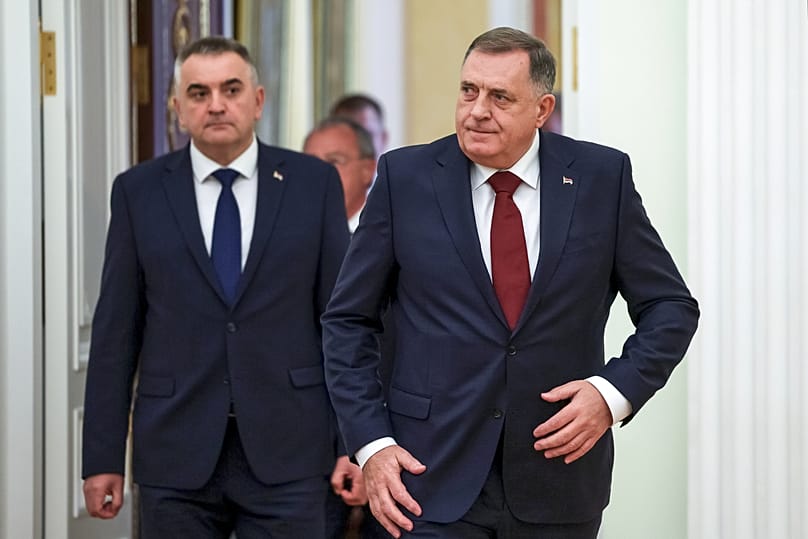
Despite not being on the ballot, the campaign has been dominated by Milorad Dodik, the pro-Russian, separatist former president of Republika Srpska. Dodik is banned from public office after being convicted of defying the international envoy who oversees the peace agreement.
Fresh from meeting Russia's president Vladimir Putin in Moscow, Dodik leads a party, the Alliance of Independent Social Democrats, that is likely to win in Republika Srpska.
At a final rally Friday in Banja Luka, attended by Russia's ambassador, Igor Khalabukov, Dodik declared Bosnia is "dead" and "an impossible country". "It doesn't make any sense," he stressed.
Off the ballot for the first time in almost 30 years, he is still in command and is present across the country's media, says Dragan Bursac, an analyst. In Bursac's view, the ban is not working, and Dodik is exploiting it.
Ethnic tensions continue to rise
Bosnia has been peaceful in recent years, but its politicians have kept ethnic divisions alive. Bosnian Serb leaders such as Dodik have pushed for their entity to break away, raising Western fears of renewed instability.
The Balkan nation remains one of Europe's poorest countries, still recovering from a war that began after it declared independence from Serb-led Yugoslavia and ethnic Serbs took up arms to carve out their own state. That conflict killed more than 100,000 people and displaced millions.
The country is formally seeking European Union membership, but progress has stalled despite EU efforts to push its leaders toward reform.
Major powers continue to influence socio-economic and political life in the small Balkan nation. Russia is holding down the EU's efforts to expand its membership throughout the Balkans, including Bosnia, while continuing to back the Republika Srpska.
While a $1.5 billion pipeline project to import US liquefied natural gas is being pushed by a corporation with ties to the Trump administration as part of the US's efforts to gain influence.
And recently, wartime wounds were reopened by public tributes in Serbia and among Bosnian Serbs to Ratko Mladic, the wartime army commander who died in late August while serving a life sentence for genocide and other war crimes.
Bosnian Serbs regard him as a hero, despite his UN court conviction over the killing of more than 8,000 Muslim men and boys in Srebrenica in 1995.
Senior Bosnian Serb officials attended his funeral in Belgrade, drawing sharp EU criticism and angering Bosniak politicians.

No comments:
Post a Comment