Serbia’s election was less a win for one set of politicians than “a victory of the people over politicians in general”, Alexander Baunov wrote in Carnegie Politika on October 26.
Aleksandar Vucic's Serbian Progressive Party (SNS), in power for 14 years, lost the October 25 vote to the Student List, the movement that grew out of the protests after the canopy of Novi Sad's railway station collapsed in November 2024, killing 16 people. Baunov, a senior fellow at Carnegie's Berlin centre, puts the list's share at 52.5% against 39.3% for Vucic's list, on the electoral commission's preliminary count.
The result is more than a defeat for Vucic. The winners have no backing from oligarchs, from defectors out of the elite or from the West, and the movement mixes liberals and nationalists held together by a demand for good government.
"These elections became one of the first cases in which the street did not break the old institutional frame but peacefully filled it," Baunov wrote. "And now it has to prove that the power of protest can become the power of government."
Horizontal against vertical
The detail Baunov picks out of Vucic's concession speech is that nobody else made it into parliament apart from the two big lists and the national minority parties. Ivica Dacic's Socialist Party, founded by Slobodan Milosevic, took 2.2% and missed the 3% threshold, and every other list, the old opposition coalition European Serbia included, polled under 1%.
"The key thing is the victory of the horizontal over the vertical: of a network movement that put political nobodies up for election over the veteran Vucic, who has been in politics since the 1990s and ran the country from the mid-2010s, but also over the old opposition parties," he wrote.
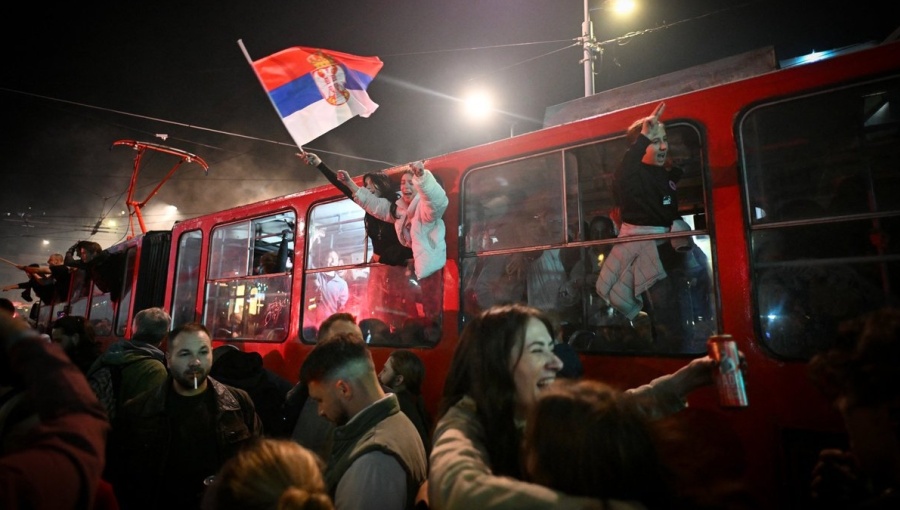
Belgrade celebrated on the night of October 26 "as if Serbia had scored the winning goal at the World Cup", Baunov wrote. Men in black hoodies were still being bussed into the pro-government tent camp in the city centre on election evening, but after the concession some of them, according to eyewitnesses he cites, joined the student crowds and chanted the victory slogans. Many of them come from the world around football, he notes. "Vucic is leaving; the contract with him is no longer valid."
Turnout was 10-15 percentage points higher than usual and was approaching 70% when the polls closed, not counting the diaspora vote, according to Baunov, who sets it against the 22.5% that turned out for Bulgaria's presidential election on the same day.
A movement without leaders
The students built their list of 250 names at plenums over more than a year and left themselves and the protest organisers off it, along with any professional politicians. It is headed by Ilija Srdanovic, a professor at the medical faculty in Novi Sad, and includes the chemist and academician Radomir Saicic, the sociologist Jovo Bakic, former central bank governor Dejan Soskic and the basketball player Dejan Bodiroga. It is not clear whether the roughly 140 seats won will go strictly in list order.
The move as a deliberate defence against the fate of France's gilets jaunes, according to Baunov.. In November 2018 only two of the eight "envoys" the movement chose by online vote turned up to meet Prime Minister Edouard Philippe, and one walked out almost at once demanding a live broadcast. "Such is the crumbling funnel of modern anti-elitism," Baunov wrote.
No oligarchs and no West
Serbia's experience is different to what has happened with Ukraine's Servant of the People in 2019, which was a president's party from the start, and with the 2004 Orange Revolution, built around career politicians and a stolen election. Nor is there a split in the elite of the kind seen in Hungary, where Viktor Orban was voted out in April after 16 years by an opposition led by Peter Magyar, a former insider in Orban's Fidesz.
The West was not behind the students either. Vucic made a show of betting on Donald Trump and told the UN in September that Serbia supported his administration's actions, and the White House did not react to the result straight away. Conceding, Vucic blamed "various European countries" and the "American deep state that opposes President Trump", Baunov writes.
Europe, in his reading, was a sympathetic onlooker mostly concerned with fragile stability in the Balkans, and the absence of recognisable pro-European leaders made the movement awkward to back. "It is hard to back a pig in a poke - a list of 250 people chosen by the votes of who knows whom," he wrote.
The campaign was not a contest between West and East either. Vucic warned his supporters that the new government would impose sanctions on Russia "by March or April", but Bakic, one of the winning candidates, said there would be none. "Russia is now too toxic to win an election on the idea of turning towards it, even in a country like Serbia," Baunov wrote. He compares the absence of anti-Moscow slogans at the protests with Armenia, where Western capitals and media also struggled to pick a side.
Good government against bad
The students instead ran on the contrast between good and bad government, "as in Ambrogio Lorenzetti's frescoes in Siena", campaigning against corruption and for efficient spending, competent economic management and decent infrastructure. That, Baunov argues, got round the classic split in the Serbian opposition between liberal Europeans and conservative nationalists who disliked Vucic equally but could not agree with each other.
Liberals and nationalists are both still inside the movement: only Serbian flags and faculty emblems were allowed at its rallies, and the Vidovdan rally on June 28, 2025 heard nationalist rhetoric and the Kosovo myth from the stage. In 2026 the students adopted a memorandum on Kosovo as part of Serbia while also running and cycling to Strasbourg and Brussels and meeting European commissioners. Baunov likens them to the liberal-nationalist coalitions that won elections and revolutions across the post-communist world, from Poland and the Balkans to Russia in 1991, Georgia and Ukraine.
Why Vucic gave up
Vucic conceded about an hour and a half after the polls closed. Baunov gives three reasons: a gap of more than half a million votes was too wide to contest by force or by trickery, the movement was too broad to be painted as the enemy of "the people", and the European perspective remained part of Vucic's own strategy. "EU membership worked as a safety catch against autocracy in Hungary ... and candidate status in Serbia," he wrote.
Vucic also has a political future to think of. He stepped down as president in September to lead his list and run for prime minister, and Serbia has to hold a presidential election by December 27. Clinging on would have pushed him away from Europe towards a Russia that is distant and busy with its war, Baunov writes. "In the 1990s Serbia fought every war except a civil one, and Vucic clearly has no wish to become the cause of one."
"What makes the movement strong at the moment of the election will become its weakness when it forms a government and governs," he added. "Here Vucic has all the advantages of experience and a bench of cadres."
Baunov describes Vucic's Serbia as a competitive autocracy, where the incumbent uses every administrative, media and even coercive resource but stops short of outright fraud. He cites the December 2023 snap election, when OSCE observers recorded pressure on voters and misuse of state resources and the independent NGO CRTA documented voters being organised and bussed into Belgrade, yet the same observers found voters still had a genuine choice.
The street in a frame
Horizontal protests usually have a short half-life, Baunov writes, citing Moscow's Bolotnaya Square and the gilets jaunes, and keeping the Serbian one going for two years was itself an achievement. What came next mattered more: the protest found a way to fill the existing institutional frame and use it without breaking it.
Power changed hands in Belgrade without fear of a coup, external pressure, a ruler's flight like Viktor Yanukovych's or a public worn out by street violence. "In Belgrade, one might say, not a single boutique was damaged," Baunov wrote. "It is as if the student movements of 1968 had gone to the polls and won. Not later, as the 'generation of 68' in power decades on, but straight away."
Serbia’s student victory raises hopes of an EU reset
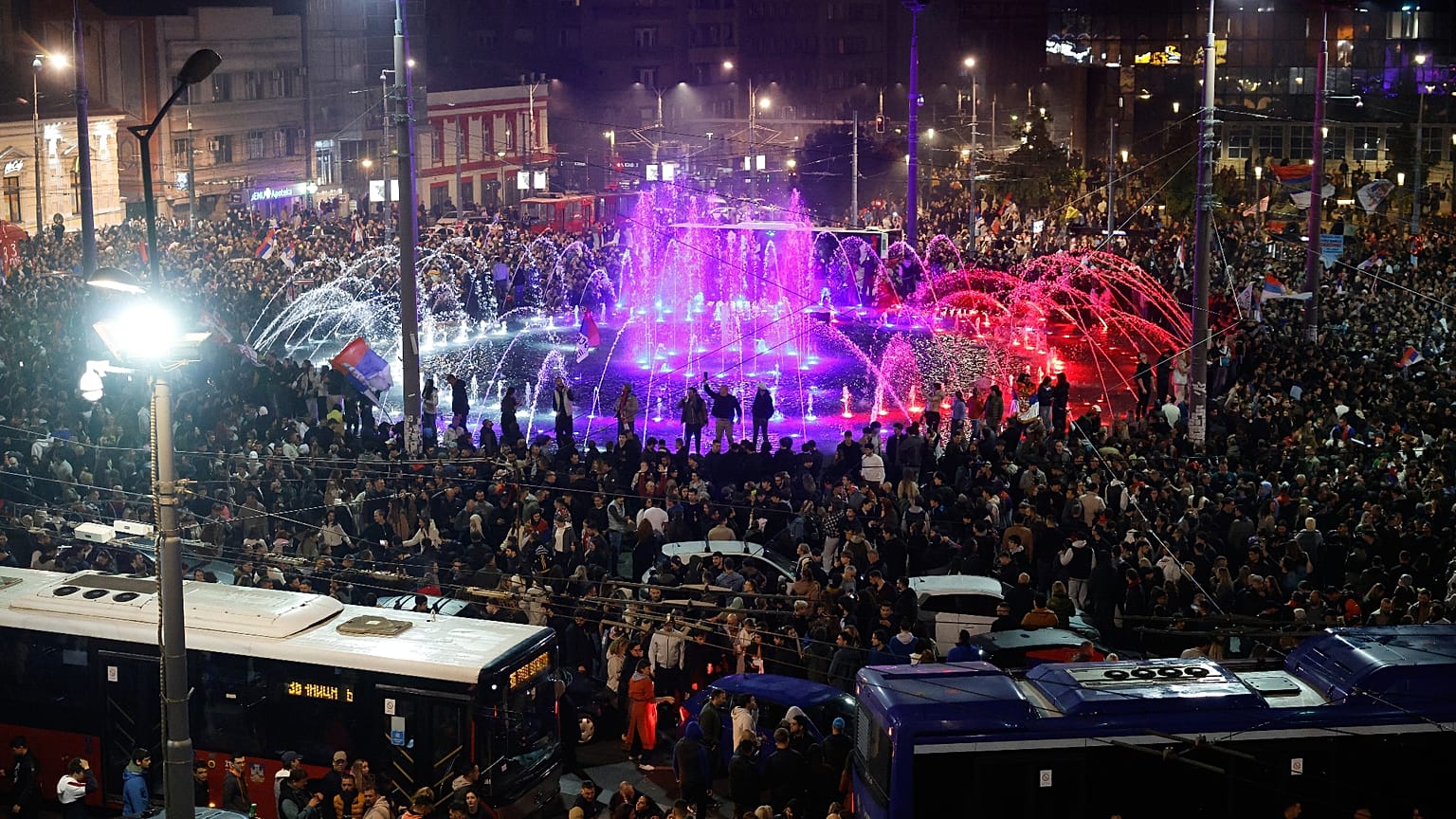
The Student List’s election win ends Vučić’s 14-year rule and raises hopes of an EU reset, but its stance on Russia sanctions and Kosovo leaves Brussels cautious.
The Student List’s landslide victory in Sunday’s parliamentary elections has raised hopes that Serbia will mend ties with Brussels and relaunch its EU accession bid, but whether Belgrade will actually change its foreign policy remains unclear.
The movement born from months of student protest has secured an absolute majority in parliament, ending the 14-year rule of Aleksandar Vučić’s Serbian Progressive Party (SNS) and fuelling expectations that the new government might seek closer ties with the EU.
“We are at the very beginning of the new path. But at least it’s a new path. We have no guarantees of anything. There’s just one guarantee that now we have the possibility, we have hope. And this is a huge achievement,” MEP Matjaž Nemec (Slovenia/S&D) told Euronews.
Protest movement
The Student List is the electoral arm of a student-led movement that grew out of a deadly disaster at a recently renovated railway station in November 2024, which raised questions about government accountability and corruption
After nearly two years, the protests became a nationwide challenge to Serbia’s political establishment, demanding institutional reform and democratic accountability and marking a historic rupture with the SNS’s 14 years in power.
The movement has elected a mix of figures from outside the traditional political class, including students, professors, doctors, artists and businesspeople.
For Brussels, the new political class’s roots in a pro-democratic, anti-corruption movement are an encouraging sign that Belgrade could align with EU values and push through much-needed rule of law reforms.
At the same time, the student movement is also very heterogeneous, at times harbouring opposing views, meaning that, beyond opposing Vučić, it is still unclear exactly what it stands for.
"Ousting Vučić from power was the pre-requisite for Serbia's European future," Jelena Vasiljević, a senior research associate at the University of Belgrade, told Euronews. "Now I hope we will be able to have an open, democratic discussion on the EU accession path."
Democratic change
The movement’s door-to-door campaign centred on corruption and accountability, drawing parallels between Vučić’s defeat and the ousting of Viktor Orbán in Hungary after 16 years. Hungary’s new Prime Minister Péter Magyar ran on a similar platform.
Magyar was the first foreign leader to call the Student List to congratulate it on its result. “I was delighted to hear how much strength our victory in April had given them during this difficult struggle,” he wrote on X.
The fair, competitive vote and the peaceful transfer of power, after Vučić conceded defeat, are seen as proof that Serbia’s democratic process is working.
Still, whether the change of government will translate into a broader realignment with Brussels, and into progress on EU accession, remains to be seen.
“It is not exactly clear what their take on foreign policy is. Many EU countries will be watching very closely,” an EU diplomat told Euronews, pointing to Serbia’s weak alignment with the bloc on foreign policy. “It remains to be seen if that will change.”
EU accession
Senior EU officials have welcomed the result. Enlargement Commissioner Marta Kos went as far as saying that “the door to the EU is open, and we are ready to move forward together.”
In July, the European Commission pushed to open Cluster 3 of Serbia’s accession talks, which have been stalled for years, but eight member states blocked the move citing democratic backsliding concerns and lack of alignment on foreign policy.
The programme the Student List published last month, however, focuses solely on domestic governance: public procurement, education, media freedom, judicial independence and health care.
Bojan Vranić, a political science professor at the University of Belgrade, cautioned EU officials against excessive enthusiasm, saying the change of government would hardly lead to a breakthrough in European integration.
“So far, the Student List has been very conservative when it comes to the European Union. They aim to, firstly, improve the system within. And once they, as they said, become a credible partner in a negotiation, then the European Union will be their partner,” Vranić said.
Proceed with caution
Optimism in Brussels is tempered by history. In 2003, Serbian Prime Minister Zoran Đinđić was murdered by former members of the country’s security apparatus for pursuing a pro-Western agenda of closer ties with Europe, economic reforms and a crackdown on organised crime.
The EU executive is due to publish its enlargement package next week, an annual report on the state of play in candidate countries that will offer a first sign of whether the bloc’s approach to Serbia is shifting, though the new Serbian government is unlikely to be in place before the reporting period ends.
Perhaps more telling will be the conclusions the Council of the European Union adopts on the package, which will show where member states stand and whether they want to encourage Belgrade.
A key test may be how the Student List-led government treats Montenegro, the frontrunner to join the EU. Vučić and the SNS tried to undermine its accession by sowing divisions based on identity politics.
“I firmly believe that a new chapter lies ahead for Montenegro and Serbia, based on respect and open dialogue, without unnecessary escalation of tensions,” Montenegrin Prime Minister Milojko Spajić wrote on X.
Foreign policy
Russia sanctions are among the main sticking points between Brussels and Belgrade, which has refused to align with the measures the EU imposed after Moscow’s full-scale invasion of Ukraine in 2022.
“The Republic of Serbia will retain its principled stance on not introducing restrictive measures toward the Russian Federation,” the student movement wrote on X in September, citing Serbia’s historical experience with sanctions.
Beyond its heavy dependence on Russian gas, Belgrade relies on Moscow’s diplomatic backing to prevent international recognition of Kosovo’s independence, which the student movement openly rejected in a memorandum published in May.
The Student List itself is split between staunchly pro-European figures and others who back a traditional Serbian nationalist agenda. Which camp prevails will shape the country’s foreign policy.
“There are strong nationalist voices in Studentska lista who would want to keep Russia onside because of Kosovo. Energy ties will persist as well. China ties might be downgraded a bit, but foreign direct investments and economic links are already there,” said Dimitar Bechev, a senior fellow at the think tank Carnegie Europe.
Vincenzo Genovese contributed to the reporting.

Issued on: 27/10/2026 -
Play (06:48 min)From the show
François Picard welcomes Helena Ivanov, Associate Research Fellow at the Henry Jackson Society, a London-based foreign policy and national security think tank advocating liberal democracy, strong transatlantic alliances, robust Western defence capabilities and the international promotion of democratic institutions. Ivanov describes the election as a historic turning point in Serbian politics. After 14 years of Aleksandar Vučić's political dominance, the reported electoral victory of a student-led movement represents, more than a challenge to an entrenched political establishment.
For Ivanov, It illustrates how sustained civic mobilization can translate popular discontent into electoral power. The Serbian experience may even establish an important political precedent: a student movement operating outside conventional party structures, sustaining its momentum for two years and ultimately achieving a decisive electoral breakthrough. "I believe Serbia is a precedent when it comes to how these elections were won," she observes, highlighting the movement's organizational distinctiveness.
Placing Serbia within a wider regional debate about democratic accountability, corruption and political renewal, Ivanov draws parallels with Hungary, examining how emerging political movements can challenge long-serving leaders and increasingly authoritarian forms of governance. She also disputes President Vučić's allegations that foreign powers orchestrated the protests, raising a broader question: under what conditions can grassroots civic mobilization become a credible electoral alternative?
Looking beyond Serbia, Ivanov suggests that the movement's success could inspire anti-corruption protests in Albania and elsewhere, sending a resounding warning to leaders accused of abusing their authority: "In Albania, but also anywhere in the world, they should be afraid."
Her concluding observation underscores the democratic principle at the heart of her analysis: even where political power appears firmly entrenched, the ballot box remains a potentially powerful instrument of accountability and change. "All it takes is one pencil and a piece of paper, and you can choose someone else."
On October 25, Serbia's student-led protest movement won a historic victory in parliamentary elections, defeating outgoing President Aleksandar Vucic's party. Supporters of the student list explained to FRANCE 24 how they mounted a massive mobilisation to fight electoral fraud and monitor the electoral process inside and outside the polling stations.
Issued on: 26/10/2026
By: Marguerite MARAMICI/The FRANCE 24 Observers

Serbia’s parliamentary elections on Sunday, October 25 delivered a political earthquake. The Student List movement challenged the Serbian Progressive Party (SNS) which had dominated Serbian politics for 14 years, led by outgoing president Aleksandar Vucic.
The result marked a historic turning point: the Student List won 52.45 percent of the vote, securing 138 seats in the National Assembly, while the Aleksandar Vucic – United Serbia list received 39.2 , earning 103 seats.
The student movement emerged in the aftermath of the collapse of a railway station canopy in Novi Sad on November 1, 2024, a tragedy that claimed 16 lives and triggered nationwide protests against corruption. Initially non-partisan, the movement gradually gained widespread public support before deciding to field its own electoral list. Rather than running for office themselves, the students chose to nominate highly qualified individuals with no prior political experience, selected through a democratic process organised within universities.
Petar Botoski, an agricultural student supporting the Student List, was in Novi Sad, a city located in the northern part of the country, when Aleksandar Vucic acknowledged the defeat of his party.
"It was the most challenging moment. We expected to win, but we did not know what would happen next. When the announcement came, I was in shock, everyone was cheering. At that time, the votes were still being transferred and being counted."
He explained that the student movement prevented much electoral fraud during the day.
“The whole day we reported to authorities incidents such as the finding of parallel lists or the detection of carousel votes.”
Both are practices that can facilitate voter pressure or manipulation of the voting process. The parallel list is an unofficial list of voters used alongside the official register to manipulate or falsify voting records, while carousel voting is a form of electoral fraud in which a voter is given a ballot that has already been marked, takes it into the polling station and deposits it in the ballot box. The voter then brings the unmarked ballot they received as proof that he or she voted as “required”.
Petar Botoski goes on:
“For a year and half, since we decided to propose a student list for the legislative elections, the student movement spent a lot of time and resources to create connections between people and to teach them how to prevent electoral fraud.
We trained at least 16,000 people to become official controllers, two for each polling station. Then we trained about five people per polling station to be part of mobile teams. Their mission was to detect fraud outside the polling stations, such as the use of parallel lists, carousel vote, pay[ing] for voters and intimidations. [Tracking] fraud had for sure an impact on the results.”
Turnout reached 69 percent, with more than 4.4 million citizens casting their ballots. This represents a significant increase compared with the 55.5 percent turnout recorded in Serbia’s December 2023 parliamentary elections.
'We ensured that it was harder for them to fraud'
Janko Sikosek, a member of the movement “Bikers with Students”, was among the volunteers that assisted in monitoring polling stations and helping to ensure a fair and transparent electoral process.
“I went out to vote early in the morning; the line was already forming before the polling station opened. At this moment, I felt very optimistic. People were looking at each other and smiling. The line was so long, I waited for an hour and a half to vote.
Then I joined my mobile team. Only in my municipality (Vozdovac), there were 14 mobile teams, each one composed of 3 people.
We were there to record, to observe, to be present. We ensured that it was harder for them (SNS supporters) to fraud.
The job of my team of bikers was to help mobile teams that got in trouble. One mobile team discovered vote-buying headquarters in Ovca, in the north of Belgrade. A guy of the mobile team was hit on the head, the other two escaped, but their car was trapped. When we intervened, a couple of our guys got hurt. One received a strike on the head with a rock and the other had his arm broken. But we managed to get the mobile team out of there.”

00:12
The incident involving Sikosek’s team was not isolated. Several other incidents were reported throughout election day, both inside and outside polling stations. For example, a group of masked men attacked election monitors from the Student List in Pancevo using pyrotechnic devices. Several of them were struck in the head.
Voir cette publication sur Instagram
Une publication partagée par Pančevo Si Ti (@pancevo.city)An attack against controllers of the mobile teams of the student list in Pančevo on October 25, 2026. ©Instagram/ @pancevo.city
Moreover, an observer from CRTA, a Serbian democracy watchdog, was harassed by a group of people in Zemur.
There were also reportedly some tensions inside the polling stations.
Marko, a student in Novi Sad, was an official controller. He reported some tensions between the controllers from SNS and the ones from supporting the Student List. He said the SNS controllers tried to obstruct some people from voting, notably younger ones, pretending “they don't look like their ID photo".
In some places, there were tensions about voting booths. Voting booths with curtains were introduced in Serbian elections for the first time in this election. According to the student supporters, this increases the risk of taking pictures of ballots. This is reportedly done by people who were paid to vote to support the ruling party or who received pressure over their vote because they work in public administrations.
Voir cette publication sur Instagram
Une publication partagée par taktinfo (@takt.info)A verbal dispute broke out at a polling place during the morning hours over curtains installed in the voting booths in Serbia in October 2025. Representatives of the student list believe that such an arrangement could facilitate the photographing of ballots, which is illegal. ©Instagram/ @takt.info
According to CRTA, the most frequently observed irregularity was the photographing of ballot papers, reported at as many as 50 percent of the polling stations monitored. Voters take pictures of their ballots when they are paid for or when they receive pressure from their employers.
An investigation published by Balkan Insight on October 20, based on more than 150 testimonies, describes pressure exerted on public sector employees to give their electoral support to the ruling party and to participate in its political rallies.
A few days before the election, Rasa Nedeljkov, the program director of CRTA, told the FRANCE 24 Observers team about some worrying observations:
“The CRTA found that 7 out of 18 lists that were going to be on the ballot were basically completely unexisting phantom fake lists. Through these fake lists, the ruling political party had the additional votes in the electoral commissions at local and national level.
We also noted that in the past 90 days, there were 14,100 new voters. This is something which is again strange and odd. We had addresses with a high number of completely new voters and multiple voters registered in one address.”
'The polling boards were filled with well-prepared representatives for the very first time'
Nedeljkov said at a press conference the day following the elections:
“Manipulation was prevented by the fact that a large number of Serbian citizens attached importance to election rule and got involved in the implementation and the control of election at polling stations. The polling boards were filled with well-prepared representatives for the very first time.”
'It was a historical moment'
Until Vucic announced his defeat, many student list supporters were quite worried about possible tensions and clashes with SNS supporters.
Sikosek, from Bikers with Students, reported his concerns a few minutes before the announcement:
“When the dark came, the police were fortifying the center of the city, there were some incidents. We were thinking that he is going to come out and say that he won. Suddenly he said that he got defeated. We were all euphoric. It was a historical moment.”
Botoski, the agricultural student, said that students will continue to monitor their elected representatives:
“We expect that the people we’ve chosen to represent the student list in parliament will do their job with care and dignity. We expect them to work on reforming the institutions and eradicate corruption from this country.”
In less than two years, Serbian students built a grassroots movement that won widespread public support and defeated a party that had been in power for 14 years. Through peaceful and democratic means, they turned public discontent into political change. The next challenge for the students and their supporters will be the presidential elections which will be held in December 2026.
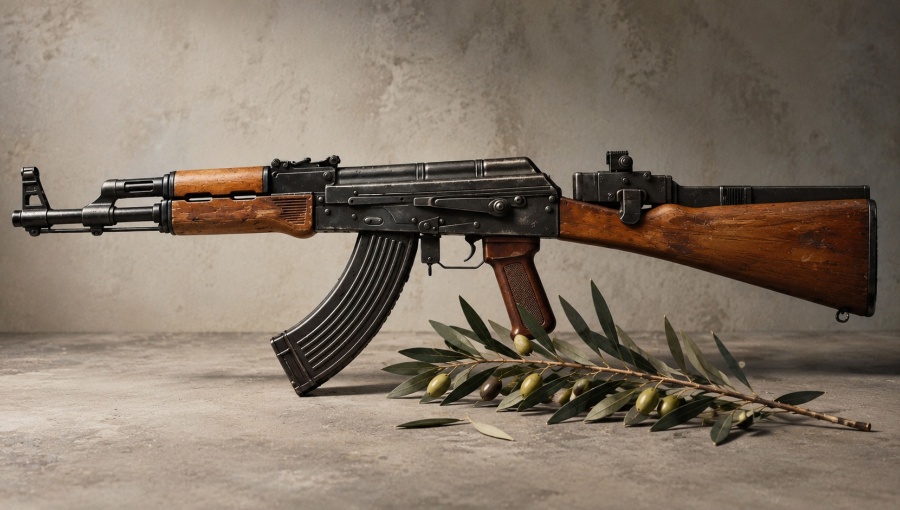
Serbia's election-winning Student List plans to stop arms exports to war zones, including sales through Western middlemen that pass Serbian ammunition on to Ukraine, Reuters reported on October 26.
The movement's leading candidates said a future government would halt exports from Serbia to areas of military conflict and cut off the Western intermediaries through which Serbian shells reach Kyiv. Reuters did not name the candidates or specify a mechanism or timetable. The movement also ruled out joining EU sanctions on Russia, continuing Aleksandar Vucic's foreign-policy line.
Taken at its word, the Student List would end the double game that made Vucic useful to both sides of the war in Ukraine: Belgrade refused to sanction Moscow while Serbian ammunition kept turning up in Ukrainian guns.
Moscow keeps the half it valued and loses an irritant. Kyiv, still short of ammunition after more than four and a half years of full-scale war, loses a supply line it never officially had. Israel stands to lose a supplier whose ammunition sales to it rose nearly 40-fold in two years.
The Student List, which grew out of two years of protests over the deadly November 2024 collapse of the Novi Sad railway station canopy, took 52.6% of the vote against 39.3% for Vucic's United Serbia list on October 25, with 96.5% of polling-station records processed, the Republic Electoral Commission said. That gives it a majority in the 250-seat parliament. Vucic, who resigned as president on September 27 to run for prime minister, conceded defeat on election night.
Shells for Kyiv
Serbian-made ammunition worth around €800mn reached Ukraine through third countries after 2022, the Financial Times reported in 2024, and Vucic defended the sales as commercial. In May 2025 Russia's Foreign Intelligence Service accused Serbian arms makers of shipping shells to Kyiv on fake end-user certificates via the Czech Republic, Poland and Bulgaria. A month later Vucic said Serbia had stopped all ammunition exports, yet Belgrade kept letting foreign shells transit its territory for the Czech-led ammunition initiative, and by November 2025 he told Euronews he would sell to EU buyers even if the shells ended up in Ukraine.
The opposition always read those sales as Vucic buying Western tolerance, Vuk Vuksanovic, a lecturer in foreign policy at King's College London, told Al Jazeera on October 26.
"Regarding Ukraine, Serbia will maintain its policy of not recognising the annexation of Crimea and Donbas. However, there is a question mark over ammunition deliveries, as the opposition viewed Vucic's weapons sales to Kyiv as a cynical ploy to buy Western tolerance for his domestic rule," he said.
President Volodymyr Zelenskiy welcomed the result in a post on X on October 26, calling it a new page in Serbia's history and saying Kyiv was ready to keep increasing cooperation with Belgrade. He visited Belgrade as recently as August.

Serbia, highlighted in bright red, and the regions at war or in conflict shaded around it. Source: Dunav Intel
Israel's ammunition pipeline
Reuters' account of the pledge did not name Israel. A ban on sales to areas of military conflict could cover Israel, which joined the US in a 39-day war on Iran from late February, but the incoming government's scope and enforcement plan are not yet clear. Serbian arms exports to Israel rose from €3mn in 2023 to €48mn in 2024 and €114mn in 2025, nearly 40-fold in two years, according to Serbian statistics office data reported by EUalive in March. Cargo flights from Belgrade to Israel doubled from 19 in 2024 to 38 in 2025, with at least 17 more in the first months of 2026.
Serbia exported a record €55.5mn of ammunition to Israel in the first half of 2025 alone, even as Vucic announced his export halt. Arms also flow the other way: Israel's Elbit Systems is supplying Belgrade under a $1.63bn five-year deal and Vucic opened a drone assembly plant with Israeli partners on September 17.
"The new government has no reason to abandon cooperation with Israel, but it will certainly re-examine newly concluded contracts - primarily those concerning Serbian ammunition exports to Israel and Israeli surveillance equipment exports to Serbia," foreign policy analyst Bosko Jaksic told Al Jazeera. He said Prime Minister Benjamin Netanyahu's government had lost another "authoritarian, nationalist ally" in Europe after Viktor Orban's defeat in Hungary.
Sanctions stay off the table
On Russia, the winners are sticking to Vucic's line. "We respect Russia as a great power and as a historically important partner, and in many cases as a protector," Jovo Bakic, a Belgrade University professor speaking for the Student List, told the Kremlin-backed broadcaster RT Balkan. "There will be no changes on this issue." He said the new government would not give up Russian gas either. The movement had already pledged on September 30 to keep Serbia's "principled" refusal to impose restrictive measures on Russia.
Vucic says otherwise. "What worries me most is that sanctions will be imposed against Russia by March or April," he told supporters at his party's headquarters as he conceded, TASS reported. Any new government will inherit Serbia's dependence on a Gazprom supply deal that has been extended only to year-end and on US waivers for the Russian-owned refiner NIS, whose latest licence expires on October 30.
"The new Serbian government will not see value in joining EU sanctions or adopting a hawkish stance toward Moscow," Vuksanovic said, though he expects intelligence cooperation with Russia to be downgraded and the pro-Moscow cheerleading of Vucic-controlled tabloids to end.
"We deeply value the contribution that Mr. Vucic has made to the development of our bilateral relations," Kremlin spokesman Dmitry Peskov told reporters on October 26, adding that Moscow hoped Vucic would keep advancing ties "even in opposition", The Moscow Times reported. The incoming government should work "constructively" with Moscow, he said.
"For our part, we intend to continue doing everything possible to foster our relations with Belgrade. But as you know, it takes two to tango," Peskov said.

No comments:
Post a Comment