IntelliNews summary:
• A Court of Arbitration ruled on August 31 that the treaty "remains fully in force" and curbed work on India's Ratle dam until after a July 2027 expert decision.
• India has accelerated four Chenab hydropower projects totalling more than 3,000 MW.
• Pakistan's western rivers carry about 135mn acre-feet a year, four times the 33mn acre-feet of the eastern rivers India kept.
• Pakistan will chair the SCO in 2027.
____________________
India said there was "absolutely no change" in its stance on the Indus Waters Treaty (IWT) as it hosted a Pakistani minister in New Delhi for the first time since 2023.
"As far as IWT is concerned, we have made our position very clear, and that is where it remains," Indian foreign ministry spokesperson Randhir Jaiswal revealed in a regular briefing on November 20. He was asked about Musadik Malik, Pakistan's climate change minister, who had flown in that morning for the first Shanghai Cooperation Organisation (SCO) Civilisational Dialogue Forum, a three-day cultural gathering at Delhi's Purana Qila opened by Indian Prime Minister Narendra Modi.
Despite their tense bilateral relations, New Delhi will let Pakistan into a multilateral room it hosts, because the SCO obliges it to invite every member, but it will not reopen the bilateral file Islamabad cares about most. India put the treaty in abeyance after gunmen killed 26 people at Pahalgam in April 2025, and the four days of fighting betweent he two countries in May 2025 that ended in a ceasefire have left little room for anything else.
Malik is the first Pakistani minister to visit India since Bilawal Bhutto-Zardari, then foreign minister, attended an SCO meeting in May 2023, Pakistani newspaper Dawn reported. The Indian foreign ministry called the forum "a multilateral event within the SCO framework, for which invitations have been extended to all members of the SCO, including Pakistan".
Malik kept to the cultural script. "Culture has a very key role to play," he told reporters on the opening day. Pressed on November 22 about his earlier warning that "if anyone lays a hand over our share of water, we'll cut off that hand", he declined to engage. "When you invite me to discuss the Indus Water Treaty, we will certainly talk about it," he said, according to The Week. Any talks on terrorism, he added, "will be based on evidence".
Rivers that run one way
The treaty's arithmetic explains why Islamabad treats water as a question of survival. The western rivers allotted to Pakistan, the Indus, Jhelum and Chenab, carry about 135mn acre-feet a year on average, against about 33mn acre-feet on the eastern rivers India kept, according to a brief by the Institute of South Asian Studies (ISAS) at the National University of Singapore. About 195mn people, 61% of the basin's population, live on the Pakistani side, and an estimated 80% of Pakistanis live in the basin.
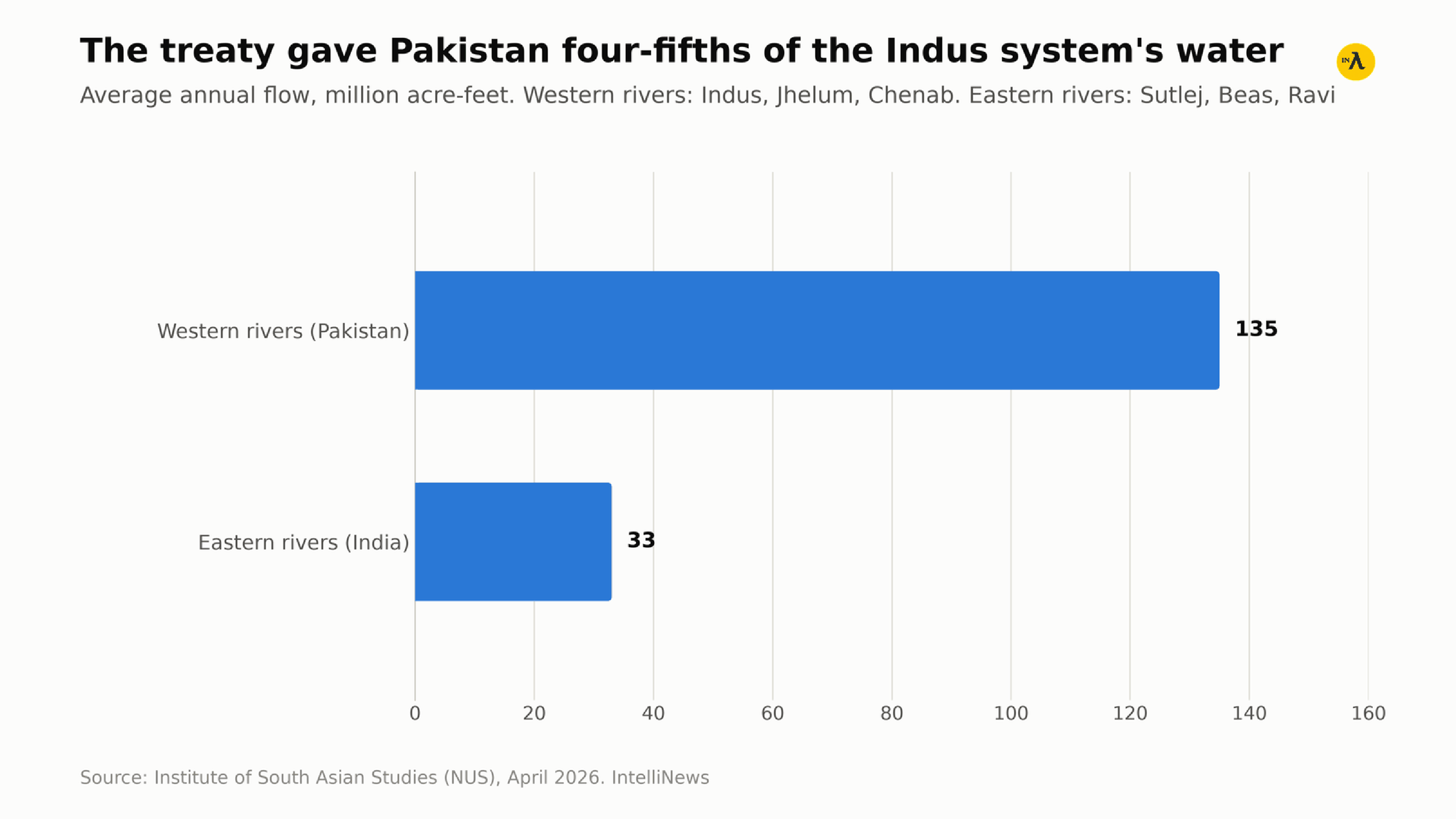
Average annual flow of the rivers allocated under the 1960 Indus Waters Treaty, million acre-feet. Source: Institute of South Asian Studies (NUS), April 2026. IntelliNews
India is using the abeyance to build upstream. It has flushed sediment from the Baglihar, Salal and Dulhasti plants on the Chenab and sped up work on Pakal Dul (1,000 MW), Ratle (850 MW), Kiru (624 MW) and Kwar (540 MW), the ISAS brief said in April. Installed hydropower capacity in Indian-administered Jammu and Kashmir, 3,540 MW at the time, was expected to reach 5,164 MW by December once Pakal Dul and Kiru are commissioned.
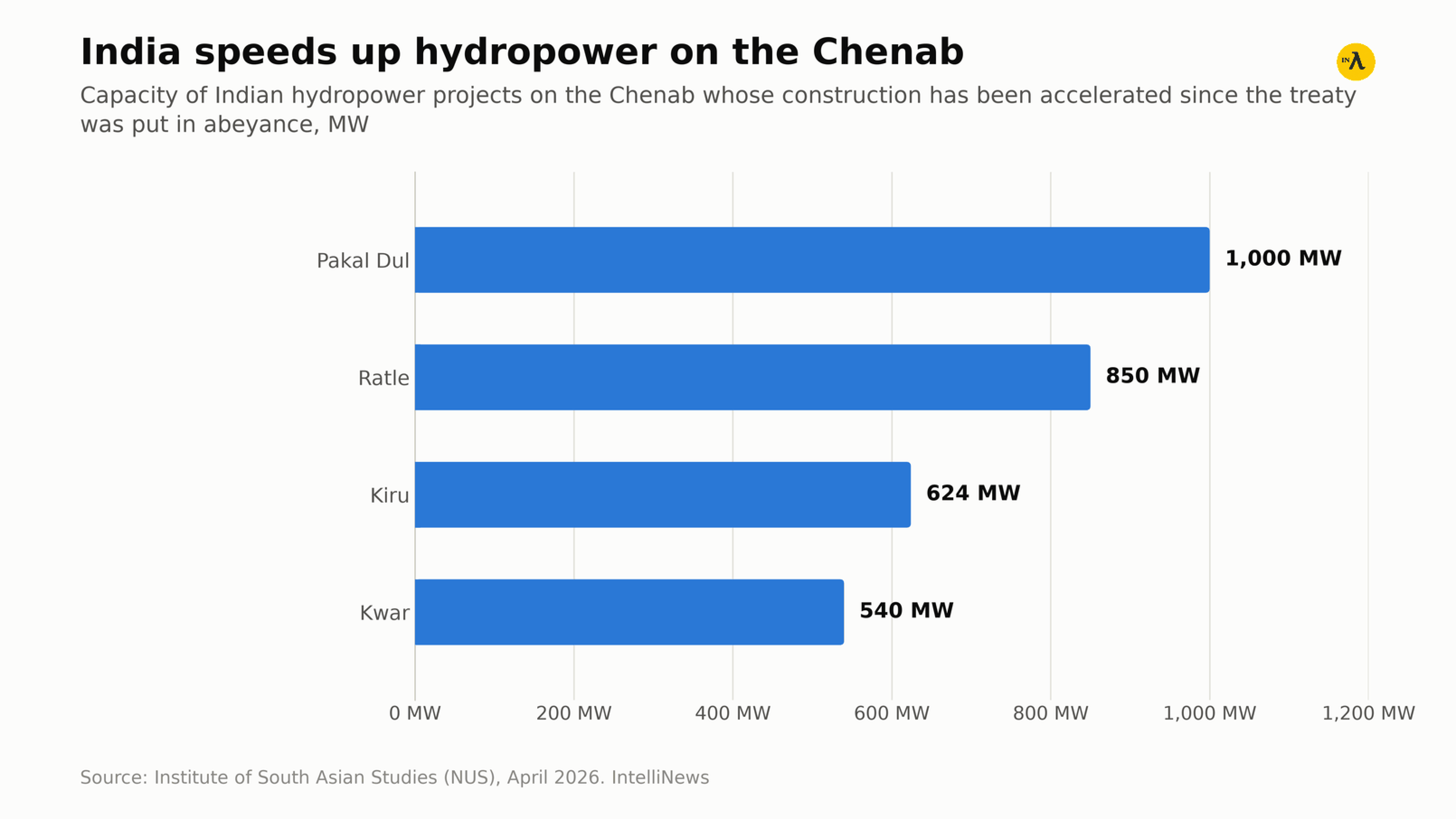
Capacity of Indian hydropower projects on the Chenab whose construction has been accelerated, MW. Source: Institute of South Asian Studies (NUS), April 2026. IntelliNews
The court says otherwise
Pakistan in the meantime has won the international legal argument, if not the practical one. On August 31 a Court of Arbitration in The Hague found unanimously that none of the grounds India had cited could justify suspending or ending the treaty, which "remains fully in force", according to the Permanent Court of Arbitration's press release. The court also barred India from concreting Ratle's dam wall and power intake above set levels until 90 days after a neutral expert rules on the plant's design, a decision expected in July 2027. India did not take part in that phase of the case.
Islamabad is spending on its own side of the border too. In early November its Economic Coordination Committee approved a PKR275bn ($995mn) grant for the water ministry's big infrastructure projects, the largest single item on the agenda.
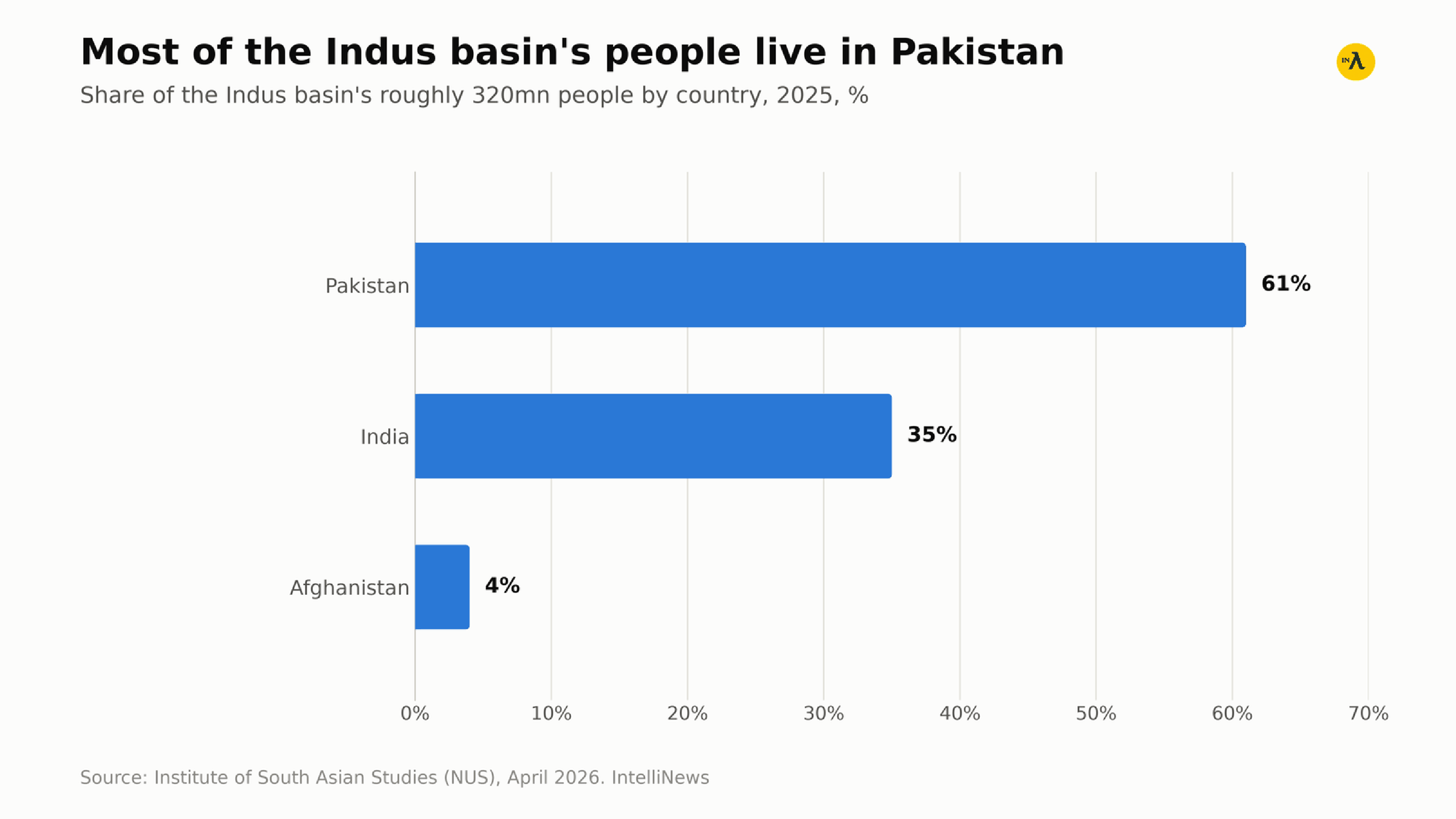
Share of the Indus basin's roughly 320mn people by country, 2025, %. Source: Institute of South Asian Studies (NUS), April 2026. IntelliNews
A club Pakistan will chair
India and Pakistan joined the SCO as full members together in 2017, which guarantees more encounters of this kind, and the bloc now has 10 members, two observers and 14 dialogue partners, according to an Indian foreign ministry brief on the organisation. Pakistan's army chief Asim Munir went to last year's summit in Tianjin, and Modi used this year's gathering in Bishkek to call for a unified response to terrorism. Pakistan expects to take over the SCO chair in 2027, its culture minister Aurangzeb Khan Khichi said in July, the Associated Press of Pakistan reported.
Hosting a Pakistani climate minister at a heritage forum cost New Delhi very little. Sending Indian ministers to Pakistan-chaired SCO meetings next year will cost more, and trade offers no ballast. Pakistan has lost an estimated $40bn since it cut commercial ties with India in 2019, according to the chairman of the Pak-India Business Council. Until that pressure bites, the treaty stays where New Delhi left it, and the Chenab keeps turning Indian turbines before it reaches Pakistan.
This article was produced with the help of the IntelliNews Lambda analytical tool

No comments:
Post a Comment