French tap water tainted by widespread forever chemicals, study finds
France's drinking water is contaminated with PFAS "forever chemicals" in 92 percent of samples, a nationwide study has found, revealing the scale of pollution from substances that do not break down in the environment.
Issued on: 04/12/2025 - RFI
The National Agency for Food, Environmental and Occupational Health Safety (Anses) analysed more than 600 tap water samples and the same number of raw water samples taken between 2023 and 2025 from sites covering about one-fifth of France’s distributed water.
The tests show that trifluoroacetic acid, or TFA, is the most common PFAS found in drinking water. PFAS are known as forever chemicals because they persist for extremely long periods.
TFA is the smallest member of this group and forms when several industrial pollutants and pesticides break down. Officials say it is close to being classed by the European Union as toxic for reproduction and it also shows signs of harming liver function.
Ineffective treatments
Average TFA levels measured slightly above 1,000 nanograms per litre. The strongest reading reached 25,000 nanograms per litre in water taken downstream from a factory that produces TFA, which Anses says is evidence that current treatments are ineffective.
France’s previous record was 13,000 nanograms per litre in Moussac, near a Solvay plant that made TFA until September 2024.
“I have never seen such levels of TFA concentration in drinking water,” said environmental chemist Hans Peter Arp, adding the concentrations will keep rising because more TFA precursors are expected to enter ecosystems.
Anses said the results fall below the “indicative health value” used by the Health Ministry. In a note published on 23 December 2024, the ministry adopted Germany’s provisional level of 60,000 nanograms per litre, below which risk is considered zero.
France has set a reduction goal of 10,000 nanograms per litre and two samples in the study exceed that figure. The Netherlands applies a far stricter limit of 2,200 nanograms per litre.
These values will remain provisional until the European Food Safety Authority sets a reference level for safe daily intake of TFA from all sources. Its conclusions were expected this year but have been postponed to July 2026.
“The threshold proposed by the EFSA does not call into question the provisional value used in France,” said Matthieu Schuler, deputy director at Anses.
Pesticide rules
EU rules set a stricter limit of 100 nanograms per litre for metabolites of so-called relevant pesticides – by-products left behind when the active substances in pesticides break down.
The European Commission considers TFA one of these metabolites because of its “worrying toxicity” for development. All samples taken by Anses exceed this 100-nanogram limit by an average factor of 10.
If France classified TFA in this way, most tap water would be labelled non-compliant. The health ministry has not asked Anses to assess TFA’s status as a pesticide metabolite.
Anses also found that TFA levels do not match the presence of other PFAS. Hydrology specialist Xavier Dauchy, who helped lead the study, said this shows separate contamination routes including atmospheric fallout.
Other chemicals detected
The study found 11 of the 20 PFAS that EU rules label a priority for water checks from January under a 2020 directive.
PFOS, identified as a possible carcinogen, appeared in 19 percent of samples. Nine samples exceeded the 100-nanogram limit. For the first time in France, the study detected TFMSA, another ultra-short-chain PFAS, in 13 percent of samples.
Anses said it should be added to permanent water monitoring.
A polluter-pays fee meant to push industry to cut PFAS discharges was due to start this year under a law passed in February. Lawmakers have postponed it to 2027.
“This vote protects the industrialists rather than drinking water,” said Green MP Nicolas Thierry, who authored the PFAS law. He said the delay leaves municipalities facing decontamination costs without resources.
Research estimates put France’s annual clean-up bill at €12 billion.
(with newswires)
Europe is turning into an underground desert as groundwater reserves are severely depleted due to intensifying climate impacts and long-term overextraction, according to a new study reported by The Guardian on November 29.
The findings have rung alarm bells as future supplies of drinking water will literally dry up, food production will plummet, and swaths of the Continent will become suitable for either agriculture or human life.
The analysis, conducted by scientists at Graz University of Technology in Austria, reveals that nearly all European countries experienced below-average groundwater levels between 2018 and 2024 in what will become an irreversible change in the medium-term.
The researchers warn that many aquifers have not yet recovered from extreme droughts in 2003 and 2018, pointing to a systemic decline in one of Europe’s most critical freshwater sources.
“Europe’s groundwater reserves have already been severely overexploited in many places and are therefore very vulnerable to the climate crisis,” said hydrologist Professor Günter Blöschl, a co-author of the study, cited by The Guardian.
Groundwater provides approximately 65% of drinking water in the European Union and supports about 25% of water used in agriculture. The long-term depletion of reserves is being driven by a combination of recurring droughts, higher evaporation rates caused by rising temperatures, and the continuous pumping of water for irrigation and industry.
The study is based on satellite data from the Gravity Recovery and Climate Experiment (GRACE) mission, which measures changes in the Earth's gravity field linked to variations in water mass. As bne IntelliNews reported, the weight of melting water flowing from the polar ice caps to the equator is already visibly slowing the earth's rotation and adding measurable extra seconds to the length of a day. The researchers examined trends across 31 European countries, finding widespread declines in subterranean water storage.
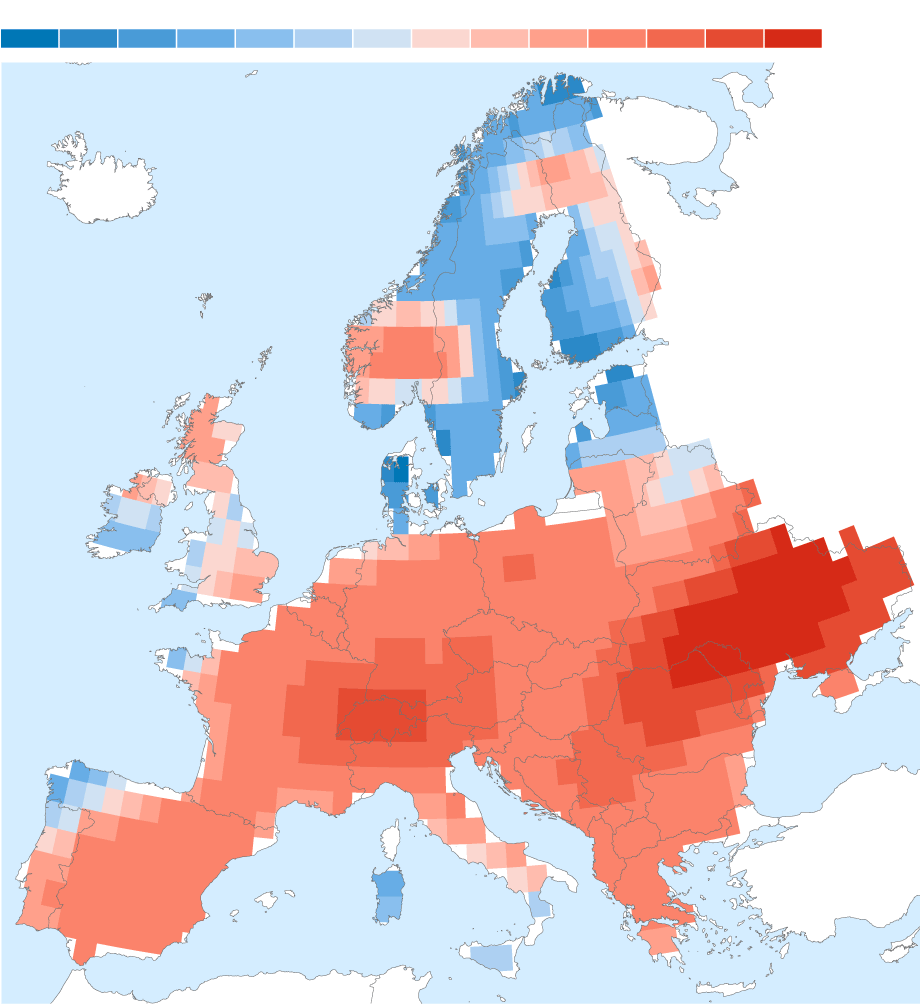
“This development is very worrying,” said Professor Claudia Hahn, lead author of the study. “The consequences will be felt not only by nature, but increasingly by us humans too.” The study found that most at risk are southern European countries such as Spain, Italy and Greece, but also warned that problems in traditionally water-rich regions such as parts of Germany and France will get worse as well.
The authors urge European governments to treat groundwater as a finite resource and to develop more robust water management systems. This includes reducing overuse, improving efficiency in agriculture, and increasing efforts to restore natural recharge areas such as wetlands and forests.
“We are seeing the result of decades of unsustainable water use,” said Blöschl. “The climate crisis is now making those practices untenable.”
Changes to the weather in Europe will be compounded by the collapse of the AMOC (Atlantic Meridional Overturning Circulation), otherwise known as the Gulf Stream that is expected in the coming decades. That will trigger a mini-ice age that will bring down temperatures in northern Europe by as much as 20°C.
Combined these two effects will drive populations from increasingly arid southern Europe and those from freezing northern climes into a narrow temperate band running across the centre of Europe.

No comments:
Post a Comment