It’s possible that I shall make an ass of myself. But in that case one can always get out of it with a little dialectic. I have, of course, so worded my proposition as to be right either way (K.Marx, Letter to F.Engels on the Indian Mutiny)
Tuesday, March 24, 2026
Chinese Publication Claims U.S. Has Two Months of Rare Earths Left
The U.S. has already launched hundreds of missiles and precision-guided weapons in the escalating conflict with Iran, an air campaign that has consumed billions of dollars in advanced military hardware in just weeks. But a new warning circulating in Chinese and Western media suggests the materials needed to keep producing those weapons may be running dangerously low.
Reports from the South China Morning Post and Reuters indicate Washington could have only weeks or months of certain rare-earth inventories available for defense manufacturing if supply disruptions deepen.
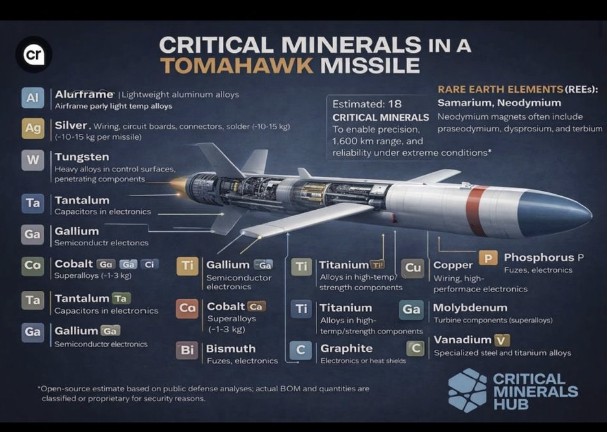
Rare earth elements are embedded throughout modern military systems—from missile guidance and drone propulsion to radar systems and fighter aircraft electronics.
“You can’t fight a twenty-first-century war with twentieth-century supply chains,” said Lipi Sternheim, CEO of REalloys. “Modern weapons rely on materials that are difficult to source, difficult to process, and difficult to replace once inventories begin to tighten.”
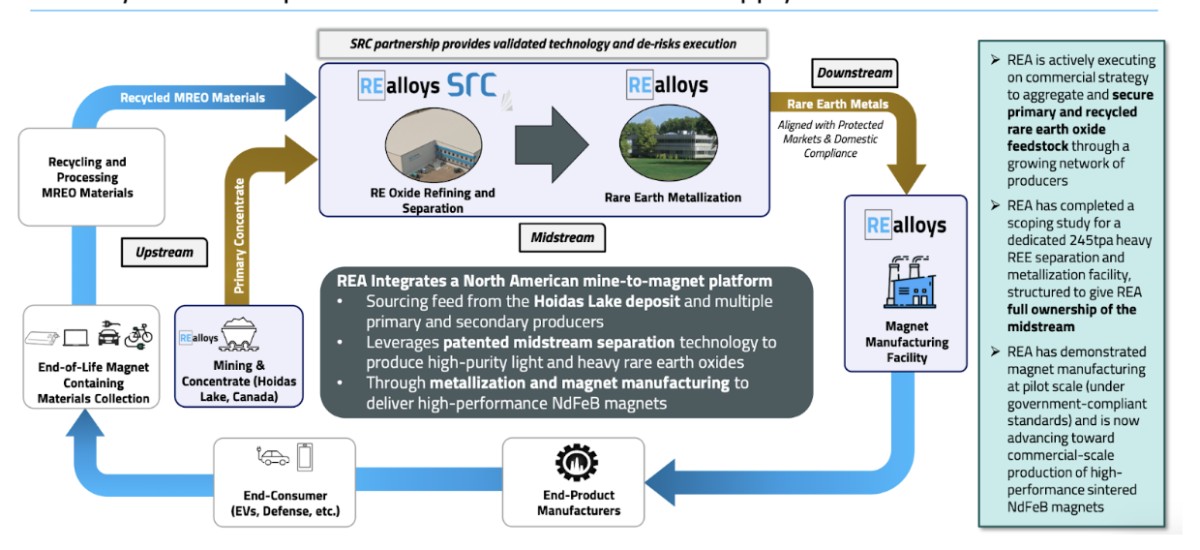
REalloys (NASDAQ: ALOY) is one of the few companies rebuilding the rare-earth metals stage of the supply chain in North America, converting rare-earth oxides into the metals and alloys used by magnet manufacturers and defense suppliers.
And it’s the 11th hour for American defense and the entire defense industry, even if it wasn’t in the middle of a war with Iran that reportedly cost $5.6 billion just in the first two days.
That vulnerability isn’t new. For decades, the United States allowed much of its rare-earth processing and metallization capacity to migrate overseas, leaving China to dominate the stages of the supply chain that convert raw materials into the metals and magnets used in advanced technology. Today, much of the rare-earth material used in Western defense systems still traces through Chinese processing facilities. The Pentagon is now racing to reverse that dependence ahead of a 2027 deadline that will prohibit U.S. weapons systems from using magnets made with Chinese-origin rare earths.
Mountain Pass in California produces rare-earth concentrate that is separated domestically into NdPr oxide. That is an important step in rebuilding North American capability - but oxide itself is not the material defense contractors actually use.
Before it can enter manufacturing, oxide must first be chemically reduced into pure rare-earth metal. That metal is then blended into precise alloys used to produce high-performance permanent magnets.
For decades, that conversion—from oxide to metal—has taken place almost entirely in China. Even when rare-earth ore was mined in the United States and separated into oxide domestically, the metallurgical step that turns that chemistry into usable industrial metal was still performed overseas.
That is the break in the supply chain.
REalloys is positioned to help close it.
At its Euclid facility, the company converts rare-earth oxides into finished metals and magnet-grade alloys through high-temperature reduction and refining processes. Those materials are the feedstock required by magnet manufacturers and advanced industrial users.
It is also one of the most technically difficult stages of the entire rare-earth value chain. Metallization requires tightly controlled reduction reactions, high-temperature furnaces, and continuous process control capable of maintaining stable yields and purity levels across multiple rare-earth elements.
“Metallization is the least developed part of the value chain outside China,” said REAlloys co-founder Tim Johnston. “It requires deep operating expertise and process control systems capable of managing complex variables in continuous production. Even with capital and strong execution, replicating that capability typically takes three to seven years or more, with significant technical and qualification risk.”
The Euclid facility is already operating, converting rare-earth oxides into metals and alloys inside North America rather than sending those materials overseas for processing.
Upstream, REalloys owns the Hoidas Lake rare-earth project in Saskatchewan, anchoring primary resource exposure inside Canada.
In Greenland, the company has signed a long-term non-binding letter of intent covering roughly 15% of future production from the Tanbreez rare-earth project, one of the largest deposits of heavy and medium rare earths outside China.
Additional supply agreements extend to Kazakhstan, where the company is working with AltynGroup on access to material from the Kokbulak project and surrounding concessions. In Brazil, an alliance tied to the Araxá rare-earth project adds another potential non-Chinese source of feedstock.
“We’ve already solved the hardest part—proving that rare-earth metallization and alloying can be done domestically to the specifications real customers require,” Johnston said.
REalloys (NASDAQ: ALOY) isn’t stopping at metallization, either.
The company is also developing a large-scale permanent magnet manufacturing facility in the United States, designed to start with roughly 3,000 tons of neodymium-iron-boron (NdFeB) magnet production annually and expand to as much as 18,000 tons per year.
At full capacity, that level of output could supply magnets for roughly 1.5 to 2 million electric vehicles annually, thousands of wind turbines, and large volumes of industrial motors, robotics systems, and medical devices. Defense systems—from missile guidance units to radar and avionics—also rely heavily on high-performance rare-earth magnets.
That dependency runs across the entire contractor base. Lockheed Martin (NYSE: LMT), whose F-35 program requires hundreds of pounds of rare earth materials per airframe for flight controls, radar, and electronic warfare suites, has moved to dual-source critical mineral inputs as the 2027 deadline closes in. RTX Corporation (NYSE: RTX) faces the same pressure through its Raytheon unit, where AMRAAM and Tomahawk production depends on dysprosium and terbium magnets capable of holding performance under combat heat and vibration. At the smaller end of the contractor spectrum, Kratos Defense & Security Solutions (NASDAQ: KTOS) has built its high-volume drone and unmanned systems business around domestic supplier agreements that lock in proven rare earth alloys—a model that only works if the metallization layer it depends on actually exists inside the United States.
The facility is designed to integrate multiple stages of the rare-earth value chain, including metallization, alloying, powder production, and final magnet manufacturing.
If completed at the projected scale, it would represent one of the largest NdFeB magnet production sites outside Asia and a significant step toward rebuilding a fully integrated rare-earth supply chain in North America.
With Euclid converting oxide into metal inside the United States, the rare-earth supply chain begins to close a loop that has been broken for decades—just as Washington prepares to bar Chinese-origin rare earths from U.S. defense systems in 2027.
By. Michael Kern for Oilprice.com
Battery metal curbs sting Chinese miners who spent big in Africa
Construction of Bikita Minerals’ spodumene plant in 2023. Credit: Bikita Minerals
African export restrictions on crucial battery metals are dealing a blow to Chinese companies that have spent billions of dollars developing mines there to dominate supplies.
For more than a decade, Chinese miners have plowed money into Africa to secure feedstocks for their refineries and factories back home amid expectation of surging demand for minerals used in electric vehicles and energy storage systems. While other parts of the world pushed back against Chinese efforts to gain a foothold, African nations still largely welcome those investments.
But things are becoming more difficult. The Democratic Republic of Congo began cobalt export curbs in February 2025 to reduce a glut and capture more value from its output, while Zimbabwe last month banned shipments of lithium concentrates to encourage local processing. The moves quickly raised prices, which are currently at or near multiyear highs.
That’s creating a predicament for Chinese miners, which for now cannot reap the full benefit of their assets there. In top cobalt supplier Congo, No. 1 producer CMOC Group Ltd. is now digging up far more of the metal than it can export. In Zimbabwe, producers need to make major additional investments in refining capacity to sidestep the ban. For the manufacturers they supply, the export curbs are driving up prices for key energy transition metals.
“These policy moves are a big deal,” said Christopher Edyegu, an analyst at Africa Risk Consulting. “The mining landscape in Africa is changing drastically and the broader trend towards resource sovereignty or resource nationalism is more likely to increase than fade, particularly given the geopolitical competition for critical resources.”
Chinese firms led by Sinomine Resource Group Co. and Zhejiang Huayou Cobalt Co. announced investments of about $2.8 billion for lithium projects in Zimbabwe since 2020, according to critical minerals consultancy Project Blue. CMOC alone has pumped about $9 billion into a pair of Congolese copper-cobalt mines since 2016 and recently unveiled a $1.1 billion expansion project.
That helped Congo more than double cobalt output in just three years, while Zimbabwe has become the world’s fourth-biggest lithium producer. It has also drawn the attention of Washington, which wants to cut dependence on Beijing for critical minerals.
Although Congo’s full ban was replaced with strict quotas in October, exports didn’t resume until recently due to delays in implementing new procedures, and are still far below normal. The curbs caused benchmark prices to jump more than 160% and cobalt hydroxide – the main product shipped from Congo – to more than quadruple, according to Fastmarkets Ltd.
Miners in Congo extract cobalt as a byproduct of copper, a metal the nation is eager to boost output of. While investors are now diverting financial resources toward favoring copper production, operational complications associated with sharply reducing cobalt output mean many continue to churn out more than required for export quotas, according to trading house Darton Commodities.
The supply disruptions are a headache for chemical refiners, battery makers and the auto sector in China, whose cobalt imports from Congo more than halved last year, according to BloombergNEF. CMOC has been especially impacted by the quotas as it can export only about a quarter of what it produced in 2024.
“These policy changes represent a significant disruption to the battery material value chain,” said Martin Jackson, head of battery materials markets at consultancy CRU Group.
In Zimbabwe, export controls – which were initially scheduled for 2027 – also risk derailing investments that Chinese companies are making in the country’s lithium sector. Zimbabwe wants miners to build plants that will turn lithium concentrate into a higher-value sulfate product, which Huayou, Sinomine and Sichuan Yahua Industrial Group Co. are already doing. Still, the prospect of an overall drop in production has helped drive lithium prices toward the highest since 2023.
“The choice will be to invest or mine elsewhere, or refine the concentrate produced in Zimbabwe,” CRU’s Jackson said. However, there’s “currently a huge mismatch” because the planned sulfate facilities will only be able to process about a third of expected concentrate production, he said.
Sinomine and Chengxin Lithium Group Co. Ltd. have been in talks with officials about the procedure for resuming exports, they said soon after the ban was imposed.
Sinomine, Huayou, CMOC, Sichuan Yahua, Chengxin didn’t respond to requests for comment.
China’s embassy in Zimbabwe on March 19 reminded Chinese firms to strengthen risk prevention and compliance, and said investors shall consider risks to avoid losses resulting from local policy changes.
Zimbabwean President Emmerson Mnangagwa on Monday said the country will ensure “that our finite resources are processed and value added at source for the benefit of our people,” and that investors “have a duty to ensure durable and mutually beneficial collaboration.”
Other metals have also come into focus. Guinea, the top source of bauxite for China’s aluminum industry, plans to control the amount of ore supplied to the market and protect the African country against a slump in prices. It hopes to compel more producers to upgrade the raw bauxite into alumina locally, but — as in Congo and Zimbabwe — some in the industry warn that abrupt shifts in policy could deter further investments.
“Export bans alone will not be sufficient to attract investments that strengthen African local processing,” ARC’s Edyegu said. Governments should also offer incentives, such as tax benefits and better infrastructure, he said.
 Construction of Bikita Minerals’ spodumene plant in 2023. Credit: Bikita Minerals


No comments:
Post a Comment