Why 2027’s ‘eclipse of the century’ is worth travelling for
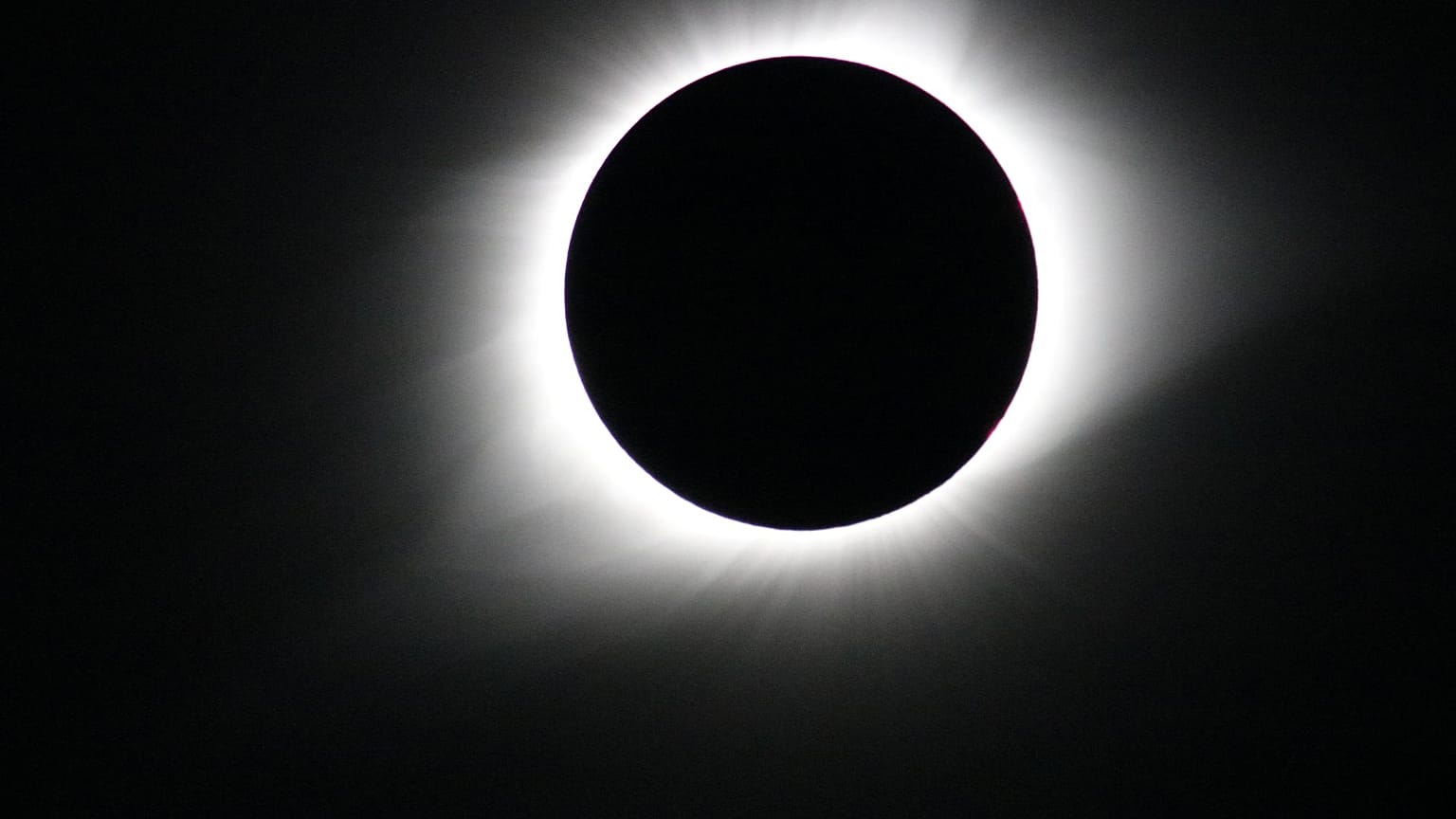
The path of totality will pass through major cities including Málaga, Tangier, Jeddah and Luxor in August next year.
Astrotourism has been among the biggest travel trends of the past five years and it shows no signs of slowing down, particularly with a solar eclipse on the horizon later this year.
While the 2026 total solar eclipse on 12 August will be pretty special as the first, and only, one to be visible in Iceland in the 21st century, long-time eclipse chasers are already looking ahead to next year.
That’s because 2 August 2027 will see the “eclipse of the century”, aka the longest total solar eclipse on easily accessible land.
Major cities in the path of totality include Cádiz and Málaga in Spain, Tangier in Morocco, and Jeddah and Mecca in Saudi Arabia. Luxor in Egypt is set to be among the most popular destinations to view the eclipse, as the maximum duration of totality – which is six minutes and 23 seconds – will occur just 60 kilometres southeast of the city.
To find out more about why this eclipse is worth travelling for, we chatted to Dr. Kelly Korreck, a programme scientist for eclipses at NASA Headquarters.
Why the 2027 ‘eclipse of the century’ is so special
“So far, Earth is the only planet we know that gets this type of solar eclipse,” Dr. Korreck told Euronews Travel.
“There are other moons that pass in front of the sun, but to have a moon that is the perfect size and the perfect distance to be able to witness this is really special.”
Scientists are able to predict the date and time as well as the length of eclipses thousands of years into the future – and know when they occurred in the past – by looking at the orbits of the moon, the sun and the Earth.
Theoretically, the longest total eclipse possible would be around seven-and-a-half minutes long. For this to happen, the sun would need to be at apogee (at its furthest point away from earth), the moon would need to be at perigee (its closest point to earth), and the path of totality would need to pass along the equator, which as you can imagine is rather unlikely.
At six minutes and 23 seconds, the total solar eclipse on 2 August 2027 isn’t far off, though.
It far surpasses the 2026 total eclipse, which will have a duration of two minutes and 18 seconds, and the Great North American Eclipse in April 2024, which lasted four minutes and 28 seconds.
What to expect during the total solar eclipse
“It’s hard to explain, especially in this digital world, why it actually is worth going out and experiencing this in real life,” Dr. Korreck said.
“The pictures are beautiful, but they don’t do the whole body experience justice.”
Dr. Korreck works as part of a team that focuses on the science that becomes possible when the moon blocks out the sun, including studies on the solar corona, the outermost layer of the sun’s atmosphere.
While NASA will be using sensitive equipment to study the solar corona, you’ll be able to see the wispy filaments with your own eyes during the totality.
Assuming a lack of cloud coverage in your choice of eclipse-watching destination, you’ll also be able to see bright stars and even some planets.
You won’t just see the difference either: You’ll feel it, too, as the temperature could drop as much as 10C while the sun is blocked by the moon.
“Human brains tend to start interpreting [the eclipse] as weird, and there might be some anxiety or fear because it’s becoming dark in a way we’re not used to,” Dr. Korreck notes.
“We’re perplexed. But then once you actually see totality, and see this beautiful outer part of the sun that you can’t see on a day-to-day basis, it’s awe-inspiring. As many times as you see it, you just want to see it again.”
How to view the eclipse safely
Proper eye protection is a key part of viewing an eclipse safely. Aside from the period of totality, when the sun is completely blocked by the moon, you will need specific solar viewing glasses.
Solar viewing glasses will need to meet the ISO 12312-2 international standard, which are thousands of times darker than sunglasses.
Alternatively, you can use a pinhole projector, which could be as simple as knitting your hands together and letting the light through, to watch on the ground below the eclipse.
The NASA website has detailed safety tips, including steps for how to make your own eclipse projector.

Gravitational waves modify the frequency (color) of light emitted by atoms depending on the direction of emission. Precise measurements of these frequency changes could offer a new way to detect gravitational waves. CREDIT: Jerzy Michal Paczos
By Eurasia Review
Gravitational waves are ripples in spacetime produced by violent cosmic events, such as the merging of black holes. So far, direct detections have relied on measuring tiny distance changes over kilometer-scale instruments. In a new theoretical study accepted for publication in Physical Review Letters, researchers at Stockholm University, Nordita, and the University of Tübingen propose an unconventional approach: tracking how gravitational waves reshape the light emitted by atoms. The work describes a possible detection route, but an experimental demonstration remains for the future.
When atoms are excited, they naturally relax by emitting light at a characteristic frequency — a quantum process known as spontaneous emission. This happens through their interaction with the quantum electromagnetic field.
“Gravitational waves modulate the quantum field, which in turn affects spontaneous emission,” said Jerzy Paczos, a PhD student at Stockholm University. “This modulation can shift the frequencies of emitted photons compared with the no-wave case.”
The team predicts that the emission becomes direction-dependent: atoms emit photons at the same overall rate — which is why this effect has been overlooked until no — but the photon frequencies vary with emission direction. This directional spectral pattern would encode the wave’s direction and polarization and could help distinguish the signal from noise.
Low-frequency gravitational waves are a major target for future space-based observatories. The authors note that narrow optical transitions used in atomic-clock platforms offer long interaction times, potentially making cold-atom systems a promising testbed.
The atoms emit light like a music player that keeps a steady tone, but a gravitational wave changes how the note sounds in different directions. “Our findings may open a route toward compact gravitational-wave sensing, where the relevant atomic ensemble is millimeter-scale,” said Navdeep Arya, a postdoctoral researcher at Stockholm University. “A thorough noise analysis is necessary to assess practical feasibility, but our first estimates are promising.”

No comments:
Post a Comment