Hapag and India Plan Cooperation for Reflagging Ships, Recycling, and Ports
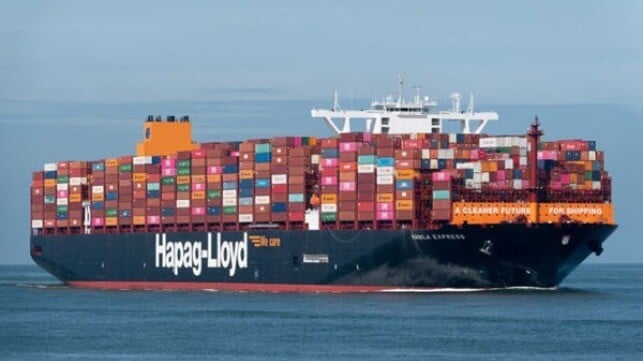
Hapag-Lloyd has become the latest among the largest carriers to map out a strategy of cooperation and expansion with India. The liner company reports it already has six dedicated services that include India and that it aims to grow volumes handled in the India area to around 3 million TEU by 2030.
India has been anxious to attract the major carriers as part of its strategy to expand its maritime related industries. It hopes to attract the lines to build and repair ships in India, but it also made changes to its cabotage regulations and announced plans for building domestic carriers. CMA CGM has reflagged ships and ordered feeder ships to be built in India, while both Maersk and MSC reflagged ships and said they were exploring opportunities.
“India is one of the most important growth markets in global trade and a key strategic partner for Hapag-Lloyd,” said Rolf Habben Jansen, CEO of Hapag-Lloyd.
Hapag reports it signed three Letters of Intent to deepen its cooperation and participation in India. Like the other major carriers, it says it intends to reflag up to four vessels under the Indian registry. However, it says there is no specific timeline or vessel profile, and that it would be subject to commercial considerations and further discussions. Reflagging requires using Indian officers and crew but opens the domestic Indian market for the carriers.
Another focus includes cooperation on the development of a ship recycling ecosystem in India. Alang, India, is well-known for its breaker operations, but so far has not moved to be incompliance with international and EU regulations on elements such as safety and environmental management. Hapag says the intended cooperation aims to support the development of recycling capacity in India, aligned with the EU Ship Recycling Regulation (SRR). Hapag says the envisioned ecosystem could provide capacity for recycling up to 100 vessels.
It also foresees discussions on a strategic cooperation related to the development of Vadhavan Port in collaboration with the Jawaharlal Nehru Port Authority. Located about 100 miles north of Mumbai, it is seen as one of India’s major upcoming infrastructure projects.
“India’s port and logistics infrastructure is developing at remarkable speed and scale,” said Dheeraj Bhatia, CEO of Hanseatic Global Terminals and member of the Hapag-Lloyd Executive Board. “Projects such as Vadhavan Port have the potential to significantly strengthen India’s role in global supply chains.
Vadhavan Port is expected to play an important role in strengthening the country’s maritime logistics network. Hapag-Lloyd intends to contribute its global shipping and terminal expertise to support this development.
Hapag already has a strategic investment in J M Baxi, a private company that operates terminals and inland transport in India. It recently revealed, according to India's The Economic Times, that through capital infusions it has grown its stake in J M Baxi. Hapag started a 35 percent in January 2023, then went to 40 percent, and is not in a 50-50 joint venture, according to the news outlet. Hapag told The Economic Times that it sees strong opportunities for its Hanseatic Terminals working with J M Baxi.

India's Hindustan Shipyard Limited (HSL). Photo Credit: Hslvizag, Wikipedia Commons
March 21, 2026
Observer Research Foundation
By Anusha Kesarkar Gavankar
India recently announced plans to invest INR 3 lakh crore to develop shipbuilding clusters across the country under the Maritime Amrit Kaal Vision 2047. As part of these efforts, India has also outlined its first Special Purpose Vehicle (SPV), the National Shipbuilding & Heavy Industries Park, Tamil Nadu (NSHIP, TN), under its Shipbuilding Development Scheme (SbDS).
As a landmark 50:50 joint venture between the V.O. Chidambaranar Port Authority under India’s Ministry of Ports, Shipping and Waterways (MoPSW) and the Tamil Nadu State Industries Promotion Corporation, the SPV exemplifies the spirit of cooperative federalism in accelerating India’s indigenous shipbuilding capabilities. Conceived as a greenfield mega shipbuilding and heavy industries cluster at Tuticorin to strengthen India’s commercial shipbuilding and repair ecosystem, NSHIP, TN aims to attract global investment, promote technology-driven manufacturing, and generate large-scale employment across skilled and semi-skilled segments.
Following this, the Mumbai Port Authority (MPA) and the Maharashtra government plan to establish a co-owned SPV to develop the second greenfield shipbuilding cluster under the SbDS. The latest meeting between HD Hyundai Group Chairman Chung Kisun and India’s Prime Minister Narendra Modi to explore potential shipyard projects further underscores the country’s growing strategic appeal for international shipbuilding players. Collectively, these developments indicate a paradigm shift in which India is actively positioning itself as a commercially competitive, export-oriented, and globally integrated shipbuilding ecosystem. These initiatives not only align with India’s national vision of Make in India and Atmanirbhar Bharat — encouraging self-reliance through import substitution, green and sustainable shipbuilding practices, and the creation of globally competitive maritime infrastructure — but also advance its ambition to rank among the world’s largest shipbuilding and heavy engineering hubs.
The Global Context
Over 90 percent of global trade moves by sea, yet global shipbuilding remains concentrated in a few countries. China, South Korea, and Japan collectively accounted for 95 percent of new shipbuilding orders by tonnage as of 2024. These nations dominate a market valued at roughly US$150 billion annually, leaving most of the world reliant on a handful of economies for commercial vessels, with significant geopolitical and strategic implications. As global trade volumes expand and shipping routes face uncertainty, countries are recognising that domestic shipbuilding is not merely an economic activity but a strategic necessity. For emerging maritime economies like India, this is crucial for economic security, supply chain resilience, energy transport, the green transition, and geopolitical influence.
Despite maritime transport handling nearly 95 percent of India’s trade by volume and around 70 percent by value, the country accounts for less than one percent of global shipbuilding output, currently rankingapproximately 18th worldwide. India’s current shipbuilding capacity is roughly 0.072 million GT, in stark contrast with China’s 39 million GT, South Korea’s 20 million GT, and Japan’s 9 million GT. This gap underscores India’s vulnerability to external supply shocks and freight volatility, reinforcing the strategic imperative to build domestic capability. Other mid-tier shipbuilding economies, such as Brazil, Vietnam, and the Philippines, illustrate that incremental growth is possible when policy, industrial strategy, and workforce development are aligned.
India: Current Landscape and Challenges
The shipbuilding capacity of a unit is defined as the “maximum carrying capacity of the ship that can be built by a shipyard, measured in terms of Dead Weight Tonnage (DWT), which is the number of tonnes (one tonne = 2,240 pounds) of stores, fuel, and cargo that a ship can carry.” India’s shipbuilding industry is broadly categorised into three segments:Large ocean-going vessels for overseas and coastal trade;
Medium-sized specialised vessels, including port crafts, fishing trawlers, offshore vessels, inland crafts, and smaller vessels; and
Defence/Naval and Coast Guard vessels.
As of 2023-24, India had 42 dry docks for ship repair, eight public-sector shipbuilding and repair companies, and nine dry docks operated by five major ports. The total workforce in Indian shipyards was just over 19,000, with officers accounting for about one-fifth. In that year, around 418 ships were repaired across both the public and private sectors. These figures show that India possesses a basic shipbuilding and repair capability but will require substantial structural reforms and a much stronger focus on workforce training and upskilling to compete globally.
India’s Shipbuilding and Ship Repairing Industry at a Glance
Shipbuilding Capacity
S. No. Name of the Company* Capacity (in thousand DWT)
1 Cochin Shipyard Ltd. 110.0
2 Hindustan Shipyard Ltd. 80.0
3 Shoft Shipyard Ltd. 10.0
4 Patra Shipping Pvt. Ltd. 10.0
5 San Marine 8.0
Ship Repairing Capacity
S. No. Name of the Company* Capacity (in thousand DWT)
1 Cochin Shipyard Ltd. 125.0
2 Hindustan Shipyard Ltd. 80.0
3 Patra Shipping Pvt. Ltd. 10.0
4 Waterways Shipyard Pvt. Ltd. 8.0
5 Modest Infrastructure Pvt. Ltd. 6.0
*Top 5 Reporting Companies
Despite a coastline of 11,098 km and a rich maritime heritage, Indian-owned ships accounted for only 4.11 percent of the country’s overseas trade by tonnage in 2023-24, underscoring the need for both demand creation and capability expansion. India’s shipbuilding sector therefore must overcome real-world challenges, including securing a steady flow of domestic and strategic orders to ensure consistent yard utilisation; addressing financing barriers and structural constraints; deepening supply chains for key components such as engines, propulsion systems, and advanced electronics; and bridging the gap between current workforce capabilities and international standards.
Addressing these concerns will be central to realising India’s ambitious shipbuilding vision while ensuring inclusive growth. The country is likely to gain a comparative advantage in green shipping technologies and specialised niche segments, where an early-mover advantage could help India secure long-term industrial and strategic gains.
Policy Architecture
India’s shipbuilding ambitions are anchored in the Maritime India Vision (MIV) 2030 and the Maritime Amrit Kaal Vision 2047 (MAKV). Some of the main objectives include:
Achieve a 5 percent share of the global shipbuilding market by 2030 to be among the top ten, and rank in the top five by 2047;
Modernise and establish world-class shipyards through public-private partnerships (PPP) and global tie-ups;
Scale domestic shipbuilding capacity to 3 million gross tonnage (GT) annually by 2047;
Expand India’s merchant fleet to roughly 100 million GT cumulatively;
Generate approximately 22 lakh (2.2 million) direct and indirect jobs;
Promote green shipping technologies, in line with India’s net-zero commitments, including green vessel construction and low-carbon shipping; and
Support domestic industry through financial schemes and Right of First Refusal (RoFR) policies.
India’s shipbuilding strategy then rests on the following factors:
Financial and Institutional Support:In 2025, following a four-pillar approach, the Union Cabinet approved an approximately US$ 8 billion (INR 69,725 crore) maritime incentives package:~US$ 2.70 billion (INR 24,736 crore) for the Shipbuilding Financial Assistance Scheme (SBFAS), including a ~US 436 million (INR 4,001 crore) “Shipbreaking Credit Note” for eco-friendly ship dismantling. A National Shipbuilding Mission will oversee the implementation of all initiatives.
~US$ 2.18 billion (INR 19,989 crore) for a dedicated Shipbuilding Development Scheme (SbDS) with 100 percent capital assistance to support greenfield/brownfield yards, infrastructure expansion, risk coverage, and the establishment of the India Ship Technology Centre to enhance technical capabilities, innovation, and skilling.
~US$ 2.73 billion (INR 25,000 crore) for a Maritime Development Fund (MDF) to underwrite long-term financing.
Regulatory, taxation, and policy reforms to strengthen maritime infrastructure and boost domestic shipbuilding.
Infrastructure status has been accorded to shipyards, reducing financing costs and enabling long-term capital investment.
Standard Operating Procedures (SOPs) mandate long-term charters for port tugs and pilot boats, thereby promoting small- and medium-sized shipyards.
RoFR provisions for Indian-built, Indian-flagged, and Indian-owned vessels aim to strengthendomestic demand creation.
Cluster-Driven Industrialisation:NSHIP, TN is the first mega shipbuilding cluster under a Centre-State SPV.
A similar cluster is being instituted jointly with Maharashtra and the MPA, alongside additional proposals in Kerala, Andhra Pradesh, Odisha, Gujarat, and Maharashtra.
Integrated waterfront clusters are being developed to leverage supplier networks, logistics, and skills, emulating global leaders such as South Korea, Vietnam, and China.
Skills and Technological Ability:A target to upskill 50,000 maritime workers by 2030, including in research and development for autonomous and green vessels
The promotion of automation, digital twin technologies, and green vessel construction using LNG, methanol, and hydrogen.
The integration of international partnerships to transfer technology, embed R&D, and develop domestic capability rather than serving merely as an assembly hub.
Shaping India’s Shipbuilding Future
India is increasingly using low-carbon and green shipping as a strategic advantage. International regulations, including the International Maritime Organization‘s net-zero targets and the European Union Emissions Trading System for maritime transport, along with the need to renew fleets, are driving demand for vessels powered by alternative fuels. Today, more than half of new ship orders worldwide involve green technologies. Indian shipyards, such as Cochin Shipyard Limited, have already secured orders for hydrogen fuel-cell and other low-carbon vessels. Government initiatives such as the Harit Nauka Guidelines for inland vessels, the Green Tug Transition Programme, and incentives under MIV further demonstrate India’s commitment to a sustainable maritime transition.
Strategic collaborations with advanced shipyards can help India quickly absorb technology, train its workforce, and strengthen domestic research and development. These partnerships and initiatives to upgrade the sector are expected to create around 3 million new jobs and attract approximately US$49 billion (INR 4.5 trillion) in investments. They also set an international example of how early engagement with leading global shipbuilders can help scale domestic industry. The main challenge, however, will be ensuring that these partnerships build lasting domestic capabilities and support competitiveness rather than delivering short-term capacity gains.
Private sector initiatives, such as Mundra Port, complement government-led efforts, demonstrating that India’s shipbuilding ecosystem is entering a new growth trajectory. Market analysis also suggests that the Indian shipbuilding industry, currently valued at US$1.12 billion, could grow at a CAGR of 60 percent to over US$8 billion by 2033 and potentially reach US$237 billion by 2047.
Conclusion
India’s shipbuilding policy marks a significant strategic shift, but whether it can achieve its full potential remains to be seen. Moving from the periphery of global shipbuilding to a credible competitor will require more than ambition; it will require consistent execution, steady demand creation, and partnerships that genuinely enable the transfer of technology and expertise. By combining financial incentives, cluster-based industrial growth, skill development, and international partnerships, the country is building an enduring sectoral framework. MAKV has the potential to make shipbuilding a central pillar of India’s economy, boosting self-reliance, technological capability, and global competitiveness. By 2047, India could not only secure its maritime interests but also emerge as a world leader in sustainable and advanced shipbuilding
Source: This article was published by the Observer Research Foundation.
Observer Research Foundation
ORF was established on 5 September 1990 as a private, not for profit, ’think tank’ to influence public policy formulation. The Foundation brought together, for the first time, leading Indian economists and policymakers to present An Agenda for Economic Reforms in India. The idea was to help develop a consensus in favour of economic reforms.

No comments:
Post a Comment