Video: One Survivor of Latest U.S. Strike on FISHING BOAT
Suspected Drug Smuggling Boat
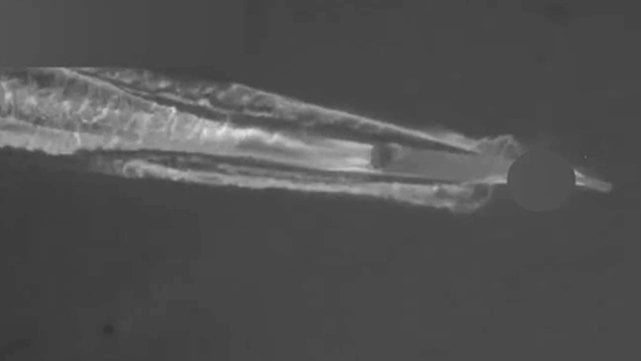
U.S. Southern Command is confirming a new strike on a suspected drug smuggling boat while saying it believed three individuals survived the strike. News of the latest strike came just a day after the Commander of the U.S. Southern Command, Marine General Francis Donovan, who is said to have directed yesterday’s strike, told a U.S. Senate hearing that they would be shifting tactics.
The report said intelligence confirmed a low-profile vessel transiting along what were termed “known narco-trafficking routes.”
Few details were released other than the traditional sensational video posted to social media. The strike reportedly took place in the Eastern Pacific on March 19, with three individuals surviving the attack. SouthCom did not say if there were more individuals aboard the boat or if anyone had died in the strike. It said the U.S. Coast Guard was immediately notified to activate a search and rescue system for the survivors.
The U.S. Coast Guard later reported that it recovered two bodies and one survivor. The individual, along with the bodies of two others, was handed over to the Costa Rican Coast Guard, according to a U.S. spokesperson
Exact counts vary on the number of strikes and people killed since the Trump administration started the campaign last September. Numbers vary between a total of 40 and 45 strikes, with between 140 and 157 people reported killed. There have been a few previous reports of survivors, but the few people who were rescued were sent back to South American countries. The U.S. has yet to arrest any of the people and put them on trial.
Donovan, who is said to have directed the strike, told the Senate Armed Services Committee that the military is pivoting to a comprehensive campaign to target and dismantle drug trafficking organizations, rather than individual boats. He said, “Looking forward, senator — the boat strikes aren’t the answer.”
The Trump administration has been calling the boats “narco-terrorists” and asserting they are operated by “designated terrorist organizations.” Critics of the efforts, however, have questioned the legal authority for the strikes. It has been pointed out that the Coast Guard previously had success in capturing the boats and arresting the operators.
Donovan did not say when the military might pivot to a new strategy. He also did not discuss the details of the efforts and whether they would continue the efforts to strike boats in the Caribbean and Eastern Pacific.
U.S. Southern Command Says Drug Boat Strikes "Aren't the Answer"
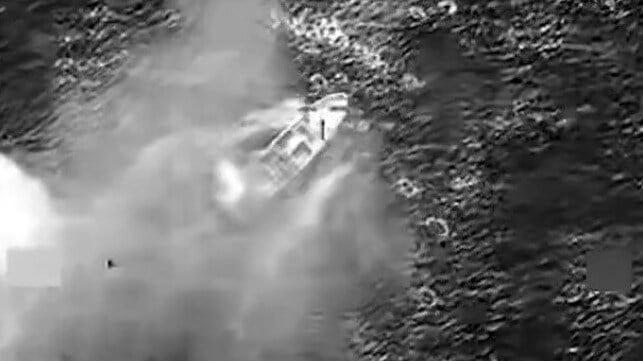
In a Senate hearing Thursday, U.S. Southern Command's top officer told lawmakers that the high-profile airstrikes on drug boats that the Pentagon has championed "aren't the answer" to cocaine smuggling in the Americas. SOUTHCOM commander Gen. Francis L. Donovan (USMC) told the Senate Armed Services Committee that the military is pivoting to a comprehensive campaign to target and dismantle drug trafficking organizations, rather than individual boats.
Since the start of enhanced operations in September, the U.S. military has conducted 45 airstrikes on suspected trafficking boats and killed 157 suspected smugglers, in addition to nonlethal interdictions completed by the Coast Guard. The lethal strikes are forcing some of the smuggling-boat operators to change their routing, but SOUTHCOM wants to do more.
"Looking forward, senator — the boat strikes aren’t the answer," Gen. Donovan told Sen. Mark Kelly (D-AZ) during a Senate Armed Services Committee hearing Thursday. "What we’re moving for right now [is] a countercartel campaign process that puts total systemic friction across this network."
The objective is to impede the entirety of the drug supply chain, he said, from production through to delivery. "I believe that actually kinetic strikes will be one of the many tools, and probably not the most effective tool, when we actually look at it as more of a campaign approach," Donovan said.
Critics of the administration's airstrike tactic have cautioned that at a practical level, it could make it harder for law enforcement to break into cartel networks. Since the airstrike method typically leaves no survivors, low-level drug boat crewmembers cannot be interrogated after the interdiction. This costs investigators an important source of information about the cartel's inner workings, critics say.
At the compliance level, many legal experts at home and abroad have suggested that the airstrike campaign does not align with international law, as it employs military force against men who have historically been treated as noncombatant criminal suspects - civilians, in the law of war. The White House maintains that the operators are "narcoterrorists," and its legal justification - reported by multiple outlets, but not released to the public - is said to rest on the theory that the strikes are targeted solely at the chemical substance aboard the boat, meaning that any harm to the crewmembers on board is incidental.

No comments:
Post a Comment