The struggle for immigration justice has become increasingly inseparable from the global fight against authoritarianism.
Washington has helped revive state terror in Central America, while fostering an epidemic of forced disappearances.
By Jonathan Ng ,
March 16, 2026
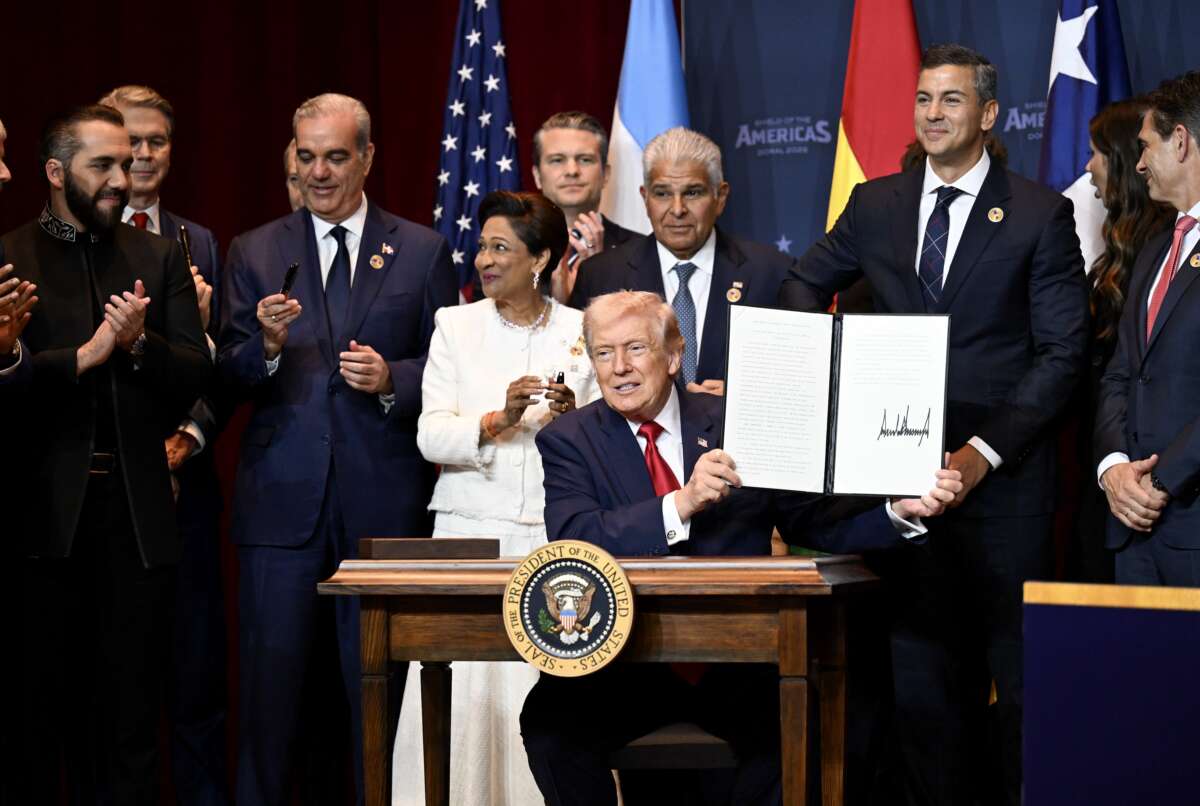
Donald Trump holds a document that he signed while surrounded by heads of state and government officials from 12 countries in the Americas as he hosts the the "Shield of the Americas Summit“ at the Trump National Doral Golf Club on March 7, 2026, in Doral, Florida.Roberto Schmidt / Getty Images
Josué Aguilar Valle, a Honduran national, recalls the “terrible” conditions at the migrant jails where U.S. immigration authorities imprisoned him last year. In La Salle County, Texas, Aguilar shared a frigid cell with 50 men, sleeping on the concrete floor. “I thought I was going to experience hypothermia,” he explained.
Aguilar’s wife struggled to locate him, as authorities repeatedly shuffled him between facilities in Florida and Texas. Aguilar became a statistic lost inside an impenetrable bureaucracy. “Every time I tried to visit him, they moved him,” his wife recounted. “It’s like they’re trying to wear families down.” Last May, Immigration and Customs Enforcement (ICE) deported Aguilar to Honduras, separating him from his U.S. family.
His experience is not unique. Human rights experts claim that President Donald Trump’s administration has restructured the immigration system to “disappear” people, undermining due process and expediting deportations by abducting civilians, hiding detainees, and deleting their data. Those searching for the vanishing victims of ICE arrests have compared the institution’s clandestine practices to “trafficking people.”
The recent wave of disappearances follows a long and traumatic historical arc. Since the 1970s, the U.S. government and its Latin American allies have frequently disappeared civilians to eliminate dissent and members of marginalized communities, while pursuing law enforcement initiatives that make immigrants vulnerable to human trafficking and state violence. In many ways, Trump’s deportation drive reflects this deeper past, as the legacy of imperialism abroad returns home — threatening both immigrant families and the remnants of U.S. democracy.
With Donroe Doctrine, Trump Threatens to Export His Brand of Authoritarianism
International solidarity, not liberal imperialism, is the only way to stop Trump’s global class war. By Ashley Smith , Truthout January 24, 2026
Josué Aguilar Valle, a Honduran national, recalls the “terrible” conditions at the migrant jails where U.S. immigration authorities imprisoned him last year. In La Salle County, Texas, Aguilar shared a frigid cell with 50 men, sleeping on the concrete floor. “I thought I was going to experience hypothermia,” he explained.
Aguilar’s wife struggled to locate him, as authorities repeatedly shuffled him between facilities in Florida and Texas. Aguilar became a statistic lost inside an impenetrable bureaucracy. “Every time I tried to visit him, they moved him,” his wife recounted. “It’s like they’re trying to wear families down.” Last May, Immigration and Customs Enforcement (ICE) deported Aguilar to Honduras, separating him from his U.S. family.
His experience is not unique. Human rights experts claim that President Donald Trump’s administration has restructured the immigration system to “disappear” people, undermining due process and expediting deportations by abducting civilians, hiding detainees, and deleting their data. Those searching for the vanishing victims of ICE arrests have compared the institution’s clandestine practices to “trafficking people.”
The recent wave of disappearances follows a long and traumatic historical arc. Since the 1970s, the U.S. government and its Latin American allies have frequently disappeared civilians to eliminate dissent and members of marginalized communities, while pursuing law enforcement initiatives that make immigrants vulnerable to human trafficking and state violence. In many ways, Trump’s deportation drive reflects this deeper past, as the legacy of imperialism abroad returns home — threatening both immigrant families and the remnants of U.S. democracy.
With Donroe Doctrine, Trump Threatens to Export His Brand of Authoritarianism
International solidarity, not liberal imperialism, is the only way to stop Trump’s global class war. By Ashley Smith , Truthout January 24, 2026
Disappearing Dissent
The term “disappearance” entered the global political lexicon after President Richard Nixon’s administration helped Chilean military leaders seize power in 1973, toppling a popular and democratic socialist government. Nixon offered Gen. Augusto Pinochet unflinching support as the archconservative officer executed thousands of leftists and imprisoned tens of thousands more. Reluctant to offend the budding dictatorship, the United States embassy in Santiago even denied protection to Americans seeking refuge from gunfire in the streets. Its indifference allowed Chilean soldiers to disappear two U.S. citizens, Charles Horman and Frank Teruggi, without pushback.
The legacy of imperialism abroad returns home — threatening both immigrant families and the remnants of U.S. democracy.
In Chile in Their Hearts, John Dinges demonstrates that the State Department treated their deaths as “an obstacle to be removed,” while refusing to recognize that Pinochet’s regime killed them. Horman and Teruggi became two of the more than 1,400 victims that the junta disappeared. For years afterward, U.S. law enforcement and intelligence assistance helped Chile and neighboring dictatorships undertake Operation Condor, a campaign of state terror that disappeared hundreds of leftists, often shuffling their corpses across borders to thwart investigators.
Following the Nicaraguan Revolution in 1979, forced disappearances skyrocketed in Central America, where President Ronald Reagan financed counterinsurgency operations against leftist movements. El Salvador became the third-largest recipient of U.S. aid; at the time, its leading politician, Roberto D’Aubuisson, announced the names of future death squad victims on television.
The courageous human rights defender Marianella García Villas routinely visited the Salvadoran countryside to photograph the corpses dumped by state forces. “All the women were raped before being murdered,” she emphasized. To stifle her investigations, the U.S.-trained Atlácatl Battalion abducted García Villas in 1983, before executing her the same way. Meanwhile, the Reagan administration harassed and spied on the sanctuary movement, which religious leaders established in the United States to protect Central American refugees. By fostering a climate of intimidation, Washington helped Salvadoran death squads sow terror as far as California.
More than anywhere, Reagan’s support for repression proved to be stomach-churning in Guatemala. Even before his election, two campaign supporters reportedly visited the country to assure officials that “Reagan recognizes … a good deal of dirty work has to be done.” His administration supplied munitions and foreign aid, while the military waged a genocidal offensive against the left and Indigenous population.
Their military instructors and equipment helped President Efraín Ríos Montt undertake a scorched-earth campaign that destroyed more than 400 Indigenous communities. In November 1982, the U.S. embassy relayed reports that state forces slaughtered hundreds of civilians in La Estancia. Survivors described victims “ripped open with machetes,” men arrested to “never [be] seen again,” and grenades shredding women and children.
Shortly afterward, Reagan visited Central America to express his support for Ríos Montt. He called the dictator “a man of great personal integrity” and slammed critics for giving him a “bum rap.” The next day, Guatemalan soldiers entered Dos Erres, before commencing a three-day orgy of violence that killed at least 162 people. In 2013, judges concluded that Ríos Montt was guilty of genocide since he intended to “cause the physical destruction of the [Indigenous] Ixil group,” in order to deprive guerrillas of support.
Beyond fomenting forced disappearances, Washington’s militarized drug policy fostered staggering levels of corruption.
In 1996, the counterinsurgency in Guatemala ended after disappearing 45,000 people and claiming 200,000 lives, and President Bill Clinton passed a landmark immigration act that further militarized the border and made it harder for Guatemalan refugees to secure asylum. The conflict was a harrowing illustration of U.S. Cold War strategy. For decades, Washington backed repressive regimes to protect global capitalism and its hemispheric dominance. From Chile to Central America, extrajudicial detentions and executions became commonplace, as U.S. allies literally disappeared dissent.
Death Lands
During the Cold War, U.S. and Latin American elites abducted dissidents to eliminate opposition to unfettered capitalism. But since then, they have disappeared migrants who have been displaced by the very system they created.
The “dirty wars” in Central America left fractured societies, while stimulating undocumented immigration to the United States. Over the 1990s and 2000s, U.S.-sponsored reforms spiked poverty levels in Central America and Mexico by shrinking the public sector, eliminating social services, and boosting import competition.
Most notably, the State Department collaborated with business-friendly governments, while spearheading the North American Free Trade Agreement (NAFTA). Despite promises to the contrary, NAFTA flooded Mexico with cheap grain and undercut small producers. Scholars such as Salvador Maldonado Aranda demonstrate that impoverished peasants immigrated or turned to drug trafficking to survive.
In 2006, President Felipe Calderón assumed power in Mexico, while facing credible accusations of electoral fraud. To boost his legitimacy, Calderón declared war against the Zetas and other drug cartels. The United States then unfurled the Mérida Initiative, which awarded Mexico nearly $3 billion in security aid. Over the following decade, U.S. officials provided advanced aircraft, surveillance technology, police equipment, and extensive law enforcement cooperation.
Yet the history of security assistance in Mexico was already checkered. The founders of the Zetas were former Mexican soldiers who received U.S. instruction at Fort Bragg. “They were given map reading courses, communications, standard special forces training, [and] light to heavy weapons,” Lt. Col. Craig Deare recalled. Even the Zetas’ name was a grotesque nod to their origins, a reference to the radio code used by soldiers targeting drug traffickers.
Washington has helped revive state terror in Central America, while fostering an epidemic of forced disappearances.
Rather than enhancing security, U.S.-Mexican cooperation spawned an uncontrollable war, while encouraging cartels to acquire military-grade firepower and diversify into human trafficking. During Calderón’s presidency, the homicide rate rose nearly 200 percent to more than 121,000 victims. And “narcofosas” (mass graves) proliferated across the countryside, as an epidemic of forced disappearances swept Mexico. Perversely, U.S. authorities across the border exploited the Anti-Drug Abuse Act of 1988 to incarcerate and expel undocumented immigrants fleeing the chaos.
Throughout the Mérida Initiative, Washington ramped up security assistance, despite knowledge that Mexican authorities helped cartels abduct civilians. In May 2010, Consul General Bruce Williamson in Monterrey concluded that violence “made travel chancy on roads” heading north. Months later, the Zetas reportedly intercepted and massacred 72 migrants in San Fernando. Forced disappearances multiplied. “Immigrants from Central America,” the U.S. embassy relayed in 2011, “accused the immigration agents of pulling them off buses and handing them over to drug gangs in the state of Tamaulipas.”
That very year, the Zetas massacred another 193 migrants there. In the aftermath, Mexican authorities confided to U.S. consular staff that they were splitting up the bodies to “make the total number less obvious.”
Beyond fomenting forced disappearances, Washington’s militarized drug policy fostered staggering levels of corruption. Over six years, Mexican authorities arrested thousands of veterans for drug-related charges, and soldiers became popular cartel recruits. Secretary of Public Security Genaro García Luna himself received bribes from drug lords, while directing Calderón’s counternarcotics crusade. Nonetheless, the U.S. officials overseeing Mérida considered him “our go-to guy” and “the most efficient partner we had.”
Ultimately, the drug crackdown discredited the government, ravaged communities, and instigated an arms race among narcotics traffickers. And as cartels kidnapped civilians to raise war funds, the country became a no-man’s land for Central and South American migrants heading north. According to the migrant rights group Movimiento Migrante Mesoamericano, 72,000 to 120,000 disappeared in Mexico between 2006 and 2016. Political scientist Pilar Calveiro concludes that the conflict created “territories of death.” U.S. leaders helped turn Mexico into a sunwashed abyss, where entire migrant convoys — the victims of Washington’s dirty wars and reforms — disappeared without a trace.
The Permanent Exception
To a disturbing degree, the exodus of migrants from Central America is itself a symptom of U.S. policies. For over a decade, support for right-wing forces in Honduras, El Salvador, and elsewhere has spurred immigration, while paving the way for forced disappearances across the region.
In 2009, U.S.-trained officers abducted President Manuel Zelaya of Honduras, then flew him out of the country from a U.S. military base. Afterward, Secretary of State Hillary Clinton recognized the new right-wing government, while helping organize sham elections to lend it legitimacy.
The MAGA movement is imposing its own state of exception to freeze immigration and stifle dissent, as masked ICE agents come to resemble the very agents of oppression that immigrants first fled.
The historian Greg Grandin concludes that the coup inaugurated “a permanent counterinsurgency on behalf of transnational capital” that only Clinton’s cooperation made possible. Over the following years, security forces murdered the environmentalist Berta Cáceres, and disappeared activists resisting the authoritarian slide. Notably, a foreign mining corporation, Entre Mares, hired a former death squad member to oversee security — superimposing the legacy of the Cold War onto the post-coup repression.
Across the border, U.S. officials also tightened relations with President Nayib Bukele in El Salvador after he assumed power in 2019. Before heading the embassy, Ambassador Ronald Johnson was a U.S. military adviser to El Salvador who led combat operations during the dirty war. In office, he protected Bukele from a probe into his negotiations with gang leaders, while the president desperately sought to reduce homicide rates. Afterward, another diplomat discovered that in August 2020, “Bukele requested Johnson remove” a U.S. contractor investigating his pact with local kingpins, and “that was what happened.”
Indeed, Republican politicians became major allies of the conservative upstart, as he branded himself “the coolest dictator in the world.” In 2020, Bukele deployed soldiers to occupy Congress in order to ramrod a security bill through. Elsewhere, U.S. foreign assistance enabled death squad activity. Armed with U.S. equipment, police moonlighted as hitmen for hire, killing at least 279 victims between January 2019 and September 2021.
In 2022, Bukele declared a “state of exception,” clamping down on both violent crime and political dissent. The law enforcement spree has generated another wave of forced disappearances: Repeatedly, masked police in unmarked vehicles have arrested civilians for alleged gang activity. By April 2024, the government had apprehended 79,211 people: imprisoning more than 1 percent of the Salvadoran population.
The human rights organization Cristosal reviewed 1,178 detentions. It found that authorities did not provide evidence in a single case demonstrating that the defendant committed a crime. Instead, Cristosal discovered a pattern of “arbitrary detentions and systematic human rights violations.”
Its findings are chilling. Police have invaded schools to arrest teenagers for their social media posts. They have sexually harassed mothers in front of their children, then hauled them off to prison. And they have raped 13-year-old girls while threatening to incarcerate them if they resist. In one case, they even imprisoned a police employee who had rejected the sexual advances of her boss. After receiving an anonymous tip, officers arrested the woman by dragging her naked from a workplace shower. Nonetheless, Trump has praised Bukele for his “fantastic job” tackling crime and reinforced law enforcement cooperation.
In short, Washington has helped revive state terror in Central America, while fostering an epidemic of forced disappearances. Working with U.S. security agencies, local powerbrokers now attack obstacles to political control and capital accumulation. Bodies dumped by roadsides and packed prisons have become symbols of a permanent state of exception: a new order imposed with U.S. arms and complicity.
The Deep Freeze
The political turmoil and forced disappearances in Central America offer the crucial context for Trump’s deportation drive. U.S. security policies have long exacerbated a refugee crisis in the region. But now, the MAGA movement is imposing its own state of exception to freeze immigration and stifle dissent, as masked ICE agents come to resemble the very agents of oppression that immigrants first fled.
Upon taking office again, Trump cut an agreement with Salvadoran authorities. He scuttled a Department of Justice investigation in order to conceal information about Bukele’s gang negotiations. In return, Salvadoran officials agreed to warehouse more than 250 Venezuelan deportees in the CECOT mega-prison.
The ACLU now registers “enforced disappearances” across the United States as federal authorities undertake dragnet operations.
Human Rights Watch concludes that their transfers constitute “enforced disappearances.” ICE shipped them to El Salvador, while agents “repeatedly refused to provide information” on their whereabouts to family members, even erasing their files from the agency’s database. Prison authorities at CECOT smashed teeth, broke a nose, blasted detainees with rubber bullets, and sexually assaulted victims with batons. CECOT’s director informed the Venezuelans that they would leave in a body bag. Last July, they finally returned to Venezuela in a prisoner exchange.
The state of exception has become the norm for regional governments, including the Trump administration. Under political pressure, Honduran and Guatemalan officials have also declared national emergencies to reduce violent crime, and Costa Rica is building a mega-prison based on CECOT. And while trampling civil liberties, the Trump administration has allocated over $170 billion to immigration enforcement, tripled ICE’s annual budget, and kickstarted a wave of prison construction. Its deportation drive allows officials to turn immigration officers into shock troops of the MAGA movement, while appealing to their political base and intimidating dissent.
The ACLU now registers “enforced disappearances” across the United States as federal authorities undertake dragnet operations. Last October, masked ICE agents detained about 400 people at an Idaho racetrack, while shouting racial slurs and manhandling civilians. They kept adults and children zip-tied for hours, depriving them of access to food, water, and restrooms — and forcing them to urinate in full view of others.
More broadly, the ACLU calls prisons such as “Alligator Alcatraz” in Florida a black hole where officials “disappear” detainees by frequently failing to record their information or inform their families of their location, turning hundreds of prisoners into lost statistics. At the Everglades site, guards have kept civilians shackled in zoo cages under the pounding sun. Officers at the nearby Krome facility have also tortured numerous victims, at one point crushing the hand of a detainee in front of human rights monitors.
This March, the inauguration of the Shield of the Americas, a multinational coalition targeting drug trafficking and immigration, dramatized the hemispheric scope of Trump’s repressive agenda. The popular Latin American news show “Macondo” dubbed it the summit of “bootlickers,” since most attendees from the region — including Bukele — are unconditional supporters of the MAGA program. Addressing the conference, Trump expressed contempt for the “damn language” of his Spanish-speaking allies while defending the latest war on drugs. Days afterward, jurists concluded that the governments of his closest regional partners, Bukele and President Daniel Noboa of Ecuador, have forcibly disappeared civilians — including children.
As Trump exploits fears about migrants to dissolve constitutional safeguards, the struggle for immigration justice becomes increasingly inseparable from the global fight against authoritarianism.
Ultimately, the current immigration crackdown obscures a long history of U.S. imperialism, while displaying the authoritarian ambitions of Trump and his hemispheric allies. Since the 1970s, the United States has promoted security measures that have disappeared thousands of civilians in order to maintain imperial supremacy, curtail crime, and undercut progressive movements. In turn, these militarized law enforcement policies have propelled waves of immigration, effectively creating a population vulnerable to human trafficking and state violence.
Rather than address these issues, ICE imprisons or deports those affected by them — literally displacing policy contradictions across borders. In the process, federal authorities not only threaten to disappear immigrants but what remains of U.S. democracy. Thus, the legacy of imperialism abroad has returned home to haunt the United States. Masked agents in unmarked vehicles now snatch civilians off the streets, just like Washington’s repressive allies in Latin America. As Trump exploits fears about migrants to dissolve constitutional safeguards, the struggle for immigration justice becomes increasingly inseparable from the global fight against authoritarianism.
The author would like to thank Sarah Priscilla Lee of the Learning Sciences program at Northwestern University for reviewing this article.
This article is licensed under Creative Commons (CC BY-NC-ND 4.0), and you are free to share and republish under the terms of the license.
The term “disappearance” entered the global political lexicon after President Richard Nixon’s administration helped Chilean military leaders seize power in 1973, toppling a popular and democratic socialist government. Nixon offered Gen. Augusto Pinochet unflinching support as the archconservative officer executed thousands of leftists and imprisoned tens of thousands more. Reluctant to offend the budding dictatorship, the United States embassy in Santiago even denied protection to Americans seeking refuge from gunfire in the streets. Its indifference allowed Chilean soldiers to disappear two U.S. citizens, Charles Horman and Frank Teruggi, without pushback.
The legacy of imperialism abroad returns home — threatening both immigrant families and the remnants of U.S. democracy.
In Chile in Their Hearts, John Dinges demonstrates that the State Department treated their deaths as “an obstacle to be removed,” while refusing to recognize that Pinochet’s regime killed them. Horman and Teruggi became two of the more than 1,400 victims that the junta disappeared. For years afterward, U.S. law enforcement and intelligence assistance helped Chile and neighboring dictatorships undertake Operation Condor, a campaign of state terror that disappeared hundreds of leftists, often shuffling their corpses across borders to thwart investigators.
Following the Nicaraguan Revolution in 1979, forced disappearances skyrocketed in Central America, where President Ronald Reagan financed counterinsurgency operations against leftist movements. El Salvador became the third-largest recipient of U.S. aid; at the time, its leading politician, Roberto D’Aubuisson, announced the names of future death squad victims on television.
The courageous human rights defender Marianella García Villas routinely visited the Salvadoran countryside to photograph the corpses dumped by state forces. “All the women were raped before being murdered,” she emphasized. To stifle her investigations, the U.S.-trained Atlácatl Battalion abducted García Villas in 1983, before executing her the same way. Meanwhile, the Reagan administration harassed and spied on the sanctuary movement, which religious leaders established in the United States to protect Central American refugees. By fostering a climate of intimidation, Washington helped Salvadoran death squads sow terror as far as California.
More than anywhere, Reagan’s support for repression proved to be stomach-churning in Guatemala. Even before his election, two campaign supporters reportedly visited the country to assure officials that “Reagan recognizes … a good deal of dirty work has to be done.” His administration supplied munitions and foreign aid, while the military waged a genocidal offensive against the left and Indigenous population.
Their military instructors and equipment helped President Efraín Ríos Montt undertake a scorched-earth campaign that destroyed more than 400 Indigenous communities. In November 1982, the U.S. embassy relayed reports that state forces slaughtered hundreds of civilians in La Estancia. Survivors described victims “ripped open with machetes,” men arrested to “never [be] seen again,” and grenades shredding women and children.
Shortly afterward, Reagan visited Central America to express his support for Ríos Montt. He called the dictator “a man of great personal integrity” and slammed critics for giving him a “bum rap.” The next day, Guatemalan soldiers entered Dos Erres, before commencing a three-day orgy of violence that killed at least 162 people. In 2013, judges concluded that Ríos Montt was guilty of genocide since he intended to “cause the physical destruction of the [Indigenous] Ixil group,” in order to deprive guerrillas of support.
Beyond fomenting forced disappearances, Washington’s militarized drug policy fostered staggering levels of corruption.
In 1996, the counterinsurgency in Guatemala ended after disappearing 45,000 people and claiming 200,000 lives, and President Bill Clinton passed a landmark immigration act that further militarized the border and made it harder for Guatemalan refugees to secure asylum. The conflict was a harrowing illustration of U.S. Cold War strategy. For decades, Washington backed repressive regimes to protect global capitalism and its hemispheric dominance. From Chile to Central America, extrajudicial detentions and executions became commonplace, as U.S. allies literally disappeared dissent.
Death Lands
During the Cold War, U.S. and Latin American elites abducted dissidents to eliminate opposition to unfettered capitalism. But since then, they have disappeared migrants who have been displaced by the very system they created.
The “dirty wars” in Central America left fractured societies, while stimulating undocumented immigration to the United States. Over the 1990s and 2000s, U.S.-sponsored reforms spiked poverty levels in Central America and Mexico by shrinking the public sector, eliminating social services, and boosting import competition.
Most notably, the State Department collaborated with business-friendly governments, while spearheading the North American Free Trade Agreement (NAFTA). Despite promises to the contrary, NAFTA flooded Mexico with cheap grain and undercut small producers. Scholars such as Salvador Maldonado Aranda demonstrate that impoverished peasants immigrated or turned to drug trafficking to survive.
In 2006, President Felipe Calderón assumed power in Mexico, while facing credible accusations of electoral fraud. To boost his legitimacy, Calderón declared war against the Zetas and other drug cartels. The United States then unfurled the Mérida Initiative, which awarded Mexico nearly $3 billion in security aid. Over the following decade, U.S. officials provided advanced aircraft, surveillance technology, police equipment, and extensive law enforcement cooperation.
Yet the history of security assistance in Mexico was already checkered. The founders of the Zetas were former Mexican soldiers who received U.S. instruction at Fort Bragg. “They were given map reading courses, communications, standard special forces training, [and] light to heavy weapons,” Lt. Col. Craig Deare recalled. Even the Zetas’ name was a grotesque nod to their origins, a reference to the radio code used by soldiers targeting drug traffickers.
Washington has helped revive state terror in Central America, while fostering an epidemic of forced disappearances.
Rather than enhancing security, U.S.-Mexican cooperation spawned an uncontrollable war, while encouraging cartels to acquire military-grade firepower and diversify into human trafficking. During Calderón’s presidency, the homicide rate rose nearly 200 percent to more than 121,000 victims. And “narcofosas” (mass graves) proliferated across the countryside, as an epidemic of forced disappearances swept Mexico. Perversely, U.S. authorities across the border exploited the Anti-Drug Abuse Act of 1988 to incarcerate and expel undocumented immigrants fleeing the chaos.
Throughout the Mérida Initiative, Washington ramped up security assistance, despite knowledge that Mexican authorities helped cartels abduct civilians. In May 2010, Consul General Bruce Williamson in Monterrey concluded that violence “made travel chancy on roads” heading north. Months later, the Zetas reportedly intercepted and massacred 72 migrants in San Fernando. Forced disappearances multiplied. “Immigrants from Central America,” the U.S. embassy relayed in 2011, “accused the immigration agents of pulling them off buses and handing them over to drug gangs in the state of Tamaulipas.”
That very year, the Zetas massacred another 193 migrants there. In the aftermath, Mexican authorities confided to U.S. consular staff that they were splitting up the bodies to “make the total number less obvious.”
Beyond fomenting forced disappearances, Washington’s militarized drug policy fostered staggering levels of corruption. Over six years, Mexican authorities arrested thousands of veterans for drug-related charges, and soldiers became popular cartel recruits. Secretary of Public Security Genaro García Luna himself received bribes from drug lords, while directing Calderón’s counternarcotics crusade. Nonetheless, the U.S. officials overseeing Mérida considered him “our go-to guy” and “the most efficient partner we had.”
Ultimately, the drug crackdown discredited the government, ravaged communities, and instigated an arms race among narcotics traffickers. And as cartels kidnapped civilians to raise war funds, the country became a no-man’s land for Central and South American migrants heading north. According to the migrant rights group Movimiento Migrante Mesoamericano, 72,000 to 120,000 disappeared in Mexico between 2006 and 2016. Political scientist Pilar Calveiro concludes that the conflict created “territories of death.” U.S. leaders helped turn Mexico into a sunwashed abyss, where entire migrant convoys — the victims of Washington’s dirty wars and reforms — disappeared without a trace.
The Permanent Exception
To a disturbing degree, the exodus of migrants from Central America is itself a symptom of U.S. policies. For over a decade, support for right-wing forces in Honduras, El Salvador, and elsewhere has spurred immigration, while paving the way for forced disappearances across the region.
In 2009, U.S.-trained officers abducted President Manuel Zelaya of Honduras, then flew him out of the country from a U.S. military base. Afterward, Secretary of State Hillary Clinton recognized the new right-wing government, while helping organize sham elections to lend it legitimacy.
The MAGA movement is imposing its own state of exception to freeze immigration and stifle dissent, as masked ICE agents come to resemble the very agents of oppression that immigrants first fled.
The historian Greg Grandin concludes that the coup inaugurated “a permanent counterinsurgency on behalf of transnational capital” that only Clinton’s cooperation made possible. Over the following years, security forces murdered the environmentalist Berta Cáceres, and disappeared activists resisting the authoritarian slide. Notably, a foreign mining corporation, Entre Mares, hired a former death squad member to oversee security — superimposing the legacy of the Cold War onto the post-coup repression.
Across the border, U.S. officials also tightened relations with President Nayib Bukele in El Salvador after he assumed power in 2019. Before heading the embassy, Ambassador Ronald Johnson was a U.S. military adviser to El Salvador who led combat operations during the dirty war. In office, he protected Bukele from a probe into his negotiations with gang leaders, while the president desperately sought to reduce homicide rates. Afterward, another diplomat discovered that in August 2020, “Bukele requested Johnson remove” a U.S. contractor investigating his pact with local kingpins, and “that was what happened.”
Indeed, Republican politicians became major allies of the conservative upstart, as he branded himself “the coolest dictator in the world.” In 2020, Bukele deployed soldiers to occupy Congress in order to ramrod a security bill through. Elsewhere, U.S. foreign assistance enabled death squad activity. Armed with U.S. equipment, police moonlighted as hitmen for hire, killing at least 279 victims between January 2019 and September 2021.
In 2022, Bukele declared a “state of exception,” clamping down on both violent crime and political dissent. The law enforcement spree has generated another wave of forced disappearances: Repeatedly, masked police in unmarked vehicles have arrested civilians for alleged gang activity. By April 2024, the government had apprehended 79,211 people: imprisoning more than 1 percent of the Salvadoran population.
The human rights organization Cristosal reviewed 1,178 detentions. It found that authorities did not provide evidence in a single case demonstrating that the defendant committed a crime. Instead, Cristosal discovered a pattern of “arbitrary detentions and systematic human rights violations.”
Its findings are chilling. Police have invaded schools to arrest teenagers for their social media posts. They have sexually harassed mothers in front of their children, then hauled them off to prison. And they have raped 13-year-old girls while threatening to incarcerate them if they resist. In one case, they even imprisoned a police employee who had rejected the sexual advances of her boss. After receiving an anonymous tip, officers arrested the woman by dragging her naked from a workplace shower. Nonetheless, Trump has praised Bukele for his “fantastic job” tackling crime and reinforced law enforcement cooperation.
In short, Washington has helped revive state terror in Central America, while fostering an epidemic of forced disappearances. Working with U.S. security agencies, local powerbrokers now attack obstacles to political control and capital accumulation. Bodies dumped by roadsides and packed prisons have become symbols of a permanent state of exception: a new order imposed with U.S. arms and complicity.
The Deep Freeze
The political turmoil and forced disappearances in Central America offer the crucial context for Trump’s deportation drive. U.S. security policies have long exacerbated a refugee crisis in the region. But now, the MAGA movement is imposing its own state of exception to freeze immigration and stifle dissent, as masked ICE agents come to resemble the very agents of oppression that immigrants first fled.
Upon taking office again, Trump cut an agreement with Salvadoran authorities. He scuttled a Department of Justice investigation in order to conceal information about Bukele’s gang negotiations. In return, Salvadoran officials agreed to warehouse more than 250 Venezuelan deportees in the CECOT mega-prison.
The ACLU now registers “enforced disappearances” across the United States as federal authorities undertake dragnet operations.
Human Rights Watch concludes that their transfers constitute “enforced disappearances.” ICE shipped them to El Salvador, while agents “repeatedly refused to provide information” on their whereabouts to family members, even erasing their files from the agency’s database. Prison authorities at CECOT smashed teeth, broke a nose, blasted detainees with rubber bullets, and sexually assaulted victims with batons. CECOT’s director informed the Venezuelans that they would leave in a body bag. Last July, they finally returned to Venezuela in a prisoner exchange.
The state of exception has become the norm for regional governments, including the Trump administration. Under political pressure, Honduran and Guatemalan officials have also declared national emergencies to reduce violent crime, and Costa Rica is building a mega-prison based on CECOT. And while trampling civil liberties, the Trump administration has allocated over $170 billion to immigration enforcement, tripled ICE’s annual budget, and kickstarted a wave of prison construction. Its deportation drive allows officials to turn immigration officers into shock troops of the MAGA movement, while appealing to their political base and intimidating dissent.
The ACLU now registers “enforced disappearances” across the United States as federal authorities undertake dragnet operations. Last October, masked ICE agents detained about 400 people at an Idaho racetrack, while shouting racial slurs and manhandling civilians. They kept adults and children zip-tied for hours, depriving them of access to food, water, and restrooms — and forcing them to urinate in full view of others.
More broadly, the ACLU calls prisons such as “Alligator Alcatraz” in Florida a black hole where officials “disappear” detainees by frequently failing to record their information or inform their families of their location, turning hundreds of prisoners into lost statistics. At the Everglades site, guards have kept civilians shackled in zoo cages under the pounding sun. Officers at the nearby Krome facility have also tortured numerous victims, at one point crushing the hand of a detainee in front of human rights monitors.
This March, the inauguration of the Shield of the Americas, a multinational coalition targeting drug trafficking and immigration, dramatized the hemispheric scope of Trump’s repressive agenda. The popular Latin American news show “Macondo” dubbed it the summit of “bootlickers,” since most attendees from the region — including Bukele — are unconditional supporters of the MAGA program. Addressing the conference, Trump expressed contempt for the “damn language” of his Spanish-speaking allies while defending the latest war on drugs. Days afterward, jurists concluded that the governments of his closest regional partners, Bukele and President Daniel Noboa of Ecuador, have forcibly disappeared civilians — including children.
As Trump exploits fears about migrants to dissolve constitutional safeguards, the struggle for immigration justice becomes increasingly inseparable from the global fight against authoritarianism.
Ultimately, the current immigration crackdown obscures a long history of U.S. imperialism, while displaying the authoritarian ambitions of Trump and his hemispheric allies. Since the 1970s, the United States has promoted security measures that have disappeared thousands of civilians in order to maintain imperial supremacy, curtail crime, and undercut progressive movements. In turn, these militarized law enforcement policies have propelled waves of immigration, effectively creating a population vulnerable to human trafficking and state violence.
Rather than address these issues, ICE imprisons or deports those affected by them — literally displacing policy contradictions across borders. In the process, federal authorities not only threaten to disappear immigrants but what remains of U.S. democracy. Thus, the legacy of imperialism abroad has returned home to haunt the United States. Masked agents in unmarked vehicles now snatch civilians off the streets, just like Washington’s repressive allies in Latin America. As Trump exploits fears about migrants to dissolve constitutional safeguards, the struggle for immigration justice becomes increasingly inseparable from the global fight against authoritarianism.
The author would like to thank Sarah Priscilla Lee of the Learning Sciences program at Northwestern University for reviewing this article.
This article is licensed under Creative Commons (CC BY-NC-ND 4.0), and you are free to share and republish under the terms of the license.
Jonathan Ng
Jonathan Ng is a postdoctoral fellow at the John Sloan Dickey Center for International Understanding at Dartmouth College.


No comments:
Post a Comment