Microsoft, Nvidia team up for AI for nuclear
_47682.jpg)
"The world is racing to meet a historic surge in power demand with an infrastructure pipeline built for the analogue age," Darryl Willis, Corporate Vice President, Worldwide Energy and Resources Industry, Microsoft, said in a blog post. "Driven by thonential expansion of digital technologies and the reindustrialisation of supply chains, the mandate for always-on, carbon-free power is urgent and absolute. Nuclear energy is the essential backbone for this future, but the industry remains trapped in a delivery bottleneck. Before a shovel even hits the dirt, critical projects are slowed by highly customised engineering, fragmented data, and mountains of manual regulatory review."
Tech giant Microsoft said it has formed a collaboration with multinational technology company Nvidia to provide a set of technologies that "bring disciplined engineering to the entire lifecycle of a nuclear plant - spanning site permitting, design, construction, and continuous operations. By enabling these capabilities within a connected, AI-powered foundation, we are empowering energy developers to make highly complex work repeatable, traceable, secure, and predictable - slashing development timelines and eliminating rework without sacrificing safety."
Willis said: "By unifying data, traceability, and simulation across phases, AI accelerates design validation with high-fidelity 3D models and Digital Twins, improves licensing consistency through AI-assisted document workflows, and connects design assumptions to operational performance - giving operators, regulators, and stakeholders clearer, continuous visibility."
Under the new collaboration, New York-based Everstar - an Nvidia Inception startup - brings domain-specific AI for nuclear to Microsoft's Azure cloud computing platform.
"The nuclear industry has been bottlenecked by documentation burden and regulatory complexity for decades," said Everstar CEO Kevin Kong. "This partnership means our customers get the secure, scalable cloud deployments they demand. It's a significant step toward making nuclear power fast, safe, and unstoppable."
Everstar has also announced its collaboration with the US Department of Energy (DOE), Idaho National Laboratory (INL), Argonne National Laboratory (ANL), and Microsoft as part of the DOE's Genesis Mission. "This announcement marks Everstar's first public milestone on a broader roadmap of activities that aims to compress the nuclear value chain by an order of magnitude for licensing, design, manufacturing, and operations," it said.
Everstar said its Gordian AI platform was used to convert a DOE safety analysis document into sections equivalent to a US Nuclear Regulatory Commission licence application - a process that typically takes a team of experts four to six weeks was completed in a single day.
Launched by President Donald Trump through an Executive Order dated 24 November last year, the White House says the Genesis mission is inspired by the legacy of the Apollo Programme "to unite America's brightest minds, most powerful computers, and vast scientific data into one cooperative system for research". The DOE-led mission aims to harness AI and advanced computing to double the productivity and impact of US science and engineering within a decade, and will "deliver decisive breakthroughs to secure American energy dominance, accelerate scientific discovery, and strengthen national security", the department said.
Taipower applies to restart Maanshan plant
_66240.jpg)
In May last year, Taiwan's Legislative Yuan passed an amendment to the Nuclear Reactor Facilities Regulation Act that allows nuclear power plant operators to apply for a 20-year licence renewal beyond the existing 40-year limit, potentially extending a plant's operating lifespan to 60 years.
Taiwan Power Company (Taipower) announced it has now submitted a licence renewal application and related documents for the Maanshan plant, which it says has already been approved by the Ministry of Economic Affairs, to the Nuclear Safety Council (NSC). The plan includes five main parts: the current status and planned schedule of the unit; manpower allocation and training; reactivation items and regular maintenance of the facility; planning of regulations during operation; and quality verification and audit plan.
The NSC said it will first conduct a procedural review of the documents that Taipower has now submitted. After confirming that the application documents are complete, it will proceed with the substantive technical review. The NSC said it will invite external scholars and experts, along with NSC colleagues, to form a special review team.
"This team will conduct a rigorous review in accordance with regulations and international practices to ensure that Taipower has submitted a proper plan for all aspects of the restart plan and that it meets quality assurance requirements before approving the plan," it said. "During the implementation of the restart plan, the NSC will also conduct on-site verification to confirm that Taipower is implementing the plan accordingly. After Taipower completes the relevant procedures according to the reactivation plan, it must submit an implementation report to the NSC for review, as required by regulations. In addition, Taipower must also submit documents related to aging assessment and management, radiation-related issues verification and assessment, and seismic safety assessment, as required by regulations."
"Even if the restart plan is approved by the Nuclear Safety Council, it cannot start generating electricity immediately," Taipower noted. "Further independent safety inspections are still required. These inspections will take approximately 18 to 24 months, after which a report must be submitted to the Nuclear Safety Council for review. The review time is determined by the Council. Only after the review is approved and a new operating licence is issued will the plant be qualified to operate."
Taiwan's nuclear energy policy
Taiwan's Democratic Progressive Party (DPP) was elected in January 2016 with a policy of creating a "nuclear-free" Taiwan by 2025. Under this policy, Taiwan's six operable power reactors would be decommissioned as their 40-year operating licences expired. Shortly after taking office, the DPP government passed an amendment to the Electricity Act, passing its phase-out policy into law. The government aimed for an energy mix of 20% from renewable sources, 50% from liquefied natural gas and 30% from coal.
However, in a referendum held in November 2018, voters chose to abolish that amendment. The Ministry of Economic Affairs said the amendment was officially removed from the Electricity Industry Act on 2 December.
Nevertheless, then Minister of Economic Affairs Shen Jong-chin said in January 2019 "there would be no extension or restarts of nuclear power plants in Taiwan due to subjective and objective conditions, as well as strong public objection".
In May 2025 - just days before the final closure of Maanshan unit 2, marking Taiwan's exit from nuclear power - Taiwan's legislature approved an amendment proposed by the main opposition party (Kuomintang) to the Nuclear Reactor Facilities Regulation Act, allowing nuclear reactor lifespans to be extended from 40 to 60 years. The move was aimed at bolstering energy security amid rising demand from AI growth and to curb reliance on imported liquefied natural gas.
Kentucky incentives support laser enrichment plant
_18080.jpg)
North Carolina-based Global Laser Enrichment (GLE) completed its full licence application to the US Nuclear Regulatory Commission for the Paducah Laser Enrichment Facility (PLEF) in July last year. It intends to re-enrich high-assay depleted uranium tails acquired from the Department of Energy at the facility at Paducah, Kentucky, and says the project represents a transformational investment opportunity for the greater Paducah region. It is expected to be the single largest capital investment in Western Kentucky's history.
The performance-based incentive package will potentially provide up to USD98.9 million in tax and other economic incentives should GLE reach agreed investment and job creation thresholds, the company said.
"GLE greatly appreciates McCracken County and the Commonwealth of Kentucky's enthusiasm and support for nuclear energy and the creation of new US domestic nuclear fuel sources," GLE CEO Stephen Long said. "The incentive package reflects a shared vision for economic development, technological leadership, and the establishment of a resilient domestic nuclear fuel supply chain."
GLE is the exclusive licensee of the SILEX laser enrichment technology invented by Australian company Silex Sytems Ltd. The company completed a large-scale uranium enrichment demonstration programme last year at its Wilmington, North Carolina Test Loop facility, reaching Technology Readiness Level 6, and is continuing its technology maturation program (TRL-7+) and full-scale preliminary detailed design for the PLEF.
The company said it "remains on track to begin re-enriching the DOE’s Paducah inventory of depleted uranium tails by 2030".
Excavation work approved for India's Mahi Banswara units
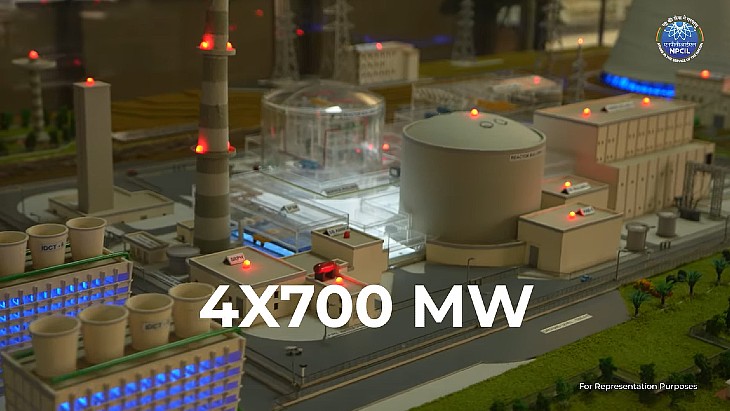
The permission, announced on Thursday, has been issued to Anushakti Vidyut Nigam Limited (Ashvini) for the 700 MWe pressurised heavy water reactors planned at the plant, in the Banswara district of Rajasthan.
Ashvini is a joint venture between Nuclear Power Corporation of India Limited (51%) and National Thermal Power Corporation (49%) formed in 2024. Construction consent was issued for all four planned units at the Mahi Banswara plant last year.
The project is part of India's fleet mode initiative to build ten identical 700 MWe reactors at various locations across India under uniform design and procurement plans, an approach the Indian government says will bring in cost efficiencies and speed deployment, while consolidating operational expertise.
The other reactors that make up the ten planned units are Kaiga units 5 and 6 (in Karnataka), Gorakhpur units 3 and 4 (Haryana), and Chutka units 1 and 2 (Madhyar Pradesh). Two 700 MWe PHWR units at Kakrapar, in Gujurat, are already in commercial operation. Rajasthan units 7 and 8 are currently in the commissioning process.
India, which currently has about 7,900 MW capacity from 24 operable nuclear power plants, is planning a large expansion of its nuclear capacity. The country says that seventeen nuclear power reactors with a total of 13,100 MW capacity are either under construction (7) or under pre-project activities (10). The ambition is for India to reach a nuclear energy capacity of about 100 GW by 2047.
First 10 years of Russian final waste repository reviewed

The repository received its first waste shipment - 13 packages of waste totalling 47 cubic metres - in November 2016. It takes class 3 waste and class 4 waste such as, for example, clothing, air filters and packaging.
The repository is made up of reinforced concrete structures. The first phase, which opened in 2016, is 140 metres long, 24 metres wide and built at a depth of 7 metres. Together with the later phases, the repository can hold up to 55,000 cubic metres for up to 300 years. The walls of the storage structures, divided into cells, are more than half a metre thick and each cell is filled with special certified containers with 15-centimetre-thick concrete walls, which contain metal barrels containing pressed radioactive waste. After filling, each cell is concreted.
Once the waste is entombed, the facility was said at launch to be able to withstand a magnitude 6 earthquake. Once the site is fully loaded - which has been scheduled for subsequent decades - it will adopt the "green lawn" principle.
Vyacheslav Alexandrov, Director of the Ural Branch of the National Operator for Radioactive Waste Management (NO RAO), said: "An important result of our work is the accident-free and safe operation of the final isolation facility. We systematically conduct environmental monitoring and radiation control, and we share the results of these observations with the public. Throughout our operation, we have not recorded a single radiation incident. This speaks to the reliability of our facility's design solutions and, of course, is a testament to the high professionalism of our specialists."
Vasily Tinin, from Rosatom, said the facility had been created with a combination of domestic technologies and the world's best practices.
He said: "The facility plays an important role in meeting the needs of the nuclear industry and makes a significant contribution to achieving the national goal of transitioning from the accumulation of radioactive waste to reducing its storage volumes and eliminating the nuclear legacy. The experience of constructing and operating the facility in Novouralsk has laid a solid foundation for the further development of radioactive waste final disposal infrastructure in other regions where Rosatom State Corporation operates."
The National Operator for Radioactive Waste Management, part of state nuclear corporation Rosatom, also has two radioactive waste final disposal facilities under construction, in Seversk and Ozersk, with the first stages of these facilities scheduled to be commissioned in 2026. A separate underground research laboratory is being built as part of a project to create a deep final disposal facility for high-level radioactive waste in Krasnoyarsk Krai in Siberia.
Singapore to bolster nuclear safety capabilities

The three studies will examine different aspects of nuclear safety: safety standards adopted by international organisations and national regulators, including how to design and operate the reactor safely, what safety systems are needed, and how to prevent accidents; international environmental standards and regulatory frameworks for nuclear facilities; and environmental considerations for the potential deployment of nuclear energy in Singapore and the region – both of which focus on how to protect public health and the environment.
"These studies will complement the ongoing study commissioned by the Energy Market Authority (EMA) to evaluate the safety performance and technical feasibility of advanced nuclear energy technologies," the National Environment Agency (NEA) noted.
The NEA, as the radiation and nuclear safety regulator, has been developing Singapore's nuclear safety capabilities through close partnerships with the International Atomic Energy Agency and established regulatory bodies in Finland, France and the USA, as well as its regional neighbours with whom it engages in nuclear safety cooperation discussions. The NEA's Nuclear Safety Advisory Panel, comprising experts in nuclear and related scientific fields, provides independent advice on nuclear safety, security and safeguards.
"The studies, together with our other capability-building efforts, ensure that Singapore is well equipped with the knowledge and technical expertise to independently assess the potential for safe deployment of nuclear energy in Singapore," the NEA said. "These capabilities will also allow us to contribute to strengthen regional discussion on nuclear, to better prepare for a region with nuclear power plants. The studies will also support our preparations in the event that countries in our region decide to deploy nuclear power."
In 2012, the Singapore government conducted a pre-feasibility study on nuclear energy. While the study concluded that nuclear power plants of the time were not suited for a small and densely populated city-state, it recommended that Singapore continue to monitor the progress of new nuclear energy technologies.
In March 2022, the EMA released a report that concluded nuclear energy could supply around 10% of Singapore's energy needs, helping its power sector achieve net-zero carbon emissions by 2050.
In October 2024, the EMA signed a memorandum of understanding (MoU) with the UAE's Emirates Nuclear Energy Company to develop capabilities in nuclear energy. Through the MoU, both parties would work together to strengthen capabilities in nuclear science and technology, and identify activities of mutual interest in areas such as the assessment of emerging nuclear technologies and human resource development. The parties agreed to facilitate information sharing through workshops, technical exchanges, and/or staff attachments.
In September 2025, the EMA appointed UK-headquartered engineering firm Mott MacDonald to conduct a study on the safety and technical feasibility of advanced nuclear energy technologies. The study aims to evaluate the safety performance and technical feasibility of advanced nuclear energy technologies, such as small modular reactors, based on their safety features, technology maturity, and commercial readiness.
Delivering his Budget 2025 speech in February last year, Prime Minister Lawrence Wong - who is also Finance Minister - said the government would study the potential deployment of nuclear power in Singapore and take further steps to systematically build up capabilities in this area. "We will need new capabilities to evaluate options, and to consider if there is a solution that Singapore can deploy in a safe and cost-effective way," he said.

No comments:
Post a Comment