Latin America and the new US colonialism
APRIL 10, 2026
Trump is presenting his increasing interference in Latin America as part of his administration’s ‘war on drugs’. It’s not – and there are growing signs of resistance, argues Mike Phipps.
Last December, the United States published its new National Security Strategy. The document says: “The United States will reassert and enforce the Monroe Doctrine.”
Originally declared in 1823, the Monroe Doctrine holds that any intervention in the political affairs of the Americas by foreign powers is a potentially hostile act against the United States. Now Trump has added a significant Corollary to the Doctrine, asserting US predominance in the whole of the Western Hemisphere. It’s in this context that Trump’s demand to take control of Greenland can be understood.
But it is in Latin America that the new approach is having most impact. Witness the bombing and killing of more than 150 fishermen in the Pacific and Caribbean. “This murder spree,” says Amnesty International, “is unconscionable and illegal.”
The New Year began with the kidnapping of President Nicolás Maduro in Venezuela. The operation, a blatant violation of international law and transparently aimed at controlling Venezuela’s oil, resulted in at least 100 fatalities. Following Maduro’s seizure, the official State Department X account wrote, “This is OUR Hemisphere and President Trump will not allow our security to be threatened.”
Trump came to the support of the right wing Milei government in Argentina during last year’s parliamentary elections, by making a $20 billion financial assistance package available to the economically beleaguered regime mid-campaign.
Cuba has been the object of a harsh blockade, which imposes heavy tariffs on “any other country that directly or indirectly sells or otherwise provides any oil to Cuba.” The embargo has led to electrical blackouts across the entire country and hospital generators almost running out of fuel. There is every likelihood that Trump will increase further pressure on the island once the war on Iran dies down. “I can do anything I want with it,” Trump said last month.
In El Salvador, the US has worked closely with President Nayib Bukele over the Trump administration’s mass deportation of migrants from various Latin American countries and their warehousing in El Salvador’s overcrowded prisons. El Salvador’s four-year “State of Exception” and its multiple violations of basic liberties has been the subject of more than two dozen human rights investigations by national and international organisations.
In October 2025, Trump accused Colombian President Gustavo Petro of being an “illegal drug dealer” and simultaneously cut off diplomatic aid to the country. Many of the US attacks on fishing boats have been near Colombia’s coastline. When asked if he was considering a military strike in Colombia, Trump said, “It sounds good to me.”
A ‘war on drugs’
Indeed, much of the US expansion into Latin America has been in the guise of fighting a ‘war on drugs’. Last month, a US-backed crackdown on supposed drug cartels along the Ecuador-Colombia border sparked accusations that security forces bombed farms, burned homes and detained and abused villagers. The operation left at least 27 people dead.
On March 24th, the New York Times alleged that Ecuadorian soldiers had set fire to and then bombed a dairy farm near the border, according to local workers. Jahiren Noriega Donoso, a lawmaker in Ecuador’s National Assembly, posted: “Unequivocally, the war that [President] Daniel Noboa has launched is not a war against crime. It is a war against the poorest among us.”
“There are 27 charred bodies, and the explanation provided is not credible,” Colombia’s President Petro wrote on social media. “Bombs lie on the ground in close proximity to families — many of whom have peacefully chosen to replace their coca leaf crops with legal crops.”
US forces were also involved in Bolivia last month in the capture of a leading drug trafficker. The country’s new right wing President is an ardent Trump supporter. On taking office last year, he proposed cutting public spending by 30%, eliminating a range of taxes on the wealthiest and setting up at least ten ‘truth commissions’ to investigate the activities of previous left-led governments – a device aimed at barring them from office in future.
US Administration officials are clear that their control of Latin America is a top priority and the ‘war on drugs’ is the spearhead. “We are not going to cede an inch of territory in this hemisphere to our enemies or adversaries,” White House security adviser Stephen Miller said last month, adding the US was “using hard power, military power, lethal force, to protect and defend the American homeland.”
In one week alone last year, the US secured military deals with Paraguay, Ecuador, Peru and Trinidad and Tobago, following earlier agreements with Guyana, the Dominican Republic and Panama. The agreements range from airport access to the temporary deployment of troops. “And this has nothing to do with drugs,” says Jorge Heine, a former Chilean ambassador and a research professor at Boston University’s School of Global Studies.
That was underlined by Trump’s pardoning last year of Juan Orlando Hernández, the former president of Honduras who was serving a 45-year prison sentence in the US on drug trafficking and weapons charges. Trump backed his right wing party colleague Nasry Asfura for the Honduran presidency and threatened to withhold much-needed aid if he lost.
America’s new colonialism takes other forms. On March 10th, Paraguay’s Congress “approved a bill that extends diplomatic immunity to all US military and civilian defence personnel,” writes Forrest Hylton. “It allows them to wear US military uniforms and carry US weapons, and travel the country’s roads with US drivers’ licences. US citizens will be subject to US, not Paraguayan law. The US had a similar deal in Iraq, as did the British in 19th-century China. It will be a first in South America.”
Plenty of precedents
Many see the behaviour of the Trump administration as a new form of fascism. As Professor Dan Hicks argued on this site recently, it might be more fruitful to analyse it as an enduring corporate-militarist colonialism.
On this basis, recent US interventions in Latin America are not so unprecedented. The US first destabilized and then promoted a coup to bring down the popular Arbenz government in Guatemala in 1954. The coups in the southern cone in the 1970s – Chile, Uruguay and Argentina – all had direct US backing. In 1983, the US invaded Grenada to topple the government and throughout that decade the Reagan administration funded the terroristic contras in Nicaragua, partly with money made from covertly selling arms to… Iran. In1989 the US militarily toppled the government of Panama, killing over 500 people. But in 1961, when the ‘liberal’ President Kennedy sent 1,400 CIA-trained Cuban exiles to bring down Fidel Castro’s revolutionary government, the attempted Bay of Pigs invasion ended in fiasco.
Weakened though the economy is by the US-led decades-long embargo, there is every sign that Cubans will fight to defend their sovereignty today. And despite the rising tide of conservative Trump-loving populists across the continent, there are also encouraging signs of pushback against the new colonialism. In Ecuador, voters rejected an attempt by the right wing President Daniel Noboa to allow the return of US military bases to the country by a hefty two-thirds margin – and voted too against other attempts to dismantle the country’s progressive constitution.
Not all left wing governments have been extinguished. Gustavo Petro in Colombia, Claudia Sheinbaum in Mexico and Lula in Brazil are in charge of three of the region’s largest countries. Trump has been unsuccessful in trying to get Brazil’s previous President, the right wing Jair Bolsanaro, freed and has been forced to negotiate, while backtracking on tariffs and sanctions against a Brazilian Supreme Court judge.
Last month Trump hosted a ‘Shield of the Americas’ summit in Florida, with 13 heads of state present – and, significantly, the three above-mentioned countries absent. An assessment from Chatham House – hardly a left wing body – disparaged the lack of detail in the official announcement at the end of the event, which failed to “address the root causes of insecurity and crime – poverty, weak states and corruption.” No new money was earmarked for the project, whose “openly partisan nature… hobbles it at the outset.”
On the ground, there are further signs of resistance. Chile may have elected its most right wing President since the Pinochet dictatorship, but within two weeks of Kast taking office, thousands of high school students have taken to the streets to protest against fuel price hikes and attacks on public education. Similar protests against fuel price rises have taken place in Bolivia.
Solidarity is urgent
It takes courage to stand up to Trump and his acolytes in countries riven by poverty and inequality, with limited access to world markets and where state violence is an everyday reality. Those who resist face the full wrath of the world’s mightiest superpower, led by a President who revels in war crimes and destruction. What kind of international solidarity should be on offer to those who put themselves in the firing line?
In the coming months, Latin America’s social movements and political activists will need the widest possible solidarity from supporters of democracy, human rights and progress in the West against the imperial ambitions of the Trump administration. Such solidarity should not be based on allegiance to particular regimes, which often brandish their anti-imperialist credentials while displaying the very authoritarian tendencies which undermine a genuine popular defence of their countries’ sovereignty. Instead, international solidarity needs to be based on the principles of national sovereignty, democratic and human rights and anti-colonial independence from external interference. A broad internationalist movement of real people-to-people solidarity will need to be built – and time is short.
Mike Phipps’ book Don’t Stop Thinking About Tomorrow: The Labour Party after Jeremy Corbyn (OR Books, 2022) can be ordered here.
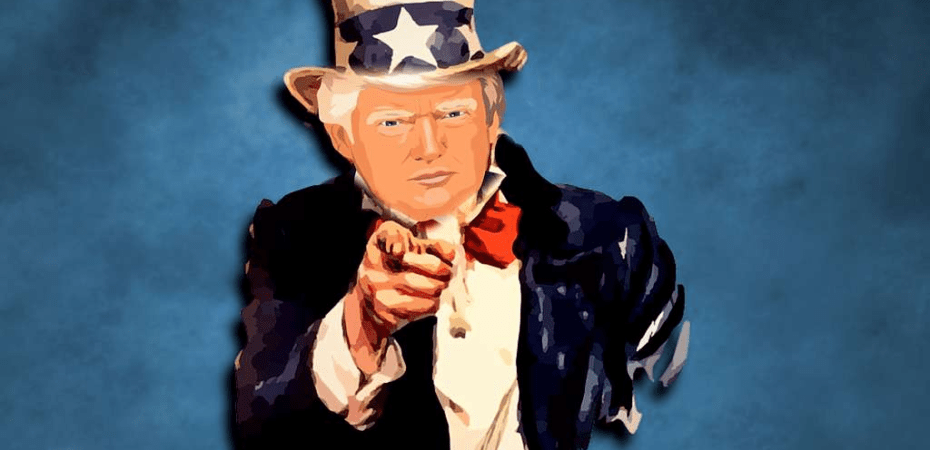
Image: https://picryl.com/media/trump-uncle-sam-bcd82e. Licence: Public Domain Mark 1.0 Universal PDM 1.0 Deed

No comments:
Post a Comment