The war on Iran and the role of the peace movement
APRIL 9, 2026
A CND Information Paper by Carol Turner analyses the recently announced ceasefire in the context of the Trump administration’s wider policy on Iran.
The acceptance by the United States and Iran of a Pakistan-brokered ceasefire for two weeks, to allow for negotiations, comes as welcome relief after President Trump’s most recent and most disgraceful threat of destroying an entire civilisation. Its implication of nuclear war against Iran sent a shiver round the world.
The breakdown of this temporary ceasefire is, however, a real possibility. Prime Minister Netanyahu has said the ceasefire does not cover Lebanon and Israeli Defence Forces continue to bomb large parts of the country. Escalation of the war remains a clear and present danger.
The peace movement remains on high alert, and we are right to be so. We continue to demand an end to the use of UK bases for US attacks on Iran.
US objectives are clear
Throughout the six week bombardment of Iran, the US military strategy is uncertain. There is no confusion about the aims of Trump’s Iran policy, however. His overall objectives are clear and consistent.
Within days of taking office in January 2025, Trump signed Presidential Memorandum PS/NS2. This is a formal instruction to all the agencies of the US state to initiate a “maximum pressure” campaign against Iran, with the aims of:
• preventing Iran ever developing nuclear weapons;
• ending its ballistic missiles programme; and
• breaking its support for regional proxies.
US-Iran relations shifted sharply during Trump’s first administration between 2017-2021. He withdrew the US from the Iran nuclear deal negotiated by the Obama White House, effectively bringing the Joint Comprehensive Plan of Action (JCPoA) to an end. Diplomatic engagement and negotiations which resulted in one of the most successful arms reduction agreements of the 21st century were replaced by a hostile and confrontational approach.
Withdrawal from the JCPoA was accompanied with over 1,500 sanctions targeting Iran’s financial, oil, and shipping sectors, with secondary sanctions on foreign firms doing business with Iran. These have severely damaged Iran’s economy. They were behind the street protests at the start of this year, combined with the added strains of the US-Israel 12 day war in June 2025.
In his second term in office, Trump has doubled down on this approach, encouraged by Prime Minister Netanyahu who openly calls for regime change.
…the military means are not
Present confusion lies not in what Trump wants, but in the manner in which he seeks to achieve it. Six weeks in, we can see how unprepared he was for Iran’s response to US-Israeli bombardment. Evidence of the military campaign so far suggests Trump did not anticipate Iran’s military capacity to retaliate. Not does he appear to have foreseen the huge impact of Iran’s asymmetrical response – their ability to punch beyond their weight by pursuing economic rather than military targets.
Iran continues to target military and economic facilities in Israel and across the Middle East, while focusing on the Strait of Hormuz. Oil prices have rocketed, as economists warn that the continuing blockade of the Strait could lead to a global economic recession. The impact is already being felt in North America and Europe, including at the petrol pumps and the cost of heating oil in Britain – and another cost of living hike is on the cards.
Meanwhile Trump’s military adventure in Iran is contributing to the drop in his domestic ratings, at their lowest since his election victory in 2024. This is a serious problem for the Republicans as the mid-term elections approach, but perhaps most important of all, there are signs that a serious split between Republicans and Democrats is posed in the longer term – something which hasn’t threatened the continuity of US foreign policy in the Middle East for the last half century.
Nuclear hypocrisy
As readers know, CND remains unshakeable in our opposition to the possession of nuclear weapons – by any and every country. This includes the UK’s Trident nuclear weapons system and the expansion of Britain’s nuclear capability which has taken place under Conservative and Labour governments alike.
A Conservative government agreed that US nuclear weapons could return to Britain, in the form of nuclear gravity bombs which were installed at RAF Lakenheath last year. The Labour government has agreed to purchase 12 US nuclear fighter jets which will be stationed at RAF Marham. They are able to deliver the US nukes sited at Lakenheath as part of Nato’s nuclear mission in Europe.
There has been no transparency about these decisions, and negligible discussion in the mainstream media. They have taken place without a vote or even a debate in Parliament. No government has acknowledged that US nukes have returned to Britain, despite parliamentary questions from Labour, Green, and SNP MPs. Successive defence ministers have side-stepped their questions with obfuscating replies that it is not British government practise to comment on the affairs of other countries.
Britain’s possession of nuclear weapons and nuclear expansion makes the UK a target in any war, and endangers everyone in Britain. This is why we must campaign against British bases being used by the US in their war on Iran.
The US-Israeli war is steeped in nuclear hypocrisy. There is no suggestion, including by any US agency, that Iran has developed nuclear weapons. The International Atomic Energy Agency (IAEA) has repeatedly confirmed that Iran does not have nuclear weapons and is not on the verge of developing them. Two nuclear weapon states, the US and Israel, are waging war to prevent Iran ever being able to develop nuclear weapons in the future.
The USA has the biggest and most powerful military in the world, including the most modern and deadly nuclear arsenal, and boasts the best-equipped ballistic missile defences.
If Trump is so keen to end Iran’s nuclear programme:
• why did he withdraw the United States from the JCPoA; and
• why has he abandoned the nuclear talks he said were making progress – only days before the bombardment began?
Israel is the only nuclear weapons state in the Middle East. It has possessed nuclear weapons since the late 1960s. Some Knesset politicians even suggested they could be used in Gaza after October 2023.
Israel:
• has never acknowledged it has a nuclear arsenal;
• is not a signatory to the nuclear Non-Proliferation Treaty, in contrast to Iran’s long time support; and
• does not permit IAEA inspections.
No War on Iran, No British Bases for US attacks
The only progress ever made in dissuading Iran from developing nuclear capability was achieved through negotiations. The essence of diplomacy is talking to people with whom you don’t agree.
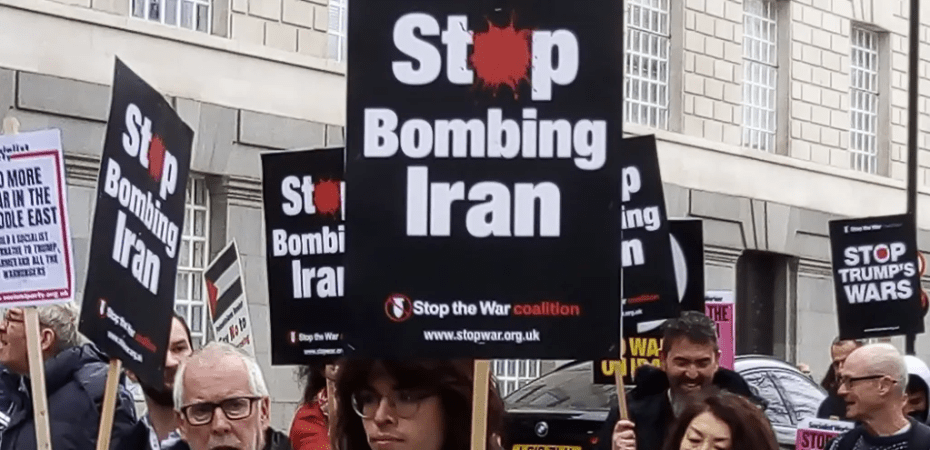
CND was out on the streets within hours of the war on Iran beginning. A No War on Iran coalition has taken shape, led by CND and Stop the War, and supported by the Palestine coalition which has organised opposition to Israel’s genocide in Gaza, and other groups such as CASMII, the Campaign Against Sanctions and Military Intervention in Iran. We have worked with NukeWatch and Drone Wars UK to track and publicise the use of British bases by US fighter jets to launch their deadly attacks on Iran. There are regular protests at RAF Fairford, from where US planes frequently launch bombing raids on Iran.
Anti-war sentiment in Britain is growing and strengthening, despite a state crackdown on the right to protest. Days after the Iran war began, the General Council of the Trades Union Congress (TUC) issued a statement reaffirming its commitment to peace, diplomacy and respect for state sovereignty. The TUC opposed the use of force without clear UN authorisation and called for an immediate halt to hostilities and the urgent resumption of talks. It also called on the UK government to resist efforts to drag Britain further into the conflict.
An open letter signed by trade union general secretaries and senior officials and individual unions have issued strong statements. There has been opposition from parliamentarians too, expressed in an Early Day Motion from Brian Leishman, a Scottish Labour MP, and signed by Labour, Green, Independent, and Liberal Democrat colleagues.
The war on Iran has already spread across the Middle East, and has the potential to expand further, bringing the threat of nuclear conflict even closer. CND will continue to campaign for an end to the US-Israel war on Iran, and an end to the US use of British bases. We insist that the only path to peace and nuclear security lies in the pursuit of diplomacy and negotiations.
Read the CND statement on the Iran ceasefire.
Carol Turner is CND Vice-Chair.
Image: c/o Labour Hub.
As the US and Israel pound Iran, a call to end the war
APRIL 4, 2026
The US and Israel have destroyed or damaged more than 115,000 civilian structures, according to Iran’s Red Crescent Society. Some 763 schools and 316 health facilities have been hit, along with water plants and roads. This week a pharmaceutical company and an orphanage were bombed. Power plants and economic infrastructure have also been targeted. World Heritage sites have been attacked.
Earlier this week, the New York Times and BBC verified in separate reports that a previously untested US-made ballistic missile was probably used in the February 28th strike on a sports hall in Lamerd, Iran, where at least 21 people were killed, including young girls training there.
Two days ago, President Donald Trump celebrated a ‘double tap’ strike on a road bridge near Tehran to Karaj, sharing video of the attack that killed eight people and wounded 95. The second strike occurred as rescue workers responded to the initial attack. The strikes killed civilians who had gathered beneath the bridge and along the riverbank to celebrate Nature Day in Iran.
Trump’s cheering of attacks on civilian targets has drawn widespread condemnation. Owen Jones said: “Donald Trump is openly flaunting his war crimes. Journalists who won’t call them that are complicit.” Zeteo editor-in-chief Mehdi Hasan said: “This is what terrorism looks like, state terrorism.”
Over 90,000 residential units have been damaged in airstrikes. More than 3 million Iranians have been displaced by the war. Nearly 2,000 people have been killed and ten times that number wounded since the start of the bombardments. US-made mines have also been air-dropped in civilian areas.
Below we publish a statement supported by trade union leaders in Iraq, leading Iranian and Kurdish political activists, John McDonnell MP and many others.
End the war immediately and unconditionally
Over one month has passed since the US-Israel attack on Iran. Thousands of dead, millions of displaced, and destruction of sections of the social infrastructure are the outcomes of the attacks and the ongoing war to date.
Continuous threats of escalation of the attacks and bombing of economic infrastructure and nuclear facilities, as well as the persistent danger of complete destruction of the most vital arteries of social and economic life, have significantly increased the risk of immediate death of tens of thousands and the gradual death of millions of human beings in Iran and the region.
This war, contrary to the claims of its perpetrators and supporters, is not in aid of the people in Iran. These attacks and pledges of further assaults are neither intended to pave the way for the freedom of the Iranian people nor to defend their struggle in getting rid of the Islamic Republic! This is a war against the people and against their more than forty years of effort to achieve freedom, welfare, and security.
The victory of either side in this war will not be a victory for the people of Iran, who had, prior to this war, begun working towards building a humane and free future. The people of Iran and their struggle for freedom are the first victims and losers of this war.
The destructive effects of this war on the lives of the people and the requirements of their freedom-seeking movement are today more undeniable than ever before.
To defend the lives and security of the people in Iran, to protect the achievements of their struggles, and to support the efforts of generations striving for freedom and a humane life, this war must end immediately and unconditionally.
We consider this demand to be the minimum demand that can be achieved through the collective power of people in Iran and around the globe; a demand that not only minimises the damage but also paves the way for the Iranian people to advance toward their aspirations for freedom.
We call on all labour unions, human rights organisations and institutions and the global civilized population to put pressure on the parties in this war to end the war immediately and unconditionally.
Supported by:
- Abdul Karim Abdul Sada (Abu Watan) – President of the General Federation of Workers’ Unions in Iraq/President of the General Union of Oil and Gas Workers
- Arrash Kamagar – Political Activist
- Assad Golchini – Communist Activist
- Assad Rostami – Secretary of the Executive Committee of the Communist Party of Iran
- Ardeshir Mehrdad – Political Activist
- Aman Kafa – Spokesperson of Iran Freedom and Revolution Watch
- Anwar Hassain Bazgar – Poet, Author and Journalist
- Azar Modaresi – Secretary of Central Committee of Hekmatist Party (Official Line)
- Bahar Monzir – Secretary of the People’s Organisation for Progress
- Dashty Jamal- Secretary of the International Federation of Iraqi Refugees
- Diana Nammi – Founder of Iranian and Kurdish Women’s Rights Organisation-UK
- Ebrahim Alizadeh – First Secretary of Komala – Kurdistan Organisation of Communist party of Iran
- Ebrahim Awkh – Political Activist
- Fereydoon Nazerie – Member of the Central Committee of the Communist Party of Iran
- Fuad Qzahi – Author
- Hassan Hesam – Member of the leadership of the Rahe Kargar
- Hassan Jumaa Awad Al-Asadi – President of the General Federation of Oil, Gas and Petrochemical Unions in Iraq
- Hosain Dolatabadi- Political Activist
- John McDonnell – Member of Parliament of the UK
- John Moloney – Assistant General Secretary of Public and Commercial Services Union, UK
- Khaled Hajmodamadi – Secretary of Leadership Committee of Hekmatist Party (Official Line)
- Mohamad Aloush – Secretary General of the Palestinian Workers’ Struggle Federation
- Nadia Mahmoud – Aman Women Alliance
- Nassrin Parwaz – Author
- Osman Haj Maref – Secretary of Central Committee of Worker’s Communist Party of Kurdistan
- Parvaneh Bokah – Member of local parliament- Hanover Germany
- Roger Silverman – Editor of the Journal On the Brink and a founding member of Workers International Network
- Reza Moqadam – Member of the Leadership of the Socialist Workers’ Alliance
- Rebwar Ahmad – Central Committee of Worker-Communist Party of Kurdistan
- Rebwar Aref – Central Committee of Worker-Communist Party of Kurdistan
- Samir Adel – Secretary of Central Committee of Worker-Communist Party of Iraq
- Soraya Shahabi – Founder of Iran Freedom and Revolution Watch
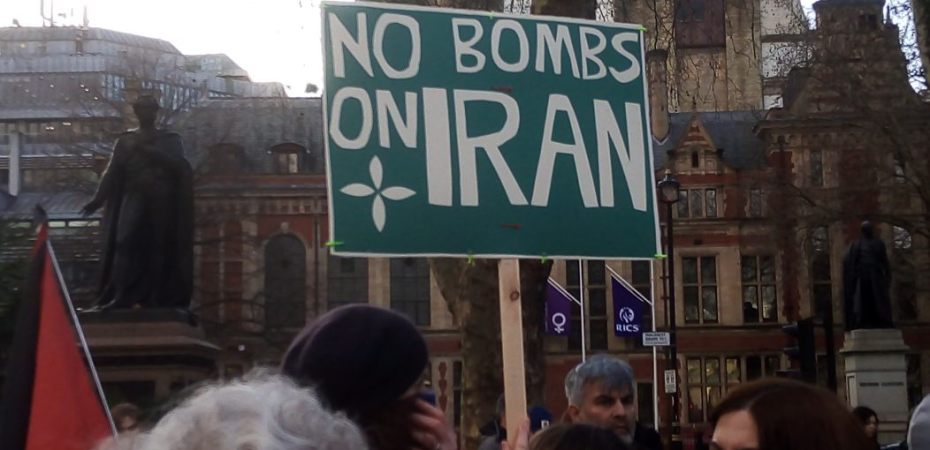
Image c/o Labour Hub.

No comments:
Post a Comment