UK
Yesterday
Right-Wing Watch
The paper cast the story as yet another example of equality and diversity spiralling out of control, complete with “fury,” “bans,” and the usual parade of indignant critics.
Right-Wing Watch
The paper cast the story as yet another example of equality and diversity spiralling out of control, complete with “fury,” “bans,” and the usual parade of indignant critics.
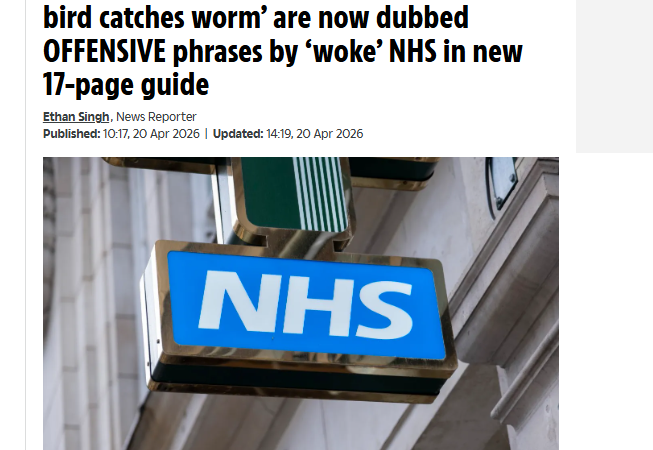
“Woke fury,” thundered Murdoch’s Sun this week, claiming that phrases like “raining cats and dogs” and “the early bird catches the worm” are now considered offensive under a new diversity guide from Lancashire Teaching Hospitals NHS Foundation Trust.
The paper cast the story as yet another example of equality and diversity spiralling out of control, complete with “fury,” “bans,” and the usual parade of indignant critics.
But strip away the outrage, and a different picture emerges.
The actual guidance does not “ban” phrases. It suggests that certain expressions, particularly those that may confuse non-native English speakers, might need explaining in a diverse workplace. In a health service where staff and patients come from a wide range of linguistic and cultural backgrounds, it’s a practical reminder that clear communication matters.
And guess who’s wheeled in for comment? Our old friend Toby Young, founder of the Free Speech Union, who warns of “witch hunts” and a creeping regime of linguistic control. According to Young, NHS staff risk being “cancelled” for everyday speech, part of a supposed effort to edge out older employees in favour of “pink-haired zealots.”
There is no evidence that NHS workers are being disciplined for using such phrases, nor that the guidance is designed to purge staff. Instead, a mild bureaucratic recommendation is inflated into a moral panic.
This is not a new tactic, for the Sun or Toby Young.
Earlier coverage in the Sun followed the same script: select a few debatable examples, strip them of context, and present them as proof of ideological takeover.
According to Young, Sutton Council’s language guide was an example of “woke” absurdity, with the newspaper gleefully reported that the council had banned the term “Christian name” because it might offend non-Christians, while also warning against calling people in their 30s “youngsters” or those over 65 “pensioners,” since these terms could be considered ageist.
This is the Toby Young who managed to secure a seat in the House of Lords from Tory leader Kemi Badenoch, despite having been forced to resign from the Office for Students in 2018 after a string of misogynistic and homophobic tweets, including one where he referred to George Clooney as “queer as a coot” and another joking about visiting a bar full of “hardcore dykes.”
But back to the smear on Lancashire Teaching Hospitals NHS Foundation Trust. The Sun also highlights the trust’s spending on diversity staff and its financial deficit, a familiar attempt to frame inclusion as waste.
No mention that the NHS workforce is more diverse today than at any point in its 75-year history, and that brings a multitude of benefits for patients and taxpayers alike.
Right-Wing Media Watch: Daily Mail faces renewed scrutiny over allegations of intrusive reporting
Yesterday
Right-Wing Watch
Questions are once again being raised about the standards of the journalism at the Daily Mail.
Right-Wing Watch
Questions are once again being raised about the standards of the journalism at the Daily Mail.
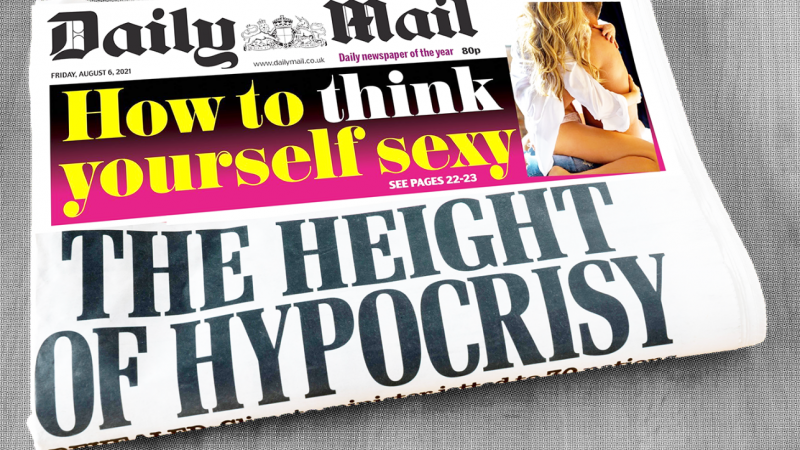
Questions are once again being raised about the standards of the journalism at the Daily Mail, after fresh allegations of intrusive conduct.
Reports that a reporter was seen peering through the post in the porch of a bereaved family’s home, have renewed concerns that parts of the press continue to prioritise access over basic decency.
According to the allegations, the reporter also repeatedly knocked on the door at the family’s home over several days and waited in their car outside the property. Such actions, if accurate, go well beyond persistent reporting and edge into harassment, particularly given the vulnerability of those involved.
The episode follows earlier controversies involving the Daily Mail. Several weeks ago, a family who had lost their daughter in a meningitis outbreak shared information with the BBC on the condition that her surname remain private. While other outlets respected this request, the Daily Mail chose to publish the identifying detail regardless.
Concerns about press conduct extend beyond individual cases. There have also been judicial criticisms of media behaviour toward child victims of crime, suggesting a broader pattern in which vulnerable individuals are subjected to aggressive reporting tactics.
The campaign group Hacked Off, which was established in the wake of the phone-hacking scandal to advocate for a more accountable press, argues that such incidents demonstrate a failure of reform. In its view, press standards have not only stagnated but may, in some respects, be deteriorating.
The campaigners are set to meet the prime minister and say they look forward to “bringing these concerns directly to him and learning what the government intend to do to protect the public from these abuses.”
These developments sit uneasily alongside claims by former Daily Mail editor Paul Dacre, who told the High Court earlier this year that he had “brought the shutters down” on unlawful newsgathering practices during his tenure. That assertion was made during the ongoing privacy case brought against Associated Newspapers Limited, publisher of the Daily Mail and Mail on Sunday, by several high-profile figures, including Prince Harry and Sir Elton John, alleging serious invasions of privacy.
The persistence of new allegations inevitably raises doubts about how far internal reforms have gone, and how effectively they are enforced.
‘Angry Leftie women’: the real politics behind the ‘femosphere’ moral panic

A familiar right-wing trope has resurfaced.
“Forget the manosphere. It’s angry Leftie women we need to worry about,” declared a recent Telegraph headline, warning that young women “radicalised” by figures like Greta Thunberg are rejecting marriage, capitalism, and social norms altogether.
And to make matters even worse, it came not from an aggrieved male, railing against feminism, but from a woman – Rowan Pelling, a journalist long preoccupied with what she sees as the excesses of modern feminism. This isn’t new territory for Pelling. As far back as 2004, she was wailing about the “angry clamour” of politically engaged women and mocking feminist demands as trivial irritations.
What she presents as a cultural gripe about “angry Leftie women” is part of a broader political project. Across the UK, US, and Europe, narratives about declining birth rates, feminism, and “cultural decay” are tied with anti-immigration rhetoric, pro-natalist policy agendas, and opposition to LGBTQ+ rights. They form an ideological ecosystem in which women’s autonomy, migration, and social liberalism are framed as interconnected threats to national identity and stability.
An utterly bizarre comparison
At the centre of Pelling’s argument, is a claim that for every young man radicalised by figures such as Andrew Tate or Charlie Kirk, there is a young woman being similarly radicalised by Greta Thunberg.
This comparison simply doesn’t hold up. Tate is a self-described misogynist influencer who promotes an ultra-masculine, capitalistic lifestyle, and rigid gender hierarchies. He has also faced serious criminal charges, including rape and human trafficking.
Greta Thunberg is an environmental activist whose message centres on climate science, collective responsibility, and political accountability. Her advocacy is rooted in widely accepted scientific consensus rather than a worldview built on gendered power.
What gets ignored
Pelling’s framing also sidesteps context. Concerns about the “manosphere” aren’t abstract, they are tied to measurable harms, including rising levels of violence against women and girls in the UK, described by the government as a “national emergency.”
Redirecting scrutiny towards environmentally engaged young women risks trivialising a growing problem.
Even Pelling’s appeal to motherhood and concern for her sons, and her dig at programmes like Louis Theroux’s Inside the Manosphere, which she says focus on problematic men while ignoring the ‘femosphere,’ feel misplaced, even perverse.
Programmes like Theroux’s arguably help equip young men with the awareness to recognise and reject toxic behaviour. As a mother of sons myself, I’m glad my boys have watched Theroux’s episode on the manosphere, for exactly those reasons.
The rise of the ‘womansphere’ and its business model
But perhaps even more revealing is how this narrative fits into a broader trend, the rise of a conservative ‘womansphere.’
Across the US and beyond, female-led platforms, including podcasts, lifestyle brands, and influencer channels, are building large audiences by promoting traditional gender roles that embrace domesticity and submission, under the guise of empowerment.
But this isn’t just ideology, it’s also commerce.
These platforms monetise discontent, through sponsorships, subscriptions, branded content, and speaking events. The ‘trad wife’ aesthetic, apron-clad domestic bliss, large families, and cheerful submission, is packaged as a lifestyle product, making outrage at feminism a revenue stream.
There’s an obvious irony. The same voices decrying feminism are profiting from freedoms, economic, social, digital, that feminism helped secure.
Old playbooks, new platforms
None of this is entirely new. The playbook echoes earlier anti-feminist campaigns led by figures like US conservative activist Phyllis Schlafly, who deeply opposed feminism, gay rights, and abortion. In the 1970s, Schlafly mobilised opposition to the Equal Rights Amendment, arguing that feminism would make women unhappy and dismantle the family.
What has changed is the scale and sophistication of the delivery. Social media has transformed these ideas into content ecosystems, where backlash isn’t just cultural, but commercial.
When the narrative lands in UK politics
This ‘panic’ is no longer confined to the US and is becoming increasingly visible in the UK.
At events like the National Conservatism Conference, concerns about falling birth rates and “cultural decline” are regularly linked to critiques of feminism and calls for a return to traditional family structures.
Figures like former Tory MP and now GB News’ host Miriam Cates have framed low birth rates as an “existential crisis,” attributing them to cultural forces undermining traditional values. Cates has also tied falling birthrates to immigration.
“Mass immigration has had significant negative effects on our culture and economy, and represents a huge failure of democracy, given that the British population has voted consistently for lower levels of immigration,” she told GB News.
“But one of the main drivers for importing migrants has been chronic low birth rates, which have led to a shortage of young workers in our labour force.”
25 April, 2026
Right-Wing Watch
The question isn’t why young women are “angry.” It’s why their autonomy is being positioned as a political problem, one that is increasingly tied to immigration, birth rates, and national identity, and used to justify a broader rollback of rights.
Right-Wing Watch
The question isn’t why young women are “angry.” It’s why their autonomy is being positioned as a political problem, one that is increasingly tied to immigration, birth rates, and national identity, and used to justify a broader rollback of rights.
A familiar right-wing trope has resurfaced.
“Forget the manosphere. It’s angry Leftie women we need to worry about,” declared a recent Telegraph headline, warning that young women “radicalised” by figures like Greta Thunberg are rejecting marriage, capitalism, and social norms altogether.
And to make matters even worse, it came not from an aggrieved male, railing against feminism, but from a woman – Rowan Pelling, a journalist long preoccupied with what she sees as the excesses of modern feminism. This isn’t new territory for Pelling. As far back as 2004, she was wailing about the “angry clamour” of politically engaged women and mocking feminist demands as trivial irritations.
What she presents as a cultural gripe about “angry Leftie women” is part of a broader political project. Across the UK, US, and Europe, narratives about declining birth rates, feminism, and “cultural decay” are tied with anti-immigration rhetoric, pro-natalist policy agendas, and opposition to LGBTQ+ rights. They form an ideological ecosystem in which women’s autonomy, migration, and social liberalism are framed as interconnected threats to national identity and stability.
An utterly bizarre comparison
At the centre of Pelling’s argument, is a claim that for every young man radicalised by figures such as Andrew Tate or Charlie Kirk, there is a young woman being similarly radicalised by Greta Thunberg.
This comparison simply doesn’t hold up. Tate is a self-described misogynist influencer who promotes an ultra-masculine, capitalistic lifestyle, and rigid gender hierarchies. He has also faced serious criminal charges, including rape and human trafficking.
Greta Thunberg is an environmental activist whose message centres on climate science, collective responsibility, and political accountability. Her advocacy is rooted in widely accepted scientific consensus rather than a worldview built on gendered power.
What gets ignored
Pelling’s framing also sidesteps context. Concerns about the “manosphere” aren’t abstract, they are tied to measurable harms, including rising levels of violence against women and girls in the UK, described by the government as a “national emergency.”
Redirecting scrutiny towards environmentally engaged young women risks trivialising a growing problem.
Even Pelling’s appeal to motherhood and concern for her sons, and her dig at programmes like Louis Theroux’s Inside the Manosphere, which she says focus on problematic men while ignoring the ‘femosphere,’ feel misplaced, even perverse.
Programmes like Theroux’s arguably help equip young men with the awareness to recognise and reject toxic behaviour. As a mother of sons myself, I’m glad my boys have watched Theroux’s episode on the manosphere, for exactly those reasons.
The rise of the ‘womansphere’ and its business model
But perhaps even more revealing is how this narrative fits into a broader trend, the rise of a conservative ‘womansphere.’
Across the US and beyond, female-led platforms, including podcasts, lifestyle brands, and influencer channels, are building large audiences by promoting traditional gender roles that embrace domesticity and submission, under the guise of empowerment.
But this isn’t just ideology, it’s also commerce.
These platforms monetise discontent, through sponsorships, subscriptions, branded content, and speaking events. The ‘trad wife’ aesthetic, apron-clad domestic bliss, large families, and cheerful submission, is packaged as a lifestyle product, making outrage at feminism a revenue stream.
There’s an obvious irony. The same voices decrying feminism are profiting from freedoms, economic, social, digital, that feminism helped secure.
Old playbooks, new platforms
None of this is entirely new. The playbook echoes earlier anti-feminist campaigns led by figures like US conservative activist Phyllis Schlafly, who deeply opposed feminism, gay rights, and abortion. In the 1970s, Schlafly mobilised opposition to the Equal Rights Amendment, arguing that feminism would make women unhappy and dismantle the family.
What has changed is the scale and sophistication of the delivery. Social media has transformed these ideas into content ecosystems, where backlash isn’t just cultural, but commercial.
When the narrative lands in UK politics
This ‘panic’ is no longer confined to the US and is becoming increasingly visible in the UK.
At events like the National Conservatism Conference, concerns about falling birth rates and “cultural decline” are regularly linked to critiques of feminism and calls for a return to traditional family structures.
Figures like former Tory MP and now GB News’ host Miriam Cates have framed low birth rates as an “existential crisis,” attributing them to cultural forces undermining traditional values. Cates has also tied falling birthrates to immigration.
“Mass immigration has had significant negative effects on our culture and economy, and represents a huge failure of democracy, given that the British population has voted consistently for lower levels of immigration,” she told GB News.
“But one of the main drivers for importing migrants has been chronic low birth rates, which have led to a shortage of young workers in our labour force.”
Right-Wing Media Watch: “The Murdoch empire is terrified” – Polanski hits back at Sun’s Grand National smear
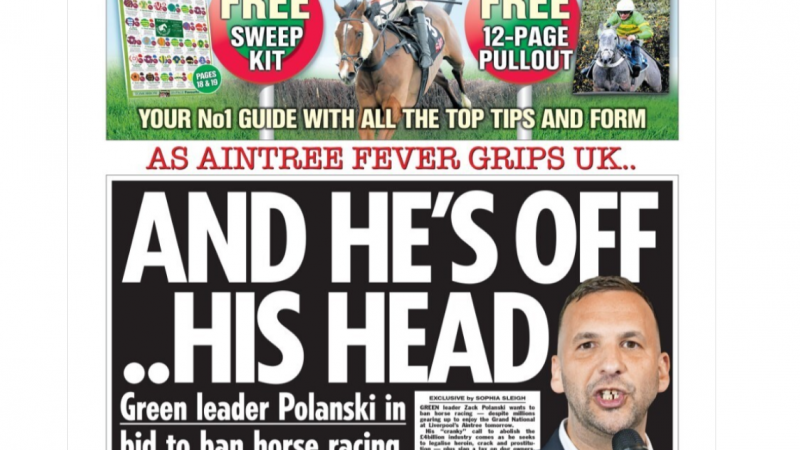
“As Aintree fever grips UK… And he’s off his head. Green leader Polanski in bid to ban horse racing.”
That was the front page of the Sun ahead of Grand National day.
Posting the article on social media, Polanski reminded of his plan to end “rip-off Britain” by taking back “power and wealth from those who have stolen it.”
He added how: “The Murdoch empire is terrified.”
And it’s not hard to see why.
Rather than engage seriously with Polanski’s proposal, part of a wider ethical critique of animal use in sport, Polanski’s position is dismissed as a “cranky call,” bundled together with other policies to create a portrayal of extremism rather than a coherent argument.
To reinforce the point, the paper reaches for predictable voices. Nigel Farage is quoted branding the proposal “cranky nonsense,” invoking heritage, jobs, and tradition. Tory MP Mick Timothy calls it “extreme madness,” while shadow sports minister Louie French suggests the Greens are “out of touch” with the countryside.
But perhaps even more telling is how far the article digs to build its case. A social media post by Polanski from 2024 is dug up. Then another, from way back in 2018, in which Polanski politely asked a musician to reconsider a horse logo on ethical grounds.
Meanwhile, industry figures are deployed to present horse racing as both safe and benevolent, citing low fatality rates among runners.
What’s largely absent is any meaningful engagement with the ethical argument itself, namely, whether entertainment justifies risk and exploitation of animals.
Horse racing in Britain is not just sport, it’s an economic and cultural institution worth billions, intertwined with gambling, land use, and elite social networks. Questioning it, seriously, means questioning a system of power and profit.
And that’s precisely what Polanski’s message gestures, not just animal welfare, but redistribution, regulation, and structural change.
No wonder the Murdoch empire is terrified.
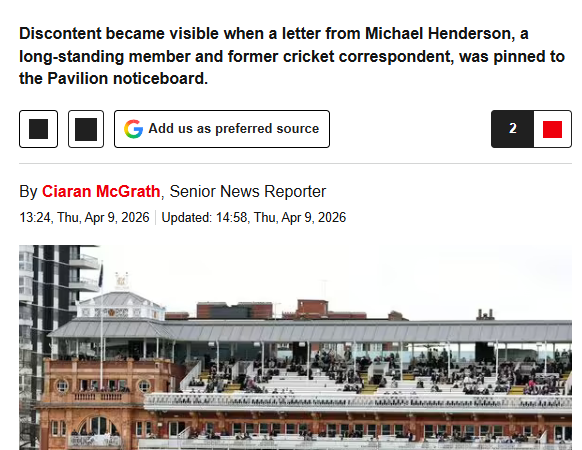
Reports that Marylebone Cricket Club is supposedly facing a backlash from members for hosting a Syrian art exhibition at Lord’s Cricket Ground were predictably seized upon by the Daily Express. The anti-immigration newspaper framed the story as yet another example of ‘woke’ overreach into traditionally apolitical spaces.
The exhibition in question features paintings by Syrian and Palestinian refugee students alongside works by established artists and was unveiled during the opening match of the season between Middlesex County Cricket Club and Gloucestershire County Cricket Club over the Easter weekend.
Even the Express concedes, albeit buried at the end of its report, that the Pavilion has long displayed a wide range of artwork and that this particular exhibition is tied to charitable aims.
Yet this context is subordinated to a more attention-grabbing narrative – a ‘backlash.’
At the centre of the supposed controversy is a noticeboard message attributed to Michael Henderson, a long-standing member and former cricket correspondent, who wrote:
“Members may have noted the daubs upstairs and the club’s endorsement of ‘creativity’ and ‘solidarity’. Solidarity with whom? The human race, perhaps. We can all agree on that. But this ‘exhibition’ is nudging us towards another view; a partial one. This is meant to be a cricket club.”
The Express extrapolates from this single intervention to imply a wider groundswell of discontent, though little concrete evidence of such is provided.
This is a familiar editorial pattern in the right-wing media, isolate a dissenting voice, amplify it, and present it as emblematic of a larger cultural shift under siege. Henderson’s own background, spanning roles at the Telegraph and Daily Mail, might offer readers useful context about his perspective, but it goes unexamined. Instead, his remarks are elevated into a proxy for “common sense” resistance.
Yet more striking still is what the article omits. There is no meaningful engagement with the purpose or significance of the exhibition itself. Syrian art in the UK is not merely decorative, it can serve as a vehicle for preserving identity, expressing resilience, and documenting the lived realities of displacement. Exhibitions like this create opportunities for dialogue, inviting audiences to confront experiences of conflict and exile that might otherwise remain abstract or distant.
But none of this complexity or tolerance fits neatly into the right’s ‘woke vs traditional’ agenda, and so it is largely ignored. Instead, the presence of refugee art in a cricket pavilion is treated as self-evidently contentious, rather than as part of a long-standing tradition of cultural programming within the space. And it is a little-known fact, that cricket is played in Syria, albeit among ex-pats and without proper cricket grounds. But as Michael Caine would say ‘not a lot of people know that.’ Certainly not Michael Henderson or the Daily Express it seems.
19 April, 2026
Right-Wing Watch
No wonder the Murdoch empire is terrified.
Right-Wing Watch
No wonder the Murdoch empire is terrified.
“As Aintree fever grips UK… And he’s off his head. Green leader Polanski in bid to ban horse racing.”
That was the front page of the Sun ahead of Grand National day.
Posting the article on social media, Polanski reminded of his plan to end “rip-off Britain” by taking back “power and wealth from those who have stolen it.”
He added how: “The Murdoch empire is terrified.”
And it’s not hard to see why.
Rather than engage seriously with Polanski’s proposal, part of a wider ethical critique of animal use in sport, Polanski’s position is dismissed as a “cranky call,” bundled together with other policies to create a portrayal of extremism rather than a coherent argument.
To reinforce the point, the paper reaches for predictable voices. Nigel Farage is quoted branding the proposal “cranky nonsense,” invoking heritage, jobs, and tradition. Tory MP Mick Timothy calls it “extreme madness,” while shadow sports minister Louie French suggests the Greens are “out of touch” with the countryside.
But perhaps even more telling is how far the article digs to build its case. A social media post by Polanski from 2024 is dug up. Then another, from way back in 2018, in which Polanski politely asked a musician to reconsider a horse logo on ethical grounds.
Meanwhile, industry figures are deployed to present horse racing as both safe and benevolent, citing low fatality rates among runners.
What’s largely absent is any meaningful engagement with the ethical argument itself, namely, whether entertainment justifies risk and exploitation of animals.
Horse racing in Britain is not just sport, it’s an economic and cultural institution worth billions, intertwined with gambling, land use, and elite social networks. Questioning it, seriously, means questioning a system of power and profit.
And that’s precisely what Polanski’s message gestures, not just animal welfare, but redistribution, regulation, and structural change.
No wonder the Murdoch empire is terrified.
Woke-bashing of the week – Express jumps on alleged cricket fan fury at ‘woke’ Syrian art exhibition at Lord’s
19 April, 2026
Right-Wing Watch
It's a familiar editorial pattern in the right-wing media, isolate a dissenting voice, amplify it, and present it as emblematic of a larger cultural shift under siege.
Right-Wing Watch
It's a familiar editorial pattern in the right-wing media, isolate a dissenting voice, amplify it, and present it as emblematic of a larger cultural shift under siege.
Reports that Marylebone Cricket Club is supposedly facing a backlash from members for hosting a Syrian art exhibition at Lord’s Cricket Ground were predictably seized upon by the Daily Express. The anti-immigration newspaper framed the story as yet another example of ‘woke’ overreach into traditionally apolitical spaces.
The exhibition in question features paintings by Syrian and Palestinian refugee students alongside works by established artists and was unveiled during the opening match of the season between Middlesex County Cricket Club and Gloucestershire County Cricket Club over the Easter weekend.
Even the Express concedes, albeit buried at the end of its report, that the Pavilion has long displayed a wide range of artwork and that this particular exhibition is tied to charitable aims.
Yet this context is subordinated to a more attention-grabbing narrative – a ‘backlash.’
At the centre of the supposed controversy is a noticeboard message attributed to Michael Henderson, a long-standing member and former cricket correspondent, who wrote:
“Members may have noted the daubs upstairs and the club’s endorsement of ‘creativity’ and ‘solidarity’. Solidarity with whom? The human race, perhaps. We can all agree on that. But this ‘exhibition’ is nudging us towards another view; a partial one. This is meant to be a cricket club.”
The Express extrapolates from this single intervention to imply a wider groundswell of discontent, though little concrete evidence of such is provided.
This is a familiar editorial pattern in the right-wing media, isolate a dissenting voice, amplify it, and present it as emblematic of a larger cultural shift under siege. Henderson’s own background, spanning roles at the Telegraph and Daily Mail, might offer readers useful context about his perspective, but it goes unexamined. Instead, his remarks are elevated into a proxy for “common sense” resistance.
Yet more striking still is what the article omits. There is no meaningful engagement with the purpose or significance of the exhibition itself. Syrian art in the UK is not merely decorative, it can serve as a vehicle for preserving identity, expressing resilience, and documenting the lived realities of displacement. Exhibitions like this create opportunities for dialogue, inviting audiences to confront experiences of conflict and exile that might otherwise remain abstract or distant.
But none of this complexity or tolerance fits neatly into the right’s ‘woke vs traditional’ agenda, and so it is largely ignored. Instead, the presence of refugee art in a cricket pavilion is treated as self-evidently contentious, rather than as part of a long-standing tradition of cultural programming within the space. And it is a little-known fact, that cricket is played in Syria, albeit among ex-pats and without proper cricket grounds. But as Michael Caine would say ‘not a lot of people know that.’ Certainly not Michael Henderson or the Daily Express it seems.

No comments:
Post a Comment